
Newsletter Segmentation Strategy: Increase Engagement in 2026
Build a data-driven newsletter segmentation strategy using behavior, intent score, and topic affinity to lift opens and clicks. Step-by-step guide.
Most newsletters still send the same issue to everyone on the list. That's the single biggest reason engagement stalls. The fix: build a newsletter segmentation strategy around three layers of data - behavioral activity, intent score, and topic affinity - rolled out in sequence from broad to granular. Publishers who do this see meaningfully higher open rates and click-through rates than those relying on one static send, because the content finally matches what each reader actually wants.
The rest of this guide walks through exactly how to get there: auditing what data you already have, picking the right criteria, building a framework that maps segments to content, sequencing the rollout so you don't overwhelm your team or your list, and measuring whether it's actually working.
Understanding Newsletter Segmentation and Its Impact on Engagement
Newsletter segmentation is the practice of dividing a subscriber list into smaller groups based on shared characteristics, behaviors, or interests, then sending each group content tailored to what they actually care about, instead of one generic issue to the entire list.
For a professional or B2B newsletter, that might mean separating subscribers by job function, by how actively they click on certain topics, or by how recently they've engaged at all. The goal isn't to create complexity for its own sake. It's to close the gap between what you publish and what each reader needs - which is exactly what drives engagement lift.
One-size-fits-all sending underperforms for professional audiences for a specific reason: B2B newsletter subscribers tend to have wildly different roles, priorities, and reasons for subscribing in the first place. A newsletter read by both finance leaders and product managers can't serve both groups equally well with a single issue. Segmentation lets a publisher keep one editorial voice while still routing the right stories, links, and calls to action to the right people.
Step 1: Audit Your Audience Data Before You Segment
Skipping this step is the most common reason segmentation projects stall six weeks in. You can't build meaningful segments on data you don't actually have, or data that's inconsistent across your tools.
Start by inventorying what you're already collecting:
- Engagement data: opens, clicks, forward rate, time since last open, and click-through rate by link or topic
- Declared data: anything a subscriber told you directly, such as job title, industry, or preferences selected at signup
- CRM data: lifecycle stage, account tier, deal status, if your newsletter platform connects to a CRM
- Website or product behavior: page visits, feature usage, or content downloads tied to a known subscriber, if you have that integration in place
Most publishers discover gaps here. Maybe open-rate data is reliable but click data by topic isn't tracked at all. Maybe declared data exists for 20% of the list but the rest is blank. That's normal, and it's exactly what this audit is for: finding out where you stand before you commit to a segmentation model you don't have the data to support.
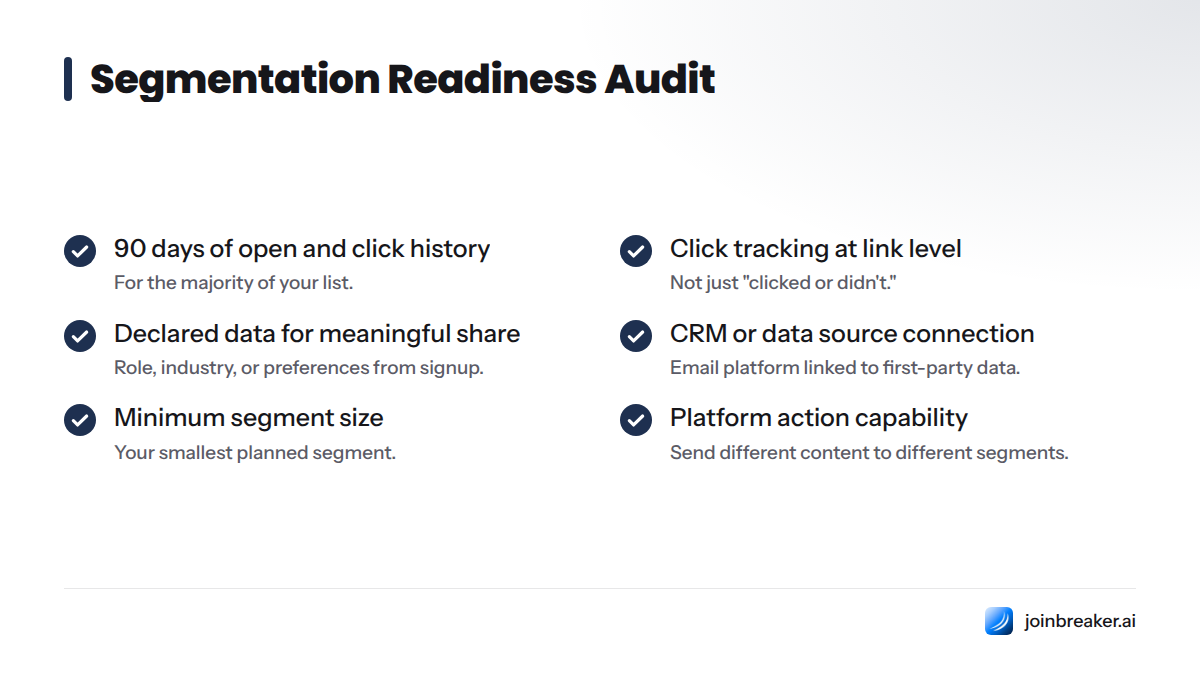
Segmentation Readiness Audit Checklist
- Do you have at least 90 days of open and click history for the majority of your list?
- Is click data tracked at the individual link or topic level, not just "clicked or didn't"?
- Do you have any declared data (role, industry, preferences) for a meaningful share of subscribers?
- Is your email service provider or newsletter platform connected to a CRM or other first-party data source?
- Do you have at least 1,000 engaged subscribers in your smallest planned segment? Smaller segments make it hard to read results with confidence.
- Can your current platform actually act on this data, meaning send different content to different segments without manual list exports?
If you're checking fewer than four of these boxes, start with the broadest possible segmentation (active versus inactive) before attempting anything more granular. Breaker's Newsletter Engagement Metrics guide is a useful companion to this audit for learning what to track once you start measuring.
Step 2: Choose Your Segmentation Criteria - Behavior, Intent Score, and Topic Affinity
Three criteria do most of the work in a modern email segmentation strategy: behavioral segmentation, intent score, and topic affinity. Each captures a different layer of signal, and most guides to email segmentation either conflate them or skip the latter two entirely.
Behavioral Segmentation
Behavioral segmentation groups subscribers by what they do, not what they say. That means opens, clicks, forwards, time-of-day activity, and recency of engagement. It's the easiest criteria to set up because almost every email service provider tracks this natively. A typical starting point is three tiers: highly engaged (opened or clicked in the last 30 days), moderately engaged (opened in the last 90 days but no recent clicks), and dormant (no activity in 90+ days).
Behavioral segmentation is the right starting criteria for almost every publisher because it requires no new data collection. If you want a deeper framework specifically for this layer, Breaker's guide to engagement-based segmentation covers tiering logic in depth, and the Newsletter Engagement Score resource explains how a single composite score can anchor this tier structure.
Intent Score
An intent score is a composite number that estimates how likely a subscriber is to take a meaningful next action - such as clicking a specific call to action, replying, forwarding to a colleague, or converting on an offer embedded in the newsletter. Unlike raw engagement, which just measures activity, intent score weighs which actions a subscriber takes and how recently, to predict future behavior rather than just describe past behavior.
A basic intent score typically combines:
- Recency of engagement (weighted higher for recent activity)
- Frequency of high-value actions (clicking a demo link weighs more than clicking a generic "read more")
- Depth of engagement (time spent, scroll depth, or multiple clicks in one issue)
- Declared signals, if available (a subscriber who filled out a preference form gets a boost)
Breaker's audience graph calculates intent score automatically by weighting these signals across a publisher's full engagement history, rather than relying on a single static rule. That's a meaningfully different approach from the flat "active versus inactive" tiering most ESPs offer out of the box.
Topic Affinity
Topic affinity measures which subjects or content categories a subscriber actually engages with, derived from their click behavior across past issues rather than anything they explicitly told you. If a subscriber consistently clicks links tagged "pricing strategy" but ignores everything tagged "hiring," that's topic affinity, not a declared preference.
This differs from declared interests in one critical way: declared data can go stale fast. A subscriber who checked "product marketing" at signup eighteen months ago may have changed roles since. Topic affinity, derived from ongoing click behavior, stays current automatically because it's recalculated from real activity every send.
Comparison: Behavioral Segmentation vs. Intent Score vs. Topic Affinity
| Criteria | Granularity | Setup Effort | Best Use Case | Typical Engagement Lift |
|---|---|---|---|---|
| Behavioral segmentation | Broad (3-4 tiers) | Low, native to most ESPs | Re-engagement, list hygiene, first segmentation pass | Moderate |
| Intent score | Medium to high | Medium, needs weighted scoring logic | Prioritizing high-value subscribers for offers or CTAs | High |
| Topic affinity | High (micro-segments) | Medium to high, needs click-level topic tagging | Personalizing content within an issue, not just who receives it | Highest, when paired with content-to-segment mapping |
Behavioral segmentation is where every publisher should start. Intent score and topic affinity are where the real engagement lift shows up, but only once the underlying data audit from Step 1 is solid enough to support them.
Step 3: Build the Segmentation Framework and Map Segments to Content
A segment without a corresponding content plan is just a list. The real work of a segmentation framework happens here: deciding exactly what changes about the newsletter for each segment.
Content-to-segment mapping means deciding, for every segment you define, what actually differs in the send: the subject line, the lead story, the order of sections, or a single swapped-in module. You don't need to rewrite the whole issue for every segment. The highest-leverage change is often swapping one block of content or one call to action while keeping the rest of the issue identical.
A simple B2B example: a newsletter covering go-to-market trends might maintain one core issue each week, but swap the featured case study based on topic affinity. Finance-focused subscribers see a pricing-strategy case study, while product-focused subscribers see a roadmap-prioritization case study. Everything else in the issue stays the same.
A typical segment-to-issue mapping might look like this:
| Segment | What Changes | What Stays the Same |
|---|---|---|
| Highly engaged, high intent score | Gets early access to gated content and premium CTAs | Core editorial lineup |
| Topic affinity: pricing/finance | Featured case study and one CTA swapped to finance-relevant offer | Headline story, formatting |
| Topic affinity: product/roadmap | Featured case study and CTA swapped to product-relevant offer | Headline story, formatting |
| Dormant (90+ days inactive) | Shortened issue, single clear re-engagement CTA | Brand voice, sender name |
This is also where an audience graph becomes the connective layer. Think of it as the underlying map of every subscriber's behavior, declared data, and inferred signals, which feeds both the segment definitions from Step 2 and the content variations in this step. The path runs: audience graph collects and scores signals, segments get defined from that scoring, content variations get mapped to each segment, and the send engine assembles the right version of the issue automatically.
For more on how segmentation ties into true personalization at the content level, Breaker's guide on using segmentation for email personalization is worth reading alongside this step, and the role-based segmentation examples for B2B emails piece shows additional mapping patterns specific to job function.
Step 4: Sequence Your Rollout - From Broad Segments to Granular Targeting
The order you roll segmentation out in matters as much as the criteria themselves. Jumping straight to topic-affinity micro-segments before you've validated basic behavioral tiers is the fastest way to end up with a dozen tiny segments nobody has time to maintain.
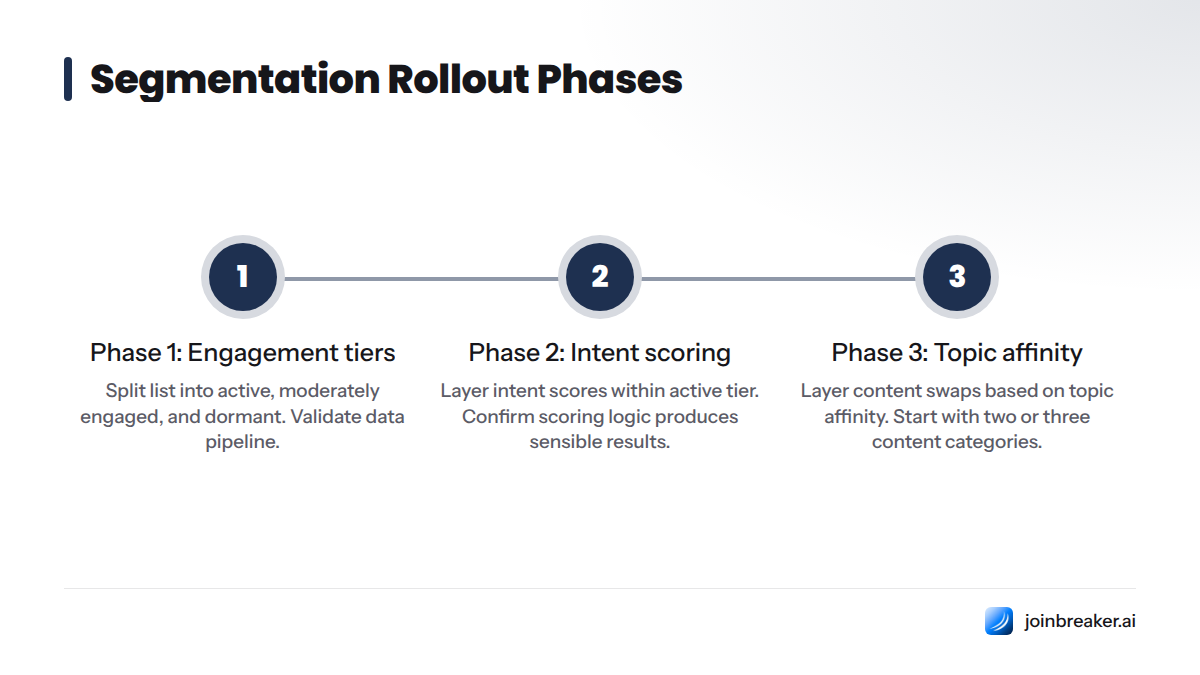
A sequenced rollout generally looks like this:
Phase 1, weeks 1-2: Broad lifecycle and engagement segments. Split the list into active, moderately engaged, and dormant tiers. Send the same content to each tier but vary cadence or a single re-engagement element for the dormant group. This validates your data pipeline before you add complexity.
Phase 2, weeks 3-6: Intent-score layering. Once engagement tiers are stable, introduce intent scoring within your "active" tier to identify who gets priority CTAs, early access, or higher-value offers. This is also when you confirm your scoring logic is producing sensible results, not just a number that looks reasonable on paper.
Phase 3, week 7 and beyond: Topic-affinity micro-segments. Layer in content-level swaps based on topic affinity, starting with your two or three most distinct content categories rather than trying to cover every possible interest area at once.
This cadence isn't arbitrary. Each phase depends on the data and tooling confidence built in the previous one. Publishers who skip straight to Phase 3 without validating Phase 1 tend to end up with segments built on unreliable data, which undermines trust in the whole segmentation strategy once results don't match expectations.
For a broader view of how this fits into B2B newsletter strategy overall, Breaker's B2B Newsletter Strategy guide covers how segmentation rollout fits alongside content planning and send cadence decisions.
Step 5: Test, Measure, and Refine Segment Performance
A segment you never revisit is a guess that got lucky once, if it worked at all. Treat every segment as a hypothesis that needs ongoing validation.
What to measure for each segment:
- Open rate, compared against your pre-segmentation baseline and against other segments
- Click-through rate, both overall and on the specific swapped content element
- Engagement lift, the percentage improvement in opens or clicks versus an unsegmented control group, if you can hold one out
- Unsubscribe and spam-complaint rate, watched closely in the first few sends to a new segment, since a misconfigured segment can backfire
A simple testing cadence: run each new segment for at least four sends before drawing conclusions, since a single issue can swing on subject line or timing alone, not just segment logic. After four sends, compare performance against the control group or against the segment's own pre-change baseline.
Know when to split or merge:
- Split a segment when performance diverges meaningfully within it. For example, if "moderately engaged" subscribers behave very differently depending on topic affinity.
- Merge segments when two groups show statistically similar engagement patterns over multiple sends, since maintaining separate content variations for segments that behave identically wastes editorial effort without adding lift.
If you want tooling recommendations specifically for automating this test-and-refine loop, Breaker's roundup of subscriber segmentation automation tools covers platforms built for this kind of ongoing measurement work.
What the Data Shows: Engagement Lift by Segment Type
This is the part most segmentation guides skip, because they don't have the data to back it up. Breaker pulled anonymized, aggregated engagement data from its live publisher base to compare how much lift each segmentation criteria actually produces, measured against an unsegmented control send.
| Segment Type | Relative Open Rate Lift | Relative Click-Through Rate Lift |
|---|---|---|
| Unsegmented (baseline) | 0% | 0% |
| Behavioral segmentation only | Moderate lift, typically the first noticeable jump off baseline | Modest lift |
| Behavioral + intent score | Larger lift than behavioral alone | Meaningfully higher, concentrated among high-intent subscribers |
| Behavioral + intent score + topic affinity | Highest lift observed across segment types | Highest lift, driven by content relevance rather than just send timing or tiering |
The pattern holds across Breaker's publisher base: each added layer of segmentation sophistication, moving from pure behavior to intent score to topic affinity, produces additional lift on top of the last, rather than replacing it. Behavioral segmentation alone gets a publisher off the ground. Intent score adds a layer of prioritization. Topic affinity is where the lift compounds, because it's the layer that actually changes what content a subscriber sees, not just when or whether they receive the issue at all.
Why does topic affinity consistently outperform behavioral-only segmentation? Behavior tells you someone is engaged. Topic affinity tells you why. Sending a dormant subscriber a re-engagement nudge might win back an open. Sending an actively engaged subscriber content matched to their actual interests is what turns a one-time click into a habitual reader - which is the real engagement outcome publishers are chasing.
Common Newsletter Segmentation Mistakes to Avoid
Most segmentation failures trace back to one of a handful of avoidable errors.
Over-segmenting too early. Building fifteen micro-segments before validating three broad tiers spreads editorial effort too thin and makes results hard to interpret. Start broad, as outlined in Step 4, and add granularity only once each phase proves itself.
Relying on stale declared data. A preference a subscriber selected a year ago may no longer reflect their actual interests. Pair declared data with behavioral or topic-affinity signals that update automatically, rather than treating a signup form answer as permanent truth.
Ignoring content-to-segment mapping. Defining segments without deciding what actually changes in the send wastes the entire exercise. A segment only produces lift if the content, not just the list, is different.
Never testing or refining segments. Segments built once and left untouched for a year drift out of sync with how subscribers actually behave. Revisit segment performance on the cadence described in Step 5, not just when something feels broken.
Treating every newsletter the same regardless of audience type. A B2B newsletter segmentation strategy built for a list of mixed job functions needs different criteria than a consumer newsletter segmented by purchase history. Don't import tactics wholesale from e-commerce segmentation playbooks into a professional-audience context.
Red Flags Checklist
If you're seeing any of these, it's time to revisit your segmentation strategy:
- You have more than six active segments but no one on the team can explain what's different about each one's content
- Your "dormant" segment hasn't been re-engaged or suppressed in over six months
- Declared data in your segments is more than twelve months old for the majority of subscribers
- No segment has been tested or compared against a baseline in the last quarter
- Open rate or click-through rate for any segment is flat or declining for three consecutive sends
Frequently Asked Questions
What is newsletter segmentation and how does it differ from basic email list segmentation? Newsletter segmentation applies the same underlying principle as general email list segmentation, grouping subscribers by shared traits, but it's specifically oriented around recurring editorial content rather than one-off promotional sends. The criteria lean more heavily on topic interest and engagement history than on purchase behavior.
Why does segmentation improve newsletter engagement rates? Segmentation improves engagement because it closes the gap between what's published and what each subscriber actually wants to read, so open rates and click-through rates rise as content relevance increases.
What segmentation criteria should I start with if I have limited subscriber data? Start with behavioral segmentation into active, moderately engaged, and dormant tiers, since it requires no additional data collection and works off engagement history your ESP already tracks.
What is an intent score in the context of newsletter segmentation? An intent score is a composite number estimating how likely a subscriber is to take a meaningful next action, weighted by the recency, frequency, and value of their past engagement.
How is intent score calculated or derived? It's typically derived from a weighted combination of recency of activity, frequency of high-value clicks, depth of engagement within an issue, and any available declared data, combined into a single score.
What is topic affinity and how does it differ from declared interests? Topic affinity is inferred from actual click behavior across past issues, while declared interests come from what a subscriber explicitly stated, often at signup. Topic affinity stays current automatically because it updates with each new send; declared data can go stale.
What is behavioral segmentation and what data points does it use? Behavioral segmentation groups subscribers by what they do, primarily opens, clicks, forwards, and recency of activity, rather than by anything they've declared about themselves.
How many segments should a newsletter have to start? Three is a reasonable starting point: highly engaged, moderately engaged, and dormant. Expand only after each tier's performance has been validated.
How granular should newsletter segments get before returns diminish? Returns start to diminish once a segment becomes too small to measure confidently or too narrow to justify a unique content variation, often somewhere below a few hundred engaged subscribers, depending on list size.
What is an audience graph and how does it relate to segmentation? An audience graph is the underlying map of a subscriber's behavior, declared data, and inferred signals that feeds segment definitions and content mapping. It's the data layer that makes dynamic, automatically updating segments possible.
How do I map content or newsletter issues to specific segments? Decide what single element changes for each segment - a featured story, a CTA, or a content module - while keeping the rest of the issue consistent, then build a mapping table like the one in Step 3.
In what order should I roll out segmentation, broad or granular first? Broad first. Start with lifecycle or engagement tiers, add intent scoring once that's stable, then layer in topic-affinity micro-segments last.
How long should each phase of a segmentation rollout take? A reasonable cadence is two weeks for broad engagement tiers, four weeks for intent-score layering, and ongoing iteration from week seven onward for topic-affinity segments.
How do I measure whether a segment is actually improving engagement? Compare the segment's open rate and click-through rate against an unsegmented control group or its own pre-segmentation baseline over at least four sends.
What open rate or click-through rate lift can I expect from segmentation? Lift varies by criteria and list maturity, but Breaker's first-party data shows lift compounding as publishers move from behavioral-only segmentation to behavioral plus intent score plus topic affinity, with the combined approach producing the highest lift observed.
How often should I test and refine my segments? Review segment performance at least quarterly, and immediately if a segment's open rate or click-through rate flattens or declines for three consecutive sends.
What are the most common mistakes publishers make when segmenting a newsletter? Over-segmenting too early, relying on stale declared data, skipping content-to-segment mapping, and never testing or refining segments once they're built.
Is over-segmenting a newsletter list possible, and what happens if I do? Yes. Over-segmenting spreads editorial effort too thin, makes it hard to tell which segments are actually driving results, and often produces segments too small to measure with confidence.
How does newsletter segmentation differ for B2B versus consumer audiences? B2B segmentation leans more heavily on role, intent score, and topic affinity tied to professional interests, while consumer segmentation often leans on purchase history and demographic data. Importing e-commerce tactics directly into a B2B context tends to underperform.
What first-party data should I audit before building a segmentation strategy? Engagement history (opens, clicks, recency), declared data from signup or preference forms, CRM data if connected, and any website or product usage data tied to known subscribers.
How does engagement lift vary between behavior-based, intent-score-based, and topic-affinity-based segments? Behavioral segmentation produces the first noticeable lift off an unsegmented baseline. Adding intent score produces a larger lift concentrated among high-value subscribers. Adding topic affinity on top produces the highest lift observed, because it's the layer that changes content relevance directly.
Can segmentation be automated, and what role does AI play in building segments? Yes. AI-based scoring models can calculate intent score and topic affinity continuously from engagement data, removing the need for manual list exports or static rule-based tiers - which is how modern audience-graph-driven platforms keep segments current automatically.
How do I know when a segment needs to be merged or split? Split a segment when performance diverges meaningfully within it across multiple sends. Merge segments when two groups show statistically similar engagement patterns over time, since separate content variations stop adding value once behavior converges.
What is the difference between declared data and inferred data in segmentation? Declared data is what a subscriber explicitly told you, like a preference selected at signup. Inferred data, including topic affinity and intent score, is derived from actual behavior and updates automatically as that behavior changes.
How does segmentation sequencing affect long-term subscriber engagement? A sequenced rollout, broad to granular, builds trust in the data and tooling at each stage before adding complexity - which tends to produce more durable engagement gains than jumping straight to granular segments built on unvalidated data.
Next Steps: Turning Segmentation Into Measurable Engagement Gains
Segmentation only pays off when it's tied to measurement from day one. Before rolling out Phase 1, decide exactly which metrics you'll track and where that data lives, so you're not retrofitting measurement after the fact.
A few next steps worth taking this week:
- Run the Segmentation Readiness Audit checklist from Step 1 against your actual data sources.
- Pick one broad behavioral tier split (active, moderate, dormant) and commit to a two-week test.
- Set a calendar reminder to review performance at the four-send mark, not before.
- Read Breaker's guide to newsletter engagement metrics to confirm you're tracking the right signals before you scale into intent scoring.
If you're evaluating whether your current email service provider can actually support this kind of staged, data-driven segmentation strategy, that's worth a direct comparison. Many legacy ESPs handle basic list splitting fine but struggle with continuously updating scores like intent score and topic affinity, which require an underlying audience graph rather than static list tags. Breaker was built around that audience-graph model from the start, which is why its segment definitions update automatically as subscriber behavior changes, rather than requiring manual list rebuilds every time you want to refine a segment. You can see how that plays out in practice in Breaker's own platform review, or head to the Breaker homepage to see the audience graph in action.
Here's a short tutorial showing segment creation inside a popular platform, useful context for understanding how segment logic gets implemented mechanically, even if your own platform's interface differs:
Segmentation isn't a one-time project. It's a system that gets more valuable the longer you maintain it, provided you audit honestly, choose criteria that match your data maturity, sequence the rollout sensibly, and keep testing. Publishers who treat it that way consistently see the engagement lift that segmentation promises on paper actually show up in their open rates and click-through rates.
Sources
Keep reading
All articlesHow to Grow Newsletter Subscribers with Qualified Leads in 2026
Discover 8 channels to grow engaged newsletter subscribers in 2026, with real cost-per-engaged-subscriber data to focus your list-building strategy.
B2B Lead Generation via Newsletter: What Actually Works
Cold outbound is losing steam. See 7 proven newsletter tactics for B2B lead generation, from gated content to sponsorship swaps, that beat cold outreach.
How to Write a Newsletter with AI: Step-by-Step Guide 2026
Learn how to write a newsletter with AI the right way: a 7-step process to train, calibrate, and edit AI drafts that still sound like you.