
Multi-Touch Attribution: A B2B Marketer's Guide to ROI
Learn how to use multi-touch attribution to prove marketing ROI. This guide covers models, implementation, and integration with your CRM for B2B growth.
Your dashboard says paid search is driving pipeline. Your sales team says prospects keep mentioning webinars, newsletters, and content. Your CFO asks why you're still funding channels that rarely appear as the final click before a demo request.
That gap is where most B2B attribution breaks.
Last-click reporting makes lower-funnel activity look heroic and everything else look optional. For B2B teams running newsletters, nurture sequences, webinars, paid social, and sales-assisted follow-up, that creates bad budget decisions fast. The newsletter that kept a buying committee engaged for weeks gets ignored. The direct visit before the form fill gets all the credit.
A defensible attribution system fixes that. Not by pretending every touchpoint matters equally, and not by turning your reporting into a black box nobody trusts. The goal is simpler. Track the path, connect it to contacts and opportunities in your CRM, and assign credit in a way your team can readily use.
Beyond the Last Click The Case for Modern Attribution
Most B2B leaders have lived through the same meeting. A channel looks weak in analytics because it rarely closes the deal directly, so finance starts circling the budget. Email nurture gets questioned. Newsletter sponsorships get questioned. Educational content gets questioned. Meanwhile branded search and direct traffic look like they're doing all the work.
That's the trap of single-touch reporting. It rewards the touchpoint closest to conversion, even when earlier interactions created the demand.
Multi-touch attribution is the practical answer. It assigns value across the journey instead of handing all credit to one interaction. That matters because budget decisions based on last-click logic usually underfund the channels that educate, nurture, and qualify buyers before sales ever gets involved.
Why this moved from optional to standard
This isn't a niche analytics exercise anymore. One 2026 industry roundup reports that 75% of companies now use multi-touch attribution, up from 58% in 2024, and teams implementing it typically see 14% to 36% CPA improvement plus an average 19% ROI lift in the first year according to Improvado's multi-touch attribution solutions roundup.
That adoption curve tells you something important. Teams aren't switching because attribution is fashionable. They're switching because the old model leaves too much money hidden in the middle of the funnel.
Practical rule: If your team runs campaigns meant to create demand before a buyer is ready to convert, last-click reporting is already undercounting part of your marketing impact.
Newsletter-led B2B teams feel this problem more than most. A subscriber might open a campaign, ignore it, come back through search, click a later newsletter CTA, attend a webinar, and only then request a demo. Last-click sees the final step. Revenue came from the sequence.
What B2B teams need instead
A usable attribution system starts with first-party tracking, not platform vanity metrics. If you need a good primer on why that foundation matters, this guide on first-party data is a worthwhile read.
It also helps to study the broader operating model around demand generation, not just reporting. Teams that want a sharper top-of-funnel engine can learn B2B strategies with LinkedFuse and compare that planning with their attribution setup.
The shift is simple in theory. Stop asking, “What got the last click?” Start asking, “What sequence moved this account toward revenue?”
What Is Multi-Touch Attribution
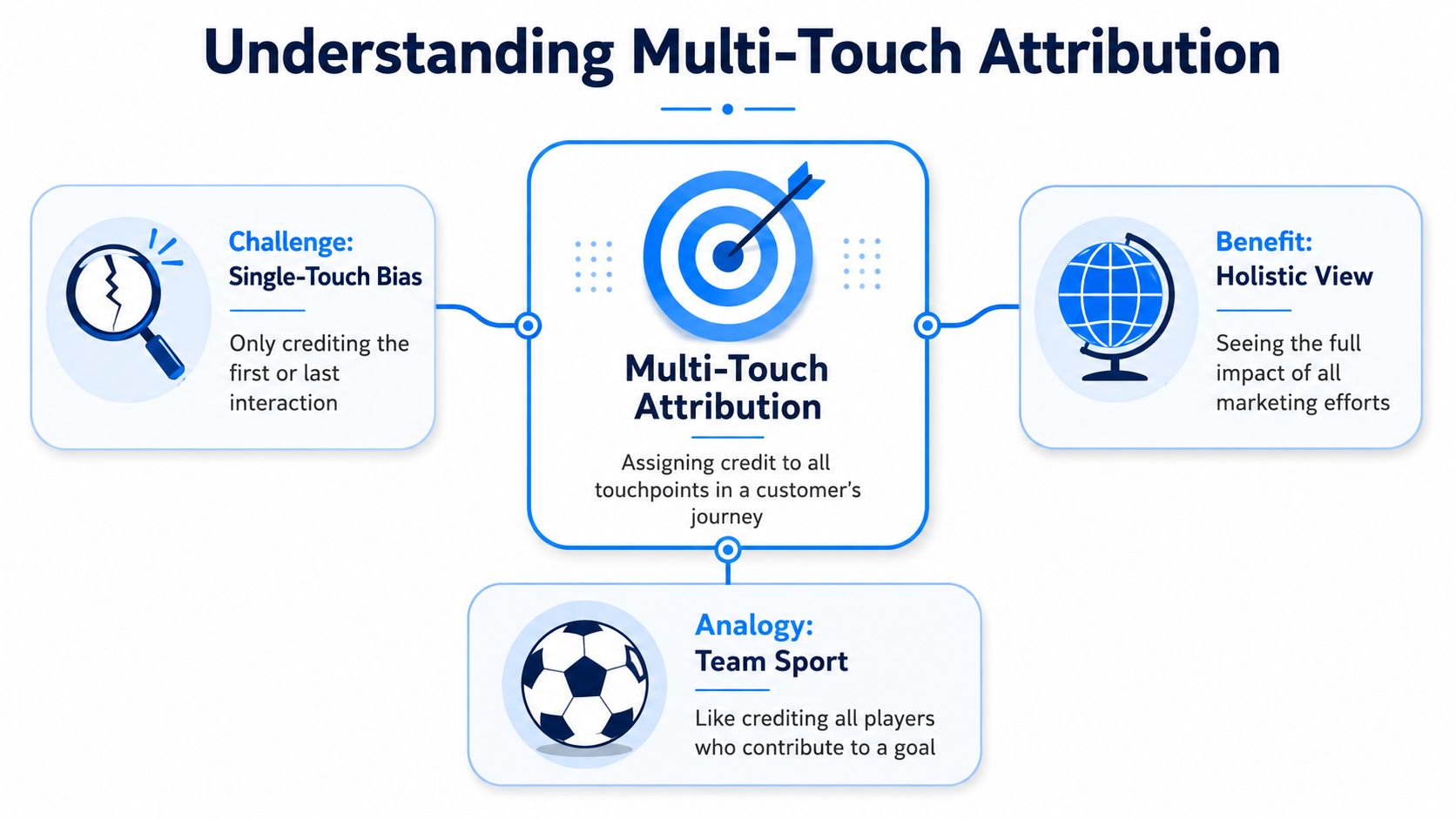
Think of multi-touch attribution like crediting a goal in soccer. The striker may score, but the play often started with a defender winning possession, a midfielder making the key pass, and a winger creating space. If you credit only the final touch, you miss how the goal happened.
That's exactly what happens in B2B marketing.
A buyer might first see a LinkedIn ad, subscribe to your newsletter, click a thought-leadership email two weeks later, attend a webinar, and then come back directly to book a demo. A last-click model gives full credit to the demo visit. A first-click model gives full credit to the ad. Both tell only part of the story.
Why single-touch models distort reality
A published benchmark found that 70% of conversion journeys involve 2 or more touchpoints, which is why assigning all credit to one interaction breaks down in real buying behavior, as outlined in Roivenue's guide to multi-touch attribution models.
For B2B teams, that distortion shows up in predictable ways:
- Top-of-funnel gets undervalued: Educational channels often influence deals long before the buyer converts.
- Nurture gets ignored: Newsletter clicks, email sequences, and webinar invites may move the deal forward without being the final interaction.
- Direct and branded search get inflated: These often appear late in the journey after other channels have already done the persuasion.
The point of multi-touch attribution isn't to make every channel look important. It's to stop one reporting shortcut from making the wrong channel look solely responsible.
What multi-touch attribution actually does
Multi-touch attribution distributes conversion credit across the touches that influenced the buyer. The split depends on the model you choose.
Common rule-based approaches include:
- Linear attribution: Credit is spread evenly across all tracked touchpoints.
- Time-decay attribution: Later interactions get more credit than earlier ones.
- Position-based attribution: The classic U-shaped version commonly gives 40% to the first touch, 40% to the last touch, and 20% to the middle touches.
Those models aren't just reporting preferences. They express different beliefs about how buyers move through a journey.
Why newsletter teams should care
Newsletters are rarely pure first-touch or pure last-touch channels. They often do the work in between. They keep your brand present, deliver educational content, promote events, and create repeat visits from known contacts. Multi-touch attribution is what finally lets that role show up in revenue reporting instead of disappearing behind “direct” or “demo request.”
Comparing the Most Common Attribution Models
Choosing an attribution model is really choosing a bias you can live with. Every model emphasizes something. The question isn't whether a model is perfect. It's whether it fits the way your buyers move.
The main trade-off is straightforward. Rule-based models such as linear, time-decay, and position-based are easier to audit, while data-driven approaches estimate credit from observed paths and often handle complex journeys better, as explained in HockeyStack's overview of multi-touch attribution solutions.
A simple B2B example journey
Use one consistent path:
- A prospect clicks a LinkedIn ad
- They subscribe to your newsletter
- They click a newsletter link to read a product education post
- They register for a webinar from a later newsletter send
- They request a demo
Now compare how each model interprets that same path.
How the main models behave
Model
How It Works
Best For
Potential Bias
Linear
Splits credit evenly across all touchpoints
Long B2B journeys where multiple touches clearly matter
Assumes each touch contributed equally
Time-Decay
Gives more credit to touches closer to conversion
Teams that want recency reflected in reporting
Can overvalue late-stage actions and under-credit early demand creation
Position-Based
Emphasizes first and last touches, with less credit to the middle
Teams balancing awareness and conversion ownership
Middle-funnel touches, including newsletters, can look smaller than they felt in reality
Data-Driven
Uses observed path behavior to estimate contribution
Larger teams with strong path data and analytics maturity
Harder to explain, trust, and troubleshoot
Where each model works in practice
Linear attribution
Linear works well when your sales cycle is long and your team needs a neutral starting point. If five touches were required to get a demo, linear says all five mattered enough to deserve equal credit.
That makes it useful for newsletter-heavy B2B programs. Newsletter engagement often supports consideration rather than creating or closing the opportunity alone. Linear doesn't punish that role.
The downside is obvious. An ad impression and a webinar registration probably didn't contribute equally. Linear ignores that difference.
Time-decay attribution
Time-decay is better when later interactions carry more decision weight. For example, a webinar attendance close to the demo request may signal much stronger intent than an ad click months earlier.
This model is often attractive to revenue teams because it still recognizes the path while leaning toward touches nearest the opportunity. But it can make newsletters look smaller if their biggest job was to start or sustain interest earlier in the cycle.
Position-based attribution
Position-based, or U-shaped attribution, is useful when your team wants to value both demand creation and demand capture. In the common convention, 40% goes to the first touch, 40% to the last touch, and 20% is split across middle touches.
That's easy to explain in a boardroom. It's also politically convenient in many organizations because it gives the acquisition team and the conversion team clear ownership.
It can still understate the middle, which is where many B2B newsletter programs do their best work.
If newsletters are a major nurture channel for your business, be careful with models that treat the middle of the journey like a rounding error.
Data-driven attribution
Data-driven attribution tries to estimate contribution from real paths rather than fixed rules. In the right environment, that can produce a more realistic view of how channels interact across devices and sessions.
But there's a cost. When a model is hard to explain, people stop trusting it. If sales, finance, or channel owners can't understand why a model changed credit distribution, they'll revert to platform reporting and gut instinct.
For many B2B teams, the strongest move is to start with a rule-based model you can defend, then graduate to more advanced modeling once the data layer is stable.
Data and Tools for Reliable Measurement
Attribution isn't mainly a modeling problem. It's a data stitching problem.
If you can't connect an anonymous website visitor to a known contact, and then connect that contact to CRM activity and revenue, your model won't rescue you. It will just spread bad inputs more elegantly.

Multi-touch attribution requires end-to-end user-level tracking across web, ads, CRM, and email. If identity stitching breaks, anonymous pre-conversion behavior can't be tied to the eventual lead or customer, and the resulting budget decisions become unreliable, as detailed in Twilio's introduction to multi-touch attribution.
The non-negotiable data layer
Reliable MTA usually depends on a few basics working together:
- Website event capture: JavaScript-based tracking for key actions like page views, form fills, asset downloads, and webinar registrations.
- Consistent campaign tagging: UTM discipline across paid media, email, partnerships, and social distribution.
- Email engagement data: Opens and clicks should map to the same person record used in your CRM.
- CRM lifecycle data: Contact creation, opportunity creation, stage changes, and closed-won outcomes need to be available for reporting.
- Platform connectors or APIs: Ad data, email data, webinar data, and CRM data have to land in one reporting layer.
When marketers skip one of these, attribution starts favoring whatever remains easiest to track. That usually means lower-funnel web sessions.
What usually breaks first
The first failure point is identity resolution. A person clicks a newsletter on mobile, later visits your site from desktop, then books a demo from a forwarded email or a direct visit. Without durable identity stitching, those actions may look like separate users.
The second failure point is taxonomy. If one team uses “paid_social,” another uses “linkedin-paid,” and a third ships campaigns without UTMs, your reporting won't classify paths consistently.
A third issue is operational, not technical. Marketing ops and revenue ops often own different parts of the stack and define “source” differently.
Good attribution needs one owner. Not because one person does all the work, but because one team must decide what counts as a touchpoint, how channels are named, and how CRM records get reconciled.
Tools are useful, but they're not the solution
You can build this in GA4, a warehouse, a BI layer, and your CRM. You can also use a dedicated attribution platform. Either way, the tooling only works after the collection layer is disciplined.
Teams doing market research alongside attribution work often benefit from stronger benchmarking habits too. If you're evaluating channel context, this guide on analyzing competitor performance can sharpen how you interpret your own reporting.
For leadership reviews, clean one-off analyses matter just as much as dashboard automation. This explanation of ad hoc reporting is useful for teams that need to answer specific revenue questions quickly without rebuilding the whole analytics stack.
Putting It All Together An Example for B2B Newsletters
A realistic B2B journey rarely starts with a demo request. It usually starts with mild interest and repeated exposure.
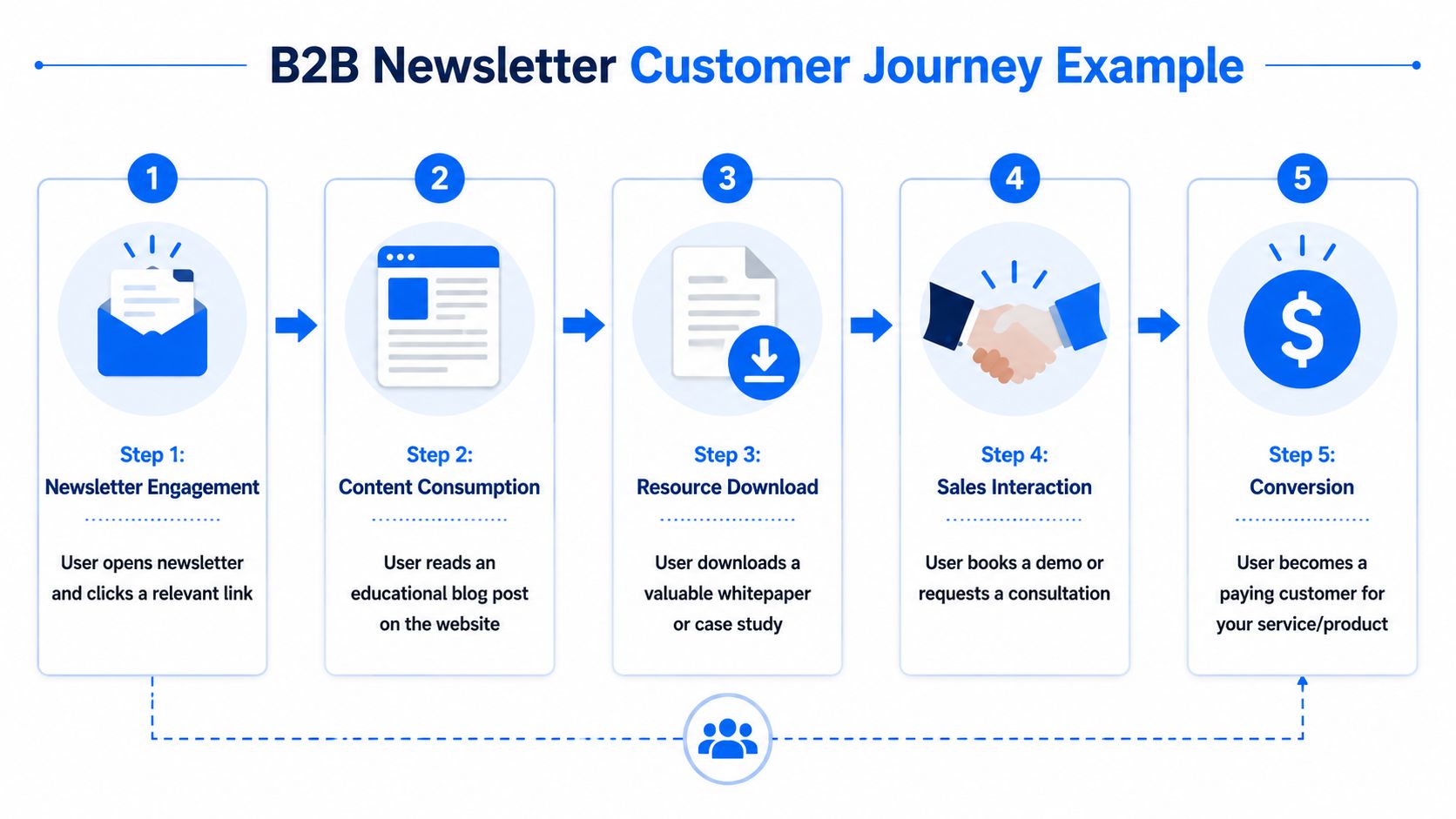
Say a prospect clicks a LinkedIn ad promoting an industry guide. On the site, they subscribe to your newsletter. A week later they click a newsletter link to a blog post about a pain point their team is facing. Later, another newsletter promotes a webinar, they attend, and a sales rep follows up. After internal discussion, they return to your site and request a demo.
That's the kind of path newsletter teams influence every week, even when last-click reports hide it.
How the same journey looks under different models
Use these five touches:
- LinkedIn ad click
- Newsletter signup
- Newsletter click to blog content
- Webinar registration and attendance
- Demo request
Under linear attribution, each touch gets equal credit. That's a clean way to show that the newsletter didn't just generate engagement. It contributed to pipeline across multiple stages.
Under position-based attribution, the first touch and last touch get most of the credit, and the middle interactions share the rest. In that setup, the ad and demo request dominate, while the newsletter signup, newsletter click, and webinar support role gets compressed.
Under time-decay attribution, the webinar and demo request usually carry more weight because they happened closer to conversion. The newsletter still matters, but the later newsletter-driven action often matters more than the earlier one.
What this reveals about newsletter ROI
A newsletter isn't one touchpoint. In a strong B2B program, it's often a recurring channel that appears multiple times in the same journey.
That changes how you should evaluate it.
- Newsletter signup matters: It turns an unknown visitor into a reachable contact.
- Newsletter clicks matter differently: Some clicks are educational. Others show active evaluation.
- Newsletter-promoted events matter most when tied to CRM outcomes: Webinar attendance, demo bookings, and opportunity creation need to flow into the same record.
If your reporting treats “email” as one lump and stops at click-through rate, you miss the commercial value of the sequence.
A practical reading of this journey
The newsletter didn't close the deal alone. It also didn't just “assist” in a vague sense. It carried the buyer from initial curiosity into active consideration.
That's why the CRM connection matters so much. Once newsletter interactions sit alongside opportunity stages, sales notes, and closed-won records, you can answer better questions:
- Which newsletter topics appear most often before qualified pipeline?
- Which campaign links influence webinar attendance?
- Which subscriber segments move from engagement to opportunity fastest?
The useful question isn't whether the newsletter got the last click. It's whether the newsletter repeatedly appeared in the journeys that produced revenue.
Common Pitfalls and Best Practices for B2B Teams
Most attribution failures don't come from choosing the wrong model. They come from trusting the model too early, changing it too often, or pretending missing data isn't a problem.
A major issue many teams underestimate is privacy. Multi-touch attribution depends on user-level data, but real-world journeys now include cookie loss, consent gaps, and fragmented identities, which makes incomplete path data a structural challenge rather than a temporary glitch, as noted in Nielsen's guide to multi-touch attribution methods and models.
What B2B teams should do
- Use a model your team can explain: If revenue leadership can't understand how credit is assigned, they won't trust the output.
- Audit your tracking continuously: Check UTMs, form capture, webinar syncs, and CRM field mapping on a regular cadence.
- Include offline and human touchpoints where possible: Sales calls, events, and hand-raisers in outbound sequences often influence deals even when web analytics can't see them cleanly.
- Create a plan for partial visibility: Some journeys will be incomplete. Document that openly instead of overclaiming precision.
What teams should stop doing
- Don't compare platform attribution to CRM attribution as if they should match perfectly: Ad platforms grade their own homework.
- Don't switch models every quarter: That makes trend analysis useless and turns attribution into politics.
- Don't treat direct traffic as pure intent: It often contains dark social, forwarded emails, untagged links, and broken session continuity.
- Don't leave ownership ambiguous: Marketing ops, RevOps, and demand gen need one agreed source of truth.
The operating model matters too
Attribution projects often stall because nobody owns the cross-functional workflow. Channel teams launch campaigns, ops teams patch the data later, and sales uses different definitions of influence than marketing.
That's partly a team design problem. For leaders thinking about who should own analytics, ops, lifecycle, and demand generation, this framework on marketing team structure for 2026 is useful as a planning reference.
The best B2B teams treat attribution as a revenue process, not a dashboard feature.
Integrating Attribution with Your CRM for True ROI
Attribution becomes financially useful only when it reaches the CRM.
Until then, you're measuring marketing interactions. Once those touches connect to contacts, accounts, opportunities, and closed-won revenue, you can measure contribution to pipeline and actual ROI.
What the CRM integration should capture
At a minimum, your system should attach touchpoint history to the same records your sales team uses every day. That usually means:
- Contact-level history: Newsletter subscriptions, email clicks, form fills, and webinar registrations
- Opportunity context: Which touches happened before opportunity creation and during active pipeline
- Revenue linkage: Closed-won amounts tied back to attributed channels and campaigns
- Time-aware reporting: The order of interactions matters as much as their existence
For most B2B teams, Salesforce and HubSpot are the obvious endpoints. The key is consistency. If marketing records one touch chronology and sales updates opportunity stages on a different timeline, your ROI model breaks.
What good CRM attribution changes
Once the integration is working, reporting gets sharper fast.
Sales can see the path that led to the meeting, not just the lead source field. Marketing can evaluate newsletters by influence on opportunity creation and revenue, not only opens and clicks. Leadership can compare channels using a common commercial outcome instead of channel-specific metrics.
That's where governance matters. Naming conventions, lifecycle stages, campaign membership, and contact-to-account association all affect the final picture. Teams that need cleaner operational discipline should review these CRM best practices before trying to make attribution a board-level metric.
The payoff is clarity. You can finally answer questions like which newsletter campaigns influenced qualified pipeline, which email-driven webinars led to real opportunities, and how much revenue your nurture program supported over a quarter.
If your B2B team wants to turn newsletters into a measurable revenue channel instead of a top-of-funnel guess, Breaker is built for that job. It combines email sending, subscriber growth, analytics, and CRM-friendly workflows so you can track newsletter engagement all the way through pipeline and ROI.
Keep reading
All articles10 Best Email Newsletter Examples of 2026
See 10 real email newsletter examples from Morning Brew, NYT Cooking & more, plus the 5 elements that make them work in 2026. Get the checklist.
How to Build an Email Automation Workflow: Steps, Triggers & Data Model
Learn triggers, conditions, splits, and actions to build reliable email automation workflows, plus a 10-step process and platform comparisons.
Why Scraped Email Lists Fail GDPR Compliance in Any ESP
Scraped email lists break GDPR Articles 6 & 7, risk €20M fines, and get your ESP account suspended. Learn the legal reality and the compliant path forward.