
Email Marketing Compliance: Your Complete 2026 Guide
Stay compliant in 2026. Our guide to email marketing compliance covers GDPR, CAN-SPAM, technical setup, and B2B list-building to protect your deliverability.
Your team has the campaign ready. The segmentation looks clean, the copy is strong, and sales wants it out today. Then someone asks the question nobody likes hearing five minutes before launch: are we compliant?
That hesitation is healthy. In B2B email, compliance mistakes rarely come from obvious recklessness. They usually come from gray areas. A product update includes a promo block. A list vendor swears the contacts are “business-only.” A regional form uses one consent flow for every market because nobody wants to maintain four versions. Those are the situations that create risk.
Email marketing compliance isn't just about avoiding legal trouble. It shapes deliverability, list quality, sender reputation, and how much trust your brand earns with every send. The teams that handle it well don't treat compliance as legal fine print. They build it into audience acquisition, campaign design, suppression logic, and infrastructure. If you sell into or operate in a regulated sector, our healthcare email marketing guide shows how HIPAA changes consent, content, and segmentation.
Why Email Compliance Is Your Biggest Risk and Opportunity
Most growth teams don't have a compliance awareness problem. They have an execution problem. Only 24% of marketers currently maintain full compliance with new email standards, according to Mailmend's email privacy regulation statistics. That gap matters because email programs break at the operational level, not at the policy slide level.
A lot of teams know the rules in broad terms. Fewer can prove consent source, show what language a contact agreed to, separate commercial from operational sends, or suppress unsubscribed users across every tool in the stack. That's where risk lives.
Compliance affects more than legal exposure
Treat email compliance like seatbelts and brakes in a car. They don't make the car slower. They let you drive with control.
A compliant program usually has better foundations:
- Cleaner acquisition paths: People know what they signed up for.
- Stronger sender reputation: Mailbox providers see fewer complaints and less suspicious behavior.
- More useful data: Your team can trust audience status, consent state, and suppression logic.
- Better cross-functional decisions: Legal, lifecycle, demand gen, and sales stop arguing over edge cases after the send is already drafted.
Practical rule: If your team can't explain why a person is on a list, you probably shouldn't email them at scale.
There's also a trust layer that many teams ignore. Buyers don't separate privacy, transparency, and brand credibility into different mental boxes. If your email behavior feels slippery, they assume your brand is slippery. That's one reason it helps marketers to review adjacent rules around claims and disclosures, including this legal guidance on endorsements from Lerner & Weiss APC. The principle is the same. Be clear about what you're doing, why you're doing it, and who's behind the message.
What works and what doesn't
Here's the practical split I see most often:
Approach
What happens
Centralized consent records
Teams can defend list membership and move faster
One generic global signup flow
Regional conflicts show up later in reviews or complaints
Automated suppression syncing
Unsubscribes stay honored across campaigns
Manual spreadsheet exceptions
People re-enter audiences they already left
Compliance done well creates a calmer operating environment. People send with confidence because the rules are built into the system, not remembered from a training deck.
Understanding CAN-SPAM GDPR and CASL
Most compliance confusion starts when teams mash different laws into one vague rulebook. That's a mistake. These frameworks overlap, but they don't operate from the same logic.
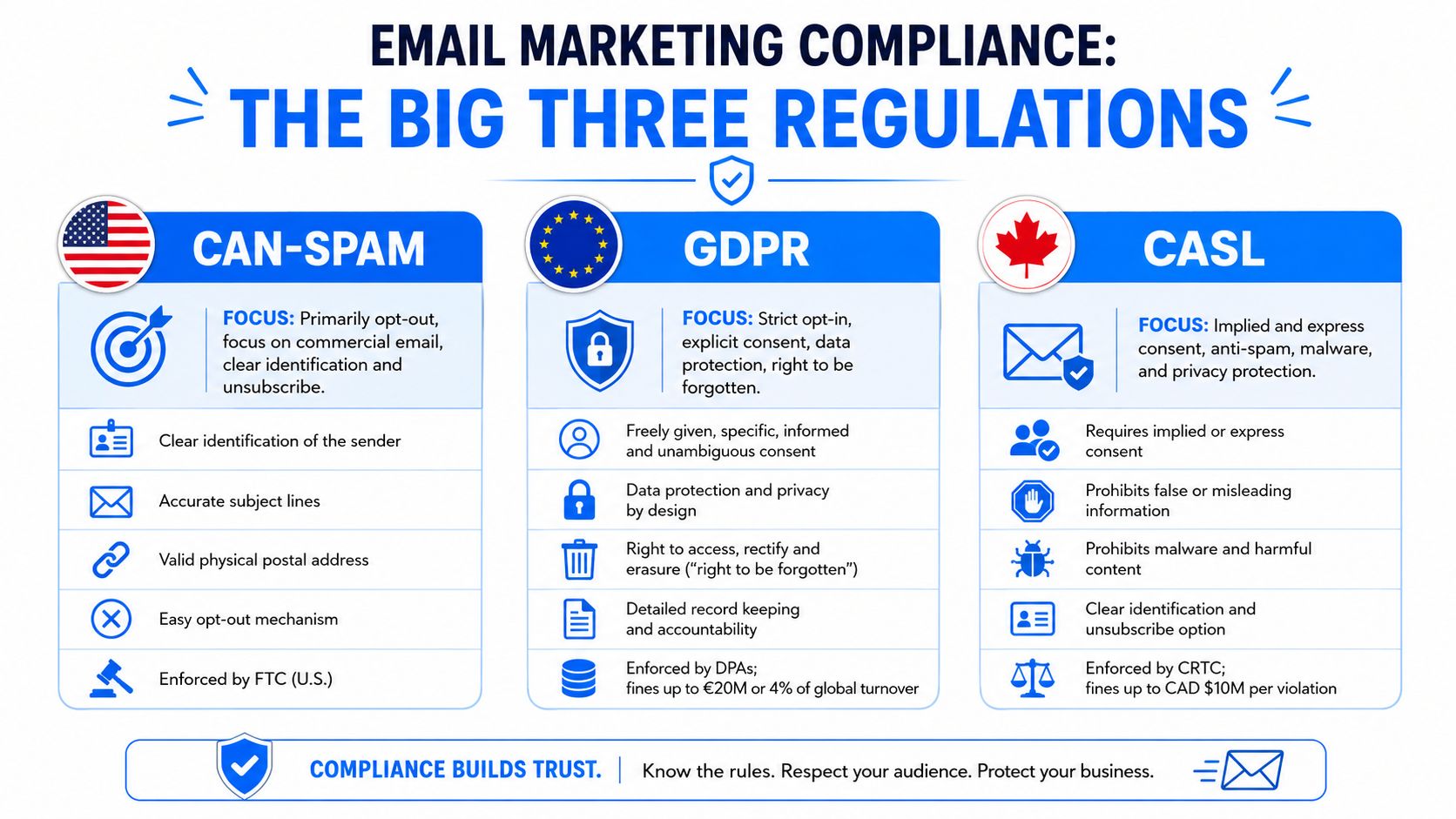
CAN-SPAM is best understood as an honesty and unsubscribe law. GDPR treats personal data like something the individual controls. CASL is stricter about permission before sending marketing messages.
The three laws in plain English
Think of CAN-SPAM as the rule that says: don't trick people, identify yourself properly, and let them leave easily. It allows commercial email in the U.S., but it polices how you send it.
Think of GDPR as digital property rights. If an email address identifies a person, you're handling personal data. That means you need a lawful basis, clear disclosures, and processes that respect the individual's control over that data.
Think of CASL as a stricter gate at the door. In practice, marketers need a much firmer basis before sending commercial electronic messages.
Where teams get tripped up
The easiest way to understand the difference is to compare the operating posture each law pushes you toward.
Regulation
Core posture
Marketer takeaway
CAN-SPAM
Opt-out focused
You can't mislead people and you must honor opt-outs
GDPR
Consent and data rights focused
You need a lawful basis and stronger documentation
CASL
Permission focused
You need to be much more careful about whether you can send at all
The cost of getting this wrong isn't theoretical. The U.S. CAN-SPAM Act allows fines up to $53,088 per individual non-compliant email, and Canada's CASL allows fines up to CA$10 million for businesses, as noted in eMercury's review of email compliance regulations.
That's why I don't recommend asking, “Which law applies to us?” The better question is, “Which law applies to this recipient, this list source, and this message type?”
A usable operating model
If you're managing a B2B program across regions, use a simple hierarchy:
- Start with recipient location and legal exposure
- Check how the address was collected
- Classify the message before drafting
- Apply the stricter standard when your team isn't sure
That last point matters. It's operationally cheaper to use a stricter consent standard than to unwind a messy send later.
For teams working through fuzzy permission states, this breakdown of implied consent in B2B email programs is useful because it helps separate “we have a business relationship” from “we clearly have permission to market.”
If unsubscribes are creating confusion, this practical guide to email unsubscribe expectations from Disputely is also worth reviewing. A lot of compliance breakdowns happen after the send, when teams fail to process opt-outs consistently across platforms.
The law may differ by region, but the safest systems all look similar. Clear permission, clear identity, and a clean exit.
Your Practical Email Compliance Audit Checklist
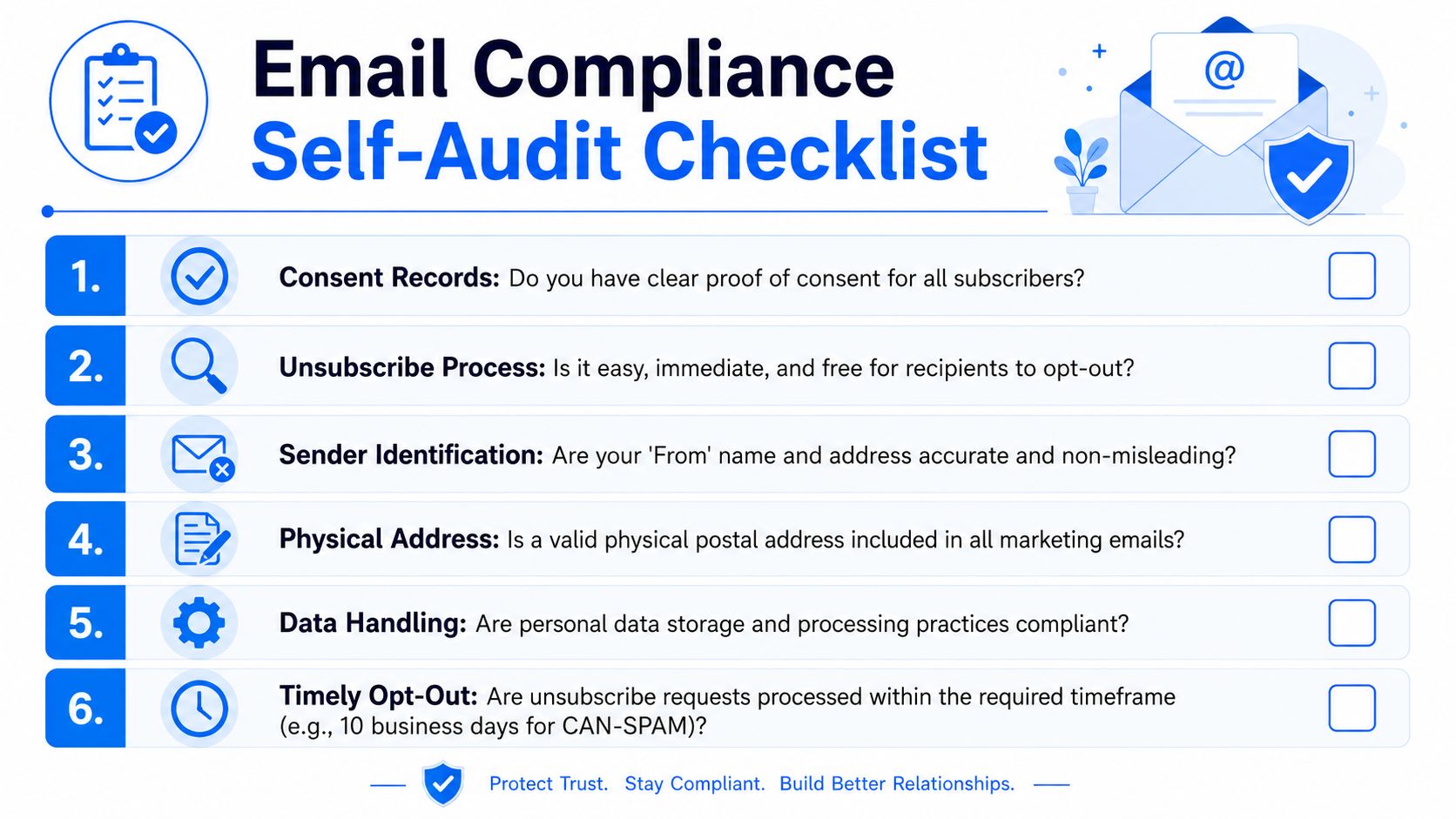
Many marketing teams don't need a legal memo first. They need an audit they can run this week. If you can answer the questions below with evidence, your email program is in decent shape. If you can't, you've found your next fix list.
Start with the visual checklist, then validate each item inside your ESP, CRM, forms, and suppression workflow.
Audit your consent trail
The first test is simple. Can you prove how each contact entered the database?
Check for these signals:
- Source clarity: The record should show whether the contact came from a form, product signup, event scan, import, sales handoff, or another path.
- Consent language capture: Save the language shown at the point of signup, not just a generic “subscribed” field.
- Timestamp logging: You need to know when the action happened.
- Jurisdiction mapping: If you market across regions, mark which standard governs that contact.
If your team wants a deeper process for documenting this, use a structured email list compliance audit workflow.
Inspect every commercial email element
Every marketing email should answer basic identity questions immediately. Who sent this? Why am I getting it? How do I stop receiving it?
Review the following:
- From name and reply path: These should identify the sender accurately.
- Subject line honesty: If the content is promotional, the subject can't disguise that fact.
- Postal address inclusion: Your footer should include a valid business mailing address.
- Footer consistency: Don't let template drift create gaps across different teams or brands.
A common failure point is cloned templates. Demand gen creates one version, lifecycle creates another, and the footer logic gradually diverges over time.
Before reviewing process details, it helps to see a practical walkthrough in action:
Test your unsubscribe flow like a recipient
Many teams tend to be more optimistic than accurate regarding compliance. Unsubscribe mechanisms must be “clear and conspicuous” and opt-outs must be processed within 10 business days under CAN-SPAM, while GDPR and CASL require express consent before sending any marketing message, according to VantagePoint's overview of CAN-SPAM compliance.
Don't just inspect the footer visually. Click it.
Then verify:
- The link works: No login, no broken page, no extra friction.
- The action is free: The recipient shouldn't have to do anything beyond the opt-out request.
- Suppression is durable: The address must stay out of future campaigns unless a valid new permission event occurs.
- Connected systems sync: Your ESP, CRM, sales engagement tool, and newsletter platform should agree on the opt-out state.
If unsubscribe requires effort, recipients won't debate policy. They'll hit spam.
Clean up your data handling
Compliance and hygiene are tied together. Old, vague, or duplicated records create avoidable risk.
Look for:
- Inactive legacy imports: If nobody can explain where the data came from, quarantine it.
- Bounces and invalid records: Remove them from active sending pools.
- Role confusion: Separate newsletter audiences from product notifications and sales outreach lists.
- Retention discipline: Don't keep marketing data forever just because storage is cheap.
A useful audit outcome is a red, yellow, green label on every list. Green means documented and active. Yellow means restricted use. Red means don't send until fixed.
Technical Setup for Bulletproof Compliance
Policies don't keep email compliant on their own. Systems do. If your infrastructure is weak, even a careful team will make mistakes because the platform allows them.
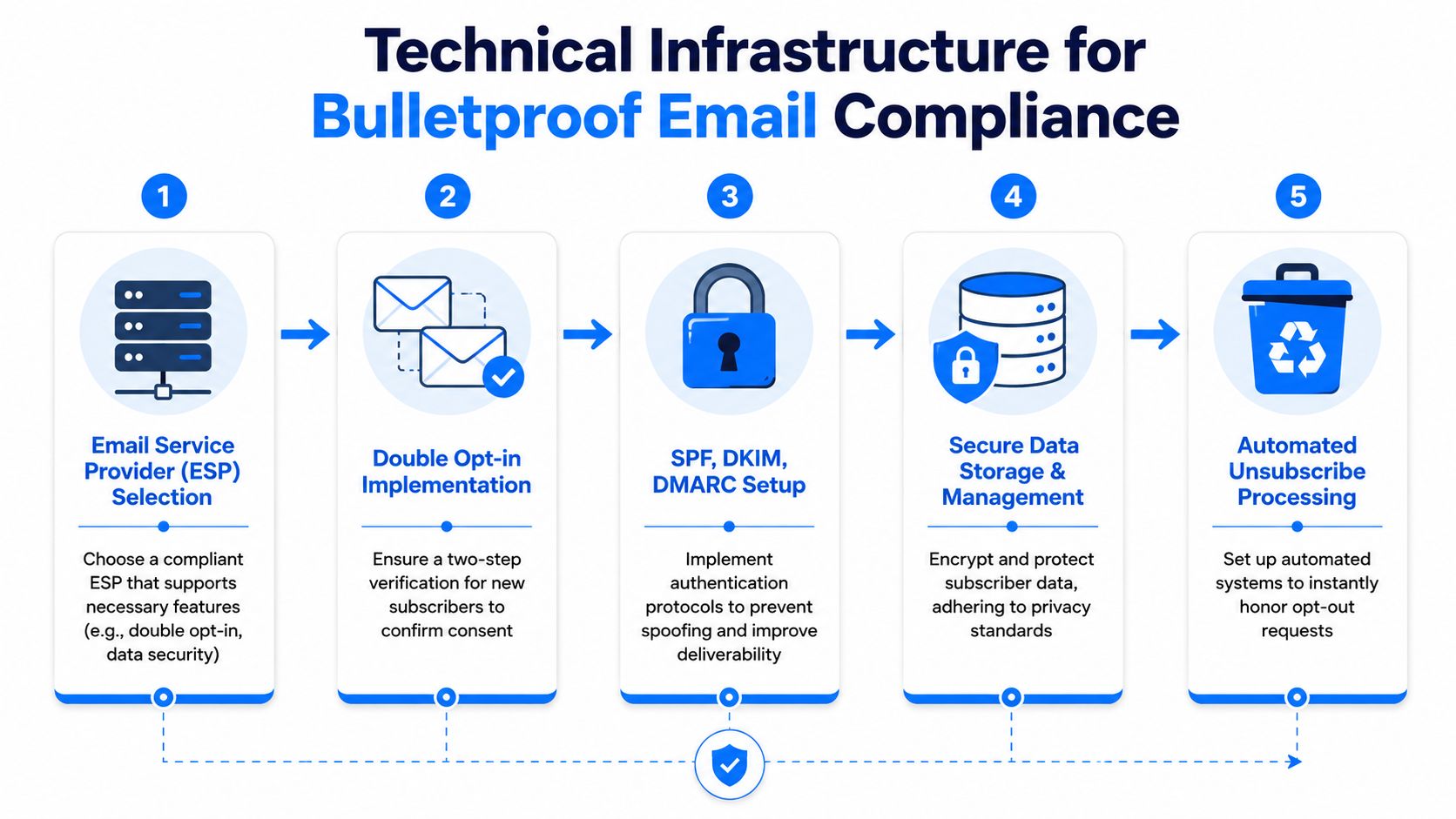
The first layer is sender identity. SPF, DKIM, and DMARC are the three core authentication protocols used to verify the sender's identity and prevent header spoofing, as explained in Klaviyo's email compliance glossary. I explain these to non-technical teams as a digital passport stack.
Think of authentication like airport security
Each protocol plays a different role.
- SPF: This is the approved traveler list. It tells receiving systems which senders are allowed to send on behalf of your domain.
- DKIM: This is the tamper seal on the envelope. It helps prove the message wasn't altered in transit.
- DMARC: This is the border officer with instructions. It tells receiving systems what to do when identity checks fail.
Without this stack, mailbox providers have less reason to trust your mail. Compliance and deliverability meet here. A message that looks spoofed or inconsistent doesn't just perform poorly. It can also undermine your ability to show that sender details were accurate.
Build compliant forms instead of fixing bad records later
Consent collection should be unambiguous at the point of entry. That means your forms need to do real work.
A good signup form usually has:
- Clear purpose language: Say what the person is signing up for.
- Granular choices when needed: Product updates, newsletter, partner content, and event invites shouldn't always be bundled together.
- Unchecked boxes where stricter consent standards apply: Don't rely on silence as permission.
- Linked privacy details: The person should be able to understand how their data will be used.
What doesn't work is the vague all-in-one field that says “enter your email to continue” and then routes the contact into broad promotional automation. That setup creates confusion because the user action and marketing outcome don't match.
A good consent form reads like a handshake. A bad one reads like a trap door.
Make unsubscribe and suppression automatic
This isn't the place for manual exports or weekly cleanup. Unsubscribes should flow directly into a suppression layer that every sending system respects.
Your stack should support:
System behavior
Why it matters
Instant suppression updates
Prevents accidental re-mailing
Shared suppression logic across tools
Stops one platform from undoing another
List-level and global opt-out handling
Matches different recipient expectations
Audit logs
Gives legal and ops teams a record when questions come up
The biggest operational mistake here is fragmented tooling. Marketing automation, newsletter sending, SDR outreach, and customer messaging often sit in separate systems. If they don't share suppression states, one unsubscribe becomes four separate risks.
Don't ignore retention and access controls
Compliance also depends on who can touch data and how long you keep it. Access should be role-based. Imports should be restricted. Legacy fields that nobody uses should be retired.
For teams evaluating platforms, this guide to email compliance software for growth teams is useful because the software choice often determines whether your compliance process is enforceable or just aspirational.
The best technical setup is boring. It prevents clever workarounds, logs important events, and makes the compliant action the easiest action.
Navigating B2B Email Gray Areas
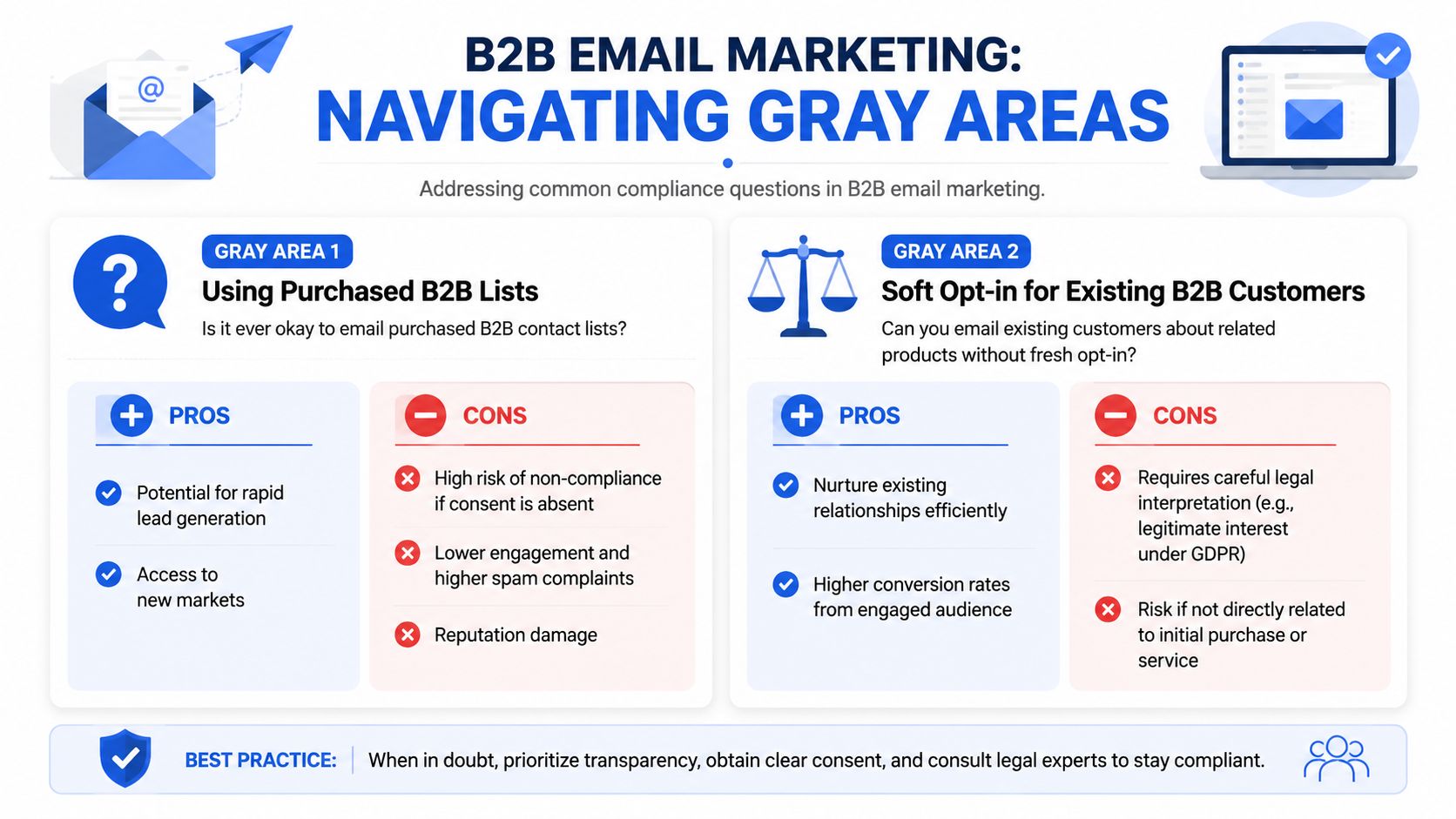
Most articles get safer and less useful right where B2B teams need actual guidance. They say “never use scraped data” or “just make sure transactional emails are transactional” and leave the hard part to you. That's not enough.
The gray areas matter because B2B teams often operate in mixed contexts. You send prospecting emails, nurture emails, onboarding notices, account alerts, event follow-ups, and product announcements. The legal answer changes based on who the recipient is, where they are, how the address was obtained, and what the message is mainly trying to do.
Scraped B2B data isn't one question
The common claim that scraped B2B email addresses are always illegal is too simple. The legal conflict between CAN-SPAM and GDPR around scraped B2B addresses is widely misunderstood, and recent UK ICO data showed a 47% increase in 2025 fines against firms using scraped lists for B2B outreach, citing lack of lawful basis under GDPR, according to this Justia Q&A summary.
The practical takeaway is not “scraping is fine.” It's that jurisdiction changes the answer.
Use this decision frame:
- If the recipient falls under a stricter consent regime: Don't rely on scraped data for marketing email.
- If your team can't document lawful basis: Don't send.
- If the list source is opaque: Treat the data as contaminated until proven otherwise.
- If sales wants to test anyway: Use one-to-one outreach channels reviewed separately from bulk marketing logic.
B2B teams often get reckless by accident. They hear that U.S. rules can be more opt-out oriented, then assume the same list can flow into a global campaign. It can't.
The mixed-purpose email trap
The second gray area is message classification. In B2B, a lot of emails are mixed. A receipt includes an upsell. A security notice includes a webinar CTA. A product alert includes “book a demo” language.
The FTC's primary-purpose test matters here. If the message would reasonably be understood as an ad, the compliance treatment changes. That means your internal label for the email doesn't control the outcome. The recipient experience does.
Here's a usable way to consider it:
Email type
Safer structure
Riskier structure
Operational update
Lead with the service information the recipient needs
Lead with promo copy and tuck service info below
Product notification
Keep the core message about account use or service access
Add aggressive sales CTAs that dominate the design
Customer alert with marketing block
Separate the promotional content clearly and minimally
Blend ad copy into the core purpose of the email
A simple test helps. Remove the promotional block and ask whether the email still needs to exist. If yes, it may be operational. If no, you're probably looking at a commercial email wearing a transactional costume.
When compliance is unclear, design reveals intent faster than legal labels do.
A defensible B2B standard
For growth teams, the most defensible standard is this:
- Classify the recipient before the campaign
- Classify the message before copy review
- Use stricter regional rules where data or geography is uncertain
- Document the rationale for edge cases
That won't eliminate every judgment call. It will eliminate sloppy ones.
Turning Compliance into Your Competitive Advantage
The strongest email programs don't separate compliance from performance. They use compliance to improve performance.
When consent is clearer, list quality improves. When unsubscribe handling is clean, complaint risk drops. When authentication is in place, mailbox providers have more reason to trust your traffic. When your team documents edge cases, launches move faster because nobody has to relitigate the same questions before every send.
That's the core opportunity in email marketing compliance. It turns a channel that often feels fragile into one that's more predictable. You get fewer last-minute approvals, fewer list arguments, fewer deliverability surprises, and a stronger foundation for segmentation and lifecycle work.
What high-functioning teams do differently
They don't rely on memory or good intentions. They operationalize compliance.
Common patterns include:
- Permission-first acquisition design
- Clear separation between transactional and promotional streams
- Shared suppression infrastructure
- Regional rules tied to data collection and audience logic
- Routine audits instead of emergency cleanups
This also changes how teams think about growth. A bloated list with weak provenance looks bigger in a dashboard, but it's harder to use safely and harder to deliver reliably. A smaller, well-governed list usually gives you better strategic options because you can trust it.
The mindset shift that matters
Compliance is often framed as a brake. In practice, it's closer to quality control. It helps you send to the right people, with the right expectations, using systems that can stand up to scrutiny.
That's useful for legal. It's even more useful for marketing ops, lifecycle, and demand gen.
If you run B2B email seriously, don't ask whether compliance is worth the effort. Ask whether your current process would survive an internal audit, an ISP reputation issue, or a buyer complaint. If the answer is shaky, the fix isn't just legal protection. It's a healthier channel.
Breaker helps B2B growth teams build newsletters that are easier to run responsibly, with audience growth, data hygiene, deliverability controls, and compliance-minded infrastructure built into one platform. If you want a cleaner way to grow without stitching together separate tools and manual workarounds, take a look at Breaker.
Keep reading
All articlesB2B Lead Generation via Newsletter: What Actually Works
Cold outbound is losing steam. See 7 proven newsletter tactics for B2B lead generation, from gated content to sponsorship swaps, that beat cold outreach.
How to Write a Newsletter with AI: Step-by-Step Guide 2026
Learn how to write a newsletter with AI the right way: a 7-step process to train, calibrate, and edit AI drafts that still sound like you.
How to Boost Conversions With Your Email Newsletter
Turn your newsletter into a conversion engine. See 2026 benchmarks, CTR vs CVR explained, and the fixes most email guides skip.