
What Is Implied Consent Your Guide to Email Compliance
Understand what is implied consent in email marketing. Learn the risks, legal landscape, and best practices to grow your list while staying compliant in 2026.
Ever had a quick chat with someone at a conference, exchanged business cards, and then found yourself on their weekly marketing newsletter? It feels a bit off, right? You never actually said they could email you every week.
That’s implied consent in a nutshell. It’s a risky assumption of permission based on a past action, not a direct, explicit agreement.
What Is Implied Consent in Email Marketing?
Implied consent is when you infer permission to email someone because of your existing relationship or a previous interaction. Maybe they bought a product from you two years ago, or downloaded a whitepaper.
This used to be common practice. For a long time, it was an accepted way to build an email list. But the game has changed, and relying on this approach today is just asking for trouble. It's a direct path to low engagement, high spam complaints, and even serious legal penalties.
The new gold standard is explicit consent. This is where someone takes a clear, undeniable action to join your list—like ticking an unchecked box that says, "Yes, sign me up for your newsletter." There's no gray area.
To get a sense of how this works outside of marketing, look at the general legal definition.
The key phrase here is "inferred from actions." That's exactly why it's so dangerous for marketers. Just because someone downloaded a PDF doesn't mean they want a lifetime of promotional emails.
The Old Way vs. The New Standard
The fundamental problem with implied consent is its ambiguity. Did that person really intend to subscribe to your marketing emails for life? This is the exact uncertainty that regulations like the GDPR and CASL were designed to eliminate.
Let's break down the difference between the two approaches side-by-side.
A quick comparison table can make the distinction crystal clear for anyone on your marketing team.
Implied vs Explicit Consent At a Glance
Aspect
Implied Consent
Explicit Consent
Permission
Assumed from an existing relationship or action (e.g., a past purchase).
Given directly through a specific, affirmative action (e.g., ticking a checkbox).
Clarity
Ambiguous and open to interpretation, creating legal risks.
Unambiguous and clear, leaving no doubt about the user's intent.
Documentation
Difficult to prove in a dispute, as it often lacks a clear record.
Easy to document with time-stamped proof of the opt-in action.
Risk Level
High, with potential for fines and brand damage.
Low, as it aligns with global privacy laws and builds user trust.
As you can see, one path is built on assumptions, and the other is built on proof.
Moving forward, this distinction is non-negotiable. It's why modern platforms like Breaker are built for this new era of trust-based marketing, focusing exclusively on helping you build high-quality, fully consented email lists. The days of cutting corners are over.
Not too long ago, the world of email marketing felt a bit like the Wild West. Marketers operated with very few rules, often assuming that a past purchase or a downloaded file was a green light for endless communication. This loose interpretation of permission, however, was on borrowed time.
As inboxes got more and more crowded, both consumers and regulators started pushing back. The first real move toward creating order was the CAN-SPAM Act of 2003 in the United States. While it didn't outright ban implied consent, it established some crucial guardrails. The act allowed sending emails to existing customers but required a clear way to unsubscribe and slapped financial penalties on those who didn't comply. It was the first sign that the days of unchecked email blasting were numbered.
The Rise of Stricter Global Standards
From there, the legal landscape only got tighter. In 2014, Canada rolled out its Anti-Spam Legislation (CASL), which took a much harder line. CASL put a two-year time limit on implied consent that came from a business relationship. Once that period was up, the consent expired unless you got explicit permission. This change forced marketers to get serious about their record-keeping, tracking not just who consented but also when and how.
The clear trend in privacy law is the steady transfer of data ownership from businesses to individuals. Each new regulation has reinforced the idea that personal data, including an email address, belongs to the user, and permission to use it must be earned, not assumed.
You can see this entire evolution from casual, implied agreements to formal, explicit consent play out over time.
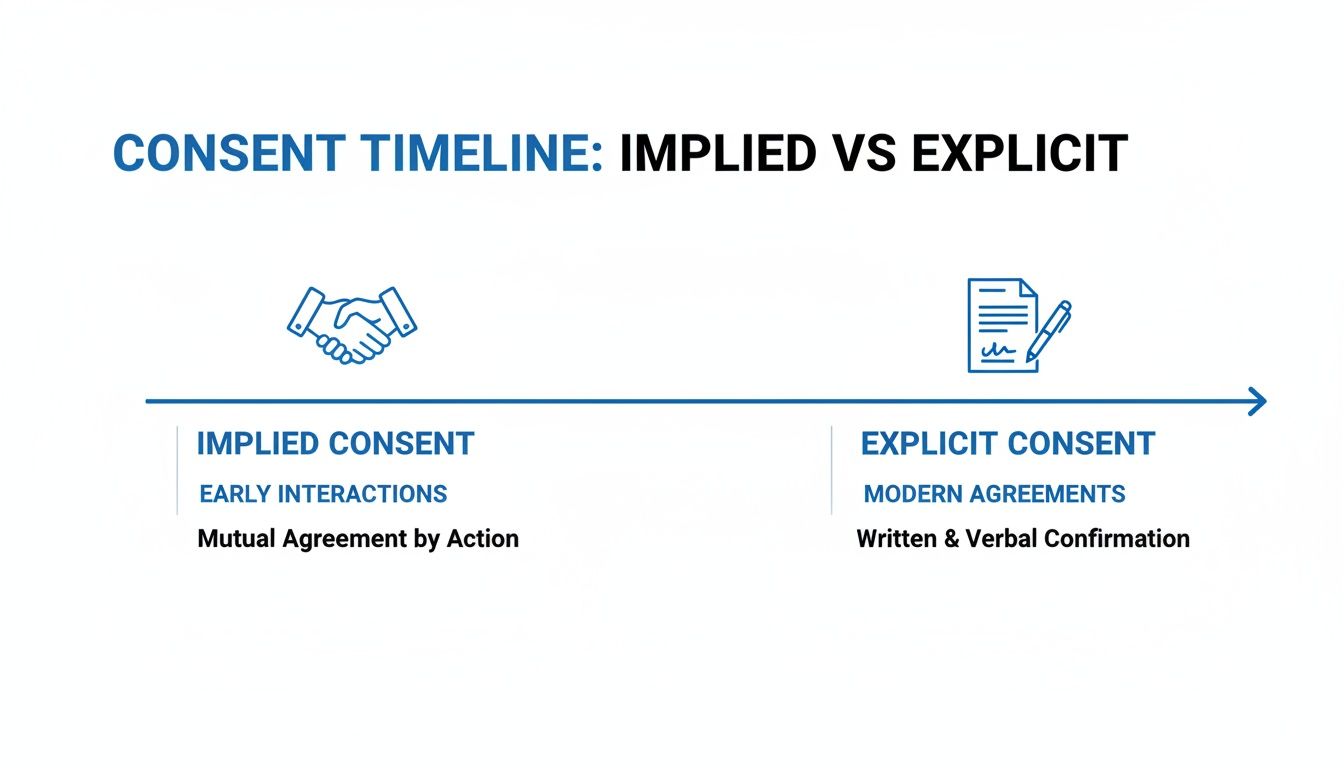
This shift isn't just about legal jargon; it's a fundamental change in how businesses have to approach relationships.
GDPR: The New Global Benchmark
The biggest shake-up arrived in 2018 with the European Union's General Data Protection Regulation (GDPR). GDPR essentially made explicit, provable consent the gold standard for anyone interacting with people in the EU. Vague language and pre-ticked boxes were officially out. Consent now had to be freely given, specific, informed, and unambiguous. You can find a deeper dive into navigating these rules in our guide on https://joinbreaker.ai/blog-posts/gdpr-consent-rules-email-marketing.
This legal evolution hasn't killed email's effectiveness—far from it. Email marketing still delivers an incredible average $36 return for every $1 spent. What has changed are the methods. Pre-GDPR lists built on flimsy implied consent often had dismal engagement. In contrast, post-enforcement campaigns that focused on re-permissioning successfully won back 30% of lapsed subscribers by earning their trust.
Understanding these legal shifts and how data is protected, as we detail in our privacy policy, is mission-critical. This isn't just about dodging fines anymore. It's about building the trust that forms the bedrock of strong, lasting customer relationships today.
Real-World Examples of Implied Consent
Implied consent isn’t some abstract legal term—it’s woven into the fabric of our daily interactions. Think about going to a coffee shop and holding out your credit card. You don't say, "I consent to this transaction." Your action does the talking.
This unspoken agreement is the heart of implied consent. But while it works for buying coffee, applying that same logic to marketing is a huge mistake. To see why, let's look at a few places where implied consent is used correctly—and why those scenarios are nothing like B2B marketing.
Consent in Healthcare and Daily Life
In a medical emergency, implied consent can be a literal lifesaver. When an unconscious patient arrives at the ER, doctors treat them under the assumption that any reasonable person would want life-saving care. The consent is implied by the dire situation.
On a more routine level, when you sit in the exam chair and roll up your sleeve for a blood pressure test, your action implies you’re okay with the procedure. No one needs to hand you a form for that.
Even law enforcement relies on it. In many jurisdictions, getting a driver's license means you’ve already given implied consent to a breathalyzer test if an officer suspects you of driving under the influence. Refusing the test has its own set of consequences because the consent was tied to the privilege of driving.
The crucial difference here is that consent is implied for a specific, immediate, and necessary action. It’s a one-time green light, not a permanent pass for all future contact. This is the exact assumption that gets marketers into trouble.
Where Implied Consent Fails in B2B Marketing
In the B2B world, making assumptions about permission is a fast track to compliance penalties and a ruined reputation. Privacy laws like GDPR and CASL are crystal clear: passive actions don't count as consent for ongoing marketing.
Yet, marketers keep making these mistakes. Here are a few common situations where people wrongly assume they have permission:
- Downloading an Ebook: Someone gives you their email for a guide you created. They’ve agreed to that single transaction. They did not sign up for your weekly newsletter, product updates, and sales demos.
- Connecting on LinkedIn: Accepting a connection request is a nod to professional networking. It is absolutely not an invitation to scrape their contact details and dump them into your cold email sequence.
- Purchasing a Contact List: This is the riskiest move of all. The people on these lists have no idea who you are and have given you zero permission—implied or otherwise. Our guide on how to find business email addresses the right way offers a much safer, compliant alternative.
Each of these examples shows a total misunderstanding of what the user intended. Their action had a narrow purpose. Stretching that purpose to justify ongoing marketing isn't just bad practice; it's a violation of trust. This is precisely why explicit, opt-in consent is the only safe and effective way to build a quality audience that actually wants to hear from you.
Purchased lists are where implied consent gets assumed most often. See the GDPR consent rules for purchased email lists for what regulators actually require.
The High Cost of Misunderstanding Consent
Ignoring the modern rules of consent isn’t just bad manners; it’s a direct threat to your bottom line, your technical infrastructure, and the reputation you’ve worked so hard to build. Relying on implied consent is a gamble where the potential payoff is tiny compared to the massive risks.
The most immediate danger is financial. These regulations aren't just suggestions—they have serious teeth. Violating consent rules can lead to fines that can cripple businesses of any size, making the cost of grabbing a few unqualified leads seem like a rounding error.

The Financial Penalties of Non-Compliance
These aren't abstract threats. Under the EU's GDPR, violations have led to a staggering €2.7 billion in fines by 2025, and email-related penalties make up a huge chunk of those cases.
Even in the U.S., the CAN-SPAM Act has allowed the FTC to collect over $50 million since it was introduced. One of the most famous examples? Uber was hit with a $900,000 penalty for ignoring unsubscribe requests. You can explore a full breakdown of the latest email compliance regulations to see how these penalties are applied.
Beyond the fines, there’s severe technical damage to think about. When you email people who never explicitly agreed to hear from you, they don't just ignore your message. They hit the spam button.
That single click sends a powerful signal to email providers like Gmail and Outlook that your domain is a source of unwanted mail. As those spam complaints pile up alongside high bounce rates, your sender reputation plummets.
Getting your domain or IP address blacklisted is the technical equivalent of a business getting evicted. Suddenly, none of your emails—not even critical messages to paying customers—can get through. This can cripple your entire communication program overnight.
The Erosion of Brand Trust
Finally, and maybe most importantly, there's the damage to your brand. In B2B, long-term relationships are built on credibility. Sending an unsolicited email is the fastest way to destroy that credibility before you've even had a chance to build it.
Your first interaction with a potential customer sets the tone for everything that follows. When that first touchpoint is an uninvited email, you're not seen as a helpful expert. You're seen as a spammer.
That initial negative impression is incredibly difficult to shake. The message you send is loud and clear:
- You don’t respect their privacy: You took their information without clear permission.
- Your outreach is impersonal: You are just another number on a mass-email list.
- Your brand is untrustworthy: You are willing to bend the rules for your own gain.
In a competitive market, prospects have countless other vendors to choose from—vendors who approached them with respect. The fleeting hope of landing one lead from a non-consented list is never worth sacrificing the trust that underpins sustainable business growth. The cost is simply too high.
Why Explicit Consent Is Your Greatest Growth Strategy
Most people think getting explicit consent is just about staying out of legal hot water. It is, but that’s only half the story. The real secret is that it's one of the best growth strategies you can have.
Think about it this way: every single person on a list built with explicit consent has raised their hand and said, "Yes, I want to hear from you." You're not talking to a list of ambivalent names; you're speaking directly to an audience of genuinely interested prospects.
This foundation of willing participants is where the magic happens. Your open rates, click-through rates, and conversions all climb because you're communicating with people who are actually invested. This positive activity sends a clear signal to email providers like Gmail and Outlook that you're a trusted sender, dramatically improving your deliverability and keeping your messages in the inbox where they belong.
Better Data and Higher ROI
Beyond just engagement, explicit consent helps you build a goldmine of high-quality, first-party data. When someone willingly signs up, you've opened a direct line of communication. This lets you gather more information over time, paving the way for powerful segmentation and hyper-relevant messaging that truly resonates and drives conversions.
Ultimately, it all comes down to a much higher return on investment. Instead of burning resources on contacts who will never convert, you get to focus your efforts on a smaller, more potent audience that delivers real business results.
The old model of list building was a numbers game—bigger was always better. The new model is a quality game. A list of 1,000 engaged, opted-in subscribers is infinitely more valuable than a list of 50,000 unconsented contacts who mark you as spam.
This isn't just theory; the industry data proves it. As marketers have moved away from unreliable open rates, we've seen a 21% year-over-year rise in click-to-open rates (CTOR). In stark contrast, broad campaigns using implied consent now risk bounce rates over 4.34% and unsubscribes around 0.52%. Meanwhile, confirmation methods like double opt-in can slash these negative metrics by 70%. Even better, they drive 320% more revenue from automated emails that make up just 2% of volume but generate a staggering 37% of sales. You can dig into more numbers by reviewing these compelling email statistics.
A Strategic Advantage for B2B Growth
Making the switch to explicit consent is far more than a compliance chore. It’s a strategic move that sets your brand up for long-term, sustainable growth. By putting trust and transparency first, you build stronger relationships from the very first touchpoint—a perfect fit for modern B2B marketing, where credibility is your most valuable currency.
This is where tools designed for this new era are essential. Platforms like Breaker, with its integrated TruSend deliverability management, help you capitalize on a high-quality, fully consented audience. By automating compliance and putting list quality front and center, you can turn your email program from a potential liability into your most powerful growth engine. You'll build a loyal subscriber base that fuels reliable lead generation and, most importantly, revenue.
Building a Compliant and High-Growth Email Strategy
It’s time to move past the murky, high-risk world of implied consent. Building a powerful, compliant email program isn't just about dodging fines; it’s about laying a foundation for sustainable growth built on genuine trust. This roadmap is your guide to swapping risky assumptions for provable, permission-based marketing.
First things first: you need to audit your current contact lists. Go through them and segment anyone who lacks a clear, documented record of consent. These contacts are a major compliance risk and should be pulled from your active campaigns immediately. You can always try to win them back with a re-engagement campaign later, but for now, they need to be sidelined.
Once that's done, it's time to make sure every new subscriber is collected the right way.
Implementing a Bulletproof Consent Process
Make double opt-in your standard for every single new signup. This simple two-step process—where a user signs up and then confirms their email—gives you an undeniable record of explicit consent. It’s your best defense. You can learn more about crafting effective opt-in forms that improve both compliance and conversions in our dedicated guide. https://joinbreaker.ai/blog-posts/opt-in-forms
You also need to use crystal-clear language on all your subscription forms. Tell people exactly what they're signing up for, how often you'll be in touch, and what kind of content they can expect. And a comprehensive privacy policy that clearly outlines your data and consent practices isn't optional—it's non-negotiable for any serious email strategy.
Finally, get a solid system in place for keeping meticulous consent records. This documentation is your proof of compliance if an auditor ever comes knocking.
Your goal is to shift your mindset from "Can I email this person?" to "Does this person want me to email them?" This change is the key to unlocking higher engagement, better deliverability, and a stronger brand reputation.
Breaker is built to make this transition seamless. The platform’s built-in data hygiene tools and TruSend deliverability management automate compliance so you can get back to focusing on what really matters: growth. When you build your marketing on a foundation of trust and real results, you create a powerful, predictable engine for generating leads and revenue.
Frequently Asked Questions
Consent is a tricky subject, and a few common questions pop up time and time again for marketers. Let’s clear up some of the most persistent gray areas around implied consent so you can move forward confidently.
Can I Email Someone Who Gave Me Their Business Card?
This is the classic conference scenario, isn't it? While it feels like a green light, modern privacy laws like GDPR see it differently. A business card implies interest in a one-on-one connection, but it does not count as explicit consent for your marketing newsletter.
The safest move? Send a single, personal follow-up. Mention where you met and invite them to subscribe to your list with a clear opt-in link. That way, you get documented consent and start the relationship on the right foot.
What Is Soft Opt-In and How Is It Different?
Soft opt-in is a very specific exception carved out in laws like GDPR and the CAN-SPAM Act. It's not a free-for-all. It only allows you to market similar products to existing customers who gave you their email during a sale.
Crucially, you must have given them a clear way to opt out at the time of purchase and include an easy opt-out in every message you send afterward. It's much narrower than general implied consent because it demands a prior commercial relationship.
Key Takeaway: Unlike broad implied consent, a soft opt-in is tied to an existing customer relationship and requires a clear opt-out opportunity at the point of collection and in every subsequent communication.
Do I Need to Worry About GDPR if My Business Is in the US?
Yes, absolutely. GDPR isn't about where your business is located; it’s about whose data you're processing. If you have a website that can attract subscribers from anywhere in the EU, you have to be GDPR-compliant.
Given how global business is today, trying to segment your audience by region is a compliance nightmare waiting to happen. The smartest, safest approach is to adopt the highest standard—explicit consent—for everyone. It keeps you compliant everywhere and builds more trust with your audience.
Turn your newsletter into a reliable engine for lead generation and revenue. With Breaker, you can build a fully-compliant email list of high-intent subscribers and manage your campaigns all in one place. Start your 7-day trial of Breaker today.
Keep reading
All articles7 Email Platforms With Inbox Placement Testing & Suppression
Compare 7 email platforms that combine inbox placement testing with suppression management, scored on features, pricing, and best-fit sender size.
Email Automation Workflow & Drip Campaign Data Structure
Learn the database schema behind email drip campaigns—tables, workflow states, and event logs that power reliable marketing automation.
Breaker Review: AI-Native ESP for Newsletter Growth
An unbiased Breaker review: pricing, features, deliverability data, and who this AI-native email platform fits best for newsletter growth.