
Email Ads Cost: A 2026 Marketer's Budget Guide
Confused by email ads cost? Our 2026 guide breaks down pricing for sponsored newsletters, CPM rates, and software. Learn to calculate your true ROI and budget.
You're probably looking at a budget sheet with three different email proposals on it and none of them line up.
One vendor quotes a sponsorship price. Another talks in CPM. Your email platform looks cheap until you add design, copy, reporting, and list growth. Then an agency says they can “handle everything,” but the monthly retainer is bigger than the sending software, and you still can't tell what your actual acquisition cost will be.
That is the central problem with email ads cost. Most pricing conversations start with media cost and stop there. They do not include list quality, internal labor, creative production, deliverability risk, or what happens when cheap distribution brings in the wrong people.
A good budget for email advertising doesn't start with “What does placement cost?” It starts with “What are we buying?” Reach is one answer. Attention is better. Qualified subscribers and pipeline are better still.
Why Email Advertising Still Delivers Unbeatable ROI
Email gets messy at the budgeting stage because it sits in two categories at once. It can act like paid media when you sponsor someone else's newsletter. It can act like owned media when you build your own list. It can also look deceptively inexpensive because the send itself is rarely the expensive part.
That confusion causes teams to underinvest, overpay, or compare the wrong things.
The reason it's worth sorting out is simple. Email marketing returns an average of $36 to $42 for every $1 spent, which translates to 3,500 to 4,200 percent ROI, according to 2025 email marketing ROI benchmarks. Few channels give you that margin for error.
Why this matters to budget owners
If you're a fractional CMO, growth lead, or agency operator, you're not trying to buy impressions for their own sake. You're trying to buy efficient outcomes. Email still matters because it can produce those outcomes without forcing you into constant bid competition the way many paid channels do.
That doesn't mean every email buy is smart. It means the channel deserves disciplined planning.
Practical rule: Don't ask whether email is cheap. Ask whether the way you're buying email creates durable value after the campaign ends.
There's another reason email deserves closer scrutiny. The strongest operators don't judge it only by open and click trends. They judge it by subscriber quality, lead progression, revenue influence, and the speed at which they can correct weak campaigns. If you need a clean framework for that, this agency guide to email analytics roi is useful because it pushes the conversation beyond surface metrics.
The upside is real, but only when cost is measured correctly
Teams get into trouble when they compare a low sponsorship fee to a high list-building cost and assume the sponsorship is the more efficient option. Sometimes it is. Sometimes it isn't. The difference usually shows up later in sales acceptance, engagement quality, and follow-up conversion.
Here's the bottom-line view I use with clients:
- Cheap reach isn't the same as efficient acquisition
- A higher upfront cost can still be the lower total cost
- Owned audience growth usually improves your economics over time
- Bad list quality inflates every downstream cost
If email is one of the highest-return channels in your mix, then understanding its real cost structure isn't a finance exercise. It's a growth decision.
The Three Main Email Ad Cost Models
A team sees a low sponsorship quote and assumes it found the cheapest path into email advertising. Six weeks later, sales is chasing weak leads, the follow-up sequence is underperforming, and the total acquisition cost is higher than it looked on the insertion order.
That gap matters.
Email ad costs usually fall into three models, and each one shifts where you pay. You can pay for access to someone else's audience, pay to build an audience you own, or pay for software and distribution infrastructure that helps you buy inventory at scale. The line item may look lower in one model, but the full cost often shows up later in conversion rates, list quality, creative workload, and how much value remains after the campaign ends.
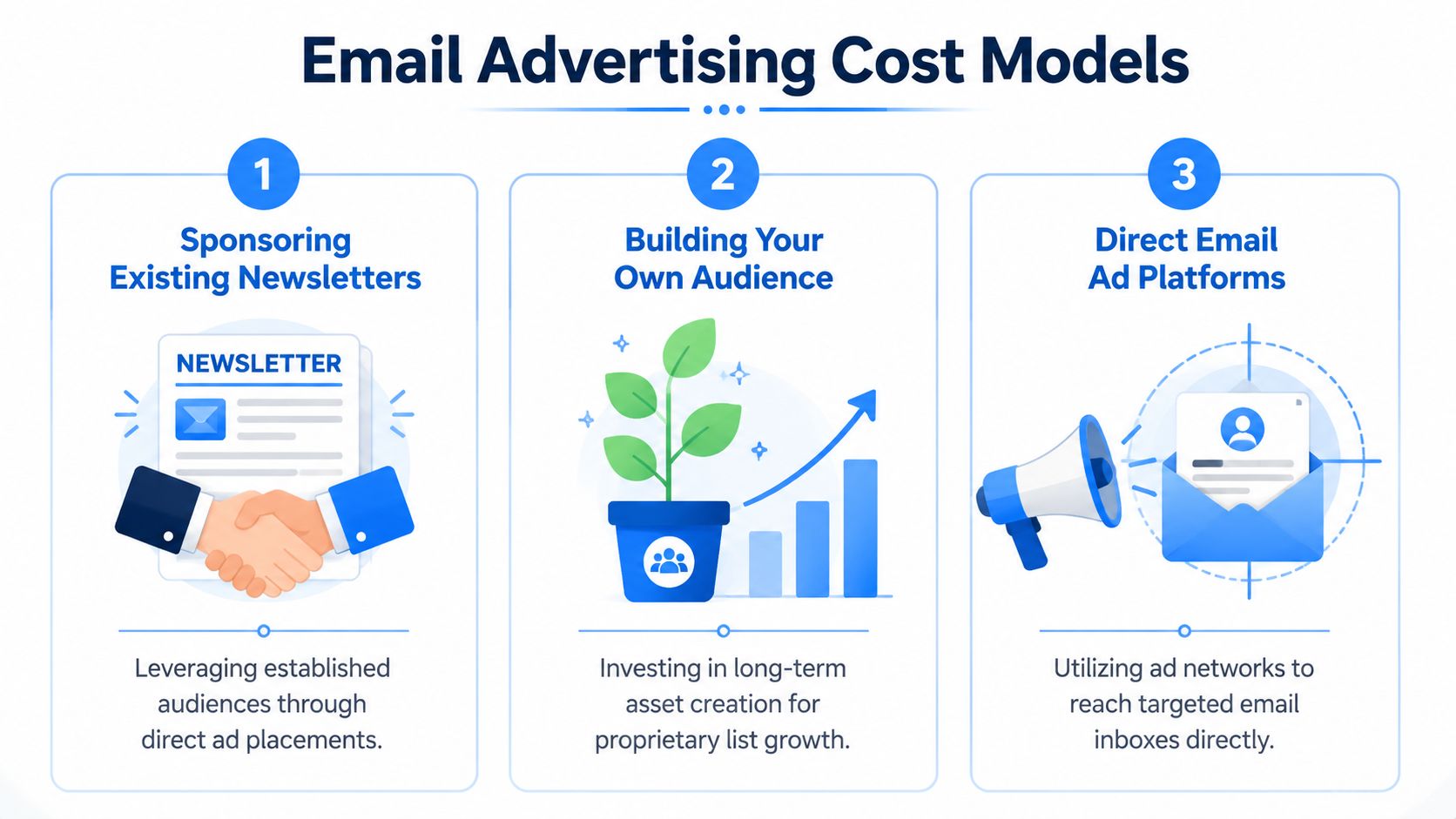
Sponsoring existing newsletters
This model buys access fast. You pay a publisher, creator, or media brand to place your message in an email their audience already trusts.
For a lot of teams, that speed is the point. Sponsorships are useful when you need market feedback quickly, want to test offers before investing in owned audience growth, or need reach in a niche where trust is hard to build from scratch.
The trade-off is control. You do not own the audience, you cannot keep reaching them without paying again, and weak targeting gets expensive fast because there is no residual asset after the send. If you are comparing placements, these newsletter advertising rate benchmarks help frame why two newsletters with similar subscriber counts can be priced very differently.
Building your own audience
This model usually looks expensive upfront because the cost sits in more places. You pay to attract subscribers, convert them, clean the list, create nurture sequences, and keep engagement healthy over time.
That work creates an asset. It also changes the economics.
A subscriber you acquire on your own list can generate value across multiple campaigns, product launches, and retention programs. A bad subscriber does the opposite. Low-intent contacts raise send costs, depress engagement, waste sales follow-up, and distort reporting. That is why the cheapest contact is often the most expensive one to acquire in practice.
I usually tell clients to stop asking, “What did this name cost?” and ask, “What will it cost to turn this name into revenue?” That is the number that matters.
Direct email ad platforms
Platforms and networks sit in the middle. They aggregate newsletter inventory, streamline campaign setup, and reduce the manual work of sourcing placements one by one.
That convenience has value, especially for lean teams or companies testing several audiences at once. It can also create false confidence. Marketplace listings tend to standardize inventory, but newsletter performance is rarely standardized. Two placements with similar pricing can produce very different results based on reader trust, ad position, and post-click alignment.
The platform fee is only part of the cost. You also need someone to judge inventory quality, manage creative testing, and cut underperforming buys quickly.
Email ad cost models at a glance
Cost Model
How It Works
Typical Price Range
Best For
Sponsoring existing newsletters
Pay a publisher to place your ad in their email
Varies by publisher, audience fit, and placement quality
Fast testing, awareness, and lead generation through trusted third-party audiences
Building your own audience
Invest in subscriber acquisition, conversion paths, and email nurture on a list you control
Varies based on acquisition channel, audience quality, and operational overhead
Long-term audience ownership and lower dependence on rented inventory
Direct email ad platforms
Buy placements through a marketplace or network
Varies by platform fees, inventory mix, and campaign volume
Teams that want scale, centralized buying, and faster execution
A low media cost can still produce a high acquisition cost if the audience is weak, the follow-up work is heavy, or the campaign leaves you with nothing you can reuse.
Which model usually fits which team
- Early-stage companies often start with sponsorships when they need speed, signal, and a fast read on message-market fit.
- Demand generation teams with strong content operations usually get better long-term economics from building an owned list.
- Small teams running many tests at once often prefer platforms because operational efficiency matters as much as media price.
The right choice depends on what you are trying to buy. Reach, learning, and audience ownership are different outcomes, and each comes with a different total cost of acquisition.
Decoding Sponsored Newsletter Costs
Sponsored newsletters are where marketers often begin because the transaction feels familiar. You find a publication with your audience, buy a placement, send creative, and wait for traffic or leads.
That simplicity is useful. It's also why weak buys slip through.
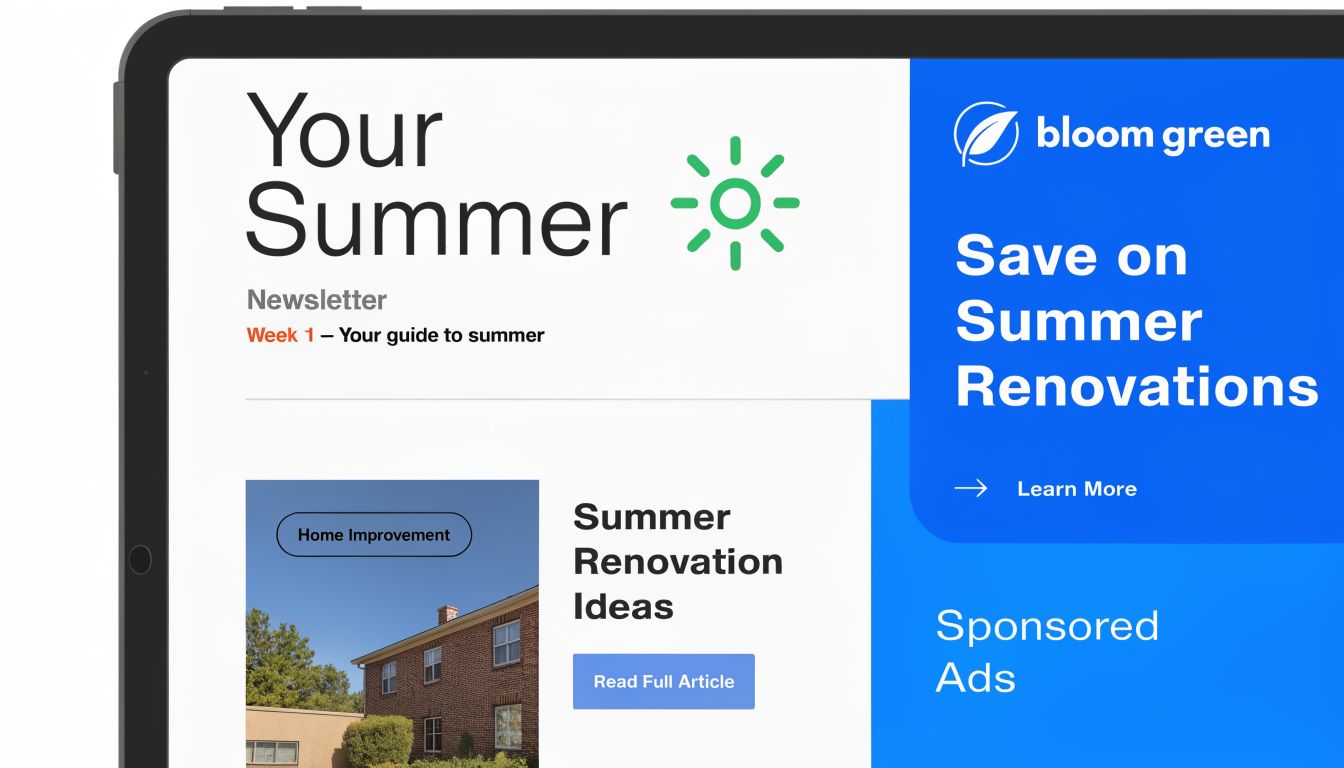
What actually changes the price
The publisher may quote a flat rate, but the primary price driver is the combination of audience fit and placement quality.
A tightly targeted B2B audience with strong trust is usually worth more than a broad list with vague relevance. A dedicated send usually costs more than a small classified placement. A top-of-newsletter placement often carries a premium because more readers see it before dropping off.
When I review sponsorship opportunities, I care less about the sticker price and more about these signals:
- Audience overlap. Does the list match the buyer you sell to?
- Engagement quality. Are readers active and habituated, or is this a stale file?
- Ad format. Is this a native mention, banner block, text placement, or dedicated solo send?
- Landing page alignment. A strong placement can still fail if the click lands on a generic page.
- Publisher transparency. Serious operators can explain who their audience is and how sponsors typically fit.
Questions worth asking before you buy
You don't need a giant diligence checklist. You need a short list of questions that uncover whether the inventory is useful.
Ask the publisher:
- What audience segment receives this issue?
- Is the sponsorship integrated into editorial, sidebar-style, or a dedicated section?
- What types of offers have historically fit the audience best?
- Can I review recent issues to understand ad density and placement style?
- Will the link be tracked in a way that matches my attribution setup?
If you need a market view on pricing logic and packaging, this overview of newsletter ad rates is a good reference point.
A newsletter sponsorship is overpriced when the publisher sells audience size but can't explain buyer intent.
What works and what usually disappoints
Strong sponsorships tend to share three traits. The audience is narrow enough to matter. The ad feels native to the newsletter voice. The offer is simple enough to act on quickly.
Weak sponsorships often fail because the advertiser tries to force direct-response math onto an audience that isn't ready for it. Another common problem is buying a broad business audience when the product really needs a narrow operator, function, or industry persona.
A sponsored newsletter can be a smart spend. But it's rented demand. Treat it like a testable media buy, not a substitute for building an audience you own.
The Cost of Building Your Own Audience
Owning the list changes the economics. Instead of paying for access every time you want attention, you invest once to acquire the subscriber and then keep earning from that relationship over time.
That's why the cost conversation gets more nuanced here. Software is only one part of the bill.

The visible costs
Many businesses prioritize the obvious line items first. They budget for email software, forms, landing pages, maybe a referral tool, and some paid acquisition spend.
Those costs matter, but they're not usually what breaks the economics. Labor and execution discipline do.
A platform can look inexpensive on paper and still become costly if your team can't consistently produce offers, segments, follow-up flows, and reporting. That's one reason some firms hire outside help. Full-service email marketing agencies charge $2,500 to $10,000+ monthly, while small to mid-market organizations often land in the $500 to $3,000 per month range when all components like software and in-house labor are included, according to email marketing pricing and budgeting data.
Paid social is the most common acquisition line item. Our Facebook ads newsletter guide shows what B2B teams typically pay per subscriber.
The hidden costs people miss
Three hidden costs show up constantly in audience-building projects.
Internal production drag
If your strategist writes the brief, a designer builds the asset, someone else loads the email, and no one owns testing or list hygiene, your “cheap” program gets expensive fast. Delay is a cost. Rework is a cost. Inconsistent cadence is a cost.
Weak acquisition sources
Not every subscriber source deserves equal trust. A subscriber from a tightly aligned lead magnet, event partnership, or relevant sponsorship often behaves differently from someone added through low-intent tactics.
That's why I'd rather see a client grow slower with better fit than buy volume that sales won't touch.
Deliverability and compliance overhead
This is the line item many teams ignore until results slip. If you add poor-quality contacts, your future campaigns get harder to land. Even good creative won't save a program that keeps feeding weak contacts into the system.
Build versus buy decision points
Use this lens when deciding whether to build internally or outsource pieces of the work:
- You should build internally when your team already has strong messaging, operational discipline, and the patience to improve over multiple cycles.
- You should use outside support when speed matters, your team lacks specialized email execution skills, or nobody owns the channel end to end.
- You should prioritize audience ownership when newsletters are tied to lead generation, category education, or ongoing account development.
For teams thinking beyond one-off campaigns, this guide to email list building strategies is a useful planning resource.
Buying access can fill next quarter's pipeline. Building an audience can reduce dependence on rented attention altogether.
The mistake is assuming owned audience growth is expensive because the upfront work is larger. In practice, it often becomes cheaper than repeat sponsorship buying once your team can reliably attract and nurture the right subscribers.
How to Calculate Your True Email Ad ROI
The cleanest way to evaluate email ads cost is to stop treating CPM as the verdict.
CPM tells you what access costs. It doesn't tell you whether the campaign brought in qualified attention, usable leads, or revenue-producing subscribers.
Start with total acquisition cost
A practical ROI model should include more than media spend. I use five buckets:
- Media cost
Sponsorship fee, marketplace spend, paid acquisition, or partnership cost.
- Creative and production
Copy, design, landing page work, approvals, and QA.
- Platform and tooling
Sending software, attribution tools, and analytics support.
- Follow-up cost
SDR time, sales review, nurture workflows, and routing work.
- Quality adjustment The part many professionals skip. Ask whether the names acquired are usable.
The core question
The question isn't “What was our CPM?”
It's “What did it cost us to acquire a subscriber, lead, or conversation that the business wanted?”
That's why cheap distribution can be misleading. Many discussions focus on generic CPM rates in the $15 to $30 range, but engaged B2B mailing lists return $36 to $50 per $1 spent, which points to a quality problem rather than an impressions problem, according to this analysis of email advertising cost effectiveness and CPM rates.
A simple framework you can use
Build your reporting sheet around these checkpoints:
- Step one. Add up every campaign cost tied to getting attention.
- Step two. Separate raw responses from qualified responses.
- Step three. Track which source produced subscribers who kept engaging.
- Step four. Compare downstream conversion by source, not just top-of-funnel volume.
- Step five. Decide whether the campaign created a reusable audience asset or only a temporary traffic spike.
If you want a practical worksheet for that process, this marketing ROI calculator guide is a solid starting point.
High CPM and high intent often beat low CPM and low trust.
A real-world way to sanity-check a campaign
Suppose you buy a low-cost placement and it drives clicks, but most signups never engage again. On paper, the media buy looked efficient. In reality, your team still paid to create the asset, route responses, maintain those names, and explain weak lead quality to sales.
Now compare that with a more expensive placement or acquisition source that produces fewer names but better fit. Even before revenue closes, you can often see the difference in engagement depth, follow-up responsiveness, and sales acceptance.
A strong email program should also connect the first touch to the message that comes next. If your acquisition source is working but your follow-up is weak, you won't see the payoff. That's where message quality matters. For outbound and nurture sequence inspiration, these proven B2B cold email scripts are useful for pressure-testing whether the handoff from acquisition to conversion is tight enough.
Here's a short explainer worth sharing internally when finance or sales wants the simplified version:
The point isn't that every expensive subscriber is good. It's that quality-adjusted acquisition cost is the metric that protects your budget from false efficiency.
Common Questions About Email Ad Costs
How much should you budget to start
A workable starting budget covers more than the send.
It needs to fund the placement or list growth, the landing page, creative, tracking, follow-up, and enough time to judge lead quality after the click. If you only budget for media, you will underestimate email ads cost and overestimate ROI.
For a first test, I usually want enough spend to compare outcomes, not just collect a handful of clicks and call it a lesson. Small tests are fine. Underpowered tests usually create false negatives.
Is email still more cost-effective than paid ads
Often, yes. Email can produce lower acquisition costs than paid social or search because you are not paying an auction price for every next impression or click.
But cost-effective does not mean cheap. A newsletter sponsorship with a higher CPM can still beat a lower-cost channel if the audience trusts the publisher, the offer matches the reader, and the leads keep engaging after signup. That is the difference between media cost and total acquisition cost.
Should you hire an agency or run it in-house
Choose based on execution risk.
Keep it in-house if your team can own targeting, copy, design, QA, analytics, and follow-up without the work stalling between departments. Bring in outside help when your team is stretched, when a campaign's failure would have significant business consequences, or when nobody can carry the program from planning through reporting.
A lot of companies do not need a large agency retainer. They need a senior operator who can tighten audience selection, fix weak offers, and set up reporting that sales will respect.
How do you vet newsletter sponsorship opportunities
Use a short operating checklist:
- Check audience fit first. Reach matters less than reaching the right buyers.
- Review recent issues. Look at tone, ad load, placement, and whether sponsors feel native or ignored.
- Ask about segmentation. A smaller send to the right slice of the list often outperforms a broad blast.
- Match the offer to reader intent. Readers respond better when the CTA fits why they subscribed.
- Measure what happens after signup. Good clicks that turn into poor leads are still expensive.
Are cheap bulk lists ever worth it
Usually not.
Inexpensive lists often appear efficient because the initial cost is low. The true expense surfaces later through poor deliverability, weak reply rates, extra SDR follow-up, lower sales trust, and a database full of names that never should have entered your system. If you buy 10,000 contacts and only a small fraction are usable, the low CPM was irrelevant.
Paying more for engaged, permission-based subscribers is often the cheaper path once you account for conversion quality and team time.
What's the best way to compare two email opportunities
Run both through the same business filter:
- What are we paying for besides access?
- Who are we reaching, specifically?
- What conversion path follows the click?
- Will this create an owned audience we can market to again?
- Will sales accept these leads as worth pursuing?
If one option is cheaper on paper but creates lower-quality names, slower pipeline movement, or more cleanup work, it is not the lower-cost option. It just had a lower purchase price.
What usually improves results fastest
Three things tend to improve performance first:
- Tighter audience selection
- A more specific offer
- Better follow-up after acquisition
Email campaigns rarely fail because the channel stopped working. They fail because the team bought attention without a clear plan for converting it.
If you want to turn a newsletter into a reliable acquisition channel instead of another manual marketing project, Breaker is worth a look. It combines email sending with B2B list growth, real-time analytics, and deliverability support, which makes it easier to pay for engaged subscriber growth instead of guessing your way through disconnected tools and rented attention.
Keep reading
All articlesBreaker for B2B, SME and Consumer Newsletter Senders
Learn how B2B, SME, and consumer audiences differ in newsletters, plus a framework for segmenting, messaging, and monetizing each without losing relevance.
What Is a B2B Content Engine
Learn what a B2B content engine is, how it differs from a content calendar or strategy, and why it's essential for AI-driven search in 2026.
8 Best Email Tracking Software Tools in 2026
Compare 8 top email tracking tools for 2026, how tracking pixels work, and why Apple's privacy rules make open rates unreliable. See our top pick.