
Affiliate Marketing Emails: A Guide to Driving Revenue
Learn how to craft affiliate marketing emails that convert. This guide covers strategy, examples, templates, and deliverability to help you drive revenue.
You already have the hard part. An audience that opens your newsletter, reads your ideas, and trusts your recommendations.
What usually stalls monetization is the middle layer. You might have sponsorships that come and go. You might sell your own product, but only to a slice of the list. You might mention tools you already use and still have no repeatable system for turning those mentions into revenue. That's where affiliate marketing emails stop being a side tactic and start acting like infrastructure.
The teams that treat affiliate email as a system tend to outperform the ones that send one-off promos whenever a partner asks. Experienced affiliate marketers keep coming back to email for a reason. 41.9% of affiliate marketers with over a decade of experience identify email as their primary source of traffic, according to Canada Create's 2025 affiliate marketing statistics roundup. That tracks with what most operators learn the long way. Social reach fluctuates. Search takes time. Paid acquisition gets expensive fast. Email gives you a direct line to people who already know why you're worth listening to. For the B2B newsletter angle specifically, see our guide to affiliate marketing email marketing.
If you're running a B2B newsletter, this matters even more. The reader relationship is already built around advice, tools, workflows, and vendor decisions. You don't need to bolt monetization onto that. You need to structure it. If you're weighing affiliate income against sponsorships, newsletter ad rate benchmarks are useful context, but the bigger upside is control. Affiliate marketing emails can keep earning after send day if you build the right sequences, segmentation, and reporting around them.
Your Newsletter Is a Revenue Engine Waiting to Start
Most newsletters leave money on the table in predictable ways.
They publish useful content, mention products casually, and hope readers connect the dots. Or they swing the other direction and blast promotions that feel disconnected from the reason people subscribed in the first place. Both approaches underperform. One is too passive. The other burns trust.
Affiliate marketing emails work best when you stop thinking in terms of campaigns and start thinking in terms of a revenue engine. That engine has inputs: audience insight, product fit, segmentation, sequencing, and deliverability. It has outputs too: clicks, partner revenue, renewal advantage, and better knowledge of what your subscribers buy.
What changes when you treat it like a system
A system does three things that ad hoc sends never do:
- It matches offers to audience intent: A RevOps subscriber doesn't need the same recommendation as a founder or a demand gen consultant.
- It creates repeatable paths to conversion: Welcome emails, educational sequences, review emails, and timed promos each have a job.
- It protects trust while monetizing it: You aren't forcing a pitch into every send. You're building a pattern readers can rely on.
Practical rule: If a subscriber can't explain why a product showed up in your email, the problem is usually strategy, not copy.
That's the opportunity sitting inside most B2B newsletters right now. You already have distribution. The missing piece is architecture.
What Are Affiliate Marketing Emails and Why They Work
A subscriber opens your email because they expect a useful answer, not another generic promotion. Affiliate marketing emails work when the recommendation arrives inside that expected context. The product fits the problem the reader is already trying to solve, and the affiliate link is how the referral gets tracked.
Affiliate marketing emails are messages that recommend a product or service with a unique link that credits you when a reader buys, books, or signs up. In B2B, the better definition is narrower. They are trust-based recommendation emails tied to a specific workflow, role, or buying stage.

That distinction matters.
A broad consumer-style affiliate blast can survive on impulse. A B2B affiliate email usually cannot. The buyer has a budget owner, internal approvals, existing tools, and a real implementation cost. Good affiliate emails reduce that friction by explaining fit, trade-offs, and expected outcome before the click.
What these emails actually do
Strong affiliate emails translate software features into business use cases. They help a RevOps lead decide whether a tool is worth a demo, help a founder compare operational overhead across vendors, or help an agency buyer choose something they can roll out across client accounts.
For a B2B audience, that usually shows up in a few reliable formats:
Email type
Best use
Reader expectation
Curated recommendation
Newsletter editions, tool roundups
“Filter the market for me”
Dedicated promo
Launches, partner campaigns, deadline offers
“Explain why I should care now”
Educational email with embedded offer
Tutorials, workflows, operational playbooks
“Help me solve the problem, then show me the tool”
Review or teardown
Deep evaluation of a platform
“Give me the strengths, limitations, and who it fits”
The inbox gives you control over framing. You can define the problem, qualify who the offer is for, disclose the relationship clearly, and send different versions to different segments. That matters more in affiliate programs with multiple offers, where a demand gen operator, sales leader, and solo consultant should not get the same pitch.
For teams mapping offers to CRM and lifecycle stages, this Salesforce email marketing guide for RevOps is a useful reference for how segmentation and automation support better message-to-offer alignment.
Why they work better than many teams expect
Email performs well for affiliate offers because intent is already present. Subscribers joined for a reason. If your newsletter consistently teaches operators how to improve pipeline reporting, lead routing, or campaign execution, a recommendation tied to one of those jobs feels relevant.
There is also a practical advantage over social and paid channels. Email gives you owned distribution and cleaner feedback loops. You can see which segment clicked, which topic drove action, which partner converted, and which recommendations only created curiosity without revenue.
That insight compounds when you run a multi-offer program. Instead of asking, “Did this promotion work?”, the better question is, “Which offer works for which segment, at which point in the subscriber journey?” That is how affiliate email starts acting like a system instead of a side tactic.
Platforms built for audience monetization help here. Breaker, for example, is useful when you need to manage multiple affiliate offers, package sponsorship and partner placements alongside newsletter sends, and keep monetization tied to audience segments rather than random one-off promotions.
The trade-offs you need to respect
Affiliate email is straightforward to launch and easy to weaken.
The common failure points are predictable:
- Trust erosion: Recommendations fall flat when the sender has not tested the product, checked the onboarding experience, or understood the actual buyer.
- Segment mismatch: A high-ticket ops tool sent to early-stage founders or freelancers will drag down clicks and train readers to ignore future offers.
- Compliance gaps: Affiliate relationships need plain disclosure near the recommendation.
- Reputation risk: Aggressive promotion patterns can hurt engagement and, over time, inbox placement.
Strong programs treat each send as both a revenue event and a sender reputation event. That is especially true for affiliates promoting multiple partners from the same domain. One poorly targeted promo does not just lower conversion on that campaign. It can make the next offer harder to place in the inbox.
The standard is simple. Recommend products you would stand behind without a commission, explain who the product is for, and disclose the relationship in plain language. That keeps the email credible, which is why affiliate marketing emails work in the first place.
Developing Your Affiliate Email Strategy
Most affiliate email programs fail before the first send. Not because the copy is weak, but because the strategy is missing.
If you pick offers based on payout alone, your emails will start sounding like someone else rented your list. If you chase every partnership opportunity, you'll lose thematic consistency fast. Good affiliate marketing emails come from a clear recommendation policy. Readers should be able to tell what kind of products you endorse and why.
The 80 20 rule is not optional
A value-first ratio keeps the list healthy. The common rule is simple. 80% of emails provide value and 20% are promotional, and that balance matters because 45.6% of emails were marked as spam in 2023 due to promotional overload, according to Emercury's guide to affiliate email sequences.
That doesn't mean counting every send with spreadsheet precision. It means readers should consistently get education, insight, and usable advice that stands on its own. Promotion should feel earned.
How to choose affiliate offers that fit a B2B audience
The fastest way to weaken your newsletter is promoting tools that solve trivial problems or create new ones.
Use a simple vetting lens:
- Audience relevance: Does this product solve a problem your subscribers already discuss?
- Workflow fit: Can readers implement it without changing their entire stack?
- Credibility: Have you used it, tested it, or seen it in real buyer workflows?
- Sales experience: Is the landing page clear, fast, and consistent with your recommendation?
- Partner quality: Can you trust tracking, reporting, and payout communication?
If you run a RevOps or GTM newsletter, product fit often matters more than commission structure. A smaller payout on a tightly aligned tool is usually better than a higher payout on a product your audience will ignore.
Build a recommendation policy before you write copy
Write down what you will and won't promote. That single step removes a lot of bad decisions later.
A practical policy often includes:
- Only promote tools within your editorial territory.
- Decline products you can't explain in plain language.
- Avoid stacking competing offers too closely unless you're doing a deliberate comparison.
- Require a real user journey before recommending anything expensive or high-commitment.
If your team also owns lifecycle and RevOps, a strong companion read is this Salesforce email marketing guide for RevOps. It's useful for thinking through how email operations, targeting, and reporting connect when affiliate campaigns sit inside a broader revenue motion.
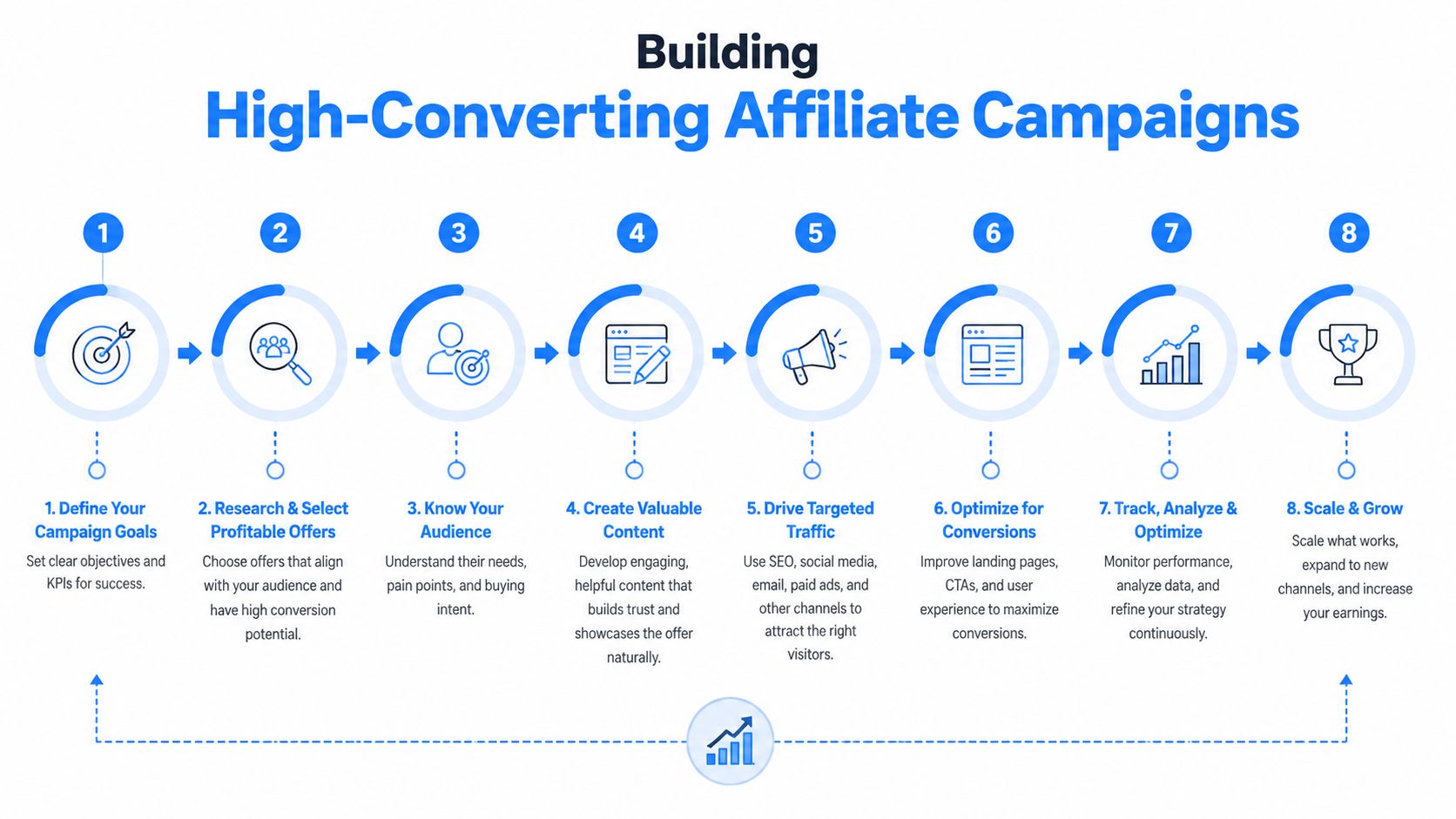
Building High-Converting Affiliate Campaigns
Most advice about affiliate marketing emails stops at list building. That's too early in the process.
Important work starts after the subscriber joins. You need a way to route different people toward different offers without turning the newsletter into a cluttered marketplace. That's where segmentation becomes the engine.
Segment for product affinity, not just engagement
Open rate alone won't tell you what someone wants to buy. Segment around likely purchase intent instead.
Research shows niche-focused affiliates have 3-5x higher conversion rates, as highlighted in LinkJolt's discussion of super affiliate positioning. That matters because broad newsletters often underperform not from lack of interest, but from lack of specificity.
Useful segmentation models for multi-offer affiliate programs include:
- Product affinity segments: Subscribers who click content about analytics tools should not get the same offers as people who click hiring software content.
- Lifecycle stage segments: New subscribers often need educational emails first. Long-time readers can handle more direct review and comparison content.
- Role-based segments: A consultant, a founder, and a demand gen leader read the same tool through different lenses.
- Behavior-based segments: Someone who clicked a tool comparison last month is a stronger candidate for a follow-up offer than someone who only opens industry commentary.
Structure campaigns around one buying job
One email should focus on one decision. Not three.
If you want the reader to act, build the message around a single buying job. For example:
Campaign angle
Email promise
Good affiliate fit
Save time
“Here's how to remove manual reporting work”
Automation, reporting, workflow tools
Improve output quality
“How to ship cleaner campaigns”
QA, enrichment, email, analytics tools
Reduce evaluation risk
“What to check before you switch vendors”
Comparison, review, implementation-focused tools
Many affiliate sends fail at this stage. They ask the reader to care about the product before they've framed the job.
Start with the friction the reader already feels. Then show the product as the shortest believable path to resolving it.
Write copy that sounds like guidance, not an ad
For dedicated promo emails, a simple problem-solution arc works well. For softer pitches, use the product as supporting evidence inside a useful lesson.
A few practices hold up consistently:
- Lead with a specific problem: “Teams often don't need more leads. They need cleaner routing and follow-up.”
- Use one core CTA: Multiple competing asks dilute intent.
- Avoid spammy urgency language: If there's real urgency, explain it plainly.
- Make the recommendation falsifiable: Mention who the tool is for and who should skip it.
If you want another perspective on how programs are evolving, this 2026 affiliate marketing strategy is useful as a directional read, especially for thinking about how creators and operators package recommendations more intentionally.
Affiliate Email Examples and Templates You Can Use Today
Templates help when they preserve judgment, not replace it. The best affiliate marketing emails still sound like a person with standards wrote them.
Use the templates below as starting points. Adapt the language to your audience, your product category, and your editorial voice.

The dedicated promo email
This format works when the offer is timely and tightly aligned.
Subject: The tool I'd use if I had to fix [problem] this week
Body:
Most teams hit the same wall with [problem]. The work gets messy, reporting slows down, or the handoff breaks.
I've been looking at tools that solve this without adding another layer of admin. [Product] stands out for one reason. It helps with [specific outcome] in a way that's practical for [audience].
I'd look at it if you need:
- [Use case one]
- [Use case two]
- [Use case three]
I wouldn't use it if your main issue is [mismatch].
If you want to evaluate it, here's the link: [affiliate link]
Disclosure: I may earn a commission if you sign up through this link.
Why it works: It narrows the audience, sets expectations, and avoids universal claims. The “who should skip it” line builds trust fast.
The value-add email with a soft pitch
This is the safest format for ongoing monetization because the email delivers value even if nobody clicks.
Subject: A cleaner way to handle [workflow]
Body:
If you're dealing with [workflow problem], start here:
1. Remove the manual step that creates the most delay.
2. Standardize the handoff between teams.
3. Track one success signal instead of ten noisy ones.
I've seen teams get stuck on step two because the tooling doesn't support the workflow they want. That's where [Product] can help. It's useful when you need [specific capability].
If you want to see how it works, take a look here: [affiliate link]
Either way, the key is keeping the process simple enough that the team actually uses it.
Why it works: The product appears as part of the solution, not the whole email. That's easier on the reader and better for long-term list health.
The review email
Use this when the buying decision is heavier and readers need judgment more than hype.
Subject: My take on [Product] for [use case]
Body:
I spent time reviewing [Product] for teams that need [job to be done].
What I like:
- [Strength]
- [Strength]
Where I'd be careful:
- [Limitation]
- [Limitation]
Best fit: [specific audience]
Poor fit: [specific audience]
If you're comparing options and want to evaluate it directly, here's the link: [affiliate link]
Disclosure: This is an affiliate link, which means I may earn a commission if you buy.
Why it works: Reviews give readers a decision framework. They also let you qualify traffic before the click, which usually improves downstream conversion quality.
For more swipeable approaches, proven affiliate marketing email strategies from LinkJolt are worth browsing alongside a solid library of email newsletter templates. The first gives you angle ideas. The second helps when you want tighter structure without flattening your voice.
Measuring and Optimizing Your Campaign Performance
Affiliate email programs get better when you treat every send as feedback.
A lot of teams stop at opens. That's not enough. Opens tell you whether the subject line earned attention. They don't tell you whether the body delivered on that promise or whether the offer was compelling.
The metric that exposes weak positioning
For affiliate emails, CTR is calculated as (Unique Clicks / Emails Opened), and the industry benchmark is 3%, according to ClickBank's affiliate email metrics guide. If your campaign falls below that, one common issue is a mismatch between the subject line and the actual content.
That mismatch matters for more than performance. It can also hurt sender reputation because readers stop trusting that your emails deliver what the inbox preview implied.
What to monitor on every affiliate campaign
Use a compact reporting view. You don't need a giant dashboard to spot the problem.
Track these metrics together:
Metric
What it tells you
Common failure signal
Open rate
Subject line and list relevance
Opens are low across similar segments
CTR
Offer-message alignment
Readers open but don't click
Conversion rate
Landing page and offer fit
Clicks happen, but partner action stalls
EPC
Revenue efficiency per click
Click volume looks good, revenue does not
EPC matters because it keeps you from celebrating low-quality traffic. Some emails generate curiosity clicks. Others generate buying clicks. Treat those as different outcomes.
A practical optimization loop
When a campaign underperforms, don't rewrite everything. Diagnose in order.
- Check subject to body alignment. If the email opened well but CTR lagged, the promise may have been stronger than the content.
- Review segmentation. A decent offer sent to the wrong cohort often looks like a copy problem.
- Simplify the CTA. Too many links or too many directions creates hesitation.
- Inspect the landing experience. If the partner page is weak, your email can only do so much.
If readers click educational emails but ignore dedicated promos, the lesson usually isn't “stop promoting.” It's “your audience wants the product framed inside a workflow.”
A solid companion resource here is this guide to email campaign performance metrics. It's useful when you want a tighter measurement discipline across editorial, monetization, and lifecycle sends.
Ensuring Deliverability for Affiliate Promotions
A strong affiliate email can still miss revenue if it lands in Promotions, spam, or nowhere at all.
Deliverability usually breaks at the system level, not at the copy level. Affiliates add more outbound links, more tracking parameters, more launch-day volume, and more repeated commercial language than a standard newsletter send. In a B2B program with multiple offers, those signals stack fast. If you promote different partners to different segments from the same domain without clear controls, one weak campaign can drag down the next three.
Why affiliate sends get filtered more often
Mailbox providers look for patterns. Affiliate sends create a few that deserve close management.
- Repeated promotional phrasing: Similar subject lines, body copy, and CTAs across multiple partner sends make classification easier.
- Messy routing: Link shorteners, redirect hops, mismatched tracking domains, and expired partner URLs increase risk.
- Weak engagement pools: Old contacts and low-intent subscribers lower positive inbox signals.
- Volume spikes: A quiet newsletter that suddenly pushes several promos in one week looks unstable.
- Offer mixing across segments: Sending the same affiliate promotion to operators, executives, and agencies at once usually hurts engagement and reputation together.
That last point gets missed. In B2B affiliate programs, deliverability and segmentation are tied together. A multi-offer program needs separate audience logic for each partner, not one master promo list.
A clean deliverability checklist
Use this before you scale affiliate promotions:
- Authenticate the domain correctly: Set up SPF, DKIM, and DMARC so mailbox providers can verify the mail.
- Separate promotional risk where needed: If affiliate volume is high, use a dedicated subdomain or sending stream instead of pushing everything through the core newsletter identity.
- Keep suppression rules tight: Remove invalid addresses, suppress hard bounces immediately, and reconsider long-inactive contacts before every large promotion.
- Control link behavior: Use clean destination URLs, limit redirect chains, and keep tracking domains consistent.
- Warm volume gradually: Increase promotional sends in steps, especially after adding a new offer category or segment.
- Reduce template noise: Plain layouts, one clear CTA, and fewer competing links usually age better than heavily designed promo emails.
- Match offers to segment intent: Send CRM offers to revenue teams, hiring tools to talent leaders, and finance products to operators who can act on them.
Tools matter here. Breaker helps by making segmentation and campaign orchestration easier to control across different audience cohorts, which reduces the temptation to blast the same affiliate promotion to the whole list.
Protect the sender, not just the campaign
Sender reputation is an asset. Treat it that way.
A bad affiliate send does not stay isolated. It can reduce inbox placement for editorial emails, lifecycle sends, sponsor campaigns, and partner launches that follow. I have seen teams blame copy when the actual issue was accumulated reputation damage from loose list rules and inconsistent promo volume.
The fix is discipline. Keep affiliate revenue inside a system with clear segment rules, stable sending behavior, clean links, and a willingness to skip an offer that does not fit the list.
The best affiliate operators protect inbox placement first, because a sender with strong reputation gets more revenue from every campaign that follows.
Frequently Asked Questions About Affiliate Emails
Do I need to disclose affiliate links in every email
Yes. If an email includes an affiliate relationship, disclose it clearly and close to the recommendation.
You don't need a paragraph of legal language. A short sentence in plain English works. The point is that readers shouldn't have to guess whether you may earn a commission from the link.
Is it better to join an affiliate network or build direct partnerships
It depends on what you value more.
Networks are easier when you want fast access to many programs, standard tracking, and less negotiation. Direct partnerships are usually better when you want closer partner communication, stronger creative alignment, and more room to coordinate launches or custom offers.
For B2B newsletters, direct relationships often produce better campaigns because you can learn how the product is sold, who it fits, and what objections buyers have.
How often should I send affiliate marketing emails
There isn't a universal send frequency that works for every list. What matters is consistency, audience expectation, and the ratio between value and promotion.
If your readers signed up for thoughtful operating advice, don't suddenly behave like a daily coupon feed. Keep the promotional cadence aligned with your editorial identity. When in doubt, reduce frequency and improve fit.
What kinds of B2B products work best in affiliate emails
The best products solve expensive, familiar problems. Think software, data tools, workflow platforms, enablement products, and services with a clear business use case.
The weak candidates are products that require too much explanation, don't match your audience's role, or create obvious conflict with your existing recommendations. If you can't explain why a specific segment should care, don't send it.
Can I promote multiple affiliate offers in the same newsletter
You can, but you need strong editorial control.
A curated tools newsletter can handle multiple offers if each recommendation has a clear role and the edition still feels coherent. A standard campaign email usually performs better with one primary offer. Too many choices shift cognitive load onto the reader, and most readers won't do the sorting for you.
What if my platform allows affiliate links but doesn't help with targeting
Then you'll hit a ceiling quickly.
Affiliate revenue depends on sending the right offer to the right segment, measuring click quality, and protecting inbox placement over time. If your platform only lets you broadcast and count opens, you'll end up doing too much manual work and learning too little from each campaign.
If you want to run affiliate marketing emails like a system instead of a side hustle, Breaker is built for that kind of work. You can grow a B2B list, target the right subscribers, monitor clicks and ROI in real time, and keep deliverability healthy without stitching together separate tools. For growth teams, consultants, and newsletter operators who want monetization without sacrificing list quality, it's a practical place to start.
Keep reading
All articlesBreaker for B2B, SME and Consumer Newsletter Senders
Learn how B2B, SME, and consumer audiences differ in newsletters, plus a framework for segmenting, messaging, and monetizing each without losing relevance.
What Is a B2B Content Engine
Learn what a B2B content engine is, how it differs from a content calendar or strategy, and why it's essential for AI-driven search in 2026.
8 Best Email Tracking Software Tools in 2026
Compare 8 top email tracking tools for 2026, how tracking pixels work, and why Apple's privacy rules make open rates unreliable. See our top pick.