
Your B2B Marketing Plan: A Step-by-Step Guide for 2026
Build a B2B marketing plan that drives real growth. This step-by-step guide covers goals, ICP, channels, budget, and measurement for 2026. Includes templates.
Your team probably already has a plan. It's in a slide deck, a spreadsheet, or a project board with labels like SEO, paid, webinars, email, and LinkedIn. The problem isn't that you have no plan. The problem is that the plan doesn't behave like a system.
That shows up in familiar ways. Marketing celebrates lead volume while sales says the leads are weak. Content gets published, but nobody can explain which assets helped a deal move. Buyers mention hearing about you in a Slack group or a forwarded newsletter, but your attribution model gives all the credit to branded search. Everyone is busy, yet the plan still feels brittle.
A useful b2b marketing plan fixes that. It ties goals to revenue, channels to buyer behavior, campaigns to buying committee roles, and reporting to decisions. It also reflects how B2B buying happens now. Not just in forms and dashboards, but in private conversations, internal threads, and backchannel sharing that your CRM won't neatly capture.
Define Your North Star: Setting Goals and Your Ideal Customer Profile
Most bad plans fail before launch. They start with channel tactics instead of business direction. If you don't know what outcome matters most and which accounts are most likely to buy, every campaign becomes an argument about opinions. A quick way to pressure-test that direction is to run your offer through the elements of the marketing mix before you pick channels.
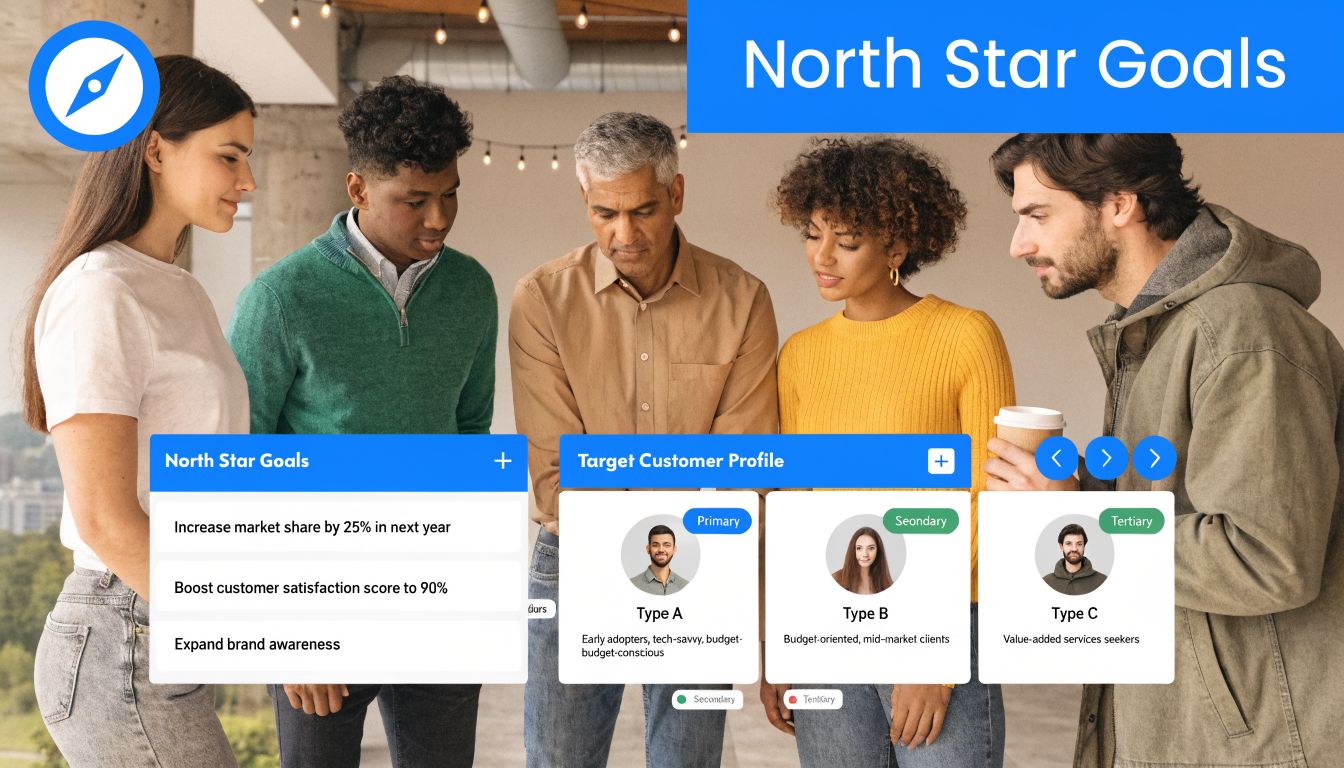
Goals without an ICP are just volume targets. You can hit them and still miss revenue. That's why I start with two linked decisions: the North Star metric and the Ideal Customer Profile.
Start with the business outcome
A North Star metric should reflect progress the company cares about. For one team, that's qualified pipeline. For another, it's product-qualified accounts entering sales conversations. For a services firm, it may be opportunities from named verticals.
If your team needs a structured way to choose that metric, the framework for defining SaaS North Star metrics is a useful reference because it forces you to connect usage, growth, and revenue instead of chasing disconnected channel KPIs.
A good b2b marketing plan usually includes goals in three layers:
- Business goal: Revenue, pipeline, expansion, or market penetration in a segment.
- Marketing goal: Qualified demand generation, account engagement, or sales enablement adoption.
- Operational goal: Publish consistently, improve handoff speed, tighten targeting, or fix reporting gaps.
That structure matters because it keeps your team from setting goals like “increase leads” when the underlying issue is poor fit, weak messaging, or a stalled sales cycle.
Practical rule: If a goal can be achieved by attracting the wrong audience faster, it's a weak goal.
Build the ICP from real signals
Your ICP is not “mid-market SaaS” or “B2B companies with growth challenges.” That's too broad to guide spend, messaging, or prioritization. A real ICP tells your team who to pursue and who to deprioritize.
Use three data types:
- Firmographic data
Industry, company size, geography, business model, and maturity. This narrows the market to companies that can realistically buy and implement your offer.
- Technographic data
What tools they already use, what their stack suggests about sophistication, and whether integration friction will help or hurt adoption.
- Behavioral data
What they read, what pages they visit, what content formats they prefer, which problems trigger urgency, and how they engage before a sales conversation.
Start simple. Review closed won accounts, stalled opportunities, and deals that looked good but went nowhere. Patterns emerge quickly when you compare them side by side. You'll often find one or two segments that convert faster, need less education, or align better with your current product and team.
That's where rigor matters. Startups that fail to define their ICP well often see up to 40% lower conversion rates because campaigns target misaligned leads, according to Zanate Marketing.
Turn the ICP into a planning tool
An ICP is only useful if it changes decisions. It should directly shape:
- Channel selection: where those buyers spend time
- Messaging: what pain points get priority
- Content formats: what helps them evaluate
- Budgeting: which segments deserve more investment
- Sales handoff: what qualifies an account for outreach
For teams refining this work, this guide on what an ideal customer profile is is a solid operational reference because it pushes the concept beyond a vague persona into something you can use in campaign planning.
A sharp ICP also helps you say no. No to adjacent segments that look attractive but drain resources. No to content topics that bring traffic from buyers who won't buy. No to “let's test everything” thinking that creates motion without progress.
Select Your Battlefield: Choosing High-Impact B2B Channels
Once the ICP is clear, channel strategy becomes less about trend chasing and more about concentration. Companies often don't lose because they chose a bad channel. They lose because they chose too many channels and ran all of them at half strength.
A strong b2b marketing plan doesn't ask, “Which channels are available?” It asks, “Which channels influence our buyer early, help them evaluate, and support sales later?”
Pick channels by buying behavior, not internal comfort
Teams often default to the channels they know best. The content team wants SEO. The founder wants LinkedIn. Sales wants outbound email. Paid media wants more budget because results are immediate.
The better approach is to sort channels by job:
Channel
Best use in the plan
Common mistake
SEO
Capture active research and build durable authority
Publishing broad top-of-funnel content with weak buying intent
Reach niche professional audiences and distribute point of view
Treating it like a brand billboard with no follow-up path
Email newsletters
Build repeat attention and nurture complex buying journeys
Sending generic updates with no segmentation or angle
Paid search
Capture in-market demand
Bidding on terms without strong landing page relevance
Webinars and video
Explain complex ideas and support evaluation
Producing long assets with no repurposing plan
This is why channel selection should be narrow. A smaller set of channels, run consistently, usually beats a larger set with uneven execution.
If your team needs a refresher on how different acquisition and distribution options work together, this breakdown of distribution channels in marketing is worth reviewing before you lock your plan.
Use content as the connective tissue
The channels don't work in isolation. Content is what makes them compound. That's also where many B2B teams underinvest in planning quality and overinvest in output volume.
According to Lead Forensics, 83% of B2B content is focused on brand awareness, and 87% of B2B marketers plan to increase investment in video in 2026. That projection matters because video now plays two jobs at once. It helps buyers understand faster, and it gives your team a format that can travel across email, landing pages, LinkedIn, and sales follow-up.
Buyers rarely consume your content in the tidy sequence your funnel diagram suggests.
That's why I usually recommend a content mix with different levels of friction:
- Low-friction content for discovery
Short opinion posts, short-form videos, practical checklists, concise commentary.
- Mid-friction content for evaluation
Webinars, comparison pages, problem-solution explainers, use-case articles.
- High-friction content for decision support
ROI narratives, implementation guides, buyer committee briefs, sales enablement assets.
Account for dark social from the start
Here's the blind spot most plans ignore. A lot of B2B influence happens where your analytics can't see it clearly. A prospect forwards a newsletter. A champion drops your article into a private Slack thread. Someone shares a video clip in a LinkedIn DM. Your dashboard sees “direct traffic” or nothing at all.
That doesn't mean dark social is unmanageable. It means you should plan for it differently.
Content that tends to travel privately has a few characteristics:
- Short, clear opinions that are easy to forward
- Useful visuals that explain a problem quickly
- Role-specific insights a buyer can share internally
- Credibility assets that help someone defend a recommendation
Don't expect perfect attribution here. Instead, watch for indirect signals. Spikes in direct visits after a newsletter send. Sales calls where prospects mention a piece of content but no tracked campaign appears in the record. Branded search lift after founder posts or webinars. Those patterns often tell you more than last-click reports.
The practical implication is simple. Choose channels that create visible demand and channels that seed private conversations. The best plans do both.
Build Your Campaign Engine: Content Calendars and Sales Alignment
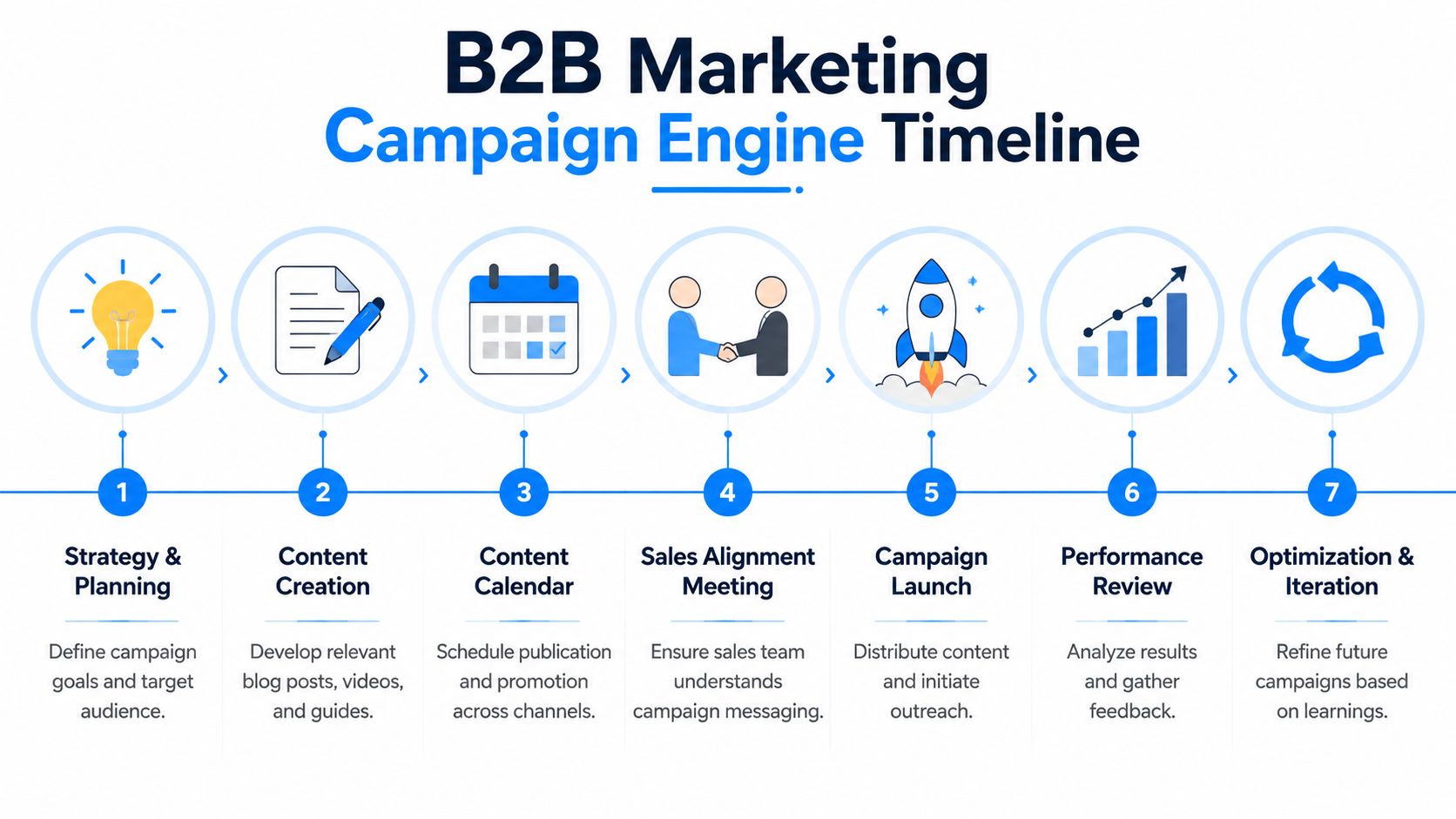
A calendar by itself won't save your marketing. Plenty of teams publish on schedule and still create friction for sales. The calendar needs to reflect how decisions get made inside target accounts.
That means organizing campaigns around buyer roles, not just topics or formats. Modern buying committees are larger and more dispersed, and many plans still fail because they treat “the lead” as one person. FullFunnel highlights this gap in its guidance on sales-marketing alignment in B2B companies. The fix is operational. Map content and follow-up to the actual stakeholders involved.
Build the calendar around roles and moments
Start with the key players in your deals. In many B2B motions, that includes a functional owner, an executive approver, a technical evaluator, and someone responsible for procurement or implementation risk.
Each of those people needs different proof.
- Functional owners want a clear path from problem to solution.
- Executives want confidence that the investment supports company priorities.
- Technical evaluators need integration clarity, process detail, and fewer unknowns.
- Procurement and operations contacts need practical information that reduces risk.
When your calendar is only organized by content theme, these needs get mashed together. The result is bland assets that don't move anyone.
A campaign is ready when sales can say who it is for, why that person should care now, and what asset helps the next conversation.
Use a 90-day roadmap, not an annual wish list
Annual planning is necessary for budget and headcount. Execution should happen in shorter cycles. Ninety days is usually the right balance. It's long enough to run integrated campaigns and short enough to adjust based on buyer response.
Here's a simple operating model I use:
- Choose one core theme for the quarter
Anchor it in a real buying problem, not a product feature.
- Assign role-specific content
One core asset can support multiple derivatives. A webinar becomes an executive summary, a technical FAQ, short LinkedIn clips, and sales follow-up notes.
- Define handoff moments with sales
Don't wait until launch. Sales should know the angle, target accounts, and talking points before the campaign goes live.
- Set a weekly review rhythm
Review engagement quality, follow-up quality, objections heard, and content usage by sales.
Sample 90-Day B2B Marketing Roadmap
Month
Theme
Key Initiatives
KPIs
Month 1
Problem definition
Publish pillar article, launch short video series, brief sales on messaging, update landing page copy
Content engagement quality, target account visits, sales feedback on message fit
Month 2
Evaluation support
Run webinar, create role-specific follow-up emails, release comparison asset, enable SDR outreach
Meeting rate from engaged accounts, asset usage by sales, progression of active opportunities
Month 3
Decision support
Publish implementation guide, create executive brief, launch retargeting to engaged accounts, hold pipeline review
Pipeline influence, opportunity progression, content touched in later-stage deals
What a working calendar includes
A real campaign calendar needs more than publish dates. Include these fields:
- Target segment
- Buyer role
- Stage in journey
- Primary CTA
- Sales follow-up owner
- Repurposing plan
- Review date
That last one matters. Most content calendars lack an expiration mindset. If an asset doesn't help current deals, refresh it, reposition it, or stop promoting it.
Run alignment through operations, not slogans
Marketing and sales alignment often gets discussed like a culture issue. Usually it's an operating issue. The teams aren't sharing the same definitions, timing, or content map.
Make alignment concrete:
- Create role-based nurture tracks so an evaluator doesn't get the same emails as an economic buyer.
- Build campaign briefs for sales with positioning, objections, and approved follow-up assets.
- Track asset usage in deals so you know what sales uses, not just what marketing publishes.
- Collect objection feedback weekly and feed it back into the next content sprint.
Plans become actionable when they tell people what to do next. Not just what the brand wants to say.
Allocate Your Resources: Smart Budgeting for Predictable Growth
Most B2B budget debates are framed the wrong way. Teams argue over cost categories instead of expected business return. That's how you end up defending line items instead of making a case for outcomes.
A better b2b marketing plan uses value-based budgeting. Start with the revenue motion you want to support, then fund the programs most likely to influence that motion. That sounds obvious, but many teams still spread budget evenly across channels because it feels safer politically.

Fund what improves deal quality
Not every tactic deserves equal treatment. If your sales motion depends on a small set of high-value accounts, broad lead generation may look efficient while producing noise.
Account-Based Marketing earns its place. According to MarketVeep, 91% of companies using ABM report increased average deal size, and 86% report higher win rates. Those are the kinds of outcomes leadership listens to because they connect directly to revenue quality, not just activity volume.
That doesn't mean every company should run a heavy ABM motion. It means your budget should match your deal economics. If a handful of accounts can materially change the quarter, personalized programs, sales support, and tighter targeting deserve more funding than generic top-of-funnel production.
Build the budget in layers
I like budgets that separate fixed capability from variable campaign investment.
Layer one is core infrastructure. This includes CRM hygiene, analytics, email tools, landing page systems, design support, and the operational pieces that keep execution from breaking.
Layer two is always-on demand. This covers recurring content production, organic distribution, newsletter operations, and search capture.
Layer three is strategic bets. ABM, vertical campaigns, event sponsorships, market expansion tests, and new content formats sit in this category.
That structure helps leadership see which spend keeps the machine running and which spend is meant to achieve step-change growth.
Budgeting gets easier when every major line item answers one question: which part of the pipeline does this improve?
Don't confuse affordability with priority
Founders and finance leads often ask what you can afford. The better question is what deserves priority right now.
For example, if paid acquisition is under consideration, a simple planning calculator like this guide to ad budget planning for indie hackers can help frame spend scenarios. Even if your company isn't an indie business, the underlying discipline is useful. Estimate required volume, pressure-test assumptions, and compare the likely return to other uses of budget.
A practical budgeting discussion should also include non-cash resources:
- Who writes and approves content
- Who supports campaign ops
- Who owns reporting
- Who joins sales alignment reviews
- Who can build role-specific assets fast enough
That's where many plans fail. The budget may exist, but the working capacity doesn't.
Make the budget defensible to leadership
Executives don't need a prettier spreadsheet. They need a clear argument. Present your plan in this order:
- Business objective
- Segments or accounts being targeted
- Programs funded
- Expected impact on pipeline quality or win conditions
- How you'll measure and adjust
If you present budget this way, you shift the conversation away from “why does marketing need this?” and toward “what happens if we don't fund this motion?”
That's a healthier conversation because it treats marketing as an investment choice, not overhead.
Close the Loop: Measuring Performance and Proving ROI
A b2b marketing plan becomes credible when reporting changes decisions. If the dashboard only tells you what happened, but not what to do next, it's reporting theater.
Many teams frequently find themselves stuck. They can show opens, clicks, visits, form fills, and content downloads. They struggle to connect those signals to revenue outcomes. That gap is larger than most leaders realize.

According to The B2B House, 52% of marketers believe their content drives leads, but only 33% can tie it to revenue. The same source notes that teams using tiered KPIs and multi-touch attribution can improve budget allocation by 20-30%. That's the standard to aim for. Not perfect attribution, but better decisions.
Build a tiered KPI system
You need different metrics for different jobs. Putting them all into one report without hierarchy creates confusion.
Top funnel metrics
Top funnel metrics tell you whether you're attracting the right attention.
Track things like:
- Engagement from target accounts
- Traffic to priority pages
- Newsletter engagement quality
- Content consumption by segment
- Direct and branded traffic patterns after campaigns
These metrics are useful early indicators. They are not proof of ROI on their own.
Mid funnel metrics
Mid funnel metrics show whether marketing is helping accounts move from curiosity to active evaluation.
Look at:
- Meetings from engaged accounts
- Sales-accepted leads or accounts
- Content touched before a meaningful conversation
- Buyer role engagement across the same account
- Follow-up response quality
This layer is where marketing and sales often diverge. Marketing sees campaign engagement. Sales sees whether the conversation is real. Your dashboard needs both views.
Bottom funnel metrics
Bottom funnel metrics answer the question leadership asks.
Track:
- Pipeline contribution
- Influenced opportunities
- Progression of opportunities with campaign engagement
- Customer acquisition cost trends
- Revenue tied to sourced or influenced programs
If your current dashboard stops before this level, you don't have a complete measurement system. You have activity reporting.
If sales can close deals without using your content, the content may still be useful. If deals close faster when they use it, now you have something to measure.
Replace last-click thinking
Last-click attribution is attractive because it's simple. It's also misleading in complex B2B journeys. The final form fill or demo request rarely explains the actual buying process.
Multi-touch attribution is better because it gives credit across the journey. It won't capture every dark social interaction or every internal share, but it gets you closer to reality. It also helps you see which channels assist rather than close.
For teams trying to get more rigorous about this, a practical primer on attributing revenue to B2B content is worth reviewing. It helps shift the conversation from vanity engagement to contribution.
A useful dashboard should combine three data perspectives:
View
What it answers
Why it matters
Channel view
Which programs create qualified engagement
Helps reallocate spend
Account view
Which target accounts are moving
Aligns marketing with sales reality
Revenue view
Which efforts influence pipeline and closed business
Proves business value
Establish a review cadence that drives action
Weekly reviews should be tactical. Monthly reviews should be strategic.
Weekly review questions
- Which campaigns generated engagement from the right accounts?
- Which assets did sales use?
- Where did follow-up stall?
- Which signals suggest dark social influence, even if attribution is incomplete?
Monthly review questions
- Which channels deserve more budget?
- Which segments are consuming content but not progressing?
- Which buyer roles are under-engaged?
- Which assets influenced active opportunities?
If you need a simple way to frame outcome conversations with leadership, a marketing ROI calculator can be a helpful planning aid because it forces assumptions into the open.
A short walkthrough can help your team align on what good measurement looks like in practice:
The key is not to chase reporting complexity for its own sake. The point is to know what to keep funding, what to fix, and what to stop. That's how a marketing plan stays alive after the kickoff meeting.
A good plan doesn't just organize campaigns. It creates repeatable progress. If you want a newsletter-led growth motion that helps you reach the right B2B audience, expand your list, and measure engagement and ROI in one place, Breaker is worth a look.
Keep reading
All articlesBreaker Review: AI-Native ESP for Newsletter Growth
An unbiased Breaker review: pricing, features, deliverability data, and who this AI-native email platform fits best for newsletter growth.
Breaker for B2B, SME and Consumer Newsletter Senders
Learn how B2B, SME, and consumer audiences differ in newsletters, plus a framework for segmenting, messaging, and monetizing each without losing relevance.
What Is a B2B Content Engine
Learn what a B2B content engine is, how it differs from a content calendar or strategy, and why it's essential for AI-driven search in 2026.