
B2B Lead Generation Websites: A Tactical Build Guide
Build high-converting B2B lead generation websites. This guide covers ICP messaging, funnels, CRM integration, forms, and optimization for B2B growth teams.
The most popular advice about b2b lead generation websites is still wrong in one important way. It overemphasizes traffic and underbuilds the system that turns a visitor into a known, qualified account.
More blog posts, more SEO pages, more paid clicks, more CTAs. None of that fixes a site that captures interest poorly, routes data badly, and leaves sales with a pile of half-usable contacts. A lot of B2B teams don't need a prettier website. They need a tighter conversion architecture.
The most effective version of that architecture is a newsletter-led website. Not a site with a newsletter bolted on in the footer. A site where newsletter signup is part of the qualification path, where every meaningful form feeds enrichment, where intent signals sync into CRM, and where nurture starts the moment someone raises a hand. That model fits how B2B buyers behave now. They research independently, compare vendors asynchronously, and often want useful content before they want a demo.
Why Most B2B Websites Fail at Lead Generation
Most B2B websites fail because they behave like showrooms. They explain the company, list product features, maybe include a contact page, then wait for buyers to do the hard work of figuring out what to do next.
That setup ignores the role websites already play in modern demand generation. Websites are the primary lead generation tool for 90.7% of marketers, ahead of blogs at 89.2% and email marketing at 69.2%, according to Email Vendor Selection's lead generation statistics. If the website is the center of the system, it can't act like passive brand collateral.
Brochure sites create friction
A brochure site usually has three problems:
- Weak next steps. “Contact us” is too broad for early-stage visitors.
- No capture path for low-intent buyers. If someone wants to learn, compare, or subscribe, the site gives them no structured way to do it.
- Disconnected data. Form fills go to inboxes, spreadsheets, or the wrong lifecycle stage in HubSpot or Salesforce.
Those gaps matter because the first conversion often shouldn't be a sales call. For many B2B categories, the right first conversion is an email signup tied to content relevance and account identification.
Most sites don't have a traffic problem. They have a sequencing problem.
What actually works
Strong b2b lead generation websites do four jobs at once:
- Translate positioning into clear page-level messaging
- Capture demand with forms matched to visitor intent
- Enrich and route leads into CRM without manual cleanup
- Nurture leads through a newsletter that keeps engagement and intent visible
That's a different model from “publish content and hope someone books a demo.” It treats the site as an operating system for lead capture and qualification.
Aligning Your Website with Your Ideal Customer
Generic messaging kills conversion because it forces buyers to interpret your relevance on their own. Most won't. They'll scan your homepage for a few seconds, decide it sounds broad, and leave.
That's a real problem in B2B because buyers do a lot of their research before they ever talk to sales. 70% of B2B buyers self-educate online and expect highly relevant content before engaging a sales rep, as noted in MarketStar's guide on B2B lead generation challenges. If your website speaks to everyone, it won't feel relevant to the accounts you want.

Build an ICP message map
Start with your Ideal Customer Profile, not your product copy doc. A usable ICP for website planning needs more than industry and company size. It should tell you what a buyer is trying to fix, what they're afraid of, and what internal pressure they're under.
A practical message map includes:
- Who they are. Revenue band, team size, business model, tech stack maturity.
- What they're dealing with. Slow pipeline, weak attribution, poor lead quality, bad handoff between marketing and sales.
- What they need to believe. That your approach fits their environment, integrates with their stack, and won't create operational mess.
- What action makes sense now. Subscribe, download, request a walkthrough, book a consult.
If you're a new hire joining an existing team, pull this from customer calls, win-loss notes, Gong transcripts, CRM fields, and paid search terms. Don't start with homepage brainstorms.
Write for the problem before the product
A homepage hero shouldn't just announce what the company does. It should tell the right buyer they're in the right place.
Weak hero:
“Modern marketing software for growing businesses”
Stronger hero:
“Turn anonymous website traffic into qualified B2B leads through newsletter capture, CRM sync, and account-level enrichment”
The second version gives the buyer three useful cues. It names the job to be done, hints at the mechanism, and narrows the audience.
Use the same logic down the page:
Website area
What to say
What to avoid
Hero section
Buyer problem and outcome
Abstract mission statements
Feature blocks
Operational benefits in plain language
Feature lists without context
Proof section
Specific use cases by segment
Generic “trusted by leaders” copy
CTA copy
Next step matched to intent
Repetitive “Contact us” buttons
Segment by use case, not only by industry
Industry pages help, but they're often too blunt. Some of the best b2b lead generation websites segment by workflow or growth motion instead.
Examples:
- PLG teams need lifecycle-triggered capture and product-qualified lead visibility.
- Fractional CMOs need cleaner attribution and fast proof of ROI.
- ABM teams need account enrichment, routing, and targeting feedback loops.
- Newsletter operators need consent, list hygiene, and monetization options that don't wreck trust.
That structure usually produces better messaging than broad “solutions for SaaS, finance, healthcare” pages.
Practical rule: If your buyer can't tell within a few seconds whether the page was built for their role, your copy is still too generic.
Match CTA depth to buyer awareness
Not every visitor should see the same ask. Someone reading a comparison page may be open to a consultation. Someone reading a top-of-funnel article may only want future insights.
A simple decision model helps:
- Low awareness: newsletter signup, ungated article cluster, checklist
- Mid awareness: template, webinar, use case page, interactive tool
- High awareness: demo, audit, consultation, pricing conversation
That's why a newsletter-led model works so well. It gives you a credible low-friction conversion path for the majority of visitors who aren't ready to talk yet, while still feeding your qualification system.
Designing High-Converting Pages and Funnels
Once the message is right, page design has one job. Reduce the effort required to take the next step.
Most conversion problems on b2b lead generation websites are not dramatic. They're cumulative. A vague headline, a weak CTA, a long form, no trust signal near the form, and an irrelevant thank-you page. Each one adds a little friction. Together they stall the funnel.
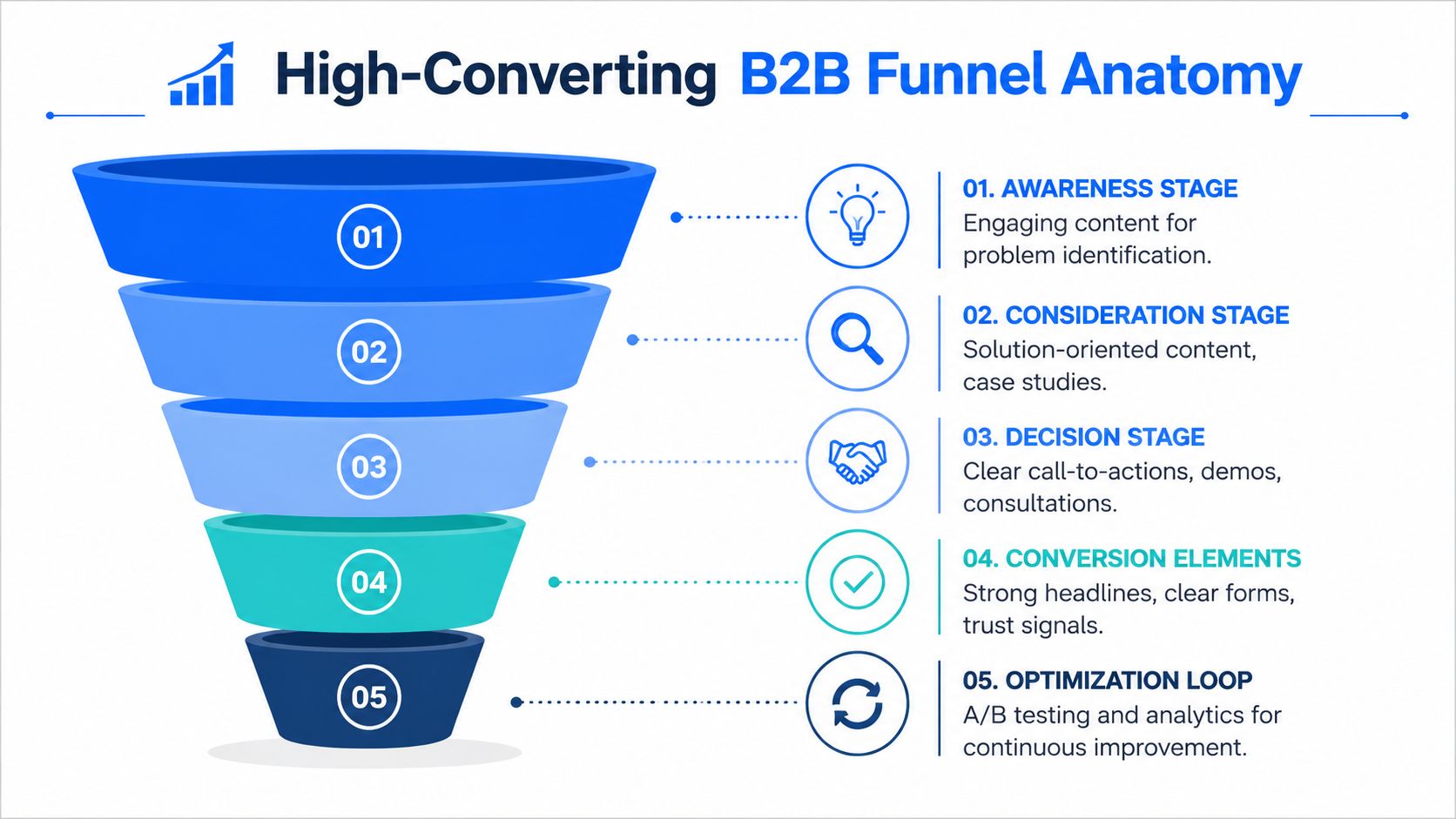
The anatomy of a page that converts
A strong page usually contains these parts in this order:
- A headline tied to a real buying problem
Use plain language. Buyers respond better to operational clarity than cleverness.
- A short subhead that explains how it works
Reduce ambiguity. Spell out the mechanism.
- One primary CTA above the fold
If the page has three competing asks, it has none.
- Trust evidence near the decision point
Logos, process clarity, use cases, or product screenshots work better than generic praise.
- A form with only the fields required at that moment
Don't ask for qualification data you can capture later through enrichment or progressive profiling.
- A thank-you page that continues the journey
Offer a secondary conversion, not a dead end.
A related point: live chat can help when buyers have small pre-conversion questions. If your team is deciding whether chat belongs on high-intent pages, this Recepta.ai guide for small business communication is useful because it frames chat as part of response flow, not as a decorative widget.
Two funnel patterns that work
The simplest useful funnel is not the same as the highest-intent funnel. Keep both.
The lightweight newsletter funnel
This works well for educational traffic from SEO, partnerships, and social.
- Visitor lands on an article or use case page
- Inline CTA offers a newsletter with specific value
- Form asks for business email
- Thank-you page offers one related asset or high-intent page
- CRM creates contact record with source and page context
- Newsletter nurture begins with content matched to topic of signup
This pattern is effective because it respects buyer timing. It doesn't force a meeting ask too early.
Here's a practical walkthrough of page-level conversion mechanics in this guide to b2b landing pages for leads.
After the click, the layout matters as much as the offer.
The higher-intent event or webinar funnel
This works for solution-aware traffic and partner campaigns.
- Registration page with topic, speaker credibility, and key takeaways
- Form captures email plus one or two qualification fields
- Confirmation page adds calendar and related resource
- Reminder sequence drives attendance
- Post-event page routes attendees differently from no-shows
- CRM updates engagement status for follow-up
The difference isn't just length. It's data strategy. Event registration can justify a slightly richer form because the value exchange is stronger.
Keep offers realistic
Not every lead magnet deserves equal investment. Some are fast to produce and useful for list growth. Others fit later-stage qualification better.
Lead Magnet Type
Effort to Create
Typical Conversion Rate
Best For
Checklist
Low
Varies by audience and page intent
Early-stage educational traffic
Template
Medium
Varies by specificity and relevance
Functional buyers with a clear task
Webinar
High
Varies by topic urgency and promotion quality
Mid-funnel evaluation and engagement
Benchmark guide
High
Varies by credibility and niche fit
Executive audiences and ABM follow-up
Because reliable conversion benchmarks differ so much by category, traffic source, and offer quality, use this table directionally. Don't use it as a forecasting model.
Design choices that usually hurt conversion
A few patterns consistently underperform:
- Slider heroes that bury the main offer
- Forms in the footer only
- Navigation overload on campaign pages
- Testimonials without context
- Thank-you pages with no next step
If a visitor has to stop and think about what to click next, the page is underdesigned.
The best pages feel obvious. Not because they're simplistic, but because every component supports one decision.
Integrating Your Newsletter and CRM for Seamless Flow
A form fill that never reaches CRM correctly is not a lead. It's admin debt.
Many b2b lead generation websites suffer from fragmentation. Marketing launches forms through a CMS or popup tool. Newsletter subscriptions live in one system. CRM records live in another. Source fields are inconsistent, duplicate handling is messy, and sales sees incomplete records with no context on what the person did.
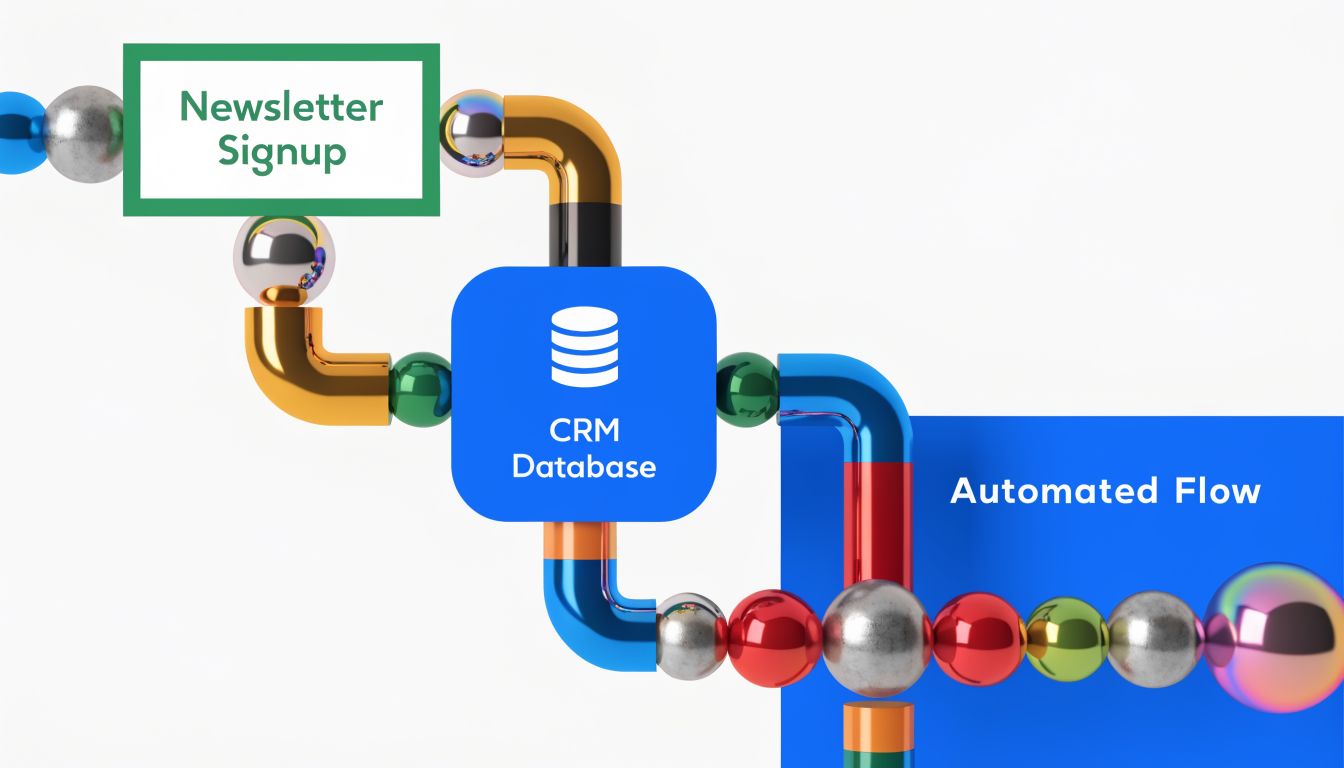
Use the newsletter as a system, not a list
The newsletter shouldn't sit off to the side as a content channel. It should be a core part of lead capture and qualification.
That means a signup should do several things at once:
- Create or update the contact in CRM
- Add consent and subscription status cleanly
- Preserve source attribution
- Trigger the right welcome or nurture flow
- Pass page-level context for future scoring
- Support later enrichment and routing
If that sounds obvious, it's because the concept is obvious. The implementation usually isn't. Teams often lose fidelity in hidden fields, inconsistent naming conventions, and duplicate records.
Decide what each form is for
Not every form should ask the same questions. The cleanest approach is to assign each form a job.
Email-only forms
Use these on blog posts, resource hubs, and newsletter modules. The goal is low-friction capture. You'll enrich later.
Progressive forms
Use these when the visitor has already shown interest. Ask one or two extra questions, such as role or company name, only when the value exchange justifies it.
High-intent forms
Use these for demos, consultations, or implementation requests. These forms can support routing and prioritization, but they still need restraint. Too many fields can suppress the very hand-raisers sales wants most.
Integrate paid social the right way
Professional network capture can outperform standard landing pages when the handoff is clean. LinkedIn Lead Gen Forms average a 13% conversion rate, compared with a 2.35% benchmark for traditional website landing pages, according to Cirrus Insight's lead generation statistics. The opportunity is not just the form completion. It's what happens next.
A useful pattern looks like this:
- Prospect submits a LinkedIn Lead Gen Form
- Data syncs into CRM with campaign metadata
- Contact enters the same newsletter and nurture framework as website-captured leads
- Sales sees source, offer, and lifecycle status in one record
That avoids the common mistake of treating paid social leads and website leads as separate universes.
Map the data flow before you launch
Before any page goes live, define the movement of data field by field.
Stage
What should happen
Form submission
Validate required fields and create or update contact
Newsletter sync
Add to the correct list or audience with consent status
CRM writeback
Apply source, campaign, page, and lifecycle defaults
Enrichment layer
Append company and role data when available
Routing logic
Send high-fit records to sales, others to nurture
Reporting layer
Attribute lead origin and downstream outcomes correctly
If you're documenting that process internally, this guide to CRM email integration is a solid operational reference.
Tool choice matters less than field discipline
HubSpot, Salesforce, Customer.io, Mailchimp, and other systems can all support this if the architecture is clear. The main requirement is consistency.
A platform like Breaker can sit in that flow when your team wants newsletter growth, embeddable forms, CRM syncing, and ongoing subscriber acquisition in one setup. The key question isn't whether the tool has integrations on the pricing page. It's whether your fields, consent logic, attribution rules, and lifecycle definitions stay intact across systems.
Don't optimize the front-end form before you've mapped the back-end consequences of each submission.
That's where smooth flow comes from. Not from adding more automation, but from removing ambiguity.
Enriching and Qualifying Leads Automatically
An email address by itself is not a usable B2B lead. It's a starting signal.
The jump from raw signup to qualified pipeline happens through enrichment, data hygiene, and lead qualification rules. Without those layers, marketing celebrates captures that sales can't prioritize, and sales ignores leads marketing worked hard to generate.
Why quality beats raw volume
This is one of the few areas where the trade-off is clear. Organizations that prioritize lead quality over sheer volume achieve 3 to 5 times higher conversion rates, according to MarketJoy's breakdown of common B2B lead generation mistakes.
That's why smart b2b lead generation websites avoid overgating random content just to inflate top-line lead counts. A smaller stream of relevant, validated, enriched leads is more useful than a larger stream of bad-fit signups.
What enrichment should add
A good enrichment process tries to answer basic sales questions quickly:
- What company is this person from
- Is that company in our ICP
- What role does this person likely hold
- Does this account already exist in CRM
- Should this record go to sales now or to nurture
That can happen through enrichment vendors, reverse lookup tools, CRM matching, or account identification software. The exact stack varies. The principle doesn't.
For newsletter-led capture, enrichment is especially helpful because low-friction forms often collect only business email. That's fine if the system can append the rest responsibly afterward.
Build a simple qualification model
You don't need an elaborate scoring framework on day one. Start with two categories.
Fit signals
These describe whether the lead resembles an account you want.
- Company size
- Industry
- Geography
- Role seniority
- Existing target account status
Intent signals
These describe whether the lead appears ready for stronger follow-up.
- Signed up from a pricing or product page
- Clicked high-intent newsletter links
- Registered for a webinar
- Returned to the site repeatedly
- Requested a consultation
A lead can have strong fit and weak intent, or the reverse. Treat those differently. A great-fit account with low current intent may belong in a nurture sequence and an account watchlist. A poor-fit lead with high intent may still be worth handling, but not with the same urgency.
High intent from the wrong account is still noise. Low intent from the right account may be early pipeline.
Protect sender reputation while you qualify
Data hygiene is not clerical work. It protects deliverability and keeps your reporting believable.
At minimum, your process should include:
- Email verification before or immediately after sync
- Duplicate management so one person doesn't fragment across records
- Suppression logic for invalid, unsubscribed, or disqualified contacts
- Field normalization for company names, job titles, and country values
If your team is evaluating vendors and workflows for this layer, this overview of data enrichment services is a useful starting point.
What doesn't work is handing sales a spreadsheet of fresh leads with no firmographic context and expecting fast judgment calls. Qualification should happen before the handoff, not during it.
Measuring Performance and Running Experiments
The wrong metrics make weak websites look healthy. Pageviews rise, downloads happen, traffic charts look good, and revenue impact remains fuzzy.
A more disciplined view starts with outcomes. Website traffic matters because it can produce qualified conversations and customers. It doesn't matter as a vanity metric on its own.
Track the metrics tied to sales usefulness
At a minimum, measure these:
- Visitor-to-lead conversion rate by page type and channel
- Lead-to-MQL rate based on your actual qualification rules
- MQL-to-opportunity rate so marketing can see if quality is holding
- Lead source performance across SEO, paid social, partnerships, and direct
- Time to first sales action for routed leads
- Newsletter engagement by segment because clicks often reveal buying intent before form resubmission
Channel quality matters. SEO-driven website leads close at 14.6%, compared with 1.7% for outbound efforts, making them more than 8.5 times more efficient, according to the earlier-cited Email Vendor Selection research. That doesn't mean outbound is useless. It means your website measurement model should respect the downstream value of organic intent.
Ignore metrics that flatter the team
Some numbers are useful diagnostics but poor success metrics:
- Bounce rate in isolation
- Total downloads without qualification context
- Raw subscriber growth without engagement quality
- Form fills with no routing outcome
- Traffic to pages that never influence pipeline
If a whitepaper gets downloads but those contacts never become qualified conversations, the issue is not content volume. It's offer quality, targeting, or handoff.
Run smaller tests with cleaner logic
A/B testing on b2b lead generation websites works best when the team changes one meaningful variable at a time.
Start with high-impact surfaces:
Test area
Example hypothesis
What to watch
Headline
Problem-led copy will outperform brand-led copy
Visitor-to-lead rate
CTA
Specific CTA text will increase action
Click-through to form completion
Form layout
Shorter form will improve starts and completions
Completion rate and lead quality
Thank-you page
Secondary offer will increase deeper engagement
Next-step clicks and later qualification
A few practical rules help:
- Test pages with enough traffic to matter
- Keep the offer constant if you're testing copy
- Don't judge results only on front-end conversion
- Review lead quality after every notable lift
Compliance belongs in this same operating rhythm. Make consent language clear. Explain what subscribers will receive. Keep preference management visible. Make unsubscribe and data handling processes easy to find. A newsletter-led website only works long term if trust stays intact.
The strongest teams don't treat compliance as legal cleanup. They treat it as part of conversion design. Clear expectations reduce friction and improve lead quality because people know what they're opting into.
If your team wants a newsletter-led system instead of another disconnected form stack, Breaker is one option to evaluate. It combines newsletter sending, embeddable signup forms, CRM integrations, audience targeting, enrichment, hygiene, and deliverability controls in one workflow, which can simplify how b2b lead generation websites capture, nurture, and route qualified subscribers.
Keep reading
All articlesBreaker for B2B, SME and Consumer Newsletter Senders
Learn how B2B, SME, and consumer audiences differ in newsletters, plus a framework for segmenting, messaging, and monetizing each without losing relevance.
What Is a B2B Content Engine
Learn what a B2B content engine is, how it differs from a content calendar or strategy, and why it's essential for AI-driven search in 2026.
8 Best Email Tracking Software Tools in 2026
Compare 8 top email tracking tools for 2026, how tracking pixels work, and why Apple's privacy rules make open rates unreliable. See our top pick.