
Distribution Channels in Marketing Your B2B Growth Blueprint
Explore essential distribution channels in marketing to fuel B2B growth. Learn how to choose, integrate, and measure your channel strategy for maximum ROI.

Distribution channels are the routes your product or service takes to get into your customer's hands. Think of them as the highways and local roads of your business, connecting what you’ve built to the people who will actually use it. Nailing your distribution strategy is the absolute backbone of your go-to-market plan.
What Are Distribution Channels in Marketing
Let's say you've created the perfect B2B software. Now what? How does it actually make its way from your company to your ideal customer? That journey is managed by your distribution channels. These aren’t just logistical paths; they are powerful assets that shape your customer experience, brand perception, and ultimately, your bottom line.
Some of these routes are direct—think of them as private superhighways you build and control yourself, like your company website or an in-house sales team. Others are vast networks managed by partners, like third-party marketplaces, affiliates, or value-added resellers. Every choice you make involves a trade-off between control, cost, and reach.
To help you get started, here's a quick summary of common distribution models. This will give you a foundational understanding of your options.
Quick Guide to B2B Distribution Models
Model
Description
Primary Goal
Direct
Selling straight to the customer via your own website, sales team, or physical stores.
Maximize control over brand, customer experience, and profit margins.
Indirect
Using intermediaries like resellers, distributors, or affiliates to reach the end customer.
Achieve broad market reach and scale quickly by using established networks.
Multi-Channel
Using a mix of direct and indirect channels that operate independently of each other.
Offer customers multiple ways to buy, capturing a wider audience.
Omnichannel
Integrating multiple channels to create a single, seamless customer experience.
Provide a unified brand journey, no matter how the customer interacts.
Each model has its place, and the best B2B strategies often blend them together. We'll dive deeper into these later, but this gives you a solid frame of reference.
The Modern Shift in Channel Strategy
The ways we reach customers have completely transformed. While traditional methods like trade shows and direct mail once dominated, the game has shifted decisively toward digital. In fact, digital channels now get the lion's share of most marketing budgets.
You can see this playing out in the spending trends. Digital channels are set to command 68.7% of a global ad spend that's projected to hit $1.04 trillion by 2026. This shift is driven by the sheer effectiveness of using multiple channels at once— 75% of marketers now use more than five distinct channels to connect with their audience.
According to the latest findings, core digital assets like a company's website, blog, and SEO are seen as the most valuable channels, with email and social media following close behind. You can explore the full marketing statistics for 2026 to see just how much these trends are shaping modern strategies.
A distribution channel is more than just a sales path; it's a critical component of your brand's relationship with the customer. Choosing the right channel mix determines how your audience finds you, how they perceive your value, and how easily they can become a customer.
Why Your Channel Choices Matter
Picking the right distribution channels isn't just a logistical task—it's a strategic decision that ripples through your entire business. Your choices have a direct impact on several core functions:
- Customer Experience: Does your channel deliver a high-touch, consultative sale, or is it a quick, self-service transaction? The path you choose defines the customer's journey and their perception of your brand.
- Brand Control: Direct channels give you total control over your messaging and brand identity. Indirect channels, on the other hand, offer wider reach but mean you're trusting a third party with your brand's reputation.
- Profit Margins: Selling directly usually means higher margins since you're cutting out the middleman. But sometimes the higher volume from an indirect partner can lead to more overall profit, even with a smaller margin per sale.
- Speed to Market: Partnering with an established distributor can get your product in front of a huge audience almost overnight. Building a direct channel from scratch takes time and a serious investment to gain momentum.
In the end, your approach to distribution channels in marketing is a foundational piece of your business strategy. It influences everything from your sales and marketing costs to your company's ability to scale and stay profitable for years to come.
Understanding Direct Versus Indirect Channels
At the end of the day, every distribution strategy boils down to two fundamental choices: selling directly to your customer or partnering with someone else to do it. The path you choose has a massive impact on your relationship with customers, your profit margins, and how quickly you can scale.
Let's break down these two primary distribution channels in marketing.
Think of direct channels as owning the entire customer experience from beginning to end. You’re in the driver’s seat for every conversation, every brand interaction, and the final sale. No middlemen. This model gives you complete control and the highest possible profit on every single transaction.
Of course, that level of control isn't free. Building and running direct channels demands a serious investment in resources, from building out a sales team to developing and maintaining a great e-commerce site. You’re on the hook for everything—marketing, sales, and customer support.
The Power of Direct Distribution
Direct channels are a game-changer for B2B companies, especially those with complex products or a focus on building long-term customer relationships. The unfiltered feedback you get is gold for product development and helps you create an incredibly loyal customer base.
Here are a few common examples of direct B2B channels:
- In-House Sales Teams: Enterprise software companies often rely on their own sales reps to manage high-value accounts. This allows for consultative selling and personalized demos that a third party just can't replicate.
- Company Website: A SaaS business selling subscriptions directly through its own platform is the classic example. They have total say over pricing, product tiers, and the user onboarding flow.
- Direct-to-Consumer (DTC) E-commerce: While it's more famous in B2C, some B2B hardware or supply companies sell directly to other businesses through their own online stores.
Direct channels offer maximum control and margin. By owning the customer relationship, you gain unfiltered insights and build strong brand equity, but you also bear the full cost and effort of customer acquisition.
This approach is perfect when your product demands a high-touch sales process or when you want to protect a premium brand image without a third party diluting it. The trade-off? Market penetration is usually slower compared to tapping into a partner’s ready-made audience.
Expanding Reach with Indirect Channels
Now, let's look at the other side of the coin. Indirect channels mean you’re teaming up with third parties—intermediaries who sell your product for you. It’s almost like franchising your sales process, letting you plug into established networks and reach a far wider audience than you ever could alone.
By using intermediaries, you can scale your market presence rapidly and break into new territories with less upfront capital. The catch is that you give up some control over your brand’s message and hand over a slice of your revenue to your partner.
Here are some common B2B indirect channels:
- Value-Added Resellers (VARs): A cybersecurity firm might work with VARs who bundle its software with their own IT consulting services. This adds extra value for the customer and helps the firm reach specific industries.
- Distributors: A hardware manufacturer could sell components through specialized electronics distributors who already have relationships with thousands of smaller businesses and retailers.
- Affiliates and Referral Partners: A project management tool might offer a commission to consultants or bloggers who refer new paying customers, essentially outsourcing a part of its lead generation.
- Marketplaces: Listing a B2B app on a platform like the Salesforce AppExchange or AWS Marketplace gives you instant access to a huge, highly relevant customer base.
Going the indirect route means you have to trust your partners to represent your brand well. This requires rock-solid relationship management and crystal-clear agreements to keep your brand consistent and ensure customers have a great experience. Ultimately, the choice between direct and indirect channels comes down to a strategic trade-off between control, cost, and reach.
Comparing Digital and Traditional Channels
Choosing your marketing channels isn't a battle of old school versus new school. Think of it more like stocking a toolbox. You wouldn't use a sledgehammer to hang a picture frame, and a smart marketer doesn't throw all their budget into just one type of channel. The trick is knowing which tool is right for the job, especially when it comes to your B2B goals.
Traditional channels are the heavy-duty, reliable tools that have built brands for decades. They’re often high-touch and tangible, creating a sense of trust and permanence that digital can sometimes lack.
The Lasting Power of Traditional Channels
While digital gets most of the spotlight, traditional channels still pack a serious punch, particularly in B2B markets where relationships and credibility are everything. These methods are fantastic for making a memorable, high-impact impression on a very specific audience.
Imagine you're selling complex industrial machinery. A glossy ad in a niche trade publication or a hands-on demo at an industry trade show will almost always be more effective than a social media post. These channels create space for deep engagement and genuine personal connection.
Think about these high-value scenarios for traditional channels:
- Industry Trade Shows: Nothing beats face-to-face interaction for building trust and demoing a complex product. They are hubs for qualified leads who are actively walking the floor looking for solutions.
- Direct Mail: A well-designed, personalized package sent to a high-value prospect can slice right through the digital noise. It’s a physical thing that demands attention in a way an email just can't.
- Print Advertising: Placing an ad in a respected industry journal positions your brand as a serious player. It gets you in front of key decision-makers who still rely on these trusted resources for industry news and insights.
Sure, these methods are often more expensive and harder to measure than their digital counterparts. But for targeted, high-stakes B2B sales, their impact can be impossible to replicate.
The Precision and Scale of Digital Channels
Digital channels, on the other hand, are the precision instruments in your marketing toolbox. They offer incredible targeting, scalability, and—most importantly—measurability. This is where modern growth teams live and breathe, using data to fine-tune performance and prove ROI.
With digital, you can target potential customers based on job title, company size, online behavior, and a dozen other data points. You can start with a tiny budget, measure the results in real-time, and scale up what’s working almost instantly.
For growth-focused teams, the core advantage of digital channels is data. Every click, every view, and every conversion can be tracked, providing the real-time feedback needed to justify budgets and build a predictable engine for revenue.
The modern B2B world is dominated by a few key digital channels:
- SEO and Content Marketing: By creating genuinely helpful content that answers your customers' questions, you attract highly qualified inbound leads directly from search engines.
- Paid Social Media: Platforms like LinkedIn let you put your message directly in front of decision-makers at your target companies, making it an incredibly powerful tool for account-based marketing.
- Email Newsletters: As a primary owned channel, email lets you build a direct relationship with your audience, nurture leads, and drive conversions. Platforms like Breaker are designed to turn newsletters into reliable lead generation machines by combining sending with automatic list expansion.
The digital space is also constantly evolving. One explosive trend is the rise of Retail Media Networks (RMNs), which have become a key distribution channel by 2026. With over 200 networks worldwide using first-party data, they offer superior targeting and attribution, delivering 1.8x better results than standard digital ads and achieving nearly 3x higher purchase intent. As e-commerce surges past 23% of all global retail sales, a net 35% of marketers are increasing their RMN spend to integrate them into their omnichannel strategies. Discover more insights about 2026 marketing trends from industry leaders.
Digital Channels vs. Traditional Channels
To make the best choice, it helps to see a direct comparison. Each approach has distinct strengths and weaknesses that will influence which one you pick for a specific campaign or goal.
Attribute
Digital Channels (e.g., Email, SEO, Social Media)
Traditional Channels (e.g., Print, TV, Trade Shows)
Targeting
Hyper-Specific: Precisely target audiences by demographics, behavior, and firmographics.
Broad or Niche: Targets are based on general readership, viewership, or event attendance.
Measurability
Immediate and Granular: Real-time data on clicks, conversions, and ROI is readily available.
Difficult and Delayed: ROI is often estimated through surveys or indirect correlation.
Scalability
Highly Scalable: Campaigns can be expanded or contracted quickly with adjustable budgets.
Limited Scalability: Scaling requires significant logistical effort and financial commitment.
Cost
Lower Entry Cost: Can start with small budgets and optimize based on performance.
High Upfront Cost: Often requires a large initial investment for ad space or event presence.
Interaction
Two-Way Communication: Enables direct engagement, feedback, and community building.
One-Way Communication: Primarily a broadcast medium with limited direct interaction.
Ultimately, the most powerful strategies don't force you to choose one over the other. They integrate both, using the broad-stroke impact of traditional methods to drive awareness and the precision of digital channels to capture and nurture those leads.
How to Choose Your B2B Distribution Channels
Picking your B2B distribution channels is like placing a high-stakes bet on where your customers are hiding. Get it right, and you unlock predictable revenue and accelerated growth. Get it wrong, and you're just wasting time and money, shouting into an empty room.
This isn’t about guesswork. It’s a strategic process of analysis and elimination to find the most profitable paths to market.
The entire foundation of a smart channel strategy is a deep, almost obsessive, understanding of your Ideal Customer Profile (ICP). If you don't know who you're selling to, you can't possibly know where to find them. You have to go way beyond basic demographics and dig into their day-to-day workflows, where they get their information, and their professional watering holes. You can learn more about how to define a powerful Ideal Customer Profile in our detailed guide.
Analyze Your Product and Market
After you’ve nailed down your customer, the next step is to look inward at your product and outward at the competition. The nature of what you sell completely dictates the kind of sales process you'll need.
A simple, low-cost SaaS tool can do incredibly well with a self-service, direct digital channel. But a complex, enterprise-level platform with a six-figure price tag? That’s going to require a high-touch, direct sales team or specialized value-added resellers (VARs) to handle the long, consultative sales cycle.
Your product's complexity and price point are the first and most important filters for your channel options.
The more complex and expensive your product, the more direct and high-touch your primary distribution channel needs to be. You can’t sell a jet engine through a shopping cart. The channel must match the consideration level of the purchase.
At the same time, you need to be watching your competitors. Don't just make a list of their channels; really try to reverse-engineer their strategy.
- Which channels do they seem to be pouring the most money into?
- Are they using direct sales teams, a network of indirect partners, or a digital-first approach?
- Where are their customers actually talking about them? Checking forums, review sites, and social media can tell you which channels are really working versus which ones are just for show.
This kind of analysis helps you spot the proven paths to market and, more importantly, the gaps they might be missing.
Align Channels with Your Resources
A perfect strategy on paper is completely useless if you don't have the team or the budget to actually execute it. Your resources are the non-negotiable constraints that will ultimately shape your channel mix. Distribution is also only one lever: it is the "place" in the 7 elements of the marketing mix, and it works best when product, price, and promotion are planned alongside it.
Building an in-house enterprise sales team costs millions in salaries and takes years to mature. Launching a full-scale partner program requires dedicated channel managers from day one. In contrast, a content and SEO strategy can be kicked off with a smaller, more focused team.
To make an informed decision, it's worth understanding the full spectrum of available retail distribution strategies to see how different models demand different levels of investment. Be brutally honest about your financial and human capital. It’s far better to dominate one or two well-chosen channels than to spread yourself thin across five and fail at all of them.
Map Channels to the Buyer's Journey
Finally, effective distribution isn't about using one channel for everything. The real magic happens when you assign the right channel to the right job at each stage of the buyer's journey. Different channels are good at different things, from making that first impression to closing the deal.
Here’s a practical way to think about it:
- Awareness Stage: The goal here is simple: get on your ICP's radar. Channels like SEO, content marketing, and paid social media are perfect for this. They help you answer your audience's questions and introduce your brand as a helpful authority.
- Consideration Stage: Now, prospects are actively evaluating solutions. This is where channels that allow for a deeper dive really shine. Email newsletters, webinars, and detailed case studies work to build trust and show off your product's true value, nurturing leads toward a decision.
- Decision Stage: The prospect is ready to pull the trigger. Your channels need to make this as smooth and frictionless as possible. Direct sales demos, a simple website checkout flow, or a responsive partner channel are what you need to convert that interest into actual revenue.
By mapping your channels this way, you create a cohesive system where every touchpoint logically moves the customer forward, making sure every dollar you spend has the greatest possible impact.
Integrating Your Channels for Exponential Growth
Picking your distribution channels is only half the job. Real, sustainable growth happens when you get those channels to work together as a single, well-oiled machine—not a random collection of tactics. A disconnected strategy is like having a team where no one talks to each other. It’s pure chaos.
An integrated approach turns your marketing from a string of one-off campaigns into an interconnected growth engine. Each channel should feed and amplify the others, creating a feedback loop that gets more value out of every single customer touchpoint.
This is why your channel decisions can't be made in a vacuum. They have to flow directly from who you're selling to, what you're selling, and how much you can afford to spend.
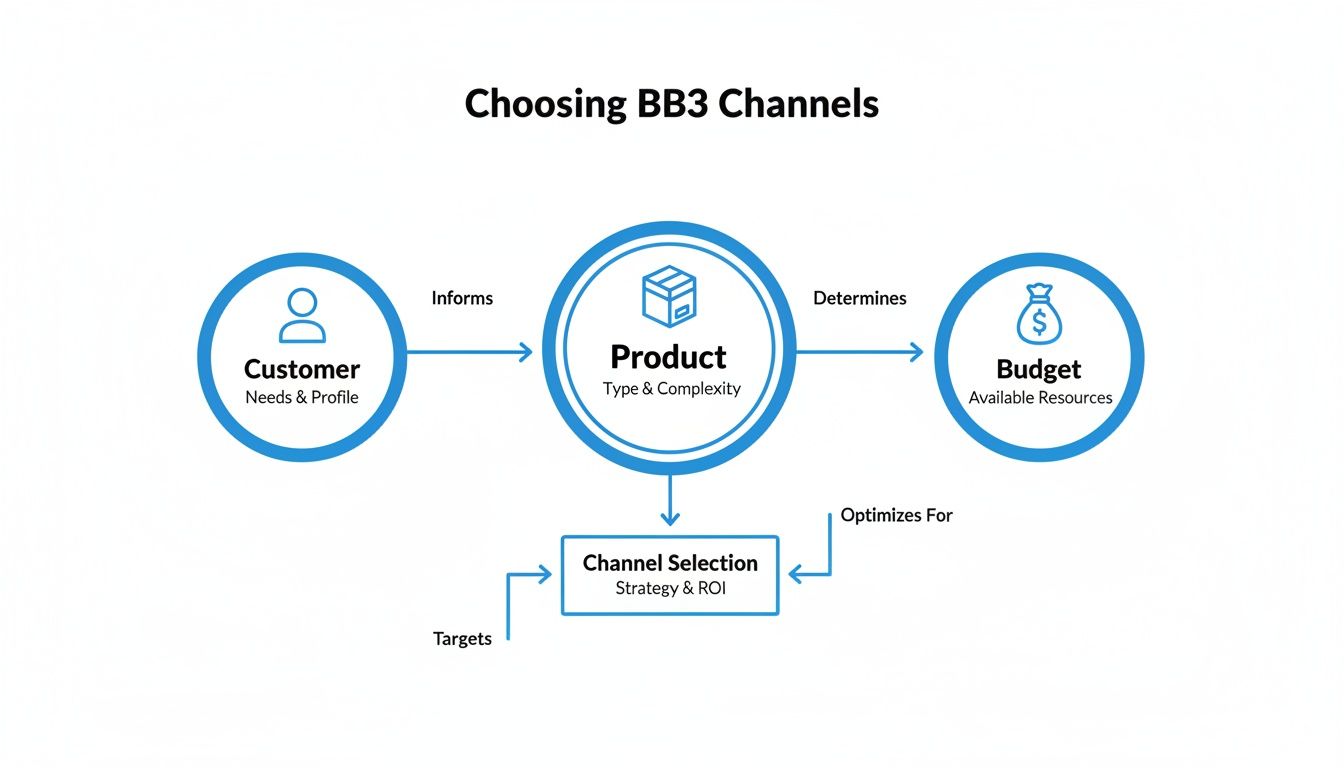
As you can see, these foundational pieces—customer, product, and budget—have to work in lockstep to guide you toward the right channels.
Build Around a Central Hub
The smartest way to integrate your channels is to pick one to be your central hub. For most B2B companies, that hub should be a high-value email newsletter. Why? It's an owned channel. You have a direct line to your most engaged prospects, far from the whims of social media algorithms.
Think of your newsletter as the command center for your entire marketing operation. It’s where you consolidate all the interest you generate from every other channel.
- From Your Blog (SEO): A reader finds your blog through a Google search. A clear call-to-action gets them to subscribe to your newsletter for more insights, turning a one-time visitor into a long-term lead.
- From Social Media: You post a sharp insight on LinkedIn that gets people talking. Instead of just counting the likes, you point that traffic to a landing page where they can subscribe to get more analysis sent right to their inbox.
- From Paid Ads: A prospect clicks a targeted ad and downloads your whitepaper. From there, they’re automatically dropped into a nurture sequence, continuing the conversation you paid to start.
This model creates a powerful cycle. Your other channels work to fill the top of your funnel, and your email newsletter takes over to build trust and eventually drive conversions. This is exactly why a solid email strategy is still a top priority for so many businesses.
The Undeniable Power of Email in B2B
The numbers don't lie. In major markets, about 75% of marketers plan to keep or increase their email marketing spend, pointing to its reliability for nurturing leads and closing deals. This is especially true in B2B. With the number of global email users expected to hit 4.9 billion by 2028, its direct-to-inbox nature is one of the few ways to cut through the noise and get immediate feedback on what's working.
Your email list is more than a database. It’s your single most valuable marketing asset. It’s an audience that has explicitly given you permission to talk to them, making it the highest-intent channel you own.
This is where a unified analytics view becomes so important. You need to see how users from different channels behave after they join your list to know what's truly working. A platform that offers a real-time analytics dashboard lets you track subscriber growth and engagement from all your sources in one place. This centralized view shows you which channels are driving not just sign-ups, but engaged subscribers who actually open and click your emails.
Unify the Customer View
True integration isn't just about funneling leads into an email list. It's about connecting the dots with the right technology.
Plugging your marketing channels into a central Customer Relationship Management (CRM) system is non-negotiable. This gives you a unified view of the customer, letting you see every single touchpoint a lead has had with your brand, no matter which channel it came from.
With this unified data, you can create incredibly relevant and personal experiences. For example, if a lead from a paid ad visits your pricing page, your CRM can trigger an automated email sequence that answers common questions about that specific tier. To learn more, check out our guide on how to use marketing automation for B2B to build these kinds of smart workflows.
When your channels talk to each other, you stop sending generic blasts and start having intelligent conversations that actually drive growth.
Measuring the Success of Your Channel Strategy
Picking and integrating your distribution channels is a huge step, but it’s really just the starting line. Without a clear way to measure what’s working, you're essentially flying blind. You can't tell the difference between a channel that's a revenue engine and one that’s just a money pit.
To really get a grip on your distribution channels in marketing, you have to prove their worth with metrics that actually matter.
This means looking past vanity metrics like social media likes or impressions. Instead, you need to focus on Key Performance Indicators (KPIs) that connect your channel activities directly to business outcomes. The goal is to answer one critical question with total confidence: "What is our marketing ROI?"
Core KPIs for Channel Performance
To get a real sense of a channel’s impact, you need to see how efficiently it turns your investment into paying customers. These three KPIs are the foundation for any serious channel measurement strategy.
- Customer Acquisition Cost (CAC) per Channel: This is the most direct way to measure a channel's efficiency. Just divide the total cost of a channel—think ad spend, salaries, and software—by the number of new customers it brought in during a specific period. A low CAC means you’ve found a highly efficient channel.
- Customer Lifetime Value (CLV) by Channel Source: Here’s a reality check: not all customers are created equal. This metric shows you which channels are bringing in your most valuable, long-term clients. A channel might have a high CAC, but if it consistently delivers customers with a very high CLV, it’s still a massive win.
- Lead-to-Close Conversion Rate per Channel: This KPI tells you how good each channel is at turning interested leads into actual sales. A high conversion rate is a great sign—it means the channel is delivering well-qualified prospects who are ready to buy, which validates its targeting and messaging.
By tracking these, you can create a scorecard for each of your channels. When looking at your digital channels, a smart approach like an Amazon CRO Strategy can show you exactly how well you're turning traffic into profitable sales.
Building a Simple Attribution Model
Attribution—figuring out which channel gets credit for a sale—can get really complicated, fast. But you don't need a complex multi-touch model right out of the gate. A simple "first-touch" or "last-touch" model is often more than enough to give you actionable insights.
An attribution model is your guide for understanding the customer journey. It helps you see which channels are sourcing new leads and which ones are influencing the final decision, so you can give credit where it's due.
For example, a first-touch model gives 100% of the credit to the channel that first brought a lead into your world, like a Google search that led them to one of your blog posts. A last-touch model, on the other hand, gives all the credit to the final interaction, such as a sales demo.
If you want to get more granular with your data, you can learn how to set up ad hoc reporting to track these custom metrics.
Tracking these KPIs puts your growth team in the driver's seat, ready to make data-backed decisions. You can confidently double down on what’s working, cut what isn't, and fine-tune your entire distribution mix for maximum profit.
Frequently Asked Questions
We get a lot of questions about distribution channels. Here are a few of the most common ones, with quick answers to clear things up.
What Is the Best Distribution Channel for a B2B Startup?
There’s no magic bullet here. The "best" channel depends entirely on your product and the specific customer you’re trying to reach. That said, direct digital channels like a targeted email newsletter and a solid SEO presence are an excellent place to start.
These channels give you a high degree of control, have low startup costs, and open a direct line of communication with your audience. This makes them perfect for building early momentum, gathering feedback, and establishing your brand without needing a massive upfront investment.
How Do I Know if My Distribution Strategy Is Effective?
A truly effective strategy goes way beyond vanity metrics like clicks or impressions. You need to see a positive return on investment. The key is to track business metrics that directly connect your marketing efforts to actual revenue.
Look at your Customer Acquisition Cost (CAC) and Customer Lifetime Value (CLV) for each channel. If one channel consistently delivers high-value customers at a cost that makes sense for your business, you know it’s working.
Can a Small Team Manage a Multi-Channel Strategy?
Absolutely, but you have to be smart about it. The classic mistake is trying to be everywhere at once, which just spreads your resources too thin and leads to burnout.
Instead, take it one step at a time:
- First, master one or two core channels—think content/SEO and email marketing.
- Focus on making them efficient and getting real, measurable results.
- Once they're running smoothly, you can then strategically add other relevant channels to the mix.
Using tools that automate tasks like audience building or email sends can make a multi-channel approach far more manageable for a lean team.
Turn your newsletter into a reliable lead and revenue engine. With Breaker, you can design powerful campaigns while our platform automatically finds and adds engaged, exact-match subscribers to your list. Start your 7-day trial with Breaker.
Keep reading
All articles7 Email Platforms With Inbox Placement Testing & Suppression
Compare 7 email platforms that combine inbox placement testing with suppression management, scored on features, pricing, and best-fit sender size.
Email Automation Workflow & Drip Campaign Data Structure
Learn the database schema behind email drip campaigns—tables, workflow states, and event logs that power reliable marketing automation.
Breaker Review: AI-Native ESP for Newsletter Growth
An unbiased Breaker review: pricing, features, deliverability data, and who this AI-native email platform fits best for newsletter growth.