
Marketing Automation for B2B: Drive Leads & Scale Growth
Marketing automation for B2B drives lead generation, nurtures prospects, & scales growth. Get your definitive guide to building a modern automation engine.
At its core, B2B marketing automation is all about using software to handle the repetitive, time-sucking tasks that used to bury marketing teams. It swaps manual grunt work for smart, scalable systems that nurture leads and personalize communication.
This frees up your team to focus on high-level strategy, while the software takes care of the day-to-day execution. The end goal? Driving more qualified leads into your sales pipeline, predictably.
The Rise of B2B Marketing Automation
It’s easy to forget, but B2B marketing used to be a world of manual chaos. Marketers were glued to spreadsheets, sending emails one by one, and chasing down leads with little more than a phone and a hunch. This old-school approach was slow, messy, and just couldn't scale.
As businesses tried to grow, the pain became obvious. How could a small team possibly keep up with hundreds—or even thousands—of potential buyers at once? The answer, of course, was technology.
From Manual Chaos to Automated Precision
The shift started in the early 2010s but really hit its stride around 2015 with the rise of platforms like HubSpot and Marketo. These tools made a simple but powerful promise: let us automate the repetitive tasks that eat up your day. The idea was to use software to deliver the right message to the right person at exactly the right moment.
And marketers bought in—big time. Today, it's projected that 76% of companies worldwide will be using marketing automation tools by 2026. This trend was supercharged by the global shift to remote work, which forced the entire B2B buying journey online almost overnight. You can find more on these trends in the latest reports on the state of marketing automation.
The core problem marketing automation solved was scale. It allowed B2B teams to move from a one-to-many broadcast model to a one-to-one conversational model, even with thousands of leads in the pipeline.
This wasn't just about sending emails faster. It was a fundamental change in strategy. Automation gave teams the horsepower to run complex campaigns they could only have dreamed of before. All of a sudden, they could:
- Build personalized journeys that changed based on how a user behaved in real-time.
- Automatically score leads based on their engagement, separating the hot prospects from the tire-kickers.
- Segment audiences into niche groups for hyper-relevant messaging.
A Strategic Necessity in the Modern Era
What started as a handy tool for efficiency quickly became non-negotiable. B2B buyers got savvier, and they started demanding personalized, relevant interactions. Generic email blasts stopped working. Buyers expected companies to understand their pain points and deliver value at every turn.
This is why marketing automation for B2B is now the engine behind modern growth teams. It's the connective tissue between marketing efforts and sales outcomes, creating a clear, data-driven path from a lead's first visit to a signed contract.
For platforms like Breaker, which are designed to turn newsletters into predictable revenue streams, this automated backbone is what makes growth possible. Understanding this history is key to seeing why automation isn’t just another tool—it's the foundation of any successful B2B marketing strategy today.
What B2B Marketing Automation Actually Does
Let's get straight to it. B2B marketing automation isn't just another piece of software on your tech stack. Think of it as your most dedicated, data-obsessed team member—one that works 24/7 and never needs a coffee break. It takes over the repetitive, yet critical, tasks that free up your team to focus on high-level strategy instead of getting bogged down in manual work.
Picture a single salesperson trying to email thousands of prospects, track their every move on your website, and then guess the perfect moment to make a call. It’s an impossible task. Automation acts like a virtual army of reps, executing personalized tasks at a massive scale.
This system is designed to identify, nurture, and qualify leads on autopilot. It makes sure that by the time a prospect speaks with a human, they’re already educated, engaged, and genuinely ready for a conversation.
The Engine of Personalized Communication
At its best, B2B marketing automation delivers the right message to the right person at the right time. It’s like a smart GPS for your customer journey. Instead of handing everyone the same generic map, it provides custom, turn-by-turn directions based on who they are and the actions they’ve taken.
For example, a prospect who downloads a whitepaper on "data security" should get a completely different set of emails than someone who just checked out your pricing page. This is all made possible through a combination of:
- Behavioral Tracking: Watching every move, from email opens and link clicks to page visits and content downloads.
- Segmentation: Grouping contacts into dynamic lists based on industry, job title, company size, or engagement level.
- Triggered Workflows: Launching automated sequences of actions the moment a user meets specific criteria.
This kind of personalization builds trust and makes prospects feel understood, not just targeted. And it's no longer a niche strategy. A 76% adoption rate now spans major markets like the US, Europe, and APAC, where automation handles everything from email nurturing to syncing with CRMs. You can find more details in these marketing automation trends and statistics.
For growth teams at newsletter platforms like Breaker, this means you can design newsletter funnels that automatically expand your lists with ICP-matched subscribers—no manual list scrubbing required.
The real power of automation is its ability to create one-to-one experiences at a one-to-many scale. It turns generic broadcasts into relevant, timely conversations that actually drive conversions.
And it doesn't stop there. The most forward-thinking teams are now looking into AI workflow automation for B2B and SaaS to push the boundaries even further. This next wave uses artificial intelligence to make smarter decisions, like predicting which leads are most likely to convert or even generating personalized email content on the fly. It’s all about building an intelligent system that doesn't just follow orders but learns and adapts to improve performance over time. If you sell software, our marketing automation for SaaS playbook covers lifecycle stages, usage-based segmentation, and lead scoring for product-led teams.
The Pillars of a Powerful B2B Automation Strategy
A strong B2B marketing automation strategy isn't about a single tool or tactic. It's built on a few core pillars that work together, creating an intelligent system that moves prospects from just browsing to signing a deal. Think of it like a high-performance engine—each part has a specific job, but they all need to run in perfect harmony to get you where you want to go.
The whole point of automation in B2B is to qualify, nurture, and segment leads more effectively. These functions build on each other, turning a simple contact list into a dynamic sales pipeline.
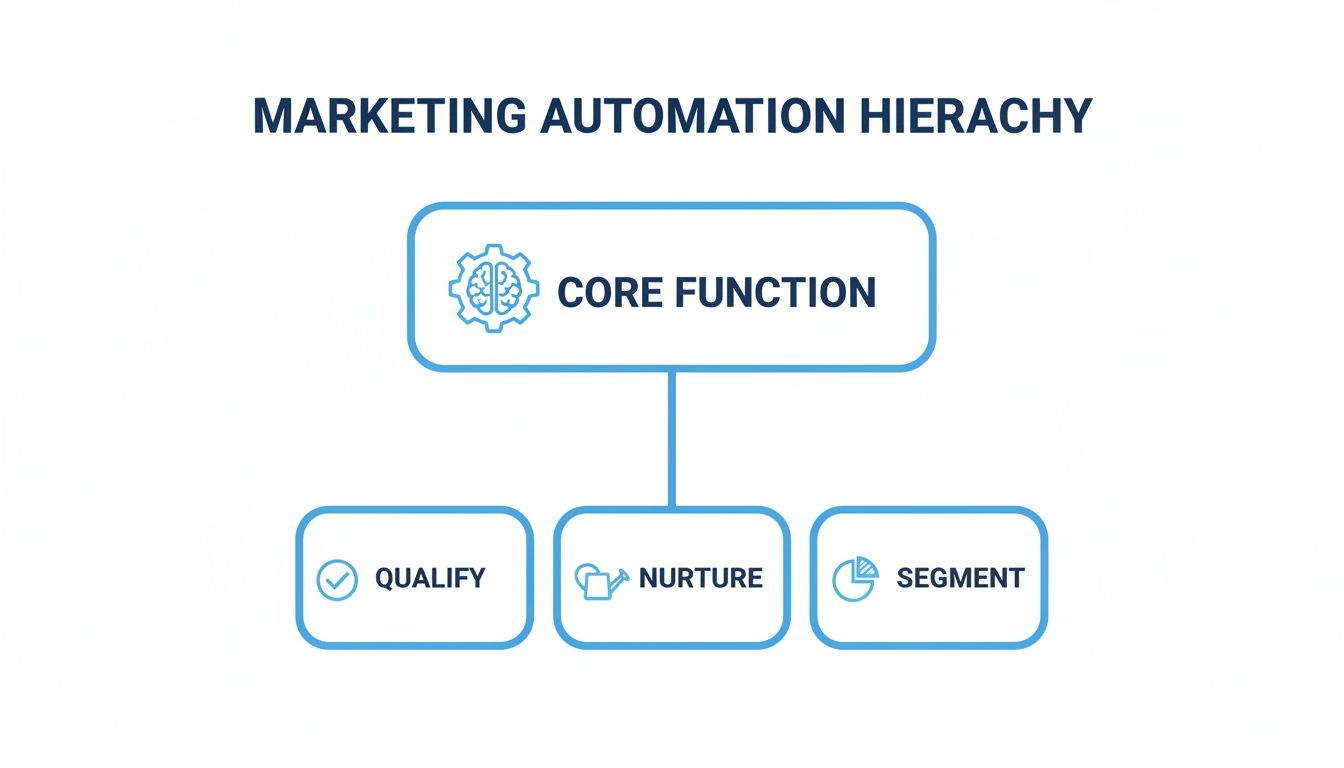
Understanding how these pillars work is the first step toward building a system that delivers real, measurable results. Let's break each one down.
Lead Nurturing: The Guided Journey
Lead nurturing is all about building relationships with prospects, no matter where they are in the sales funnel. It’s not about shouting your sales pitch at a stranger; it’s about having a thoughtful conversation that builds trust over time by delivering helpful, relevant content.
Imagine a user signs up for a free trial of your SaaS product. A smart nurturing workflow might look something like this:
- Day 1: A welcome email with a quick-start video to help them get that "aha!" moment.
- Day 3: An email highlighting a key feature they haven't tried yet.
- Day 7: A case study showing how a similar company found success with your platform.
This automated journey makes sure no lead falls through the cracks. It proactively educates and supports potential customers long before they ever talk to a salesperson.
Lead Scoring: The Temperature Check
Let's be honest: not all leads are created equal. Lead scoring is how you automatically figure out who's hot and who's not. It’s a temperature check for your pipeline, assigning points to leads based on who they are and what they do, so you can separate the sales-ready prospects from the tire-kickers.
Points are usually assigned for two types of data:
- Demographic Info: Things like job title (+10 for "VP of Marketing"), company size (+5 for 100-500 employees), and industry.
- Behavioral Actions: Actions speak louder than words. Did they visit the pricing page (+15), download a whitepaper (+10), or open a specific email (+5)?
Once a lead hits a set score (say, 100 points), they’re automatically flagged as a Marketing Qualified Lead (MQL) and handed off to the sales team. This ensures reps spend their time on the most promising opportunities, which has a massive impact on efficiency. And it's not just for the big guys—45% of small businesses have adopted automation, driven by cost savings and ROI. Research even shows a 14.5% boost in sales productivity from automation, which you can read more about in these marketing automation statistics.
Segmentation: Creating Hyper-Relevant Audiences
Segmentation is the art of dividing your audience into smaller, more focused groups. It’s what powers true personalization, letting you move away from one-size-fits-all messaging. Instead of blasting your entire database with the same email, you can create dynamic lists for hyper-targeted conversations.
A great B2B marketing automation strategy doesn't just send emails; it starts conversations. Segmentation ensures you're starting the right conversation with the right person.
Common ways to segment a B2B audience include:
- Industry: Sending a healthcare-focused case study only to contacts in the medical field.
- Job Role: Targeting VPs of Sales with content about pipeline management.
- Engagement Level: Creating a re-engagement campaign for leads who haven't opened an email in 90 days.
When you segment your list, your messaging resonates more deeply because it feels like you understand your audience, not just market to them. This is where data quality becomes non-negotiable; using high-quality data enrichment services can give your segmentation a huge advantage.
The table below summarizes how these core pillars function together to drive real business value.
B2B Marketing Automation Pillars Explained
Pillar
Function
Example Use Case
Business Impact
Lead Nurturing
Builds relationships over time with automated, relevant content.
Sending a sequence of educational emails to a new webinar registrant.
Increases lead-to-customer conversion rates and keeps your brand top-of-mind.
Lead Scoring
Ranks leads based on their demographic data and online behavior.
Automatically flagging a lead as "hot" after they visit the pricing page three times.
Focuses sales team's effort on the most qualified leads, improving efficiency and close rates.
Segmentation
Divides your audience into smaller groups based on shared traits.
Targeting CFOs with content about financial ROI and cost savings.
Boosts engagement and response rates by delivering highly personalized messaging.
Analytics
Measures the performance and ROI of marketing campaigns.
Tracking the conversion rate from MQL to a closed-won deal.
Provides data to prove marketing's revenue contribution and optimize future campaigns.
Each pillar supports the others. Nurturing works best with well-segmented lists, and lead scoring helps you decide which segments to prioritize. It all comes together to create a system that’s much more powerful than the sum of its parts.
Analytics and Reporting: Proving the ROI
The final pillar is analytics. This is where you connect the dots between your marketing activities and actual sales outcomes, proving your return on investment. Modern automation platforms have powerful dashboards that show you exactly what's working and what isn't.
Instead of getting lost in vanity metrics like opens and clicks, you can focus on the KPIs that the C-suite really cares about:
- MQL to SQL Conversion Rate: How many of the leads marketing generates are actually accepted by sales?
- Sales Cycle Length: Is automation helping to shorten the time it takes to close a deal?
- Pipeline Velocity: How quickly are deals moving through the funnel?
- Customer Acquisition Cost (CAC): What is the total cost to acquire a new customer through your automated campaigns?
By focusing on these metrics, you can have a real conversation about revenue impact. This data-driven approach allows for continuous improvement, so you can fine-tune your workflows and double down on the strategies that are truly driving growth.
How to Build Your B2B Automation Tech Stack
Your B2B marketing automation platform is a powerful tool, but it truly shines when it’s connected to your other growth tools. Building a "tech stack" is all about making your different systems talk to each other, getting rid of those frustrating data silos and creating one clear picture of your customer.
Think of your marketing automation tool as the brain of your operation. For it to make smart decisions, it needs good information from the rest of the body—your CRM, data tools, and any other channels you use. When these systems are in sync, you create an intelligent growth engine that works for you.
Imagine this: a new lead signs up for your newsletter. Their contact info is automatically enriched with their company and role, scored based on how well they fit your ideal profile, and then instantly sent to a sales rep's CRM queue. No one has to lift a finger. That's what an integrated tech stack can do.
The Core Components of Your Stack
Putting together a B2B automation stack doesn't need to be overwhelming. You can start with just a few key pieces that work together to create a smooth data pipeline, from that first contact all the way to a closed deal.
Here are the essentials:
- Marketing Automation Platform (MAP): This is your command center. Whether it’s a tool like HubSpot or Marketo, or a specialized newsletter platform like Breaker, this is where you’ll build your automated workflows, segment audiences, and run campaigns.
- Customer Relationship Management (CRM): Your CRM (think Salesforce or Pipedrive) is where all your customer interactions live. A solid integration means lead data, engagement history, and scoring from your MAP syncs directly to sales, giving them a complete view of every prospect.
- Data Enrichment and Hygiene Services: Good, clean data is everything. Tools like Clearbit or built-in AI enrichment features clean up your contact lists, add valuable details like company size and job titles, and make sure your segmentation is spot-on.
These three parts are the backbone of any modern B2B growth stack. Getting them to work together makes a level of coordination possible that used to be a pipe dream.
Creating a Unified Growth Engine
A connected tech stack isn't just about shuffling data around. It’s about creating a single source of truth that finally gets marketing and sales on the same page. When both teams are working from the same playbook with the same data, handoffs are seamless and communication just flows. That kind of alignment is what really speeds up a sales cycle.
A disconnected tech stack creates friction. An integrated one creates momentum. Your goal is to build a system where data flows freely, empowering every team to make smarter, faster decisions.
For product-led growth teams, this setup isn't a "nice-to-have"—it's the engine that turns a great newsletter into a lead-generating machine. You can discover more insights about marketing automation statistics here to see the trends shaping this space.
Integration in Action
So, what does this actually look like day-to-day? A well-oiled stack fuels workflows that have a real impact on revenue. For example, when a lead opens a marketing email and clicks a specific link, that action can automatically create a task for a salesperson inside the CRM.
This integration is also how you prove your ROI. When your MAP and CRM are connected, you can build reports that trace a lead's journey from their very first click on an email all the way to a closed-won deal. It gives you undeniable proof of marketing's contribution to the bottom line. If you're ready to get started, you can learn more about creating your first workflow in our guide.
Ultimately, building a smart tech stack is what shifts marketing from a cost center to a predictable, data-driven revenue engine.
Automating B2B Newsletters for Growth

While automation can touch every part of the customer journey, your B2B newsletter is where you can build one of the most powerful lead-gen engines you have. It’s a direct line to your audience, but without automation, it’s just another content channel.
Add automation, and your newsletter transforms into a predictable source of qualified leads. The goal is to graduate from manually sending weekly updates to running an automated system that acquires, nurtures, and converts subscribers with very little hands-on effort. This is where marketing automation for B2B stops being a buzzword and becomes a tactical tool that ties your content directly to revenue.
Defining Your Ideal Subscriber Profile
Before you automate a single thing, you have to know exactly who you’re talking to. The first step is to define your Ideal Customer Profile (ICP). An ICP isn't just a job title; it's a detailed picture of the company and the specific person who gets the most value from what you sell.
Think about both the company and the person:
- Company Size: Are you selling to scrappy startups or established enterprise clients?
- Industry: Which sectors feel the pain points you solve most acutely?
- Job Titles: Who are the decision-makers, and who are the key influencers you need on your side?
- Technographics: What other tools are already in their software stack?
This profile becomes the blueprint for your subscriber acquisition. A platform like Breaker can use this ICP to automatically find and add engaged, exact-match subscribers to your list, turning growth from a manual chore into a hands-off process.
Building Your Automated Newsletter Funnel
Once you know who you're targeting, you can build the automated workflows that turn subscribers into leads. This isn't one giant, complicated sequence but a series of smaller, interconnected campaigns triggered by what your subscribers actually do.
1. The Automated Welcome Sequence
Your first impression is everything. A welcome sequence is an automated series of emails sent to new subscribers, designed to build trust and deliver a hit of immediate value. It's your chance to properly onboard them into your world.
- Email 1 (Immediate): Confirm their subscription and deliver any promised lead magnet. Remind them why they signed up.
- Email 2 (Day 3): Share one of your greatest hits—your most popular article or a powerful case study.
- Email 3 (Day 5): Ask a simple question to encourage a reply and learn more about their challenges.
This simple workflow ensures every new subscriber gets a consistent, positive first experience with your brand.
2. Link-Triggered Nurturing Workflows
This is where your automation starts getting really sharp. Instead of just tracking opens and clicks, you can create workflows that kick off when a subscriber clicks a specific link in your newsletter.
Imagine a subscriber clicks a link to an article about "improving sales team productivity." This isn't just a click; it's a powerful buying signal. An automated workflow can then pull this contact into a targeted sequence of emails focused entirely on your product's sales-related features and benefits.
This technique lets you segment your audience based on their self-professed interests, delivering hyper-relevant content that naturally moves them closer to a sale. Setting up these targeted journeys is a core function of effective marketing automation for B2B. If you're looking for a detailed walkthrough, check out our guide on how to get started with newsletter automation setup.
The market for these capabilities is exploding, with Statista forecasting it will reach $13.71 billion by 2030. For marketers on the ground, those using these tools see 80% better lead generation and a massive 451% increase in qualified leads just through nurturing. You can find more data by exploring the latest marketing automation statistics.
Connecting Newsletters Directly to ROI
Ultimately, the point of automating your B2B newsletter is to prove its value as a primary growth channel. By integrating your newsletter platform with your CRM, you can finally track a subscriber’s entire journey, from their first click to becoming a paying customer. When building your tech stack, it's essential to consider the specialized platforms available. Exploring the top 12 SaaS marketing automation tools can help you find the right fit for your B2B growth goals.
This closed-loop reporting lets you answer the questions that really matter:
- Which newsletter campaigns brought in the most MQLs?
- What is our average conversion rate from a new subscriber to a new customer?
- What is the total revenue influenced by our newsletter?
Armed with this data, your newsletter is no longer a "nice-to-have" marketing activity. It becomes a documented, predictable revenue driver for the business.
Your B2B Marketing Automation Checklist
Alright, you get the theory behind B2B marketing automation. But how do you actually do it without getting bogged down? Turning all that strategy into action can feel overwhelming, so we’ve put together a practical checklist to get you started.
Think of it as a crawl-walk-run game plan. Follow these steps, and you’ll build a smart automation strategy that delivers early wins and sets you up for long-term success.
1. Define Your Goals
Before you even think about touching any software, you need to know what you’re aiming for. What does success look like? Vague goals like “get more leads” just won’t cut it. You have to get specific.
Your goals need to be measurable and tied directly to real business outcomes. Here are a few solid examples:
- Increase Marketing Qualified Leads (MQLs) by 20% in the next quarter.
- Reduce the average sales cycle length from 90 to 75 days.
- Improve the MQL-to-SQL conversion rate by 15%.
These clear targets become your North Star, guiding every decision you make from here on out—from the platform you choose to the first workflow you build.
2. Map Your Customer Journey
Next, you need to put yourself in your customer’s shoes. What’s the typical path someone takes from hearing about your brand for the first time to signing a contract? Map out those key stages and the touchpoints that matter most.
For each stage, think about the questions your prospects have and the information they need to move forward. This map is the blueprint for your lead nurturing, ensuring you send the right message at the right time.
A journey map turns your automation from a bunch of disconnected actions into a cohesive, customer-centric experience. It’s the difference between building relationships and just sending emails.
3. Organize Your Data and Choose a Platform
Your automation engine is only as strong as the data you feed it. Before you dive in, take the time to clean up your existing contact database. Make sure your data is accurate, complete, and segmented in a way that makes sense for your business.
Once your data is in good shape, it’s time to pick your platform. Look for a tool that fits your budget but, more importantly, plays nicely with your existing CRM. For newsletter-focused growth, a platform like Breaker that bundles sending with automatic subscriber acquisition can be a seriously powerful choice.
4. Build Your First Workflow
Don't try to boil the ocean. Seriously. Start small with a single, high-impact workflow that you can manage easily. A welcome sequence for new subscribers or a simple nurturing campaign for fresh leads are perfect places to begin.
Here’s a simple plan to get your first one live:
- Pick a trigger: What action kicks off the workflow? (e.g., a new subscriber signs up via a form).
- Outline the steps: Map out the sequence of emails and the time delays between them.
- Create the content: Write clear, helpful, and concise emails for each step.
- Launch and watch: Activate the workflow and keep a close eye on the initial results.
5. Test and Iterate Based on Performance
Finally, remember that marketing automation is never a "set it and forget it" game. Your work is never really done. You need to constantly monitor your analytics to see what’s working and what’s falling flat.
Pay close attention to metrics like open rates, click-through rates, and conversion rates at every stage of your funnel. Use A/B testing to experiment with different subject lines, content, and calls to action. This cycle of testing and iterating is what separates a good automation strategy from a great one.
Frequently Asked Questions
Stepping into the world of B2B marketing automation can bring up some questions, especially when you're just getting your bearings. Here are a few of the most common ones we hear from teams looking to get started or fine-tune their strategy.
Is Marketing Automation Only for Large Enterprises?
Not anymore. While big companies were definitely the first to jump on board, today’s platforms are built to be affordable and scalable for businesses of all sizes. Many now offer pricing that’s tied to your results and features designed specifically for leaner teams.
Think of it this way: automation levels the playing field. It gives small and mid-sized businesses the power to run sophisticated marketing programs that can compete with the big players, all without needing a huge team to manage every moving part.
Will Marketing Automation Make My Outreach Feel Robotic?
This is a common fear, but good marketing automation actually does the exact opposite—it lets you personalize your outreach at a scale you could never pull off manually. That "robotic" feel people worry about comes from poorly planned, generic campaigns, not the tech itself.
A smart strategy uses segmentation and dynamic content to make sure every message feels relevant and strengthens your relationship with the prospect. It’s about being more human, not less.
By tapping into data on a contact's behavior, job title, and interests, you can send them content that’s both timely and genuinely helpful. That's how you make your outreach feel more personal, not more automated.
How Do I Measure the ROI of Marketing Automation?
Measuring your return on investment is not just possible—it’s essential. The key is to track the metrics that have a direct line to your sales pipeline. You'll want to keep a close eye on:
- The number of Marketing Qualified Leads (MQLs) you generate.
- Your conversion rate from MQL to Sales Qualified Lead (SQL).
- Any changes to your average sales cycle length.
- The impact on your customer acquisition cost (CAC).
When you connect your automation platform to your CRM, you can draw a straight line from your marketing activities to actual revenue. This makes it easy to show the real financial impact of your work.
Ready to turn your B2B newsletter into a predictable growth engine? Breaker combines powerful email sending with automated list expansion to find your ideal customers and fill your pipeline. Start your free 7-day trial today.
Keep reading
All articlesBreaker for B2B, SME and Consumer Newsletter Senders
Learn how B2B, SME, and consumer audiences differ in newsletters, plus a framework for segmenting, messaging, and monetizing each without losing relevance.
What Is a B2B Content Engine
Learn what a B2B content engine is, how it differs from a content calendar or strategy, and why it's essential for AI-driven search in 2026.
8 Best Email Tracking Software Tools in 2026
Compare 8 top email tracking tools for 2026, how tracking pixels work, and why Apple's privacy rules make open rates unreliable. See our top pick.