
Your Guide to a B2B Marketing Automation Platform
Discover what a B2B marketing automation platform is, its core benefits, how to choose one, and actionable workflows to drive growth and ROI for your business.
Your team probably has the same problem most B2B teams have. Leads live in the CRM, campaign data lives in the email tool, intent signals sit in another dashboard, webinar attendance is buried in a CSV, and sales still asks the same question every week: which of these contacts are worth a call?
That's usually the moment people start looking for a B2B marketing automation platform. Not because they want another tool, but because the current setup leaks time, context, and pipeline. Manual handoffs slow down follow-up. Static lists go stale. Reporting turns into an argument instead of a decision-making system.
A good platform fixes that by turning scattered activity into coordinated action. It gives marketing one place to track behavior, trigger follow-up, route signals to sales, and measure whether any of it is moving buyers forward. In a category this mature, that shift isn't optional anymore. The global marketing automation software market is projected to grow from USD 9.80 billion in 2025 to USD 36.97 billion by 2035, at a 14.20% CAGR, and businesses using these solutions to manage leads report a 10% revenue increase within 6 to 9 months according to this marketing automation market projection.
Beyond Spreadsheets and Scattered Tools
Most B2B marketers don't suffer from a lack of activity. They suffer from disconnected activity.
One team runs paid campaigns. Another sends newsletters. Sales works inside the CRM. Someone exports webinar registrants every Friday. Someone else manually tags leads after they visit a pricing page. The problem isn't effort. The problem is that each motion creates a fragment, and nobody sees the whole buying journey in time to act on it.
Where the chaos actually shows up
The cracks usually appear in four places:
- Lead follow-up slows down: A prospect shows buying intent, but the alert reaches sales too late.
- Nurture becomes generic: Everyone gets the same sequence because segmentation is hard to maintain.
- Reporting becomes political: Marketing reports engagement. Sales reports pipeline. Finance wants revenue.
- Operations become brittle: One broken integration or spreadsheet formula throws off routing and attribution.
A B2B marketing automation platform works best when you treat it as the operating layer between buyer activity and team response. It collects signals, updates records, applies rules, triggers messaging, and creates enough shared context that sales and marketing stop arguing about whose data is right.
Practical rule: If your team still needs spreadsheets to explain who engaged, what they did, and what should happen next, your stack isn't automated. It's partially digitized.
That distinction matters. Plenty of teams buy software and still run the same manual process inside a nicer interface.
What changes when the system is connected
The value isn't just convenience. It's visibility and timing.
When the platform is wired correctly, a form fill, webinar registration, content download, repeat site visit, or pricing-page session can change what the buyer sees next and what sales does next. That creates a single motion instead of a chain of disconnected tasks. It also forces better upstream discipline around lifecycle stages, ownership, and data structure, which is why solid CRM operating habits matter before automation gets layered on top.
That's the key appeal. A strong platform doesn't replace strategy. It makes strategy executable at scale.
What a B2B Marketing Automation Platform Actually Is
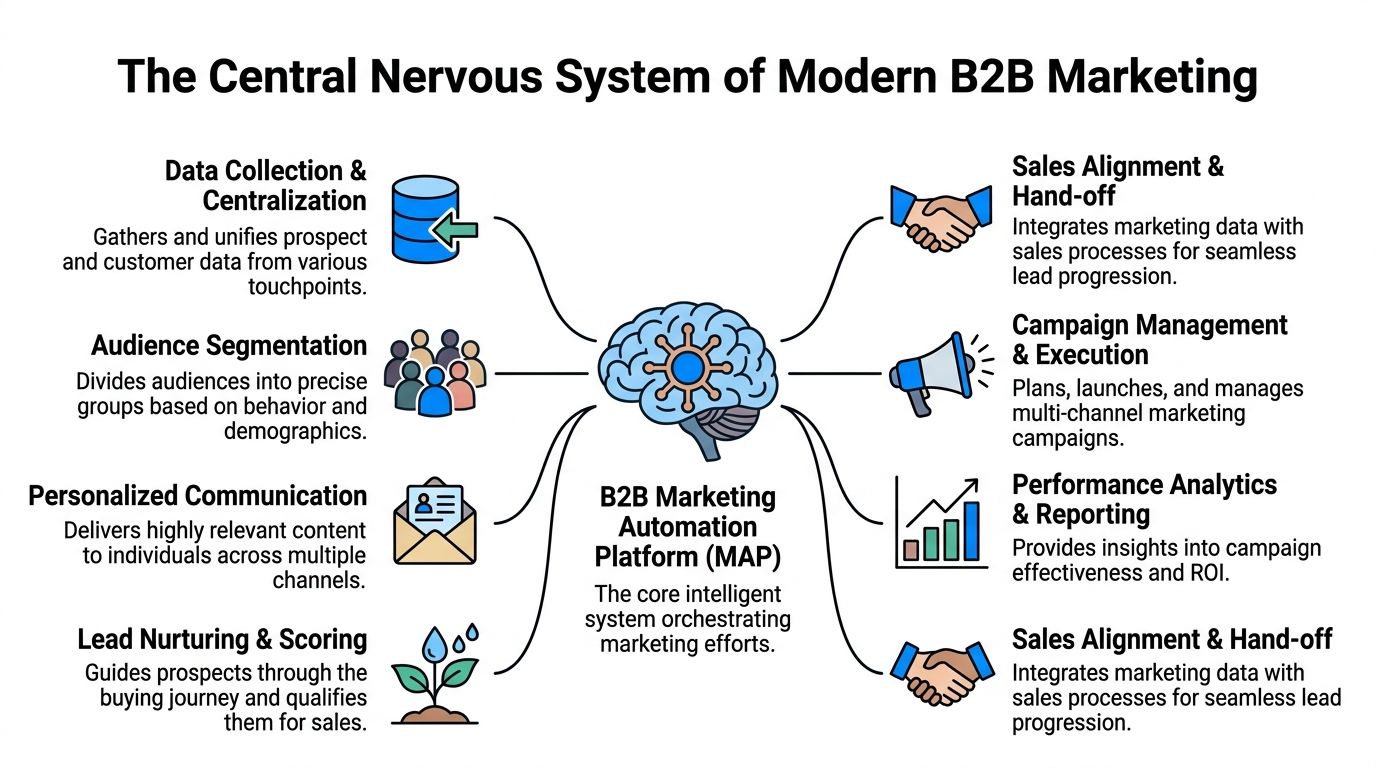
A B2B marketing automation platform is easiest to understand as the central nervous system of your marketing operation.
Your website, email program, CRM, webinar tool, ad platforms, forms, and sales alerts are the limbs. Buyer behavior is sensory input. The automation platform receives that input, interprets it, and tells the rest of the system what to do next.
What it coordinates every day
At a practical level, the platform usually handles work like this:
- Collecting signals: page views, form fills, email clicks, event attendance, content engagement
- Segmenting audiences: by role, account, industry, buying stage, or behavior
- Triggering communication: nurture emails, reminders, routing notifications, task creation
- Scoring readiness: deciding which people or accounts deserve attention now
- Syncing with sales tools: so reps don't work from stale or partial information
- Reporting performance: so marketing can connect activity to pipeline, not just clicks
That sounds straightforward until you apply it to a real B2B buying motion.
In B2C, automation often optimizes for volume and speed. In B2B, it has to support long sales cycles, multiple stakeholders, committee-based decisions, and purchases that carry more risk. One person downloads the guide. Another joins the demo. Procurement appears late. Legal slows everything down. A B2B platform has to recognize that these aren't isolated contacts. They're pieces of one deal.
Why B2B automation feels more operational than promotional
That's why feature lists can be misleading. The job isn't just to send emails. The job is to help revenue teams manage uncertainty across a messy buying process.
A good platform should help marketing answer questions like:
Question
Why it matters
Who is actually researching?
So sales doesn't chase casual engagement
Which account is warming up?
So outreach matches buying momentum
What content fits this stage?
So nurture reflects buyer context
When should sales step in?
So handoff happens at the right moment
If your team is also trying to sharpen the handoff from engagement to conversation, this guide on generating qualified B2B meetings is useful because it focuses on what happens after interest appears, which is where many automation programs break down.
One more thing matters here. The platform isn't your ESP with extra buttons. It's the system that decides who should get what, when, and why. If you're sorting through the line between an email service provider and a broader automation layer, this breakdown of ESP roles in email marketing helps clarify where simple sending ends and orchestration begins.
The best automation setups don't feel automated to the buyer. They feel well-timed.
Core Capabilities That Drive B2B Growth
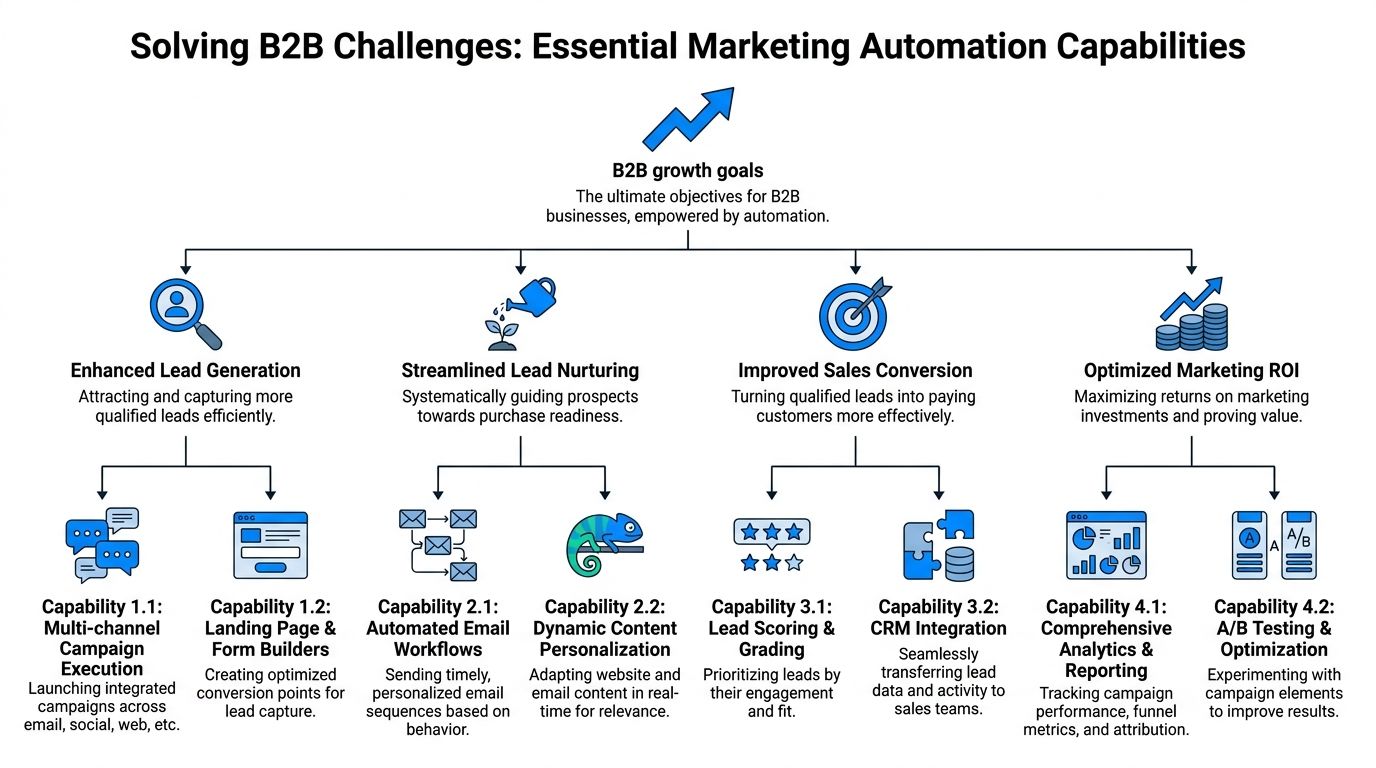
Feature checklists are easy to compare and almost useless for buying decisions. The better question is which capabilities solve the problems your team already feels every week.
Lead nurturing for long sales cycles
Most B2B buyers don't convert on the first touch. They read, disappear, revisit, compare vendors, pull in colleagues, and come back when timing changes. Without structured nurture, marketing either goes silent or sends generic blasts that don't match where the buyer is.
This is where workflow automation earns its keep. Sequences can adapt to what people do, not just when they entered the list. Someone who attends a webinar can receive deeper evaluation content. Someone who only downloaded a top-of-funnel guide can stay in educational nurture. Someone who visits pricing may trigger a different path entirely.
The payoff can be substantial when nurture is paired with scoring and behavioral logic. Organizations utilizing nurture workflows with lead scoring and behavioral triggers see MQL-to-SQL conversion rates increase by 30% to 50% compared to traditional batch-and-blast email, and the average ROI for marketing automation is $5.44 for every dollar spent, according to these 2026 marketing automation data points.
Lead scoring for better sales trust
Sales doesn't need more leads. Sales needs fewer false positives.
A mature B2B marketing automation platform helps score both fit and behavior. Fit asks whether this person or account resembles your ideal customer. Behavior asks whether they're acting like an active buyer. Both matter. A junior contact at the right company may need nurture. A highly engaged contact at the wrong company may never close.
That's also why teams need shared definitions. If marketing calls someone a lead after one ebook download and sales expects active evaluation, trust erodes fast. A simple distinction helps resolve this. If your team still blurs the line, this explainer on understanding lead and prospect roles gives a clean operational framing.
A scoring model should help sales prioritize. If it creates more debate, it's not a model. It's a noise generator.
CRM integration for clean handoff
Automation without CRM alignment creates a polished front end and a broken back end.
When a lead score changes, a form is submitted, or a target account shows new activity, sales should see that context inside the system they already use. Not in a separate report. Not in a weekly export. Not after someone from marketing manually pushes an update.
The strongest setups also preserve history. Reps should be able to see what content the contact consumed, which campaign sourced them, whether others from the same account engaged, and what stage marketing believes they're in. That context changes the quality of outreach.
Analytics for proving what matters
A platform also has to answer the uncomfortable question. Did this program create pipeline, or did it just create activity?
Good reporting doesn't stop at opens and clicks. It maps campaigns to progression: inquiry to MQL, MQL to SQL, opportunity creation, and revenue influence. Even if attribution in B2B is never perfectly clean, teams still need directional truth. Which workflows accelerate deals? Which channels create junk? Which content moves accounts from interest to evaluation?
The business case gets stronger when analytics are tied to action. A report alone doesn't improve performance. A report that identifies drop-off points and triggers operational fixes does.
The capabilities that usually matter first
If a team is choosing where to focus first, these are usually the highest-value capabilities:
- Behavior-based nurture: Keeps your brand present during slow buying cycles.
- Shared scoring logic: Gives marketing and sales one definition of readiness.
- Reliable CRM sync: Prevents promising leads from falling into a handoff gap.
- Lifecycle reporting: Shows whether campaigns influence pipeline, not just engagement.
The pattern is simple. The capabilities that drive growth aren't the flashiest ones. They're the ones that reduce delay, improve relevance, and make the next action obvious.
Choosing the Right Platform for Your Business
The wrong way to buy a B2B marketing automation platform is to compare feature grids until one vendor appears to offer the most. The right way is to decide what operating model your team can support.
Some companies need one system that does almost everything in one place. Others get better results from a focused stack that combines a CRM, automation layer, analytics, and specialized tools. Neither path is universally better. The fit depends on your team, your process discipline, and how complex your go-to-market motion is.
The first decision is architectural
Here's the practical trade-off.
Criterion
All-in-One Platform (e.g., HubSpot, Marketo)
Best-of-Breed Stack (e.g., CRM + Breaker + Analytics Tool)
Speed to launch
Faster if your team wants one vendor and fewer moving parts
Slower at first because setup and integration need more planning
Flexibility
Good, but you're limited by the vendor's opinionated workflow model
Stronger if you want to choose the best tool for each job
Reporting consistency
Easier when data stays in one environment
Depends on how well the tools sync and how clean your data model is
Cost control
Simpler on paper, but bundled pricing can climb as usage grows
More modular, though overlapping tools can create waste
Operational complexity
Lower day to day for lean teams
Higher, especially if nobody owns integrations and process design
Specialization
Broad capability
Strong depth in specific functions
All-in-one platforms usually work best for teams that want speed, simpler onboarding, and fewer dependencies. Best-of-breed stacks make sense when one area of the journey needs deeper support than a single suite can offer. That could be analytics, enrichment, newsletter growth, account intelligence, or advanced segmentation.
The most overlooked buying criterion
Most buyers ask about workflow builders, templates, AI features, and dashboards. Fewer ask how fresh the data is when a buyer does something important.
That's a mistake.
68% of marketers report that stale lead scores from batch-processed systems cause delayed sales alerts, while 74% of successful implementations mandate real-time CRM integration to share data instantly, according to this analysis of real-time CRM integration in B2B marketing automation.
If your platform updates scores or segments on a delay, your sales team may miss the small window when buyer interest is strongest. In B2B, that lag isn't a technical nuisance. It's a conversion problem.
Ask vendors one blunt question: when a prospect visits a high-intent page, how long until sales sees it in the CRM?
If the answer is vague, the rest of the demo doesn't matter much.
Questions worth asking before you sign
Skip broad prompts like "Does it support personalization?" Every platform will say yes. Ask operational questions instead.
- How does the platform handle score updates? You want to know whether key changes happen instantly or on a batch schedule.
- What does the CRM sync include? Contacts alone aren't enough. Activity history, field updates, lifecycle status, and ownership logic matter.
- How hard is troubleshooting? Broken workflows happen. You need logs, clear conditions, and a team that can debug without filing a ticket for every issue.
- Can non-technical marketers build and change workflows? If every edit needs ops support, velocity drops.
- What happens when your process changes? Organizations often outgrow their first lifecycle model. The platform should adapt without requiring a rebuild.
What usually works in practice
For lean teams, a strong all-in-one tool often wins because adoption matters more than theoretical sophistication. A simpler platform used well beats a complex platform used halfway.
For mature teams with specialized channel owners, a best-of-breed stack can be the better choice because it lets each system do one job well. But that only works if someone owns the architecture. Without process discipline, best-of-breed turns into best-of-luck.
The smartest buyers don't ask which platform is best overall. They ask which platform best supports the job their team must do every day.
Actionable Automation Workflows for B2B Teams
The easiest way to judge a B2B marketing automation platform is to stop thinking in features and start thinking in workflows. If you can't picture how a buyer moves through the system, the platform probably won't help much.
Here's what that looks like in practice.
A new inbound lead who isn't sales-ready yet
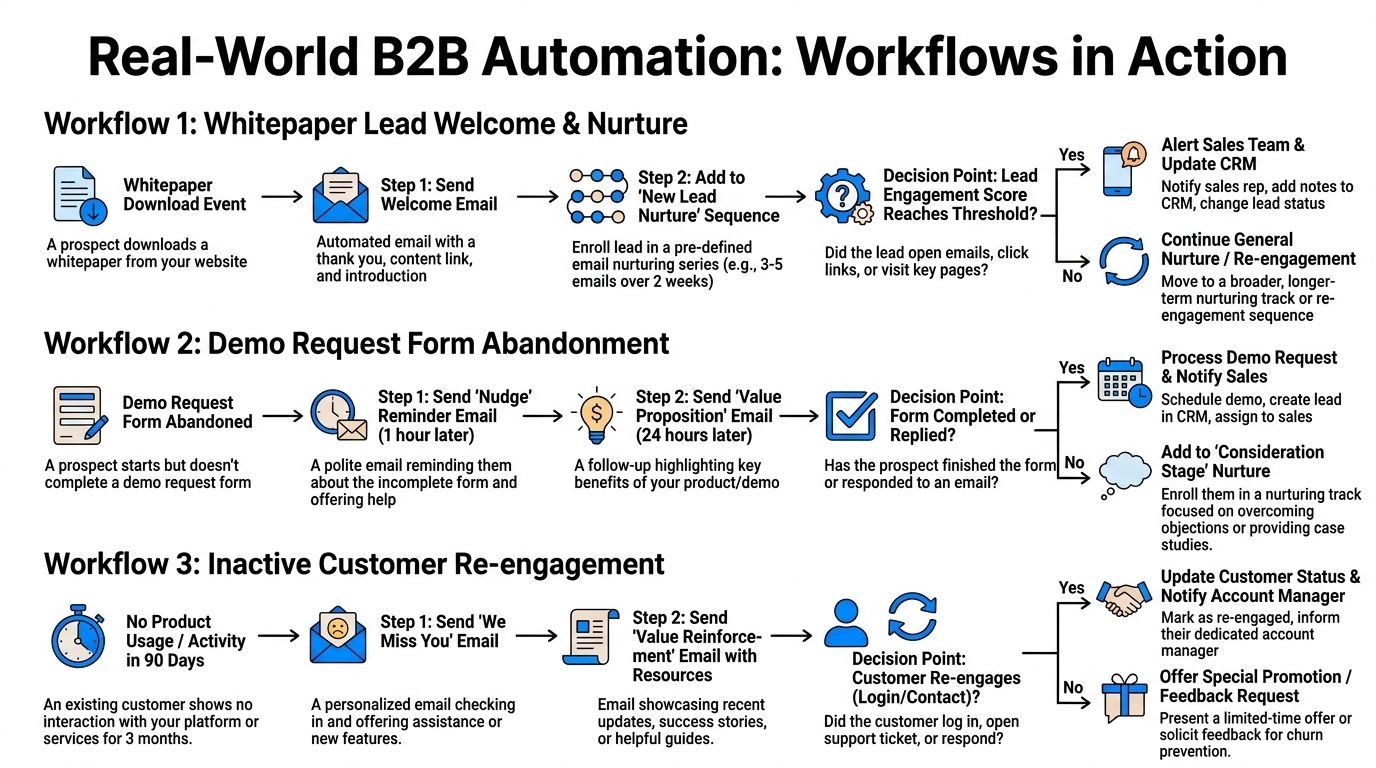
A prospect downloads a whitepaper from your site. That action matters, but it doesn't mean they want a call today.
The first workflow should acknowledge the conversion quickly, deliver the promised asset, and place the lead into a short nurture stream based on topic and role. If they consume follow-up content, revisit the site, or engage with comparison pages, the system can raise the score and alert sales. If they don't engage, they shouldn't disappear. They should move to slower educational nurture.
This is the basic pattern:
- Trigger: whitepaper download
- Immediate action: send the asset and a short thank-you email
- Next step: enroll in a topic-based nurture sequence
- Decision point: check for meaningful engagement
- Outcome: route to sales if ready, or continue nurture if not
That sounds simple because it should be simple. Teams often overcomplicate early workflows with too many branches, too many scores, and too many exceptions. Start with a clean path and add logic only when you have a clear reason.
If you're building these journeys from scratch, this practical guide to a marketing automation workflow is a good reference for structuring triggers, actions, and decision points without creating workflow sprawl.
A buyer who started a demo request and stopped
This one gets ignored more often than it should.
Someone visits your demo page, starts filling out the form, and exits. That's not a cold lead. That's a warm lead with friction. A strong automation setup treats abandonment as a signal, not a dead end.
The first follow-up should be short and useful. Remind them they can finish the request and offer help. If they still don't convert, the next message should focus on value, not pressure. It might highlight the use case they were likely exploring or answer common evaluation questions.
After that, route them differently based on behavior:
- If they complete the form: notify sales and create the appropriate record.
- If they reply with a question: route to the right rep or queue.
- If they ignore both messages but continue browsing: add them to a consideration-stage sequence.
- If they disappear completely: pause and re-enter them later through broader nurture.
A lot of abandoned demo workflows fail because the emails sound like a cart recovery campaign copied from ecommerce. B2B buyers need reassurance, relevance, and a reason to keep moving.
Here's a useful walkthrough before building more advanced automations:
A target account showing hidden demand
Modern platforms become more interesting.
Some accounts won't fill out a form until late in the process. They conduct independent research. Multiple people visit content. Pricing or comparison pages get repeat traffic. Anonymous behavior starts to cluster around one account. Good automation can detect that pattern and change your response before the hand raise arrives.
AI-driven intent signals now enable platforms to identify hidden demand by analyzing anonymous buyer behavior, allowing marketing teams to prioritize high-propensity accounts with 65% higher conversion accuracy than traditional lead scoring, based on this review of AI-driven intent signals in B2B automation.
That doesn't mean you unleash aggressive outbound immediately. It means you adapt the account experience.
A practical workflow might do this:
Signal
Automated response
Repeated visits from a target account
Increase account priority and notify account owner
Engagement with solution or pricing content
Swap generic nurture for evaluation-stage content
Multiple stakeholders showing activity
Serve messaging tailored to different roles
Strong account-level intent with no form fill
Trigger coordinated marketing and sales review
When anonymous behavior starts to look organized, treat the account as active even if no single contact has raised a hand.
That's the job-to-be-done view of automation. You're not building workflows because the platform can. You're building them because buyers move unevenly, and your team needs a reliable way to respond without starting from zero each time.
Implementation Best Practices and Common Pitfalls
Most automation failures aren't caused by weak software. They're caused by weak operating habits.
A B2B marketing automation platform can route signals, trigger campaigns, and surface performance. It can't fix muddy lifecycle stages, duplicate records, unclear ownership, or a sales team that doesn't trust the scoring model. Those problems just become more visible after implementation.
What works when teams get this right
Start small and make the first workflows count. A welcome nurture, a high-intent handoff, and one re-engagement sequence are usually enough to prove value and expose process gaps. Once those run cleanly, expand.
It also helps to lock down the basics before launch:
- Agree on lifecycle definitions: Marketing and sales need the same meaning for inquiry, MQL, SQL, and opportunity.
- Clean your data first: Bad fields, duplicates, and broken ownership rules spread fast once workflows start firing.
- Assign one operational owner: Someone has to manage logic, QA, sync issues, and reporting changes.
- Review workflows on a schedule: Nurture paths degrade when offers, messaging, and routing rules go stale.
What tends to go wrong
The first common mistake is treating the platform like an email blaster with nicer segmentation. That wastes most of the value.
The second is building too much too early. Teams map every possible branch, every exception, and every persona before they've validated the basics. Complexity arrives long before clarity.
The third is "set it and forget it." Automation doesn't stay effective on autopilot. Offers change. buyer behavior changes. Sales feedback changes. A sequence that worked six months ago can underperform for weeks without notice if nobody reviews it.
Good automation is maintained. Great automation is challenged regularly by sales feedback and performance data.
A practical implementation mindset
Think of automation as a program, not a project. The software may launch on a date. The operating model won't be finished on that date.
The best teams run it like a continuous system. They check handoff quality. They listen to sales calls. They refine score thresholds. They remove dead branches. They update nurture content when buyer objections shift. That's where results come from.
If you're evaluating success, don't start with vanity metrics. Start with operational ones. Are leads routed correctly? Do reps act on alerts? Are nurture paths matching actual buying stages? Once those are reliable, pipeline reporting becomes more meaningful.
A platform helps when it makes good decisions easier and bad process harder to ignore. That's the standard worth using.
If your team wants a simpler way to turn newsletters into a reliable acquisition channel, Breaker is built for that job. It combines email sending, audience growth, targeting, deliverability support, and real-time analytics in one workflow, which makes it a strong fit for B2B teams that want newsletter-led lead generation without stitching together multiple tools.
Keep reading
All articlesDrip Campaign Template: Ready-to-Use Email Sequences
Get 6 ready-to-paste drip campaign templates with subject lines, body copy, and send timing—plus a step-by-step guide to building your own.
Post-Webinar Survey Questions Template (2026)
30+ post-webinar survey questions with NPS, CSAT, and CES templates, plus timing and length tips to boost completion and qualify leads faster.
GDPR Consent Requirements for Purchased Email Lists
Purchased email lists rarely meet GDPR's consent bar. Learn the legal basis rules, PECR overlap, and safer alternatives before you hit send.