
How to Sell an Idea: The B2B Playbook for Buy-In
Learn how to sell an idea with this step-by-step playbook for B2B marketers. Master stakeholder mapping, storytelling, pitching, and objection handling.
80% of sales require at least 5 follow-up calls or meetings, while the average person stops after 2 attempts. 60% of customers say no four times before saying yes, and idea selling works the same way when the room is skeptical and the budget is tight.
That's why the question isn't how to make a pitch sound better. It's how to keep an idea alive long enough for the right people to understand it, pressure-test it, and feel safe backing it. The difference between ideas that land and ideas that die is usually not brilliance, it's sell-through.
You've probably seen a strong concept get nodded at in a meeting, then disappear into a shared drive. The slide deck was clean, the logic was sound, and the room still moved on. That gap between interest and adoption is where most B2B ideas get lost.
A good guide to selling lead gen makes the same point in a different context, the first conversation rarely closes the deal. The lesson is broader than lead generation. If you want buy-in, you need a repeatable way to earn it, not just a persuasive opening.
Why Great Ideas Die Without a Sell-Through Plan
The weakest place to lose a good idea is in a meeting where everyone nods, nobody owns the next step, and the concept slowly disappears into calendars, side conversations, and internal politics. That failure mode is common because the room can agree that an idea is smart and still leave without a clear path to action.
A polished pitch does not fix that gap. In B2B buying, people usually study the idea before they speak to you, compare it against alternatives, and arrive with an opinion already forming. That means work starts before the meeting and continues after it, inside the buyer committee and the procurement process, where attention is fragmented and skepticism is high.
The first pitch is only the opening move
The practical mistake is treating the first meeting like the point of decision. It is only the first checkpoint in a longer effort to reduce uncertainty, create internal advocates, and make approval feel safe. A strong idea-selling process needs a clear opening, a reason to reconnect, and evidence that keeps building instead of repeating the same claim in different words.
Practical rule: If the room seems interested but noncommittal, treat that as incomplete conviction, not rejection.
Persistence matters more than polish. The guide to selling lead gen makes the same point from a service-selling angle, first contact rarely carries the whole decision. That lesson applies to internal ideas too. A sponsor may like the concept, but if the follow-through is thin, the idea gets parked until attention shifts elsewhere.
What the modern buyer expects
Modern buyers are busy, but the deeper issue is how they buy with other people. They want relevance fast, they want material they can forward, and they want enough evidence to defend the idea in a room they are not controlling. If your proposal cannot survive outside your presentation, it will not survive the committee.
HubSpot sales statistics and sales summaries from EmailAnalytics sales statistics point to the same practical reality. Buyers do their homework early, often before they ever give you time on the calendar, which puts your idea under review long before you start talking. You do not get to rely on a clean deck and a confident delivery. You need a sell-through plan that keeps the idea visible, credible, and easy to revisit until the right people are ready to act.
Mapping Every Stakeholder Before You Pitch
A committee doesn't buy ideas as a group, it buys them person by person. The sponsor wants momentum, the finance lead wants fewer surprises, the operator wants something that won't blow up their workflow, and procurement wants clean terms. If you pitch everyone the same way, you're really pitching no one.
Start with a one-page stakeholder matrix before you write a slide. Put every name in the decision chain on paper, then add three columns, what they care about, what they fear, and what language they use when they talk about the problem. That simple exercise is usually enough to show where the friction really lives.
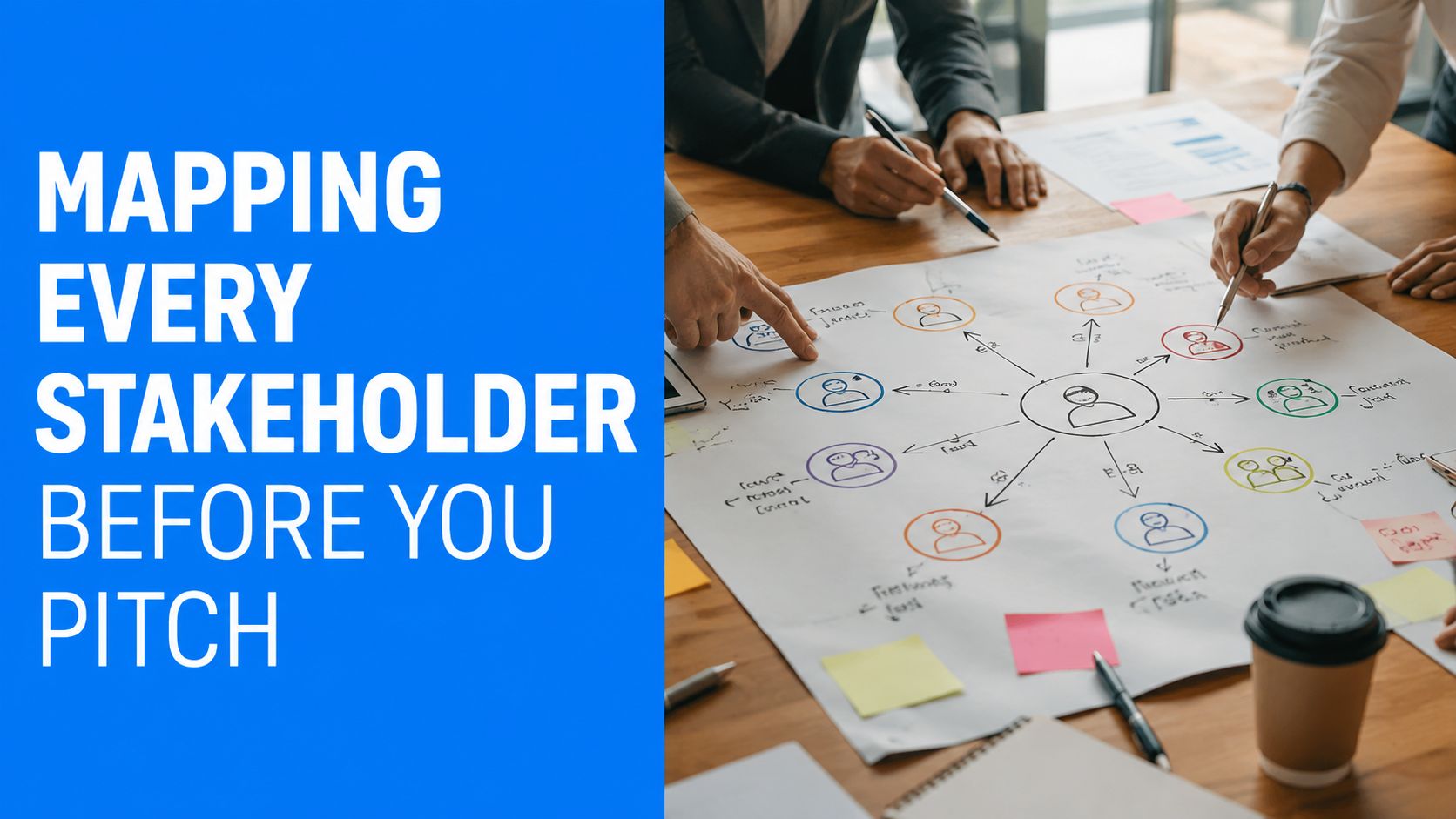
Build the matrix in one sitting
Use this sequence:
- List the decision circle. Include the sponsor, budget holder, end-user champion, risk-averse operator, and anyone who can slow the process down.
- Write the incentive. Revenue growth, cost reduction, risk mitigation, speed, or career visibility.
- Capture the pain point. Don't write generic phrases like “efficiency.” Use the words they'd use in a meeting.
- Score influence and resistance. High influence plus high resistance needs the most preparation.
- Mark the alignment score. If someone benefits from the idea but doesn't feel urgency, they'll need separate nurturing.
That's the part many teams skip. They prepare the pitch for the sponsor and forget that someone else has to defend it behind the scenes.
Rule of thumb: The person who says “this makes sense” is not always the person who can move the budget.
The internal advocacy problem is getting harder, not easier. Gartner projected that by 2025, 80% of B2B sales interactions between suppliers and buyers would happen in digital channels Harvard Business Review on selling ideas. Digital interactions usually mean more forwarding, more reviewing, and more people weighing in before anything gets approved. The idea has to travel well inside the organization, not just impress in the room.
What to do with the map
Once the matrix is filled out, don't use it as a static document. Use it to decide who needs the first private conversation, who needs proof before they'll listen, and who can become a champion once they understand the upside. A good stakeholder map also keeps you from overinvesting in the loudest person in the room.
If you need a structure for that kind of account-level planning, the account planning template is a useful reference point. The goal isn't more paperwork, it's fewer surprises when the proposal starts moving through the organization.
Framing and Storytelling That Moves Decision-Makers
A strong idea can still get rejected if it is framed around the wrong outcome. Finance hears risk, marketing hears channel sprawl, product hears implementation drag. The idea has to be translated into the problem each stakeholder already owns, then tied to the result they are measured on.
Lead with the pain they already feel, not the elegance of the solution. If the CFO cares about predictability, frame the idea around steadier financial performance. If the CMO cares about pipeline quality, frame it around audience ownership or attribution. If the product lead cares about feasibility, frame it around implementation risk and the speed of learning.
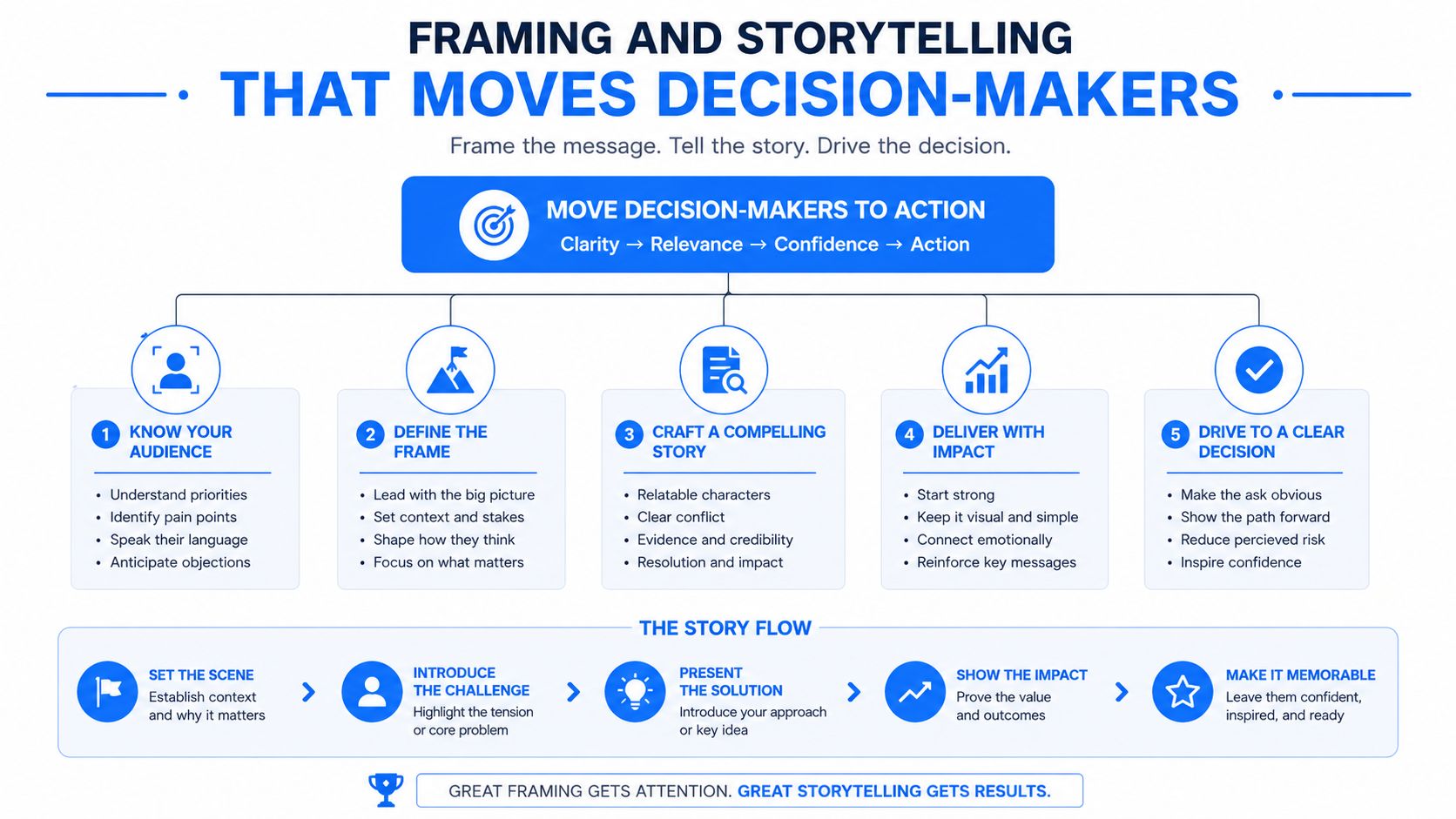
The framing formula that actually holds up
Use this structure for each stakeholder.
- Start with the problem they already recognize. Make the pain feel familiar, not abstract.
- Connect the idea to relief. Show how the idea removes friction or delivers a result they want.
- Anchor the payoff to their metric. Speak in the language they're measured against.
- Keep the proof tight. One clean example beats a long explanation.
- Leave a clean next step. The frame should invite a decision, not a debate.
A B2B growth marketer I worked with had a newsletter-led acquisition concept that went nowhere when it was pitched as a marketing experiment. The CFO heard spend, the CMO heard another channel to manage, and sales heard distraction. Once the idea was reframed as revenue predictability for finance, audience ownership for marketing, and pipeline control for sales, the conversation changed because each stakeholder could see their own win. The same idea, with the wrong frame, looked like overhead. With the right frame, it looked like a business decision.
A one-page framing brief helps keep that discipline in place. For each stakeholder role, write the problem in their words, the solution in your words, and the payoff in the metric they own. If you need a practical starting point, a business case template can help you organize the argument before you start socializing it.
The same discipline shows up in strong speaking advice. If you want a clean way to structure the emotional and logical flow of a pitch, the speech storytelling techniques resource is worth studying for pacing, emphasis, and audience connection.
Why the first frame rarely wins
Internal persuasion is rarely a one-shot event. Buyers and stakeholders usually need more than one pass before they say yes, especially when the idea affects budget, process, or ownership. The first frame is usually a test of relevance, not a verdict on the idea.
That means persistence with evidence is the work itself. One meeting rarely settles the question, and the people in the room are often not the only people who matter. A stakeholder may nod in the meeting, then go back and defend the idea to finance, peers, or a manager who was not present. The frame has to survive that second conversation.
That is why the messaging has to be easy to repeat. If the champion cannot explain the idea in a sentence that sounds credible to their own team, the frame is too vague. Give them language they can use internally, not just a polished line for the meeting.
Building Evidence That Pre-Sells Your Idea
A stakeholder rarely decides the moment you walk into the room. They compare your idea against other priorities, check whether the risk is tolerable, and look for proof that the argument will hold up when they repeat it to someone else. If the evidence is thin, they may nod politely and then stall once the meeting ends.
That is why the work starts before the pitch. Your material has to make the idea feel credible enough that people want to keep discussing it, even if they are not ready to approve it yet. The Tell It Sell It exercise is useful here because it forces you to separate the core idea from the proof that supports it.
The evidence stack that holds up
A strong evidence stack usually has four layers.
Market validation shows why the idea matters now. That can be a shift in the category, repeated customer complaints, or internal demand that keeps coming up in different teams.
Prototype or pilot proof shows the idea can work outside theory. A prototype helps because it lets people see the experience, test the logic, and raise objections before budget is fully committed Shopify on how to sell an idea.
Cost modeling shows whether the idea has a believable path to return. If you cannot connect the idea to cost, revenue, or risk reduction, the skepticism is reasonable.
Social proof shows that someone with a similar problem has tried a similar approach and found value in it.
This stack lowers uncertainty and gives your champion something concrete to take into the next conversation. It also keeps the discussion grounded in evidence instead of preference.
Send the evidence before the room meets
Email still does the heavy lifting for this kind of pre-sell. Buyers often want time to review material on their own, especially when the idea touches budget, process, or ownership. That makes a written packet more useful than a live explanation alone.
The important part is not volume, it is timing and clarity. Send the evidence early enough that people can read it, think about it, and come back with informed questions instead of first impressions. The packet should make it easy for a stakeholder to forward the case internally without rewriting the whole argument.
The business case template helps organize that packet. Use it to turn evidence into a document people can judge on its merits, not a loose set of claims they have to reconstruct for themselves.
The framing formula that holds up
A useful frame does three things: it names the problem in the audience's language, states the idea in your language, and ties the payoff to the metric they care about. That sequence gives the room a clear way to repeat the argument without flattening it.
The statistic that 60% of customers say no four times before saying yes is a reminder that persistence matters more than a polished opening. In practice, one conversation rarely closes the case. The stronger move is to give stakeholders language, proof points, and a simple sequence they can reuse when the idea gets questioned elsewhere.
Keep the framing tight enough that the champion can carry it internally. If they need to explain the idea to finance, a manager, or a peer who missed the meeting, the evidence has to do real work on its own. That is where the sell-through happens, or fails.
The Pitch Structure and Objection Script
A good pitch doesn't try to impress people with complexity. It helps them make a decision. The strongest versions usually follow a simple order, problem, solution, implementation, and payoff.
That structure shows up again and again in expert guidance because it matches how skeptical buyers think. They want to understand the pain, see the fix, know what it takes to execute, and understand the return. Everything else is noise.
A 20-minute pitch that doesn't drift
Use a clean time split.
- 3 minutes, the problem. Name the pain in plain language. Make it specific enough that the room nods.
- 5 minutes, the solution. Show the idea and why it fits this particular problem.
- 5 minutes, implementation. Explain what happens first, who owns what, and what support is needed.
- 4 minutes, payoff. Show the business logic with projected profitability, market size, or other evidence you already have.
- 3 minutes, objections. Leave room for the concerns people will raise the second you stop talking.
Keep the language simple. Avoid technical jargon unless the whole room speaks it. A one- to two-page sell sheet beats a sprawling deck when the goal is alignment, not theater wikiHow on selling an idea.
Objections are not interruptions
Budget concerns usually mean the buyer doesn't see a clean trade-off yet. Timeline doubts usually mean execution risk hasn't been de-risked. Internal politics usually mean you haven't equipped the champion to re-sell the idea.
Use this response pattern.
- Acknowledge the concern. Don't swat it away.
- Restate the shared goal. Show that you're solving the same problem.
- Point to the evidence. Return to the prototype, pilot, or cost logic.
- Offer the smallest safe next step. This keeps the conversation moving.
If the committee still isn't aligned, don't argue for a full yes. Make it easier for them to take the next rational step. That's often the role of the champion in the room, and the pitch should give that person language they can reuse without translating your whole argument.
For a useful exercise that sharpens this kind of internal translation, the Tell It Sell It exercise is worth adapting to your own proposal. It's especially helpful when the audience is smart, skeptical, and already carrying competing priorities.
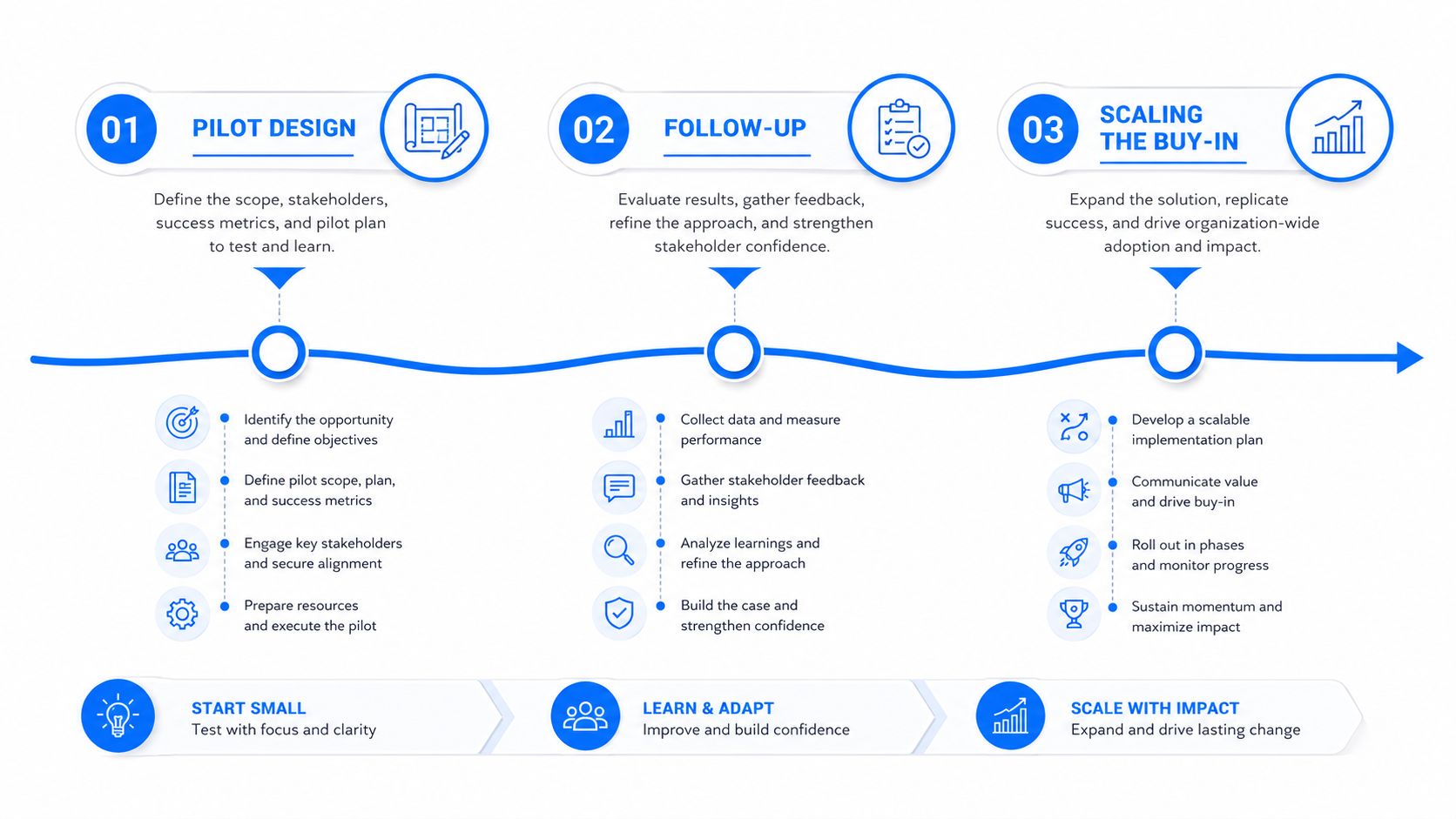
Pilot Design, Follow-Up, and Scaling the Buy-In
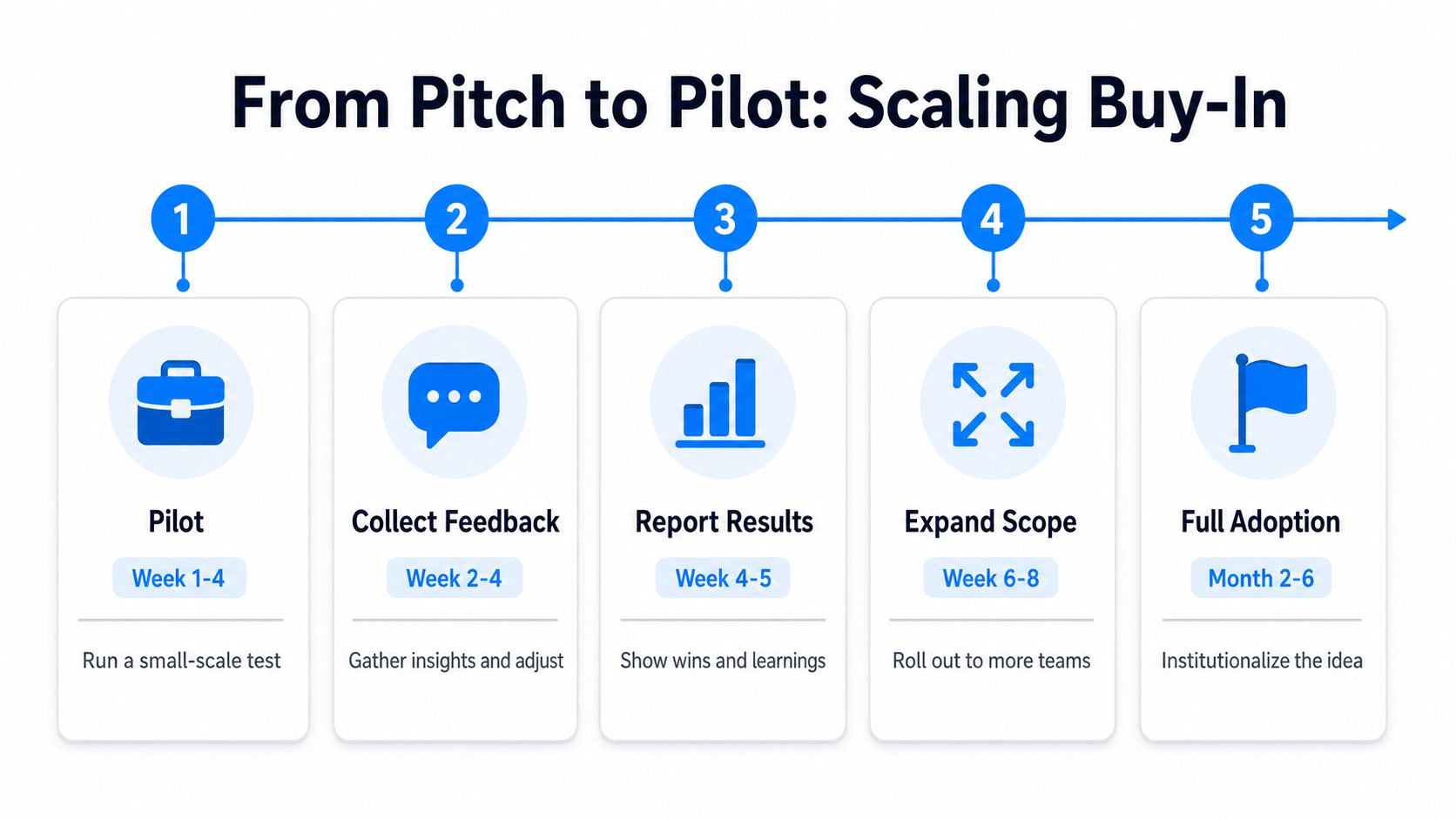
A pitch only opens the door. The idea still has to survive the gap between agreement in the room and action inside the business, and that gap is where good proposals usually fade. If you rely on memory alone, the idea is already vulnerable.
A better move is to design a pilot that lowers risk for everyone involved. Keep it small enough that people can reverse course without pain, but specific enough that the output produces evidence, not just comfort.
Build the pilot around a decision, not curiosity
A pilot needs a question with a decision attached to it. What exactly are you testing, who owns the measurement, and what result would justify expansion? If those answers are missing at the start, the pilot becomes a loose experiment that generates commentary instead of commitment.
The follow-up work matters just as much. Buyers and internal stakeholders rarely decide in a single sitting, and research from EmailAnalytics sales statistics shows that sales conversations often require several touchpoints before they close. That should not be read as permission to pester people. It means the idea needs a planned cadence that keeps it alive while decision-makers do their own internal work.
The sequence should feel organized, not noisy:
- Day 1, recap the meeting. Send the agreed next step and the pilot scope.
- Week 1, share the baseline. Confirm what you are measuring before anything changes.
- Week 2, send a brief progress note. Keep it factual and short.
- Week 3, surface early signals. Highlight what is changing and what is not.
- Week 4, schedule the review. Make the decision point visible.
That cadence keeps the idea from going cold. It also gives the champion inside the company something concrete to forward when other stakeholders ask what is happening.
Follow up without sounding needy
Silence after a pitch is normal, especially when people need time to raise the idea with finance, operations, or their own boss. The mistake is sending empty nudges that ask for attention without adding anything useful. Each follow-up should carry a new artifact, a small metric update, a pilot note, or a clearer view of the risk.
A clean way to handle the message itself is to use a follow-up email guide and keep the writing short, direct, and easy to forward. The best follow-up email is usually the one that makes the next internal conversation easier, not the one that tries to win the whole case by itself.
When the pilot works, document the path from hesitation to approval. Capture the objections, the evidence that mattered, and the exact language that finally earned support. That record becomes the template for the next idea, which saves time and makes the next round of buy-in less dependent on memory or charisma.
Keep reading
All articlesBreaker for B2B, SME and Consumer Newsletter Senders
Learn how B2B, SME, and consumer audiences differ in newsletters, plus a framework for segmenting, messaging, and monetizing each without losing relevance.
What Is a B2B Content Engine
Learn what a B2B content engine is, how it differs from a content calendar or strategy, and why it's essential for AI-driven search in 2026.
8 Best Email Tracking Software Tools in 2026
Compare 8 top email tracking tools for 2026, how tracking pixels work, and why Apple's privacy rules make open rates unreliable. See our top pick.