
Business Case Template: Get Your Project Approved in 2026
Download our free business case template and follow this guide to define your project, calculate ROI, and present a proposal stakeholders can't refuse.
You already know the feeling. You've spotted a growth opportunity, maybe a better way to capture demand, launch a B2B newsletter, replace a patchwork of tools, or fix a funnel that keeps leaking revenue. The idea is solid. The need feels obvious. Then someone asks for the business case.
That's the moment most good ideas slow down.
Not because the initiative is weak, but because the proposal reads like a project outline instead of a buying argument. A strong business case template doesn't just help you organize information. It helps you sell the decision. If you work in B2B marketing, that distinction matters. You're rarely asking for budget in a vacuum. You're competing against sales hires, product requests, infrastructure upgrades, and every other “urgent” priority in the room.
The teams that get approved usually aren't the ones with the most complete document. They're the ones that make the clearest case for action, show what happens if the company waits, and give stakeholders confidence that the project won't drift after approval.
From Great Idea to Funded Project
A lot of marketing proposals die in the hallway conversation.
Someone says, “We should launch this.” A manager says, “Interesting. Put together a business case.” Then the idea gets reduced to a few bullets, a vague cost estimate, and a promise that “it should improve pipeline.” That isn't enough. Decision-makers don't fund enthusiasm. They fund clarity.
The business case matters because it turns a good idea into a decision document. It forces you to answer the questions stakeholders care about. What problem are we solving? Why now? What's the cost of doing nothing? What are the alternatives? What will success look like? What could go wrong?
Why good ideas still get rejected
In practice, weak proposals usually fail for one of three reasons:
- The problem is fuzzy. “We need more leads” doesn't create urgency.
- The solution is disconnected. The proposed tool or campaign sounds interesting, but the path from spend to outcome isn't clear.
- The execution risk is ignored. Stakeholders assume the team is underestimating rollout effort, adoption friction, or change management.
That last point matters more than many marketers think. A staged business case method should define the problem with hard data, quantify financial impact, compare alternatives, set scope boundaries, and include risk mitigation and implementation planning. In IT contexts, surveys cited in the literature indicate up to 20% of projects fail and 45% are challenged, which is why scope control and stakeholder alignment belong in the core case, not an appendix (Six Sigma business case guidance).
A business case isn't paperwork. It's insurance against vague ownership, sloppy scope, and optimistic assumptions.
Marketing leaders run into this same issue when pitching platform changes, acquisition bets, or new channel investments. If the initiative needs capital, headcount, or leadership attention, stakeholders will scrutinize the mechanics. That's also why it helps to understand how financing logic works in adjacent decisions. If your proposal has a capital component, a resource like step-by-step business acquisition financing is useful because it shows how lenders and operators evaluate risk, structure, and repayment logic before money moves.
What funded projects have in common
Approved projects usually share a pattern:
- The pain is measurable
- The recommendation is specific
- The alternatives are acknowledged
- The delivery plan looks realistic
- The ask is sized to the outcome
That's what separates “interesting idea” from “approved initiative.”
Anatomy of a Persuasive Business Case Template
A persuasive business case template is less like a report and more like a structured sales conversation. Every section should answer a stakeholder objection before they raise it.
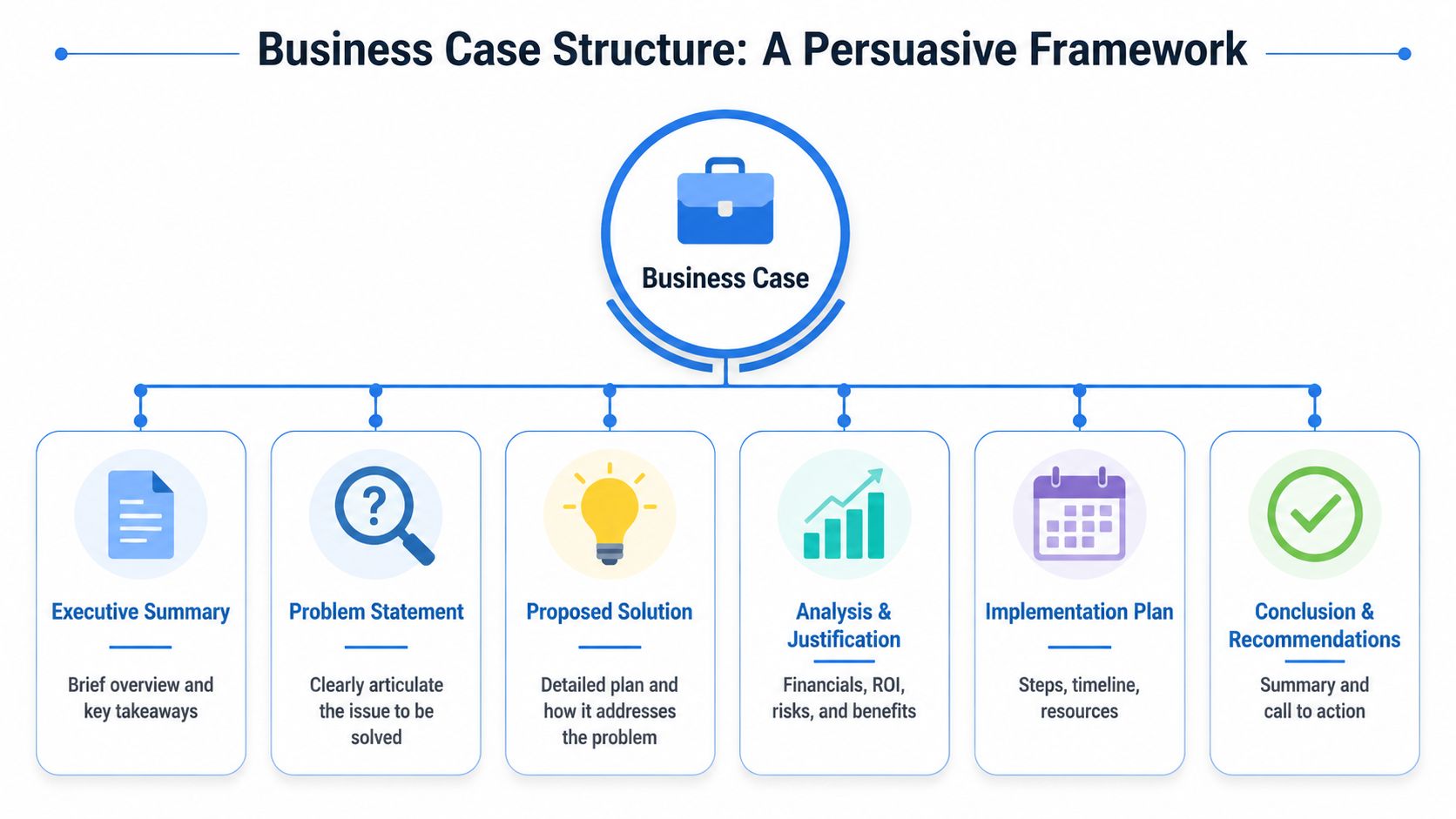
A standard structure typically organizes the problem, solution, benefits, scope, stakeholders, resources, risks, costs, and success metrics in one decision document. For larger initiatives, extensive business cases commonly run 10–20 pages, while the executive summary should be no longer than one page and readable in a few minutes (Macabacus business case template guidance).
Executive summary
This is the gatekeeper. If the summary is muddy, most executives won't trust the rest of the document.
A strong summary does four things fast:
- Names the problem in plain business language
- States the recommendation without hedging
- Shows the expected business impact
- Clarifies the decision required
Don't treat this like an introduction. Treat it like the answer key.
Problem statement
This section creates urgency. It should describe the current state, the operational or commercial cost of staying there, and why the issue deserves attention now.
Weak problem statement:
- Too broad. “Our brand awareness is low.”
Stronger problem statement:
- Tied to business friction. “Outbound demand is becoming more expensive, sales is spending time on low-fit accounts, and marketing lacks an owned audience channel that compounds over time.”
The point is to make the pain concrete enough that doing nothing feels like a decision, not a neutral default.
Proposed solution and scope
Decision-makers want confidence, not poetry.
Your solution section should explain what you're recommending, how it works, what's included, and what is explicitly out of scope. Scope discipline matters because stakeholders know projects expand after approval if the original boundaries are soft.
Use plain specifics. Name the channel, workflow, vendor category, team ownership, dependencies, and rollout phases.
Analysis and justification
This is the center of gravity. It should connect cost to business value, but not only in financial terms.
A persuasive analysis covers:
- Expected benefits such as pipeline contribution, process efficiency, or stronger audience ownership
- Resource needs including budget, people, systems, and approvals
- Risks and assumptions so the case doesn't look naive
- Success metrics that make post-approval accountability possible
Practical rule: If a stakeholder can't tell how they'll judge success, your business case is still a draft.
Implementation and recommendation
Close with execution logic. Show the timeline, owners, major milestones, and the final recommendation.
The recommendation should be direct. Not “consider moving forward.” Say what you want approved, under what conditions, and what happens next if the answer is yes.
How to Frame the Problem and Position Your Solution
Most business cases weaken at the exact point where they should become convincing. The writer knows the initiative is valuable, but the problem statement stays vague and the solution sounds preselected.

The fix is simple in principle and hard in practice. Start with the operational pain, not the tool. Then position the recommendation as the most credible way to close that gap.
Start with business friction
For B2B growth initiatives, the raw complaint is often something like “we need better lead gen” or “paid channels are getting harder.” That's not a business case. It's a mood.
A stronger framing sounds more like this:
- Current state. Marketing relies too heavily on rented channels and inconsistent handoffs.
- Business consequence. Sales gets volume, but not enough sustained engagement from the right accounts.
- Strategic risk. The company doesn't own enough audience attention in a channel it can repeatedly activate.
That framing gives your stakeholders something to evaluate. It also keeps the proposal from turning into a tool pitch too early.
Match the solution to the pain
If the problem is lack of owned demand and weak repeat engagement, your solution should directly address those issues. For example, a B2B newsletter initiative can be positioned as a way to build an owned audience, create a repeat touchpoint with target accounts, and give sales a warmer pool of engaged contacts over time.
That's where platform selection becomes relevant. A tool like Breaker can fit this kind of case because it combines newsletter sending with automatic list expansion for B2B audiences, plus analytics and CRM connectivity. In a business case, though, the platform is still secondary. The primary argument is that the company needs a repeatable audience asset, not just another campaign.
If your proposal starts with software features, stakeholders will compare vendors. If it starts with business pain, they'll evaluate outcomes.
A short explainer can help your team tighten the logic before the meeting:
Use a before and after story
This is the narrative move that makes the case persuasive.
Situation
Before approval
After approval
Audience building
Reliant on external channels
Owned subscriber base with repeat reach
Sales support
Irregular intent signals
Ongoing engagement data sales can use
Campaign model
One-off pushes
Compounding content and distribution engine
That kind of contrast helps non-marketing stakeholders understand why the initiative matters. It turns abstract growth language into an operating improvement.
Filling the Blanks with Data That Sells
A business case starts to win or lose in the financial model.
This is the point where stakeholders stop reacting to the idea and start testing whether the proposal deserves budget. A good template helps, but persuasion is key. The numbers need to show that the initiative can produce business value, that the assumptions are reasonable, and that the team understands the trade-offs if results come in slower than planned.
Practical template guidance recommends mapping costs, timelines, and ROI with hard data, while also capturing non-financial benefits such as customer satisfaction, compliance, and reputation (Smartsheet business case templates). For B2B growth initiatives, that usually means building a case that goes beyond “more leads” and explains how the program improves pipeline quality, sales efficiency, or channel dependence over time.
What numbers belong in the model
Use inputs your team can defend in a budget meeting.
For a newsletter launch or audience-building program, that usually means combining internal operating data with explicit assumptions. Avoid fake precision. Stakeholders trust a model more when it is directionally strong and easy to audit than when it looks mathematically polished but falls apart under questions.
Include four categories:
- Program costs such as software, internal production time, freelance or agency support, distribution, and reporting
- Business benefits such as qualified conversations, influenced pipeline, higher account engagement, or lower reliance on paid acquisition
- Strategic value such as audience ownership, better contact-level intelligence, and tighter sales and marketing coordination
- Scenario ranges that show what happens if adoption is slower, costs are higher, or commercial impact is stronger than expected
Simple formulas that keep you honest
A persuasive model is usually simple.
Use formulas that another leader can follow in a minute:
- Total cost = software + internal labor + external support + launch costs
- Estimated return = value of outcomes reasonably tied to the initiative
- ROI = (estimated return - total cost) / total cost
If your team needs a cleaner way to structure assumptions, this marketing ROI calculator guide for building defensible projections is a useful starting point. Then swap in your own conversion rates, deal values, and operating costs.
Build three scenarios
Single-outcome forecasts create skepticism. Range-based models create trust.
Use a worst case, base case, and best case. That framing shows leadership that the team has pressure-tested the proposal and understands the downside, not just the upside. It also gives stakeholders a clearer way to judge risk tolerance. Some leaders will approve a project because the upside is attractive. Others will approve it because the downside is manageable.
Here's a simple way to show that logic without inventing unsupported figures:
Example ROI Projection: B2B Newsletter Launch (Year 1)
Metric
Worst Case
Base Case (Expected)
Best Case
Subscriber growth
Below target due to slower adoption
In line with planned growth assumptions
Exceeds plan through stronger engagement
Content production cost
Higher than expected due to heavier editorial load
In line with budgeted internal effort
Lower due to reusable content workflows
Platform and operations cost
Slightly above plan from added support needs
Matches approved budget
Controlled through phased rollout
Sales engagement impact
Limited early influence on pipeline
Consistent signal generation for sales follow-up
Strong adoption by sales and broader pipeline influence
ROI outlook
Longer payback and tighter margins
Defensible return based on expected performance
Faster payback and stronger strategic value
What a CFO Wants to See
CFOs rarely push back on growth itself. They push back on models they cannot verify.
The strongest business cases make review easy:
- Separate assumptions from facts
- Show where internal data was used
- Flag dependencies such as sales follow-up, content capacity, or CRM hygiene
- State what is not quantified instead of hiding it in the narrative
A believable model is easier to approve than an aggressive one.
That same discipline applies to qualitative benefits. Audience ownership, stronger message control, and repeat engagement with target accounts can matter a lot in a B2B program. Present them as strategic value, not disguised revenue proof. That keeps the case credible and helps stakeholders see the full payoff without feeling like the math is doing too much work.
How to Present Your Business Case to Stakeholders
A finished document doesn't win approval on its own. The meeting does.
Many templates explain the headings but not the decision logic leaders use. That's the fundamental gap. Strong guidance from public-sector business case frameworks points to a deeper truth: the best template isn't the most complete one. It's the one that forces a clear recommendation under constraints, because completeness without comparison can weaken the case (decision-focused business case template guidance).
Tailor the pitch to the seat in the room
Don't present the same argument to everyone.
- For the CFO. Lead with cost logic, scenario planning, assumptions, and downside protection.
- For the Head of Sales. Focus on lead quality, account fit, engagement visibility, and follow-up practicality.
- For the CEO or GM. Tie the initiative to strategic position, execution confidence, and what changes if the company approves now versus later.
If you want a practical way to shape these pathways before the meeting, a decision tree template for PowerPoint can help you map the recommendation, alternatives, and likely objections.
Present the comparison, not just the answer
One of the fastest ways to lose credibility is to act like there was never a real choice.
Show the available paths. That might include a phased pilot, a lighter internal build, a vendor-backed launch, or a do-nothing option. You don't need equal space for every option, but you do need to show why the recommended path is stronger on feasibility, impact, and risk.
A simple comparison slide often does more work than five pages of explanation.
Handle objections like an operator
Good objections improve the case.
When someone asks, “What if adoption is slow?” or “Why not delay until next quarter?” resist the urge to defend every detail. Clarify the assumption, restate the trade-off, and bring the answer back to decision criteria.
“We considered delay, but delay preserves the current dependency on external channels and pushes the learning curve out. The recommendation is to start with a scoped rollout so we can control risk while building evidence.”
That sounds like management, not marketing.
Your Final Checklist and Downloadable Template
You are five minutes from the review meeting. The slides are polished. The numbers look clean. Then someone asks three simple questions. Why this, why now, and why your team? If the document answers those quickly, the meeting moves toward approval. If it does not, even a strong idea stalls.
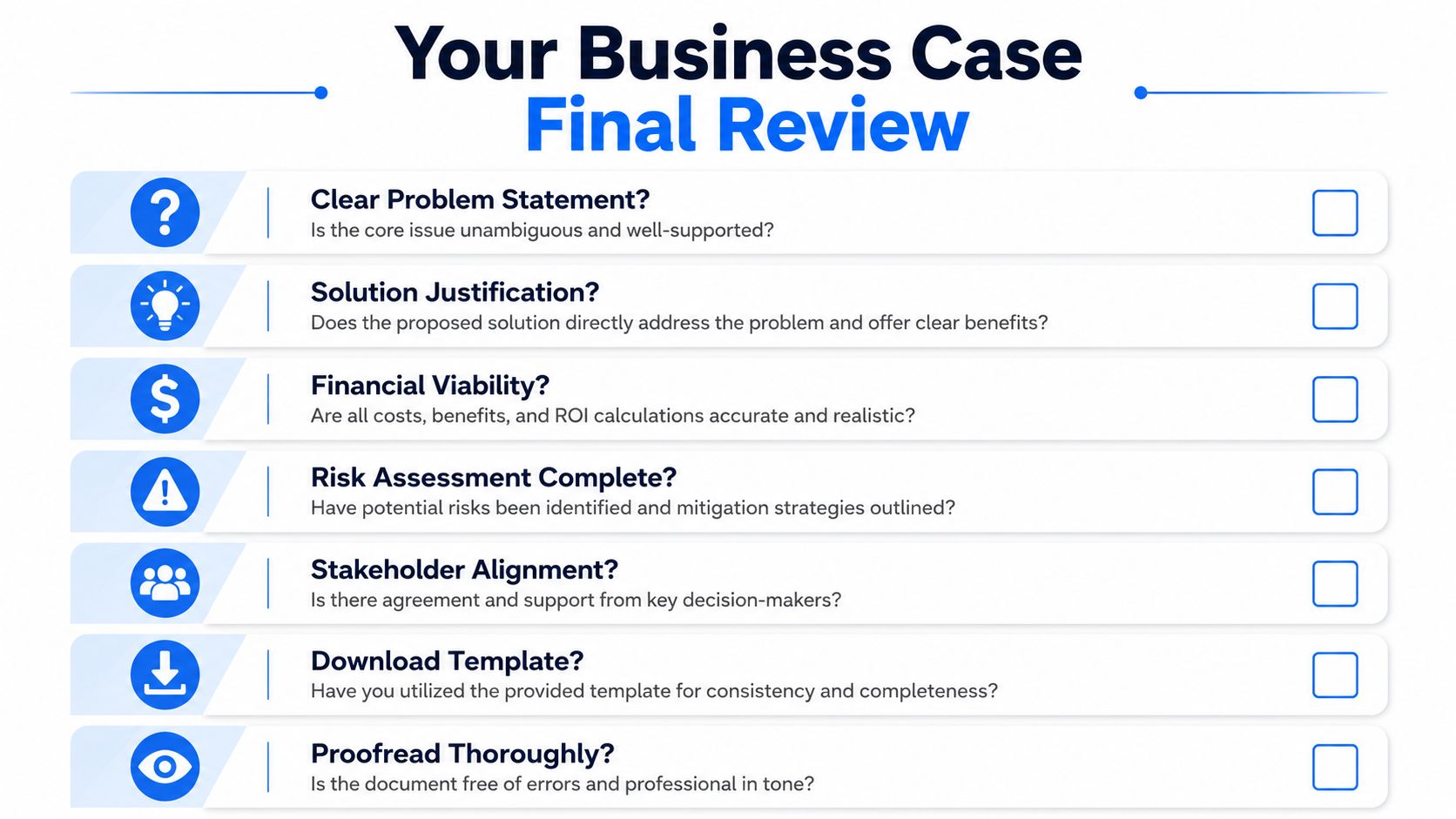
Final review questions
Use this checklist before you send the memo or present the deck:
- Is the problem specific and backed by internal evidence rather than broad frustration?
- Does the recommendation solve that problem clearly, or does it just add a tool, channel, or project?
- Have you shown all alternatives, including the do-nothing path?
- Are the financial assumptions clear enough for finance to pressure-test them?
- Did you include non-financial benefits that matter to operations, sales, customer success, or leadership?
- Is the implementation plan credible on owners, dependencies, timing, and handoffs?
- Can each stakeholder see their upside quickly within the first few minutes?
- Is the ask explicit on budget, headcount, timeline, and decision needed?
Good business cases reduce friction for the buyer inside the company. In this case, the buyer is your leadership team.
Make the template work harder
A template does not win budget by itself. The quality comes from how well the case anticipates scrutiny and makes the next step easy to approve.
One practical way to tighten the document before final review is to align it with your account priorities and commercial motion. This account planning template for stakeholder and revenue alignment can help if your proposal touches target accounts, sales coordination, or expansion strategy.
Before you call it done, check the last page. It should leave no ambiguity about the recommendation, the trade-offs, the owner, and the immediate next action. That is the standard decision-makers respond to.
If you're building a case for a B2B newsletter, audience-growth program, or owned-demand initiative, Breaker is one option to evaluate. It combines newsletter sending with automatic list expansion, analytics, CRM integrations, and deliverability tooling, which can make it easier to translate a growth concept into an operational plan your stakeholders can effectively assess.
Keep reading
All articles8 Best Email Tracking Software Tools in 2026
Compare 8 top email tracking tools for 2026, how tracking pixels work, and why Apple's privacy rules make open rates unreliable. See our top pick.
6 Best Email Trackers for Newsletter Senders in 2026
Open rates lie. Learn how email trackers really work, why Apple and Gmail skew the data, and which tools newsletter senders should actually use in 2026.
Post Webinar Survey: Questions, Examples, and a Checklist
What to ask in a post webinar survey, when to send it, three example formats, and a checklist for turning the answers into segmented follow-up and pipeline.