
Email Marketing for Healthcare: Boost Engagement 2026
A complete guide to email marketing for healthcare. Learn HIPAA compliance, patient segmentation, workflows, and KPIs to boost engagement.
Healthcare organizations often treat email like a basic utility. That's a mistake. In this sector, open rates average between 34.6% and 44.6%, click-through rates range from 1.75% to 4.64%, and ROI is approximately $36 for every $1 invested, according to healthcare email benchmark data from 9 Clouds. Those numbers reframe the channel. Email isn't a side tactic. It's one of the few places where trust, timing, and relevance can work together at scale.
The bigger surprise is why healthcare performs so well. Patients open emails that help them take the next step. Clinicians open emails that save time, surface useful information, or improve referral flow. Partners respond when outreach is specific to their role and not written like a mass blast. That split matters. Email marketing for healthcare isn't one audience. It's at least two broad ones: patient communication on the B2C side, and clinician or partner outreach on the B2B side.
Most weak programs fail for the same reason. They use one list, one newsletter, one tone, and one sending rhythm. Strong programs separate audiences early, build compliant data practices from the start, and design workflows around real operational moments such as booking, follow-up, referral coordination, service updates, and professional education.
Why Email Marketing in Healthcare Outperforms Other Industries
Open rates in healthcare regularly sit well above many other sectors, but the stronger explanation is simpler. Healthcare emails often answer an immediate need for two different audiences: patients trying to take the next step in care, and clinicians or referral partners trying to reduce friction in access, scheduling, or coordination.
That utility changes how the inbox works. For patients, email supports real care moments such as appointment preparation, follow-up instructions, preventive education, and service reminders. For clinicians and partners, it supports referral flow, specialist access, program updates, and professional communication that saves time.
Relevance beats volume
The benchmark numbers matter, but the operating model matters more. As noted earlier, healthcare email performance is strong because messages are tied to intent, timing, and known audience needs. Analysts at 9 Clouds also found that segmented sends around wellness content, appointment reminders, and post-visit follow-up outperform generic newsletters because the content is timely and useful.
Internal efficiency often pushes teams toward one broad newsletter. External performance usually suffers. A patient looking for prep instructions does not want the same message a referring physician needs about specialist availability, and neither audience benefits from a round-up of internal announcements with no clear action.
A simple test helps here.
If the recipient cannot explain why the email arrived today and what to do next, the campaign is too broad.
Trust gives healthcare email an edge
Healthcare brands start with a level of attention many industries have to fight for, but that advantage only holds when the message respects the relationship. Relevance builds trust. Over-targeting or sloppy consent practices break it fast.
High-performing campaigns consistently focus on:
- Patient communication tied to care moments: appointment reminders, wellness education, post-visit support, preventive care prompts, and service-line updates written in plain language.
- Clinician and partner outreach tied to operational value: referral guidance, access to specialists, event invitations, new service announcements, and updates that make coordination easier.
- Personalization based on stated interests or professional role: preference data, geography, specialty, or service-line relevance. Not sensitive diagnosis data.
- Clear consent boundaries: teams need to know the difference between explicit permission and assumptions such as implied consent in email marketing, especially when lists include both consumer and professional contacts.
Low-performing campaigns usually share the same problems:
- One master newsletter for patients, physicians, employers, and partners: different audiences have different stakes, reading habits, and reasons to engage.
- Messages centered on the organization instead of the recipient: a departmental update is not automatically useful to a patient or a referring practice.
- Personalization that feels invasive or premature: healthcare marketers can target with care-moment context and declared preferences without crossing into details that feel too personal.
The trade-off is real. Narrower segmentation takes more planning, more coordination with operations, and better list management. It also produces stronger engagement, fewer unsubscribes, and a program that serves both B2C patient communication and B2B clinician outreach without flattening them into the same strategy.
Teams that want sharper ideas for audience growth outside the inbox can also study latest business growth articles that focus on how different channels support sustainable demand generation.
Navigating the Compliance Minefield of HIPAA and Consent
Email marketing for healthcare breaks down when teams confuse “healthcare-related” with “HIPAA-safe.” They aren't the same thing. A useful mental model is simple: your marketing system can know enough to send relevant messages, but it can't act like an extension of the clinical record unless you've built the right permissions and safeguards around it.
What compliance looks like in practice
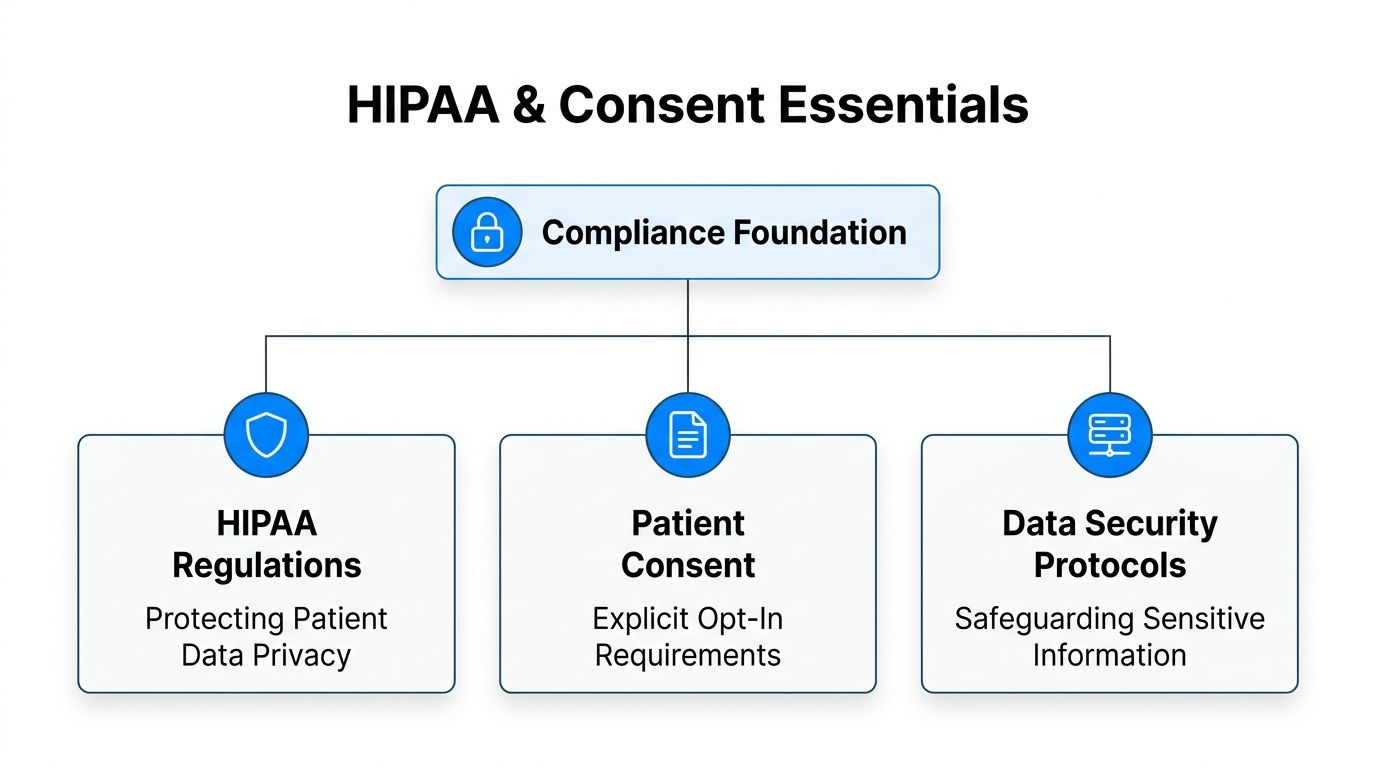
According to Mailsoftly's healthcare email marketing guidance, compliant healthcare email marketing requires explicit opt-in consent, and pre-checked boxes are invalid. It also requires strict separation of email addresses from the electronic health record, and marketing emails must not include PHI such as diagnoses or medications. The same guidance states that healthcare email platforms should support strong list segmentation, multi-step automation with conditional logic, encryption in transit and at rest, and full implementation of SPF, DKIM, and DMARC for deliverability and security.
Those requirements aren't legal trivia. They shape how your program should be built.
Think of your EHR as the locked clinical cabinet. Your marketing platform is the front desk communication system. The front desk can know that someone wants pediatric wellness updates or orthopedic service announcements because they told you so. It can't pull diagnosis details from the cabinet and use them in a campaign just because the technology makes that possible.
Consent has to be clear and provable
A lot of healthcare organizations still collect email consent badly. They bury it in intake paperwork, default people into marketing lists, or make patients guess what they'll receive. That approach creates compliance risk and weak engagement at the same time.
Use a cleaner standard:
- Ask directly: Tell people what they're signing up for.
- Separate purposes: Treatment communication and marketing permission aren't the same thing.
- Store proof: Keep records of when and how consent was captured.
- Honor preference changes quickly: Unsubscribes and content preferences need to flow through the system without delay.
If your team still relies on ambiguous permission practices, this explainer on implied consent in marketing is worth reviewing because implied consent is often misunderstood and over-applied.
Later in the patient journey, cross-channel coordination matters too. Teams that handle email well usually pair it with a disciplined public-facing content strategy. For that side of the work, optimizing healthcare social presence offers a useful companion perspective.
The subject line can create risk too
Compliance isn't only about databases and permissions. It also shows up in copy. Mailsoftly specifically warns against alert-inducing subject lines like “Urgent: Your Health Update” because they can trigger anxiety and reduce open rates. That's a practical reminder that healthcare messages carry emotional weight.
Use language that is specific, calm, and action-oriented. “Your appointment checklist” is better than “Important health alert.” “Choose your wellness topics” is better than “Critical patient notice.”
A short training video can help teams align on the basics before they build campaigns:
A simple compliance split
Email type
Safe direction
Risky direction
Patient marketing
Wellness education, service updates, preference-based content
Diagnosis-specific messaging without proper authorization
Patient operational outreach
Scheduling, preparation, follow-up handled through approved workflows
Mixing clinical detail into general marketing tools
Clinician and partner outreach
Referral resources, service announcements, event invites
Sending lists built from inappropriate data sharing
Consent collection
Explicit opt-in with clear expectations
Pre-checked boxes, vague disclosures, bundled permission
Keep your marketing database informed by permission and preference, not by clinical detail.
Effective Segmentation for Patients Clinicians and Partners
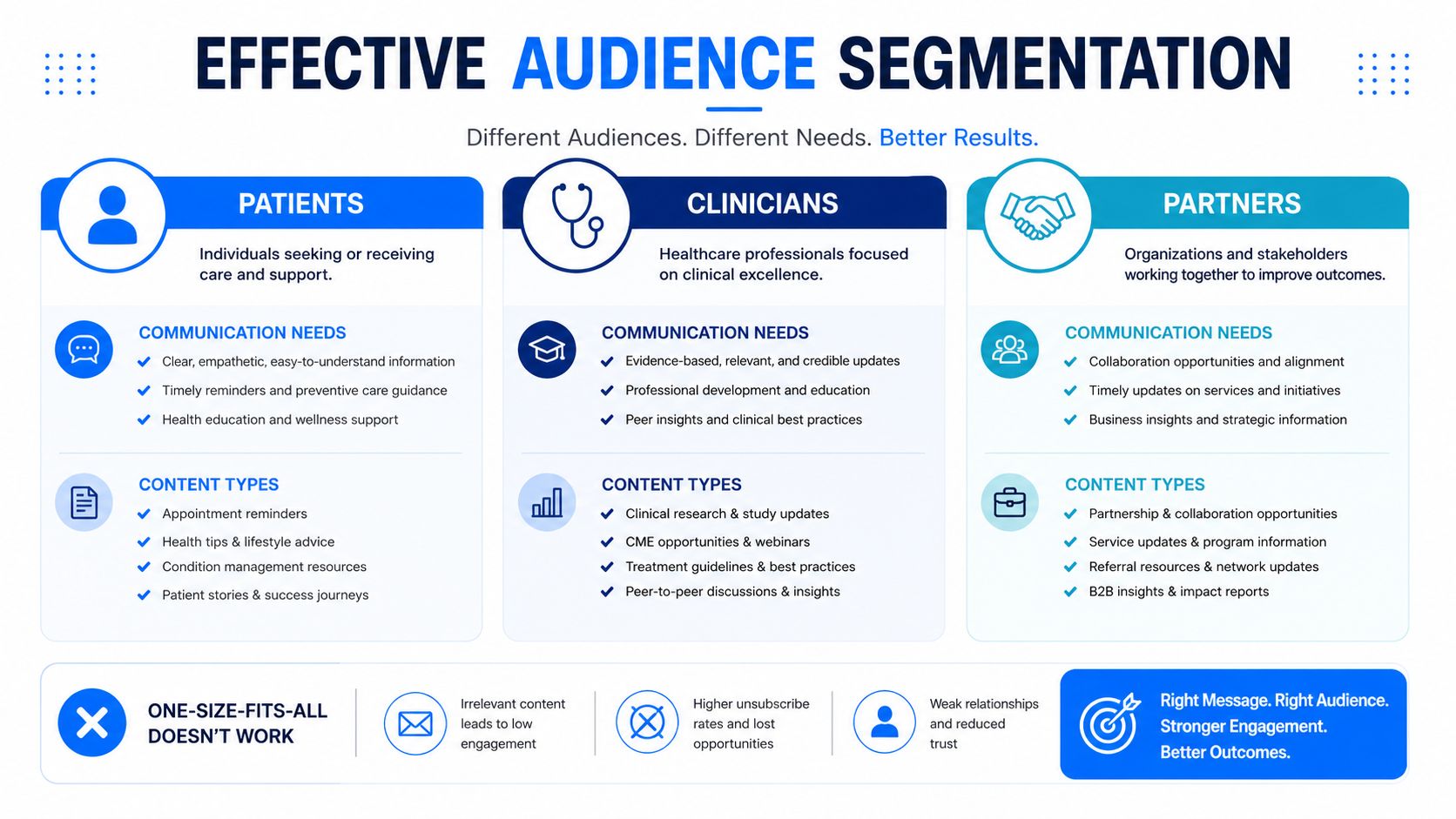
The fastest way to lower performance is to merge unlike audiences into one list. Patients, clinicians, and external partners don't read email the same way, don't care about the same outcomes, and shouldn't get the same cadence.
Patient segmentation should follow stage and preference
For patients, useful segmentation starts with information they voluntarily provide or behavior they display in the email program. Service-line interest, preferred location, age-range relevance when appropriate, engagement history, and topic preferences are all workable. A new subscriber interested in women's health content should not receive the same sequence as an established patient who only wants appointment preparation and preventive care reminders.
Good patient segments often include:
- New subscribers: Welcome, expectations, navigation help
- Active care participants: Appointment prep, follow-up education, support resources
- Preventive care audiences: Wellness tips, screening reminders, seasonal education
- Inactive readers: Re-permission or re-engagement campaigns
Clinician outreach needs professional relevance
Clinicians don't need patient-style nurture copy. They want information that respects time and supports practice. Segment by specialty, referral relationship, facility affiliation, geography, and past engagement with professional content.
That means a primary care physician might receive specialist access updates and referral process guidance, while a surgeon might receive service-line developments, event invitations, or peer-focused education. The tone should be concise, evidence-aware, and operationally useful.
A clinician will forgive a plain layout faster than a wasted email.
Partners require B2B logic, not consumer logic
Healthcare organizations often forget that vendors, employers, community organizations, and strategic partners form a separate B2B audience. Their segmentation should look more like standard account-based marketing than patient communication.
Use role, organization type, business relationship, and stage in the partnership cycle. A benefits leader evaluating occupational health services needs a different message from a technology partner already integrated into your workflow.
Here's a clean way to consider it:
Audience
Primary filter
Best content angle
Patients
Preference and journey stage
Helpfulness, reassurance, next step
Clinicians
Specialty and referral relevance
Efficiency, access, professional value
Partners
Role and organization type
Business case, collaboration, implementation
Teams that want to refine B2B list logic can borrow ideas from broader newsletter strategy. This guide to audience segmentation strategies for B2B email is especially useful when partner outreach starts to scale.
Designing High-Impact Email Campaign Workflows
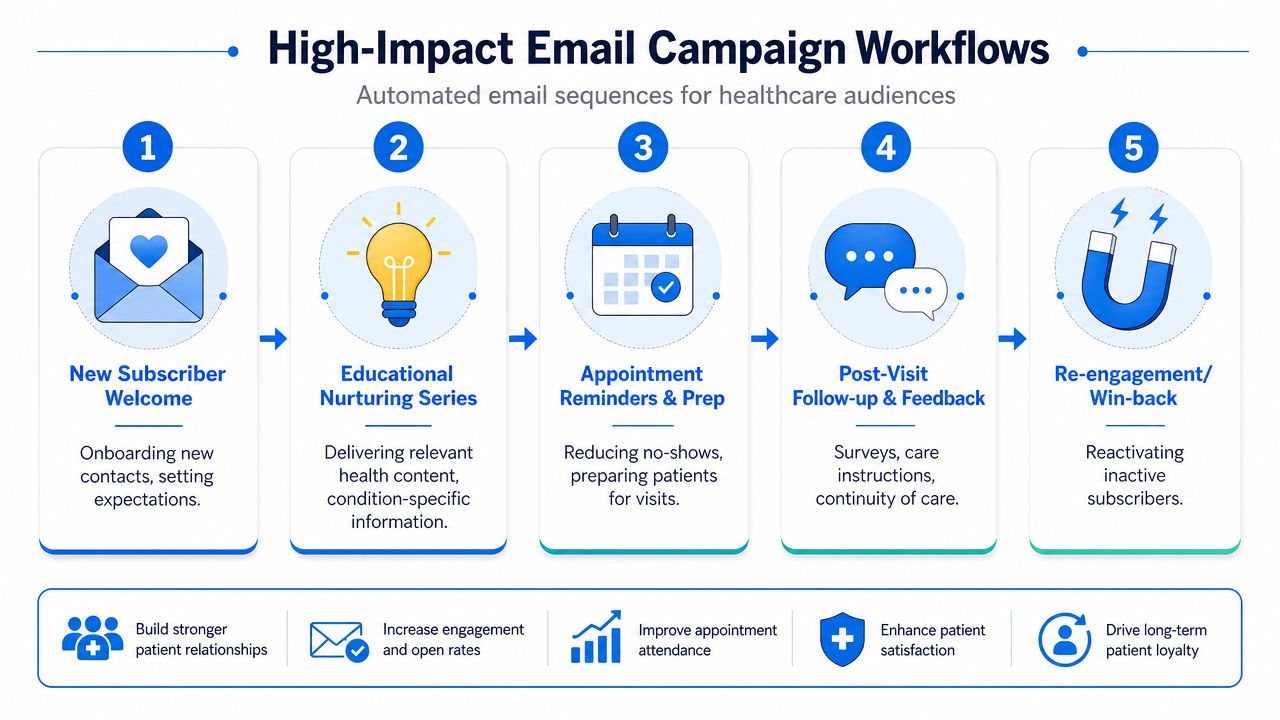
Single sends rarely do enough in healthcare. The stronger approach is to build workflows around real decisions and recurring actions. That's true for patients, and it's equally true for clinicians and partners.
A patient journey that feels useful
A patient signs up through a website form after reading about a service line. The first email shouldn't sell harder. It should orient them. Explain what they'll receive, how often, and where to take the next step if they want to book.
Then the workflow branches.
If the patient clicks scheduling information, the next email should support booking with practical details such as what to expect, what questions to prepare, or how to choose a location. If they engage with education instead, the sequence should stay educational until behavior suggests readiness for appointment-related messaging.
A workable patient workflow often looks like this:
- Welcome and expectations
- Educational follow-up based on selected interest
- Appointment prompt when engagement indicates intent
- Preparation message after scheduling
- Post-visit follow-up and feedback request
- Longer-term wellness re-engagement
The mistake many teams make is collapsing all of that into one recurring newsletter.
A clinician workflow should reduce friction
Now take a referring clinician. They download a referral guide or register for a service-line update. The follow-up sequence shouldn't sound like patient outreach with a lab coat on it. It should answer practical questions quickly.
The first message might confirm the topic and provide direct access to referral instructions. The next could introduce specialist availability, access points, or relevant event information. If the clinician engages, route them into updates tied to their specialty or referral behavior. If they don't, slow the cadence and send only high-value notices.
Field note: The best clinician emails usually answer one operational question well instead of trying to say everything at once.
Workflow design choices that matter
A strong workflow depends less on fancy automation than on disciplined triggers and exits.
- Entry criteria: Define why someone enters the sequence. Form fill, content download, event registration, or post-visit status are common triggers.
- Branch logic: Use engagement, stated preference, and stage, not guesswork.
- Exit conditions: Stop sending once the person reaches the goal or moves to another track.
- Hand-off rules: Make sure marketing, operations, and referral teams know who owns the next action.
Patient and B2B workflows share one truth. Each email should make the next action easier. If the sequence creates confusion, the automation is working against you.
Crafting Messages That Build Trust and Drive Action
Healthcare email copy fails when it sounds either too clinical or too promotional. Patients need clarity and reassurance. Professionals need brevity and relevance. Both groups need a reason to act.

Writing for patients
Patient-facing copy should sound calm, direct, and respectful. Don't flood the message with medical terminology if plain language will do. Don't overcompensate with cheerfulness either. People can tell when a serious topic is being wrapped in generic marketing language.
A better patient email usually has:
- A clear subject line: Specific, not alarming
- A simple opening: Why the message matters now
- One primary action: Book, confirm, read, prepare, or reply through the right channel
- Accessible language: Short sentences, common words, visible buttons
Here's a practical before-and-after example.
Version
Subject line
Opening
Weak
Important Update Regarding Your Ongoing Care
We are reaching out to inform you of several important matters related to your health journey
Better
How to prepare for your upcoming visit
Here's what to bring, what to expect, and how to reschedule if needed
The second version reduces uncertainty. It also tells the reader exactly what they'll get.
Writing for clinicians and partners
Professional audiences don't need emotional cushioning. They need signal. That means faster framing, stronger hierarchy, and fewer words. Lead with the operational value, not the marketing setup.
For example:
- Weak: We're excited to share a new update from our team that may be of interest to your practice
- Better: New referral pathway for cardiology consults at our north campus
That kind of opening respects time. It also helps the reader decide immediately whether the email matters to their work.
Calls to action should match the relationship
A patient CTA should reduce effort and uncertainty. “Schedule your visit,” “Review your checklist,” or “Choose your topics” are strong because they are simple and specific. A clinician CTA should support workflow. “Download referral guide,” “Contact specialist liaison,” or “Register for update” does the job.
Avoid CTAs that sound inflated:
- Learn more today
- Gain better health
- Transform your patient journey
Those phrases belong in generic software ads, not healthcare communication.
Use the fewest words that still make the next step obvious.
Tone matters most when the message is routine. Routine messages are where trust is either reinforced or gradually eroded. If your audience consistently feels informed instead of handled, your copy is doing its job.
Ensuring Deliverability and Maintaining List Health
Healthcare teams often focus on content first and infrastructure later. That order creates trouble. Deliverability is not a technical add-on. It's the condition that allows every compliant, well-written campaign to matter.
Authentication and reputation work together
In healthcare, sender trust is both human and technical. Human trust comes from useful messaging and responsible data handling. Technical trust comes from proving to mailbox providers that your messages are legitimate. That's why SPF, DKIM, and DMARC matter. They aren't box-checking exercises. They help receiving systems verify that your domain is authorized to send what it sends.
Once authentication is in place, list behavior starts shaping reputation. If recipients ignore, delete, unsubscribe from, or complain about your messages, mailbox providers notice. If they open, click, and interact consistently, that helps too. Deliverability is the cumulative result of both setup and sending discipline.
List hygiene is ongoing operational work
Healthy lists don't stay healthy on their own. You need a maintenance routine.
- Remove bad addresses quickly: Hard bounces and invalid contacts should not linger.
- Honor unsubscribes immediately: Friction here damages trust fast.
- Watch engagement decay: If someone hasn't interacted in a long time, reduce cadence or ask whether they still want the content.
- Separate audience intent: A clinician who wants referral updates shouldn't be pushed into patient education streams.
A lot of healthcare organizations hesitate to suppress inactive contacts because the raw list size feels valuable. It usually isn't. A smaller, cleaner list is easier to deliver to and easier to segment well.
Formatting choices can hurt inbox placement
Deliverability also shows up in the copy and design layer. All-caps subject lines, excessive urgency, image-heavy layouts with little text, or vague sender naming can make legitimate campaigns look suspicious. In healthcare, those mistakes feel worse because recipients are already sensitive to language that sounds alarming or manipulative.
The technical and editorial pieces meet. Authentication gets you credibility at the gate. List hygiene preserves it. Clear, relevant copy helps keep it.
For a broader operational checklist, this guide to email deliverability best practices is a solid reference for teams tightening sender reputation and inbox placement.
Measuring Performance and Selecting the Right Tools
Open rates and clicks are useful diagnostics. They are not the scorecard.
In healthcare, email earns its keep when it changes behavior you can trace. For patient communication, that usually means appointment booking, form completion, portal activation, pre-visit preparation, medication or care-plan follow-through, or continued use of educational content. For clinician and partner outreach, the bar is different. Look for referral engagement, event registration, meeting requests, service-line inquiries, account progression, and named stakeholder involvement.
That split matters. A patient newsletter and a physician outreach sequence may both perform well in the inbox while driving completely different business and care outcomes.
Measure outcomes, not just activity
A practical measurement model ties engagement signals to the next operational step.
Audience
Leading indicators
Outcome indicators
Patients
Opens, clicks, topic preferences, cadence tolerance
Bookings, confirmations, portal actions, follow-up completion
Clinicians
Opens on specialty-specific sends, content downloads, registrations
Referral activity, liaison contact, service-line engagement
Partners
Reply rate, asset engagement, meeting interest
Qualified opportunities, partnership progression, stakeholder involvement
If reporting stops at opens and clicks, optimization stays shallow. Teams can see which subject line won attention, but not whether the campaign improved access, strengthened referral relationships, or created real pipeline.
I usually want one more layer. Time-to-action often tells you more than total clicks. If patients click but do not complete a scheduling flow, the issue may sit on the landing page or in the intake process rather than in the email itself. If clinicians open a service-line update but never request follow-up, the offer may be too broad, the audience too mixed, or the next step too demanding.
Tool selection should start with risk and complexity
A common mistake is choosing a platform based on templates and price, then finding out that segmentation is shallow, automation is rigid, reporting is disconnected from outcomes, or compliance controls are hard to verify. In healthcare, that buying sequence creates expensive cleanup work later.
Start with a tighter set of questions:
- Can the platform keep audiences separate? Patients, clinicians, referral sources, and partners need distinct data rules, content paths, and suppression logic.
- Does it manage consent and preferences clearly? Your team should be able to confirm who opted in, what they agreed to receive, and how exclusions are enforced.
- Can it run multi-step workflows with conditional logic? Healthcare programs rarely succeed on one-off sends alone.
- How does it handle data security and access control? Review storage, permissions, auditability, and administrative controls early.
- Can reporting connect engagement to care or commercial outcomes? If not, the platform will produce activity reports, not decision support.
What strong platform evaluation looks like
Good evaluation includes marketing, compliance, IT, and the teams that own follow-up. Marketing should test segmentation, workflow setup, reporting quality, and day-to-day usability. Compliance and IT should review data handling, permissions, access control, retention practices, and vendor documentation. Operations should confirm that alerts, handoffs, and routing rules match how the organization works in practice.
Choose the platform your team can govern well, not the one with the longest feature list.
The patient side and the B2B side often need different strengths from the same system. Patient programs usually depend on preference management, recurring journeys, service reminders, and clear suppression handling. Clinician and partner outreach often needs CRM sync, account-level targeting, ownership by market or service line, and reporting tied to referrals or pipeline. One platform can support both, but only if those use cases are tested separately during selection.
A practical scorecard
When I evaluate tools for healthcare email programs, I score five areas:
- Segmentation depth: Can the team build precise audiences without manual exports and workaround fields?
- Workflow flexibility: Can one trigger branch into different paths based on audience, behavior, or service line?
- Compliance support: Are permissions, suppression rules, and user access visible and manageable?
- Deliverability tooling: Can the team monitor sender reputation, inbox placement, and domain health without leaving gaps?
- Reporting quality: Can performance be tied to appointments, referrals, meeting creation, and partnership progress?
The best programs are rarely the flashiest. They are measurable, governable, and built around the actual differences between patient communication and clinician or partner outreach.
For teams focused specifically on the B2B side of healthcare marketing, finding a platform built for that motion is key. If your team runs B2B healthcare outreach, newsletters, or partner communication and wants stronger audience growth without sacrificing deliverability, Breaker is worth a look. It combines email sending, list expansion, targeting, data hygiene, analytics, and deliverability management in one platform, which makes it useful for growth teams that need newsletter performance tied to pipeline instead of vanity metrics.
Keep reading
All articlesHow to Write a Newsletter with AI: Step-by-Step Guide 2026
Learn how to write a newsletter with AI the right way: a 7-step process to train, calibrate, and edit AI drafts that still sound like you.
How to Boost Conversions With Your Email Newsletter
Turn your newsletter into a conversion engine. See 2026 benchmarks, CTR vs CVR explained, and the fixes most email guides skip.
Drip Campaign Template: Ready-to-Use Email Sequences
Get 6 ready-to-paste drip campaign templates with subject lines, body copy, and send timing—plus a step-by-step guide to building your own.