
Email Compliance Software: Master Laws & Boost Growth
Master email laws like GDPR & CAN-SPAM with email compliance software. Learn key features and choose the best solution for growth in 2026.
You've got a campaign queued, the segment looks right, the copy is strong, and someone on the team asks one last question before launch: “Are we allowed to send this?”
That moment is more common than most marketing leaders admit. It doesn't just happen in healthcare, finance, or legal. It happens in ordinary B2B teams that buy lists from partners, inherit old CRM data, run webinars across regions, or ask agencies to move fast. The fear isn't abstract. It's operational. One bad send can create unsubscribe complaints, legal scrutiny, internal friction with security, and damage to sender reputation that takes time to repair. Healthcare teams face the strictest version of this, and our email marketing for healthcare guide covers HIPAA-compliant list building and workflows.
The teams that handle this well stop treating compliance like a last-minute legal review. They build it into the system. That's where Email compliance software changes the conversation. Used well, it doesn't slow growth down. It gives growth teams a way to move faster with fewer blind spots, better data hygiene, clearer approvals, and stronger audience trust.
That shift matters because email is still one of the few channels where trust and performance are tightly linked. When recipients know why they're hearing from you, can change preferences easily, and don't get irrelevant or risky messages, engagement quality improves. So does deliverability. If your broader security posture is still fragmented, it also helps to look at practical cyber risk solutions for businesses so compliance doesn't live in a silo apart from business risk.
Moving from Compliance Fear to Confidence
The most useful way to think about compliance is simple. It's not a brake pedal. It's a control system.
A team without controls hesitates before every send. They rely on memory, spreadsheets, old opt-in assumptions, and scattered approvals in Slack or email. A team with controls knows which contacts can be mailed, which content needs review, what records are being archived, and how opt-outs are being handled. Confidence comes from repeatable process, not guesswork.
What fear looks like in practice
Marketing teams usually don't struggle because they don't care. They struggle because the risk sits in ordinary workflow details:
- Inherited contacts from a sales handoff with unclear consent history
- Regional sends where one campaign touches US, UK, EU, and Canadian recipients
- Partner lists where the vendor says the data is compliant but can't show how permission was captured
- Sensitive content that may include personal, financial, or healthcare-related information
- Last-minute edits that bypass review and create inconsistency between what legal approved and what went out
None of that is solved by telling marketers to “be careful.”
Practical rule: If compliance depends on people remembering every rule before every send, the process is already too fragile.
What confidence actually feels like
Teams get calmer when compliance lives inside the tools and approvals they already use. Good Email compliance software checks consent status, enforces suppression rules, routes messages through the right review path, encrypts sensitive information where needed, and keeps records that can stand up to audit or dispute.
That changes the tone of the work. The question stops being “Can we get away with sending this?” and becomes “Have we set the rules correctly?” That's a much healthier place to operate from if you care about sustainable pipeline, not just this week's blast.
The Global Map of Email Marketing Laws
Sending email across markets is a lot like driving across borders. The car is the same, but the road rules change. If your database includes people in the US, EU, UK, or Canada, you can't assume one standard covers every send.
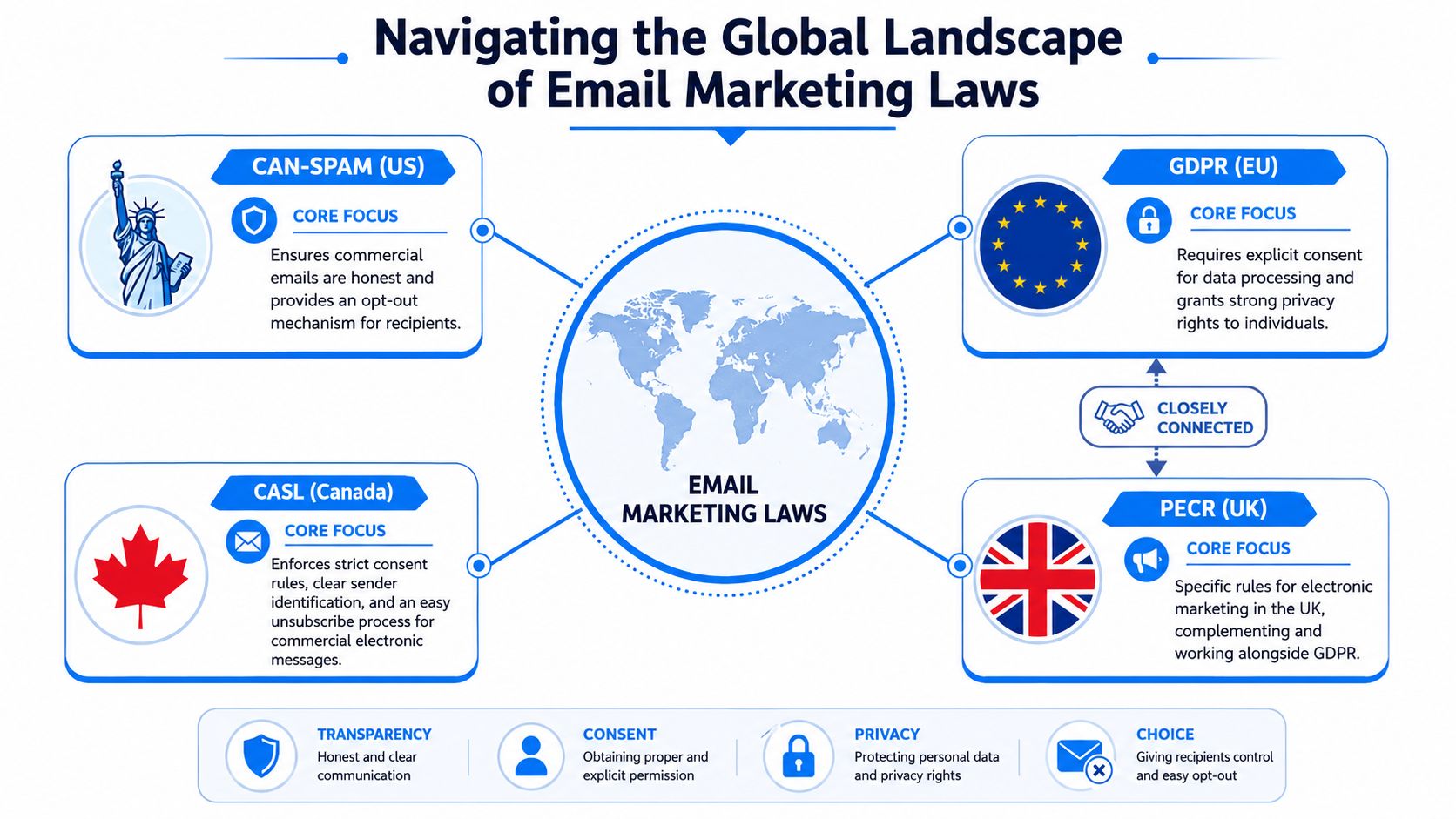
The main laws marketers hear about are CAN-SPAM in the US, GDPR in the EU, CASL in Canada, and PECR in the UK. The acronyms can make this sound more complicated than it is. The underlying logic is consistent: people should know who is contacting them, why they're being contacted, and how to stop it.
The common principles behind the acronyms
Here's the cleanest mental model.
Regulation
Region
What marketers should focus on
CAN-SPAM
United States
Honest commercial messaging and a working opt-out path
GDPR
European Union
Explicit consent, privacy rights, and lawful handling of personal data
CASL
Canada
Strict consent expectations, sender identification, and unsubscribe clarity
PECR
United Kingdom
Electronic marketing rules that work alongside UK privacy requirements
If you want a practical external overview, EmailScout's guide on privacy laws is useful for comparing how these frameworks differ without turning the topic into legal theatre.
Why this matters beyond legal language
This isn't just paperwork. Over 1,000 fines for non-compliance with email data privacy regulations have been issued globally, including a landmark €746 million penalty levied against Amazon for violating the General Data Protection Regulation (GDPR), which highlights the financial risk of weak controls (mailcon.com on email compliance software).
That doesn't mean every B2B marketer needs to become a privacy lawyer. It means your program needs a defensible standard for consent, transparency, and withdrawal.
A practical way to operate across regions
Teams achieve better outcomes when they stop chasing edge cases and adopt a few strict defaults:
- Document consent clearly. If you can't explain where an address came from, don't mail it.
- Identify the sender plainly. Avoid fuzzy branding or unclear ownership of the message.
- Make opt-out easy. If someone wants out, the process should be immediate and clean.
- Track geography where relevant. The same email may require different handling depending on recipient location.
For marketers still sorting through gray areas like inferred permission, this explainer on implied consent is a good reality check. Implied consent is often treated as broader than it really is.
Laws differ. The operational discipline doesn't. Keep proof of permission, be transparent, and respect withdrawal fast.
The teams that get this right don't memorize every clause. They build a system that assumes scrutiny and still works.
What Is Email Compliance Software Exactly
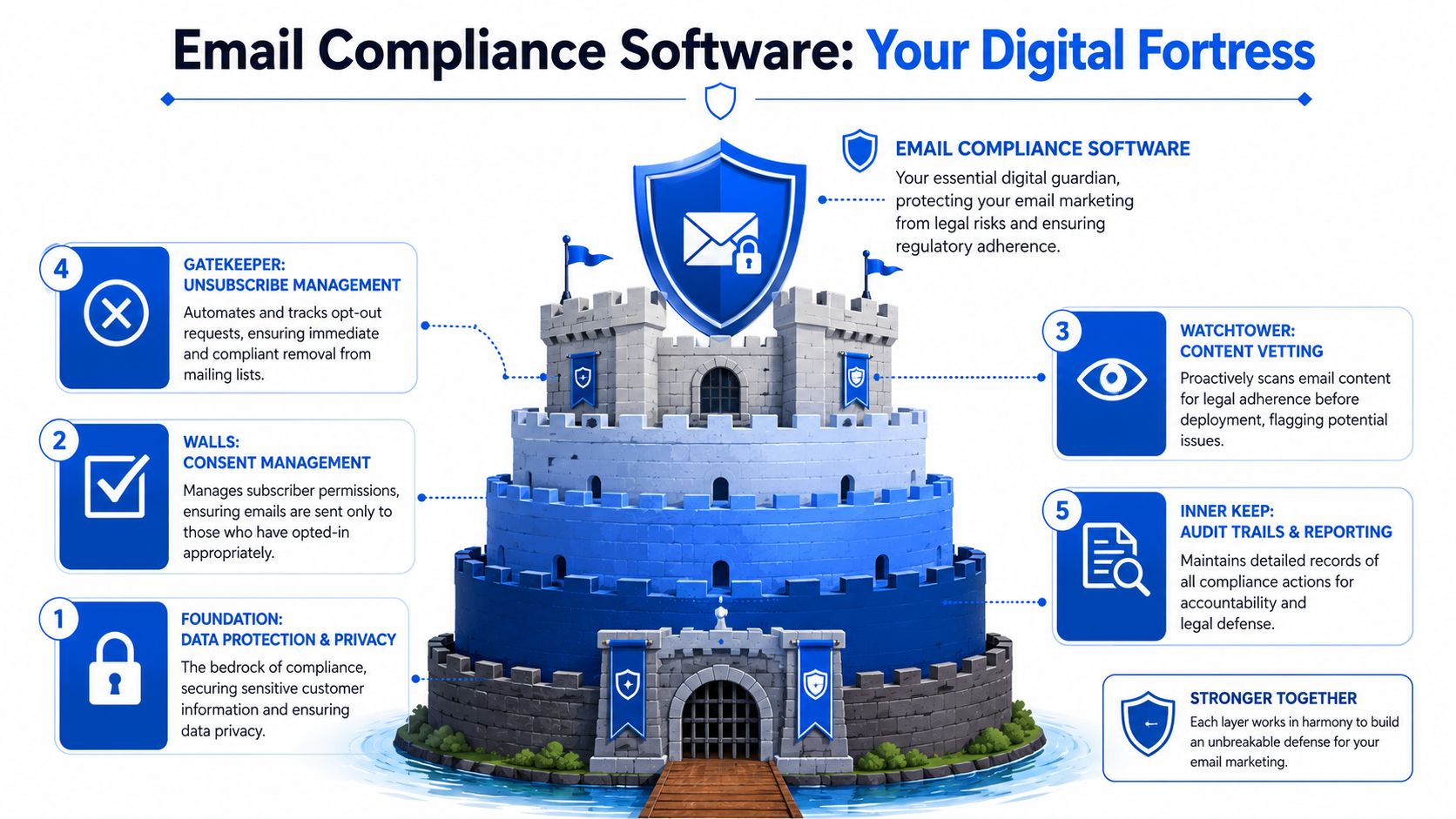
Email compliance software is best understood as a digital compliance officer embedded in your email operations. It doesn't replace legal counsel or security leadership. It operationalizes their rules so marketers, sales teams, and admins don't have to enforce everything manually.
That's why the category is broader than one checkbox labeled “compliant.” In practice, it's a set of controls working together: consent management, role-based approvals, audit trails, encryption, suppression handling, retention, and archiving.
What the software actually does
When teams first evaluate this category, they often expect a legal filter that checks subject lines and adds an unsubscribe link. That's too narrow.
Strong Email compliance software sits inside the message lifecycle:
- Before send it checks permissions, content rules, approval paths, and suppression status.
- During send it can apply policy-based controls such as encryption or restricted routing for sensitive data.
- After send it records what happened, who approved it, what consent basis applied, and whether any retention or e-discovery rules should attach.
This is one reason the category has become more important in regulated sectors. Email compliance software is now business-critical for regulated firms in industries such as finance, healthcare, and legal, as it helps organizations manage complex workflows, approval processes, and documentation required to send emails in a compliant manner (fintech.global on why email compliance software is business-critical). For the finance side specifically, see our email marketing for financial services guide.
Why marketers should care
Marketers sometimes hear “compliance software” and assume it's mainly for IT, legal, or procurement. That misses the point. It directly affects campaign execution.
A good setup reduces the operational mess that drags performance down:
- fewer questionable contacts in the active list
- cleaner suppression logic
- consistent template governance
- clearer ownership over who can approve what
- better documentation when a prospect, customer, regulator, or internal stakeholder asks what happened
If you want a grounded comparison of where GDPR and CAN-SPAM compliance features show up in modern tools, Mail Merge for Gmail's compliance guide is a useful companion read.
The value isn't just blocking risky sends. The value is making compliant sends easier than risky ones.
That distinction matters. Bad systems rely on vigilance. Good systems shape behavior.
Anatomy of Powerful Email Compliance Software
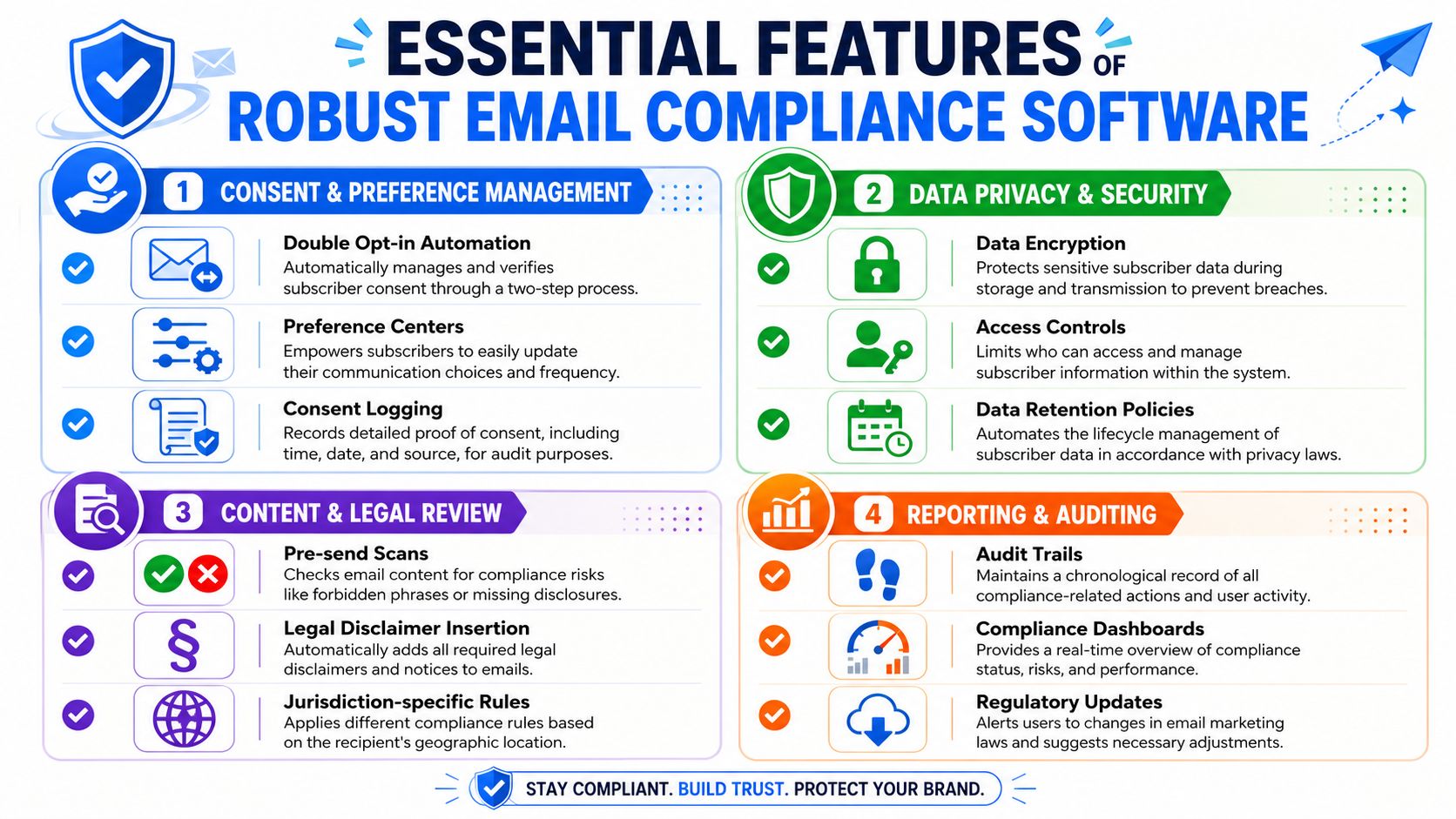
The easiest way to assess this category is to stop looking at feature lists as isolated bullets. Group them by the problems they solve. The strongest platforms usually cover four jobs well: consent, list integrity, data protection, and oversight.
Consent and preference management
Consent is the foundation because every other control depends on whether you should be contacting someone in the first place.
Look for:
- Consent logging that records where permission came from, not just whether a field says “subscribed”
- Preference centers that let people adjust topics or frequency instead of forcing a binary stay-or-leave choice
- Suppression management that prevents accidental sends to opted-out contacts
- Role-based permissions so not everyone can override list rules
The difference between basic and mature software shows up here fast. Weak tools store status. Better tools store context.
List integrity and data hygiene
A lot of compliance failures begin before a message is written. They start when poor data enters the system. Purchased lists, partner uploads, event scans, and old CRM imports can all create risk if no one verifies the source and scope of permission.
That's also where deliverability and compliance intersect. Dirty lists create both legal exposure and sender reputation problems. If your team is still treating list quality as a separate issue, it helps to connect it with email deliverability monitoring, because bad consent practices and bad inbox placement often travel together.
Here's a practical checklist for list integrity:
- Source verification for every new batch of contacts
- Field standardization so consent metadata isn't lost during imports
- Automated suppression sync across CRM and sending tools
- Jurisdiction-aware segmentation when different recipients need different handling
Data protection and security controls
Many teams often underestimate what the software should do. Spam filtering isn't enough. Compliance-grade protection needs controls for sensitive information.
Effective email compliance software utilizes centrally managed Data Loss Prevention (DLP) and policy-based encryption engines to automatically detect and protect sensitive data patterns like PII, preventing data exfiltration and ensuring adherence to mandates like GDPR and HIPAA (Trustifi on email compliance software).
That matters for more than obvious regulated use cases. Even standard B2B campaigns can expose personal data through attachments, forwarded threads, exports, or replies that contain more context than marketing intended to send.
A quick explainer helps here:
Feature
What it solves
DLP policies
Flags or blocks sensitive data before it leaves the system
Policy-based encryption
Protects content in transit when messages contain protected information
Access controls
Limits who can create, approve, export, or modify sensitive workflows
Secure archiving hooks
Preserves compliant records without relying on users to save them manually
Here's a useful walkthrough before you go deeper into vendor demos:
Oversight and proof
The final layer is what makes the whole system defensible. You need evidence, not good intentions.
That means audit trails, reporting, change history, and traceable approvals. If legal asks who approved a campaign, if a customer asks when they consented, or if an internal review questions why a contact was mailed, your system should answer that without manual reconstruction.
If a platform can't show what happened, when it happened, and who changed it, it isn't strong enough for serious compliance work.
How to Evaluate and Choose Your Solution
Most vendor evaluations fail because teams ask broad questions and get polished broad answers. “Is it compliant?” is a weak question. Every vendor will say yes. Better questions force the product to show how compliance works inside your actual workflow.
Start with your operating reality
Before the demo, write down the environments the software must fit:
- your CRM
- your email service provider or newsletter platform
- who needs approvals
- which teams touch contact data
- what kinds of regulated or sensitive information show up in campaigns or replies
- whether legal holds, retention, or discovery requests are relevant to your business
If you skip that step, you'll end up buying a feature-rich tool that doesn't match how your team ships campaigns.
Questions worth asking vendors
Use the meeting to test process, not brand positioning.
- How does consent data enter the platform?
Ask them to show imports, field mapping, preference syncing, and suppression handling.
- What happens when a user tries to mail a suppressed or unverified segment?
You want to see enforcement, not just alerts.
- How are approval workflows configured?
Check whether approvals can differ by team, message type, or jurisdiction.
- What evidence is available after a send?
Archiving and audit quality become apparent.
A critical point to verify is immutable, cloud-based email archiving with e-discovery capabilities, because that enables auditable proof of consent and retention required for regulations such as GDPR and CAN-SPAM (Spambrella on regulatory compliance).
Red flags during evaluation
Some tools look strong in screenshots and weak in operation. Watch for these gaps:
Red flag
Why it matters
Compliance is mostly manual checklists
Manual controls fail under campaign pressure
Archiving is editable or inconsistent
That weakens legal defensibility
Consent records are shallow
You need source detail, not just status labels
Reporting is hard to export or interpret
Audit readiness depends on usable records
Integrations are “possible” but not native or proven
Workarounds create data drift
Ask for a workflow demo, not a product tour
The best request you can make is simple: “Show us how our team would build, approve, send, suppress, archive, and later retrieve one campaign.”
That forces the vendor to demonstrate real life. It reveals whether the platform is built for operators or just packaged for procurement.
A strong choice usually feels boring in the best way. The rules are clear. The logs are complete. The integrations are predictable. People know what happens if they make a mistake. That's what you want.
Integrating Compliance into Your Marketing Workflow
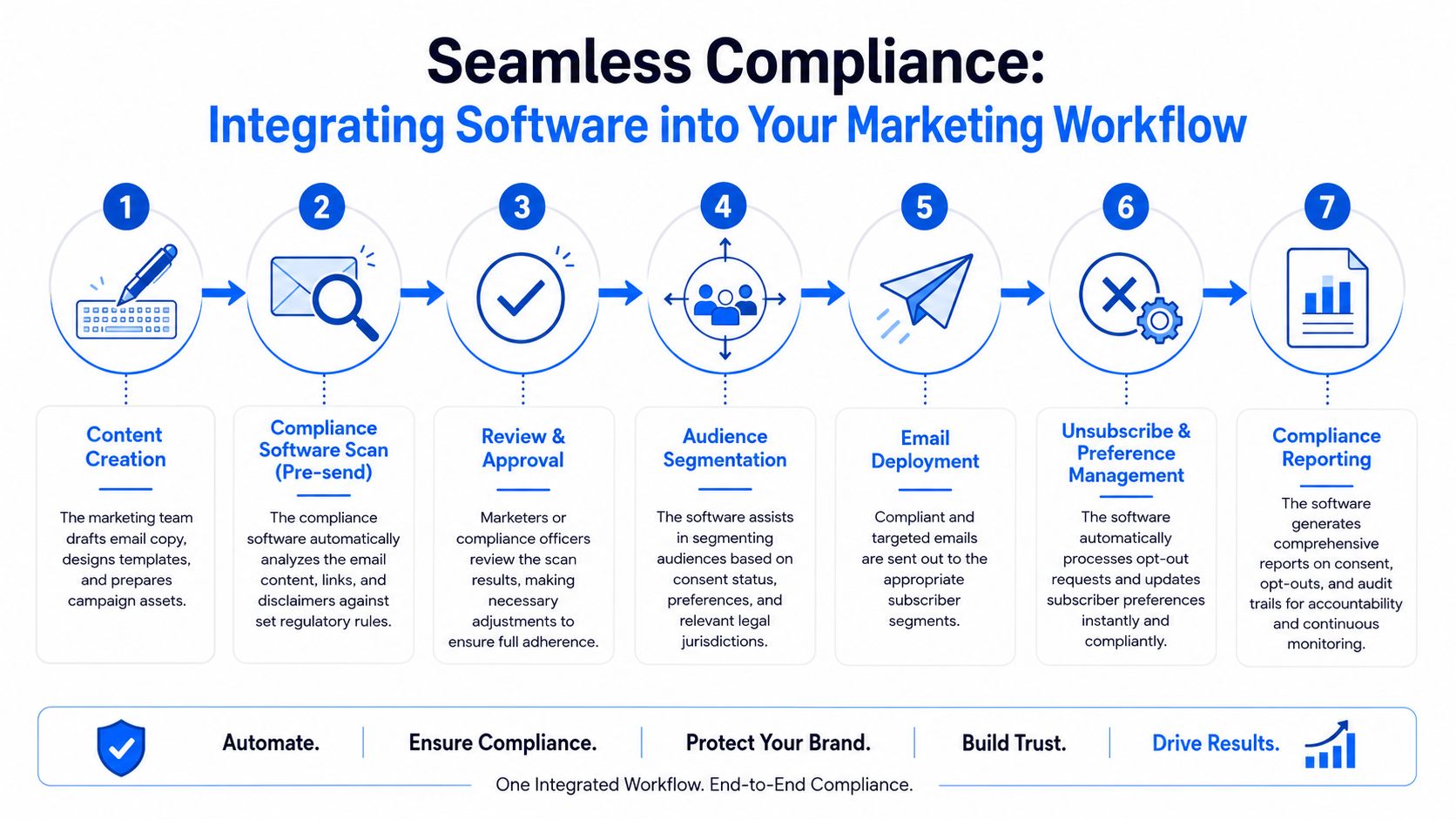
Compliance works best when nobody has to leave their normal workflow to enforce it. If your marketers write in one system, your CRM stores consent in another, your newsletter platform sends from a third, and opt-out updates live somewhere else, mistakes creep in at the handoff points.
The cleanest setup treats compliance as an invisible layer across the stack. Marketing drafts the email, the platform scans content and audience, approvals route automatically if needed, suppressed or unverified contacts stay out, the send goes live, and reporting records what happened.
A workable operating model
In a practical B2B stack, the sequence often looks like this:
- CRM holds the contact record and whatever permission metadata your team has collected
- Compliance tooling checks audience eligibility before the list reaches the sending layer
- Marketers build the campaign in the newsletter or automation platform
- Approval logic applies if the message, audience, or content type triggers review
- Suppression and preference changes sync back after the send
- Archiving and reporting preserve evidence without asking users to do extra manual work
If your team is still stitching this together ad hoc, it helps to formalize the handoffs with a documented marketing workflow so compliance controls aren't dependent on tribal knowledge.
The part many teams get wrong
Third-party data is where a lot of programs fail. A vendor says the list is opted in. Sales wants speed. Marketing imports it. Nobody asks how the consent was captured.
That's a serious weak point. Data shows that 40% of email compliance violations stem from unverified third-party consent sources, and brands need to verify the “source of birth” for each address rather than relying on vendor assurances (Ezepo on email compliance software).
That phrase matters. Source of birth means the original context in which the email address was collected. Not who sold it to you. Not who uploaded it. The actual consent event.
Don't ask a vendor whether the list is compliant. Ask them to show how permission was obtained, what language was used, and what proof still exists.
What works and what doesn't
Here's the trade-off I've seen repeatedly.
Works
Doesn't work
Syncing suppression lists automatically
Exporting and re-uploading CSVs between systems
Keeping consent metadata attached to the contact
Treating opt-in as a plain yes or no field
Requiring proof before third-party imports go live
Accepting “permission was granted” at face value
Building approval rules into the platform
Handling approvals in email threads and chat messages
Archiving records automatically
Expecting busy teams to save evidence manually
When compliance is integrated well, marketers don't feel blocked. They feel protected. The system catches preventable errors, and the team spends less time debating whether a send is safe.
Compliance as Your Unfair Growth Advantage
The strongest email programs don't grow in spite of compliance. They grow because of it.
When people trust that your team handles data carefully, honors preferences, and sends relevant communication to the right audience, the downstream benefits stack up. Your lists stay cleaner. Internal approvals move faster because the process is clear. Security and legal teams stop acting like last-minute obstacles because the controls already exist. Deliverability improves because you're not pushing questionable data through the same pipes as your best subscribers.
That's the strategic shift. Compliance isn't a tax on marketing. It's an operating discipline that protects the channel while making it more reliable.
For B2B teams, that matters even more. You're often working with smaller total audiences, higher-value relationships, longer buying cycles, and more scrutiny around how data is collected and used. Sloppy acquisition and vague consent practices may create short-term volume, but they weaken trust at the exact point where buyers are deciding whether your brand is credible.
Treat Email compliance software as infrastructure. Not decoration. Not insurance paperwork. Infrastructure.
If you want a newsletter platform that treats growth, data hygiene, compliance, and deliverability as part of the same system, take a look at Breaker. It's built for B2B teams that want to grow their audience without cutting corners on list quality, targeting, or inbox performance.
Keep reading
All articlesPost-Webinar Survey Questions Template (2026)
30+ post-webinar survey questions with NPS, CSAT, and CES templates, plus timing and length tips to boost completion and qualify leads faster.
GDPR Consent Requirements for Purchased Email Lists
Purchased email lists rarely meet GDPR's consent bar. Learn the legal basis rules, PECR overlap, and safer alternatives before you hit send.
7 Email Platforms With Inbox Placement Testing & Suppression
Compare 7 email platforms that combine inbox placement testing with suppression management, scored on features, pricing, and best-fit sender size.