
Affiliate Program Pay Guide for Marketers and Affiliates
Discover how affiliate program pay works from commission models to payout methods, benchmarks, tax considerations, and strategies for maximizing revenue.
You're staring at two affiliate offers in your inbox, both sound strong on paper, and both promise “great payouts.” One is a SaaS partnership with recurring commission. The other is a generic promotion with a bigger headline rate but vague terms, slow approval, and a minimum payout that might keep smaller checks locked up for months. If you write for a B2B newsletter or serve a niche audience, that choice can shape whether your affiliate income feels steady or unpredictable.
That's why affiliate program pay matters as a system, not just a rate card. The best programs don't merely advertise a commission, they define how tracking works, when money gets held, which conversions qualify, and how long you keep earning from a subscriber or buyer. Affiliate marketing has become a mainstream acquisition channel, with businesses typically earning an average $6.50 in ROI for every $1 invested, more than 80% of brands using it to drive leads and sales, and the global affiliate industry valued at $18.5 billion in 2025 FirstPromoter's affiliate marketing statistics.
If you're comparing partner options, Mailwarm's partner network is a useful example of how a focused program can be framed for a specific audience. The bigger lesson is simpler, though, and more useful: when you understand payout structure, you can judge whether a program fits your traffic, your list, and your revenue goals instead of chasing the highest number in the headline.
Understanding Affiliate Payment Models
Affiliate pay usually looks simple at first, then gets complicated fast. A program says it pays for clicks, leads, impressions, or sales, but each model rewards a different kind of behavior. For marketers, the right choice depends on whether your audience clicks quickly, buys slowly, or needs repeated touches before it converts.
The three core models
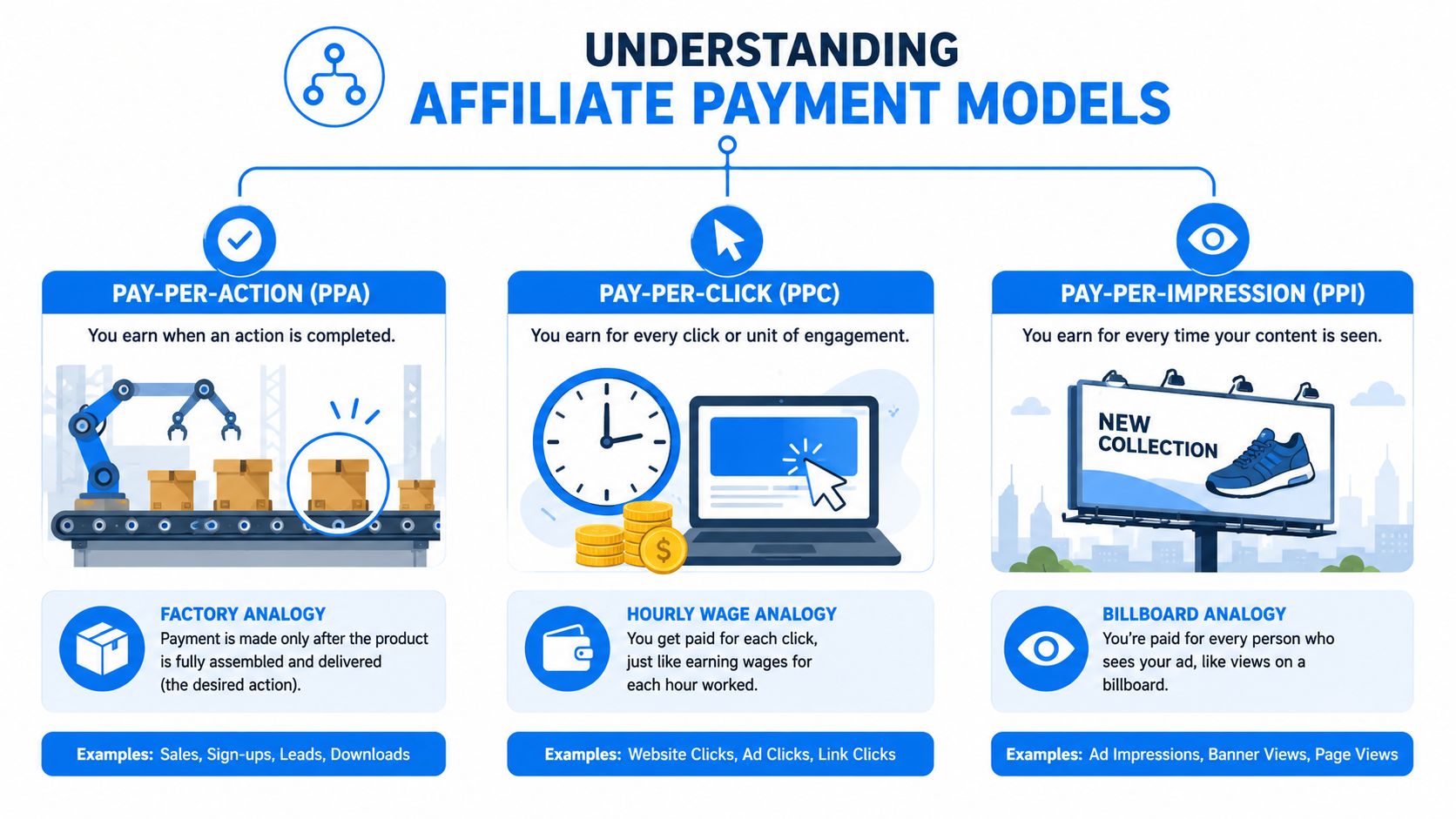
Pay-Per-Action pays after a specific action happens, such as a signup, trial, or sale. Payment for this model is strictly contingent upon the successful conclusion of the specified action. In affiliate programs, this is often the clearest model for B2B tools because the merchant wants a verifiable outcome, not just traffic.
Pay-Per-Click pays when someone clicks your link. That's closer to an hourly wage than a sales commission, because you get paid for activity rather than closed business. It can work in some promotional setups, but it puts more pressure on traffic quality and fraud controls.
Pay-Per-Impression pays for visibility. The closest analogy is a billboard, where the value comes from being seen rather than being acted on immediately. That model is easier to understand than it is to use well, because visibility alone doesn't tell you whether the audience cared.
Why validation sits in the middle
Affiliate systems don't usually pay the moment a click or conversion appears. The technical payment pipeline tracks the affiliate link event, validates the action against fraud rules, calculates the commission, and holds funds pending refund windows and fraud screening Tipalti's affiliate payments guide. That pending period is frustrating when you're waiting on cash, but it protects both sides from clawbacks and false conversions.
Practical rule: if a program can't explain how it validates conversions, you don't really know how it pays.
SaaS programs often layer recurring commissions on top of action-based tracking, so one conversion can create a stream of payouts instead of a single check. That's especially important for newsletter-led audiences, where a reader may not buy immediately but can stay valuable over time. Cookie duration matters in that setup because it determines how long after a click the referral can still be credited, which changes how much of your content inventory earns.
Typical Affiliate Rates and Benchmarks
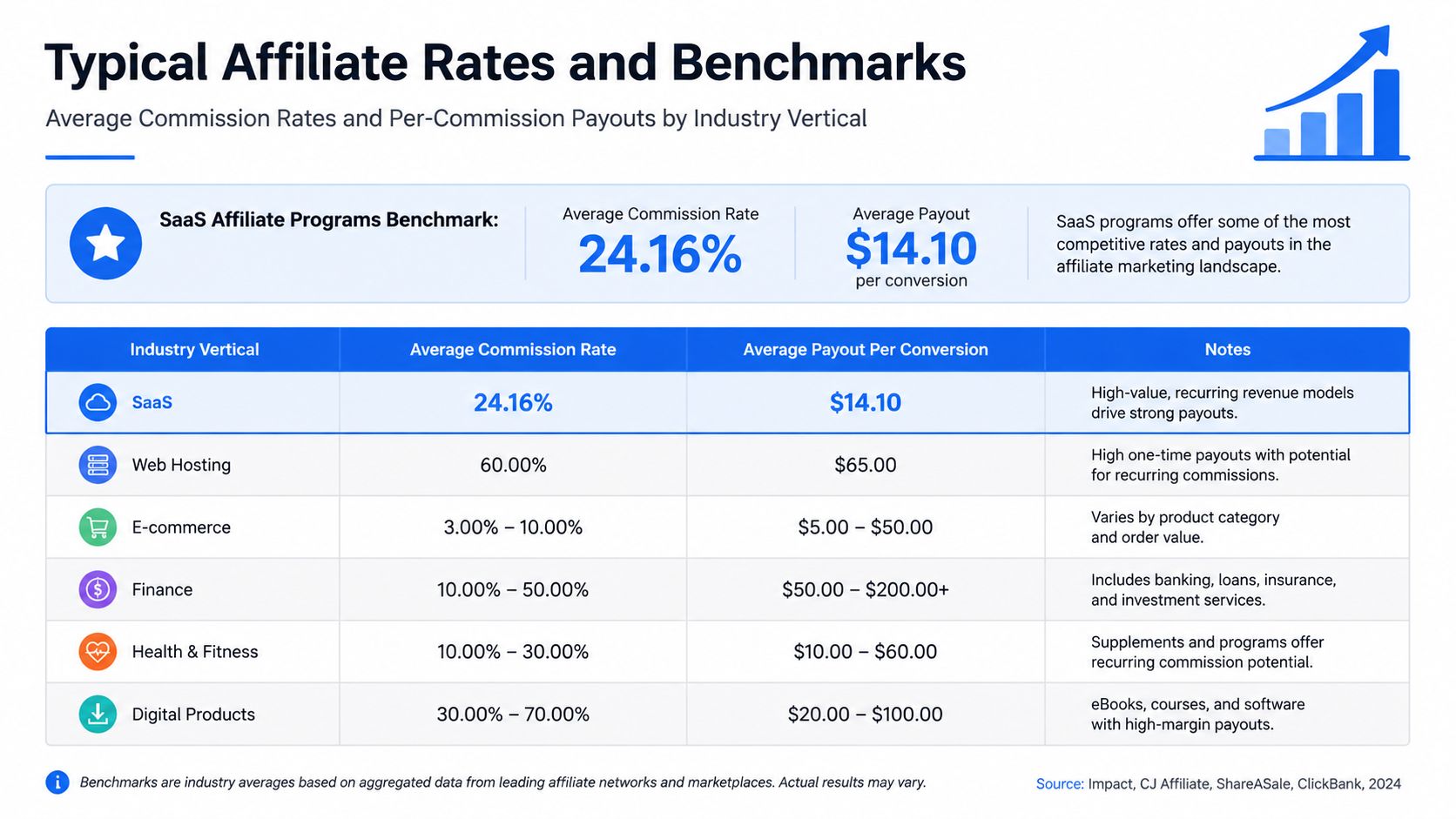
Rate comparison gets messy when you look only at the percentage. A 24.16% average commission rate in SaaS sounds modest next to some “high-paying” offers, but the average payout per commission is $14.10, and the all-time average payout is $13.56, which points to stable per-conversion economics in software Rewardful's affiliate marketing statistics. That's a different game from one-off consumer promos, where the value is usually tied to a single transaction.
What the benchmark really tells you
The useful question isn't “Which program has the biggest number?” It's “Which model matches my audience's buying pattern?” In SaaS, recurring revenue often matters more than a single flat bounty, because a reader may subscribe, keep paying, and continue generating value for the merchant after the first month. That's why the commission percentage by itself can be misleading.
Newsletter publishers should also look at how a program structures conversion value, not just rate. A smaller recurring payout can beat a larger one-time reward if the audience trusts your recommendations and keeps the customer active longer. That's especially relevant for B2B content, where buying decisions move slower and comparison content often sits closer to the final click than broad promotional copy.
For a practical example of how ad inventory and newsletter monetization are discussed from a publisher angle, the internal breakdown in newsletter ad rates is a useful companion read. It helps frame affiliate pay as part of a larger revenue mix instead of a standalone tactic.
How to read an offer without getting fooled
- Compare the unit of pay: A commission on a subscription, a lead, or a click all mean different things.
- Ask about recurrence: If a program pays again when the customer renews, that changes long-term value.
- Check the approval logic: If conversions sit in review for a while, the headline rate matters less than actual approval rates.
- Watch the payout floor: A high rate can still be hard to reach if the minimum threshold is too high.
Payout Schedules and Methods
The fastest way to make affiliate income feel unreliable is to ignore payout terms. A good program tells you when earnings become payable, what must happen before approval, and how money gets sent. The merchant side cares about fraud, refunds, and accounting, while the affiliate side cares about predictability and cash flow, so both sides need the schedule to be explicit.
Thresholds and timing
Experts recommend setting a minimum payout threshold at no more than 2–3× the average commission on a single sale Matt McWilliams on paying affiliates. That keeps the program from drowning in tiny transfers while still letting affiliates see money often enough to stay motivated. If the threshold is much higher than the typical commission, smaller partners may never cross it.
Net timing should be written plainly, usually as net-30 or net-60, so nobody has to guess when a payout is coming. The point of that language is simple, it ties the earned commission to a defined review period and payment window. When the terms are fuzzy, affiliates start treating the program as a side bet instead of a dependable channel.
Hold earnings until the refund window closes, not because the merchant is slow, but because the program needs to know the sale stuck.
Rails that actually matter
The main payout rails are domestic ACH, Global ACH or eChecks, digital wallets, and SWIFT wires. For U.S. partners, PayPal and ACH are the most common expectations, while Wise or Payoneer help with international payments Matt McWilliams on paying affiliates. The right rail depends on volume, geography, and how urgently a partner wants access to the funds.
If you're building terms, think like an operations manager. Define the approval date, the payout date, the minimum threshold, and the supported methods in one place. That reduces back-and-forth and cuts down on payment leakage caused by missing tax details or late bank setup.
Calculating Affiliate Commissions with Examples
A commission table looks abstract until you run the numbers on one campaign. Suppose a B2B newsletter promotes a subscription product priced at $200 per month with a recurring commission structure. If the commission rate is 20%, the affiliate earns $40 for each active subscriber in the first month, and the long-term value depends on how long those subscribers stay active.
A simple commission walk-through
If 100 readers sign up, first-month gross commission would be $4,000 before refunds, reversals, or churn. That number is easy to calculate, but it's not the number you should forecast against, because some customers won't stay active and some conversions won't clear the validation window. The merchant's approval process matters just as much as the headline rate.
Recurring pay changes the picture because the same customer can generate more than one payout. If the subscriber stays active for several months, the affiliate's value grows without requiring another click from the audience. That's why recurring SaaS offers can suit newsletter publishers so well, especially when the content is designed for decision-makers who don't buy on impulse.
Use the internal ROI framing in this marketing ROI calculator resource when you want to compare projected payout against the time it takes to produce a recommendation or review. It helps translate commissions into actual effort, which is the primary test for a newsletter operator.
Where the formula breaks
Refunds reduce the paid base. Churn reduces the recurring tail. Approval delays shift when cash arrives, even if the conversion already happened in your dashboard.
That's why the cleanest way to estimate affiliate income is to build it in layers:
- Start with gross conversions: Count the signups or sales you expect.
- Apply the commission rule: Multiply by the agreed payout structure.
- Allow for validation lag: Don't treat pending conversions as settled cash.
- Account for retention: Recurring offers only stay valuable if the customer keeps paying.
Tax and Compliance for Affiliate Payments
Affiliate pay doesn't stop at the commission rate. Programs also need the right tax forms, or payouts can stall before they ever leave accounts payable. For U.S. affiliates, the standard form is a W-9. For non-U.S. affiliates, it's usually a W-8BEN, and collecting both before the first payout helps avoid delays.
The reason this matters is straightforward. Payment teams can't process cleanly when they're waiting on missing identity and tax documentation. If the partner is international, the rail choice also affects compliance because different payment methods create different operational needs, especially when money moves across borders.
Global complexity without the jargon
Affiliate income is still income, no matter where it comes from. Affiliates should keep their own records of earned commissions, payout dates, and withheld amounts so they can report income correctly on tax returns. Merchants, meanwhile, need to know whether the payment is domestic or cross-border so they can route it through the right compliance workflow.
VAT and GST can also matter for international payments, depending on where the partner lives and how the program is structured. The exact treatment varies, so the practical move is to collect the right tax documentation early and confirm how the merchant handles it before you rely on the income. That keeps the program from turning into a paperwork problem after the content is already live.
Clean onboarding is cheaper than fixing payout errors after the fact.
Global payout rails, including ACH, digital wallets, and SWIFT, all have different administrative footprints. The more international the partner base, the more important it is to standardize the paperwork before the first commission is earned. That's not just compliance, it's a way to protect payout speed and reduce avoidable rework.
Strategies for Newsletter Publishers and Affiliates
Newsletter creators don't need to spray affiliate links across every issue. The stronger model is to treat affiliate pay like a product decision, then match the offer to the audience segment most likely to care. That's especially true for B2B readers, where the buying cycle is longer and one well-placed recommendation can matter more than repeated generic promotion.
Choose placements with intent
The highest-converting slot is usually the one that already carries trust. For many newsletters, that means a recommendation block, a short editor's note, or a relevant case study paragraph rather than a hard-sell banner. If the offer fits the issue's theme, readers are less likely to treat it like a detached ad.
A good successful SaaS affiliate program usually makes the tradeoff clear, recurring value for the affiliate, and a real customer acquisition path for the merchant Suby's SaaS affiliate program guide. That's the kind of structure newsletter publishers should look for when they want revenue that compounds instead of resetting every month.
Match offers to audience behavior
Affiliate pay for B2B and newsletter-led audiences often ranges 20%–50% recurring commissions or $150+ per lead, reflecting longer cycles and higher deal values Elementor's affiliate earnings guide. That range matters because it tells you the economics are built for patience, not volume spam. A smaller list with strong intent can outperform a broad audience that clicks but never buys.
- Segment the list: Send the right offer to the readers who already care about the problem.
- Test editorial placement: Move the link inside a helpful recommendation, not just the footer.
- Track by source: Watch which issue, angle, and CTA produce qualified clicks.
- Automate follow-up: Use workflows so recurring offers keep earning without manual rework.
For a tactical companion on sequencing and messaging, the internal guide on affiliate email marketing is worth using alongside this framework. It helps turn one-off promotions into a repeatable system.
Key Takeaways and Next Steps
Affiliate program pay works best when you treat it like a contract with mechanics, not a lucky conversion. The most important variables are the payment model, the validation process, the payout schedule, and the tax setup. Once those are clear, the headline commission rate becomes much easier to judge.
For newsletter publishers and B2B marketers, the biggest mistake is chasing the largest advertised rate without asking how the money is earned. A recurring commission can be more valuable than a one-time bounty, a modest threshold can be better than a high one, and a slower approval window can still be fine if the economics are strong. The right offer is the one that matches how your audience makes purchases.
A simple action plan looks like this:
- Review your audience type: Decide whether your readers click fast, compare slowly, or convert over time.
- Pick the right model: Match Pay-Per-Action, click-based pay, or recurring commissions to that behavior.
- Check the terms: Confirm net timing, payout threshold, supported rails, and tax form requirements.
- Measure actual value: Compare approved payouts, not just advertised rates.
- Revisit regularly: Programs change, and so does your audience's response.
If your current partnerships feel inconsistent, audit them now and rank each one by reliability, not just rate. The goal isn't to collect more offers, it's to build a payout system that keeps working when one campaign slows down. That's how affiliate income becomes predictable enough to plan around.
If you're building a newsletter business or a B2B growth engine, Breaker helps you turn audience attention into measurable revenue with better targeting, cleaner workflows, and clearer reporting. Visit Breaker to see how a newsletter platform built for growth can support your affiliate and sponsorship strategy.
Keep reading
All articlesBreaker Review: AI-Native ESP for Newsletter Growth
An unbiased Breaker review: pricing, features, deliverability data, and who this AI-native email platform fits best for newsletter growth.
Breaker for B2B, SME and Consumer Newsletter Senders
Learn how B2B, SME, and consumer audiences differ in newsletters, plus a framework for segmenting, messaging, and monetizing each without losing relevance.
What Is a B2B Content Engine
Learn what a B2B content engine is, how it differs from a content calendar or strategy, and why it's essential for AI-driven search in 2026.