
Call Management Software: The 2026 Buyer's Guide
Learn how call management software routes, records, and analyzes calls. Compare features, pricing models, and integrations to pick the right platform in 2026.
You know the feeling. A high-intent buyer calls, the phone rings twice, then the lead vanishes into voicemail, a shared inbox, or someone's personal mobile. Marketing swears the campaign worked, sales swears the calls were weak, and nobody can prove which ad, email, or landing page created the conversation.
That's why call management software matters in 2026. The old view was narrow, a system for routing calls and recording conversations. The better view is more useful, and more honest, it's a revenue-attribution layer that shows which calls deserve credit, which ones were missed, and which channels are paying for themselves.
The Ring You Cannot Trace
The worst part of an untracked call isn't the missed opportunity you can see, it's the one you can't. A marketer looks at a dashboard full of clicks and form fills, then hears a sales rep say, “We got three good calls this morning,” with no idea which campaign made that happen. The call came in, someone answered it, and the trail ended there.
That gap is where revenue gets fuzzy. If you can't connect phone activity to source, you can't defend spend, you can't compare channels, and you can't tell whether your best pipeline came from paid search, email, or a newsletter audience. If you're still relying on forwarded desk phones, a quick cleanup step is to review a guide to disabling forwarding in Teams before you blame the wrong system for missed handoffs.
Why the old phone setup breaks revenue visibility
Teams don't lose leads because they lack a phone number. They lose them because the number is disconnected from the rest of the revenue stack. A call comes in, but the CRM doesn't know who answered, the campaign doesn't know the source, and marketing can't see whether the phone line produced pipeline or just noise.
That's the difference between a phone system and call management software. A phone system connects people. A call management layer connects people, process, and evidence. If your team is serious about spend accountability, that distinction isn't optional.
Practical rule: if a call can't be tied back to a source, it isn't a measurable lead. It's just a conversation.
For teams that need a practical reference point on unified phone handling, a call center management software overview can help frame the difference between simple telephony and software that manages the full interaction path.
What Call Management Software Actually Does
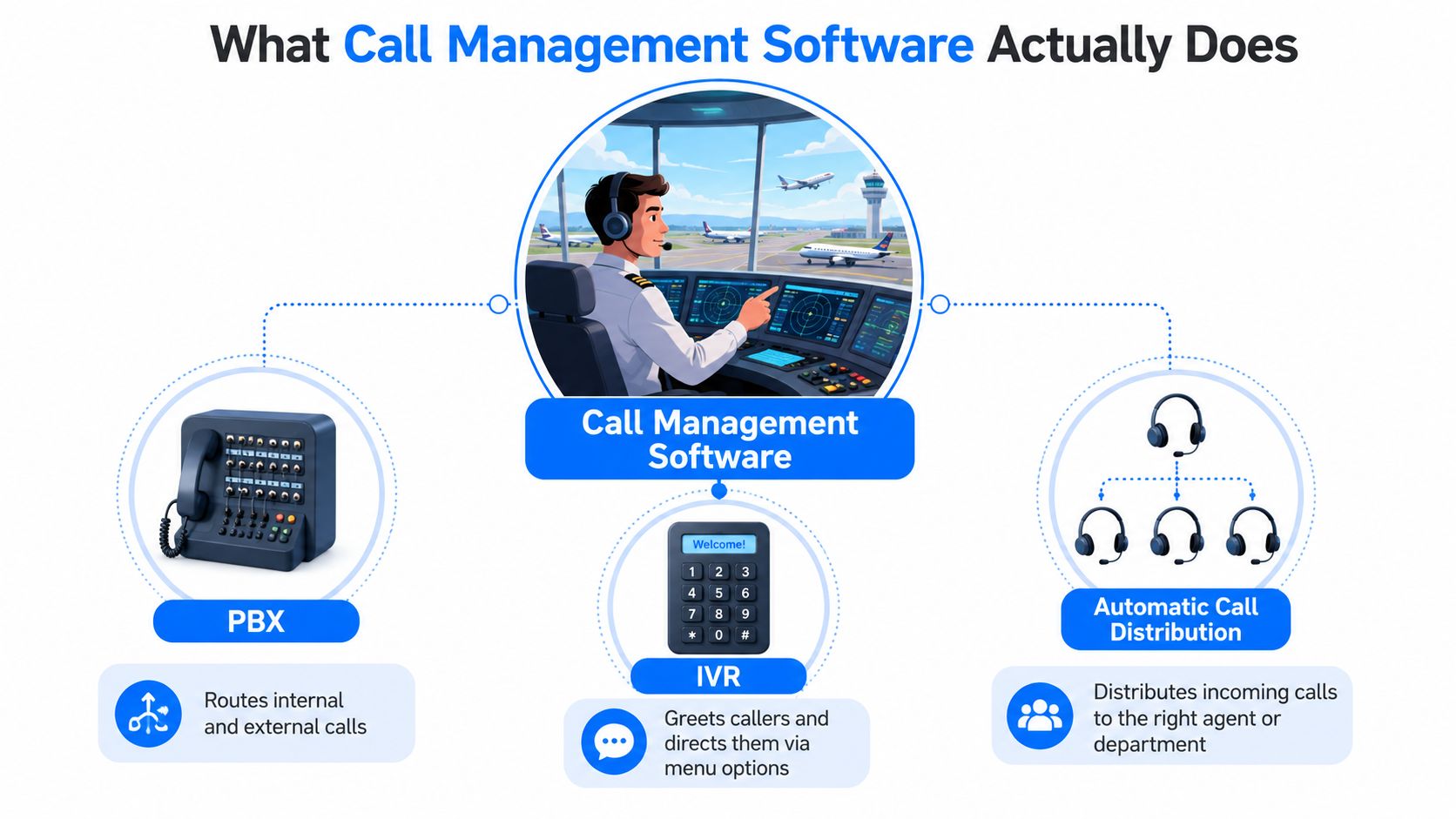
Think of call management software as an air traffic controller for voice. A call enters the system, gets identified, gets routed, gets answered, and leaves behind a record you can audit later. That's the job, and it's why buyers should care less about glossy feature lists and more about whether the platform can control the call path cleanly.
The core building blocks
A PBX is the private phone network behind your business numbers. It decides how calls move inside the organization, so a caller can reach the right team without your staff playing receptionist. In a small team, that might just mean one main line and a few extensions. In a larger operation, it becomes the backbone that keeps voice traffic organized.
SIP trunking is the internet connection that carries those calls. Instead of leaning on traditional phone lines, SIP lets the system move voice over the network, which is why cloud-hosted setups can scale more cleanly. If your team has remote reps, SIP is usually the less painful path.
IVR, or interactive voice response, is the menu a caller hears first. It asks them to choose a path, then hands the call off without wasting human time on basic sorting. The NPC India procurement document on routing architecture lays out the same logic clearly, IVR gathers intent before human handoff, then automatic call distribution (ACD) routes based on rules like skill, availability, and priority.
Why routing, recording, and analytics belong together
Skills-based routing matters because not every call should go to the first available rep. A billing question should not land with a new business AE who's never seen that objection before. Good routing reduces transfers, shortens queue time, and keeps callers from repeating themselves.
Call recording gives you accountability. You use it for training, dispute resolution, and QA, but the stronger use case is operational memory. Without recordings, every failed handoff becomes a story with no evidence.
Analytics turns the whole system into management data. The platform should show who answered, where calls stalled, what got resolved, and what didn't. If you want a plain-language benchmark on the broader category, the Zoom guide to call management software is useful because it separates routing, recording, and reporting from the idea of a full contact center stack.
The cleanest way to think about it is simple. PBX connects the phone network, IVR qualifies intent, ACD assigns the right person, and analytics tells you whether the system is doing its job.
Cloud vs On-Prem and the PBX Decision
Most buyers overcomplicate this decision. For most B2B growth teams in 2026, the default should be cloud-hosted call management software with SIP. That gives you speed, lower maintenance, and easier scaling without dragging IT into every change request.
The exception is real, though. If you're in a regulated environment, have strict data residency rules, or already sunk serious capital into on-prem telephony, the math shifts. In those cases, control can matter more than convenience, but that trade-off should be deliberate, not inherited.
Factor
Cloud-Hosted
On-Premises
Setup speed
Faster to deploy
Slower, heavier lift
Maintenance
Vendor-managed
Your team owns it
Scalability
Easier to expand
Harder to expand cleanly
Remote work
Strong fit
Usually clunkier
Control
Less direct
More direct
Disaster recovery
Built into the service model
Must be planned and maintained internally
A mid-market team with SDRs in three cities usually gets more value from hosted voice than from hardware in a closet. A small company gets even more benefit, because nobody wants to become the part-time PBX admin. If you want a plain-English view of spend patterns for hosted systems in the UK SMB market, the F1Group hosted telephone system overview is a useful context piece.
Where each model actually makes sense
Cloud wins when you care about agility. If you're rolling out a new campaign, adding seats, or supporting a hybrid team, cloud keeps the admin burden low. It also makes it easier to connect call data back to your CRM and marketing stack.
On-prem still earns a look when your infrastructure is already there and your compliance team wants tighter control. But buyers should be honest about the cost. The hidden expense is rarely the box itself. It's the upkeep, the upgrades, the troubleshooting, and the delays every time someone wants a new queue or routing rule.
If your team wants flexibility more than hardware ownership, cloud is the sensible default. If your business needs direct control over the stack, on-prem may be worth the drag.
Why Call Data Is a Revenue Asset
A call is not just a support event. It's often the highest-intent signal in the whole funnel. When someone picks up the phone, they're telling you that static web analytics never captured the whole story, and that phone interaction should be treated like pipeline data, not admin noise.
Attribution is the first job
The market tells you why this matters. The global contact center software market reached an estimated USD 63.88 billion in 2025 and is projected to reach USD 263.75 billion by 2034, a 16.50% CAGR over the forecast period, according to Fortune Business Insights. That scale matters because call handling, routing, recording, analytics, and omnichannel service functions are now packaged into broader software operations, not treated as side utilities.
Call tracking follows the same pattern. One estimate shows the category moving from USD 10.0 billion in 2023 to USD 10.84 billion in 2026, with a projected USD 20.3 billion by 2032 at an 8.2% CAGR, while ResearchAndMarkets separately projects USD 9.79 billion in 2025 and USD 15.33 billion by 2030 at a 9% CAGR. Those numbers point to the same conclusion, call data is being used to attribute, qualify, and evaluate voice interactions at scale, not just log them. Dataintelo's call tracking software report makes that trend hard to ignore.
Revenue teams need the same data marketing does
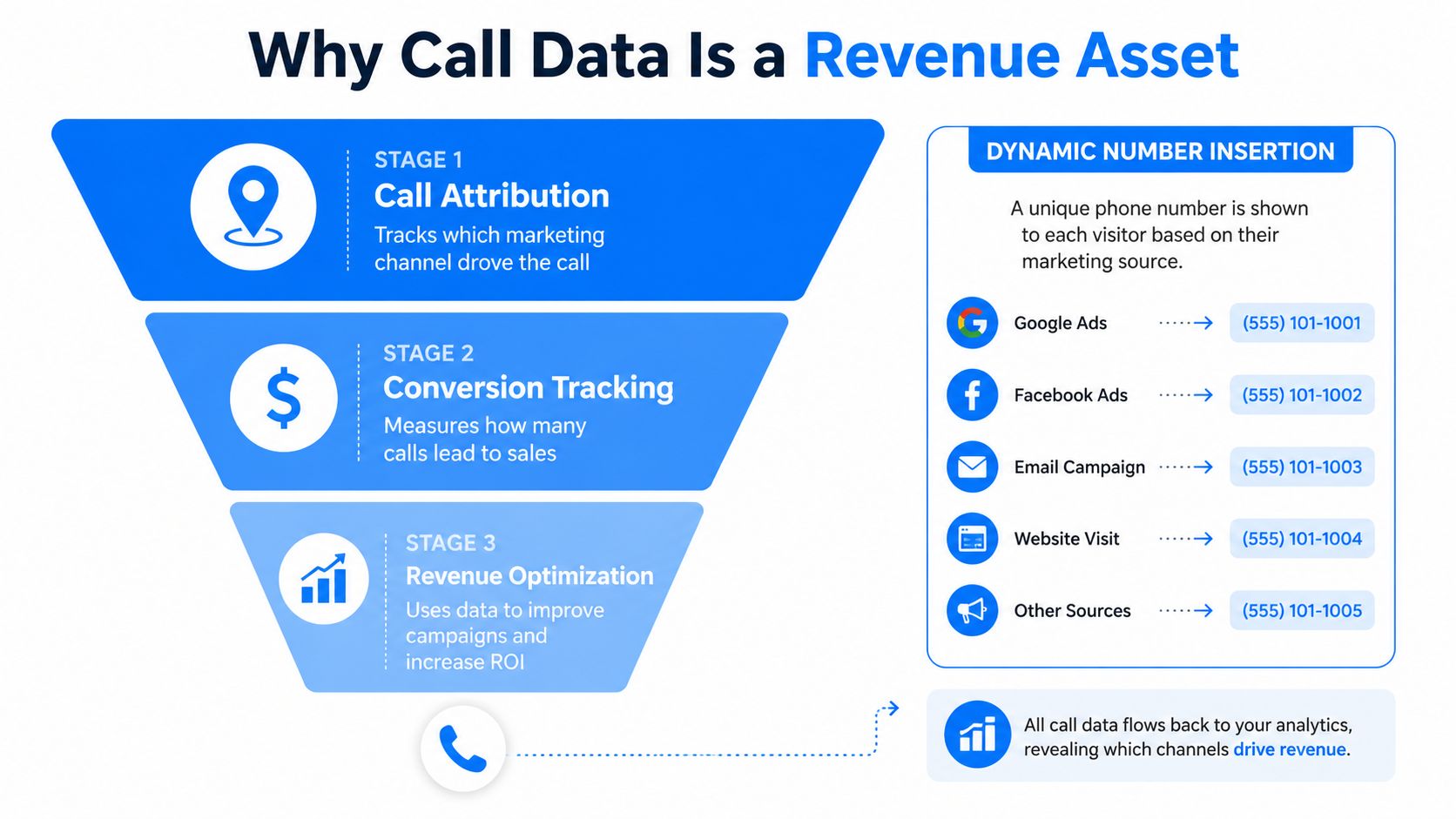
The revenue use case is straightforward. If you use dynamic number insertion, each source can carry its own phone number, so you can trace a call back to a campaign, a keyword, or an email send. That gives marketing real visibility into which sources drive qualified phone leads instead of just form submissions.
Call recordings and transcripts add another layer. They help you score leads by intent, spot common objections, and recover missed opportunities when a call goes unanswered. If you want a clean way to think about first-party context before the call hits the queue, the internal guide on what is first-party data fits this attribution model well.
The point is not that every call turns into revenue. The point is that call management software can show which calls deserve credit, which channels create them, and which ones need a better follow-up motion.
A Practical Selection Checklist for Buyers
Most vendor demos are built to impress a room, not to survive procurement. Don't buy for the prettiest dashboard. Buy for the way your team works, because the wrong platform becomes expensive the first time volume rises or routing changes.
Match the platform to the team, not the pitch
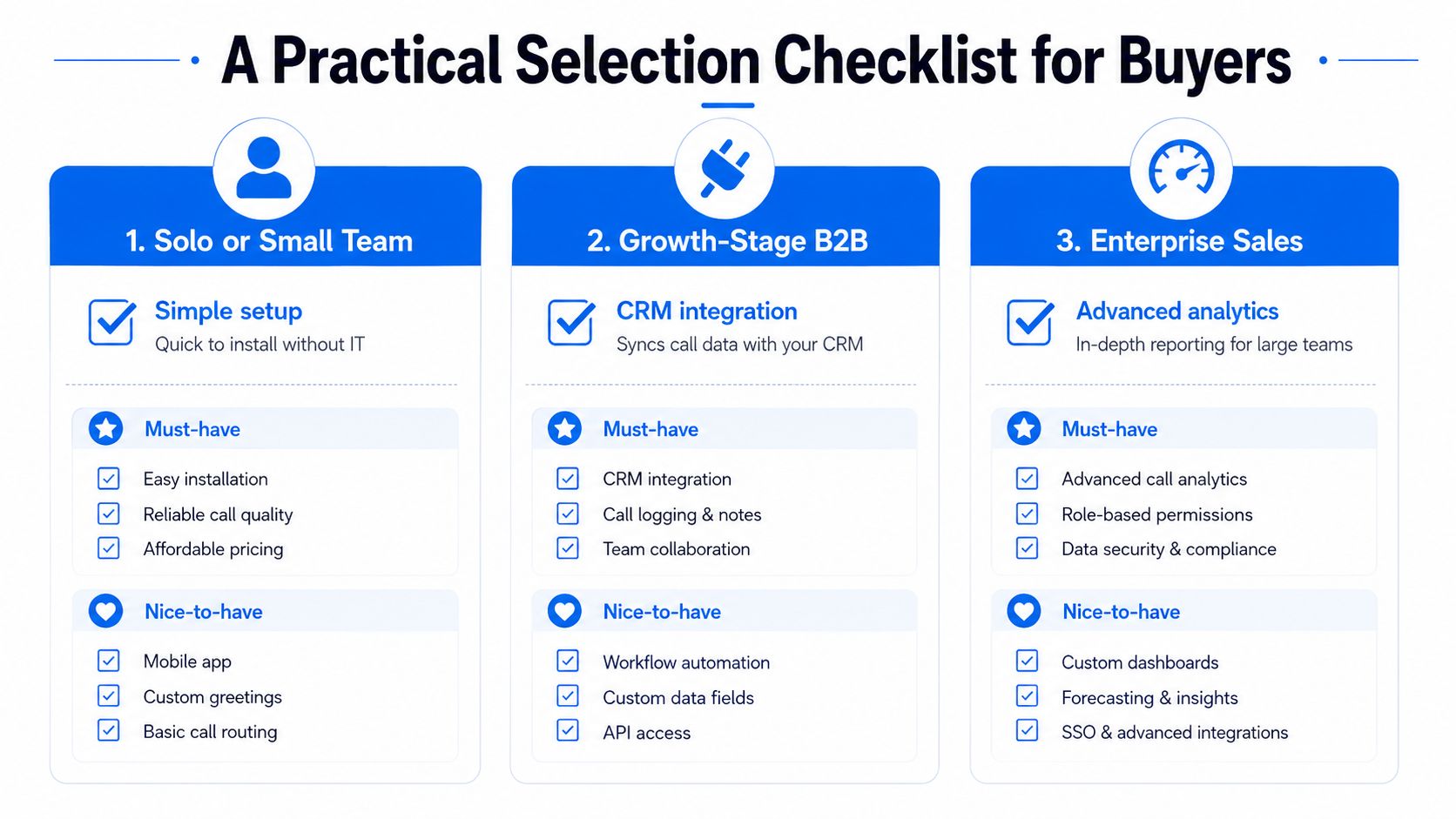
For a solo or small team, keep the bar low and practical. You need simple setup, call routing, recording, and basic analytics. Anything more should earn its place. A full enterprise-style suite will just slow you down.
For growth-stage B2B, the priorities shift. CRM integration is essential, because manual logging is where follow-up falls apart. At this stage, a platform that syncs call events into Salesforce, HubSpot, or your CRM of choice is usually more valuable than one with an impressive AI demo.
For enterprise sales, deeper reporting matters, along with queue controls, admin visibility, and tighter policy management. But don't let “enterprise” become a synonym for “bloated.” If a feature doesn't help managers route, audit, or connect revenue data, it's probably optional.
Ask vendors the questions that expose weak products
Use this short list in every demo:
- Call volume realism: Ask what the system looks like at your actual daily volume, not the vendor's benchmark demo.
- Inbound vs. outbound balance: Some tools are strong for service, others for sales. If your mix is off, the platform will be too.
- Attribution accuracy: Ask how source-level tracking survives transfers, callbacks, and repeat visitors.
- Cost discipline: Make the vendor show total cost of ownership, not just the headline subscription.
- Integration timing: Ask what breaks if the CRM sync fails for a day.
The strongest buying signal is not a long feature list. It's a platform that handles the basics cleanly and doesn't punish you for growth. If you want a reusable framing document for budget sign-off, the internal business case template is the kind of practical asset that keeps the conversation grounded.
Integrations That Prevent Leads From Falling Through the Cracks
A phone call without CRM context is a blind spot. The rep knows someone called, but not whether they came from an event follow-up, a paid campaign, or an organic newsletter click. That's how opportunities get handled twice or not at all.
The fix is to wire call events into the systems that already own the customer record. Call logs, recordings, and transcripts should land in the CRM automatically, not after someone gets around to updating notes. When the call data sits beside the rest of the account history, follow-up gets faster and attribution gets cleaner.
The stack should talk to itself
Salesforce and HubSpot should be the first integration targets for most organizations. If a rep can see caller context before picking up, they waste less time and make better judgments. If marketing can see which campaigns generated phone conversations, they can stop optimizing for vanity metrics.
Newsletter-driven demand matters here too. Breaker's targeting engine delivers engaged, exact-match subscribers using custom targeting, AI enrichment, proprietary data, data hygiene, and compliance, with real-time analytics on opens, clicks, subscriber growth, and ROI, which creates a clean lead source that call management software can attribute phone calls back to. That's useful because a subscriber who becomes a caller is often a stronger signal than a form fill alone.
A useful sequence looks like this:
- Connect the CRM first. Without the contact record, the rest of the data has nowhere to land.
- Sync call activity next. Make sure calls, recordings, and notes appear automatically.
- Add marketing attribution last. Tie the source back to campaigns and audience segments once the contact data is stable.
The reverse ETL guide is a good mental model for this, because it shows why moving usable data back into operational tools matters more than just storing it in a warehouse.
The rule is simple. If an integration only helps after a manager exports a spreadsheet, it's not really integrated.
The AI Trap and Common Buying Mistakes
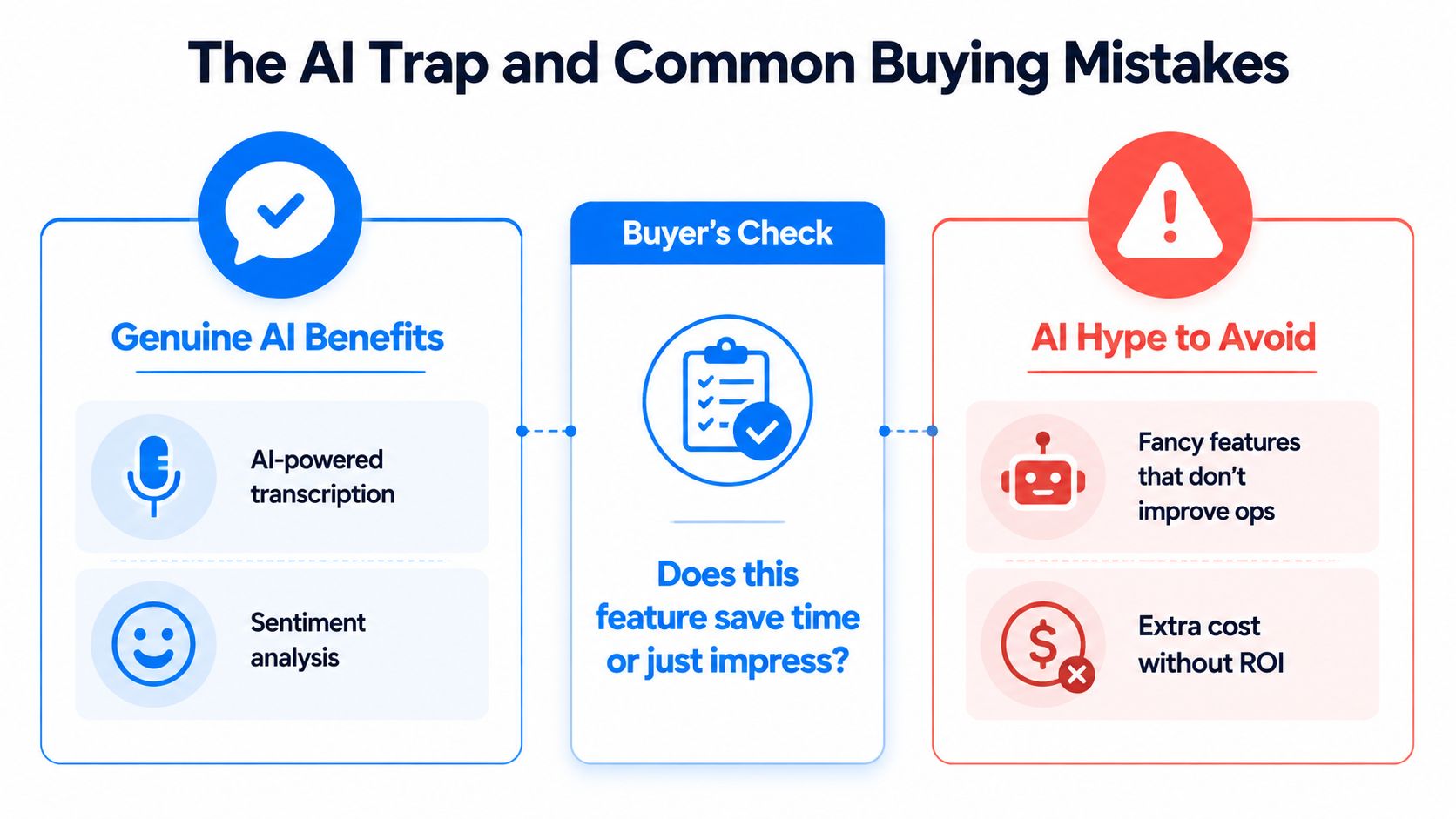
A lot of 2026 demos start with AI. That's usually a tell. If the routing is weak, the recording is messy, and the reporting is shallow, AI transcription won't save the product. It'll just make the demo feel more modern.
Useful AI has a job to do
AI-powered transcription is valuable when your team uses call notes for QA, coaching, or lead qualification. Sentiment analysis is useful when it helps managers spot friction early. Predictive routing is useful when it reduces transfers and gets a caller to the right person faster.
The problem is overbuying capability before the basics are stable. The NICE feature guide reflects the broader trend toward AI-powered automation, predictive routing, and call analysis, but it also reinforces something buyers should not miss, core routing, queue handling, recording, and reporting still matter most.
The mistakes that cost teams money
The most expensive mistake is buying for a volume you don't have. If your team handles modest call traffic, predictive dialers and heavy workforce tools may be overkill. You'll pay for complexity before you've earned it.
The second mistake is ignoring pricing until the bill lands. Per-minute and per-call models can look harmless in a demo, then feel very different when volume rises. A platform that prices growth as a penalty is the wrong platform.
Compliance is another trap. Call recording consent, GDPR, and TCPA aren't add-ons, they shape how the system should be configured from day one. If a vendor treats them like a checkbox, walk away.
Buyer's check: does this feature save time, improve accuracy, or shorten the path to revenue. If it just makes the demo nicer, skip it.
Bringing It All Together
The right call management software does three things well. It routes calls to the right human, it records and transcribes for accountability, and it feeds call data back into the systems that measure revenue. Miss any one of those jobs and the stack starts to leak value.
Track the metrics that show whether the system is helping, not just operating. First-call resolution tells you whether callers are getting handled without repeat effort. Average handle time shows whether routing and context are helping reps work efficiently. Qualified call rate, attributed pipeline from calls, and missed-call recovery rate tell you whether the platform is contributing to revenue instead of just moving voices around.
Don't let the checklist make the decision for you
The biggest mistake is buying a feature matrix instead of a workflow. Vendors will always have one more AI toggle, one more dashboard, one more add-on. None of that matters if the call path is broken or the CRM sync fails when a rep needs it most.
Your buying rule should be simple. Define the buyer journey the call must support, then shortlist vendors against that journey. If the platform can't prove it helps you route, record, and attribute cleanly, it's not the one.
If you're ready to turn phone activity into something your revenue team can measure, Breaker gives you the kind of clean audience and attribution context that makes call-based ROI easier to defend. Visit Breaker to see how it fits into a modern B2B growth stack, then map your next campaign to the calls it should generate.
Keep reading
All articles8 Best Email Tracking Software Tools in 2026
Compare 8 top email tracking tools for 2026, how tracking pixels work, and why Apple's privacy rules make open rates unreliable. See our top pick.
6 Best Email Trackers for Newsletter Senders in 2026
Open rates lie. Learn how email trackers really work, why Apple and Gmail skew the data, and which tools newsletter senders should actually use in 2026.
Post Webinar Survey: Questions, Examples, and a Checklist
What to ask in a post webinar survey, when to send it, three example formats, and a checklist for turning the answers into segmented follow-up and pipeline.