
What Is First Party Data? a B2B Marketer's Guide
What is first party data and why is it crucial for B2B marketing? Our guide explains how to collect, enrich, and activate it for newsletter growth and lead gen.
First-party data is the data a company collects directly from its own audience through channels like its website, app, CRM, email program, purchase flow, and support conversations. It matters because brands using first-party data can achieve 8x ROI, more than 25% lower CPA, and up to 2.9x revenue growth, and the share of brands using exclusively first-party data for personalization rose from 20% in 2021 to 25% in 2022.
Most advice about first-party data is too abstract to help a working B2B team. It usually stops at taxonomy. It tells you the label, then leaves you with no real plan for turning newsletter signups, clicks, and CRM records into qualified pipeline.
That's the wrong approach. For a growth team, the useful question isn't just what is first party data. The useful question is whether your team can collect it cleanly, enrich it, segment it, and use it to send newsletters that create actual sales conversations.
In B2B, newsletters are one of the best places to make first-party data useful. They sit close to intent. They produce behavioral signals fast. They also force discipline, because weak segmentation shows up immediately in poor engagement, weak replies, and leads that never move.
Why First-Party Data Is Your New Superpower
Calling first-party data a buzzword misses the point. It's a business asset that became more valuable as privacy rules tightened and browser changes weakened old tracking methods. In a worldwide survey, Statista found that the share of brands using exclusively first-party data for personalization increased from 20% in 2021 to 25% in 2022, a 5-point increase in one year (Statista on first-party data use in personalization).
That shift didn't happen because marketers suddenly fell in love with cleaner terminology. It happened because teams need data they can trust and act on. A newsletter operator cares less about abstract data theory than about questions like these: Which subscribers are engaged? Which companies keep returning to product pages? Which contacts click education content but ignore demo offers?
What makes first-party data different
First-party data comes from direct interaction. Someone visits your site, fills out a form, opens an email, attends a webinar, requests a demo, or talks to support. Your systems record that interaction because the relationship is yours.
That sounds simple, but it changes how a team works.
- You control collection: You decide what forms ask, what events get tracked, and how fields map into your CRM.
- You control activation: You can use the data in lifecycle emails, lead scoring, routing, and newsletter segmentation.
- You control governance: Consent, retention, suppression, and user preferences can all live inside your own stack.
Practical rule: If your team can't explain exactly where a customer field came from, it's hard to use that field confidently in segmentation or reporting.
Why this matters for B2B newsletters
A newsletter is more than a distribution channel. It's a signal engine. Every signup form, preference center, click, reply, and unsubscribe tells you something about fit and intent.
When teams ignore that, they send one generic stream to everyone. The result is familiar. Founders, product marketers, RevOps leads, and enterprise buyers all get the same message, even though they care about different problems and buy on different timelines.
When teams use first-party data well, the newsletter becomes a working feedback loop. It helps you identify good-fit accounts, shape editorial direction, and push engaged readers toward next actions that sales can use.
First Second and Third-Party Data Explained
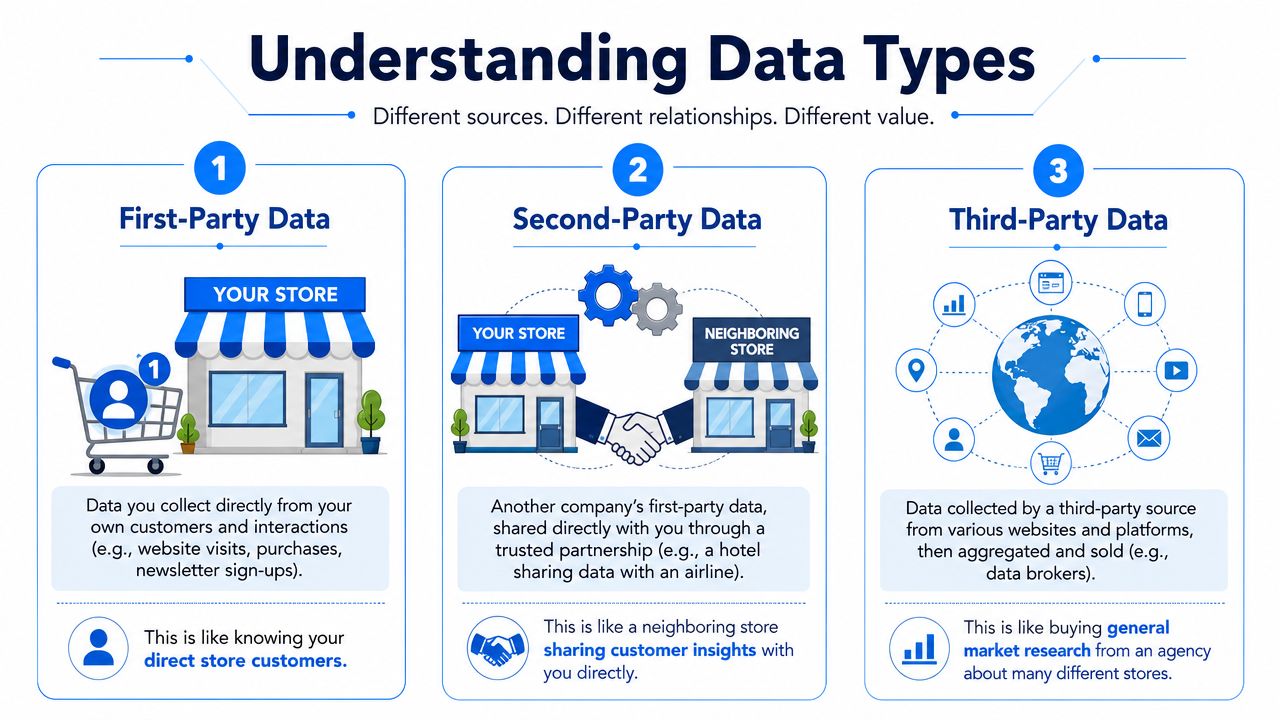
The easiest way to understand the difference is retail.
First-party data is what you learn from customers who walk into your own store.
Second-party data is what a trusted partner shares with you from their store.
Third-party data is what a broker sells after collecting and aggregating information from many places.
That mental model is usually enough for strategy discussions. The technical definition matters when you're building workflows. First-party data is defined by how it's collected, not by whether the field is demographic, behavioral, or transactional. It's data gathered directly from owned channels such as websites, CRMs, email platforms, apps, purchase systems, and support interactions, and because it's captured at the point of interaction, it typically has higher signal fidelity than brokered data (StackAdapt on how first-party data is defined).
A practical comparison
Data type
Where it comes from
Typical strength
Main trade-off
First-party
Your own website, CRM, email, app, purchase and support systems
High relevance and direct connection to your audience
Requires discipline to collect, structure, and maintain
Second-party
A partner sharing their own first-party data directly with you
Can add useful context in a trusted partnership
Depends on relationship quality and data compatibility
Third-party
Aggregated data collected and sold by outside providers
Broad reach and scale
Lower confidence, weaker provenance, and more compliance scrutiny
What each type is good for
First-party data is best when you need precision. If you're deciding who enters a nurture sequence, which subscribers should see product-led content, or which accounts deserve outbound follow-up, direct signals beat generalized assumptions.
Second-party data can work when two companies serve overlapping audiences. A media brand and a software vendor, or a platform and an integration partner, may share useful insights in a controlled way. The value comes from trust and context, not volume.
Third-party data is where many teams get sloppy. It can still be useful for broad audience discovery or market-level planning, but it often breaks down when you ask it to support nuanced lifecycle decisions. A bought audience segment might help you reach people. It won't tell you how they behave inside your newsletter or whether they've shown buying intent in your product journey.
The closer the signal is to a real interaction with your brand, the more comfortable you should feel using it for messaging and prioritization.
The mistake most teams make
They treat all data as interchangeable. It isn't.
A CRM filled with purchased contacts isn't the same as a CRM populated by newsletter subscribers who chose topics, clicked content, and revisited pricing pages. Those two audiences may look similar in a spreadsheet. They behave very differently in campaigns.
For B2B newsletter growth, the distinction matters because newsletters compound on relevance. If the underlying data comes from real engagement, segmentation gets sharper over time. If the underlying data comes from weak or generic sources, the newsletter becomes noisy and performance drifts.
How to Collect and Enrich Your First-Party Data
The best first-party data programs don't begin with a giant data model. They begin with a few reliable collection points and a clear plan for making those signals usable.
A helpful way to organize the work is by separating declarative and behavioral data. Qualifio describes declarative data as information a user explicitly provides, such as name, email, or country, while behavioral data comes from observed actions like site visits, app usage, purchase history, and email engagement. That split matters because declarative fields help identity resolution, while behavioral fields support predictive scoring and targeting (Qualifio on declarative and behavioral first-party data).

Start with owned channels
For most B2B teams, the cleanest sources are boring on purpose.
- Website forms: Newsletter signup forms, demo requests, gated assets, webinar registration, and contact forms.
- Email activity: Opens, clicks, replies, forwards, topic preferences, and unsubscribe behavior.
- CRM records: Sales-entered notes, lifecycle stage changes, account ownership, opportunity association, and meeting outcomes.
- Product or app events: Trial starts, feature usage, workspace creation, and return visits.
- Support interactions: Ticket categories, onboarding questions, renewal friction, and product pain points.
Not every field deserves equal importance. Teams often over-collect form data and under-collect behavioral context. Asking for too much too early hurts conversion. Asking for too little leaves you with a database of email addresses that can't support meaningful segmentation.
Collect in layers, not all at once
A better pattern is progressive profiling.
Ask for the minimum required to begin the relationship. Then capture more context through later forms, preference centers, sales conversations, and observed behavior. If someone subscribes to a newsletter, you don't need to know everything on day one. You do need a clean email address, a clear consent state, and a way to link future actions back to that profile.
A smart operator also maps collection to use cases. If you want to personalize newsletter issues by job role, capture role. If you want to prioritize accounts by company type, collect or append firmographic context. If you want to spot intent, make sure your site and email events connect back to the contact record.
Enrichment turns records into working profiles
Many programs improve quickly by leveraging specific data points. A plain signup record has limited value. A profile with company name, role context, engagement history, and lifecycle signals is much easier to activate.
That's why many teams pair first-party collection with enrichment workflows. A good primer on the wider context is this guide to essential marketing data for growth, which helps frame where owned data fits alongside other inputs. If you want a practical look at turning raw contact records into more useful profiles, this overview of data enrichment services for marketing teams is worth reviewing.
Don't enrich for vanity. Enrich for decisions. If a field won't change routing, personalization, prioritization, or reporting, it probably doesn't need to exist yet.
What works and what doesn't
What works is a narrow, disciplined stack. A form tool, CRM, email platform, and event tracking setup that share IDs and field definitions will outperform a sprawling system full of duplicates and contradictory values.
What doesn't work is treating your newsletter list like a static asset. It's a living dataset. Subscribers change jobs, interests shift, companies move upmarket, and engagement fades. If your team doesn't refresh profiles, suppress stale records, and update segmentation rules, first-party data decays into clutter.
Activating Data for B2B Newsletter Growth
Collection is only half the job. Pipeline comes from activation.
The advantage of first-party data in B2B newsletters is that it connects content behavior to commercial intent. Avaus reports that brands using first-party data can achieve 8x ROI, more than 25% lower CPA, and up to 2.9x revenue growth, with personalization helping improve retention and reduce costs (Avaus benchmarks for first-party data). Those outcomes make sense when you look at how newsletter programs work. Relevance compounds. Generic sends waste attention.
Segment by buying context, not just demographics
Many B2B newsletters stop at simple audience buckets. Industry, company size, and title matter, but they're not enough on their own. The stronger segments combine profile data with behavior.
Consider a SaaS company selling to revenue teams. It may create segments like these:
- New subscribers from target accounts: Send education-first issues, not aggressive product pushes.
- Highly engaged readers with product-page visits: Introduce stronger calls to action such as demo invitations or comparison content.
- Existing customers reading advanced content: Shift toward adoption, expansion, and use-case depth.
- Cold subscribers who haven't engaged recently: Run re-engagement or preference-refresh campaigns.
That model is more useful than one broad “marketing leaders” segment. It reflects both fit and momentum.
Personalization that actually helps
Personalization gets overhyped when teams confuse it with token substitution. Adding a first name to the subject line isn't a strategy. Matching content to problems, maturity, and timing is.
Useful newsletter personalization often looks like this:
- Editorial relevance: Different lead story blocks for founders, operators, or enterprise buyers.
- CTA relevance: A workshop invite for engaged readers, a template download for earlier-stage contacts.
- Cadence changes: Heavier nurture for active evaluators, lighter sends for low-intent readers.
- Sales handoff signals: Internal alerts when a subscriber shows repeated engagement across high-intent content.
Here's a good operating principle. Don't personalize everything. Personalize the parts that affect next action.
A newsletter becomes a pipeline channel when every click means something operationally, not just editorially.
A useful companion to this work is a clear email list building strategy for B2B growth. Strong activation depends on strong acquisition. If the list comes in with weak fit, even good segmentation has limits.
Build a feedback loop between content and sales
Mature teams separate themselves in this way.
A growth marketer notices that finance leaders click compliance content but ignore product updates. Sales hears the same accounts ask about governance during calls. Marketing responds by building a finance-specific content track inside the newsletter and a related nurture path. Over time, that audience becomes easier to identify, score, and route.
That loop works because the data is first-party. The signals came from your own audience and your own channels. You're not guessing from abstract intent categories. You're watching real contacts interact with real messages.
Midway through planning, it helps to see how another team frames activation workflows in practice:
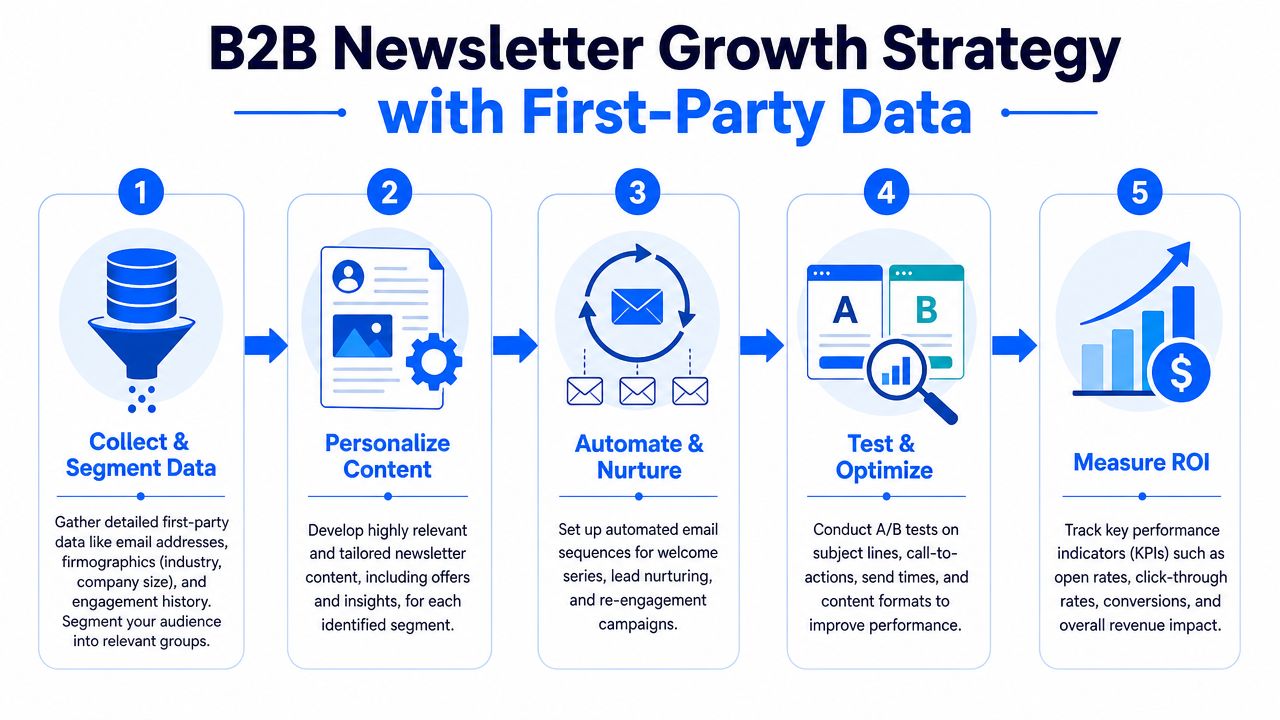
A practical activation sequence
- Capture the signup cleanly
Store source, consent status, signup context, and any declared preferences.
- Append account context
Add company, role clues, and lifecycle fields if available through your systems.
- Track early engagement
Watch which topics, links, and CTAs each subscriber responds to in the first few sends.
- Route by intent
Move active readers into the right nurture or alert sales when interest clusters around high-value topics.
- Refine segments over time
Keep updating rules as contacts reveal more through behavior, replies, and form submissions.
What usually fails is over-engineering. Teams build elaborate scoring models before they've proven basic segmentation. Start with a handful of trusted signals. Newsletter signup source, company context, repeat clicks, and high-intent page visits are often enough to improve quality fast.
Navigating Privacy Compliance and Building Trust
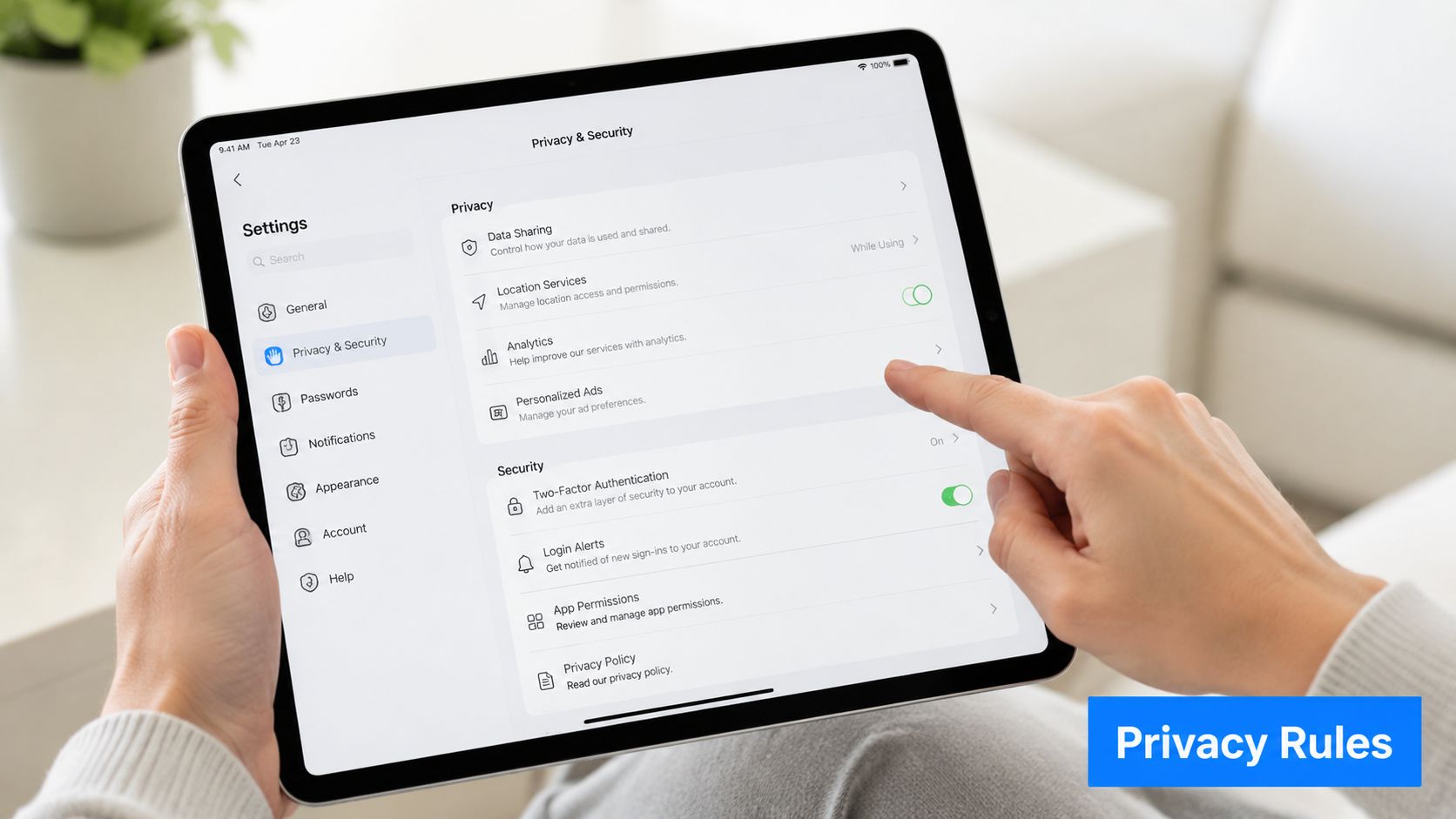
First-party data is often described as more privacy-friendly, and that's directionally right. The relationship is direct. The collection path is visible. The systems are usually yours to govern. But none of that means your team gets a free pass on consent, transparency, or suppression.
In practice, responsible use starts with clarity. People should know what they're signing up for, what kind of communication they'll receive, and how to change preferences later. If your newsletter form promises insights and then drops people into unrelated product blasts, trust erodes quickly.
Governance has to be operational
Good compliance isn't a PDF in a legal folder. It shows up in the campaign workflow.
- Clear consent states: Your CRM and email platform should reflect whether someone subscribed, how they subscribed, and what they agreed to.
- Preference management: Let subscribers adjust topics or cadence instead of forcing an all-or-nothing choice.
- Suppression discipline: Honor opt-outs consistently across campaigns and systems.
- Retention awareness: Don't keep stale or unnecessary records forever just because storage is cheap.
A lot of B2B teams also get tripped up by edge cases around consent language and follow-up rules. If your team is sorting through those distinctions, this guide to implied consent in email marketing is a useful practical reference.
Trust improves data quality
There's a strategic benefit here that gets ignored. When subscribers trust the brand, they share better information and engage more authentically. They choose preferences, reply to emails, register for events, and update details when they change roles.
That creates a healthier first-party dataset. Better data then leads to better targeting, more relevant newsletter content, and fewer annoying mismatches.
Privacy work isn't separate from growth work. In newsletter programs, trust is one of the inputs that improves signal quality.
The teams that handle first-party data well tend to sound more straightforward everywhere else too. Their forms are simpler. Their unsubscribe flows are cleaner. Their nurture sequences are easier to understand. Buyers notice that.
Common Pitfalls and the Future of Customer Data
The biggest mistake with first-party data is assuming collection alone creates an advantage. It doesn't. Plenty of teams have forms, event tracking, CRM records, and newsletter metrics. They still can't answer basic questions about who their best subscribers are or which content themes move accounts toward pipeline.
Pitfalls that stall useful execution
A few problems show up repeatedly:
- Data silos: Email engagement lives in one tool, CRM stages in another, site behavior somewhere else, and nobody trusts the joins.
- Bad hygiene: Duplicate contacts, stale firmographics, and inconsistent field naming ruin segmentation.
- Analysis paralysis: Teams wait for a perfect model instead of using the signals they already have.
- Over-personalization: They create too many tiny segments and can't sustain content quality across them.
- Weak feedback loops: Marketing sends the newsletter, sales ignores the signals, and product never hears what buyers clicked.
None of these are glamorous problems. They're operational. That's why they matter.
First-party and zero-party data are starting to work together
The next shift isn't a replacement of first-party data. It's a better combination of signals.
Braze notes an emerging trend toward combining first-party data, which reflects observed behavior like opens and purchases, with zero-party data, which reflects explicitly shared preferences. As privacy changes make passive tracking less complete, the focus shifts from defining the categories to deciding which signal to trust for segmentation and personalization (Braze on first-party and zero-party data).
That's the future for serious newsletter operators. Don't choose between observed behavior and declared preference when you can use both. If a subscriber tells you they want case studies, that's valuable. If they consistently click pricing-adjacent content instead, that's valuable too. The strongest programs reconcile the two.
The practical takeaway
If someone asks what is first party data, the simple answer is still correct. It's data you collect directly from your own audience. But the strategic answer is more useful. It's the foundation for a newsletter engine that learns from every send, sharpens audience fit, and gives sales a cleaner path to engaged accounts.
Treat it like infrastructure, not jargon. Build it patiently. Use it in public-facing channels like your newsletter, where the quality of your data shows up fast.
If your team wants to turn newsletter engagement into a more reliable growth system, Breaker is built for that job. It combines email sending, audience targeting, enrichment, list growth, analytics, and deliverability tools in one platform, so B2B marketers can grow engaged subscriber lists and activate first-party signals without stitching together a messy stack.
Keep reading
All articlesNewsletter Agency Services: How Agencies Scale Client Newsletters
Managing multiple client newsletters? Learn what a true newsletter agency platform needs to prevent list mixing, voice drift, and invisible ROI.
Building Owned Audiences: Move Followers to Your Newsletter in 2026
Social platforms can vanish overnight. Learn how to convert Instagram, TikTok, and YouTube followers into a newsletter list you actually own.
Newsletter Analytics: Which Metrics Actually Matter in 2026
Open rate and clicks don't predict buyers. Learn the 7-step method to track click depth, recency, and topic affinity for a revenue-predictive intent score.