
What Is Data Enrichment: Your B2B Marketing Guide 2026
Unlock B2B growth! Learn what is data enrichment and how it transforms your strategy. This 2026 guide covers types, use cases, KPIs, & best practices.
Your newsletter list is growing, but results aren't. Open rates flatten. Clicks cluster around the same small group of subscribers. Sales says the audience looks broad, not qualified. And every personalization idea runs into the same wall: you only know a first name, a work email, and maybe a company field someone typed into a form months ago.
That's a common B2B problem. Teams think they have audience data, but what they really have is a pile of partial records. Those records are enough to send email. They're not enough to build a newsletter that consistently attracts the right subscribers, keeps content relevant, and proves revenue impact.
Data enrichment fixes that gap. It turns a list of contacts into a working audience model. Instead of treating every subscriber like a generic lead, you can understand who they are, what kind of company they work for, what tools they likely use, and how to segment them in a way that maps to buying context.
For newsletter growth, that is often underestimated. The better your context, the better your targeting, signup flow, onboarding sequence, editorial segmentation, and handoff to sales. If you're trying to build toward unified customer data, enrichment is often the practical step that gets you there.
From Incomplete Contacts to Actionable Intelligence
A raw B2B contact record usually looks usable until you try to do real marketing with it.
You have an email address. Maybe a name. Maybe a company domain. That's enough to hit send, but not enough to answer the questions that drive newsletter growth: Is this person in your ICP? Are they a founder, operator, or individual contributor? Do they work at a startup, a mid-market firm, or a large enterprise? Should they get your product-led content, your industry analysis, or your buyer education sequence?
Why basic contact data underperforms
Most newsletter problems don't start in the email editor. They start in the database.
When records are incomplete, teams fall back on blunt segmentation. They send the same issue to everyone. They write vague copy that tries to speak to too many roles at once. They judge performance at the list level instead of by audience quality. That usually creates a misleading picture: the newsletter may be “working,” but not for the people who matter.
A talented growth marketer can compensate for some of this with strong messaging. They can't compensate forever.
In B2B, weak audience context turns newsletter strategy into guesswork.
Where enrichment changes the game
Data enrichment gives your first-party records the context they're missing. It helps you move from “we have a subscriber” to “we know why this subscriber belongs on this list and what they're likely to care about.”
That matters across the full lifecycle:
- Acquisition: You can target exact-match subscribers instead of broad lookalikes.
- Content planning: You can shape editorial around role, industry, and company profile.
- Monetization: You can show sponsors and leadership that the audience is qualified, not just large.
- Sales alignment: You can identify which subscribers fit the accounts and personas your team wants.
The practical shift is simple. You stop treating data as storage and start treating it as an operating advantage.
What Exactly Is Data Enrichment
A newsletter signup comes in with a work email and a first name. That record is enough to send an email. It is not enough to decide whether this person matches your ICP, which content track fits them, or whether they should count toward audience value for sponsors and sales.
Data enrichment fills in those missing details by appending outside data to a record you already own. In B2B, that usually means taking a known identifier, such as an email address or company domain, and adding fields like job title, company size, industry, location, or technology stack.
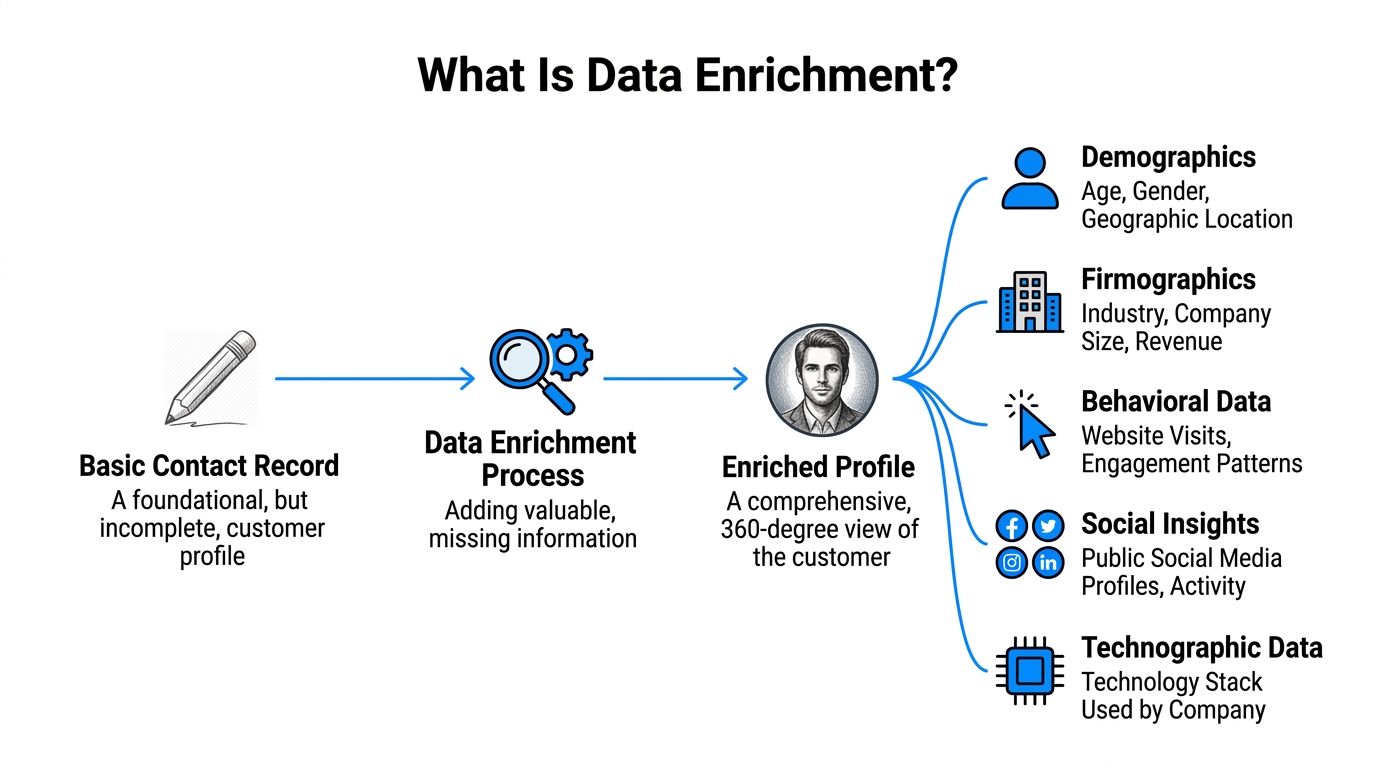
What enrichment does in practice
The process is simple on paper. Match the record, append new attributes, then push those fields into the systems your team uses for acquisition, segmentation, and reporting.
In practice, quality depends on match rates, field accuracy, refresh frequency, and whether the added data changes decisions. A vendor can append fifty fields, but if none of them help you target better subscribers or improve newsletter conversion, you bought noise.
Useful enrichment often includes:
- Role data such as job title, department, and seniority
- Company context such as industry, employee count, and revenue band
- Location signals such as country, region, or market
- Behavioral inputs such as on-site actions or engagement history
- Technology context for qualifying accounts by stack fit
For newsletter operators, this is the difference between storing subscribers and using subscriber data. If you need a refresher on the records your team collects before any appended data enters the picture, this guide to first-party data fundamentals lays that groundwork.
A short walkthrough helps make the process concrete:
What enrichment is not
Teams often lump enrichment together with other data work, and that causes problems during implementation.
Process
What it does
What it doesn't do
Data cleaning
Fixes errors, normalizes formats, removes duplicates
Doesn't add new context
Data transformation
Changes structure or format
Doesn't deepen the profile by itself
Data enrichment
Appends verified information to existing records
Doesn't replace cleanup or transformation
The distinction matters because the order matters.
If your CRM has duplicate contacts, inconsistent company names, or invalid emails, enrichment can make the mess bigger by attaching good external data to the wrong internal record. Clean first. Then enrich. Then test whether the new fields improve audience selection, onboarding paths, and downstream revenue reporting.
Why marketers should care
Data enrichment sounds technical. For a B2B newsletter, it is an audience growth and monetization tool.
It helps teams acquire exact-match subscribers instead of broad top-of-funnel names. It gives editors and lifecycle marketers enough context to personalize by role, industry, and account type. It also makes ROI easier to defend because you can show that the list contains the companies and decision-makers the business wants, not just a high subscriber count.
That is the practical definition. Enrichment adds context your team can use to grow a better B2B newsletter and prove its value.
The Four Essential Types of B2B Enrichment Data
For newsletter growth, four data types do the heavy lifting. They help you answer a practical question fast: who joined, which accounts matter, what content will keep them reading, and which subscribers are likely to turn into pipeline.
A large subscriber count can hide a weak audience. These fields make the difference between a list that looks good in a dashboard and one that helps sales, sponsorship, and lifecycle teams.
Data types that change newsletter performance
Data Type
What It Is
B2B Examples
Newsletter Use Case
Firmographic
Attributes about the company
Industry, company size, revenue band, location
Filter new subscribers against your ICP, segment editions by company type, and show sponsors the audience mix
Demographic
Attributes about the individual professional
Job title, seniority, department, function
Personalize onboarding, tailor subject lines and issue angles by role, and separate decision-makers from practitioners
Technographic
Information about a company's tech stack
CRM, marketing automation, analytics, support tools
Send stack-specific content, promote relevant integrations, and avoid irrelevant offers
Behavioral or Intent
Signals from actions or engagement
Website visits, content downloads, newsletter clicks, repeat topic engagement
Adjust content recommendations, trigger follow-up sequences, and identify subscribers moving toward evaluation
Firmographic data
Firmographic data usually delivers the first clear win.
If your newsletter is meant for B2B SaaS operators, revenue leaders, or enterprise marketers, company context tells you whether you are attracting the right readers or just collecting email addresses. Industry, size, and revenue band are the fields I would start with because they improve targeting, reporting, and sponsor conversations at the same time.
They also prevent bad editorial decisions. A newsletter issue built for mid-market SaaS teams will often miss with consultants, ecommerce brands, or local service businesses. Without firmographics, those groups get lumped together and performance data becomes harder to trust.
Use firmographics to answer questions like:
- Are new subscribers coming from the kinds of companies we want?
- Which company segments stay engaged after the first 30 days?
- Should this campaign promote an operator-focused issue or an enterprise-focused one?
Demographic data
In B2B, demographic enrichment is mostly professional identity.
Role, function, and seniority shape what a subscriber cares about and how they evaluate your content. A founder may want strategic framing. A demand gen manager wants tactics. A RevOps lead wants process, tooling, and implementation detail. A CMO wants business impact.
That matters for newsletters because role-based relevance drives both opens and downstream conversion. It also helps platforms like Breaker qualify subscriber quality beyond raw signups. A list with the right job titles is worth more than a larger list full of students, freelancers, and unrelated functions.
Technographic data
Technographic data is one of the most useful layers for B2B newsletter monetization.
If you know a subscriber's company uses HubSpot, Salesforce, Segment, or another core tool, you can send content that matches their operating environment. Case studies feel more relevant. Product examples land faster. Integration offers make sense.
It also helps you avoid waste. There is no reason to send a Marketo playbook to a team that does not use Marketo, or push a Salesforce-focused sponsor placement to readers who work in a completely different stack.
Behavioral and intent data
Behavioral data tells you what subscribers care about right now.
A reader who clicks three issues about attribution has different intent from one who only reads about newsletter operations or deliverability. That difference should shape what they receive next. It can also shape how you score subscriber quality, route leads, or package high-intent audience segments for sponsors.
Profile data tells you who the subscriber is. Behavioral data tells you what they are trying to solve.
If you need to prioritize, start with firmographic and role data. Add technographic and behavioral layers once they support a clear newsletter decision, such as better onboarding, tighter segmentation, stronger sponsor targeting, or cleaner attribution back to revenue.
How Enrichment Powers B2B Newsletter Growth
Newsletter growth gets framed as a top-of-funnel problem. Most of the time, it's a matching problem. You don't just need more subscribers. You need more of the right subscribers, and you need enough context to keep them engaged after they join.
That's where enrichment earns its keep.
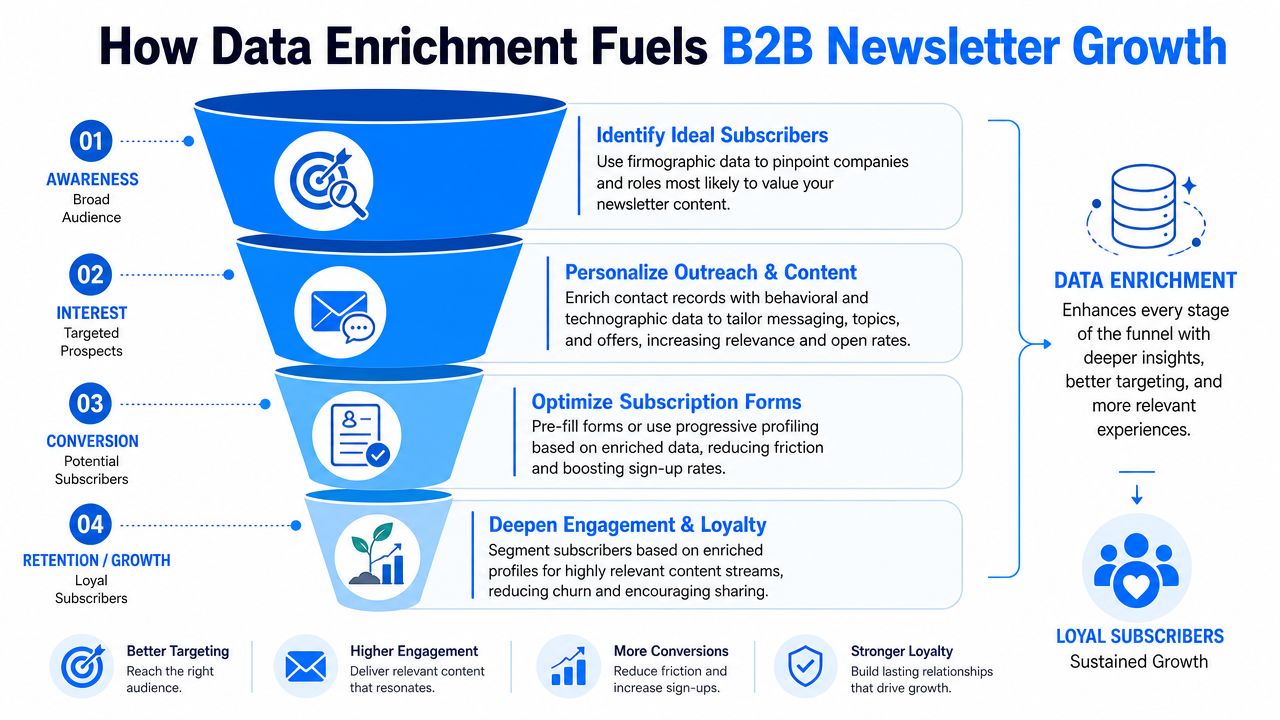
Hyper-targeted segmentation
Without enrichment, segmentation usually stays shallow. Geography. Signup source. Maybe lifecycle stage.
That's not enough for a serious B2B newsletter. Once you append role, company type, and other account context, your segments start reflecting how buyers differ. A growth lead at a mid-market SaaS company should not get the same content mix as a founder at a services business or a product marketer inside a large enterprise team.
This has measurable upside. Evidence from industry benchmarks indicates that enriched customer profiles enable segmentation precision that lifts campaign lift by 20-30% compared to non-enriched baselines (AtroPIM benchmark note).
A newsletter example makes this clearer:
- Before enrichment: one weekly send to “marketing subscribers”
- After enrichment: separate content tracks for RevOps leaders, growth marketers, and founders at software companies
Same list infrastructure. Different relevance.
Better ICP alignment during subscriber acquisition
A lot of newsletter growth looks healthy on the surface because subscriber count rises. Then the team checks pipeline influence and realizes the list is filling with people outside the buying profile.
Enrichment helps upstream. If someone signs up with a work email, you can use appended company and role detail to decide whether they belong in your core newsletter flow, a secondary nurture path, or no path at all. That protects list quality before bad-fit records distort performance reporting.
This also changes paid and partner acquisition. Instead of promoting your newsletter to a broad category like “B2B marketers,” you can define the exact subscriber profile you want and build around that.
Deeper personalization without creepy personalization
Good newsletter personalization isn't about stuffing dynamic fields into a subject line. It's about making the content selection feel obviously relevant.
An enriched record can support decisions like:
- Topic prioritization: send deliverability content to lifecycle marketers, not product teams
- CTA matching: offer a technical guide to operators, a strategic brief to executives
- Onboarding logic: sequence different welcome emails by role or company type
Here, many teams overreach. They collect extra data, then use it to overpersonalize copy in a way that feels forced. What works better is subtle relevance. Choose the right examples, pain points, and offers. Let the reader feel understood without reminding them how much data you have.
The best newsletter personalization feels accurate, not invasive.
Proactive list hygiene
Enrichment doesn't only improve who you add. It improves who you keep.
B2B lists decay because people change jobs, companies rebrand, and fields go stale. An enrichment process paired with validation helps surface outdated or incomplete records before they damage deliverability or muddy audience analysis.
That means your newsletter metrics become more trustworthy. A drop in engagement is less likely to be caused by stale data and more likely to reflect a real content or targeting issue.
What works and what doesn't
What works:
- Using enrichment to sharpen ICP boundaries
- Segmenting on fields that affect message relevance
- Refreshing records on a schedule
- Combining profile data with actual engagement signals
What doesn't work:
- Appending every available field because it exists
- Creating dozens of tiny segments nobody can operate
- Trusting enriched data without validation
- Treating acquisition quality and list hygiene as separate problems
For newsletter growth, enrichment works best when it supports a small set of decisions repeatedly: who to acquire, what to send, when to follow up, and how to prove the audience is commercially meaningful.
Measuring the ROI of Your Enrichment Strategy
If enrichment doesn't change business outcomes, it's just a cleaner database. The point is to improve how your newsletter acquires, converts, and qualifies subscribers.
The easiest mistake is measuring enrichment only inside the CRM. That misses where value shows up. You want to track impact across engagement, conversion, and operating efficiency.
Engagement signals
Start with the behavior inside the newsletter itself.
When segmentation improves and content matches the subscriber more closely, teams usually see clearer patterns in:
- Open quality: whether key segments consistently engage
- Click behavior: which subscriber profiles respond to which topics
- Reply and forward activity: a strong signal for high-intent B2B audiences
- Subscriber retention: whether the right people keep reading over time
Don't stop at list-wide averages. Compare enriched segments against broad, non-enriched audiences to see whether relevance is improving.
Conversion and revenue signals
The stronger ROI case usually appears after the click.
Track whether enriched subscribers are more likely to take the next valuable action, such as requesting a demo, downloading a resource, or entering a sales conversation with enough context to route properly. If your team uses revenue modeling, connect newsletter-originated contacts to downstream outcomes by enriched segment, not just by campaign.
A useful way to frame the question is simple: are the subscribers you enriched becoming better opportunities than the subscribers you merely collected?
If you need a framework for that business case, a practical marketing ROI calculator guide can help structure the inputs.
Efficiency signals
Some of the return is less glamorous, but still important.
Look for improvements in:
Area
What to watch
List hygiene
Fewer invalid or stale records entering active sends
Team time
Less manual research before segmentation or sales handoff
Reporting clarity
Faster answers to “who is actually on this list?”
Acquisition waste
Less spend on subscribers outside your ICP
If enrichment is working, your team should spend less time guessing and more time executing.
That's the ROI story. Better targeting, cleaner reporting, and a newsletter audience that more closely matches the business you're trying to build.
How to Choose the Right Data Enrichment Vendor
Many teams don't need the vendor with the biggest feature grid. They need the one that fits how their data moves through forms, CRM records, newsletter tools, and reporting.
That choice gets easier when you evaluate vendors against the workflow, not the sales demo.
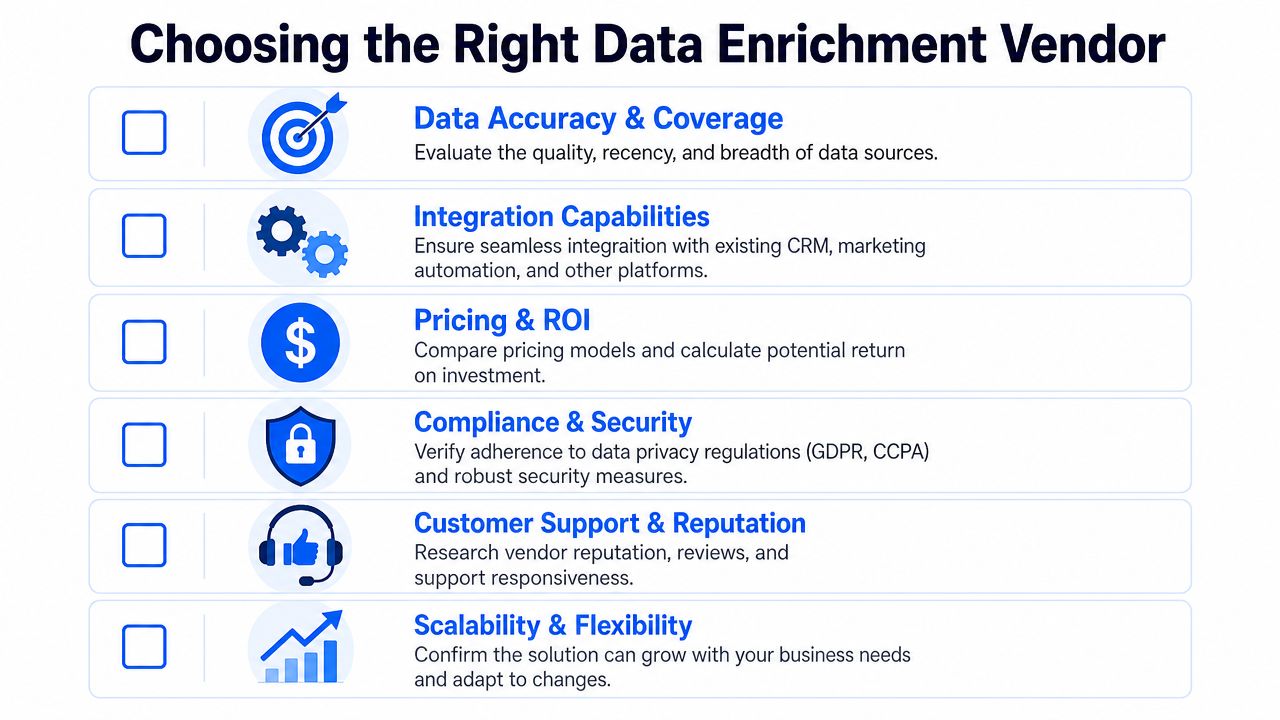
Start with the fields that matter
A good vendor discussion starts with your destination systems and business decisions. Alation notes that expert specifications call for a channel-specific data model, where attribute requirements are defined by destination, and that automated workflows with direct CRM integrations and scheduled refreshes help reduce manual work while keeping data fresh for real-time decisions (Alation on enrichment workflows).
For a B2B newsletter team, that means asking:
- Which fields do we need at signup?
- Which fields do we need before a send?
- Which fields do sales need before follow-up?
- Which fields are nice to have, but operationally irrelevant?
If a vendor can append twenty attributes but only three affect your segmentation and qualification logic, the other seventeen are noise.
Evaluate the workflow, not just the data
A strong enrichment vendor should support the way B2B marketers work.
Look for:
- Real-time enrichment: useful when someone fills out a form and you need immediate routing or personalization
- Batch enrichment: essential for improving older records already in your CRM or ESP
- Field mapping control: because mismatched fields create quiet reporting problems
- Refresh logic: so records don't go stale after the first append
This is also where source strategy matters. Some teams combine provider data with public web inputs for niche workflows. If that's part of your process, understanding finding the right scraping API can help you assess what should be gathered directly versus purchased from a structured provider.
The trade-offs worth taking seriously
Not every vendor handles the same priorities well. Here's the practical lens I'd use:
Evaluation area
What good looks like
Common failure mode
Data quality
Clear sourcing, recent updates, useful B2B coverage
Impressive volume, weak accuracy
Integrations
Works with CRM, automation, and sending stack
Export-import workflows that create lag
Compliance
Clear handling rules, deletion support, governance
Hand-wavy privacy language
Usability
Marketers can operate it without engineering every week
Tool only works with heavy ops support
Questions to ask in the demo
Don't ask only what the vendor can enrich. Ask how that enrichment behaves in production.
- What happens when fields conflict with existing CRM values?
- How often is data refreshed?
- Can we choose which records get enriched and when?
- How is match confidence handled?
- What controls exist for deleting or suppressing records?
The wrong vendor usually reveals itself here. Great slides, vague operational answers.
The right one makes enrichment boring in the best sense. Data shows up where it should, refreshes when it should, and supports the campaign decisions your team already needs to make.
Navigating Data Privacy and Compliance
Privacy concerns around enrichment are legitimate. B2B marketers should take them seriously. The answer isn't to avoid enrichment. It's to do it with clear standards, transparent handling, and restraint.

Responsible enrichment looks different from indiscriminate collection
Good enrichment is selective. You add data that improves relevance, segmentation, and operational accuracy. You don't harvest everything you can find because it might be useful later.
That means keeping a few principles in place:
- Purpose limitation: only enrich fields you can use
- Transparency: document what data you append and why
- Governance: make deletion, suppression, and correction manageable
- Vendor scrutiny: verify how outside providers source and maintain records
If your team needs legal guidance on broader operational standards, this overview from By Design Law Firm is a helpful starting point.
Compliance supports growth
Some teams treat compliance like friction. In practice, it protects the long-term value of your newsletter.
A list built on questionable data handling becomes harder to trust internally and externally. Sales doubts the records. Subscribers feel mismatched. Leadership gets nervous about scale. Reputable enrichment practices avoid that spiral by making relevance and restraint work together.
The rule is simple: enrich to serve the audience better, not to exploit the fact that data exists.
Trust compounds more slowly than list growth, but it matters longer.
Turn Your Data from a Cost to a Competitive Edge
A contact list by itself isn't a growth asset. It becomes one when the records are rich enough to support targeting, personalization, qualification, and measurement.
That's what data enrichment does. It adds the context your newsletter program needs to attract exact-match subscribers, send more relevant content, and connect audience growth to revenue outcomes. Paired with disciplined operations and solid CRM data management practices, it turns subscriber data from a storage problem into a competitive advantage.
If you want a newsletter platform that combines sending, list growth, AI enrichment, hygiene, compliance, and ROI tracking in one workflow, take a look at Breaker. It's built for B2B teams that want more than email sends. It helps you grow with engaged, exact-match subscribers and measure what that audience is worth.
Keep reading
All articlesBreaker Review: AI-Native ESP for Newsletter Growth
An unbiased Breaker review: pricing, features, deliverability data, and who this AI-native email platform fits best for newsletter growth.
Breaker for B2B, SME and Consumer Newsletter Senders
Learn how B2B, SME, and consumer audiences differ in newsletters, plus a framework for segmenting, messaging, and monetizing each without losing relevance.
What Is a B2B Content Engine
Learn what a B2B content engine is, how it differs from a content calendar or strategy, and why it's essential for AI-driven search in 2026.