
10 CRM Best Practices for B2B Growth in 2026
Unlock B2B growth with these 10 CRM best practices. Learn how to master data hygiene, segmentation, automation, and analytics to scale your marketing.
Your Customer Relationship Management (CRM) system is more than a digital rolodex; it’s the central nervous system of your growth strategy. For B2B marketers and newsletter creators, a well-optimized CRM is the difference between scattershot campaigns and a predictable revenue machine. However, many teams only scratch the surface, leaving massive potential on the table. The gap between an average CRM user and a top performer lies in a set of core operational disciplines.
These aren't just abstract theories; they are actionable frameworks that transform your subscriber list into a high-value asset. Before diving into specific strategies, it is essential to understand the foundational principles of CRM and explore a practical guide to CRM success. A solid foundation makes implementing advanced tactics much more effective.
In this roundup, we will break down the 10 most critical CRM best practices that drive tangible results. We’ll cover everything from foundational data hygiene and advanced segmentation to sales alignment and automation, providing concrete examples and implementation steps to help you turn insights into action immediately. It's time to stop treating your CRM as a database and start using it as a strategic growth engine.
1. Implement Segmentation and Targeted Personalization
Moving beyond a "one-size-fits-all" approach is one of the most critical CRM best practices for meaningful growth. Instead of sending the same message to your entire contact list, segmentation involves dividing your audience into smaller, distinct groups based on shared characteristics. This foundational practice ensures your marketing and sales efforts are relevant, which directly improves engagement, conversions, and customer loyalty.
The power of segmentation lies in its ability to facilitate targeted personalization. When you understand the unique attributes of a specific group, you can craft messages, offers, and content that speak directly to their needs and pain points. This not only makes your communication more effective but also shows subscribers that you understand their context, building stronger relationships over time. For a deeper look into this topic, you can learn more about best practices for CRM email personalization and see how targeted messaging produces results.
How to Implement Segmentation
Segmentation can be based on several data types, each offering a different lens through which to view your audience.
- Firmographics: Group contacts by company attributes like industry, company size, or annual revenue. For instance, a SaaS provider might create a segment for "startups in the fintech industry with fewer than 50 employees" to send them a targeted onboarding sequence.
- Demographics: Use individual-level data such as job title, seniority level, or geographic location. A B2B marketer could target "VPs of Marketing in North America" with an invitation to an exclusive webinar.
- Behavioral Data: Segment based on actions users take (or don't take). This includes website pages visited, features used in your product, content downloaded, or email engagement. HubSpot’s active lists can automatically group contacts who have viewed your pricing page more than three times in a week.
- Engagement Scoring: Create segments for "highly engaged," "moderately engaged," and "at-risk" contacts based on a cumulative score of their interactions. This helps prioritize follow-ups and re-engagement campaigns.
Pro Tip: Start by identifying your Ideal Customer Profile (ICP) and create 3-5 core segments that align with your highest-value customers. You can always add more complexity later. Review and refine these segments quarterly based on campaign performance and evolving business goals.
2. Establish and Monitor Data Quality Standards
A CRM is only as powerful as the data it contains. Establishing rigorous data quality standards is a foundational CRM best practice that prevents your system from becoming a disorganized liability. Without clean data, even the most sophisticated marketing and sales strategies will fail, leading to inaccurate targeting, poor deliverability, and a damaged sender reputation. Consistent data hygiene is the engine that keeps your entire customer relationship strategy running smoothly.
The core principle behind data quality is maintaining an accurate, complete, and reliable source of truth for every contact. This involves proactively preventing bad data from entering your system and regularly cleaning out obsolete or incorrect information. Processes like email validation, duplicate removal, and data enrichment ensure that your segmentation and personalization efforts are built on a solid foundation, leading to better engagement and more trustworthy analytics.
How to Maintain Data Quality
Implementing a multi-faceted approach to data hygiene ensures your CRM remains a valuable asset.
- Validation: Use tools to confirm that the data you collect is legitimate, especially email addresses. This can be done at the point of capture (e.g., through a double opt-in process) or in bulk using third-party services like ZeroBounce or NeverBounce. This step is critical for protecting your email deliverability.
- Deduplication: Most CRMs, such as ReallySimpleSystems, offer automated rules to detect and merge duplicate contacts based on email addresses or other unique identifiers. Running these processes regularly prevents sending redundant messages and maintains a clean view of a contact's history.
- Hygiene and Cleansing: Periodically remove inactive or unengaged subscribers from your lists. This practice, a core component of Breaker's TruSend deliverability system, lowers your email costs, improves open rates, and signals to inbox providers that you manage a healthy list.
- Enrichment: Fill in missing information in your contact profiles automatically. Services like Clearbit or Hunter.io can append data points like job title, company size, and industry based on just an email address, providing a richer profile for segmentation.
Pro Tip: Schedule a quarterly "deep-clean" audit of your entire database to catch issues that automated workflows might miss. Before any major marketing campaign or product launch, run a full list hygiene process to maximize reach and engagement. Immediately remove hard bounces after every send.
3. Create an Integrated Marketing and Sales Alignment Framework
One of the most impactful CRM best practices involves breaking down the silos between your marketing and sales departments. A disconnected approach where marketing generates leads and simply throws them over the wall to sales creates friction, lead leakage, and lost revenue. An integrated framework aligns both teams on shared goals, definitions, and processes, ensuring a smooth prospect journey from initial awareness to closing a deal.
This alignment is powered by the CRM, which acts as the central source of truth for all customer interactions. When both teams operate from the same data set, marketing can see which campaigns produce high-quality leads, and sales gains crucial context on a prospect’s history and interests. For a truly integrated framework, incorporating effective sales pipeline management best practices is crucial to converting leads efficiently and tracking progress against shared targets.
How to Implement a Sales and Marketing Framework
True alignment requires a combination of technology, process, and communication. Your CRM should facilitate, not complicate, this collaboration.
- Define Lead Qualification Criteria: Work with sales to establish clear, mutually agreed-upon definitions for a Marketing-Qualified Lead (MQL) and a Sales-Qualified Lead (SQL). Document these criteria directly within your CRM's knowledge base. For example, an MQL could be a contact who downloaded an e-book and works at a company with over 100 employees.
- Establish Service Level Agreements (SLAs): Create documented SLAs that outline expectations for both teams. Marketing might commit to delivering a certain number of MQLs per month, while sales agrees to a specific follow-up time for every lead assigned to them, such as within four business hours.
- Create Unified Pipeline Views: Configure your CRM to provide shared dashboards and pipeline views. Platforms like HubSpot and Salesforce allow both teams to see the entire customer journey, from the first marketing touchpoint to the final sales stage, identifying bottlenecks in real-time.
- Implement a Feedback Loop: Build a process where sales can provide direct feedback on lead quality. This can be done with a simple "lead status" field in the CRM (e.g., "Accepted," "Rejected - Bad Fit," "Rejected - Not Ready") that marketing can use to refine its targeting and campaigns.
Pro Tip: Schedule weekly or bi-weekly sync meetings between marketing and sales leaders. Use this time to review pipeline metrics, discuss lead quality, and strategize on upcoming campaigns. These regular check-ins are vital for maintaining alignment and addressing issues before they grow.
For teams running outbound, the framework only holds if the CRM is configured for it. See our guide to setting up an outbound sales CRM for stage design, sequences, and the handoff to marketing.
4. Develop a Consistent Lead Nurturing Strategy
A core CRM best practice is acknowledging that most B2B buyers are not ready to purchase immediately after their first interaction. A consistent lead nurturing strategy builds systematic workflows that guide prospects through the buyer journey with relevant, timely content. This approach establishes trust, demonstrates thought leadership, and keeps your brand top-of-mind, so you are the first choice when buying signals emerge.
The purpose of lead nurturing is to build a relationship before making a hard sales pitch. By delivering value over time, you educate your audience and qualify their interest without being overly aggressive. This systematic contact, managed within your CRM, ensures no lead falls through the cracks and that sales conversations happen only when the prospect is properly warmed up. For a closer look, you can learn more about how Breaker’s platform enables consistent B2B nurturing with its scheduling and targeting capabilities.
How to Implement Lead Nurturing
Effective nurturing requires a structured approach that aligns content with the prospect's stage in the buying journey.
- Map the Buyer Journey: Before building any workflow, clearly define your awareness, consideration, and decision stages. What questions do prospects have at each stage? What content can answer them? This map becomes the blueprint for your nurture sequences.
- Create Segment-Specific Workflows: Build 4-6 core nurture sequences for your most important prospect segments. For instance, a sequence for a "VP of Marketing" (demographic) who downloaded an "SEO ebook" (behavioral) should be different from one for a "CFO" who visited your pricing page.
- Use Behavioral Triggers: Move leads through your funnels based on their actions. A contact who clicks a link in an awareness-stage email could be automatically moved to a consideration-stage sequence. Tools like ActiveCampaign and Marketo excel at creating these conditional nurture paths based on engagement.
- Balance Value and Calls-to-Action (CTAs): Early-stage nurture content should focus on education with soft CTAs like "Read our guide" or "Watch our webinar." As engagement increases, you can introduce stronger CTAs like "Request a demo" or "Speak to sales."
Pro Tip: Don't let your nurture sequences run on autopilot indefinitely. Monitor key metrics like open rates, click-through rates, and conversion rates for each stage. If a particular email has low engagement, test a new subject line or different content to optimize the flow.
5. Implement Account-Based Marketing (ABM) and ICP Definition
Shifting from a volume-based to a value-based approach is a powerful strategy for improving marketing efficiency. Account-Based Marketing (ABM) flips the traditional sales funnel on its head. Instead of casting a wide net to capture leads, you first identify a select group of high-value target accounts and then concentrate your marketing and sales efforts directly on them. This ensures your resources are focused on prospects with the highest probability of conversion and greatest lifetime value.
The foundation of any successful ABM program is a clearly defined Ideal Customer Profile (ICP). Your ICP is a precise description of the company-not the individual person-that would get the most value from your product or service. This focus on specific accounts makes ABM one of the most effective CRM best practices for B2B organizations looking to close larger deals and align their sales and marketing teams.
How to Implement ABM
Building an ABM strategy requires a tight alignment between sales and marketing, supported by the right technology and data.
- Define Your ICP and Target Accounts: Work directly with your sales team to define your ICP based on firmographics like company size, industry, revenue, and technology stack. From there, build a target account list of your top 50-100 companies that perfectly match this profile.
- Enrich Account Data: Use tools to automatically enrich account data and categorize prospects by their ICP fit. This helps you understand the entire buying committee and identify key decision-makers within your target accounts. Platforms like LinkedIn Sales Navigator are excellent for this research.
- Develop Personalized Campaigns: Create customized campaigns and content tailored to the specific needs and pain points of your target account clusters. Instead of one generic message, you might develop 2-3 variations of a campaign for different account tiers or industries.
- Coordinate Multi-Channel Outreach: Orchestrate your outreach across multiple channels, including email, social media, and advertising. Platforms like Terminus or 6sense help manage this coordinated effort, ensuring a consistent message while sales conducts its own personalized outreach.
Pro Tip: Before launching any personalized campaigns, build dedicated time into your workflow for account research. Understanding recent company news, strategic priorities, or personnel changes can provide the perfect angle for your outreach and dramatically increase its effectiveness. Track account-level engagement as a separate metric to measure true progress.
6. Establish Real-Time Analytics and Reporting Dashboards
Relying on static, outdated reports is a fast way to fall behind. A core CRM best practice is to establish centralized dashboards that provide real-time visibility into campaign performance, subscriber behavior, and key business metrics. This operational discipline enables rapid, data-informed decision-making and allows teams to optimize strategies without waiting for manual report generation or data compilation.

The primary advantage of real-time analytics is the ability to react instantly to performance data. Instead of analyzing a campaign's results after it has concluded, you can monitor opens, clicks, and conversions as they happen, making adjustments on the fly to improve outcomes. Platforms like Breaker surface these insights automatically, connecting email activity directly to ROI. For an in-depth guide on this, you can explore the ultimate guide to real-time email analytics dashboards and see how immediate data access drives better results.
How to Implement Real-Time Dashboards
Building effective dashboards means focusing on clarity and actionability, not just data volume.
- Define Core Metrics: Start by tracking essential indicators like open rates, click-through rates, unsubscribes, conversions, and ROI. Also monitor subscriber growth rate and cost per new engaged subscriber to measure list health and acquisition efficiency.
- Create Role-Specific Views: Build separate dashboards tailored to different stakeholders. An executive view might show high-level ROI and revenue attribution, a manager view could focus on team performance and campaign pipelines, and a practitioner view would detail tactical metrics for specific emails or workflows.
- Connect to Revenue: A critical step is building dashboards that connect email performance to downstream revenue. Tools like HubSpot offer attribution reporting that shows how marketing activities contribute to closed deals, proving the direct value of your efforts.
- Set Automated Alerts: Configure your analytics platform (e.g., Klaviyo, Tableau, Looker) to send automated notifications for significant events, such as a sudden drop in engagement for an automated sequence or a campaign that is severely underperforming against its benchmark.
Pro Tip: Integrate your real-time dashboard review into your team's weekly syncs. Dedicate 10-15 minutes to reviewing key metrics, comparing week-over-week performance, and identifying one or two optimization opportunities. This keeps the team aligned and fosters a culture of continuous improvement.
7. Create a Feedback Loop for Continuous Campaign Optimization
Effective CRM management goes beyond launching campaigns; it requires a systematic process for learning and iterating. Establishing a feedback loop means you actively test elements, capture insights from performance data, and apply those learnings to future efforts. This operational framework is one of the most powerful CRM best practices because it transforms your platform from a static database into a dynamic learning engine that drives continuous improvement.
The core idea is to move from "set it and forget it" to a culture of constant, data-driven refinement. Companies like Netflix and Amazon are famous for this approach, A/B testing nearly every aspect of the user experience to optimize engagement and conversions. By adopting a similar mindset, you can ensure that every marketing dollar and sales hour is spent more effectively over time, compounding your growth.
How to Implement a Feedback Loop
Building a sustainable optimization process involves a structured approach to testing and documenting results. This ensures that knowledge isn't lost and that wins are replicated across the organization.
- Isolate Variables: To understand what truly moves the needle, test only one element at a time. For an email campaign, this could be the subject line, the call-to-action (CTA) button color, or the send time. Isolating the variable gives you clear, actionable data on its specific impact.
- Document Everything: Create a shared testing backlog or document where your team records each test. Include the hypothesis ("We believe a personalized subject line will increase open rates"), the variations being tested, the results, and the key takeaways. This repository becomes an invaluable resource for future campaign planning.
- Focus on High-Impact Elements: Prioritize tests on elements with the greatest potential to affect your key metrics. Subject lines directly influence open rates, while CTA placement impacts click-through and conversion rates. Start there before moving to smaller details.
- Analyze and Share Learnings: Use real-time analytics to monitor performance and identify what’s working. Schedule monthly or quarterly reviews to discuss cumulative learnings as a team. Sharing wins and insights broadly builds momentum and encourages a company-wide culture of optimization.
Pro Tip: Before launching any test, define your statistical significance threshold and ensure you have a large enough sample size (ideally 1,000+ contacts per variation) to get reliable results. This prevents you from making decisions based on random chance rather than true performance differences.
8. Build Compliant, Permission-Based Subscriber Acquisition
A high-quality CRM database is built on a foundation of trust and consent, not sheer volume. Establishing rigorous processes for acquiring subscribers with explicit permission is a critical CRM best practice that protects your brand, ensures legal compliance, and cultivates a highly engaged audience that genuinely wants to hear from you. This approach prioritizes quality over quantity, leading to better deliverability, higher open rates, and a stronger brand reputation.
Neglecting compliance with regulations like GDPR, CAN-SPAM, and CCPA can result in steep fines and severe damage to your sending reputation. Modern CRM and email platforms like HubSpot and ConvertKit have built-in compliance features because they recognize that permission is non-negotiable. By making consent the cornerstone of your acquisition strategy, you attract subscribers who are more likely to convert and become loyal advocates for your brand.
How to Implement Compliant Acquisition
Adhering to legal standards and earning subscriber trust involves several key operational steps.
- Implement Double Opt-In: Require new subscribers to confirm their email address by clicking a link in a confirmation email. This verifies interest, reduces spam complaints, and creates a clean, engaged list from the start.
- Set Clear Expectations: Your signup forms and landing pages should explicitly state what subscribers will receive, including the type of content and a reasonable estimate of your sending frequency.
- Simplify Unsubscribing: The unsubscribe process must be simple and immediate, ideally a one-click action. Hiding or complicating this process violates regulations like CAN-SPAM and damages user trust.
- Maintain Consent Records: Keep a detailed audit trail of how and when each subscriber gave their consent. This is a requirement under GDPR and a best practice for demonstrating due diligence.
Pro Tip: Schedule an annual review with your legal team to audit your privacy policies, consent language, and data handling procedures. Train your entire marketing and sales team on the fundamentals of CAN-SPAM, GDPR, and other relevant regulations to create a culture of compliance.
9. Develop a Customer Success and Retention Framework
Extending your CRM strategy beyond acquisition is a core tenet of modern growth. One of the most profitable CRM best practices is to build a dedicated framework for customer success and retention. This approach recognizes that keeping and expanding existing customer relationships costs significantly less than acquiring new ones, directly impacting your bottom line and long-term stability. It involves a structured process for onboarding, ongoing engagement, and proactive support.
This strategic shift turns your CRM from a simple sales tool into a customer-centric engine for sustainable growth. Companies like Slack master this with exceptional onboarding flows and in-app education that guide users to value quickly. Similarly, HubSpot’s Service Hub is built around the idea that customer service is a revenue driver, not just a cost center, focusing on retention, satisfaction, and expansion opportunities.
How to Implement a Retention Framework
A successful retention framework uses CRM data to understand customer health and deliver timely, relevant interactions post-sale.
- Onboarding Sequences: Create automated email and in-app message sequences that guide new customers through key activation steps. The goal is to help them achieve their first "win" with your product as fast as possible.
- Health Scoring: Develop a customer health score within your CRM based on product usage, support tickets, survey responses, and engagement. This metric helps predict churn risk and signals when an account needs attention.
- Proactive Engagement: Schedule regular business reviews (monthly or quarterly) for key accounts to discuss progress, gather feedback, and identify new goals. Use your CRM to track these meetings and their outcomes.
- Feedback Loops: Implement systems for regularly collecting and acting on customer feedback, such as Net Promoter Score (NPS) surveys. Log these scores in the CRM to create a historical record of customer sentiment.
- Expansion Plays: Train your sales and support teams to identify upsell and cross-sell opportunities during regular customer interactions. Use CRM automation to flag accounts that reach certain usage thresholds or show interest in premium features.
Pro Tip: Don't let your customer education stop after onboarding. Use your newsletter or a dedicated customer content track to continuously share advanced tips, new feature announcements, and case studies. This keeps customers engaged and demonstrates ongoing value.
10. Enable Marketing Automation with Conditional Workflows
One of the most powerful CRM best practices is moving from static email blasts to dynamic, automated conversations. Conditional workflows are intelligent, rules-based sequences that trigger actions based on subscriber behavior in real-time. This operational practice reduces manual administrative work and ensures your communications are both timely and contextually relevant, personalizing the customer journey at scale.
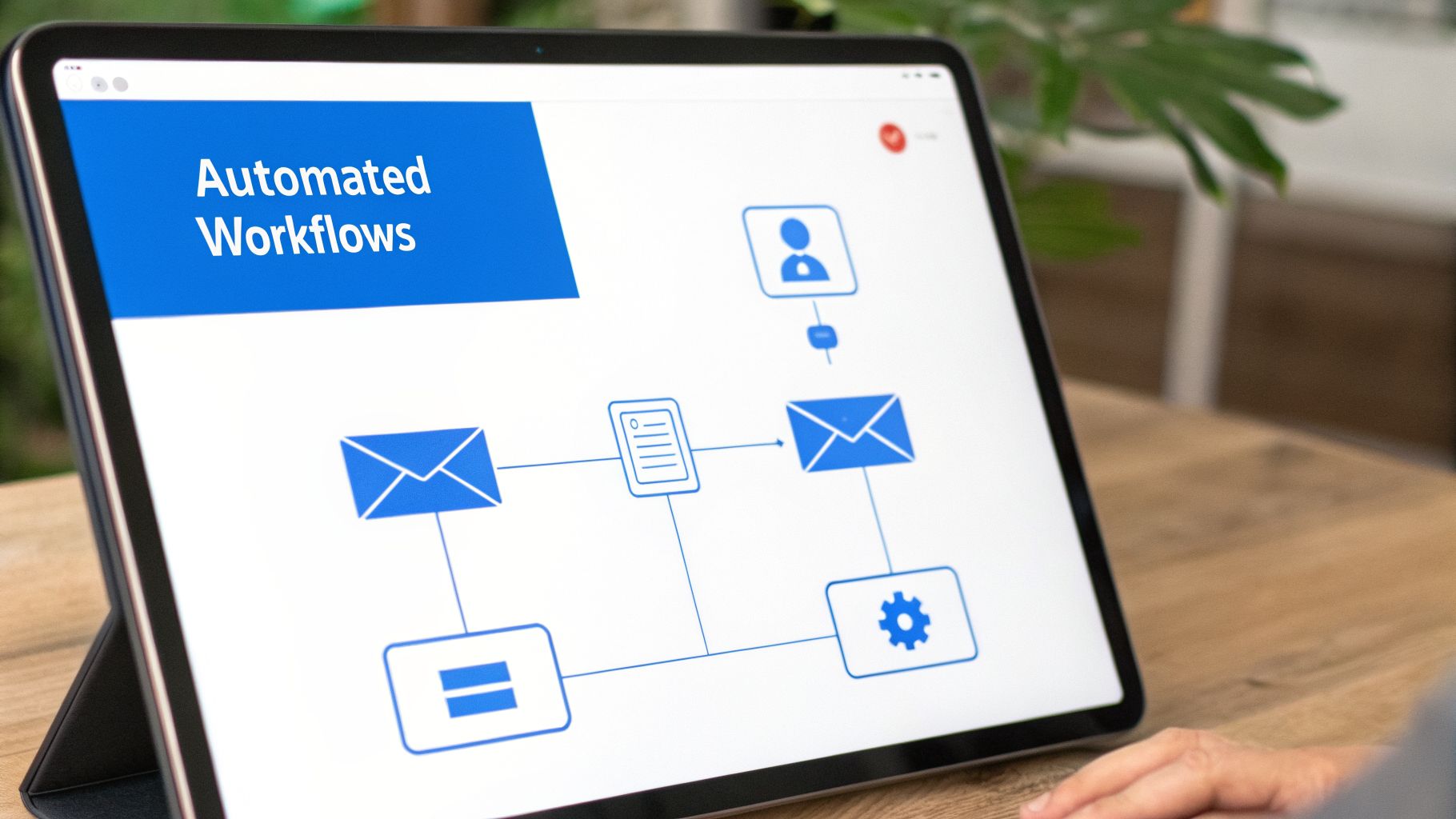
The core strength of this approach is its adaptability. Instead of forcing every lead down the same path, conditional logic ("if/then" statements) creates branches that respond to individual actions. For example, if a contact visits your pricing page, a workflow can tag them as a "Hot Lead" and notify a sales rep. If they ignore three consecutive emails, a different branch could move them into a re-engagement sequence. Platforms like HubSpot and ActiveCampaign excel at this, offering visual builders to map out these complex journeys. To get a better sense of how these work in practice, you can explore detailed examples of marketing automation workflows and see how they drive results.
How to Implement Conditional Workflows
Building effective automation requires a strategic, step-by-step approach to avoid creating a tangled mess of triggers and actions.
- Map the Journey: Before you open your CRM's workflow builder, sketch out the ideal customer journey on a whiteboard or in a flowchart tool. Identify key decision points and the actions you want subscribers to take.
- Use Behavioral Triggers: Base your workflows on meaningful user actions. Triggers can include opening an email, clicking a specific link, downloading a resource, viewing a key webpage, or using a product feature.
- Start Simple: Begin with 3-5 foundational workflows. Good starting points include a welcome series for new subscribers, a lead nurturing sequence for demo requests, or a re-engagement campaign for inactive contacts.
- Test and Measure: Always test your workflow with a small internal segment before activating it for your entire audience. Define clear success metrics for each workflow, such as conversion rate, meeting bookings, or engagement lift.
Pro Tip: Document your workflow logic in a central knowledge base. As your automation becomes more complex, this documentation will be critical for team alignment, troubleshooting, and onboarding new team members. Review and optimize workflow performance quarterly to ensure the paths are still effective and aligned with business goals.
For worked examples of conditional splits, from a simple welcome series to lifecycle routing by role, see our email marketing automation workflow guide.
10 CRM Best Practices Comparison
Practice
Implementation complexity 🔄
Resources & speed ⚡
Expected outcomes 📊⭐
Ideal use cases 💡
Key advantages ⭐
Implement Segmentation and Targeted Personalization
🔄 Medium–High — requires data, dynamic content and ongoing tuning
⚡ Moderate setup time; needs segmentation tools and data pipelines
📊 Higher opens/CTR and conversion; ⭐ Improved relevance and CLTV
💡 Tailored B2B campaigns, varied audiences, product launches
⭐ More relevant messaging, better engagement, efficient targeting
Establish and Monitor Data Quality Standards
🔄 Medium — initial cleanup high; ongoing hygiene processes
⚡ Ongoing maintenance; requires validation/enrichment tools
📊 Improved deliverability and accurate metrics; ⭐ Lower bounces/complaints
💡 Any sender at scale or focused on deliverability and compliance
⭐ Protects sender reputation, reduces costs, ensures compliance
Create an Integrated Marketing and Sales Alignment Framework
🔄 High — organizational change and shared processes
⚡ Moderate tech work; significant time for consensus and SLAs
📊 Higher MQL→SQL conversion and faster sales velocity; ⭐ Better pipeline accuracy
💡 Companies with separate marketing and sales teams, ABM programs
⭐ Smoother handoffs, clearer priorities, improved forecasting
Develop a Consistent Lead Nurturing Strategy
🔄 Medium — workflow design and content planning
⚡ Content-intensive; slower time-to-impact but scalable
📊 Increased conversions over time; ⭐ Stronger pipeline qualification
💡 Long B2B buying cycles, early-stage leads, education-driven sales
⭐ Sustained engagement, scalable personalization, higher LTV
Implement Account-Based Marketing (ABM) and ICP Definition
🔄 High — requires deep ICP research and coordination
⚡ High upfront investment; slower acquisition velocity, strong downstream ROI
📊 Higher conversion rates and deal sizes; ⭐ Improved ROI and win rates
💡 Enterprise sales, high-value accounts, strategic growth initiatives
⭐ Focused resource allocation, larger deals, competitive advantage
Establish Real-Time Analytics and Reporting Dashboards
🔄 Medium–High — integrations and tracking setup required
⚡ Integration effort upfront; enables rapid, near-instant decisions
📊 Faster optimization and transparency; ⭐ Reduced reporting lag and better insights
💡 Data-driven teams needing rapid iteration and cross-team visibility
⭐ Real-time visibility, quicker optimizations, stakeholder alignment
Create a Feedback Loop for Continuous Campaign Optimization
🔄 Medium — requires disciplined testing and documentation
⚡ Ongoing testing cadence; needs analytics and time to learn
📊 Incremental, compounding performance gains; ⭐ Evidence-based improvements
💡 Teams prioritizing A/B testing and continuous improvement
⭐ Institutional learning, better decision-making, steady uplift
Build Compliant, Permission-Based Subscriber Acquisition
🔄 Low–Medium — process and legal controls to implement
⚡ Slower acquisition speed; needs consent tooling and training
📊 Higher deliverability and lower complaints; ⭐ Legal protection and trust
💡 Any org collecting personal data, regulated industries, long-term lists
⭐ Compliance, trust, higher inbox placement and list quality
Develop a Customer Success and Retention Framework
🔄 Medium–High — cross-functional systems and culture change
⚡ Continuous resource commitment; longer ROI horizon but high value
📊 Reduced churn and higher expansion revenue; ⭐ Predictable recurring revenue
💡 SaaS/subscription businesses and high-ARPA products
⭐ Increased LTV, upsell opportunities, brand advocates
Enable Marketing Automation with Conditional Workflows
🔄 Medium — workflow logic can become complex
⚡ Initial design time; automates repetitive work and scales efficiency
📊 Faster, timely follow-ups and improved conversions; ⭐ Reduced manual effort
💡 Teams needing scalable personalization and behavior-driven journeys
⭐ Efficiency at scale, timely relevance, consistent experiences
From Best Practices to Business Results
We have journeyed through ten foundational CRM best practices, moving from high-level concepts to concrete, actionable steps. You've seen how a systematic approach to data quality, segmentation, and alignment can turn a simple contact list into a powerful engine for business growth. The practices outlined, from developing consistent lead nurturing strategies to building compliant subscriber acquisition funnels, are not isolated tactics. They are interconnected components of a single, cohesive growth system.
The core idea is to shift your perception of the CRM. Stop seeing it as a digital rolodex or a passive database where contact information goes to rest. Instead, view it as the central nervous system of your entire marketing and sales operation. It’s an active, intelligent hub that informs strategy, automates execution, and provides the data necessary for continuous improvement. The most successful B2B marketers and newsletter creators don't just use their CRM; they build their business processes around it.
Turning Theory into Tangible Results
Adopting these CRM best practices is not a sprint; it's a marathon of continuous refinement. The sheer volume of advice can feel overwhelming, but the key is to start small and build momentum. Do not attempt to overhaul your entire CRM strategy overnight. Instead, select one or two areas that present the most significant opportunity or the most pressing pain point.
For many, this starting point is data hygiene. A clean, well-organized database is the bedrock upon which all other practices are built. Without trustworthy data, your segmentation is flawed, your personalization is inaccurate, and your analytics are misleading.
Another excellent starting point is segmentation and personalization. Even basic segmentation, such as separating customers from prospects or categorizing leads by industry, can immediately improve the relevance of your communication and lift engagement rates. From there, you can layer in more advanced techniques like lead scoring and conditional automation workflows.
Key Insight: True CRM mastery is not about implementing every single best practice at once. It's about creating a culture of iterative improvement, where your team is constantly testing, learning, and refining its approach based on real-world data and feedback.
The Strategic Value of a Well-Managed CRM
Implementing these practices moves your team from a reactive to a proactive stance. Instead of manually pulling lists for every campaign, you'll have dynamic segments that update automatically. Instead of guessing which leads are sales-ready, you'll have a data-driven lead scoring model that surfaces opportunities with precision. This operational efficiency is a massive benefit, but the true value is strategic.
A well-oiled CRM provides the clarity needed to make smarter business decisions. It answers critical questions:
- Which marketing channels are producing the highest-value customers?
- What is the average time it takes to convert a lead from a specific industry?
- Which pieces of content are most effective at moving prospects through the funnel?
By connecting CRM data to business outcomes, you can directly attribute revenue to specific marketing and sales activities. This transforms the marketing function from a cost center into a documented revenue driver, giving you the credibility and a seat at the strategic table. The journey from implementing CRM best practices to achieving predictable, scalable growth starts with the decision to treat your CRM with the strategic importance it deserves.
Ready to put these CRM best practices into action without the manual overhead? Breaker is designed to automate critical growth functions, helping you expand your target lists, enrich contact data, and identify ideal customer profiles directly within your existing systems. See how you can accelerate your growth strategy by visiting Breaker.
Keep reading
All articlesHow to Boost Conversions With Your Email Newsletter
Turn your newsletter into a conversion engine. See 2026 benchmarks, CTR vs CVR explained, and the fixes most email guides skip.
Drip Campaign Template: Ready-to-Use Email Sequences
Get 6 ready-to-paste drip campaign templates with subject lines, body copy, and send timing—plus a step-by-step guide to building your own.
Post-Webinar Survey Questions Template (2026)
30+ post-webinar survey questions with NPS, CSAT, and CES templates, plus timing and length tips to boost completion and qualify leads faster.