
Email Marketing for Affiliates: The 2026 Playbook
A detailed guide to email marketing for affiliates. Learn to build compliant lists, craft campaigns, master deliverability, and scale revenue in 2026.
Most advice on email marketing for affiliates is stuck in the shallow end. It treats email like a place to paste links, stack urgency, and squeeze a few extra commissions out of an offer before the audience tunes out.
That works briefly. Then open quality drops, unsubscribes climb, inbox placement gets worse, and the list you thought was an asset starts behaving like a liability.
A durable affiliate email program works differently. It treats the list as owned distribution, the inbox as rented attention, and trust as the constraint that controls everything else. Copy matters. Offers matter. But the affiliates who keep earning from email are usually the ones who built systems for consent, segmentation, deliverability, and measurement before they scaled promotions. If you run a B2B newsletter, the affiliate marketing email marketing guide walks through the setup step by step.
Why Email Is Your Most Valuable Affiliate Asset
The biggest misconception in email marketing for affiliates is that email is just a monetization layer sitting on top of content. It isn't. It's the business asset itself.
Social reach is volatile. Search positions move. Paid acquisition gets expensive fast. An email list is different because you can contact people directly, segment them based on behavior, and measure response without depending on a platform to keep showing your content. That ownership is why experienced operators keep coming back to email.
The performance gap is also hard to ignore. One industry roundup reports that about 22.8% of affiliate marketers use email marketing as their leading traffic source, and affiliates who use email see 66.4% more conversions than those who don't. The same roundup says more experienced affiliates are 47.8% more likely than beginners to use email, which is a useful signal that email isn't just an add-on channel. It's a maturity marker in how serious programs operate, according to this affiliate email marketing statistics roundup.
That changes how you should think about the channel. Email is not where you dump promotions after publishing a blog post or recording a video. It's where you build repeatable revenue from the people who already raised their hand.
Practical rule: If a promotion would damage trust with your best subscribers, it doesn't belong in your affiliate email program.
A good list gives you three advantages at once:
- Audience ownership means you aren't waiting for algorithmic distribution.
- Behavioral data lets you separate buyers, clickers, readers, and inactive subscribers.
- Compounding value turns each new subscriber into a long-term revenue opportunity instead of a one-time click.
If you need a broader framing of why marketers still prioritize owned channels, this breakdown of the advantages of email marketing is worth reviewing.
The affiliates who last don't treat their list like rented traffic. They treat it like inventory they have to protect.
Building Your Affiliate List Without Breaking Trust
A large list with weak intent is usually worse than a smaller list with clear permission. That's the part beginners resist because subscriber count feels like momentum. It isn't, unless the people joining actually want the emails you're planning to send.

Purchased lists are one of the fastest ways to poison an affiliate email program. The reason is operational, not philosophical. Permissionless contacts tend to produce low engagement, more unsubscribes, and more spam complaints, which can damage sender reputation and even lead to blacklisting, as outlined in this guidance on email marketing mistakes and permission-based acquisition.
What good list growth looks like
The right acquisition model is simple. Ask clearly. Deliver what you promised. Set expectations early.
Three acquisition sources usually produce the healthiest affiliate lists:
- Content-driven opt-ins from blog posts, videos, newsletters, or niche resources
- Lead magnets with buying intent such as buyer's guides, comparison frameworks, or toolkits
- Event and community signups where the subscriber already understands your topic and point of view
The key is alignment. If your affiliate revenue comes from software, don't offer a generic giveaway just to inflate the list. Offer something that attracts a software-evaluating audience. The lead magnet should pre-qualify future offer fit.
Write opt-ins like an adult, not a trickster
A lot of weak affiliate lists start with deceptive form copy. The form promises one thing, and the welcome email delivers something else.
Good opt-in language is direct:
- Clear benefit
“Get one tactical email each week with software recommendations, buying frameworks, and workflow breakdowns.”
- Clear disclosure
“Some emails include affiliate recommendations when a tool is relevant.”
- Clear cadence
“Expect one newsletter plus occasional product deep dives.”
Bad opt-in language creates problems later:
- Too vague
“Join for exclusive updates.”
- Too broad
“Get everything you need to grow.”
- Too coy about promotions
“Free resources and surprises.”
If promotions are part of the value exchange, say so. The right subscribers won't mind. The wrong subscribers will self-select out early, which is exactly what you want.
For a practical companion piece on acquisition mechanics, this guide to email list building strategies is useful.
The best lists are built with expectation, not persuasion. People should know what they're signing up for before they enter their email.
Your welcome sequence sets the rules
Most affiliates spend too much time on the promotional email and not enough time on the first few emails that define the relationship.
Your welcome sequence should do four things:
- Deliver the promised asset immediately
- Explain what kinds of emails the subscriber will receive
- Establish your filter for recommendations
- Invite a low-friction engagement action, like replying with a challenge or clicking into a preference topic
That third point matters. Tell subscribers how you decide what to recommend. If you evaluate tools based on fit, use case, price sensitivity, or implementation complexity, say that upfront. It makes later affiliate promotions feel curated rather than opportunistic.
Trust compounds faster than list size
A permission-based list gives you room to monetize repeatedly. A sketchy list forces you into short-term tactics because the relationship starts weak.
A durable affiliate program doesn't ask, “How do I get more emails?” It asks, “How do I earn the right to keep showing up in the inbox?” That shift changes your forms, your lead magnets, your welcome flow, and the quality of every campaign that follows.
Crafting High-Converting Affiliate Email Campaigns
Most affiliate emails fail for one of two reasons. They're either too promotional too early, or too watered down to move anyone to act.
Good campaigns sit in the middle. They make a clear recommendation, but they earn that recommendation with context, relevance, and timing.
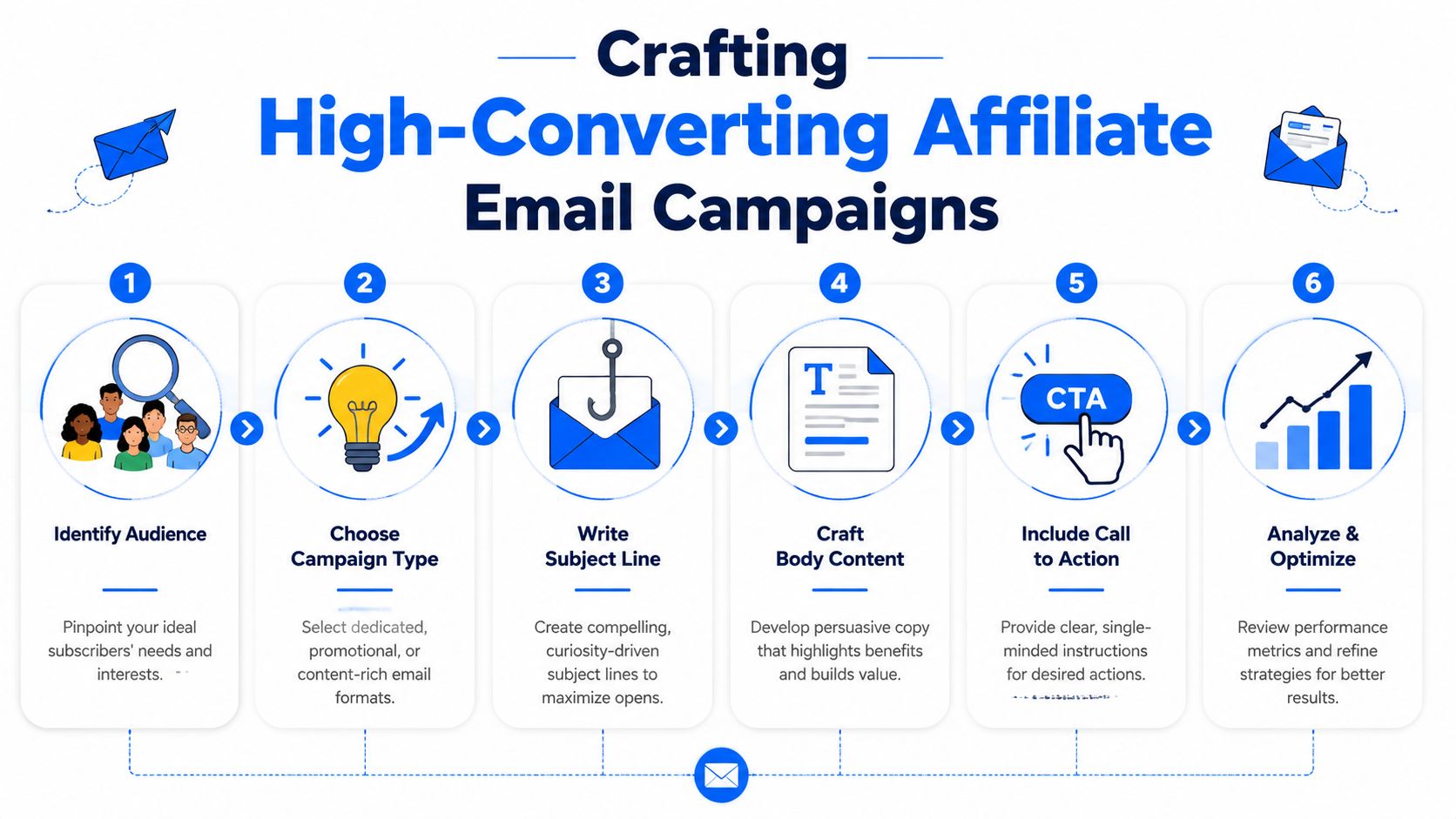
Match the campaign type to buyer intent
Not every affiliate promotion should look like a launch email. The format should reflect how aware the reader is and how much friction the offer carries.
Campaign Type
Best For
Key Tactic
Dedicated promo email
Time-sensitive offers or strong product-market fit
Focus on one problem, one offer, one CTA
Newsletter soft mention
Ongoing monetization without exhausting trust
Embed the recommendation inside useful editorial content
Review-style deep dive
Higher-consideration products
Teach evaluation criteria before linking
Follow-up sequence
Readers who clicked but didn't convert
Address objections and fit questions over multiple emails
A dedicated promo works when the audience already understands the problem and the product solves it cleanly. A soft mention works better when you want monetization to feel native to a content habit. Review-style emails are stronger for B2B tools because people often need buying context, not hype.
If you run webinars or educational demos as part of your funnel, a structured webinar follow-up email sequence can be a useful model for how to keep momentum after a high-intent event without sounding repetitive.
The anatomy of an affiliate email that gets clicks
Strong affiliate emails usually contain five parts:
- A sharp opening that names the problem or moment
- A point of view on why the problem exists or why common solutions disappoint
- A recommendation tied to a use case, not just a product name
- A caveat or fit qualifier so the pitch feels honest
- A single CTA that tells the reader what to do next
What doesn't work is generic benefit dumping. “Boost productivity.” “Save time.” “Scale faster.” That language says nothing. Affiliates who convert consistently describe the before-and-after state with enough specificity that the reader can place themselves in it.
Use automation carefully
Automation is useful. Lazy automation is expensive.
One source notes that segmented campaigns can generate 46% higher open rates, but the real question is whether personalization improves downstream revenue rather than just top-line engagement, as discussed in this piece on email marketing for affiliates and automation trade-offs.
That distinction matters because automated affiliate emails often optimize for the easy metric. Opens rise because the subject line got smarter or the timing improved. Revenue doesn't always follow if the email body feels machine-made or the recommendation lacks judgment.
What should stay human
In most affiliate programs, these parts should stay human-curated:
- Offer selection because product-audience fit is strategic
- Positioning angle because nuance builds trust
- Disclosures and caveats because honesty improves conversion quality
- Objection handling because buyers don't all hesitate for the same reason
These parts can usually be automated safely:
- Send timing
- Basic segmentation
- Reminder logic
- Click-based branching
- Template assembly
Automation should remove repetitive labor, not remove editorial judgment.
The best email marketing for affiliates uses AI and automation as production support, not as a replacement for taste. If an email sounds interchangeable with fifty others in the category, it will perform like it.
Mastering Deliverability and Affiliate Compliance
A lot of affiliate operators still treat deliverability like cleanup work for later. That's backwards. Deliverability decides whether the campaign exists in practice.
If your promotion lands in spam, it doesn't matter how good the angle was or how strong the commission is.

Recent guidance has made that more urgent. Gmail and Yahoo's 2025 bulk-sender requirements tightened expectations around authentication, one-click unsubscribe, and spam complaint thresholds, which means inbox placement is now an operational constraint, not just a best practice, according to this overview of affiliate email deliverability challenges.
Why affiliate-heavy emails get filtered faster
Affiliate campaigns carry a few built-in risks:
- Promotional density gets too high when every send pushes an offer
- Audience mismatch grows when the same promotion goes to the entire list
- List decay adds disengaged subscribers who stop opening and start ignoring
- Trust erosion shows up when readers can't predict the difference between editorial and monetized content
Spam filters don't read your intent. They read your patterns. If recipients ignore, delete, unsubscribe, or complain often enough, mailbox providers learn from that behavior.
That's why relevance beats volume. A lower-frequency program sent to the right segments will usually outperform a high-frequency blast model over time.
The practical compliance checklist
Many teams don't need a theory lecture here. They need a sending checklist.
- Use one-click unsubscribe so readers can leave without friction.
- Disclose affiliate relationships clearly when you recommend products.
- Segment by interest and behavior instead of mailing every offer to everyone.
- Monitor sender reputation and list hygiene as ongoing maintenance, not quarterly cleanup.
- Remove or suppress chronically inactive contacts when they stop engaging.
If your list quality is questionable, email validation should happen before the next promotion, not after the complaint spike. This guide on strategies for successful email validation gives a useful overview of how teams clean inputs before they damage performance.
A platform with built-in monitoring can help here. For example, email deliverability best practices become much easier to operationalize when your sending setup includes hygiene controls, reputation monitoring, and segmented campaign management in one workflow.
Frequent promotions don't kill deliverability by themselves. Irrelevant promotions do.
Protecting inbox placement during monetization pushes
The danger period for affiliate newsletters is usually when promotions start working. Revenue goes up, so the natural impulse is to send more of the same.
That's where good programs break from fragile ones. They protect the list during the upswing by rotating formats. Mix promotional sends with educational editions. Use segments aggressively. Keep affiliate-heavy campaigns focused on subscribers who have shown interest in that topic or product category.
If you want a visual walkthrough on keeping campaigns out of trouble, this is worth a watch:
Deliverability isn't glamorous. But if you ignore it, every other part of your affiliate email system gets weaker.
Measuring Affiliate Email ROI Beyond Opens and Clicks
Open rate is useful for diagnostics. Click-through rate is useful for message-market fit. Neither one is the final score.
Affiliate email programs live or die on revenue efficiency. HubSpot summarizes typical email marketing ROI at 10:1 to 36:1 for most organizations, with top-performing programs exceeding 50:1, and that benchmark is a useful reminder that email gets judged on financial performance, not activity alone, in this roundup of email marketing ROI benchmarks.
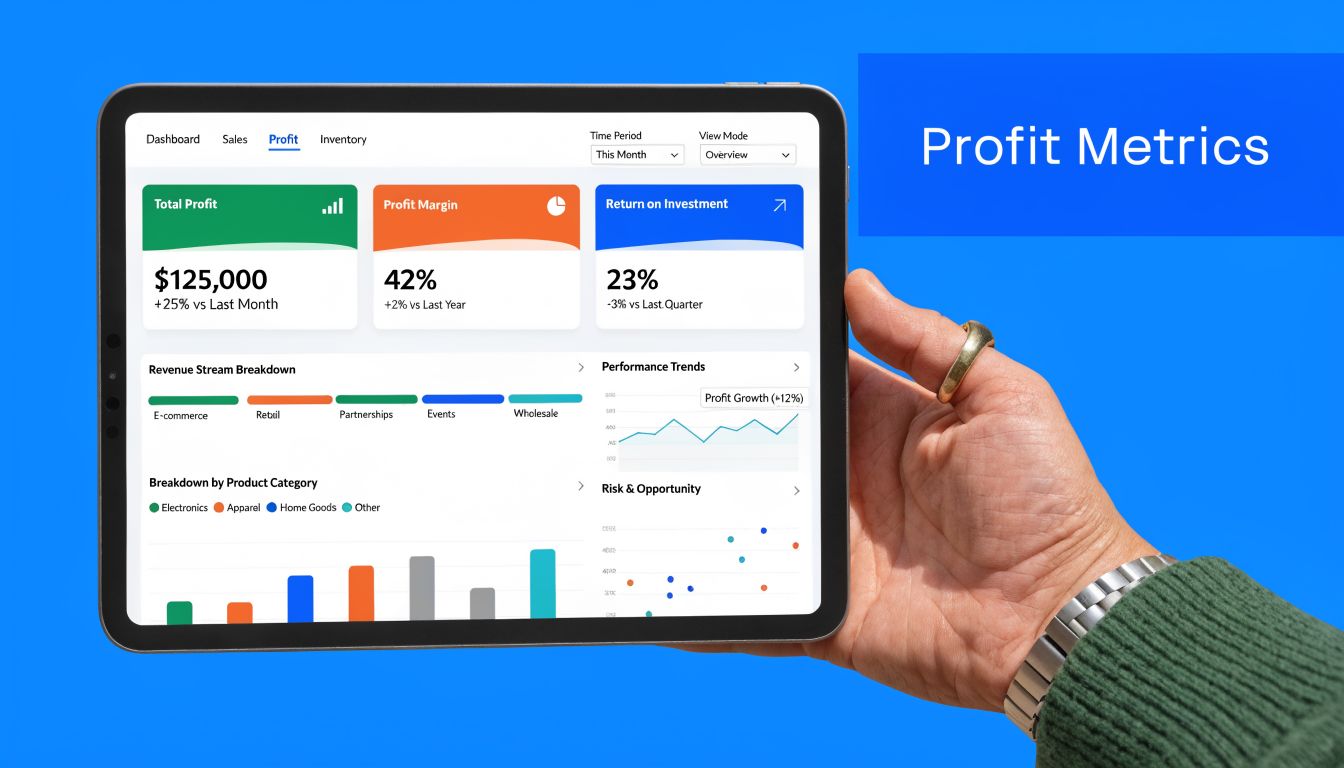
The metrics that actually matter
If you're serious about email marketing for affiliates, build reporting around commercial outcomes.
Track these first:
- Conversion rate from click to sale or lead
- Earnings per click to compare offers on equal footing
- Revenue per subscriber to understand list quality
- Unsubscribe rate to see the hidden cost of monetization pressure
Those numbers tell you whether a campaign generated profitable action or just superficial engagement. A flashy email with high opens but weak earnings per click is often a subject-line win and a commercial loss.
Measure at the campaign and segment level
A common mistake is averaging performance across the whole list. That hides where the money originates.
Break reporting down by:
View
What it reveals
Offer
Which affiliate products deserve more promotion
Segment
Which audience clusters buy, click, or churn
Email type
Whether newsletters, deep dives, or dedicated promos create better revenue quality
Time window
Whether the campaign drives immediate action or delayed conversions
This is also where attribution discipline matters. If you need a cleaner framework for tying revenue back to sends, this guide on email attribution for SaaS is a practical reference for structuring campaign measurement.
Build a dashboard that forces better decisions
Your dashboard doesn't need to be complex. It needs to be honest.
At minimum, review these questions every cycle:
- Which offers generated the most revenue per click?
- Which segments clicked but didn't convert?
- Which campaigns drove unsubscribes out of proportion to revenue?
- Which subscribers haven't engaged recently and may be hurting list quality?
A profitable affiliate email program isn't the one with the highest open rate. It's the one that earns repeatedly without degrading the list.
The right reporting keeps you from over-mailing weak offers, under-investing in strong ones, and mistaking activity for profit.
Scaling Affiliate Revenue with Smart Automation
Automation doesn't make a weak affiliate program stronger. It makes the existing system faster. If your offers are sloppy, your targeting is broad, and your emails are generic, automation just scales the damage.
Used correctly, though, it gives you an advantage. You stop building every campaign from scratch and start routing subscribers into paths that match what they've shown you.
Build evergreen revenue paths
The simplest automations usually outperform the flashy ones because they solve recurring situations.
Three sequences matter most:
- Best-of sequence
New subscribers should see your strongest evergreen recommendations after the welcome flow. Not all at once. Space them out, tie them to common use cases, and keep the recommendations editorial.
- Last-chance sequence
If an offer has a real deadline, automate the reminder path for subscribers who clicked but didn't act. Keep it short. Deadline pressure works best when you haven't already trained the list to distrust urgency.
- Re-engagement sequence
Before suppressing inactive subscribers, give them a clean off-ramp or a chance to reset preferences. Ask what they still want to hear about. If they don't respond, stop mailing them.
These automations create coverage across the lifecycle without turning your newsletter into a nonstop sales engine.
Personalization starts before the send
A lot of affiliates personalize too late. They swap in a first name or dynamic subject line and call it segmentation.
The better model starts before campaign creation. One strong workflow is to identify the creator or partner, map where they're most active, assess their content and monetization model, and then personalize the pitch to fit their audience and business model, as described in this guide to affiliate outreach email mistakes and better workflows.
That same logic applies to subscriber automation. Don't just ask, “What email should go out next?” Ask:
- What problem is this subscriber trying to solve?
- What category have they clicked before?
- Do they respond to educational content or direct recommendations?
- Are they a prospect, a buyer, or a drifting reader?
Those signals should determine the sequence.
Keep the machine narrow and accountable
The best automated affiliate systems are narrower than people expect. They don't try to orchestrate every possible branch. They automate the few moments where intent is obvious.
Good triggers include:
- Clicked a product category link
- Downloaded a topic-specific resource
- Stopped engaging for a sustained period
- Viewed a comparison or review page
- Joined from a specific acquisition source
Poor triggers usually rely on weak signals or vague assumptions. That's how people end up in irrelevant promo loops.
A useful operating rule is simple. Every automated email should answer one question clearly: why is this person receiving this message right now? If your team can't answer that in one sentence, the automation probably needs work.
Scale with guardrails
As the program grows, don't just add more branches. Add review points.
Audit your automations for:
- Stale recommendations
- Broken assumptions about subscriber interest
- Expired promotions
- Overlapping sequences
- Tone drift between human-written and automated emails
Smart automation creates predictable revenue because it preserves relevance at scale. That's the key win. Not fewer hours in the ESP. Better timing, cleaner segmentation, and more consistent monetization without burning the list.
If you're building a B2B newsletter or affiliate-heavy email program and want growth plus infrastructure, Breaker is worth a look. It combines email sending, list growth, analytics, and deliverability management in one platform, which is useful when you're trying to scale monetization without losing control of list quality or inbox placement.
Keep reading
All articlesGDPR Consent Requirements for Purchased Email Lists
Purchased email lists rarely meet GDPR's consent bar. Learn the legal basis rules, PECR overlap, and safer alternatives before you hit send.
7 Email Platforms With Inbox Placement Testing & Suppression
Compare 7 email platforms that combine inbox placement testing with suppression management, scored on features, pricing, and best-fit sender size.
Email Automation Workflow & Drip Campaign Data Structure
Learn the database schema behind email drip campaigns—tables, workflow states, and event logs that power reliable marketing automation.