Email Marketing for Restaurants: A Complete Playbook

You already know the feeling. Friday dinner is full, Saturday looks solid, and then Tuesday and Wednesday drag. You post on Instagram, maybe boost a special, maybe drop a story about the chef's new dish, and then you wait for the algorithm to decide whether your regulars will even see it.
That's why email marketing for restaurants matters so much. It gives you a direct line to people who already know your name, have already ordered, booked, or walked through the door, and are far more likely to come back if you stay relevant. The best restaurant email programs aren't built around random blasts. They're tied to operations, guest data, and timing.
Most owners don't need more marketing noise. They need systems that connect reservations, POS data, online ordering, and guest behavior into emails that drive covers and orders.
Why Email Is Your Restaurant's Most Valuable Marketing Channel
Email keeps winning because it does two things social platforms don't reliably do. First, it gives you owned access to your guests. Second, it produces results you can track from send to reservation to spend.
The headline number still gets attention because it should. Email marketing generates about $36 in revenue for every $1 spent, according to SevenRooms' restaurant email marketing ROI overview. For restaurants, that same source says average open rates can be as high as 40.03%. Those aren't vanity numbers. They point to a channel that guests pay attention to.
Ownership beats rented attention
A restaurant's social following is useful, but it isn't stable. Platform reach shifts. Paid costs move. A post that worked last month can disappear this week. Your email list works differently because you built it from actual guest relationships.
If someone booked a table, ordered takeout, joined Wi-Fi, or signed up for updates, you have a permission-based way to reach them again. That matters when you need to fill a weak service, launch a new menu, push event reservations, or bring back guests who haven't visited lately.
Practical rule: Treat your email list like an operating asset, not a side project. It should sit alongside your POS, reservation book, and ordering system in importance.
Revenue comes from repeat behavior
Restaurants rarely need one-time awareness as much as they need repeat visits. Email is built for that. It can remind a brunch guest about a seasonal weekend special, invite a wine buyer to a pairing dinner, or nudge a regular takeout customer back before they drift to another option.
That's also why email belongs inside a broader effective restaurant marketing strategy, not off to the side as a monthly newsletter no one owns. When restaurants get email right, they stop sending generic updates and start building repeatable revenue motions around actual guest behavior.
Control changes how you market
With email, you control message, timing, audience, and offer. You can test subject lines, isolate a guest segment, and compare one send against another. You can't do that well when all your communication depends on public feeds and paid distribution.
For a restaurant owner, that control is the difference between hoping people show up and running a channel that helps make it happen.
Building Your Email List at Every Guest Touchpoint
Most restaurants under-collect email addresses. Not because guests won't sign up, but because the request only appears in one place, usually a weak website footer form or a vague "join our newsletter" box.
Your list should grow anywhere a guest already interacts with your business.

Capture emails where intent already exists
The easiest email to collect is the one attached to an existing transaction or touchpoint. Start with the places where guests are already giving you information:
- Reservations and waitlists: Add an opt-in during booking and confirmation flows. This works well because the guest is already planning a visit.
- Online ordering checkout: Include a clear consent box for menu drops, offers, and updates. Takeout and delivery customers are often strong repeat buyers.
- Digital receipts: A receipt email can double as a list-building moment if the opt-in language is clear and separate.
- Wi-Fi login: If you offer guest Wi-Fi, use a branded access page that explains the value of joining your list.
- In-store QR codes: Table tents, host stand signage, check presenters, and pickup shelves all work if the incentive is specific.
- Website forms: Put forms on reservation pages, menu pages, event pages, and exit-intent moments, not just in the footer.
A generic "subscribe for updates" line won't do much. "Join for early access to tasting menus, event tickets, and subscriber-only offers" is much stronger.
Train staff without making it awkward
Front-of-house teams can help, but only if the ask feels natural. Don't turn servers into telemarketers. Give hosts and cashiers one line that fits the moment.
For example:
- At pickup: "Want the next menu drop and subscriber-only offers by email?"
- At the host stand: "We send event invites and first access to holiday bookings if you'd like to join."
- At checkout for regulars: "We can send your receipt and occasional specials if you'd like."
The best prompts connect to a clear guest benefit. If there's no benefit, sign-up rates stay soft and list quality suffers.
A bad list form asks for attention. A good list form offers a reason.
Keep acquisition clean and usable
Don't buy lists. Don't scrape contacts. Don't lump everyone into one catch-all database with no source tracking. A restaurant needs to know where the address came from and what the guest did.
Use tags like reservation, online order, dine-in receipt, event signup, and Wi-Fi capture. That single detail becomes useful later when you segment campaigns and build automations. If you want a broader framework for capture mechanics, this guide to email list building strategies is a useful reference.
The operational goal is simple. Every normal guest interaction should create an opportunity to earn permission for the next one.
Smart Segmentation to Send Emails Guests Actually Want
If every guest gets the same email, you're not doing marketing. You're broadcasting. Restaurants have much richer data than most local businesses, and that data should shape what each guest receives.
The upside is substantial. Olo's restaurant email marketing strategies notes that personalized marketing can lift spend by email recipients by 20% over 30 days. In practice, that means relevance isn't just a nicer experience. It's a sales lever.
Segment by behavior, not demographics first
Age and zip code can help, but behavior usually tells you more. Start with what the guest has done.
- Visit frequency: First-timer, occasional guest, regular, lapsed.
- Order pattern: Dine-in only, takeout heavy, delivery heavy, reservation-led.
- Spend level: Higher-value guests often respond better to access and exclusivity than blunt discounts.
- Location: Essential for multi-unit groups. A downtown lunch guest shouldn't get suburban family-night promotions.
- Dietary preference or menu affinity: Vegetarian diners, wine buyers, brunch regulars, dessert add-on buyers.
The hospitality mindset is straightforward. You wouldn't greet a first-time diner the same way you greet someone who comes in every week. Your email program should follow the same logic.
Here's a quick explainer worth watching before you build your segment map:
What useful restaurant segments look like
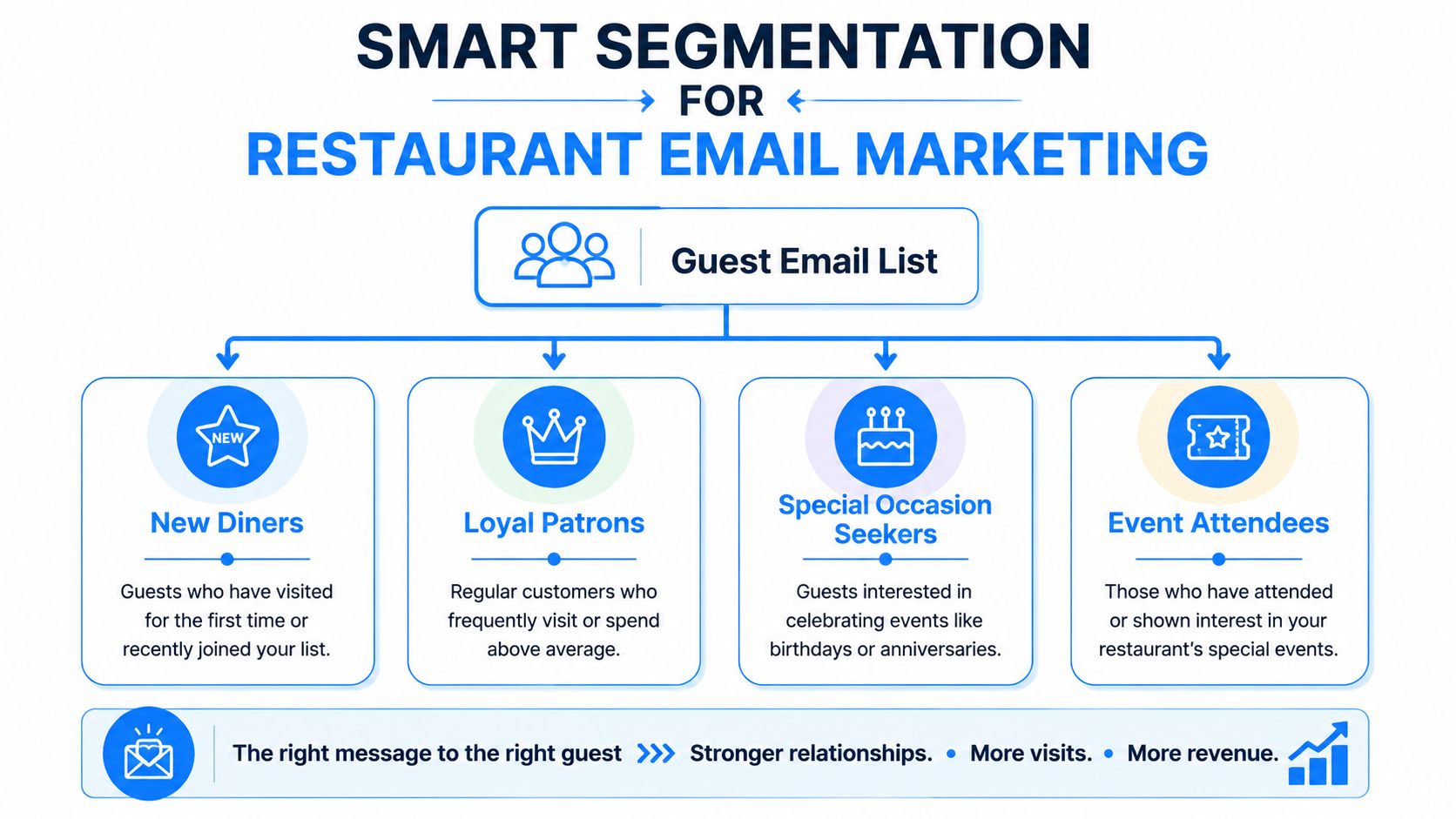
A practical segmentation model often starts with four groups:
New guests
These people need orientation. Send your story, signature dishes, how to book, and one strong reason to come back soon.Regulars
Don't over-discount them. They already like you. Give them early access, insider updates, event invites, and recognition.Lapsed guests
These people need a reason to remember you now, not six weeks from now. Lead with what changed: new menu items, patio season, brunch launch, special event calendar.Channel-based buyers
Takeout and dine-in are different habits. A guest who orders lunch bowls for pickup may not care about your Friday tasting menu, and your anniversary diners may ignore weekday delivery promos.
Send fewer emails to more precise groups. Most restaurants have a relevance problem, not a volume problem.
Build segments from systems you already use
Your POS, reservation platform, loyalty tool, and ordering system already hold most of the data you need. The challenge is getting those signals into your email platform in a usable way.
That means fields and tags like:
- recent visit date
- last order channel
- average check pattern
- no-show status
- event attendance
- favorite category or repeated item type
If you're thinking through tagging logic more broadly, this breakdown of audience segmentation strategies is helpful as a framework, even though restaurant teams will adapt it to hospitality data.
Segmentation works when it changes the message, not just the list label. If the email content doesn't change, the segment isn't doing much.
Crafting Campaigns That Fill Tables and Drive Orders
It is 3 p.m. on Tuesday. Reservations for tonight are thin, online orders are flat, and someone on your team suggests sending "an email about everything." That approach usually produces a busy message with weak results because the guest has no obvious next step.
Campaigns that drive revenue are built around one operational goal. Fill a slow shift. Sell seats for a fixed event. Push catering orders before a local game. Bring back takeout customers who have not ordered in 30 days. Once the goal is clear, the offer, audience, and call to action get much easier to define.
Match the campaign to the revenue problem
A good restaurant email campaign starts with the constraint inside the business, not with a content calendar.
If Wednesday dinner is soft, send a short reservation-focused email to nearby dine-in guests and make the booking link the main action. If you are launching a chef collaboration, sell the experience and the limited availability. If weekend brunch is packed but weekday lunch needs help, promote lunch to office-heavy guests who have ordered pickup before, not to anniversary diners who only book on Saturdays.
That trade-off matters. Broad sends feel efficient, but they often blur the offer. Narrow campaigns usually produce better booking and ordering behavior because the message matches a real dining decision.
Four campaign scenarios that reliably perform
1. Slow-shift recovery
Use these when you need near-term covers or orders. Keep the email tight: one reason to come in, one deadline, one link. A neighborhood Italian spot might send local subscribers a same-week note about half-price bottles on Wednesday with a direct reservation button. A fast-casual concept might push a pickup bundle before the lunch rush to guests who already order online.
2. Event and experience emails
Guests buy these for the occasion, not for the discount. Sell what makes the night different. Mention the guest chef, limited menu, winemaker, live music set, or holiday format. Then send people straight to the event booking page. If reservations live in a separate platform, link there directly instead of forcing guests through your homepage.
3. Newsletter-style sends with a real CTA
A monthly email can work if it behaves like a sales tool, not a bulletin board. Include one primary conversion action and let everything else support it. For example, a steakhouse newsletter might include a new seasonal dish, a private dining reminder, and Father's Day reservations, but the email should still have one featured action above the fold.
4. Calendar-driven demand emails
Restaurants win a lot of revenue around dates guests already care about. Mother's Day, graduation weekend, local sports playoffs, patio opening, restaurant week, office holiday parties. These sends work best when they answer the guest's planning question fast: what is happening, who it is for, and how to book before space runs out.
Restaurant Email Campaign Cheat Sheet
| Campaign Type | Primary Goal | Example Content Idea |
|---|---|---|
| Promotional offer | Fill slow shifts or drive near-term orders | Midweek dinner special for local subscribers |
| Event announcement | Sell seats for a specific experience | Wine pairing dinner invitation with booking link |
| Newsletter | Maintain visibility and drive repeat visits | Seasonal menu update plus one featured reservation CTA |
| Special occasion message | Capture date-driven demand | Holiday brunch reservations or celebration dining package |
Build the email around the conversion path
Creative matters, but the booking or ordering path matters more.
If the email promotes reservations, link to the exact reservation page with the date or event preselected when possible. If it promotes takeout, send guests to the matching ordering category, not the generic homepage. I have seen restaurants lose response because the email promised taco night and the click landed on a full menu with no mention of tacos.
This is also where your operating systems should shape the campaign. POS data can tell you what guests buy. Reservation data can tell you who books for occasions versus casual weeknight meals. Ordering data can separate dine-in regulars from delivery-first customers. Use those signals to decide what to feature, not just who receives the send.
Wi-Fi capture can support this too, if consent is set up properly and guest data feeds into your email platform cleanly. This guide on optimizing restaurant WiFi for customer loyalty is a useful operational reference for that part of the stack.
A strong campaign feels simple to the guest because the operational thinking happened before the send. One audience. One offer. One action. That is how email fills tables and drives orders instead of adding noise.
Putting Your Guest Communication on Autopilot
Automation is where email marketing for restaurants stops being a calendar task and starts acting like infrastructure. A good automated program runs in the background and responds to what guests do. Join the list. Book a table. Finish a pickup order. Go quiet for too long. Each action should have a next message.
That's the part most restaurant teams leave underbuilt. Loman.ai's discussion of restaurant email marketing points out that many guides focus on simple promotions but miss post-visit lifecycle automation that connects reservations, takeout, and loyalty into one measurable system.

The flows worth building first
Start with the sequences closest to revenue and repeat visits.
Welcome flow
A new subscriber shouldn't wait for your next newsletter. They should get an immediate message that tells them what kind of restaurant you are and what to do next.
A solid welcome flow usually does three jobs:
- confirms the signup
- introduces your strongest reasons to visit or order
- pushes one clear next action, usually booking or ordering
For a neighborhood bistro, that might mean a first email with your story and reservation link, followed by a second email featuring signature dishes and best nights to visit.
Post-visit follow-up
Operators often leave money on the table. Someone dined with you yesterday. That is the best time to ask for feedback, invite a review, or guide them toward the next relevant occasion.
For dine-in, a post-visit email can ask how service went and highlight another reason to return. For takeout, it can recommend related items or promote a different daypart. The email should reflect the channel. A pickup customer and a Saturday night anniversary table are not the same guest.
A restaurant doesn't need more one-off promos if it hasn't built a post-visit follow-up system.
Add special-date and reactivation logic
Birthday and anniversary emails still work, but they work better when they connect to guest history. A regular who books celebratory dinners may respond to a reservation-focused message. A casual lunch guest may need a simpler invitation.
Re-engagement flows are just as important. If a guest hasn't visited in a while, don't dump them into generic promotions forever. Trigger a win-back sequence based on recency. Mention something new, relevant, or seasonal. If they still don't engage, suppress them rather than training them to ignore you.
Tie automation to operations, not just marketing
The strongest automations come from operational signals:
- reservation completed
- reservation canceled or no-show
- first online order
- repeat order
- long gap since last visit
- event attendance
- loyalty milestone
That's how your email system becomes a digital front-of-house layer. It follows the guest journey across channels and keeps communication timely without creating more manual work for your team.
Mastering Timing, Subject Lines, and Deliverability
A strong offer won't help if the email lands in spam or arrives after the meal decision has passed. Timing and deliverability are operational disciplines. They aren't cosmetic tweaks.
Restaurants often make the same mistake here. They increase frequency when sales are soft, but they don't watch engagement closely enough to know when the list is tiring out.
Watch the right warning signs
Rewards Network's guidance on restaurant email performance recommends aiming for open rates around 43.69% and unsubscribe rates below 0.5%. If opens fall or unsubscribes rise, the fix is usually not "send more." It's to reduce frequency, tighten targeting, improve relevance, and clean the list.
That matters because over-emailing creates three problems at once:
- guests stop opening
- unsubscribes climb
- mailbox providers get stronger signals that your messages aren't wanted
Practical timing rules
You don't need a rigid universal send schedule. You need timing that fits guest intent.
- Same-day promotions: Send when the decision window is opening, not after it has passed.
- Weekend dining pushes: Send early enough for guests to plan, especially if reservations matter.
- Event campaigns: Start with enough runway for consideration, then tighten reminders as the date approaches.
- Post-visit and transactional follow-ups: Send while the experience is still fresh.
Subject lines should do one of three things. Signal value, create relevance, or provide clarity.
Examples:
- Your table this weekend
- A first look at our new seasonal menu
- Still thinking about dinner plans for Wednesday
- Thanks for dining with us. One quick question
- Early access to our tasting event
Protect inbox placement
Deliverability starts with list quality and sending discipline. Suppress inactive contacts. Remove bad captures. Keep consent records. Don't blast your full database because you have a slow weekend.
If you want a deeper operational framework, this guide to email deliverability best practices is useful. For restaurants, the principle is simple: inbox placement is part of revenue management. If your promos, reminders, and event emails stop landing, the whole system weakens.
Measuring What Matters and Integrating Your Tech
Friday lunch was packed, your weekend wine dinner email got strong clicks, and online orders were up. The question then becomes which sales came from the email, which came from regular demand, and which guests are now more likely to come back. If you cannot answer that from your systems, you are still judging marketing by surface-level signals.

Move past vanity metrics
Open rate still has some diagnostic value. It can help you spot subject line problems, sending frequency issues, or deliverability trouble. But restaurant owners need numbers tied to guest behavior and sales.
Track outcomes such as reservations booked, covers seated, online orders placed, offer redemptions, revenue per recipient, and repeat visits within 30, 60, or 90 days. A Mother's Day campaign with average clicks can still beat a flashy promotion if it drives larger party reservations and higher check averages. A discount email can get plenty of engagement and still train guests to wait for offers.
This is the shift that matters. Email should be measured like a revenue channel, not a content channel.
The integrations that matter most
The best reporting starts with your operational systems. If your email platform sits alone, you will spend too much time exporting CSVs and guessing which campaign influenced what.
For most restaurants, the priority stack looks like this:
- POS integration: Connect purchases, average spend, menu category preferences, and visit recency.
- Reservation system integration: Tie emails to bookings, no-shows, party size, and dining frequency.
- Online ordering integration: Track first order, repeat order, daypart habits, and lapsed ordering behavior.
- Loyalty integration: Use point activity, tier status, and redemption history to shape offers and suppress irrelevant sends.
Once those connections are in place, lifecycle automation gets much smarter. You can send a win-back email only to guests who have not visited in 45 days, exclude anyone with a reservation already on the books, and follow up after a high-value dinner with an event invitation instead of a generic newsletter.
Build one guest view across channels
Restaurants get better results when email and SMS have clear jobs. Email handles menu launches, chef event storytelling, post-visit follow-up, and nurture flows. SMS handles reservation reminders, limited-time updates, and short booking windows. Used together, they support the same guest journey instead of competing for attention.
This guide on integrating text and email campaigns is useful if you are mapping those channel roles.
The goal is one guest record that reflects what the guest does. What they ordered. Whether they book tables or order takeout. How often they visit. Which offers they redeem. That setup gives you cleaner attribution, better automation, and fewer irrelevant sends.
If your tech stack cannot pass data between email, POS, reservations, and ordering, fix that before you add more campaigns. Better targeting and better reporting usually produce more revenue than sending more often.
If you're building a smarter newsletter and want stronger list growth, cleaner deliverability, and clearer ROI reporting, Breaker is worth a look. It combines campaign creation, subscriber growth, targeting, list hygiene, and analytics in one system, which is useful for teams that want email to operate like a real growth channel instead of a disconnected send tool.