
Master Email Marketing for Restaurants
Turn diners into regulars using our guide to email marketing for restaurant success. Discover list building, automation, and campaign secrets to boost revenue.
You run a special. You post it on Instagram. A few regulars like it, a couple of people share it, and then the platform moves on. Friday night arrives and the dining room still looks thinner than it should.
That's the problem with rented attention. Social reach shifts, ad costs rise, and even strong creative can disappear under an algorithm you don't control. Email marketing for restaurant operators solves a different problem. It gives you a direct line to guests who already know your food, your location, and your brand.
The catch is that email only works when it's run like an operating system, not a random promotion tool. A restaurant that sends one generic blast every few weeks usually gets mediocre results. A restaurant that builds a clean list, segments guests, automates key touchpoints, and watches deliverability closely turns email into a repeat-visit engine.
Why Email Is Your Restaurant's Most Valuable Marketing Channel
Restaurants need channels they control. Email is one of the few that still qualifies.
Social media is useful for discovery and brand presence, but it's unreliable for repeat business. You can't depend on a platform to show your weekend special to the exact people who ordered from you last month. Email lets you do that directly, with no algorithm sitting between you and the guest.
Email drives owned demand
A strong restaurant email program does three things at once:
- Protects repeat business: You can bring back guests without paying for every impression.
- Supports retention: You stay visible between visits, not just when someone happens to scroll past your content.
- Makes promotions measurable: Reservations, online orders, coupon redemptions, and loyalty actions can all be tracked back to specific sends.
The financial case is strong when execution is disciplined. Hospitality benchmarks cited by MyEmma's restaurant email guide put email at about $36 to $38 returned per $1 spent, which is why many operators treat it as a serious revenue channel rather than a side tactic.
Practical rule: Email isn't valuable because it's cheap. It's valuable because you own the audience.
That said, high ROI doesn't come from blasting discounts. It comes from doing the basics well: mobile-friendly design, clear calls to action, relevant timing, and list quality. If guests mistake your email for spam, the economics change fast.
Why restaurants benefit more than many other businesses
Restaurants live on frequency, habit, and timing. A guest doesn't need a long buying cycle. They need a reason to come back this week, book for Saturday, order dinner tonight, or use the birthday reward you already promised them.
That makes email unusually powerful for a restaurant compared with many other local businesses. You're not trying to educate someone over six months. You're trying to influence near-term behavior from people who already know what you sell.
Here's a simple way to look at it:
Channel
What it does well
Main limitation
Social media
Awareness and discovery
Reach is inconsistent
Paid ads
Immediate traffic
Costs keep recurring
SMS
Urgent reminders
Easy to overuse
Repeat visits, retention, loyalty, orders
Requires system and list hygiene
If you want a broader framework for owned-channel planning beyond restaurants, Adwave's guide on boost your small business email marketing is a useful companion resource.
Building Your Guest Email List From Scratch
A restaurant email program is only as good as the list behind it. Not the size. The quality.
If you collect addresses from guests who want updates, offers, and reminders, email performs. If you pull in low-intent contacts from sloppy forms or unclear consent, open rates drop, spam complaints rise, and future sends get weaker.
Start with high-intent collection points
The best list-building methods sit where buying intent is already high. Campaign Monitor's restaurant guidance emphasizes placements like homepage forms, menu pages, reservation forms, exit-intent pop-ups, and QR code sign-ups because those touchpoints catch people who are already engaged with the brand, as noted in the list-building strategies for email growth playbook.
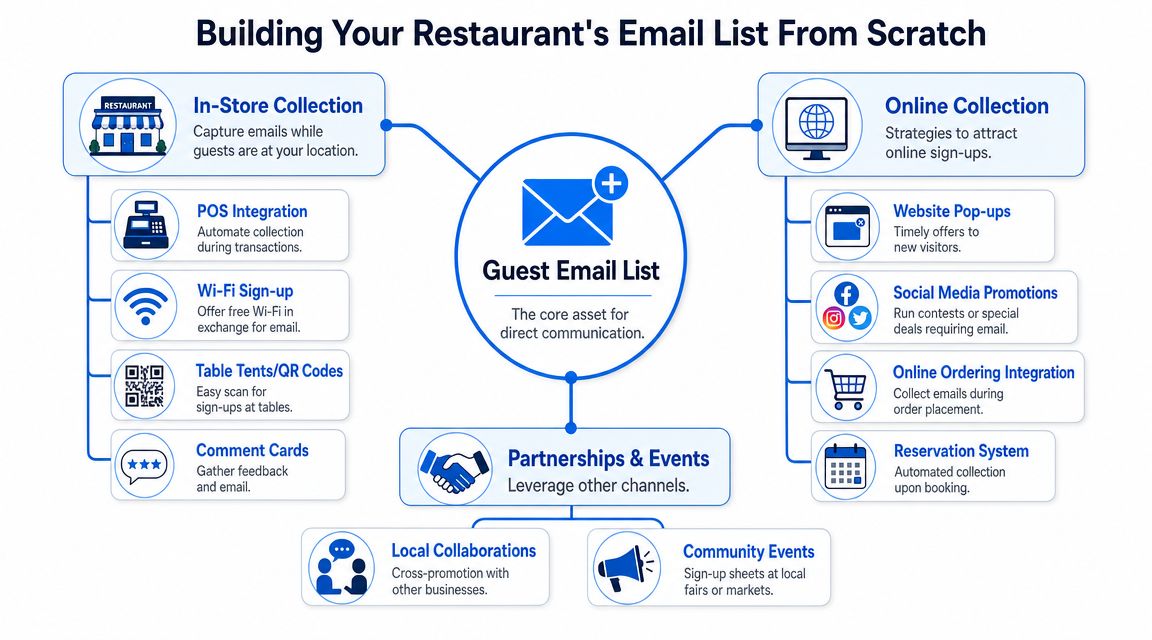
Here are the collection points I'd prioritize first.
Online list-building tactics
- Homepage signup form: Put a simple form above the fold or in the header/footer. Don't ask for five fields if name and email will do.
- Reservation path: Add an opt-in during booking. Guests making reservations are already raising their hand.
- Online ordering flow: Capture consent during checkout for future updates and reorder reminders.
- Menu page prompt: Someone browsing your menu is often deciding whether to visit. Give them a reason to stay connected.
- Exit-intent popup: Use this carefully. It works best when the offer is specific, like early access to seasonal specials or a welcome reward.
What matters is friction. If the form feels like paperwork, conversion drops. If it feels like a quick exchange of value, people sign up.
In-restaurant collection tactics
The physical location gives you collection opportunities that most businesses don't have.
- QR codes on tables or inserts: Keep the landing page clean and mobile-friendly.
- Printed receipts: Add a short invitation to join for offers, events, or loyalty perks.
- Takeout packaging: Great for guests who may not have engaged with your brand beyond the order itself.
- Comment cards or feedback prompts: If someone is willing to leave feedback, they may also opt into future emails.
- Guest Wi-Fi login: This can work well when consent is clear and the experience isn't annoying. If you use Wi-Fi capture, Splash Access has a practical guest WiFi marketing guide detailing the mechanics.
If staff have to explain the signup process for more than a few seconds, the process is too complicated.
What to offer in exchange for an email
You don't always need a discount. In many restaurants, a discount is the most expensive way to build a list.
Better incentives often include:
- Early access: Seasonal menus, limited reservations, special event seating.
- Member-only updates: Wine dinners, chef nights, holiday booking alerts.
- Convenience: Order reminders, booking reminders, loyalty updates.
- Birthday perks: Particularly effective if your concept is celebration-friendly.
For quick-service and delivery-heavy operators, a welcome offer can still make sense. For fine dining or special-occasion restaurants, exclusivity often works better than a price cut.
What not to do
Don't buy lists. Don't scrape emails. Don't add every past guest from a spreadsheet unless you have proper consent and a realistic reason to believe they expect your email.
Bad list growth creates hidden costs:
- Lower deliverability
- More unsubscribes
- More spam complaints
- Worse campaign data
A smaller clean list outperforms a bloated weak one almost every time.
Crafting Campaigns That Actually Fill Tables
Most restaurant teams don't struggle because they lack ideas. They struggle because they send the wrong type of email for the business goal.
A promo email can drive a fast repeat visit. A loyalty email can lift spend. A reservation email can help fill a specific service window. If you treat all three as the same thing, the calendar gets noisy and performance gets muddy.
Segment before you write
SevenRooms recommends segmenting by visit frequency, location, service behavior, and loyalty status, and the logic is straightforward. A first-time guest needs a different message than a weekly regular. A takeout-heavy customer shouldn't get the same push as someone who only books the dining room.
The performance gap between generic and triggered messaging is large. SevenRooms cites an average restaurant email open rate of 18.5%, while welcome emails can reach 68.6% open rates in context-rich, automated flows, according to its restaurant email ROI analysis.
That's why segmentation matters. Relevance changes outcomes.
Match the campaign to the goal
Use this as a practical planning grid.
Campaign Type
Primary Goal
Example
Recommended Frequency
Welcome email
First repeat visit
“Thanks for joining us. Here's what to try first.”
Triggered at signup
Promo email
Bring guests back soon
“Join us this week for our new lunch special”
Based on business cycle
Reservation email
Fill specific services
“Book your table for Saturday before prime slots go”
Around target dates or demand windows
Event announcement
Sell seats for experiences
“Wine tasting dinner now open for reservations”
As needed
Loyalty update
Increase spend and retention
“Your reward is ready” or “Try this members-only menu item”
Based on loyalty activity
Feedback follow-up
Gather reviews and recover service issues
“How was dinner last night?”
Triggered after visit
Re-engagement email
Win back inactive guests
“We haven't seen you in a while”
Triggered after inactivity
Campaigns that work for specific restaurant models
A few examples make the trade-offs clearer.
For a neighborhood lunch spot, frequency matters more than storytelling. Weekly menu reminders, office catering nudges, and loyalty updates usually outperform polished brand essays.
For a fine dining restaurant, fewer sends with stronger intent work better. Reservation access, tasting menu launches, wine events, and special-occasion booking windows fit the buying pattern.
For a multi-location group, location-based segmentation is essential. Don't send a downtown brunch feature to a suburban dinner-only audience.
For a delivery-first brand, the email needs to reduce friction. Reorder prompts, cart recovery, and post-order follow-ups beat broad newsletters.
Write emails that ask for one action
Many campaigns break down. This often occurs when operators try to promote a special, announce live music, mention the loyalty program, highlight three dishes, and ask for a reservation in one send.
Don't do that.
Pick one primary action:
- Reserve a table
- Order online
- Use a birthday reward
- RSVP for an event
- Leave feedback
If you want help tightening subject lines so the right people open the send, this guide to email subject line best practices is worth bookmarking.
One email should lead to one clear next step. Extra choices usually reduce response.
Putting Your Marketing on Autopilot with Automation
The biggest shift in restaurant email hasn't been design. It's been timing.
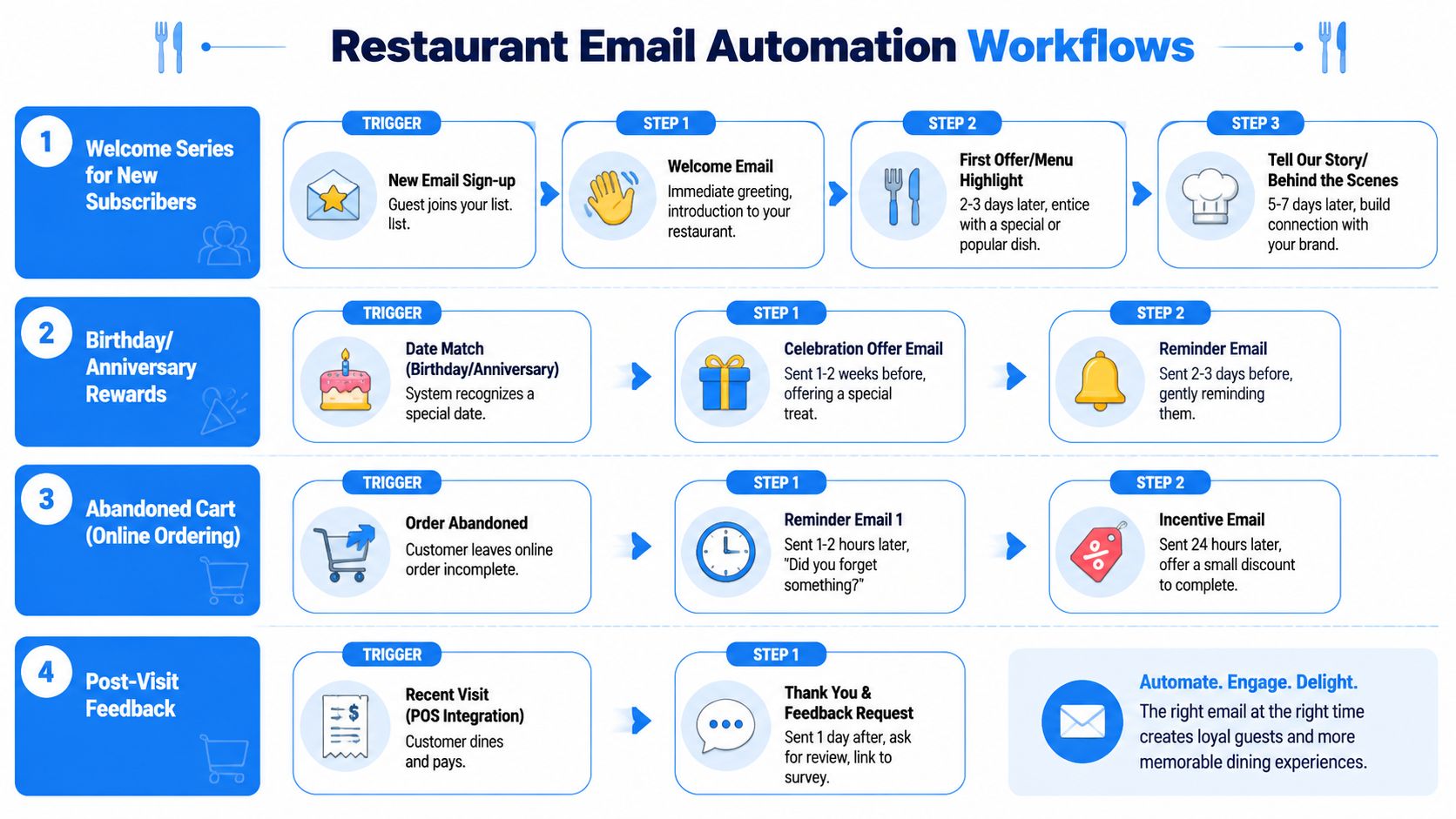
The strongest programs don't rely on the team remembering to send every message manually. They build trigger-based flows that react to guest behavior. A signup triggers a welcome email. An order triggers a thank-you. A lapse in activity triggers a win-back message.
Here's a visual way to map those flows.
The automations I'd set up first
Olo's restaurant guidance recommends sending an automated welcome or thank-you email within 24 hours of an online order, often with an incentive for a return visit, and also advises a feedback request within 24 hours after order completion in its restaurant email marketing strategies. That reflects how email marketing for restaurant operators has shifted from broad promotion to lifecycle retention.
Those are the first two flows I'd build. Then I'd add re-engagement.
Welcome or thank-you flow
A guest joins your list or places an order. They should hear from you quickly, while the brand is still fresh in mind.
A simple welcome flow can include:
- Message one: Thank them, set expectations, introduce your strongest offer or most popular menu category.
- Message two: Highlight what makes the restaurant distinct. Signature dish, chef angle, happy hour, family bundle, whatever matters.
- Message three: Ask for the next visit or order directly.
This flow works because it catches attention at the highest-intent moment.
Post-visit feedback flow
This one is underrated. A feedback email does more than gather reviews.
It helps you:
- Spot service problems early
- Capture positive sentiment when the visit is fresh
- Create another touchpoint without forcing a discount
- Differentiate happy guests from unhappy ones for follow-up
For dine-in restaurants, this email can ask about food, service, and overall experience. For takeout and delivery, ask about packaging, timing, and order accuracy.
A quick explainer on automation strategy can help your team visualize how these triggers work in practice:
Re-engagement and occasion-based flows
The next automation to build is the win-back sequence.
Some guests drift because they moved. Some because the habit broke. Some because they forgot. A re-engagement flow gives you a structured way to bring them back without adding another generic campaign to the calendar.
Use re-engagement when:
- A frequent guest goes quiet
- A first-time guest never returns
- An online ordering customer hasn't reordered
- A loyalty member stops engaging
Birthday and anniversary flows also work well, especially for concepts tied to celebration, family dining, dessert, or drinks. The key is to make the reward feel timely and easy to use, not buried in conditions.
The overall principle is simple. Manual campaigns create spikes. Automation creates continuity.
Measuring What Matters and Optimizing for Revenue
Friday's promo email can look strong by noon. Open rate is healthy. Clicks are coming in. Then dinner service closes and the real question hits. Did it drive covers, online orders, and profitable repeat visits, or did it just generate curiosity?
That distinction matters more in restaurants than in many other businesses. A campaign can produce plenty of engagement and still hurt margin if it trains guests to wait for discounts, fills only low-value dayparts, or brings in one-time bargain hunters instead of regulars.
Start with benchmarks, then tie performance to the P&L
Owner.com notes that successful restaurants often see 10% to 20% of total revenue coming from email, with healthy targets around a 35% open rate, a 1.2% click-through rate, and a hard bounce rate below 0.2% in its guide to restaurant email benchmarks and strategy.
Use those numbers as context, not a scorecard. A reservation campaign for Valentine's Day should be judged differently from a Tuesday lunch push or a post-dinner feedback email. The better approach is to connect each email type to the job it is supposed to do. Promotions should drive return visits. Loyalty campaigns should raise average order value. Win-back emails should recover lapsed guests at an acceptable cost.
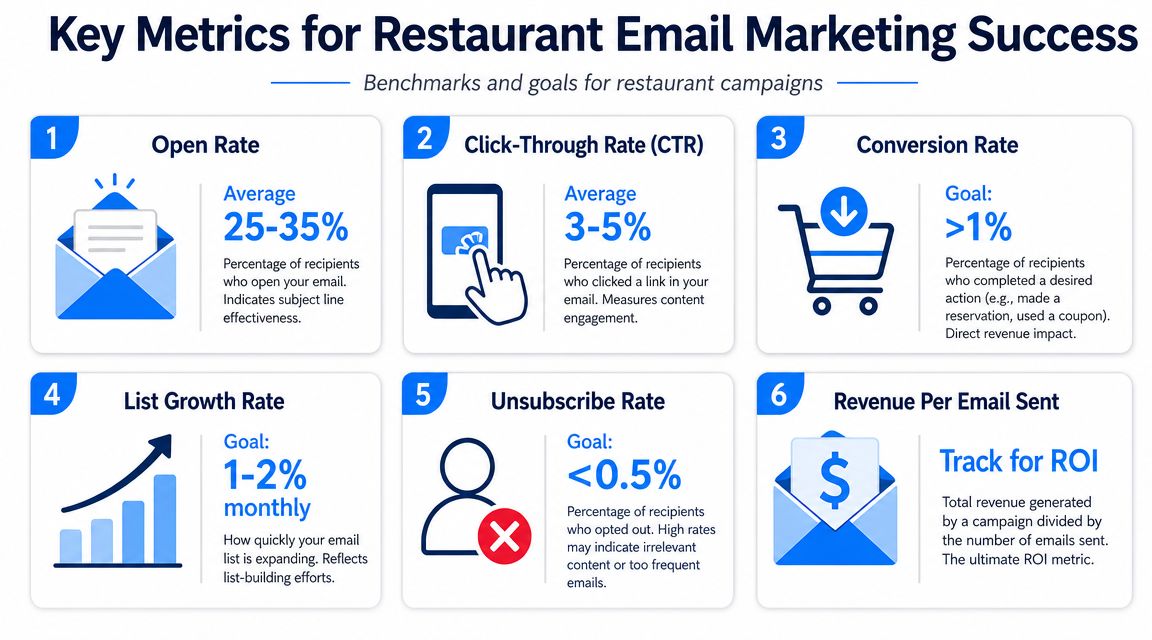
Track restaurant email performance in two layers
Engagement metrics help diagnose message performance:
- Open rate: Measures subject line strength and sender recognition.
- Click-through rate: Measures how well the offer, creative, and CTA pull interest.
- Hard bounce rate: Shows whether list quality is slipping.
Business metrics show whether the email made money:
- Reservation count from email
- Online order count from email
- Offer redemption rate
- Revenue attributed by campaign
- Average order value from email-driven customers
- Repeat visit behavior by segment
The trade-off is straightforward. A discount campaign may win on clicks and redemptions while lowering check average. That can still be the right move if the goal is to fill a slow Monday. A chef's tasting email may get fewer clicks but produce high-value bookings. That is a better result for a premium concept.
Test offers based on business outcomes, not vanity metrics
A/B testing works best when the test matches a revenue question.
Useful restaurant tests include:
- Subject line style: Direct offer vs menu-led curiosity
- CTA wording: “Reserve now” vs “Book your table”
- Offer structure: Free appetizer vs percentage discount
- Send timing: Mid-morning vs late afternoon
- Audience split: First-time guests vs repeat diners
One caution here. CTR is helpful, but it is not the finish line. If you want a cleaner way to interpret click performance before tying it back to covers and revenue, Bare Digital offers a practical guide on boosting marketing CTR for UK businesses. The examples are broader than hospitality, but the measurement logic still applies.
The winning version is the one that produces stronger economics. If Version B gets fewer clicks but books more four-tops, drives higher order values, or brings back lapsed regulars, keep Version B.
Build one weekly report your operators will read
Restaurant teams rarely need complicated attribution models. They need a reporting view that connects campaign activity to guest behavior fast enough to change next week's sends.
Keep it focused:
What to review
What it tells you
Action to take
Opens by campaign type
Which themes earn attention
Improve subject lines and segmentation
Clicks by offer
Which promotions create interest
Adjust creative and CTA
Reservations or orders by send
Which campaigns generate revenue
Repeat strong formats
Revenue by segment
Which guest groups matter most
Personalize future sends
Bounce and unsubscribe trends
Whether list quality or frequency is slipping
Clean list and reduce fatigue
Review that dashboard weekly, then make one or two changes, not ten. Restaurants get better results from steady iteration than from constant overhauls.
Tooling also affects what you can measure well. Mailchimp, Klaviyo, Constant Contact, and Breaker can support campaign tracking, segmentation, and list operations. The right fit depends on how your POS, reservation platform, and ordering stack pass data back into email. Reporting quality also depends on inbox placement, which is why teams should understand email deliverability best practices for restaurant campaigns before they judge campaign performance.
Compliance, Deliverability, and Long-Term List Health
The most overlooked part of email marketing for restaurant brands isn't creative. It's infrastructure.
You can write strong copy, design a clean offer, and build smart automations. If your list is messy and your sender reputation slips, fewer guests will ever see those emails. EmailOctopus emphasizes that deliverability management, list hygiene, and sender reputation are core infrastructure, especially because restaurants often collect emails from mixed-quality sources like QR codes and Wi-Fi forms that need to be cleaned and verified, as described in its restaurant email strategy and deliverability guide.
Compliance is the floor, not the strategy
At a minimum, your emails should include:
- Clear consent practices
- An obvious unsubscribe link
- Accurate sender identity
- Your valid business details
- No misleading subject lines
That isn't just legal housekeeping. It also sets the tone for trust. Guests are far more forgiving of a frequent email program when they know exactly why they're receiving messages and how to opt out.
Protect list quality like an asset
Restaurant lists get messy faster than many marketers expect. Addresses come in from reservation systems, POS prompts, Wi-Fi capture, QR code forms, event signups, and online ordering. Not all of those contacts are equal.
A durable list-health routine includes:
- Removing invalid addresses
- Watching hard bounces closely
- Suppressing unengaged contacts when needed
- Separating contacts by source
- Reviewing complaint and unsubscribe patterns
- Avoiding vague or forced opt-ins
If you want a deeper operational checklist, this guide to email deliverability best practices is a solid reference.
A restaurant doesn't lose email performance all at once. It usually erodes send by send, when weak addresses stay on the list and irrelevant emails keep going out.
What long-term success actually looks like
A healthy program doesn't chase every send opportunity. It protects the inbox placement of the emails that matter most.
That means sending fewer irrelevant campaigns, keeping collection standards high, and treating the list as a revenue asset. The restaurants that win with email are usually not the loudest. They're the most consistent, the most relevant, and the most disciplined behind the scenes.
Breaker gives teams one place to send campaigns, manage list growth, monitor analytics, and support deliverability. If you want to see how that kind of system works in practice, visit Breaker.
Keep reading
All articlesHow to Boost Conversions With Your Email Newsletter
Turn your newsletter into a conversion engine. See 2026 benchmarks, CTR vs CVR explained, and the fixes most email guides skip.
Drip Campaign Template: Ready-to-Use Email Sequences
Get 6 ready-to-paste drip campaign templates with subject lines, body copy, and send timing—plus a step-by-step guide to building your own.
Post-Webinar Survey Questions Template (2026)
30+ post-webinar survey questions with NPS, CSAT, and CES templates, plus timing and length tips to boost completion and qualify leads faster.