
What Is ICP in Marketing and How Does It Drive Growth
Learn what is ICP in marketing and how to build one that attracts high-value B2B customers. A complete guide to defining your Ideal Customer Profile for growth.
In B2B marketing, your Ideal Customer Profile (or ICP) is a hyper-detailed description of the perfect company you should be selling to. Think of it as the GPS for your entire marketing strategy, guiding you straight to the accounts most likely to buy, stick around, and become your most valuable customers.
Defining Your Ideal Customer Profile
Imagine trying to sell enterprise-grade software to a local coffee shop. You might be passionate, and your product might be great, but your efforts are completely misplaced. Without a clear Ideal Customer Profile, many B2B companies do the digital equivalent—shouting their message into a crowded market, just hoping the right person happens to overhear.
An ICP is what cuts through all that noise. It's a data-backed sketch of a fictional company that gets the absolute most value from your solution and, in turn, provides the most value back to your business. This isn't just about surface-level details; it’s a rich picture built from specific company attributes.
Key Components Of An ICP
When you start building out your ICP, you're really looking at a few distinct layers of company-level data:
- Firmographics: These are the basic stats of a company. Think industry, employee count, annual revenue, and geographic location. For example, a sharp ICP might be "SaaS companies in North America with 50-200 employees and over $10M in ARR."
- Technographics: This is all about the tech stack a company uses. Knowing a prospect runs on Salesforce, uses Marketo for automation, or is an AWS shop helps you tailor your pitch and speak directly to their integration needs.
- Behavioral Data: This gets into the why. What are the company's biggest pain points? What are their strategic goals for the next year? What triggers their buying decisions or budget cycles?
A well-defined ICP isn't just for targeting—it's a core strategic tool. When you laser-focus on the right companies, the results are dramatic. It’s not uncommon to see conversion rates triple while customer acquisition costs (CAC) are slashed by 50%. Why? Because you stop wasting time and money on leads that were never going to convert in the first place.
ICP vs. Buyer Persona
One of the most common points of confusion is the difference between an Ideal Customer Profile and a Buyer Persona. They absolutely work together, but they are not the same thing. To properly identify your target audience, you need both.
An ICP defines the right company, while a Buyer Persona describes the right person inside that company.
Here’s a quick breakdown to make the distinction crystal clear.
ICP vs Buyer Persona Key Differences
Aspect
Ideal Customer Profile (ICP)
Buyer Persona
Focus
The Company (Organization-level)
The Person (Individual-level)
Data
Firmographics (industry, revenue, size)
Demographics (age, role, career path)
Purpose
To identify the right accounts to target.
To understand the people within those accounts.
Think of it this way: Your ICP helps you find the perfect company (like a Series B fintech startup with 150 employees). Your Buyer Personas then help you understand the key people you need to talk to there (like "Marketing Mary," the VP of Marketing, or "Technical Tom," the Head of Engineering).
Ultimately, your ICP is the "who" at the company level. It's the foundation for all effective B2B marketing.
Why an ICP Is Your Most Valuable Marketing Asset
It’s easy to think of an Ideal Customer Profile as just another targeting tool—a simple list of attributes for your sales team. But that’s like calling a high-performance engine a hunk of metal. You're not wrong, but you’re missing the entire point.
A well-defined ICP is the operational blueprint for your whole growth strategy. It’s what separates guesswork from a predictable path to revenue. Honestly, it might be the single most valuable asset your marketing team can create.
Its real power is in making your communication incredibly relevant. When you know exactly who you're talking to—their industry, their pain points, even the tech they’re already using—you can stop shouting generic pitches into the void. Instead, you're speaking directly to their world, and that’s how you get people to actually listen.
Aligning Your Entire Organization
This deep customer understanding goes way beyond marketing campaigns. It gets your entire company on the same page. Suddenly, sales, marketing, and product development are all rowing in the same direction.
- Sales teams stop wasting time on dead-end leads. They can focus their energy on prospects who are already a great fit and are far more likely to close.
- Marketing teams can create content that actually resonates, which means higher-quality leads and a shorter journey from interest to conversion.
- Product teams get a clear roadmap for what to build next, ensuring they’re spending resources on features your best customers will actually use and love.
This kind of alignment cuts out the internal friction and wasted effort. When everyone is chasing the same profile, every single action reinforces the others. You build powerful, compounding momentum.
By focusing on the quality of leads through a precise ICP, companies see some incredible efficiency gains. Updated benchmarks show that a strong focus on ICP-fit leads can lift lead-to-deal conversions by as much as 45%. That’s a massive competitive advantage in a crowded market. You can dig deeper into how data models are evolving to find these efficiencies on AlmohMedia.com.
Driving Tangible Business Outcomes
At the end of the day, an ICP's value shows up on the bottom line. The clarity and alignment it brings lead directly to the kind of business results every executive and stakeholder wants to see.
When you consistently bring in the right-fit companies, a chain reaction of positive effects begins. Sales cycles get shorter because prospects immediately see the value—you don't have to spend as much time convincing them. Your customer acquisition cost (CAC) drops because you’re not burning cash on unqualified leads. That is also the foundation of email marketing for customer acquisition: the tighter the profile, the cheaper each new customer.
And maybe most importantly, customer lifetime value (LTV) goes up. Why? Because customers who are a perfect fit for your product are happier, more successful, and stick around for the long haul. That’s how you build a stable, predictable, and much more profitable business.
Building Your Ideal Customer Profile Step by Step
Building an Ideal Customer Profile might feel like a huge task, but it’s actually pretty simple when you break it down. Instead of guessing who your customers are, we’re going to use real data from your happiest clients to create a blueprint for growth. The idea is to move from a vague concept to a concrete, actionable guide.
It all starts by looking at the customers who already get the most value from what you do.
Analyze Your Best Existing Customers
The best place to find the truth about your ICP is within your current customer base. But not all customers are the same. You're looking for the ones who are more like partners than just clients. These are the companies that renew without a fuss, upgrade their plans, and tell others about you.
Your first step is to identify your top 5-10 best customers. What makes them the "best"? It usually comes down to a few key things:
- High Customer Lifetime Value (LTV): They've spent the most with you over time.
- High Satisfaction: They give you great feedback and high Net Promoter Scores (NPS).
- Low Cost to Serve: They don't need a ton of support and had a smooth onboarding.
- Strong Advocates: They’re happy to provide testimonials, case studies, or referrals.
Once you have this list, you can start digging into what makes them so great.
Gather Quantitative and Qualitative Data
With your list of top customers in hand, it’s time to collect two kinds of data: the "what" and the "why." You need the hard numbers (quantitative) to define their company profile and the human insights (qualitative) to understand their real motivations.
Start with the quantitative data by looking at their company details:
- Industry and Niche: What specific market are they in?
- Company Size: How many employees do they have? What’s their annual revenue?
- Geography: Where are their offices located?
- Technology Stack: What other software do they use? Think CRM, marketing automation, etc.
Next, it's time for the qualitative part—you need to actually talk to them. Set up short interviews with your key contacts at these companies. Your goal is to hear their story. What problems were they dealing with before they found you? Why did they start looking for a solution in the first place? What was their buying process like? This is where you find the rich context behind the numbers.
If this process feels overwhelming, our guide on B2B email audience segmentation strategies offers some helpful frameworks.
To organize this effort, you need a clear framework for what data to collect. This table breaks down the essential information you'll need.
ICP Data Collection Framework
Data Category
Key Questions to Ask
Example Data Point
Firmographics
What industry are they in? How many employees? What's their annual revenue?
B2B SaaS, 50-250 employees, $10M-$50M ARR
Geographics
Where are they located? What markets do they serve?
Headquarters in North America, serving a global customer base
Technographics
What core software do they use (CRM, ERP, etc.)?
Uses Salesforce as CRM, Marketo for automation
Goals
What are their primary business objectives? What does success look like?
"Increase qualified lead volume by 25% this year."
Challenges
What pain points are they trying to solve? What's holding them back?
"Our sales team wastes too much time on unqualified leads."
Buying Process
Who is involved in the decision? What triggers their search for a solution?
The VP of Marketing is the decision-maker; budget season is the trigger.
Having this data structured makes it much easier to spot the patterns that define your ideal customer.
As you can see, a clear ICP is the first step toward aligning your teams and creating a growth engine that works.
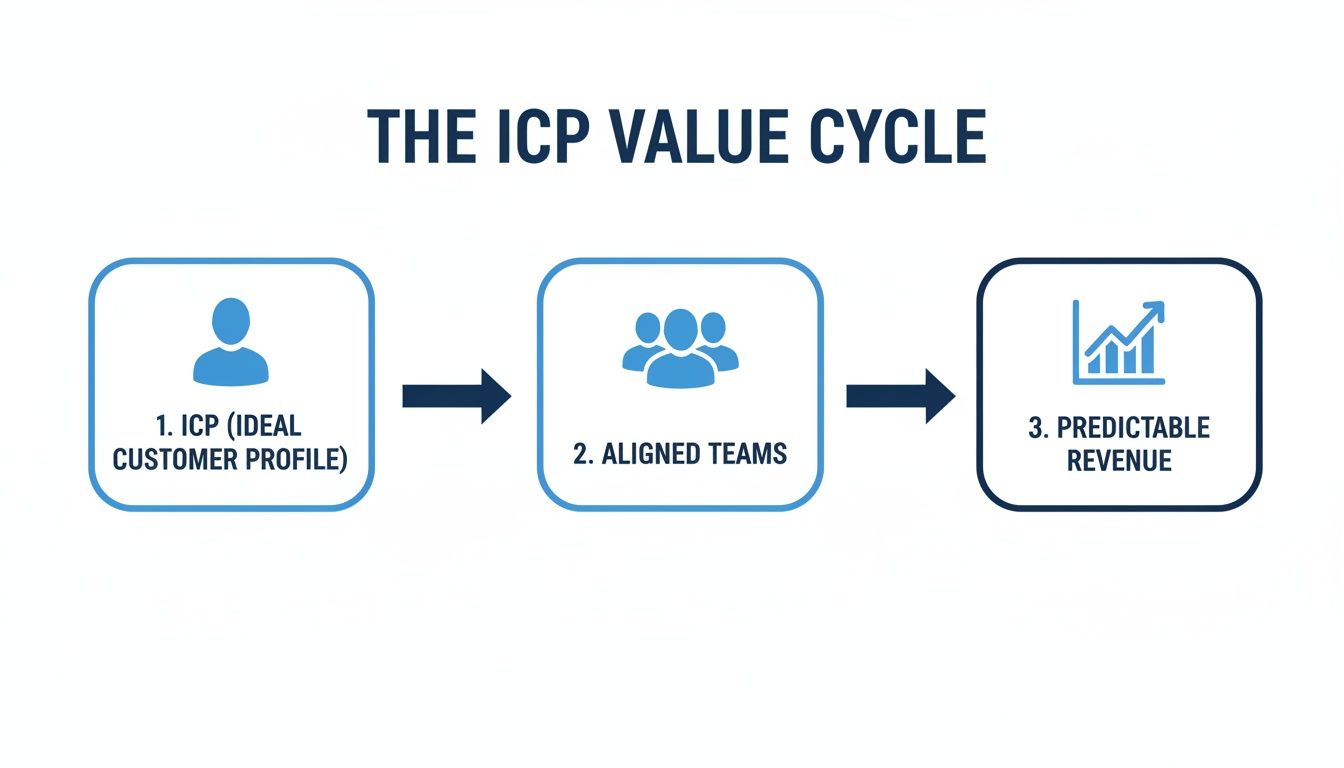
This simple cycle shows that everything starts with knowing exactly who you're trying to reach.
Synthesize and Document Your ICP
The final step is to pull all your findings together into a single, easy-to-read document. This one-pager becomes your North Star for every marketing and sales decision you make. It needs to be clear, concise, and simple enough for anyone in the company to pick up and use immediately.
Your ICP document isn’t just a marketing asset; it’s a company-wide alignment tool. It ensures everyone—from sales and marketing to product and customer success—is focused on attracting and serving the same high-value customer.
Your final ICP should be a summary of the patterns you uncovered. For example: "Our ICP is a B2B SaaS company with 50-250 employees in the fintech industry, located in North America, that uses Salesforce as its CRM. They are typically trying to solve the problem of poor lead quality and are motivated by achieving measurable marketing ROI."
Validating and Refining Your ICP with Data
Here’s the thing about your first Ideal Customer Profile: it’s a hypothesis. A really good, educated guess, but a guess nonetheless. Markets change, your product gets better, and your customers' needs shift. If you want your ICP to stay sharp, you have to treat it like a living document—one that you’re constantly testing against real-world data.
This whole process kicks off by measuring whether your ICP is actually working. Are the leads who fit your profile performing better than everyone else? Don't just assume they are—prove it. A simple A/B test is a great place to start. Pit a campaign with messaging aimed squarely at your ICP against a broader, more generic one. Then, watch the metrics like open rates, click-throughs, and conversions to see which one comes out on top.
Tracking Performance and Gathering Feedback
Campaign stats are just the beginning. The real proof is in the pudding when you look at the entire customer journey. The true value of your ICP shines through when you compare the KPIs of ICP-fit leads against those who don't fit the mold.
You'll want to zoom in on the metrics that really matter to the business:
- Lead-to-Close Rate: Are your ideal leads turning into paying customers more often?
- Sales Cycle Length: Is it taking less time to get a deal signed with these accounts?
- Customer Acquisition Cost (CAC): Is it cheaper to bring on customers who match your profile?
- Customer Lifetime Value (LTV): Are these the customers who stick around and generate more revenue over the long haul?
An ICP is only as good as the results it drives. If your data shows that "ideal" customers have shorter sales cycles and 2x higher LTV, your profile is working. If not, it's a signal that your hypothesis needs adjustment.
This is how you turn your ICP from a wish list into a model based on what actually drives revenue. But numbers alone don't tell the whole story. To get the full picture, you need to mix that quantitative data with some good old-fashioned human insight.
Creating a Tight Feedback Loop
Often, the most valuable intel comes straight from the trenches. Your sales and customer success teams are on the front lines every single day, talking to prospects and customers. They hear all about new pain points, what competitors are up to, and how priorities are changing on the ground.
Set up a real feedback loop between marketing, sales, and success. This isn't just another meeting for the sake of it—it's a focused sync-up on ICP performance. Sales can tell you if the leads marketing is sending over are actually any good. Success can share which types of customers are crushing it with your product and which ones are struggling. This qualitative feedback is the "why" behind the numbers you’re seeing.
By the way, if you’re finding it tough to keep your contact data clean enough for these feedback loops, looking into data enrichment services can give you a serious leg up.
This constant cycle of testing, measuring, and talking to your team is what keeps your understanding of what an ICP in marketing is sharp, accurate, and tied directly to business results.
Common Mistakes to Avoid When Creating Your ICP
Building an Ideal Customer Profile is a game-changer, but it's easy to get it wrong. A few common missteps can turn what should be a strategic roadmap into a document that just collects digital dust. Knowing these pitfalls is the first step to creating an ICP that actually works.
Honestly, a bad ICP is worse than no ICP at all. A flawed profile actively sends your sales and marketing teams down the wrong path, wasting time and money.
One of the biggest mistakes is creating the ICP in a vacuum. When marketing builds the profile alone, it’s all theory. You miss out on the boots-on-the-ground insights from your sales and customer success teams—the people who know what’s really happening.
Another classic error is relying on gut feelings instead of data. Your intuition is a great place to start, but it's not a strategy. An effective ICP is built on a hard look at your best customers, not who you wish they were. Without data, your ICP is just a wish list.
Making Your Profile Too Vague
A profile that’s too broad is useless. Saying your ICP is "all tech companies" or "any business that needs marketing" is like having no profile at all. The whole point of an ICP is to focus your efforts with laser precision.
When a profile lacks specifics, your teams are left guessing. How can a salesperson prioritize leads if every company seems like a fit? How can a marketer write a message that lands when the audience is "everyone"?
What to do instead: Get brutally specific. Define firmographics like company size (100-500 employees) and revenue, technographics (using Salesforce), and the real-world problems they have, like struggling with lead quality. A great ICP sounds like: "Series B fintech companies with 100-500 employees using Salesforce who are frustrated with low-quality leads."
Forgetting to Involve Your Sales Team
Your sales team is in the trenches every single day. They know which pain points actually get a response, what objections pop up constantly, and what separates a genuinely qualified lead from a tire-kicker. Ignoring them is a massive missed opportunity.
If sales isn't part of the creation process, they won't trust the ICP. You'll get friction between marketing and sales, and your shiny new profile will be ignored.
- What to do instead: Make your sales and customer success teams co-authors of the ICP. They should have just as much say as marketing.
- Run workshops where sales can break down their best and worst deals.
- Ask them to list the common traits of customers who close fast and have a high LTV.
- Use their direct feedback to either confirm or challenge the data you've gathered.
By turning these common mistakes into learning opportunities, you can build a resilient, data-driven ICP that acts as a true North Star for your entire company. This collaborative, specific, and data-backed approach ensures every effort is focused on attracting and keeping the customers who will actually grow your business.
Activating Your ICP for B2B Newsletter Growth
This is where the rubber meets the road. All the work you’ve done defining what an ICP in marketing is goes from theory to real, measurable results. A razor-sharp Ideal Customer Profile is the single best tool for growing a high-value B2B newsletter.
It’s how you turn a simple content channel into a powerful engine for winning new customers.
Instead of chasing vanity metrics like subscriber count, you can get laser-focused on attracting the exact people who will one day become your best clients. Your ICP is the blueprint for finding them, shifting your entire newsletter from a volume game to a strategic asset.
From Broad Audience to Exact Subscriber
Imagine you want to attract VPs of Sales at Series B fintech companies that use Salesforce. A generic newsletter on "sales tips" is far too broad and will just get lost in the noise.
But with a well-defined ICP, you can build a newsletter specifically for them.
This kind of precision lets you:
- Create hyper-relevant content: You can tackle the specific challenges and ambitions of your ICP. Think topics like, "How to Scale a Sales Team After Your Series B."
- Target your acquisition efforts: Use a platform like Breaker to find and attract subscribers who fit your ICP criteria, right down to their job title and the tech they use.
- Speak their language: Your copy and content will resonate because it’s built on a deep understanding of their world, not on generic business platitudes.
This targeted approach transforms your newsletter into a magnet for qualified prospects. Because the content is made just for them, they are far more likely to subscribe, stay engaged, and view you as a trusted authority. You can learn more about how this works in our guide on how ABM email targeting boosts lead quality.
The result is a direct line from your content straight to revenue. When you attract ICP-fit subscribers, you see higher open rates, deeper engagement, and a list full of future customers who are already pre-qualified by the content they choose to read.
Frequently Asked Questions About Ideal Customer Profiles
As you start to build out your own ICP, a few common questions always seem to pop up. Let's tackle them head-on so you can move forward with clarity.
How Is an ICP Different From a Target Market?
Think of it like this: your target market is the entire city you're operating in. It’s broad—maybe "B2B SaaS companies in North America." It gives you a general direction, but it's not specific enough to act on.
An Ideal Customer Profile, on the other hand, is a specific street address within that city. It's razor-sharp: "B2B SaaS companies with 50-250 employees, $10M-$50M in revenue, using Salesforce, and openly complaining about poor lead quality on LinkedIn." One gives you a map; the other gives you a destination.
How Many ICPs Should a Business Have?
For most startups and small businesses, the answer is refreshingly simple: start with one. Pouring all your energy into a single, perfectly defined ICP is the fastest way to nail your messaging, find product-market fit, and build real momentum.
Down the road, as you launch new products or expand into different verticals, you can absolutely add more. The key is to only create a new profile when you have the resources to serve it just as well as your first one, without watering down your focus.
How Often Should I Update My ICP?
Your ICP is a living document, not something you carve in stone and forget about. Markets change, your product gets better, and your customers' needs evolve right along with them.
As a rule of thumb, plan to formally review and tweak your ICP every 6 to 12 months. But stay on your toes—if you notice a big shift in your business, like a sudden drop in win rates or a new type of customer consistently closing, that's your signal to revisit it sooner.
Ready to stop guessing and start growing your newsletter with subscribers who actually fit your ICP? Breaker combines an intuitive email platform with a powerful targeting engine to deliver engaged, exact-match B2B subscribers directly to your list. Start your 7-day trial and see the difference.
Keep reading
All articlesNewsletter Agency Services: How Agencies Scale Client Newsletters
Managing multiple client newsletters? Learn what a true newsletter agency platform needs to prevent list mixing, voice drift, and invisible ROI.
Building Owned Audiences: Move Followers to Your Newsletter in 2026
Social platforms can vanish overnight. Learn how to convert Instagram, TikTok, and YouTube followers into a newsletter list you actually own.
Newsletter Analytics: Which Metrics Actually Matter in 2026
Open rate and clicks don't predict buyers. Learn the 7-step method to track click depth, recency, and topic affinity for a revenue-predictive intent score.