
How to Make Digital Products: A B2B Playbook for 2026
Learn how to make digital products that sell. Our step-by-step playbook covers ideation, validation, building, and monetizing for B2B growth teams and creators.
You already have the raw ingredients.
Maybe it's a B2B newsletter with steady opens. Maybe it's a consulting pipeline full of repeating questions. Maybe your sales team keeps sending the same one-pager, template, or teardown to prospects because it helps deals move forward. The problem isn't audience attention. The problem is that attention hasn't been turned into an asset people can buy, use, or share.
That's where many teams stall. They brainstorm ebooks, courses, prompt packs, calculators, or lightweight tools without first deciding what business outcome the product should create. A better approach starts with a narrower question: what specific result will a buyer pay to get faster, cheaper, or with less risk? Once you answer that, making a digital product becomes a packaging and validation problem, not a creativity problem.
From Audience to Asset Why Digital Products Matter Now
If you're sitting on audience trust but no product, you're leaving value trapped in content. A digital product gives that trust a structure. It can become a lead qualifier, a revenue stream, a sales enablement asset, or the entry point into a larger service or software offer. For blog-led audiences, our guide on making money blogging shows where products sit next to ads, affiliates, and sponsorships.
That matters because digital buying behavior is already mainstream. The digital product market was estimated to generate more than $2.5 trillion in annual value by 2025, internet users spent over $560 billion on digital media in 2024, and 68% of internet users aged 16+ paid for digital content monthly, according to Whop's digital product statistics. This is no longer a niche creator economy side lane. Buyers are used to paying for digital value.

Start with a commercial use case
In B2B, the strongest digital products usually do one of four jobs:
- Generate qualified demand by attracting buyers with a useful, outcome-specific asset
- Shorten the sales cycle by helping prospects understand a complex problem
- Create standalone revenue through paid templates, reports, tools, or training
- Build authority so your company becomes the obvious choice in a crowded category
A generic “lead magnet” rarely pulls its weight. A focused product does. A messaging framework for one buyer segment, a reporting template tied to one workflow, or a training asset that helps one team complete one task is much easier to sell than broad education.
Audience fit comes before product format
Before you choose whether the asset is a guide, dashboard, workbook, or mini-tool, define exactly who it serves. If your team hasn't done that rigorously, use a framework to develop an effective B2B ICP before building anything. Product quality can't rescue weak audience targeting.
Practical rule: Don't ask, “What digital product should we make?” Ask, “What repeatable buyer problem are we already close enough to solve?”
This also changes how you think about monetization. Teams often treat products, content, and acquisition as separate functions. They aren't. They sit on the same system buyers already use online. If you want a sharper view of the economics behind that system, this breakdown of how internet sites make money is useful because it frames digital assets as monetizable infrastructure, not just content pieces.
Find Problems Worth Solving Not Just Ideas to Build
Most weak digital products start life as internal enthusiasm. Someone says, “We should turn this into a course,” or “Let's package our process into a playbook.” That's backwards. The market doesn't pay for your effort. It pays for relief, speed, clarity, and reduced risk.
A better method is to treat product discovery like intelligence gathering. You're looking for repeated friction, especially the kind buyers already patch with spreadsheets, repeated Slack messages, manual workarounds, or inconsistent SOPs.
Mine the places where pain already shows up
Start with sources closest to revenue:
- Support tickets: Look for recurring confusion, implementation bottlenecks, and “how do I” requests.
- Sales call notes: Pay attention to objections, stalled approvals, and repeated requests for examples.
- Customer success conversations: These reveal what buyers struggle to operationalize after purchase.
- Lost deal reasons: Some losses point to gaps that a digital product can solve before the next sales conversation.
- Community threads and niche forums: Search for complaint language, not just interest language.
- Review sites and marketplace comments: Repeated dissatisfaction often points to unmet needs.
- Internal documents people keep reusing: If the same checklist or worksheet gets shared over and over, that's often a latent product.
One practical shortcut is to look at operational categories where teams already want to optimize. Collections of real-world AI automation examples can help you spot where manual work, repetitive decisions, and handoff friction already exist. Don't copy the examples. Use them to identify expensive workflows with obvious pain.
Score problems before you name solutions
Once you collect a list, don't jump straight into building. Score each problem using decision criteria your team can act on.
Criteria
What to look for
Frequency
Does this problem come up repeatedly across calls, tickets, or content replies?
Urgency
Is the pain immediate, or is it a “nice to fix later” issue?
Economic value
Does solving it help the buyer save time, reduce risk, close deals, or improve execution?
Specificity
Can you describe the buyer, context, and desired outcome clearly?
Current workaround
Are people already using clumsy substitutes like docs, sheets, or manual processes?
Problems with vague language usually fail this test. “People need better strategy” is not a product brief. “Series A SaaS marketing teams need a reusable customer interview analysis template before repositioning a homepage” is much closer.
Repeated pain beats clever ideas. If buyers keep describing the same failure point in their own words, you're getting a product signal.
Use ICP language, not internal language
Many B2B teams often overlook a key element. They package offers around what they do internally instead of what the buyer is trying to accomplish. A prospect doesn't wake up wanting your framework. They want a cleaner handoff, a faster launch, a more credible board deck, a better onboarding sequence, or a tighter outbound system.
If your team needs a sharper lens for that, reviewing a practical definition of what an ideal customer profile is can help align pain, buyer type, and product packaging before the work starts.
Validate Demand Before You Write a Single Line of Code
Validation is not optional. It's the gate that prevents your team from spending weeks building something buyers politely praise and never purchase.
This matters even more now because product creation is easier than it used to be. AI can help draft, design, outline, and prototype faster, which sounds productive until it enables a team to ship the wrong product at higher speed. The overlooked discipline is proving buyers will pay before production begins. Recent guidance on niche selection stresses detecting repeated unmet needs in reviews, forums, and search data before building, especially because easier creation increases the risk of weak market fit, as discussed in MyDesigns' guide to choosing the right digital product niche.
What validation actually means
Validation isn't asking, “Would you use this?”
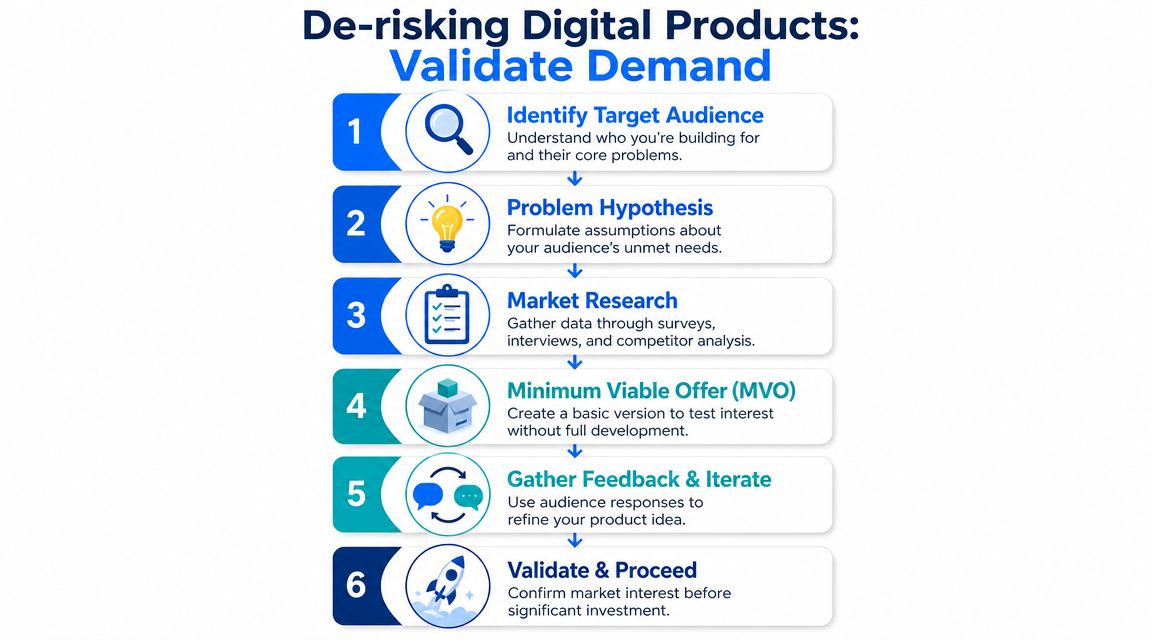
People say yes to almost anything that sounds useful. Validation means measuring behavior that creates commitment. In practice, that can be a pre-order, a waitlist signup from the right audience, a booked call tied to the offer, or a prototype test where users complete the core task without handholding.
Use a simple sequence:
- State the problem clearly
Write a one-sentence problem hypothesis. Name the buyer, the pain, and the desired result.
- Create a minimum viable offer
This isn't the product. It's the promise. A landing page, one email, a short loom walkthrough, or a checkout page with a concise offer can do the job.
- Ask for commitment
Add a real next step. That could be “buy now,” “reserve access,” “apply,” or “join the pilot.”
- Collect objection data
If people click but don't convert, ask why. Price? Timing? Trust? Missing features? Wrong audience?
- Decide go, revise, or kill
Don't interpret weak interest as a cue to build more. Weak interest often means the offer isn't sharp enough or the problem isn't painful enough.
Low-cost tests that reveal real demand
A strong validation stack usually includes several small experiments rather than one big bet.
- Smoke test page: Publish the offer before the finished product exists. Measure intent.
- Pre-sell campaign: Sell limited access or founding-user access before full production.
- Audience poll: Useful for segmentation, not final proof. Ask about current workflows and blockers.
- Prototype walkthrough: Show the logic of the solution with a Figma flow, Notion mockup, or sample deliverable.
- Problem interview: Ask buyers how they solve the problem now and what breaks in the current process.
If the only evidence you have is positive feedback, you do not have validation. You have compliments.
What teams usually get wrong
The common failure pattern is easy to recognize. The team builds too much, tests too late, and hears criticism only after sunk cost makes change politically difficult.
Watch for these signs:
- You're debating features before proving the offer
- The landing page describes the asset, not the outcome
- The audience is broad because narrowing feels risky
- Feedback comes from peers, not buyers
- You're tracking interest but not commitment
When people ask how to make digital products profitably, this is the missing piece. The winning teams don't start with production. They start with a falsifiable commercial hypothesis.
Choose Your Format Build and Package for Value
Once the problem is validated, format becomes a strategic decision. The right format isn't the one your team feels like making. It's the one that gets the buyer to the promised outcome with the least friction.
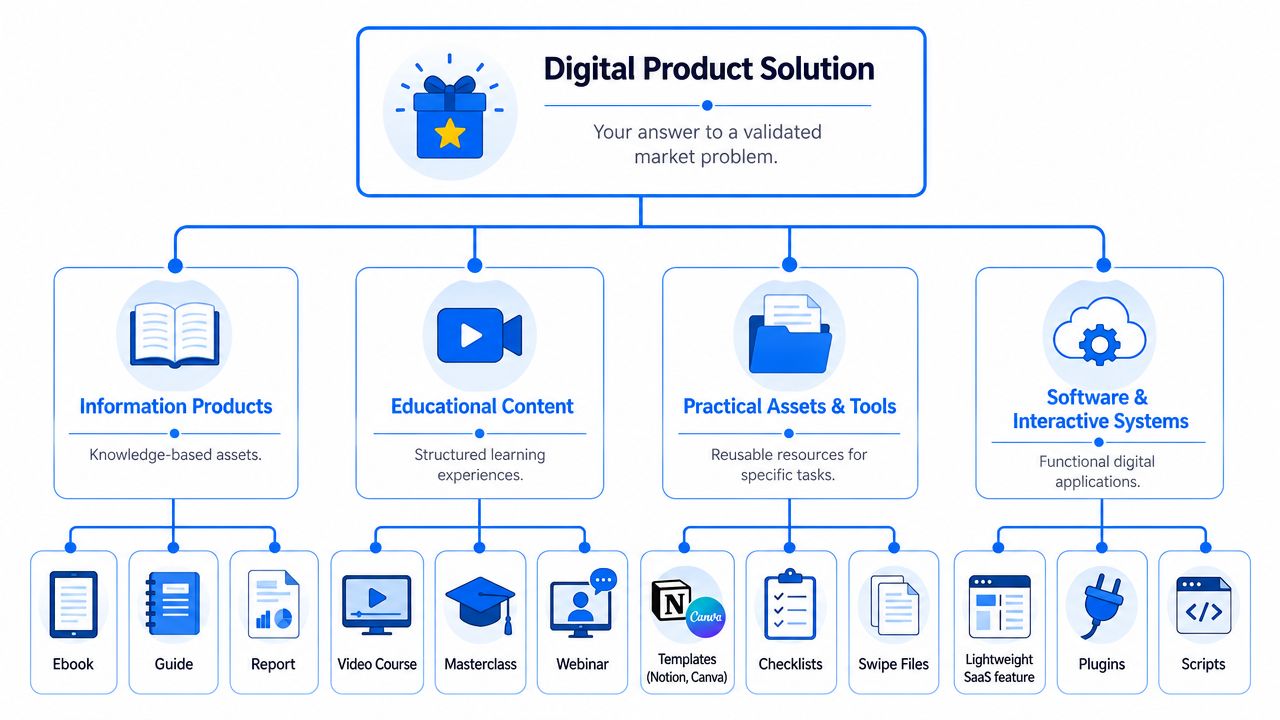
That means you should package around time-to-value, not around content volume. A buyer who needs a faster quarterly planning process probably wants a template, worksheet, or dashboard before they want a long video course. A buyer navigating a complex category decision may need a short advisory report before they need software.
Match the format to the buyer job
Use this comparison when choosing what to build:
Format
Best use case
Weakness
Guide or report
Clarifying a problem, framing a decision, building authority
Often low implementation value on its own
Template pack
Helping buyers execute a repeatable task quickly
Can feel generic if not tailored to a narrow workflow
Workshop or mini-course
Teaching a process that needs explanation and examples
Slower time-to-value for buyers who want immediate output
Checklist or swipe file
Reducing friction in a specific repeated activity
Easy to commoditize if the promise is broad
Lightweight tool or calculator
Delivering instant utility or diagnosis
Requires clearer scoping and stronger maintenance discipline
Subscription resource
Serving ongoing needs with updates or recurring deliverables
Demands a repeatable publishing and support rhythm
A good packaging question is: what does the buyer need right after purchase? If the answer is “a result they can use today,” lean toward templates, tools, calculators, and implementation assets. If the answer is “a better decision,” a report, teardown, or guided framework may be enough.
Build in stages or you'll overbuild
The teams that make useful digital products consistently don't jump from idea to polished release. They use a staged process. Prophet describes a six-phase pipeline of Opportunity Definition, Rapid Experience Design, Alpha, Beta, Core, and Retirement in its guide to digital product creation. The underlying point is practical: define the problem, test the interaction, validate usability, then scale.
That sequence matters because many teams treat the product as just the interface. It isn't. The offer also includes positioning, onboarding, support, delivery, and the internal process required to keep it useful.
Here's a workable translation for a B2B growth team:
- Opportunity Definition
Write the problem, buyer, and commercial use case. Be explicit about what the product must change for the customer.
- Rapid Experience Design
Sketch the shortest path from purchase to first value. Use docs, wireframes, sample outputs, or a Notion prototype.
- Alpha
Put the rough version in front of a small set of target users. Watch where they get stuck.
- Beta
Tighten copy, structure, onboarding, and delivery. Validate that users can get the promised result without your live intervention.
- Core
Publish the stable version with clear positioning, support expectations, and a repeatable acquisition path.
Packaging is part of the product
Names, visuals, and copy aren't decoration. They determine whether buyers understand the offer fast enough to act.
Good packaging usually has three parts:
- A narrow promise
“Template library for B2B growth” is weak. “Board-ready monthly growth reporting template for seed to Series A SaaS teams” is stronger.
- A clear mechanism
Buyers should understand what they are getting. Framework, dashboard, audit kit, operator workbook, or rollout playbook are more concrete than “resources.”
- Fast proof of fit
Use screenshots, sample pages, short demos, or a before-and-after workflow explanation.
This video is useful if you want a visual primer on product structure and format decisions.
One practical note on tools: if you're outlining a digital product and need help structuring modules, format, and pricing logic, Breaker includes an AI workflow that generates a digital product outline from user inputs. Used well, that can speed up early packaging work. It shouldn't replace validation or positioning.
Develop Your Pricing and Go-to-Market Strategy
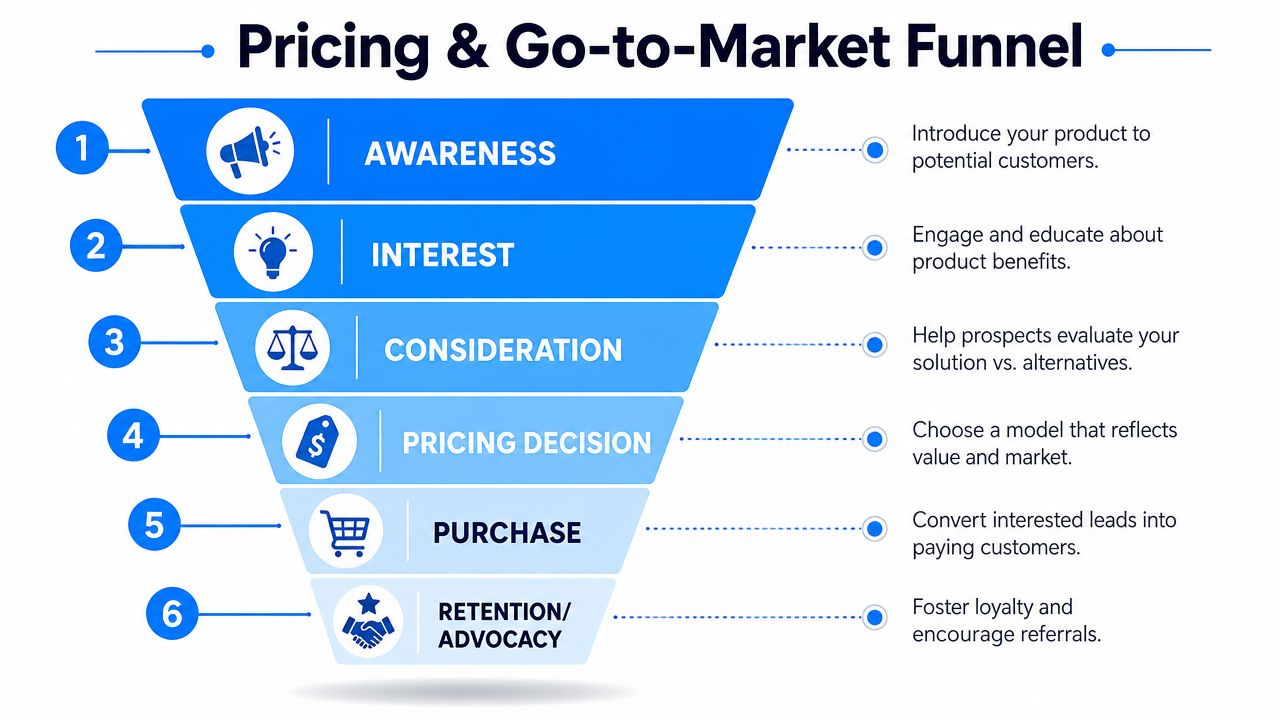
Pricing is where a lot of promising digital products get exposed. If the offer is vague, pricing feels arbitrary. If the promise is specific, pricing becomes easier because the buyer can compare price against an expected result.
The wrong move is to price from effort. Buyers don't care how long it took your team to produce a workbook, dashboard, or course. They care whether it helps them make money, save time, reduce risk, or avoid expensive mistakes.
Choose a pricing model that fits the buying logic
Different digital products call for different commercial structures.
Pricing model
Works best when
Trade-off
One-time purchase
The product solves a bounded problem with clear delivery
Revenue is less predictable unless acquisition stays strong
Tiered pricing
Buyers differ in complexity, team size, or support needs
Requires sharper packaging and clearer boundaries
Subscription
The product needs updates, recurring insights, or ongoing access
Retention becomes as important as acquisition
Pilot or cohort pricing
You're validating demand with higher-touch delivery
Harder to scale if manual support stays attached
For B2B teams, one-time pricing works well for templates, playbooks, and tactical toolkits. Tiered offers make sense when some buyers only need the asset while others need implementation support, licenses, or add-ons. Subscription works when the product changes often enough that ongoing access feels rational, not forced.
Launch like an operator, not a creator
The launch is not the finish line. It's the first full test of your message, channel mix, pricing, and onboarding. Product design guidance from Q Agency recommends a sequence of research, prototyping, user feedback, development handoff, QA, launch, and iteration, with measurable success criteria at each step, as described in its digital product design process guide.
That advice is easy to miss because teams often treat launch as a date. It's better treated as a loop.
Operating principle: A launch should answer questions. Which message pulls qualified buyers? Which objections block purchase? Which buyers activate fastest after purchase?
A practical go-to-market sequence looks like this:
- Warm the market early
Publish problem-led content before the offer goes live. Teach the pain, not just the product.
- Segment your audience
Don't send the same launch message to everyone. Existing customers, newsletter readers, and sales-qualified leads need different angles.
- Use proof before polish
Show sample outputs, walkthroughs, or a product preview. Buyers need evidence of utility.
- Reduce checkout friction
Keep the buying path short. Long forms and vague package descriptions kill intent.
- Instrument post-purchase behavior
Track what buyers do after purchase. Activation signals matter more than applause.
Review after launch with hard questions
A weak launch doesn't always mean bad product. It may mean weak positioning, mispriced packaging, poor audience fit, or a mismatch between format and urgency.
Run a post-launch review around these questions:
- Did the right audience click?
- Did they understand the promise quickly?
- Did pricing fit the perceived value?
- Did buyers reach first value without extra support?
- What objections showed up repeatedly?
Teams improve their ability to create digital products that earn. They stop evaluating success by whether the product shipped and start evaluating whether the system converted, activated, and retained the right buyers.
Beyond the Launch Turn Your Product into a System
A one-off product can create a spike. A system creates compounding returns.
The shift happens when you stop treating the product as a campaign and start treating it as part of your operating model. Your newsletter, content engine, sales conversations, and product feedback loop should all feed the same asset. Every repeated customer question becomes research. Every launch becomes a refinement cycle. Every support conversation can improve onboarding, copy, or packaging.
Build the evergreen engine
An evergreen digital product system usually includes:
- A steady acquisition channel such as newsletter content, SEO pages, partner distribution, or webinars
- A conversion asset like a product page, preview, case walkthrough, or email sequence
- An activation path that gets buyers to value fast
- A feedback loop that informs updates, expansions, and new offers
If your team needs a practical checklist for release mechanics, an effective product launch plan can help operationalize the handoffs around launch, follow-up, and post-release review.
Use the product to strengthen the business
The highest-value digital products rarely live in isolation. They support a broader commercial strategy.
A focused product can qualify leads before a sales call. It can prepare buyers for a higher-ticket engagement. It can create recurring touchpoints with customers who aren't ready for your main offer yet. It can also support a product-led growth motion by giving prospects a lower-friction way to experience your thinking before they buy software or services.
That's why it helps to think in systems, not assets. The strongest teams connect product creation to distribution, monetization, and account expansion. If that's your model, this perspective on product-led growth strategy is useful because it ties user value, adoption, and commercial design into one motion.
The durable advantage isn't one digital product. It's the ability to repeatedly identify buyer pain, package a narrow outcome, validate demand, and launch with a feedback loop already in place.
When you work this way, product creation stops feeling speculative. It becomes a repeatable B2B growth discipline.
Breaker helps B2B teams turn newsletter attention into a growth system. If you want a platform that combines email campaigns, audience growth, ICP-based targeting, and built-in analytics in one place, explore Breaker.
Keep reading
All articlesNewsletter Segmentation Strategy: Increase Engagement in 2026
Build a data-driven newsletter segmentation strategy using behavior, intent score, and topic affinity to lift opens and clicks. Step-by-step guide.
How to Grow Newsletter Subscribers with Qualified Leads in 2026
Discover 8 channels to grow engaged newsletter subscribers in 2026, with real cost-per-engaged-subscriber data to focus your list-building strategy.
B2B Lead Generation via Newsletter: What Actually Works
Cold outbound is losing steam. See 7 proven newsletter tactics for B2B lead generation, from gated content to sponsorship swaps, that beat cold outreach.