
Affiliate Marketing Email Marketing: A B2B Growth Guide
Learn how to integrate affiliate marketing email marketing into your B2B newsletter. This guide covers strategy, setup, compliance, and optimization for growth.
Your B2B newsletter is probably in a familiar spot right now. The audience is solid, replies are healthy, and people clearly trust your recommendations. But monetization still feels constrained. You can sell your own product, run sponsorships, or leave that trust unused. A lot of teams stop there because affiliate email sounds like the fastest way to turn a useful newsletter into a low-grade promo channel.
That concern is valid.
I've seen affiliate programs work inside B2B newsletters only when they're treated like a product system, not a side hustle. The bad version is random links, generic offers, and short-term commission chasing. The workable version is narrower. You recommend tools your audience already needs, sequence promotion after value, track downstream list impact, and protect sender reputation like it's part of revenue, because it is. For the full operating playbook, from list building to deliverability, see our guide to email marketing for affiliates.
The Power of Integrating Affiliate and Email Marketing
A B2B operator opens your newsletter looking for a practical fix. Maybe they need a cleaner handoff from lead capture to sales, or a faster way to route inbound demand. If the email helps them solve that problem and points them to a tool that fits the workflow, affiliate revenue feels earned. If the recommendation is off-target, the click might still come through, but trust drops first and revenue usually follows.
That is why affiliate marketing and email work well together. Email gives you repeat access to a permission-based audience you already understand. Affiliate partnerships let you monetize adjacent products without forcing your team to build a full software stack around every problem your readers face.
In B2B, that matters because buyers rarely need one tool. They need a working system. A newsletter that teaches process can monetize responsibly by recommending products that help readers implement the process. A piece on lead routing can naturally point to B2B marketing automation workflows. A post about list growth can reference no-code newsletter templates if the reader is still setting up acquisition.
Why B2B newsletters fit this model
B2B purchase paths are messy, multi-tool, and spread across teams. Readers often arrive with one problem and discover three dependencies behind it. That makes newsletters a strong environment for affiliate offers, because the recommendation can sit inside an existing educational context instead of interrupting it.
The standard is simple.
If the product helps the reader apply what you just taught, it can belong in the email.
That is a higher bar than “the commission is good,” and it should be. In my experience, affiliate revenue inside a B2B newsletter holds up only when the offer improves the outcome of the content itself. The email is doing two jobs at once. It is teaching and pre-qualifying. When those stay aligned, conversions are cleaner and unsubscribes stay under control.
Where affiliate email programs break down
I've seen affiliate email programs fail for a few predictable reasons:
- Partner selection based on payout size, not audience fit
- Promotional frequency that outruns trust
- Broad sends for narrow use cases
- Reporting that celebrates clicks but ignores unsubscribes, complaints, and reply quality
Those are operating mistakes, not channel problems.
A B2B audience can usually tell whether a recommendation came from actual product judgment or from a quarterly revenue target. Once that judgment looks weak, future offers get harder to convert, even the good ones. That is the true power of integrating affiliate and email marketing correctly. You are not just inserting monetized links into a newsletter. You are building a repeatable revenue layer on top of audience trust, and that only works if list health and recommendation quality stay ahead of short-term commission goals.
Building a Sustainable Affiliate Email Strategy
Most affiliate revenue problems start before the first send. The issue usually isn't copy. It's partner fit, payout design, and audience tolerance. If you solve those three, execution gets much easier.
Email remains a strong monetization channel for affiliate programs. One 2025 benchmark reports $42 returned for every $1 spent, and 22.8% of affiliate marketers use email marketing to drive campaign traffic, according to Post Affiliate Pro's ROI overview. That doesn't mean every B2B newsletter should push affiliate offers aggressively. It means the channel is established enough to deserve a real operating model.
Pick partners your readers would thank you for
I use a simple filter for B2B affiliate partners. If I wouldn't introduce the product on a call with a customer, I won't put it in the newsletter.
Good affiliate partners usually fit one of these categories:
- Workflow extension where the product helps the reader implement something you've already taught
- Stack adjacency where the tool complements a platform your audience already uses
- Operational shortcut where the product removes a painful manual step
- Budget bridge where the offer is a practical option for teams not ready for enterprise software
Poor partner fit shows up fast. Readers ignore the email, reply with confusion, or engage with the content but not the offer. That's useful feedback. It usually means the product belongs to a different audience segment, or nowhere in your program at all.
Choose the payout model based on risk, not hype
B2B teams often default to whichever payout sounds largest. That's backwards. The right model depends on how much control you have over intent, handoff quality, and sales cycle length.
Model
Best For
Typical Payout
Risk Profile
CPA
Offers with a clear purchase action and short path to conversion
Fixed commission per sale
Lower ambiguity, but depends on partner conversion quality
CPL
High-intent lead generation where the partner values qualified signups or demos
Fixed commission per qualified lead
Medium risk because lead qualification can get disputed
Revenue share
Subscription products and tools with expansion potential
Ongoing share of customer revenue
Higher upside, slower feedback loop, more dependency on retention
In B2B newsletters, I usually prefer simple economics at the start. Fixed payouts are easier to audit. Revenue share gets attractive once you trust the partner's reporting and know your audience stays with the product.
Build the system before the campaign
Before you promote anything, get the plumbing in place. That includes signup paths, tagging, consent, and a clear entry point into your email flow. If you're still stitching forms together manually, it's worth starting with no-code newsletter templates so your acquisition layer doesn't slow down testing.
For teams building broader lifecycle programs around affiliate traffic and newsletter monetization, this guide to B2B marketing automation systems is a useful reference point. The affiliate layer works better when it's plugged into a real automation setup instead of isolated blasts.
Sustainable affiliate revenue comes from consistency. One relevant partner promoted carefully will outperform a rotating parade of mismatched offers.
Set your boundaries early
Before launch, define a few rules:
- Promotion threshold so your newsletter doesn't drift into ad inventory
- Audience fit standard so every offer solves a known problem
- Exit criteria for partners that create complaints, confusion, or list fatigue
- Measurement window long enough to judge quality, not just immediate click activity
A lot of teams mature at this point. They stop asking, "How much can this offer pay?" and start asking, "What does this do to list quality over the next quarter?"
Executing Your First Affiliate Campaign
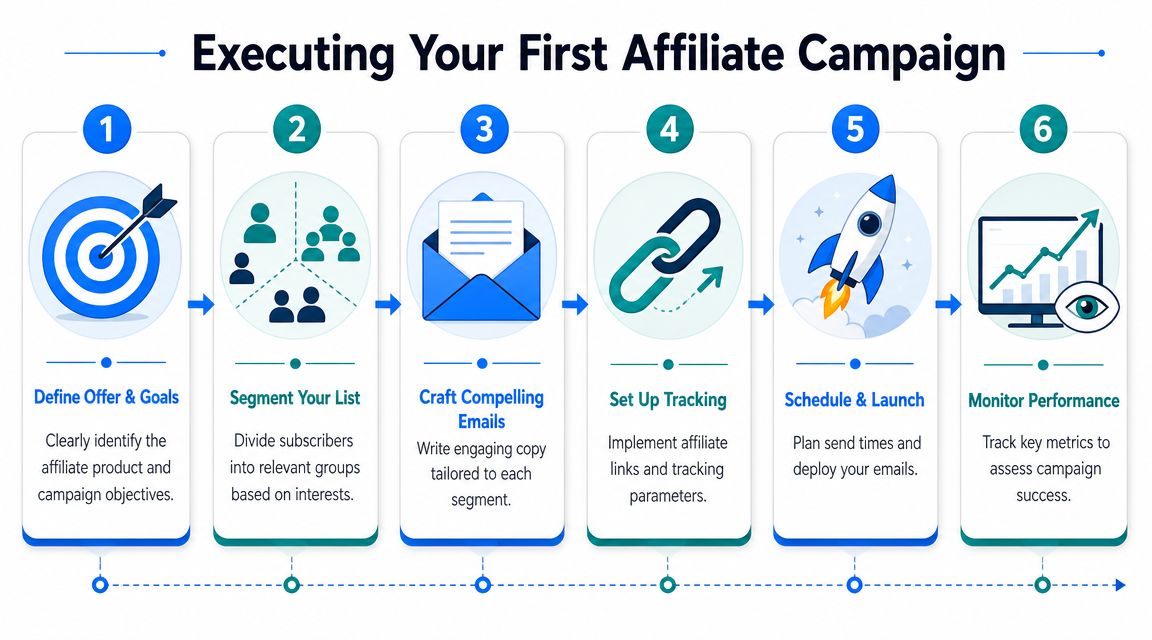
The first campaign should be boring on purpose. One offer. One audience segment. One clear problem. One tracking setup you can verify without guessing. That's how you learn what your list will tolerate and what it will reward.
Start with segmentation, not creative
Most newsletter teams over-focus on the email copy and under-focus on who should receive it. In B2B, segmentation usually matters more than persuasion. A strong offer sent to the wrong readers still underperforms.
Useful segments for an affiliate campaign include:
- Topic-based readers who consistently click content in one category
- Lifecycle stage such as new subscribers versus long-term readers
- Role-based groups like founders, operators, marketers, or RevOps teams
- Product interest signals drawn from prior link clicks or form submissions
If you don't have deep behavioral data yet, start simple. Use the content source that drove the signup or the newsletter category they engaged with most recently. That's enough to avoid blasting everyone with the same recommendation.
Use a value-first welcome sequence
One of the cleanest structures for affiliate email campaigns is a 3-step welcome automation. The sequence is straightforward: email one delivers the lead magnet, email two builds trust through story or positioning, and email three bridges into the affiliate offer, based on the recommended setup described in this walkthrough.
That structure works because it mirrors how trust forms in B2B inboxes. People don't need the offer first. They need context first.
A practical version looks like this:
- Email one delivers the promised asset, resource, checklist, or template
- Email two explains the problem in operational terms and shows your point of view
- Email three introduces the tool or service that helps the reader implement the advice
Decide between dedicated sends and integrated placements
There are two reliable ways to launch an affiliate offer in a newsletter program.
Integrated placement means the recommendation lives inside a standard newsletter edition. This works well when the offer naturally supports the main topic.
Dedicated send means the whole email centers on one problem and one recommended product. This works better when the tool needs explanation, comparison, or stronger narrative framing.
I usually start with integrated placements for an existing audience and use dedicated sends only when I know the segment has enough intent to justify the extra promotional weight.
Treat your first campaign like a diagnostic. You aren't just testing an offer. You're testing audience fit, trust elasticity, and whether your newsletter can monetize without changing its tone.
Keep the mechanics clean
Execution breaks when links, tags, and naming conventions get messy. Use one naming system for campaigns and one place to log where each affiliate link appears. If the same offer runs in a welcome flow, newsletter placement, and dedicated send, label those separately from day one.
That discipline matters later when the commission data comes in and you need to answer a simple question: which email did the work?
Writing Affiliate Copy That Converts
Affiliate copy lives or dies on credibility. In B2B, readers aren't looking for hype. They're looking for judgment. They want to know why this tool, why now, and why they should trust your recommendation instead of opening another tab and doing the research themselves.

The easiest way to damage that trust is to write affiliate emails like ads. Generic praise, feature dumping, and vague outcomes all signal the same thing. The sender is trying to monetize attention, not help the reader make a decision.
Write from the problem backward
Strong affiliate copy starts with a work problem the reader already recognizes. Not "here's a great platform." More like, "if your team is still reconciling lead sources manually every week, this is the category of tool I'd fix first."
That framing does two jobs. It proves you understand the context, and it makes the product feel like a solution rather than an interruption.
A practical structure:
- Problem first with a specific operational pain
- Why it matters in terms of wasted time, messy handoffs, or blind spots
- Your recommendation with a clear reason for fit
- The trade-off so the endorsement doesn't sound scripted
- CTA that tells the reader what they'll evaluate next
Respect the 80 20 balance
Recent guidance recommends an 80/20 balance of value to promotion and cautions against placing affiliate links in the first email of a sequence, according to Beehiiv's affiliate email marketing guidance. I agree with that approach for B2B audiences because trust decays slowly, then all at once.
If readers start expecting every useful lesson to end in a commission link, your content loses authority. The best affiliate email programs preserve editorial gravity. They teach often and promote selectively.
Here are the patterns that usually work:
- Use restrained subject lines that promise relevance, not tricks. If you need better angle options, this roundup of email subject line best practices is useful for pressure-testing tone.
- Name the use case instead of writing broad praise
- Acknowledge fit limits when the tool isn't right for every team
- Disclose plainly so the recommendation stays transparent
A simple CTA often performs better than a polished sales phrase. "See how it handles enrichment workflows" is stronger than "Realize your revenue potential."
Show judgment, not enthusiasm
Readers trust selective recommendations. They distrust endless positivity.
When I write affiliate copy for B2B, I want the email to sound like an operator making a recommendation in Slack. Clear reason, honest caveat, direct next step. That usually means including lines such as:
- This makes sense if your team already has enough volume to justify automation.
- I wouldn't use this if you're still proving the workflow manually.
- The setup is worth it when the reporting gap is already costing time.
That kind of language reduces impulse clicks, but it improves qualified clicks. That's the trade you want.
A short breakdown of tone helps here:
Don't write like a partner manager. Write like the person who has to defend the recommendation in front of the revenue team.
For teams that want a visual example of persuasive structure and pacing, this walkthrough is a helpful companion:
A simple copy formula that holds up
Use this when you're stuck:
- Name the problem
- Explain why common fixes fall short
- Introduce the product category
- Recommend the specific tool
- State who should and shouldn't click
- Add a transparent disclosure
- End with one action
That doesn't feel clever. It feels useful. Useful is what converts over time.
Managing Compliance and Attribution
Most affiliate newsletter programs get sloppy in two areas first. Disclosure drifts into fine print, and attribution becomes a patchwork of dashboard screenshots, affiliate portals, and assumptions. Both problems are fixable if you treat compliance and measurement like operating requirements, not legal afterthoughts.
Put disclosure where people can actually see it
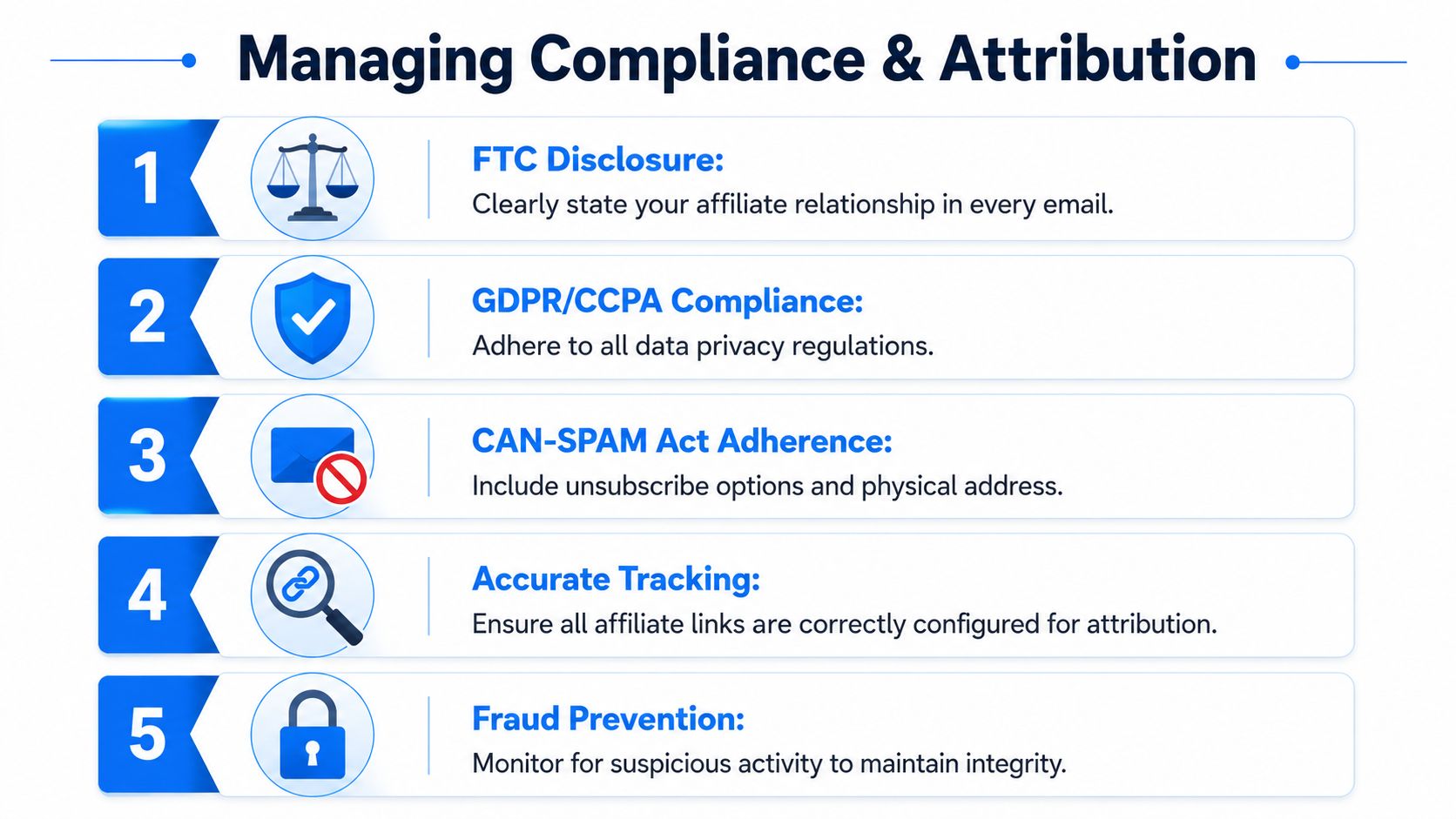
Affiliate disclosure should be clear, close to the recommendation, and written in normal language. If the reader has to hunt for it, you've already made the wrong trade.
I prefer short disclosure language such as:
This email includes affiliate links. If you buy through them, we may earn a commission at no extra cost to you.
That doesn't need to be dramatic. It needs to be visible. Place it before the main affiliate CTA or directly above the section that includes the recommendation.
You also need your standard email compliance basics in place. Consent handling, unsubscribe functionality, and subscriber data management aren't separate from affiliate marketing. They're part of whether your program remains viable.
Make attribution answer practical questions
Attribution should tell you more than whether a partner reported a conversion. It should help you understand which send, segment, and placement drove the result.
At a minimum, structure your tracking so you can identify:
- Campaign source tied to the email or workflow
- Audience segment that received the offer
- Placement type such as dedicated send versus newsletter block
- Link position when multiple CTAs point to the same partner
For internal decision-making, I like pairing affiliate platform data with campaign naming discipline and standard analytics parameters. If you're building the finance side of this out, a practical marketing ROI calculator framework helps keep affiliate economics comparable to your other channels.
Watch for reporting mismatches
Affiliate tracking often breaks in subtle ways. A partner may collapse multiple placements into one report. Internal analytics may show strong clicks while the affiliate dashboard shows weak conversion credit. That doesn't always mean fraud or bad faith. Sometimes it's delayed reporting, cookie windows, or platform limitations.
Still, you need a habit of reconciliation.
Use a recurring review process:
- Check link integrity before each send
- Log campaign IDs in one shared sheet or dashboard
- Compare click data against affiliate-side activity
- Flag anomalies when one placement behaves very differently from the rest
This is also where a newsletter platform can matter. Breaker includes real-time analytics, list hygiene, targeting, and deliverability management, which helps teams monitor campaign behavior and subscriber quality from the same operating environment instead of splitting everything across disconnected tools.
Clean attribution protects more than revenue. It protects editorial judgment. If you can't tell which recommendations actually help readers act, you'll keep repeating the wrong offers.
Optimizing for Long-Term Revenue and Deliverability
True skill in affiliate marketing email marketing isn't getting an early commission. It's keeping the newsletter healthy while revenue compounds. Those are not the same objective. A campaign can make money and still weaken the list.
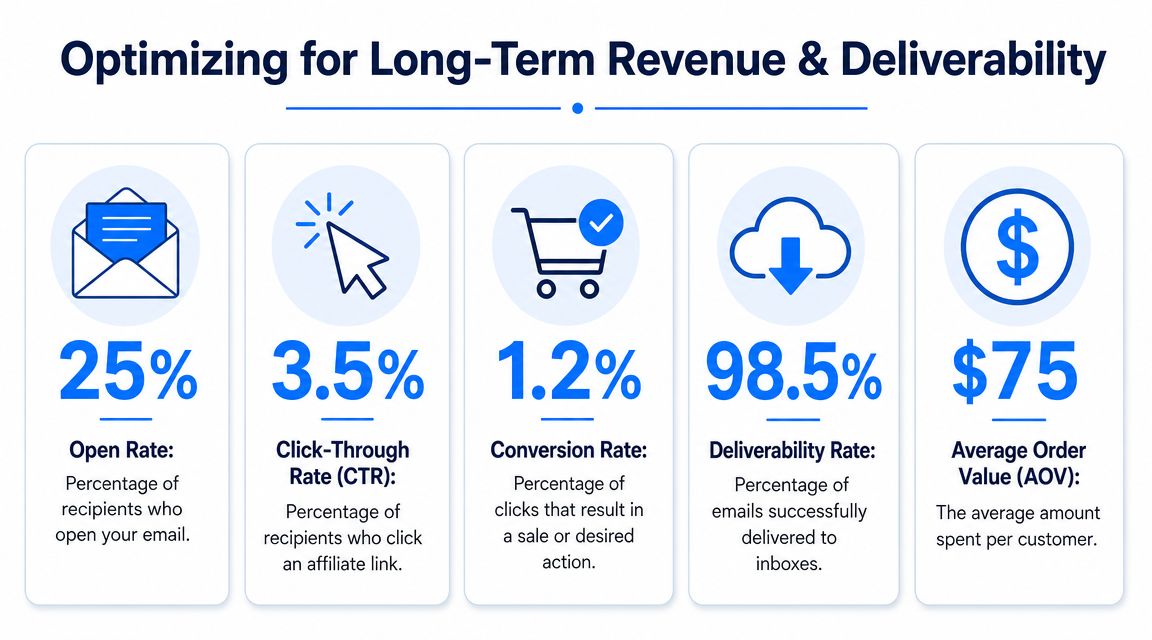
Much affiliate advice falters by overemphasizing immediate clicks and underemphasizing what happens to engagement quality after the promotion. Advanced email teams take a broader view. They track outcomes like revenue per recipient, customer lifetime value, and engagement scores, not just short-term response, as discussed in Klaviyo's guidance on better email measurement.
Measure the program, not just the send
A single affiliate email can look strong in isolation and still cause subtle damage. Maybe the clicks were high, but a valuable segment stopped engaging for the next month. Maybe the revenue came from a small group of power readers while everyone else tuned out.
That's why I look at affiliate performance in layers:
- Direct monetization from the specific offer
- Recipient quality after the campaign
- Engagement continuity in the following sends
- List stability including complaint signals and unsubscribe patterns
- Partner durability over repeated promotions
This is also where teams benefit from understanding marketing attribution models. If a reader clicks an affiliate offer after several educational emails, last-click thinking can hide what created intent.
Optimize around trust signals
The most useful tests in affiliate email aren't always headline or button tests. They're trust tests.
Good things to test include:
- Disclosure placement near the recommendation versus near the CTA
- Offer framing as a tool recommendation versus a workflow shortcut
- Editorial tone with more direct operator language versus more polished brand copy
- Placement style inside the newsletter versus a dedicated campaign
- Audience narrowing to see whether fewer recipients create healthier downstream engagement
When teams skip these tests, they often push frequency instead. That's risky. More promotion can create short-term lift, but it can also train mailbox providers and subscribers to treat your emails like lower-value inventory.
Protect inbox placement while you scale
Deliverability is part of monetization. If affiliate promotions reduce engagement quality, your future editorial emails suffer too. That's the hidden cost of overpromotion.
I look for three practical warning signs:
- Engagement softness after an affiliate-heavy period
- More passive readers who stop clicking anything, not just offers
- Message mix drift where promotions begin to outnumber clear value emails
When you see those, don't just rewrite the CTA. Reduce pressure. Tighten segmentation. Revisit partner quality. The strongest affiliate newsletter programs usually grow because they keep earning the next open.
Long-term affiliate revenue comes from list discipline. Protect the inbox, protect trust, and the commissions have room to repeat.
If you're building a B2B newsletter that needs both growth and monetization, Breaker is built for that operating model. It combines email sending, targeting, subscriber growth, analytics, and deliverability management in one platform, which makes it easier to run affiliate-backed newsletter programs without losing control of list quality.
Keep reading
All articlesNewsletter Analytics: Which Metrics Actually Matter in 2026
Open rate and clicks don't predict buyers. Learn the 7-step method to track click depth, recency, and topic affinity for a revenue-predictive intent score.
Newsletter Segmentation Strategy: Increase Engagement in 2026
Build a data-driven newsletter segmentation strategy using behavior, intent score, and topic affinity to lift opens and clicks. Step-by-step guide.
How to Grow Newsletter Subscribers with Qualified Leads in 2026
Discover 8 channels to grow engaged newsletter subscribers in 2026, with real cost-per-engaged-subscriber data to focus your list-building strategy.