
Can Money Be Made Blogging: 2026 Income Potential
Discover how can money be made blogging in 2026. This guide explores income potential, timelines, & strategies for creators and B2B marketers.

Yes, money can absolutely be made blogging, but the odds are uneven. Only 14% of bloggers earn any income at all, and just 2% earn more than $100,000 per year.
That's the part most advice skips. The internet is full of cheerful posts that make blogging sound like a simple formula: publish articles, rank in Google, add ads, wait for passive income. That advice was always incomplete, and now it's less reliable than ever.
The better way to think about blogging is as a media business with lopsided outcomes. A small group builds real assets: a focused audience, an email list, a clear offer, and multiple ways to monetize attention. Everyone else publishes into a very crowded market and hopes traffic turns into money somehow.
If you're asking can money be made blogging, the honest answer is yes, but usually not by treating the blog itself as the product. The blog is the acquisition layer. The money tends to come from what sits behind it: affiliate offers, sponsorships, services, digital products, and above all an audience you can reach without begging a platform for distribution.
The Short Answer and the Surprising Truth
Blogging can make money. For many publishers, it does not.
That gap matters more than the usual success stories. The hard part is not proving that blogging revenue exists. The hard part is understanding why income concentrates in a small slice of blogs, while a much larger group publishes consistently and sees little financial return.
A blog by itself is rarely the business. It is a distribution asset. It brings in attention, qualifies readers, and creates trust. Revenue usually shows up only after that attention is converted into something you control and can monetize repeatedly.
Why income is so uneven
Blogging rewards audience ownership more than raw publishing volume. A site with steady search traffic but no email capture, no clear offer, and no repeat touchpoint is exposed to every algorithm change and every traffic dip. A smaller blog with a strong newsletter, a focused niche, and one solid offer can outperform it.
That is the uncomfortable truth behind blogging income. A lot of advice still assumes organic search will keep delivering readers at low cost. In practice, search is less predictable than it used to be, and platform reach is borrowed reach. If Google or a social platform slows down your distribution, your revenue usually follows.
Email changes that equation. A newsletter gives you direct access to readers who already raised their hand. That makes monetization more durable, whether the offer is consulting, a productized service, affiliate recommendations, a course, or sponsorship inventory. If you want a broader view of how publishing businesses turn attention into revenue, this breakdown of how internet sites make money is a useful reference.
Blogging makes more sense when it supports a business model
For a B2B company, consultant, agency, or subject-matter expert, a blog often works best as part of a larger system. One post can rank, get shared, start an email relationship, and assist a sale months later. In that setup, the blog does not need millions of pageviews to justify itself. Coaches are a clear example: our guide to email marketing for coaches shows how a post turns into a subscriber and then a client.
General-interest blogs have a harder path. Ad revenue usually requires scale. Search traffic is less stable. Readers often arrive once, skim, and leave without joining anything.
A stronger model looks like this:
- Blog content attracts readers with a specific problem or purchase intent.
- Newsletter signup turns one visit into an owned audience relationship.
- A clear offer gives that audience a reason to buy, book, or click.
- Repeat communication creates more chances to monetize than a single pageview ever will.
The surprising part is not that blogging still works. It is that the reliable money tends to come from owning the audience behind the blog, not from the blog page itself.
Exploring the 6 Primary Monetization Models
There isn't one blogging business model. There are several, and they don't perform equally.
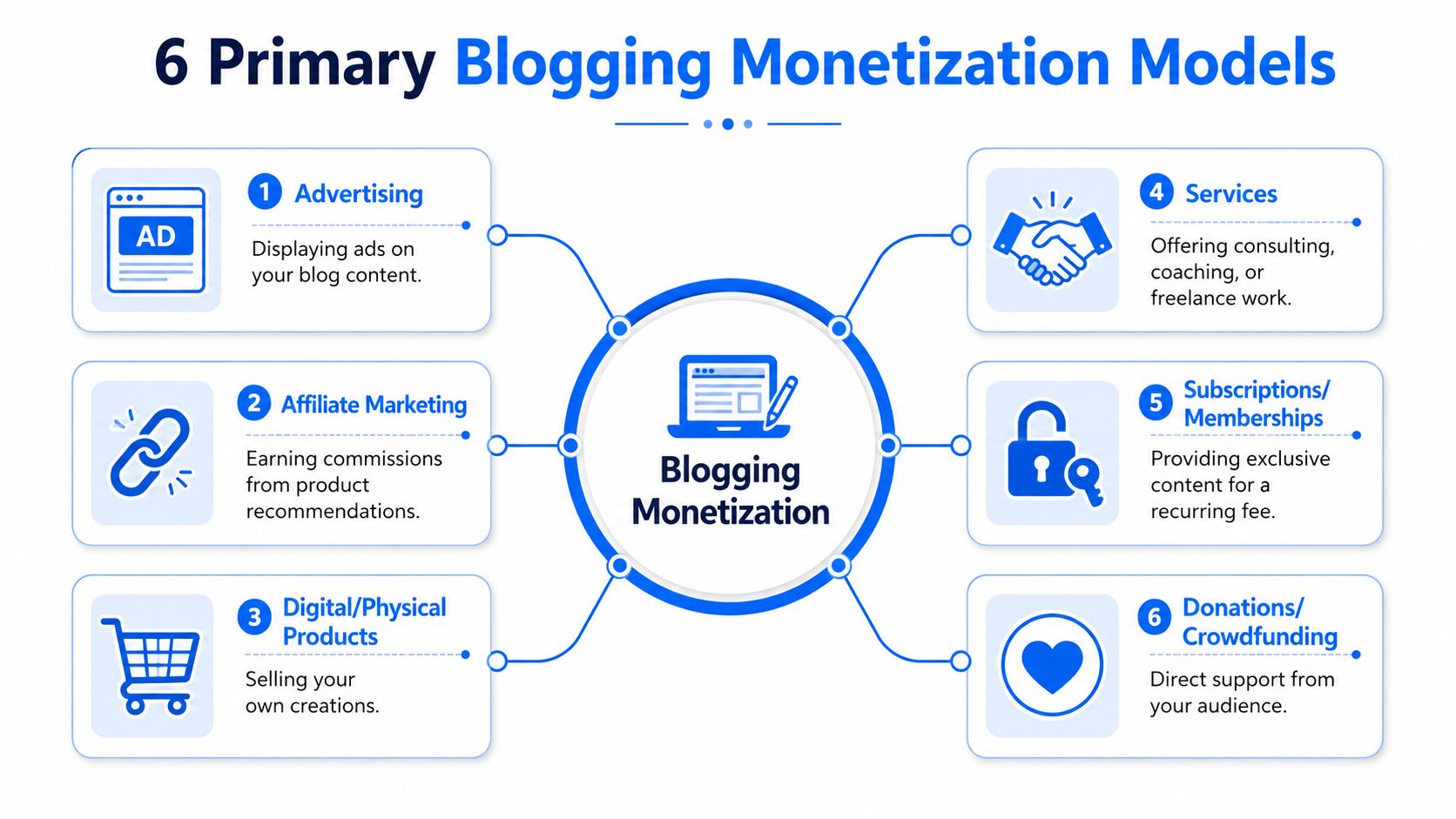
The practical mistake many bloggers make is choosing the easiest model to install instead of the strongest model for their niche. A display ad is easy to paste into a site. That doesn't make it the best path to revenue.
Industry-facing guidance summarized by Simple Programmer's blog monetization explainer makes this clear: the highest-converting models are usually direct-response monetization paths like affiliate links, sponsorships, digital products, and consulting, while ad networks often require very large audiences to generate meaningful income.
Advertising and affiliate income
Display ads are the default starting point because setup is simple. You write, publish, install ads, and collect revenue when readers visit. The problem is that this model usually needs scale. If your blog covers broad topics and gets a lot of repeat traffic, ads can be a useful layer. If your traffic is modest or your niche is narrow, ads rarely carry the business.
Affiliate marketing is stronger for niche blogs with commercial intent. A post that helps a buyer compare tools, evaluate software, or solve an expensive problem can monetize far better than a general informational article. Affiliate revenue comes from recommending something relevant at the moment a reader is already close to action.
A useful way to think about that difference is simple. Ads pay for attention. Affiliate content pays for intent.
A small audience that wants to buy is usually worth more than a large audience that only wants to browse.
For a broader breakdown of business models beyond blogging alone, this guide on how internet sites make money is worth reviewing because it helps place blogs inside the larger economics of digital publishing.
Sponsorships and owned offers
Sponsored content sits in the middle. It works best once you've built trust in a niche and can show that your audience is useful to a brand. In B2B, this often looks less like generic sponsored posts and more like newsletter sponsorships, category partnerships, expert roundups, or product-led content collaborations.
Digital products usually offer better economics than ads because you keep more control over pricing, positioning, and delivery. A template pack, playbook, mini-course, or toolkit can fit naturally behind problem-solving content. If the blog attracts readers with a specific pain point, a digital product can serve as the next step.
Services, subscriptions, and support
Services are often the fastest serious monetization path for experts. A consultant, strategist, coach, designer, or freelancer can use blog posts to pre-sell expertise. In many B2B niches, one qualified client lead is worth far more than months of ad revenue.
Subscriptions or memberships work when readers want ongoing access, community, research, or premium insight. This model is strongest when the blog sits inside a recurring publishing habit, usually email-driven rather than website-driven.
Donations or crowdfunding can work for creator-led brands with a loyal audience, but they're less predictable than the other models. I'd treat support from readers as a bonus layer, not the foundation.
Here's the blunt version:
Model
Best for
Main limitation
Ads
High-traffic publishers
Needs scale
Affiliate
Intent-heavy niche content
Depends on offer fit
Sponsorships
Trusted niche audiences
Harder early on
Digital products
Experts with clear IP
Requires creation and positioning
Services
Consultants and operators
Less scalable at first
Subscriptions
Loyal repeat readers
Needs ongoing value
For most serious bloggers, the best setup isn't one model. It's a stack.
Realistic Timelines and Income Expectations
The hardest part of blogging isn't writing. It's staying in the game long enough for the economics to work.
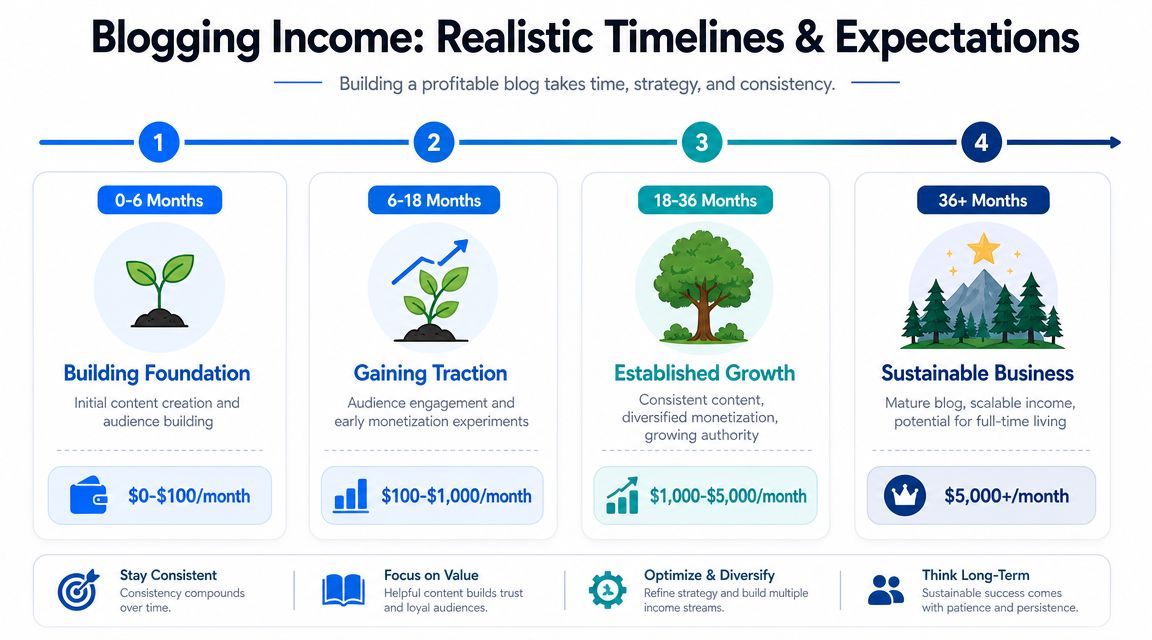
Too many people quit during the awkward middle phase. They've published enough to feel invested, but not enough to see compounding returns yet. That gap is where unrealistic expectations do the most damage.
According to research summarized by Productive Blogging, the average blogger takes about 21 months to start earning money and about 4 years and 1 month to reach a full-time income. The same research says 26% begin earning within 6 months, while 24% reach full-time income within 2 years of starting. It also reports that bloggers with 5 to 10 years of experience average about $2,325.62 per month.
What that means in practice
Those numbers don't mean your blog will follow a fixed schedule. They do mean blogging behaves more like asset building than quick freelancing cash.
The early phase is usually heavy on effort and light on return. You're learning the niche, building authority, figuring out what topics pull qualified readers, and tightening your calls to action. That's why a blog feels slow at first. You're laying distribution and conversion infrastructure before the income is obvious.
Most blogs don't fail because monetization is impossible. They fail because the creator expected proof too early.
A useful way to frame the journey
Instead of asking how fast blogging pays, ask what stage you're in.
- Early stage
You're publishing, testing topics, and building trust. The right goal is signal, not income maxing.
- Traction stage
Some posts start pulling qualified traffic. Early affiliate clicks, subscriber growth, inbound interest, or small sponsorship conversations begin showing up.
- Business stage
You have repeatable acquisition, at least one working monetization path, and enough content depth that new posts lift old ones rather than standing alone.
That's also why longevity matters so much. A blog with years of accumulated authority, internal links, buyer-focused content, and an email list is playing a different game than a new site with ten articles.
Expectations that keep people honest
A few practical expectations help:
- Don't expect ads to validate the model early
Ads are often the least informative signal. They tell you you have traffic, not that you have a strong business.
- Do expect monetization experiments to evolve
Many bloggers start with one model and later realize another fits better. A consultant may begin with affiliate links and later discover services are the main revenue engine.
- Amplify your time's impact
If blogging fits your niche, every good post can keep working. That doesn't guarantee income, but it does mean the payoff structure is cumulative.
The timeline isn't encouraging if you want instant cash. It's very encouraging if you want to build something durable.
The Metrics That Actually Drive Revenue
Traffic matters. It just doesn't matter in the way most bloggers think.
A lot of creators obsess over sessions, impressions, and rankings because those numbers are visible. Revenue comes from less glamorous metrics: click-through rate, subscriber capture, offer relevance, conversion rate, and customer value.

A more useful framework comes from DaedTech's breakdown of blog monetization economics: expected revenue ≈ traffic × CTR × conversion rate × commission or margin. The example used there is simple. 100 readers, a 10% click-through rate, and a 10% downstream conversion rate produce one sale.
Why small traffic can still produce meaningful revenue
That equation changes how you evaluate content. A post with modest traffic can be highly valuable if readers click and buy. A post with lots of traffic can be weak if it attracts the wrong audience or leads nowhere.
This is especially true in B2B and high-intent niches. A tutorial for a serious buyer, a comparison post for a costly tool, or a detailed implementation guide can produce much stronger economics than a broad awareness post.
Here's a simple comparison:
Content type
Looks good in analytics
Often better for revenue
Broad informational post
High traffic
Not always
Buyer-intent comparison post
Lower traffic
Often yes
Problem-solution service post
Modest traffic
Very often
Email-first content upgrade
Fewer pageviews
Strong long-term value
The best post on your site might not be the one with the most traffic. It might be the one that moves readers into an offer.
Track the funnel, not just the article
If you want a blog to make money, measure the full path:
- Entry quality
Are readers arriving with a problem that matches something you can monetize?
- Click behavior
Are they taking the next step, whether that's an affiliate click, a demo request, or an email signup?
- Conversion efficiency
Does the destination page or offer close?
- Retention value
If the first visit doesn't convert, do you have a way to reach that reader again?
That last point matters more than most bloggers realize. When a post gets attention, the immediate question shouldn't be “how many pageviews did it get?” It should be “how many owned contacts did it create?”
If you're refining newsletter performance, these email campaign performance metrics are more useful than raw traffic dashboards because they force you to evaluate what happens after the click.
Promotion strategy matters too, but only when it feeds a system that converts. For example, creators experimenting with social proof on distribution channels sometimes review resources like Buy Twitter Likes from Upvote Club as part of broader visibility testing. That kind of tactic only helps if the content and capture path underneath it are already strong.
The operating principle is straightforward: publish with a revenue path in mind. Otherwise you're measuring motion, not business progress.
How to Build a Blog That Attracts Money
The old playbook said to publish a lot, rank in Google, and monetize later. That's shaky advice now.
In 2024, Pew Research found that Google users clicked a link only 8% of the time after seeing an AI summary, versus 15% when no AI summary was shown, as cited in this analysis of how bloggers actually make money. If search increasingly answers the question before the click, then a blog that depends only on search visits is building on rented ground.

Start with a monetizable niche
Not every niche is equal. A profitable blog usually sits where three things overlap:
- A real recurring problem
- An audience with budget or buying influence
- A natural next step after the article
That next step matters. If readers finish your content and have nowhere sensible to go, the blog becomes educational but economically weak.
B2B categories are often strong here because content can lead into software, consulting, audits, templates, training, or partnerships. The narrower the problem, the easier it is to match content with a monetization path.
Build for capture, not just discovery
If organic traffic weakens, your subscriber base becomes an essential asset. That's why newsletters matter so much now. Search can introduce a reader. Email keeps the relationship alive.
A good blog post should do at least one of these jobs:
- Pull a subscriber with a strong lead magnet
- Qualify a buyer by framing a painful problem clearly
- Pre-sell an offer by showing the cost of inaction
- Create trust so future emails convert better
If you're designing that system, these examples of lead magnets that actually fit B2B buying journeys are a useful starting point.
For operators who want a broader playbook, this guide on how to grow your email list for SaaS is helpful because it treats list building as a strategic growth function rather than a sidebar form.
Search can introduce you. Email lets you follow up, educate, and sell without waiting for another algorithmic gift.
Publish content that leads somewhere
A blog that attracts money usually has a content map, not just a pile of articles.
Use three content types:
- Problem-aware posts
These attract readers who know something is wrong but don't know the solution yet.
- Solution-aware posts
These compare approaches, tools, or categories and often perform well for affiliate or service-led monetization.
- Decision-stage posts
These help someone choose, implement, or justify a purchase. They often bring the strongest commercial intent.
This video is a useful companion if you're thinking about blogging more like a business than a writing hobby.
A lot of blogging advice still treats traffic as the end goal. It isn't. Traffic is the top of the funnel. The primary job is turning borrowed attention into owned attention, then turning owned attention into revenue.
Your First Steps to a Profitable Blog
If you want to know whether can money be made blogging, stop looking for certainty and start building the inputs that make monetization possible.
Many overcomplicate the start. You don't need a giant content machine on day one. You need a focused niche, a credible publishing rhythm, one capture mechanism, and one monetization path that suits your audience.
A practical starting checklist
- Choose a narrow commercial niche
Pick a topic where readers have a clear problem and a plausible buying path. “Marketing” is too broad. “Email onboarding for B2B SaaS” is much stronger.
- Create a simple subscriber offer immediately
Don't wait until traffic arrives. Add a lead magnet, checklist, template, or short guide from the beginning.
- Write a small set of pillar posts
Focus on articles that answer high-value problems, not random topics. If you need help structuring this, a solid content strategy blueprint can keep your first publishing cycle coherent.
- Pick one primary revenue model first
Don't launch ads, affiliate offers, consulting, a course, and a membership all at once. Start with the model that fits your niche best, then add layers later.
- Review content like an operator
Ask what each post is supposed to do. Rank? Capture? Sell? Pre-qualify? If the answer is “just get traffic,” tighten the plan.
The right mindset going in
Blogging still works. What doesn't work well is vague content, generic audiences, and a monetization plan that begins and ends with ads.
The creators and marketers who win tend to do one thing differently. They treat the blog as the front door, not the whole business. They use content to attract the right people, email to keep access to those people, and offers that match real buyer intent.
That's the model worth building now.
If you want to turn your blog into an owned audience and a repeatable growth channel, Breaker is built for that job. It gives B2B marketers, consultants, and newsletter creators a way to send campaigns, grow engaged subscribers, track performance, and build a monetizable audience that doesn't depend entirely on search traffic.
Keep reading
All articlesHow to Write a Newsletter with AI: Step-by-Step Guide 2026
Learn how to write a newsletter with AI the right way: a 7-step process to train, calibrate, and edit AI drafts that still sound like you.
How to Boost Conversions With Your Email Newsletter
Turn your newsletter into a conversion engine. See 2026 benchmarks, CTR vs CVR explained, and the fixes most email guides skip.
Drip Campaign Template: Ready-to-Use Email Sequences
Get 6 ready-to-paste drip campaign templates with subject lines, body copy, and send timing—plus a step-by-step guide to building your own.