
What Is B2B Demand Generation: A 2026 Guide
Discover what is b2b demand generation, how it differs from lead gen, and key KPIs. Get your 2026 roadmap & tactical playbooks.
Someone on the team has probably asked for “more leads” this quarter.
That request sounds simple until you look at what is happening in most B2B funnels. Traffic is uneven. Demo requests come in bursts. Sales says the volume is fine but fit is weak. Marketing reports engagement, yet leadership wants pipeline. Everyone is measuring activity, but no one feels they're operating a dependable system.
That's where people start asking what B2B demand generation really is. Not as a buzzword, but as an operating model.
What Is B2B Demand Generation Really
B2B demand generation isn't a campaign type. It's a pipeline operating system.
When marketers talk about demand gen like it's a pile of tactics, they usually end up with disconnected motion. A webinar here. Paid social there. A few nurture emails. Maybe a gated guide. The result is activity without continuity. Buyers experience fragments. Sales inherits confusion.
Modern B2B buying doesn't reward fragmented marketing. According to Monday.com's demand generation overview, B2B sales cycles often involve 5–11 stakeholders and last 6–18 months. That's why effective teams use multi-touch attribution and sustained messaging across the whole buying committee, not a one-time lead capture event.

Why lead volume stops being enough
If a deal takes months and multiple people have to agree, the old “download equals lead equals opportunity” model breaks fast.
A single person can raise a hand and still have no ability to buy. Another account can show no form fills at all while several stakeholders discreetly consume your content, discuss your category internally, and reach out only when they're already close to a decision. That's why demand gen has to do more than collect contacts. It has to create familiarity, shape preference, and keep momentum alive until the account is ready to move.
Practical rule: If your program breaks when form fills drop for a month, you don't have demand generation. You have a lead capture habit.
What the system is actually designed to do
At a working level, demand generation creates the conditions for revenue. It helps the right accounts understand the problem, recognize your approach, trust your point of view, and progress through a messy buying process with less friction.
That means your content, paid distribution, retargeting, CRM logic, sales handoff, and reporting can't live as separate projects. They have to work like connected layers in one system.
If you want a clean executive-level explanation of that shift, this guide to demand generation for leaders is useful because it frames demand gen as a revenue discipline rather than a marketing channel.
How Demand Generation Differs From Lead Gen and ABM
The easiest way to get demand gen wrong is to confuse it with adjacent motions.
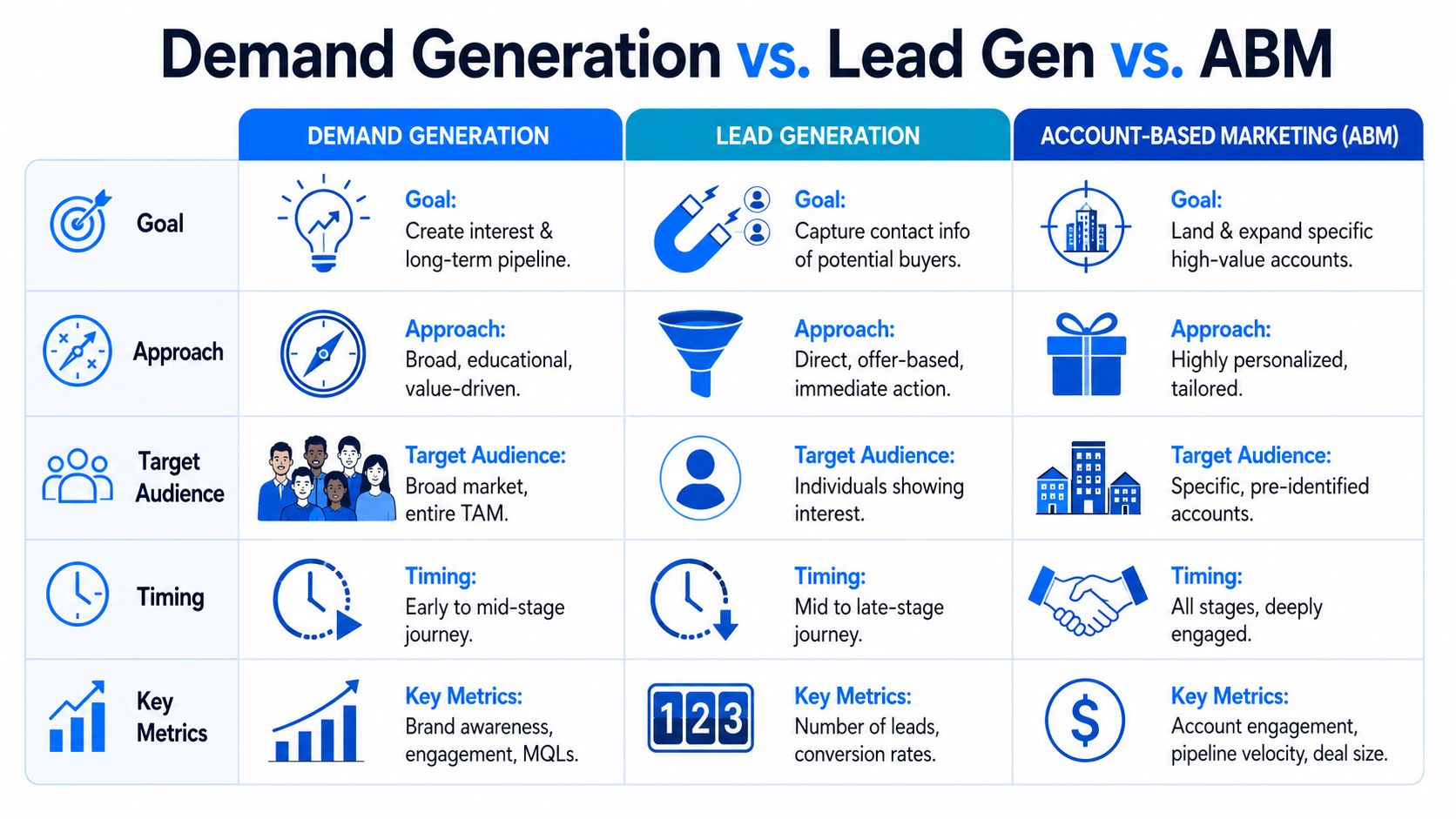
Lead gen, demand gen, and ABM can work together. They often should. But they are not interchangeable, and teams waste a lot of budget when they pretend they are.
Three motions, three jobs
Here's the simplest way I explain it internally.
Motion
Best analogy
Core job
What goes wrong when overused
Demand generation
Build the market
Create awareness, trust, and category pull
You get attention without conversion paths
Lead generation
Set traps where interest already exists
Capture contact information and route intent
You optimize for quantity and call it pipeline
ABM
Coordinate a pursuit plan
Win specific high-value accounts with tailored plays
You personalize too early for accounts that don't care yet
Lead gen is the capture layer. It's usually offer-driven. A demo request, content download, webinar signup, or contact-us flow. Useful, necessary, and often over-relied on.
Demand gen is broader. It warms the market before buyers actively raise their hands. It gives people repeated reasons to remember you, trust you, and keep encountering your ideas in useful contexts.
ABM is focused account pursuit. It narrows the field and increases relevance for named accounts. If demand gen is building air cover, ABM is coordinating pressure on specific targets.
Demand generation versus demand capture
This is the distinction most guides blur, and it matters.
The best programs balance market creation with intent capture. As Losasso explains in its breakdown of demand generation and demand capture, demand generation creates future demand among buyers who aren't actively shopping yet, while demand capture monetizes existing intent from people already searching for solutions.
That sounds academic until budget gets tight.
If you put all spend into capture, you can harvest existing intent for a while. Then the pipeline gets expensive and brittle because you're fighting in crowded channels for buyers who are already comparing vendors. If you put all spend into generation, you may build awareness without enough immediate conversion paths to satisfy revenue pressure.
Good teams don't ask “demand gen or capture?” They ask where the bottleneck is. No awareness problem gets solved by another bottom-funnel form. No near-term pipeline gap gets solved by brand-only activity.
A practical split often looks like this:
- Demand generation when you need more category awareness, stronger recall, better audience education, or more direct traffic and branded engagement over time.
- Demand capture when buyers are already in motion and you need fast routing from intent to conversation.
- ABM when a shortlist of accounts is strategically important enough to justify custom outreach, custom proof, and closer sales-marketing coordination.
Where ABM fits without becoming everything
ABM is often treated like a replacement for demand gen. It isn't. It's a precision layer.
For teams building a more structured account program, Testimonial's Abm Os page is a useful example of how vendors are packaging ABM as an operating model rather than a one-off campaign. That framing is helpful because ABM works best when it has process, not just personalization.
If you want to see how different teams execute account-focused programs in practice, these account-based marketing examples are a good reference point.
Later in the buying motion, a short explainer can help align both teams around the same definitions:
The Four Pillars of a Modern Demand Generation Engine
Once you stop treating demand gen as a list of campaigns, the architecture gets clearer. Strong programs usually stand on four connected pillars. If one is weak, the rest underperform.
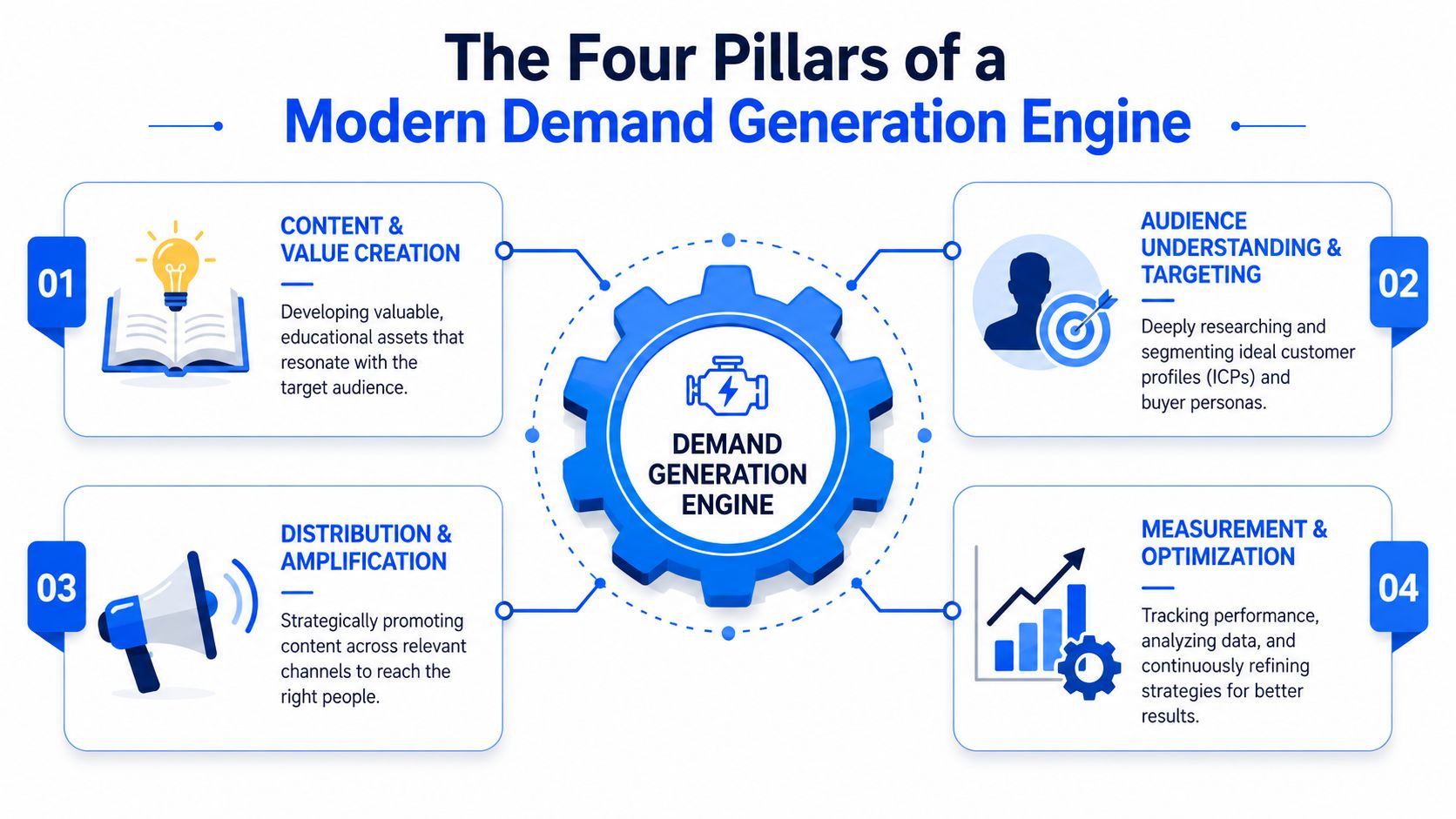
Audience clarity
You can't generate demand in a market you haven't defined.
That starts with a usable ICP, not a vague persona slide. A real ICP includes the kinds of companies you can win, the conditions that make your offer relevant, and the signals that separate curiosity from actual fit. Firmographic filters matter. So do technographic clues, pain patterns, buying triggers, and internal use case differences.
Most weak demand gen starts here. Teams say they target “B2B SaaS” or “mid-market companies” and then wonder why messaging feels generic.
Content and channel fit
Content is not the engine by itself. It's the fuel and the interface.
Your audience needs material that helps them make sense of a problem before they're ready for a product pitch. That can include newsletters, category education, comparison pages, product marketing assets, webinars, paid social creative, customer proof, and sales enablement content. The format matters less than the timing and relevance.
A common failure mode is publishing useful top-of-funnel content while neglecting the middle. Buyers get interested, then hit a dead zone. No clear path to evaluate. No bridge to sales. No proof for internal stakeholders.
If your thought leadership can't connect to a sales conversation, it's content marketing. If your sales assets can't stand alone in-market, they're just collateral.
Technology and orchestration
Many teams discover whether they have a system.
Modern demand generation runs on a data-and-orchestration layer. As Sopro's guide explains, these programs depend on a marketing automation platform, CRM integration, and lead scoring logic to prioritize accounts and personalize messaging at the right moment.
In practice, that means a few things are essential:
- CRM integrity: Sales and marketing need one operational record of account and contact history.
- Automation logic: Nurtures, routing, suppression, and follow-up can't depend on manual spreadsheet work.
- Segmentation: You need separate paths for audience cohorts, not one giant drip sequence.
- Signal handling: Website behavior, engagement, and account activity should influence timing and next steps.
- Scoring and prioritization: Not every engaged contact deserves a handoff. Fit and behavior need to work together.
Tools differ, but the jobs don't. Teams typically use a CRM such as HubSpot or Salesforce, automation like HubSpot or Marketo, paid platforms like LinkedIn and Google, and reporting layers that connect engagement to pipeline. In newsletter-led motions, a platform like Breaker can sit in that stack as the email and audience-growth layer, especially when the newsletter itself is part of the demand engine.
Measurement tied to revenue
Measurement is the pillar that keeps everything honest.
If you only track opens, clicks, and lead counts, you'll keep rewarding the wrong behavior. The better question is whether your system is helping the right accounts move from awareness to opportunity with less wasted effort.
That's why strong teams anchor on commercial outcomes. They look at sourced pipeline, influenced pipeline, sales acceptance quality, conversion through stages, and speed through the funnel. The point isn't perfect attribution. The point is operational visibility.
Demand Generation Channels and Actionable Playbooks
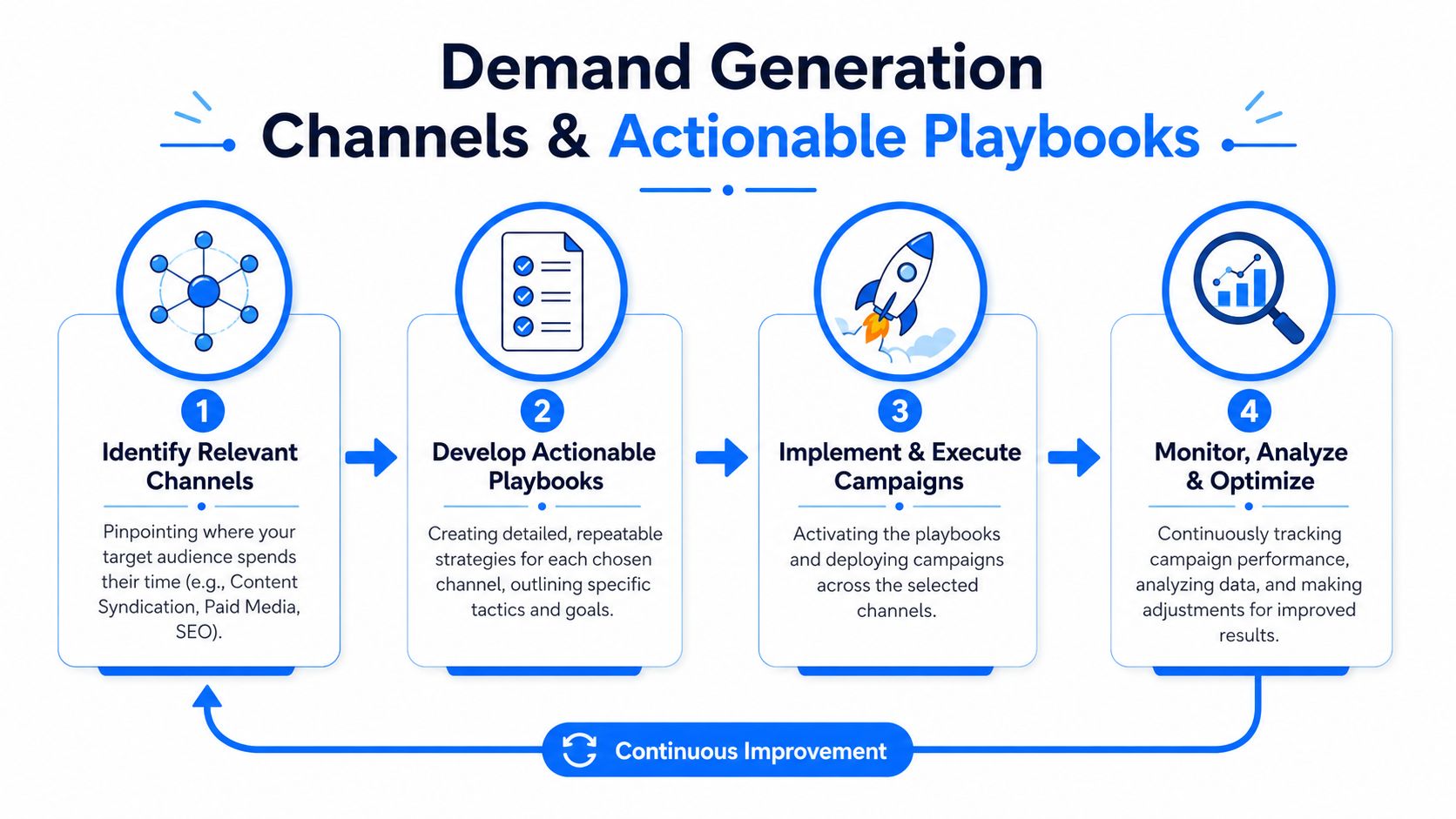
Teams generally don't have a channel problem. They have a coordination problem.
They're running paid social, publishing content, trying SEO, maybe sponsoring newsletters, maybe testing webinars. None of that is wrong in itself. The issue is that each channel gets managed like a separate mini-program, so the buyer experiences disconnected touches instead of a coherent journey.
The channel mix that usually matters
In B2B, the most dependable channel set tends to include a combination of:
- Owned content: Website articles, solution pages, newsletters, webinars, resource hubs.
- Paid amplification: LinkedIn, search, retargeting, sponsored content, selective partner placements.
- Outbound support: SDR follow-up, triggered outreach, account-based sequences.
- Lifecycle email: Nurture, reactivation, handoff support, expansion messaging.
- Social distribution: Executive posts, team distribution, clips, commentary, creator partnerships.
The mistake is thinking each should prove itself alone. They usually work as a sequence. Someone sees a useful post, subscribes, reads a newsletter for weeks, visits the site, returns through retargeting, then responds to outreach because your brand is no longer unfamiliar.
A newsletter-driven demand generation playbook
A B2B newsletter is one of the cleanest ways to operationalize demand gen because it sits between awareness and conversion. It's recurring, measurable, and naturally suited to long buying cycles.
Here's the version that tends to work.
Start with one audience, not everyone
Pick one ICP slice you can speak to with confidence. Not “marketing leaders.” More like growth leaders at B2B software companies, or RevOps teams inside sales-led companies, or consultants serving a specific client type.
That decision affects everything. Topic choice. CTA language. examples. Sponsorship fit. Sales follow-up.
Build a repeatable editorial promise
Your newsletter needs a reason to exist beyond “company updates.”
Good recurring angles include teardown formats, operator lessons, category changes, implementation checklists, messaging critiques, and curated examples. What matters is consistency. Buyers return when they know what kind of value they'll get.
For teams trying to sharpen their social distribution around that newsletter, this guide on how to grow on LinkedIn is useful because it shows how to turn expertise into repeatable posts without sounding like corporate filler.
Distribute the newsletter like a product
Many newsletters stall because they publish but don't distribute.
Use founder posts, team posts, website forms, partner swaps, paid subscriber acquisition, webinar follow-up, and repurposed clips. The newsletter shouldn't sit in a hidden nav link. It should act like your recurring touchpoint for the market.
If you want more ideas for channel combinations around this model, these B2B demand generation tactics are a helpful complement.
Score engagement without overreacting
Treat engagement as a signal layer, not a verdict.
Someone who reads consistently, clicks product-adjacent links, revisits solution pages, or forwards issues internally is more interesting than someone who opened once because the subject line was strong. Your job is to notice patterns, not chase every click.
A simple operating approach looks like this:
- Publish on a fixed cadence: Irregular sends kill memory.
- Tag content themes: Know which topics correlate with deeper commercial interest.
- Route strong signals: Send high-fit, high-engagement contacts into customized follow-up.
- Retarget readers: Use paid media to stay present after email engagement.
- Feed sales context: Let reps see what the account consumed before outreach.
A newsletter works best when it's treated like a weekly market touchpoint, not a container for announcements.
Create capture points without turning every issue into a pitch
This balance matters.
Every send should have a path to next action, but not every send should force it. Some issues can drive to an ungated article. Others can point to a webinar, a product page, a comparison guide, or a consultation. If every edition screams for a demo, engagement erodes. If none of them create progression, you've built a media asset with no commercial path.
The strongest newsletter programs create a rhythm. Value first, then light conversion opportunities, then stronger capture when behavior suggests readiness.
The Demand Generation KPIs That Actually Matter
Most reporting decks still overweight activity. That's why demand gen often gets misread.
Open rates, click rates, and cost per lead can be useful diagnostic metrics. They tell you whether a specific message or channel is functioning. They do not tell leadership whether marketing is helping the business create revenue efficiently.
Top of funnel signals that are useful, but limited
At the top of the funnel, you want signs that your market is noticing you.
That includes content consumption, subscriber growth, return visits, direct traffic patterns, engagement by target accounts, and audience-quality indicators. These help you answer tactical questions. Are the right people seeing the work? Are they coming back? Are some topics pulling stronger fit than others?
Those metrics matter, but they're not enough on their own. A healthy-looking content dashboard can still hide a weak pipeline engine if the engaged audience doesn't match the ICP or never progresses.
Middle funnel metrics that show system quality
In this context, demand gen starts proving operational value.
Middle-funnel KPIs show whether your programs are moving people from awareness into serious evaluation. Think sales-accepted leads, meetings from marketing-engaged accounts, progression from target account engagement into opportunity creation, and the quality of handoffs between marketing and sales.
This layer also reveals process flaws. If engagement is strong but handoffs stall, routing may be wrong. If conversion dies after first meeting, the market may be interested but your positioning may be attracting the wrong use cases. Working through a market analysis template is a quick way to check whether the segments you target and the positioning you use still line up.
A useful mental model is this:
Funnel layer
Helpful metric types
Why they matter
Top
Reach, engagement, subscriber growth, content interaction
Shows if the market is paying attention
Middle
Sales acceptance, meeting creation, account engagement depth
Shows if attention is turning into real evaluation
Bottom
Pipeline, velocity, CAC, revenue contribution
Shows commercial impact
Bottom funnel metrics executives actually care about
This is the scoreboard.
As SalesMotion notes in its demand generation strategy perspective, strong programs are judged by marketing-sourced pipeline, pipeline velocity, CAC, and revenue. Those metrics connect targeting quality and messaging effectiveness to commercial outcomes.
That shift is showing up more broadly. Pipeline-360 reports that 42% of B2B marketers now cite revenue generated as a top performance indicator, and that marketing budgets remain around 7.7% of company revenue. The same source, citing Gartner data, says 73% of Chief Sales Officers prioritize growth from existing customers, which is one reason expansion and account-based programs now sit much closer to core demand strategy.
Those numbers matter because they change the conversation. Demand gen is no longer judged mainly by lead volume. It's judged by whether it helps the business create and expand revenue.
The fastest way to lose credibility in demand gen is to report busy metrics to people who carry a revenue number.
A practical reporting cadence usually separates diagnostic metrics from business metrics. Channel owners can manage the diagnostics. Leadership should see the business metrics first.
A Starter Roadmap for Your First 90 Days
If your current motion feels messy, don't try to rebuild everything at once. A workable demand gen system usually starts by tightening one audience, one message set, one distribution loop, and one reporting view.
Days 1 to 30
Start with foundations.
Define your ICP in operational terms. Audit your existing content and map it to the buyer journey. Check whether your CRM stages, campaign naming, and source tracking are clean enough to support basic reporting. Align sales and marketing on what counts as a meaningful handoff.
Keep the list short:
- Clarify the audience: Choose one segment you can realistically influence.
- Tighten the message: Write the core problem, stakes, and differentiated point of view in plain language.
- Audit infrastructure: Fix broken forms, duplicate fields, weak lifecycle stages, and messy routing.
- Pick one core channel: Newsletter, paid social, webinar, or search-driven content. Don't launch four at once.
Days 31 to 60
Activate the first loop.
Launch a small, coherent program with repeated touches. That might mean a newsletter plus LinkedIn distribution plus retargeting. Or a webinar series plus nurture plus SDR follow-up. What matters is consistency and signal flow, not channel count.
A simple build phase often includes:
- One recurring content format
- One conversion path
- One follow-up sequence
- One sales feedback loop
If you need a planning template for this stage, a practical B2B marketing plan helps turn the strategy into a calendar and ownership model.
Days 61 to 90
Now optimize.
Look for friction, not just performance winners. Which content themes attract fit? Which sources produce shallow engagement? Where are handoffs stalling? Which accounts show repeated interest without outreach? By addressing these points, demand gen transitions into an operating system rather than a launch.
Refine from evidence:
- Double down on fit: Keep what attracts the right accounts, not just the most clicks.
- Adjust routing: Improve thresholds for sales follow-up.
- Expand carefully: Add a second channel only after the first loop is stable.
- Report upward: Show pipeline movement, not just campaign activity.
By day ninety, you don't need a fully mature demand engine. You need one motion that people trust, one dashboard leadership can understand, and one repeatable process your team can improve.
Breaker helps teams run newsletter-led demand generation with email sending, audience growth, ICP-based targeting, CRM-friendly workflows, and analytics in one place. If your demand strategy depends on a recurring newsletter as both a content hub and a signal source, Breaker is one option to evaluate.
Keep reading
All articlesHow to Write a Newsletter with AI: Step-by-Step Guide 2026
Learn how to write a newsletter with AI the right way: a 7-step process to train, calibrate, and edit AI drafts that still sound like you.
How to Boost Conversions With Your Email Newsletter
Turn your newsletter into a conversion engine. See 2026 benchmarks, CTR vs CVR explained, and the fixes most email guides skip.
Drip Campaign Template: Ready-to-Use Email Sequences
Get 6 ready-to-paste drip campaign templates with subject lines, body copy, and send timing—plus a step-by-step guide to building your own.