
Achieve 1 Million Subscribers: Newsletter Growth 2026
Our 2026 playbook guides you to 1 million subscribers. Master strategy, acquisition, retention, and scalable systems for newsletter growth.
The most popular advice about reaching 1 million subscribers is also the least useful. It tells you to chase virality, post everywhere, and wait for one breakout moment to change the trajectory of your newsletter. That framing is seductive because it makes growth sound glamorous. It's also why so many newsletters stall.
A million subscribers is rarely the result of a single lucky event. It's the output of a system that compounds. Strong positioning pulls in the right people. A clean signup path converts them. A welcome flow gets them active. Deliverability protects inbox placement. Segmentation keeps the content relevant. Partnerships and paid acquisition add fuel only after the machine can hold the load.
That's the practical lens that matters. If you treat newsletter growth like a content hobby, you'll get hobby outcomes. If you treat it like an engineering problem, you can identify constraints, remove friction, and scale what already works. Email is worth that level of discipline because it remains one of the highest-return channels available, with an average ROI of $36 for every $1 spent across industries.
The Million-Subscriber Myth
The myth is simple. People think 1 million subscribers comes from attention. In practice, it comes from infrastructure.
Attention helps. Brand helps. Distribution helps. But those are inputs, not the whole model. Plenty of newsletters attract traffic and still fail to scale because the value proposition is fuzzy, the signup page asks for too much, the onboarding sequence is weak, or the list degrades faster than the team replaces lost engagement.
Why growth hacks usually disappoint
A growth hack can create a spike. It usually can't sustain a business asset.
The pattern is easy to spot. A team sponsors a big creator, runs a giveaway, posts a viral thread, or gets mentioned on a large podcast. Traffic jumps. Subscriber growth jumps for a week. Then the graph flattens because nothing beneath the acquisition layer changed. The newsletter didn't become more relevant. The funnel didn't get tighter. The retention system didn't improve.
Practical rule: If a tactic only works when you're actively pushing it, it's not a growth engine. It's a campaign.
The more useful question isn't “How do I get more traffic?” It's “Where does growth break when volume increases?” That's a better operator's question. It forces you to examine conversion, activation, engagement, and churn instead of treating traffic as the universal answer.
What elite scale actually looks like
Big subscriber milestones are rare in creator ecosystems. For YouTube, hitting 1 million subscribers is widely treated as an elite benchmark. One 2024 estimate found fewer than 60,000 channels worldwide had reached 1 million subscribers out of over 100 million YouTube channels, or about 0.06%, roughly 1 in 1,700 channels. That same source notes only 4.4% of YouTube's 2.8 billion active users had created a channel, which helps explain why the milestone remains exceptional rather than ordinary.
Newsletter operators should read that the right way. Not as intimidation, but as calibration. A million is not a casual target. It demands elite execution and patience.
For email, the mistake is assuming content quality alone gets you there. Content matters, but scale comes from converting audience attention into repeatable subscriber growth while maintaining quality. That means thinking like a systems builder, not a creator waiting for a breakthrough.
The better framing
Treat the journey like a production system with interconnected parts:
- Acquisition: Bring in qualified people, not random volume.
- Conversion: Make signup friction low and the promise clear.
- Activation: Get new subscribers to experience value quickly.
- Retention: Keep the list alive with relevance and cadence.
- Quality control: Protect deliverability, reputation, and list health.
That framing changes your priorities. It also changes your emotional posture. You stop chasing novelty and start improving mechanics.
Building Your Growth Engine Before You Hit the Gas
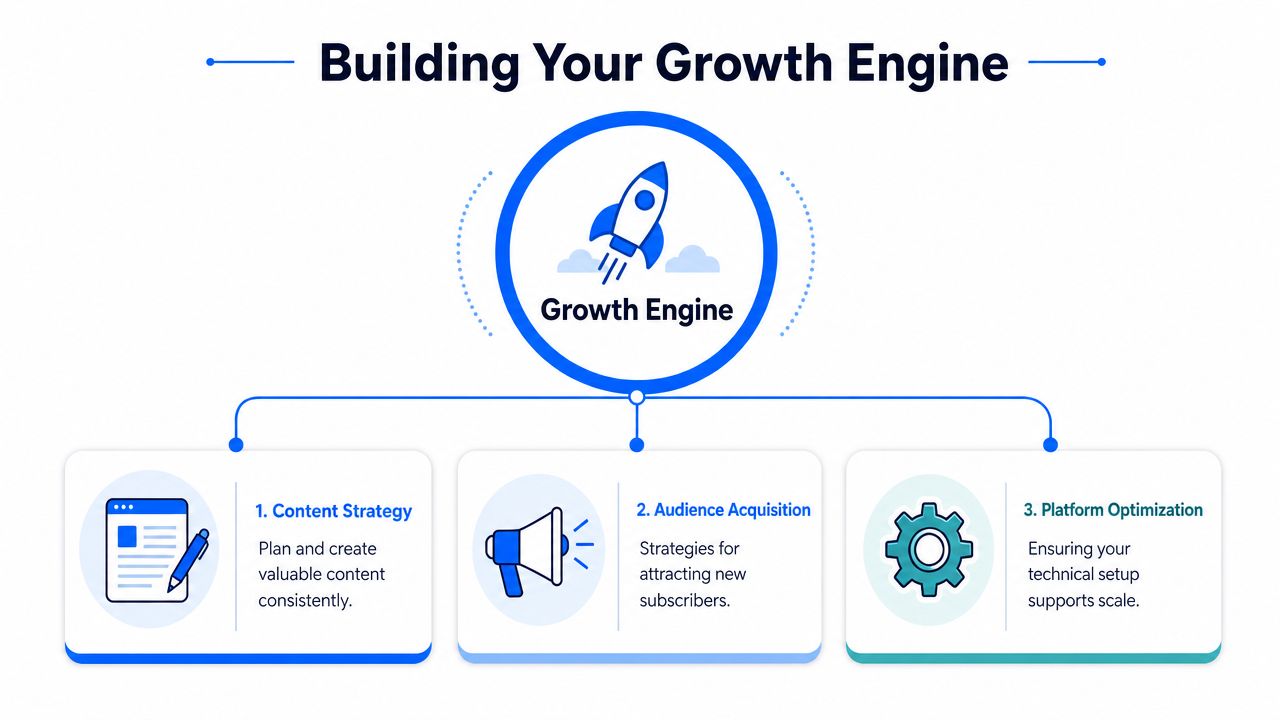
A newsletter that wants to reach scale needs an actual engine. Not a pile of tactics. Not a calendar full of content ideas. An engine.
Teams often try to accelerate too early. They buy sponsorships before the landing page converts. They launch referral loops before the welcome sequence works. They publish more content before deciding who it's really for. That's how budgets get burned and teams mistake motion for progress.
Start with a sharp ICP
“Anyone interested in growth” is not an audience. It's a wish.
Your ideal customer profile should be narrow enough that a real person can read your signup page and think, “This is for me.” In B2B, that usually means defining role, company type, business maturity, and the specific problem your newsletter helps solve. A fractional CMO serving SaaS startups needs a different editorial promise than a PLG team inside a mature enterprise company.
A useful ICP has operational consequences. It tells you which examples belong in your newsletter, which channels deserve budget, which partnerships make sense, and which leads should never enter your main nurture path. If you need a concrete demand generation lens for that thinking, these B2B pipeline growth strategies are a useful companion because they tie audience building to actual pipeline priorities instead of vanity metrics.
Write a value proposition people can repeat
Your signup page should answer one question fast. Why should someone subscribe if they already have too much email?
Many newsletters fail at this point. They describe the format, not the outcome. “Weekly insights on marketing” is weak because it sounds like everything else. “A weekly teardown of B2B newsletter funnels, with actionable fixes operators can apply immediately” is stronger because it makes the utility obvious.
Three tests help here:
- Clarity test: Could a stranger explain your newsletter after reading one sentence?
- Specificity test: Does the promise mention a distinct audience, problem, or outcome?
- Consistency test: Will the next ten issues all reinforce the same core promise?
If the answer is no to any of those, your acquisition channels will underperform no matter how good the traffic is.
Build a content framework, not a content pile
Publishing regularly matters, but consistency without structure creates drift. The strongest newsletters use a repeatable framework. Readers know what kind of value they'll get, even when the topic changes.
A practical framework often includes a few recurring lanes:
Content Lane
Purpose
What it does for growth
Educational analysis
Explain a problem deeply
Builds authority and shareability
Tactical breakdowns
Show how to execute
Improves retention because readers can apply it
Curated signals
Filter important changes
Trains habit and recurring opens
Opinionated takes
Interpret trade-offs
Differentiates the brand from commodity content
A growth engine becomes easier to scale when each issue reinforces the same promise from a slightly different angle.
The engine is ready when content, audience fit, and technical setup support each other. At that point, adding acquisition spend makes sense. Before that, more traffic only magnifies weaknesses.
The Acquisition Flywheel Organic Paid and Partnerships
Acquisition works best when you stop asking which channel is best and start asking what role each channel should play. Organic, paid, and partnerships solve different problems. Teams get into trouble when they expect one channel to do all the work.
Organic channels create defensibility. Paid channels create speed. Partnerships create borrowed trust. The right mix depends on your stage, budget tolerance, and how clearly your newsletter serves a specific audience.
Organic builds the long-term asset
Organic growth is slower at first and more resilient later. Search, social content, founder distribution, community participation, and owned media all belong here.
The strength of organic is intent matching. A useful article, teardown, or post can keep attracting subscribers long after you publish it. The weakness is patience. Organic usually won't bail out a weak quarter, and it won't compensate for vague positioning.
Organic tends to work best when you publish content that naturally leads to the newsletter rather than content that treats the newsletter as an afterthought. If you need a broader playbook for that, these email list building strategies map well to a newsletter-first acquisition model.
Paid gives you controlled acceleration
Paid acquisition is not just a volume tool. It's a testing environment.
A disciplined operator uses paid to validate offers, hooks, landing pages, and audience segments. Once something converts with consistency, paid helps scale it. If nothing converts, paid reveals that quickly and expensively. That's useful too, as long as you learn from it.
Common paid options include newsletter sponsorships, social ads, search campaigns, and creator placements. The trade-off is quality variance. Some paid sources deliver readers who genuinely want the content. Others produce subscribers who sign up easily and ignore every send after that. That's why paid should never be judged on signup count alone.
Partnerships improve trust and quality
Partnerships often produce the best subscribers because trust transfers from one audience to another. Cross-promotions, swaps, guest essays, webinar co-marketing, and affiliate relationships all fit this bucket.
The catch is alignment. If the partner audience doesn't overlap with your ICP, the list grows but engagement weakens. Good partnerships are rarely just “big audience plus placement.” They work because the fit is obvious to the subscriber before they click.
The best-performing partnership campaigns usually feel like recommendations, not advertisements.
Acquisition Channel Trade-Offs
Channel
Cost
Speed to Results
Scalability
Subscriber Quality
Organic
Lower cash cost, higher time cost
Slower
High if content compounds
Often strong when audience intent is clear
Paid
Direct budget required
Fast
High when economics work
Mixed, depends on targeting and offer
Partnerships
Usually moderate effort, sometimes fees or rev share
Medium
Moderate to high with repeatable partners
Often high if audience fit is tight
How to blend them without wasting effort
The flywheel works when each channel supports the others.
- Use organic for proof: Publish ideas that demonstrate authority and reveal what topics attract the right readers.
- Use paid to scale validated offers: Promote only the hooks and landing pages that already show strong conversion behavior.
- Use partnerships to fill credibility gaps: Borrow trust from adjacent operators, brands, or creators your audience already respects.
- Track source quality downstream: Look at activation and ongoing engagement by source, not just signup totals.
- Retire weak channels fast: If a source sends low-intent subscribers, fix the offer or cut the spend.
At scale, channel diversification matters. A newsletter dependent on one source is always one algorithm shift, CPM swing, or partnership failure away from a stall.
Protecting Your Asset Deliverability and List Hygiene
A large list with weak deliverability is a false asset. It looks impressive in a dashboard and underperforms where it counts. If your emails don't land in the inbox, every acquisition dollar becomes less efficient.
This is why experienced operators treat deliverability as a growth function, not a technical afterthought. The job isn't just sending email. The job is making sure the right subscribers keep receiving it, opening it, and trusting it.
Decay is always working against you
Email lists don't hold still. People change jobs, abandon old addresses, unsubscribe, and disengage.
That's not a theory. B2B email lists naturally decay by about 22.5% every year. If you ignore that reality, you can keep adding names while the underlying asset gets weaker. The list gets bigger on paper and less valuable in practice.

A lot of teams resist cleanup because they hate deleting subscribers. That instinct is understandable and wrong. Dead weight hurts sender reputation, distorts reporting, and makes it harder to identify what content works.
The operational checklist that matters
You don't need exotic tactics here. You need discipline.
- Authenticate properly: Set up SPF, DKIM, and DMARC so inbox providers can trust your mail stream.
- Use confirmed intent when appropriate: Double opt-in adds friction, but it can improve list quality for sources that bring in lower-intent signups.
- Monitor engagement by cohort: Don't evaluate the whole list as one blob. Watch how subscribers from each source behave over time.
- Suppress chronic inactives: If someone hasn't engaged after repeated attempts, move them out of the main sending pool.
- Watch complaint signals: One bad acquisition source can compromise performance for the rest of the list.
If you want a more tactical framework, these email deliverability best practices are useful for building a process your team can maintain.
A smaller active list often wins
The wrong mental model is “bigger is always better.” The better one is “reachable and engaged is better.”
When teams prune responsibly, open behavior becomes easier to interpret. Click patterns tell a clearer story. Sending reputation improves. Editorial decisions get sharper because the audience you're measuring is real, not padded with addresses that stopped caring months ago.
Clean lists make strategy easier because they remove fake signals.
The unglamorous work of list hygiene protects every growth channel above it. Without that discipline, scale becomes fragile.
Automating Engagement and Retention
A subscriber signs up on Tuesday afternoon after reading a sharp teardown on LinkedIn. That moment feels like a win, but it's only a handoff. The main work starts after the form submission.
If nothing happens next, the subscriber forgets why they joined. The inbox fills up. Your newsletter arrives without context. By the third or fourth send, you're another sender asking for attention.
What a strong onboarding path feels like
The first email shouldn't just confirm the signup. It should orient the reader.
A useful welcome sequence does three things quickly. It restates the promise, delivers proof, and teaches the subscriber how to get value from the newsletter. That might mean sending your best issue, pointing to a curated archive, or asking one preference-setting question that improves future relevance.
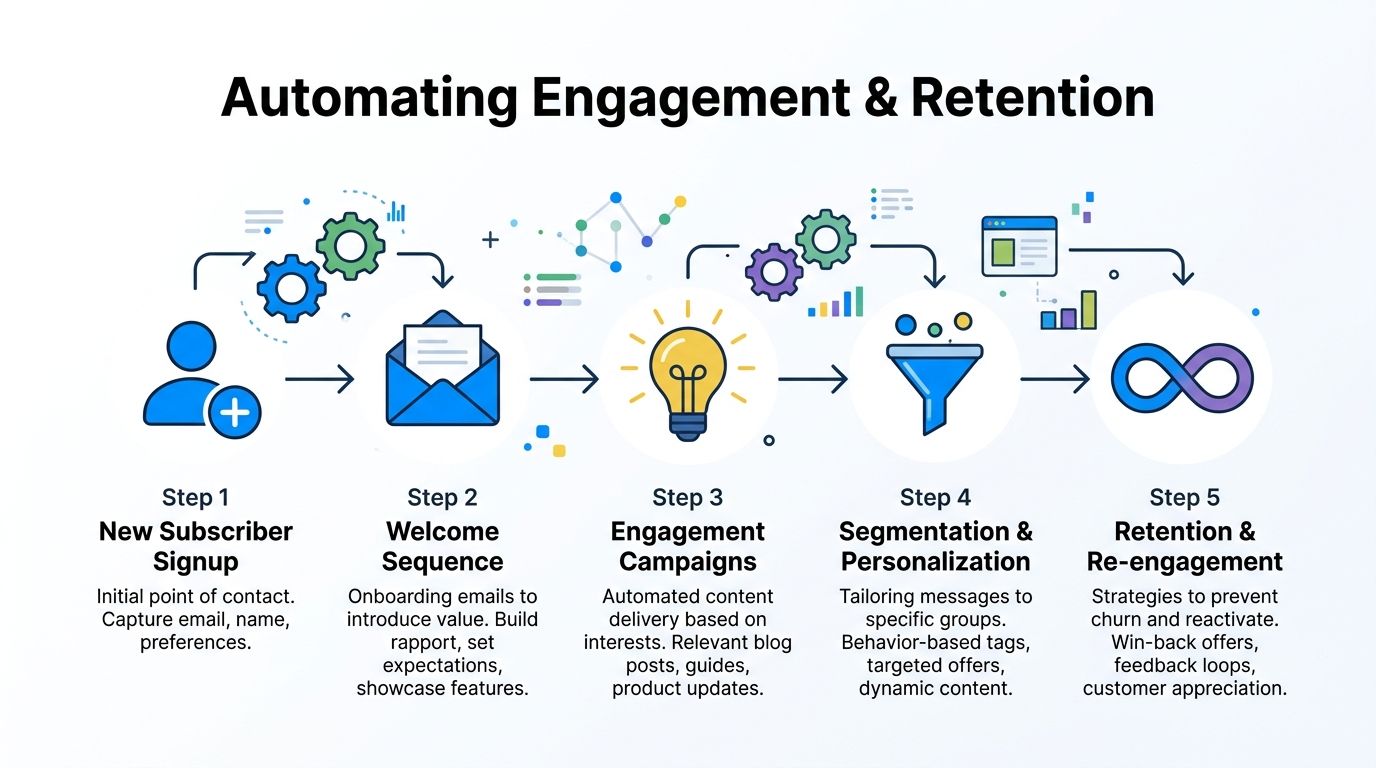
A simple journey often looks like this:
- Signup confirmation with a clear reminder of what they subscribed to.
- Welcome email that highlights one immediate benefit.
- Best-of email with a small set of high-signal past issues.
- Segmentation touchpoint that captures interest or role.
- Regular cadence entry once the subscriber understands the format.
Where automation earns its keep
Automation matters because it creates consistency. Every new subscriber gets a high-quality introduction, even when the team is busy with other work.
The strongest flows don't stop at onboarding. They react to behavior. A reader who clicks on PLG content can receive more product-growth analysis. A subscriber who stops engaging can move into a re-engagement path with a simpler ask. Someone who consistently clicks monetization topics might be better suited for a more specific editorial segment.
This walkthrough is a useful visual reference for how those journeys can be structured in practice:
A more detailed operational view of these flows is covered in this guide to a marketing automation workflow.
Retention should feel personal, not manual
The best retention systems feel attentive without requiring constant hand-holding. That usually comes from a few rules done well:
- Set expectations early: Tell people what they'll receive and how often.
- Earn the second open: The first open comes from curiosity. The second comes from relevance.
- Use behavior as a signal: Clicks, replies, and topic preferences are more useful than broad assumptions.
- Re-engage before removing: Give inactive readers a clean chance to stay before suppressing them.
- Keep the voice consistent: Automation breaks trust when the emails sound generic or disconnected from the main publication.
A subscriber who feels understood stays longer. Retention systems exist to create that feeling at scale.
Scaling Beyond Manual Effort with Systems and PLG
Manual hustle stops working long before 1 million subscribers. A founder can write every issue, approve every landing page, manage every partnership, and inspect every segment when the list is small. That operating model eventually becomes the bottleneck.
Scale requires systems that keep producing outcomes when no one is manually pushing every lever. Newsletter growth begins to overlap with product-led growth thinking under these conditions.
Turn the newsletter into a product, not just a publication
PLG is useful here because it asks a sharper question. What inside the product drives more adoption?
For newsletters, the “product” includes the reading experience, the sharing mechanics, the archive, the signup journey, and any tools or resources attached to the publication. A newsletter grows faster when readers can naturally bring in other readers.
That often shows up in a few forms:
- Referral loops: Give existing readers a reason to invite peers.
- Shareable assets: Build charts, snippets, templates, or frameworks that travel well outside the inbox.
- Interactive utilities: Checklists, calculators, or assessments can convert intent into subscriptions.
- Archive design: Make older issues useful enough that they continue attracting and converting new visitors.
None of that is a gimmick if it reinforces the core value proposition. It becomes a gimmick when the mechanism is stronger than the content.
Build systems around bottlenecks
Most growth teams don't need more tactics. They need fewer recurring bottlenecks.
If onboarding quality depends on one person remembering to update a sequence, build a review process. If segmentation is always delayed because your stack is fragmented, fix the data flow. If paid acquisition launches slowly because creative approval is chaotic, create a repeatable asset pipeline.
Tooling matters. Email platforms, analytics, enrichment, CRM sync, and deliverability monitoring should work together well enough that the team spends time making decisions, not moving data. Tools like Kit, HubSpot, Customer.io, and Beehiiv solve different parts of that stack. Breaker is another option in this category for B2B newsletter operators because it combines email sending with list growth, analytics, targeting, and deliverability management in one platform.
Systems should remove repeated human decisions from low-leverage work, not remove judgment from strategy.
Use automation where it compounds
There's a lot of noise around AI and automation. The highest-impact use cases are not “write more content faster.” They're usually operational.
Good automation helps teams segment readers based on behavior, route leads into the right nurture paths, identify engagement shifts earlier, and maintain list quality without constant manual cleanup. It can also shorten the feedback loop between publishing and learning. That matters because speed of iteration is one of the few durable growth advantages available to lean teams.
At this stage, the newsletter stops behaving like a campaign and starts behaving like infrastructure. That's the difference between growth that depends on heroic effort and growth that keeps compounding.
The Math of a Million Measuring What Truly Matters
The cleanest way to think about 1 million subscribers is not as a dream number. It's a funnel problem.
That framing removes drama. It replaces vague ambition with controllable variables. Traffic quality, landing page conversion, activation, retention, and monetization each have their own math. You don't need to guess where growth comes from when the system is instrumented properly.
The benchmark that changes the conversation
A useful benchmark comes from conversion math. If your channel converts at about 2% from qualified visitors to subscribers, reaching 1 million subscribers requires roughly 50 million qualified visits. If that conversion rate falls to 1%, the requirement doubles to roughly 100 million qualified visits, as explained in this funnel engineering breakdown.
That single comparison is why obsessing over acquisition alone is such a mistake. Small conversion improvements change the scale requirement dramatically. The same is true deeper in the funnel. If activation is weak, paid traffic gets more expensive. If retention is weak, acquisition has to carry too much load.
Historical benchmarks matter, but only as context
Creators often underestimate the sheer volume associated with big audience milestones. In one analysis of recent YouTube creators, channels took an average of 492 videos to reach 1 million subscribers, with a range from 123 to 1,688 videos, about 4 years on average, and roughly 118 million total views by the time they hit the milestone. That worked out to about 1 new subscriber per 118 views on average in that sample.
Newsletter growth won't map directly to YouTube, but the lesson travels well. Scale usually comes from sustained output plus conversion efficiency, not one-off flashes of attention.
What to measure every week
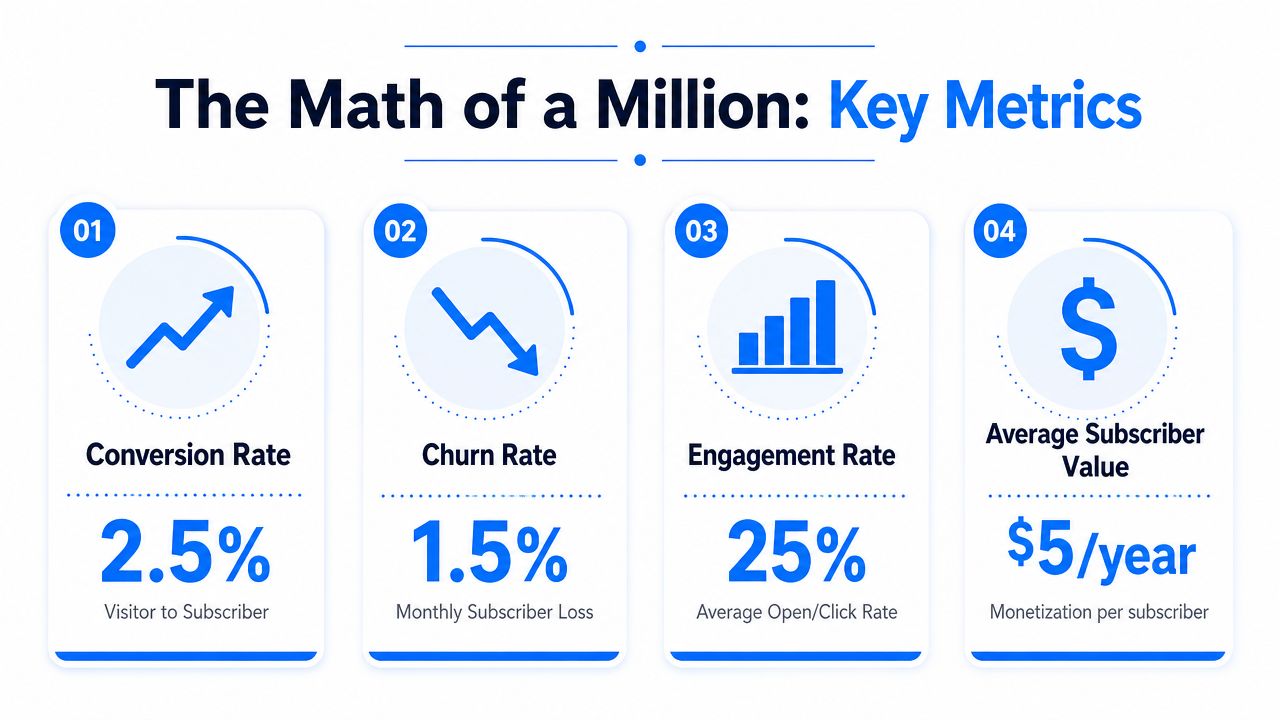
A serious newsletter dashboard should answer a few hard questions:
- Where do qualified visitors come from? Measure traffic by source and intent, not just volume.
- Which pages convert? Signup conversion belongs on the same dashboard as acquisition source.
- Do new subscribers activate? Watch whether they open, click, or reply early in the lifecycle.
- Which cohorts retain best? Separate a strong source from a noisy one by downstream behavior.
- What does each subscriber become worth? Without a value model, paid scaling decisions get sloppy.
If you can't see where subscribers are leaking out of the system, you can't fix growth. You can only spend more.
A lot of teams overcomplicate this with excessive dashboards. Keep it operational. One weekly review. One owner per metric. One action tied to every observed weakness.
Think in quarterly constraints
At this level, planning gets simpler when you ask one question each quarter: what is the single bottleneck limiting subscriber growth right now?
Sometimes it's top-of-funnel traffic. Sometimes it's conversion. Sometimes it's weak onboarding, poor list quality, or low inbox placement. The right move is not doing a little more of everything. It's fixing the tightest constraint first, then reassessing.
That's the engineering mindset. Not frantic activity. Controlled iteration, measured inputs, and relentless removal of friction.
If you're treating newsletter growth like a system instead of a guessing game, Breaker is built for that operating model. It combines email sending with B2B list growth, targeting, analytics, and deliverability management so teams can work on conversion, quality, and scale in one place instead of stitching together disconnected tools.
Keep reading
All articlesNewsletter Segmentation Strategy: Increase Engagement in 2026
Build a data-driven newsletter segmentation strategy using behavior, intent score, and topic affinity to lift opens and clicks. Step-by-step guide.
How to Grow Newsletter Subscribers with Qualified Leads in 2026
Discover 8 channels to grow engaged newsletter subscribers in 2026, with real cost-per-engaged-subscriber data to focus your list-building strategy.
B2B Lead Generation via Newsletter: What Actually Works
Cold outbound is losing steam. See 7 proven newsletter tactics for B2B lead generation, from gated content to sponsorship swaps, that beat cold outreach.