
How Do You Start a Newsletter That Actually Grows Your B2B
Struggling with how do you start a newsletter? This guide shares real-world B2B strategies for defining your audience, creating content, and growing your list.
Starting a newsletter involves a few key stages: mapping out your audience and goals, creating a content plan, picking your tech stack, and then, finally, launching. The real secret isn't just in the writing—it's in building a solid strategic foundation before you send a single email. This is what turns your newsletter into a predictable growth channel, not just another task on your marketing to-do list.
Defining Your Strategy Before You Write a Single Word

The most common mistake I see marketers make is diving headfirst into content creation. They come up with a clever name, pick a nice template, and start writing about what they think their audience wants to read. This approach almost always leads to inconsistent results, low engagement, and eventually, burnout.
A great B2B newsletter should be treated like a product. It needs to solve a specific problem for a specific type of person. So, before you even think about subject lines or CTAs, you need to answer three fundamental questions: Who are you serving? What do you want to achieve? And why should they care enough to open your email?
Getting these answers right creates the strategic framework that will guide every decision you make, from your content pillars to how you get new subscribers.
Pinpoint Your Ideal Customer Profile
Your newsletter isn't for everyone; it's for someone. That someone is your Ideal Customer Profile (ICP). And you need to go way beyond broad demographics like job titles or company size. You have to get inside the head of the human on the other side of the screen.
What are their daily frustrations? What are their long-term career ambitions? What industry jargon do they actually use? What other newsletters or podcasts are already in their rotation? This deep level of understanding is what separates a generic, forgettable newsletter from one that feels indispensable. For a deeper dive, check out our guide on what an Ideal Customer Profile is and how to build one.
For instance, a marketing agency targeting SaaS startups wouldn't just define their ICP as a "VP of Marketing." They'd get granular:
- Job Title: VP of Marketing at a Series A SaaS company with 50-100 employees.
- Primary Goal: Drive qualified demo requests to hit aggressive quarterly growth targets.
- Key Challenge: Lacks a large internal team and needs scalable, high-ROI marketing channels.
- Watering Holes: Follows growth marketing thought leaders on LinkedIn and is active in private Slack communities for marketers.
This level of detail immediately tells you what kind of content will resonate. Instead of writing about generic marketing tips, you can zero in on topics like "How to Build a Lead Gen Engine with a Lean Team" or "The Three Paid Channels Dominating B2B SaaS Right Now."
Set Concrete Business Goals
A newsletter without a clear goal is just a hobby. For any B2B company, it has to serve a real business function. Your primary goal will directly shape your content, your calls-to-action, and how you measure success down the line.
Your newsletter's main objective should be a measurable outcome tied to pipeline or revenue. Vague goals like "building brand awareness" are nearly impossible to track and even harder to justify when it's time to talk budgets.
So, what is the primary job of your newsletter?
- Top-of-Funnel Lead Generation: Is the goal to attract net-new prospects who fit your ICP and convert them into subscribers?
- Mid-Funnel Nurturing: Are you trying to educate existing leads in your CRM, build trust, and move them closer to a sales conversation?
- Customer Engagement and Retention: Is the aim to keep current customers engaged, reduce churn, and maybe even drive a few upsell opportunities?
- Thought Leadership: Are you positioning a key executive or the company itself as the undisputed expert in your niche?
Choosing one primary goal is critical. It brings focus. A lead generation newsletter will naturally prioritize high-value, shareable content with clear CTAs, while a customer retention newsletter might lean more into product tips and success stories.
Building Your Content Engine for Consistent Value
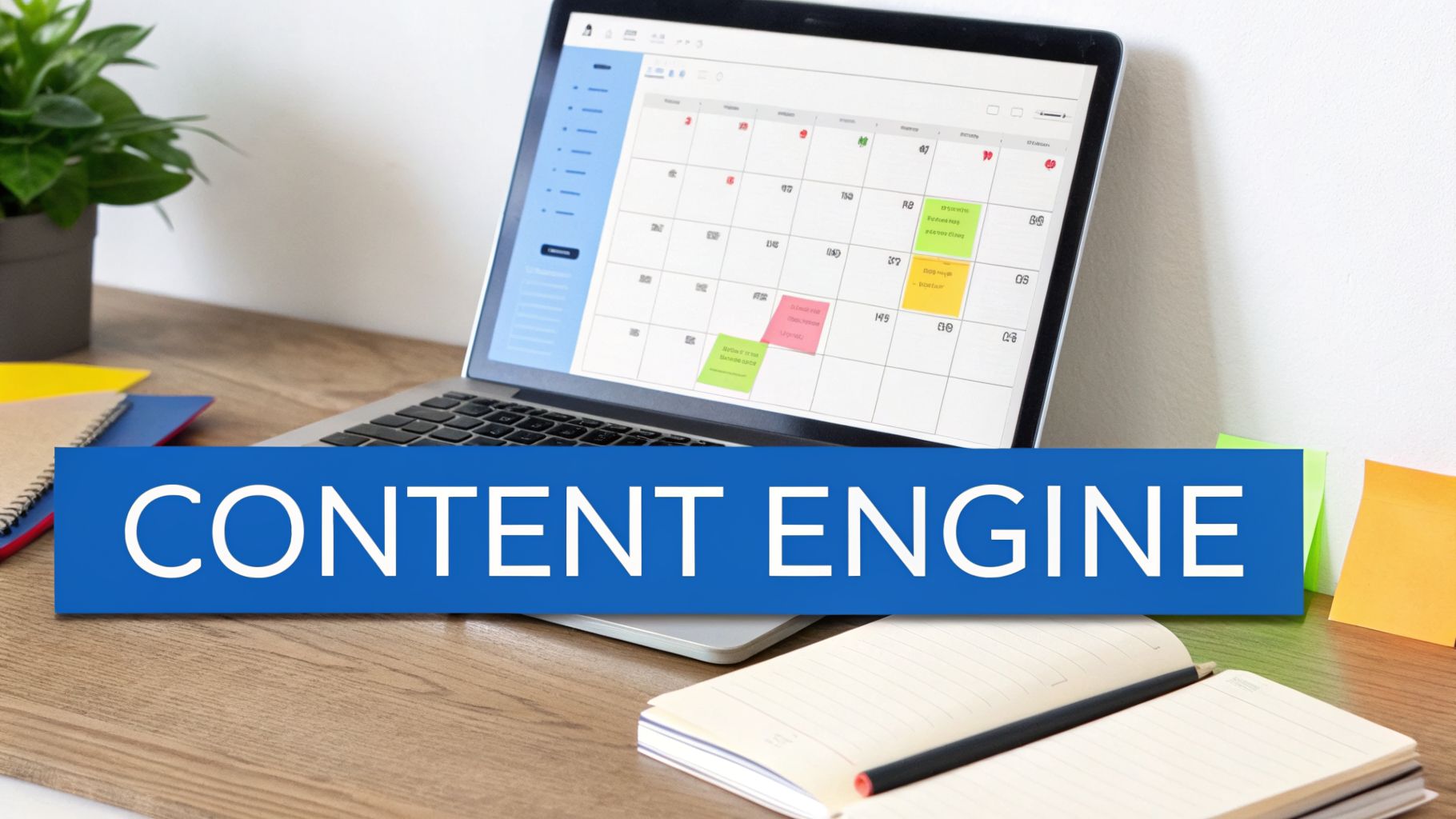
Once your strategy is locked in, the real work starts. A successful newsletter isn't born from last-minute scrambles; it's the output of a well-oiled content engine. This system is your best defense against burnout and the only way to deliver predictable value.
The foundation of this engine is a solid set of content pillars. These are the three to five broad topics that speak directly to your ICP's biggest headaches and connect back to your product's core value. Think of them as the guardrails for your content, ensuring every issue is relevant and cements your expertise.
For a B2B SaaS company targeting product managers, for instance, your pillars might be "User Onboarding Tactics," "Product-Led Growth Experiments," and "Feature Prioritization Frameworks." This keeps you from chasing random ideas and helps build a cohesive library of content over time.
Designing Your Editorial Calendar
An editorial calendar is what turns those abstract pillars into a concrete publishing plan. It’s not just a list of dates—it’s your roadmap for the first few months, detailing topics, formats, and authors. This is how you stay ahead and maintain a steady rhythm.
Start by mapping out your first four issues. That gives you a one-month runway, which is manageable but just enough to build real momentum. For each issue, you’ll want to define:
- The Core Topic: What specific question or problem are you solving?
- The Format: Is it an expert interview, a curated resource list, a deep-dive analysis, or a case study?
- The Primary CTA: What do you want the reader to do next? Book a demo, read a blog post, or register for a webinar?
Getting this clarity transforms a daunting task into a series of small, executable steps. You can explore different ways to approach this process in our guide on how to plan newsletter content monthly.
Creating Reusable Newsletter Formats
Trying to reinvent the wheel with a new format for every single issue is a fast track to exhaustion. A much smarter approach is to develop a few reusable templates that you can rotate through. This standardizes your workflow and lets your audience know what to expect.
Some effective B2B newsletter formats include:
- The Expert Q&A: Feature an industry leader or an in-house expert answering a pressing question your ICP has. This builds authority through association.
- The Curated Briefing: Sift through all the industry noise and share the three most important articles, stats, or tools of the week with your own commentary. You become their trusted filter.
- The Tactical Deep-Dive: Pick one specific problem and provide a step-by-step solution, complete with examples and screenshots. This delivers immediate, actionable value.
A consistent format does more than save you time—it builds a habit with your readers. When they know what to expect and find it valuable, opening your email becomes an automatic part of their routine.
This approach is especially powerful in a growing market. The global newsletter industry is projected to hit $17.8 billion by 2028, fueled by audiences seeking curated, high-value information directly in their inboxes. Substack alone pays creators over $300 million annually, showing the massive demand for quality content.
Finally, to keep your content engine running smoothly, consider using some of the best AI tools for content creators. These tools can help with everything from brainstorming ideas to refining your copy, freeing you up to focus on high-level strategy and unique insights. By systematizing your content creation, you build a sustainable process that turns your newsletter into a reliable asset for growth.
If the newsletter is for your own team rather than customers, these staff newsletter ideas show how to keep an internal edition useful week after week.
Choosing the Right Tech Stack for B2B Growth
Your tech stack is the foundation of your newsletter. The right combination of tools will feel like a silent partner, automating the grunt work and fueling your growth. The wrong stack becomes a constant source of friction, manual exports, and missed opportunities.
When you're first figuring out how to start a newsletter, the sheer number of options can be overwhelming. You've got everything from simple email tools to full-blown growth suites. The key is to pick tools that match your B2B growth goals, not just your immediate need to send an email.
This means you need to look past the fancy drag-and-drop editor. Instead, focus on the features that will scale with you. Can it plug into your CRM? Does it have smart features for list growth? Will it help you prove ROI to your boss down the line?
The first stack decision is where the newsletter lives. Our guide to choosing between LinkedIn, email, and Substack newsletters explains why owning the list usually wins for B2B.
Core Components of Your Newsletter Stack
At a bare minimum, your tech stack has to do three things well: send emails, capture subscribers, and make sure those emails actually get delivered. Everything else is built on top of this.
- Email Service Provider (ESP): This is your mission control. It’s where you’ll build your newsletter, manage your subscribers, and see basic analytics. These platforms range from straightforward senders to complex marketing automation machines.
- Signup Forms and Landing Pages: You need a reliable way to turn website traffic into subscribers. Most ESPs offer basic forms, but dedicated landing page builders often give you more control and can seriously boost your conversion rates.
- Deliverability and Authentication: This is the technical stuff that keeps you out of the spam folder. Setting up SPF and DKIM records is non-negotiable if you want to build a solid sender reputation and ensure your emails land in the inbox.
Beyond the basics, think about how your tools connect. For B2B, a smooth integration between your ESP and your CRM (like Salesforce or HubSpot) is a must-have. It's what allows you to see how your newsletter impacts the sales pipeline, attribute new leads, and even personalize content based on where someone is in their buying journey.
From Simple Senders to Growth Platforms
The market for newsletter tools is huge and growing fast. To put it in perspective, as of 2026, there are more than 50,000 newsletters on Beehiiv alone—almost double the number from the previous year. This boom shows just how easy it's become to start a newsletter. You can discover more insights about the future of newsletters and AI adoption on HubSpot's blog.
This growth has also created a few different categories of tools:
- Traditional ESPs: These are your workhorses for sending straightforward campaigns and are often part of a bigger marketing suite. They're reliable, but they might not have the specialized features needed for aggressive B2B list growth.
- Creator-Focused Platforms: Think Substack or Beehiiv. These are fantastic for monetization and building a community, but they can fall short when it comes to deep B2B integrations or advanced ways to acquire subscribers.
- Growth-Focused Platforms: This is where tools like Breaker fit in. They combine a powerful email sending system with built-in features to automatically add high-quality, ICP-fit subscribers to your list. This is a perfect match for B2B teams focused on generating leads.
Here’s a look at a platform built specifically for B2B growth, with a clear focus on both sending emails and acquiring new subscribers.
The interface makes it obvious that the goal isn't just to create campaigns but to actively grow your list with the right people—a major advantage for any B2B marketer.
The best tech stack for you depends entirely on your primary goal. If you're building a personal brand, a creator platform might be perfect. If you're tasked with generating a pipeline for a sales team, a growth-focused platform will deliver a much higher ROI.
For B2B teams, the ability to find and add relevant subscribers is a game-changer. For a deeper analysis, check out our guide on the best email newsletter platforms for B2B list growth. Also, to make sure your B2B newsletter grows, choosing the right tools is critical, which includes exploring effective LinkedIn newsletter tools. Picking the right platform means you spend less time on manual list-building and more time creating valuable content that actually converts.
Crafting Your Launch Plan and Welcome Sequence
The difference between a newsletter that takes off and one that flops often comes down to the launch. Just hitting "send" and hoping for the best is a recipe for a fizzled-out project. A proper, structured plan, on the other hand, turns your debut into a strategic event.
It's all about preparing your first few issues, warming up your audience, and having a killer welcome sequence ready to go from day one.
A successful launch isn't about chasing a huge subscriber number overnight. It's about attracting the right subscribers and making a fantastic first impression. This first group of engaged readers will become your best advocates, sharing your content and fueling your organic growth down the road.
Building Your Pre-Launch Checklist
Before you even think about telling the world about your newsletter, you need to get a few key pieces in place. This isn't just about the tech setup; it’s about having the content and assets ready to make your newsletter feel polished and valuable from the moment someone signs up.
Your pre-launch checklist should cover three core areas:
- Content Readiness: Have your first 2-3 issues completely written, edited, and ready to go. This buffer is a lifesaver, preventing you from scrambling for content in those crucial first weeks so you can focus on promotion and engaging with new readers.
- Technical Setup: Make sure your signup form is live on your website, your welcome email is activated, and you’ve sent yourself a few test campaigns. Check everything—formatting, links, and deliverability.
- Promotional Assets: Get your launch announcements ready. This means simple graphics and copy for social media (especially LinkedIn) and any partners you might be working with.
The entire point of a pre-launch phase is to iron out all the wrinkles for both you and your new subscribers. When launch day hits, your only job should be driving people to a system that’s already humming along perfectly.
Essential Newsletter Pre-Launch Checklist
To make sure nothing slips through the cracks, use a checklist to track your progress. This keeps everything organized and ensures you’re fully prepared for a smooth launch day.
Category
Task
Status (Not Started / In Progress / Complete)
Content
Write and edit the first 3 newsletter issues.
Content
Design and finalize the newsletter template.
Content
Create a lead magnet (if applicable).
Technical
Choose and set up the Email Service Provider (ESP).
Technical
Authenticate your sending domain (SPF, DKIM).
Technical
Create and embed signup forms on the website/landing page.
Technical
Build and test the automated welcome email sequence.
Technical
Integrate ESP with your CRM or other key tools.
Promotional
Prepare social media announcement copy and graphics.
Promotional
Draft outreach emails for partners or initial promotion.
Promotional
Set up analytics and tracking (e.g., UTMs for links).
Following this checklist systematically will give you the confidence that all your bases are covered before you hit "go."
The technical flow below shows the essential steps you need to lock in before you can launch with confidence.
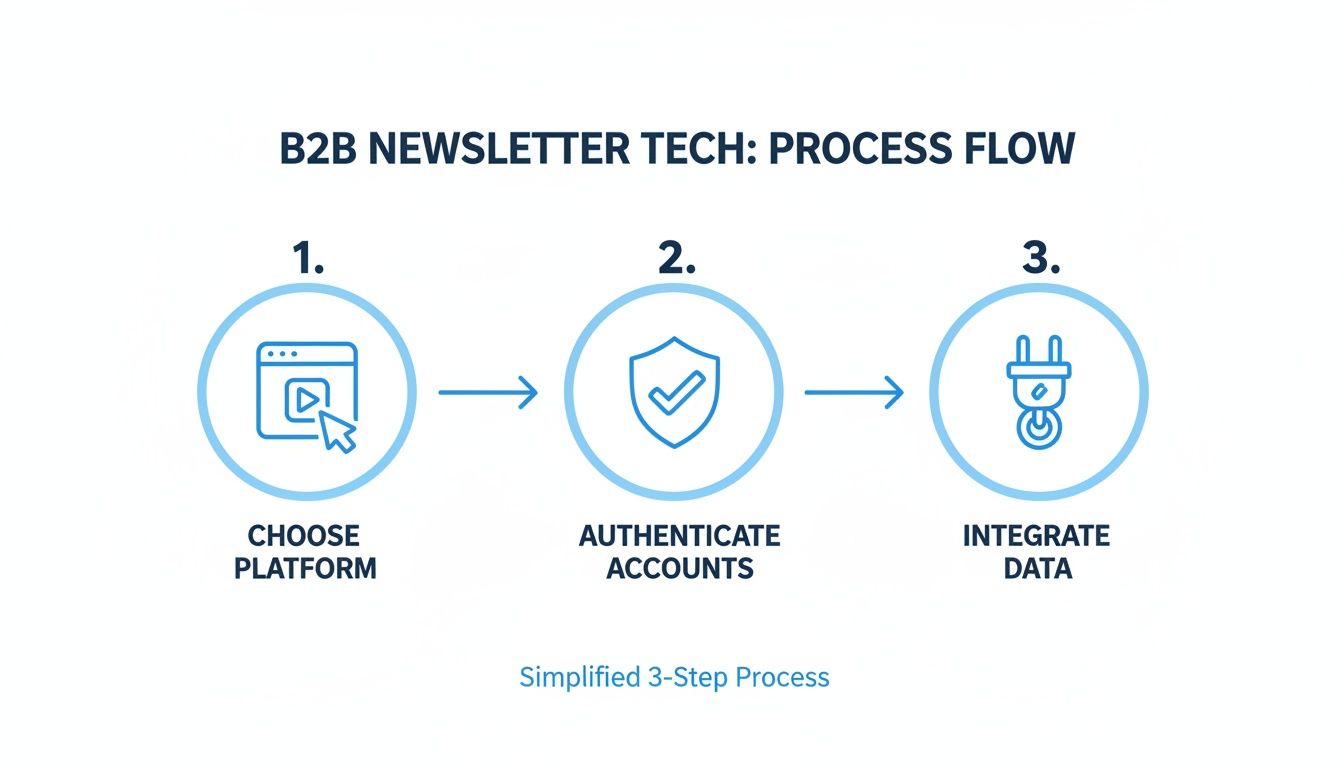
As you can see, picking a platform is just the beginning. Authentication and integrations are what ensure your emails actually land in the inbox and your subscriber data flows where it needs to go.
The Power of a Welcome Sequence
Your welcome email is, without a doubt, the most important email you will ever send. It gets the highest open rates you'll ever see—often topping 50%. This is your one shot to set the tone, deliver on the value you promised, and turn a casual subscriber into a loyal reader. Our welcome email format guide breaks down the structure, personalization, and testing that make it work.
A single welcome email is good, but an automated 2-3 part sequence is far better. This mini-onboarding series lets you accomplish a few key goals without overwhelming your new subscriber.
Here’s a simple but incredibly effective welcome sequence:
- Email 1 (Sent Immediately): Confirm their subscription and deliver on your promise (like a free guide or template). Use this email to restate the newsletter's value and tell them what to expect, like, "You'll get a new issue in your inbox every Tuesday morning."
- Email 2 (Sent 2 Days Later): Share your absolute best piece of content. This could be a link to a top-performing blog post, a popular case study, or a free tool. It’s your chance to immediately prove your expertise and provide value.
- Email 3 (Sent 4 Days Later): Ask a simple question to get a conversation started. Something like, "What's the biggest challenge you're facing with [your topic] right now?" This does two things: it sparks engagement and gives you priceless feedback for future content ideas.
This sequence starts the relationship off on the right foot. It makes subscribers feel seen and valued, which is the secret to building a newsletter that actually keeps its audience.
Proven Strategies for Growing Your Subscriber List
So, your newsletter is officially live. The welcome sequence is doing its job, and you’ve sent out the first few issues. Now for the hard part: turning that early spark into steady, predictable growth.
The real goal isn't just a bigger subscriber count. It’s about attracting high-quality readers who perfectly match your Ideal Customer Profile (ICP).
This is where you need to shift from a creator's mindset to a growth marketer's. It’s a mix of smart organic tactics that turn your existing assets into subscriber magnets and targeted paid strategies that bring qualified leads right to your doorstep. Every single tactic should be laser-focused on attracting genuine potential customers.
Turn Your Owned Channels into Growth Engines
Before you even think about spending a dollar on ads, make sure your owned channels are working overtime to capture subscribers. These are the assets you already have—your website, your content, and your team—and they are often the best sources for high-intent readers.
Start treating your website like it was built for one purpose: capturing leads. Sticking a single sign-up form in the footer and hoping people find it just won't cut it. You need to think about the user’s journey from their perspective.
- Blog Post CTAs: Embed specific, relevant calls-to-action right inside your most popular articles. If an article is about "Scaling a Sales Team," the CTA shouldn't be a generic "Join our newsletter." It should promise more content just like it.
- Homepage Visibility: Don't hide your newsletter. Feature it prominently on your homepage like it's a core product offering, not just some side project. Clearly explain the value in one or two sharp sentences.
- Dedicated Landing Page: Every great newsletter needs its own landing page. This gives you a single, focused link you can share everywhere and a place to really sell the benefits of subscribing.
Beyond your website, your team's day-to-day emails are a completely untapped growth channel. Create a standardized email signature with a link to your newsletter’s landing page and have everyone in the company use it. You’ll be surprised how many signups this can drive over time with literally zero extra effort.
Expand Your Reach with Partnerships and Paid Tactics
Once your organic machine is humming along, it’s time to start reaching new audiences. This is where partnerships and paid acquisition enter the picture, but the key is to stay highly targeted to maintain the quality of your list.
Cross-promotions are one of the most effective growth hacks out there. Find other newsletters that serve a similar ICP—but aren't direct competitors—and set up a "swap." You promote their newsletter, and they promote yours. It’s a warm introduction to a pre-qualified audience that already loves reading newsletters.
When you're looking for partners, subscriber count is just one piece of the puzzle. Dig into their engagement rates and, more importantly, the quality of their audience. A shoutout from a small, highly-respected newsletter is often worth more than a mention in a massive, generic one.
Another powerful move is to repurpose your best content into lead magnets. That awesome webinar you hosted or that in-depth guide you wrote can be gated behind a simple newsletter sign-up form. Promoting this high-value content on platforms like LinkedIn is a great way to capture leads who are actively looking for the solutions you provide.
Put Subscriber Acquisition on Autopilot
For B2B teams focused on building pipeline, the holy grail is automating the acquisition of ICP-fit subscribers. This means moving beyond manual tactics and using technology to consistently add qualified professionals to your list.
This is where platforms like Breaker completely change the game. Instead of just waiting for inbound traffic, tools like this let you define your ICP with incredible precision—targeting specific job titles, industries, and company sizes. The platform then goes to work identifying and adding engaged, relevant professionals to your list for you.
This approach flips the traditional growth model upside down. You’re not just hoping the right people stumble upon your sign-up form; you’re proactively reaching them. It ensures your list growth is directly tied to your business goals, filling your audience with people who aren’t just readers, but potential customers. This is how a newsletter goes from a simple marketing task to a reliable lead generation engine.
Once these channels are running, the 1 million subscribers playbook shows how to scale them into a repeatable growth engine.
Measuring What Matters and Optimizing Performance
Sending your newsletter is only the beginning. The real magic happens when you dive into the data to figure out what’s working, what’s not, and—most importantly—why.
Forget about vanity metrics. A high open rate might feel good, but it doesn't tell you if your newsletter is actually driving business. True success comes from tracking the deeper engagement signals that tie directly back to your goals.
Beyond the Open Rate: Core Engagement Metrics
To really get a feel for performance, you need to look past opens and focus on a few key metrics that show how your audience is actually interacting with your content. These numbers tell a story about whether your message is hitting the mark.
After every send, keep an eye on these indicators:
- Click-Through Rate (CTR): This is the percentage of people who opened your email and then clicked a link. A healthy CTR is a dead giveaway that your content and CTAs are compelling.
- Click-to-Open Rate (CTOR): This metric compares unique clicks to unique opens, giving you a purer measure of your content's quality by only looking at the people who actually saw your message.
- Click Distribution: Where are people clicking? If 90% of your clicks are on the first link, it’s a strong hint that the rest of your newsletter isn't grabbing their attention. This is gold for optimizing your layout.
- Unsubscribe Rate: No one likes to see people leave, but a low unsubscribe rate (ideally under 0.5%) is a good sign. If you see a sudden spike, it's an early warning that your content strategy needs a rethink.
Your goal isn't just to get an open; it's to get a valuable action. A sky-high open rate with a rock-bottom CTR usually means your subject line wrote a check that your content couldn't cash.
Interpreting Your Data for Actionable Insights
Anyone can collect data. Turning it into smart decisions is what sets great marketers apart. Your analytics dashboard is packed with clues that can help you improve every single part of your newsletter.
Start by asking the right questions and letting the data answer them. For example, what content format consistently drives the most clicks? Is it the expert interviews, the curated lists, or the tactical how-to guides? Let that insight shape your next editorial calendar.
Context matters, too. While general open rates hover between 10-25%, niche B2B newsletters can do much better. It's not uncommon for consulting newsletters to hit a 45.96% open rate, with nonprofits seeing even higher at 52.38%. Plus, with 54% of newsletters being opened within the first hour of sending, you can see just how critical your subject line and send time really are. You can learn more about how newsletters are still a major growth engine on Stripo's blog.
Connecting Newsletter Performance to Business ROI
At the end of the day, a B2B newsletter has to justify its existence by impacting the bottom line. You need a straightforward way to connect your email efforts to real business outcomes like qualified leads, sales pipeline, and closed deals.
This is where a solid integration between your email platform and your CRM becomes your best friend. By using UTM parameters on every link, you can track which subscribers click through and what they do on your site, allowing you to attribute new leads directly to specific newsletter campaigns.
Here’s a simple framework to prove ROI:
- Track Subscriber-to-Lead Conversions: How many subscribers fill out a demo request or contact sales form after clicking a link in your newsletter?
- Monitor Influence on Pipeline: Work with your sales team. How many contacts in their active pipeline are also engaged newsletter subscribers? This proves your newsletter’s value as a nurturing tool.
- Calculate Customer Acquisition Cost (CAC): Compare the cost of running the newsletter (platform fees, your time) to the number of customers it helps bring in.
When you track these metrics, you’re no longer just sending emails. You’re building a documented revenue driver that earns its place in the budget year after year.
Ready to build a newsletter that not only engages but also predictably acquires high-quality subscribers? Breaker combines a powerful email editor with an automated growth engine, helping you find and add ICP-fit professionals to your list. Start your free trial today at https://joinbreaker.ai.
Keep reading
All articlesBreaker for B2B, SME and Consumer Newsletter Senders
Learn how B2B, SME, and consumer audiences differ in newsletters, plus a framework for segmenting, messaging, and monetizing each without losing relevance.
What Is a B2B Content Engine
Learn what a B2B content engine is, how it differs from a content calendar or strategy, and why it's essential for AI-driven search in 2026.
8 Best Email Tracking Software Tools in 2026
Compare 8 top email tracking tools for 2026, how tracking pixels work, and why Apple's privacy rules make open rates unreliable. See our top pick.