
The 12 Best B2B Content Marketing Tools to Scale Growth in 2026
Discover the 12 best b2b content marketing tools for 2026. A guide to the top platforms for SEO, automation, content experience, and email growth.
Effective B2B content marketing is more than just publishing strong articles; it's about engineering a system that consistently attracts, engages, and converts the right accounts. The difference between a high-performing content engine and a collection of disconnected assets often comes down to the technology you use. The right b2b content marketing tools are essential for building a scalable, ROI-driven program.
A modern B2B content workflow moves through distinct stages, each requiring specific capabilities:
- Ideation & SEO: Finding topics that resonate with your target audience and rank.
- Creation & Production: Efficiently producing high-quality content.
- Distribution & Activation: Ensuring your content reaches the right people.
- Experience & Personalization: Delivering tailored content journeys for key accounts.
- Measurement & Attribution: Proving content’s impact on pipeline and revenue.
This guide is your strategic resource for navigating this complex ecosystem. We move beyond simple feature lists to provide real use cases, honest limitations, and critical pricing considerations for the top platforms in the market. Each entry includes screenshots and direct links to help you evaluate solutions for your specific needs. You will learn how to select and combine tools to build a cohesive tech stack that drives measurable results. To build a truly robust B2B content engine, consider expanding your tech stack to include advanced solutions like the 12 Best AI Search Visibility Tools to master generative search. Let's dive into the tools that will power your content strategy.
1. Breaker
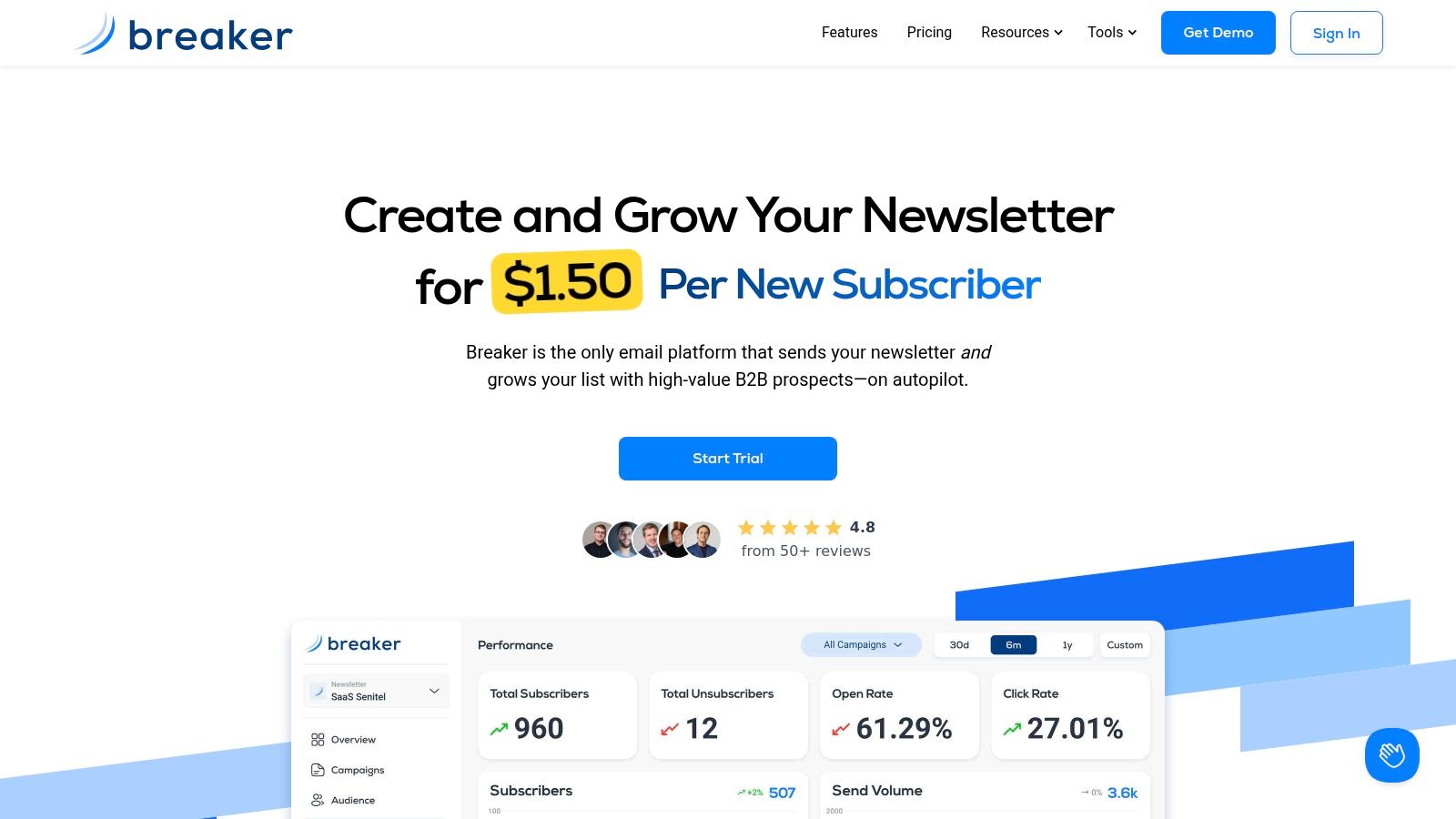
Breaker positions itself as a specialized newsletter platform engineered to convert email marketing into a predictable revenue channel for B2B teams. It directly addresses a core challenge for growth marketers: not just sending emails, but building a high-quality, engaged audience that aligns perfectly with their Ideal Customer Profile (ICP). The platform combines a straightforward campaign builder with an automated list-expansion engine, making it a formidable tool for B2B content marketing programs focused on lead generation and pipeline growth.
Key Features & Use Cases
What separates Breaker is its built-in audience acquisition engine. Instead of relying solely on organic sign-ups, it proactively finds and adds exact-match, engaged subscribers using a combination of custom targeting, AI enrichment, and proprietary data. This is particularly valuable for teams needing to scale their reach quickly without sacrificing lead quality.
- Ideal Use Case: A PLG SaaS company can use Breaker to build a targeted newsletter audience of product managers at mid-market tech firms. The platform's engine will find these specific professionals, and its analytics will track how many sign up for a free trial directly from a newsletter campaign, tying content directly to user acquisition.
- Integrated Deliverability: Breaker includes its TruSend feature, which combines list hygiene and reputation monitoring to maximize inbox placement. This ensures your carefully crafted content actually reaches your audience, a critical factor often overlooked by standard email service providers.
- Performance Analytics: The platform provides real-time analytics that go beyond simple open and click rates. It surfaces subscriber growth trends and ROI, allowing marketers to demonstrate the financial impact of their content programs.
Expert Insight: Breaker’s pay-per-new-engaged-subscriber model aligns cost directly with results. You're not just paying to send emails; you're paying for verified, engaged additions to your audience, which is a significant shift from traditional per-contact pricing.
Pricing & Implementation
Breaker operates on a usage-driven pricing model, with costs tied to the number of new engaged subscribers acquired.
- Starter Plan: Includes 100 new subscribers and up to 50,000 email sends.
- Custom Tiers: Scale for larger needs, supporting 1,000+ new subscribers and over 250,000 sends.
- Trial & Support: All plans come with a 7-day free trial and white-glove support, which helps with initial setup and strategy.
Integrations with CRMs like HubSpot and Salesforce are available, and it connects with monetization tools like Paved, making it adaptable for various B2B workflows.
Limitations
The primary consideration is the pricing model. While it ensures you pay for quality, costs could become unpredictable for teams with very aggressive, large-scale acquisition goals or those targeting lower-conversion market segments. Additionally, the provided marketing materials lack public-facing case studies or customer awards, so prospective buyers should request performance benchmarks and client references during the evaluation process to validate its effectiveness.
Website: https://joinbreaker.ai
2. HubSpot Marketing Hub
HubSpot Marketing Hub functions as a complete content marketing and automation platform built upon a robust CRM. It excels for B2B teams wanting to connect every content asset-from blog posts and landing pages to emails and social media-directly to a contact record. This unified data model is its core strength, allowing marketers to trace a lead's entire journey from their first blog visit to a closed deal.
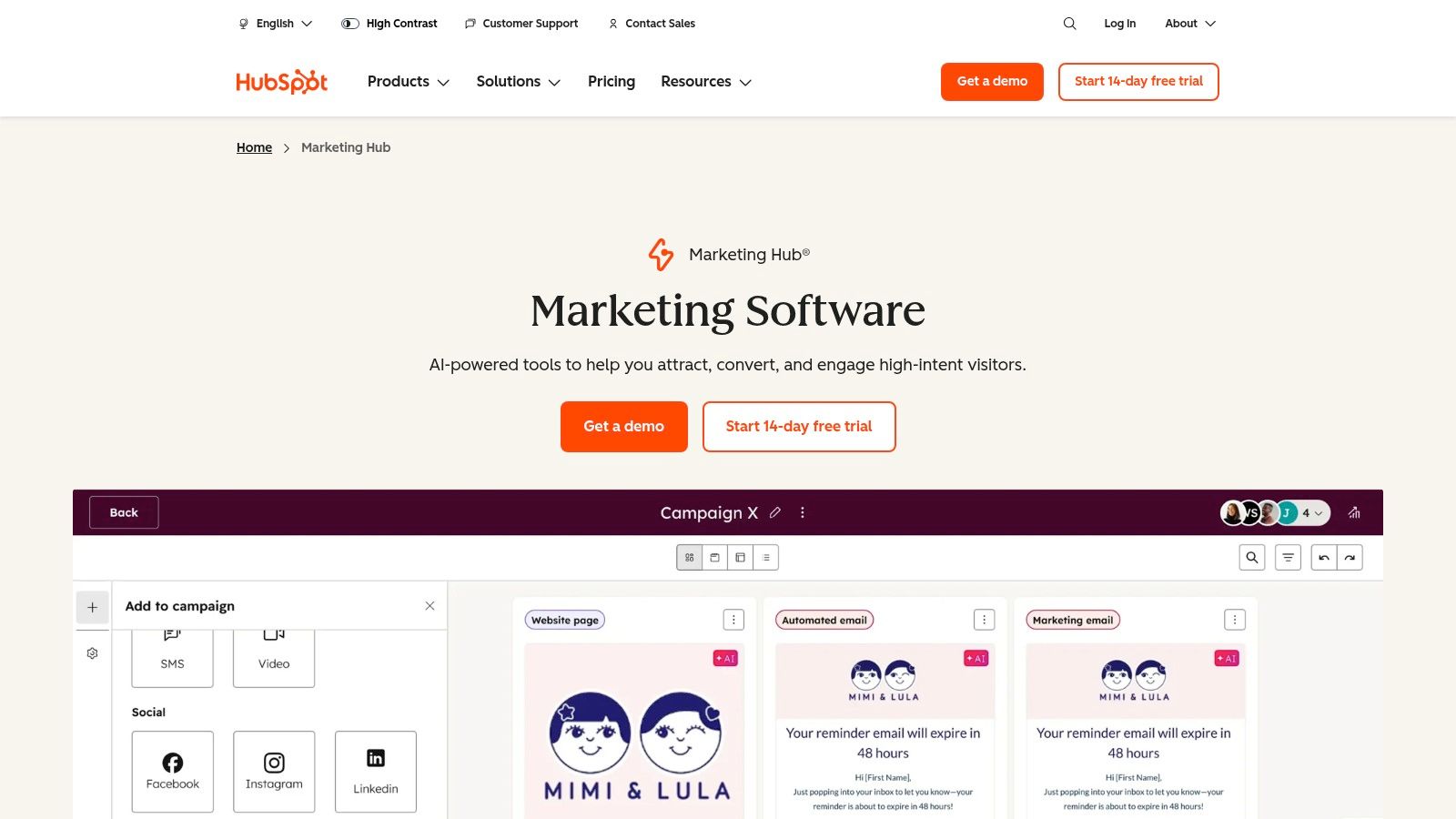
Unlike point solutions, HubSpot combines creation tools (drag-and-drop builders, CMS) with powerful distribution and nurturing features. Its Workflows tool is central to this, enabling the creation of complex, trigger-based email sequences that adapt to user behavior. If you’re looking to scale your lead nurturing, understanding the benefits of marketing automation is a critical first step. The platform’s attribution reporting (in Pro and Enterprise tiers) directly links content marketing efforts to revenue, answering the perennial question of ROI.
Core Features & Use Case
- Ideal Use-Case: A B2B organization scaling its content program and needing to prove ROI by connecting marketing activities directly to sales outcomes and customer lifecycle stages.
- Key Features: Integrated CRM, Workflows for automation, native social and ad management, and attribution reporting.
- Pricing: Starts with free tools, then paid tiers from $18/month (Starter) to $3,600/month (Enterprise), billed annually. Costs scale with contact and user counts.
- Pros: A mature, all-in-one system with extensive integrations and strong educational resources.
- Cons: The contact-based pricing can become expensive quickly as your database grows. Higher tiers often require paid onboarding for full implementation.
Website: https://www.hubspot.com/products/marketing
3. Adobe Marketo Engage
Adobe Marketo Engage is an enterprise-grade B2B marketing automation platform designed for complex nurture sequences, lead management, and cross-channel personalization. It is especially powerful for businesses that need to orchestrate and measure content across long and intricate sales cycles. Where other tools offer broad functionality, Marketo provides operational depth for enterprise content programs that demand granular control.
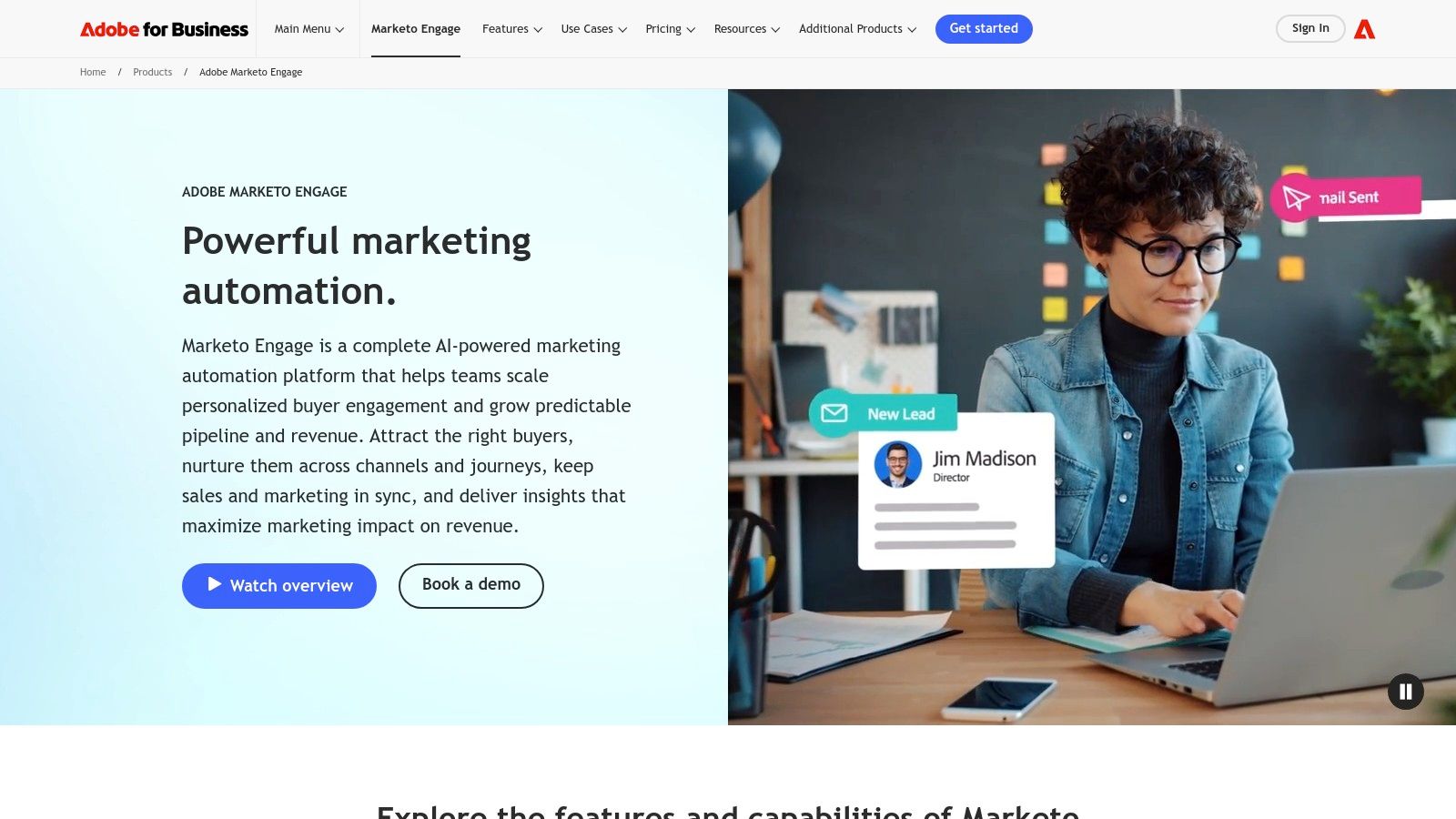
The platform’s real strength lies in its flexibility. Its "Smart Campaigns" engine allows marketers to build highly specific workflows based on a near-limitless combination of triggers and filters. This capability is essential for account-based marketing (ABM) and managing sophisticated lead scoring models. Recent additions include generative AI helpers for creating emails and landing pages, along with tight CRM integrations with Salesforce and Microsoft Dynamics. Marketo is one of the more involved b2b content marketing tools, best for teams with dedicated operations support.
Core Features & Use Case
- Ideal Use-Case: A large enterprise with a dedicated marketing operations team needing to manage complex, multi-touch nurture paths and gain deep insights into long sales cycles.
- Key Features: Advanced lead and account scoring, flexible smart campaigns, generative AI assistants, and native webinar dashboards.
- Pricing: Quote-based and tailored to specific needs. It is positioned at the enterprise level, so expect a significant investment.
- Pros: Extremely flexible smart campaigns for sophisticated B2B workflows and a deep ecosystem of enterprise add-ons like Marketo Measure for attribution.
- Cons: The complexity requires dedicated operations resources to manage effectively. Pricing is quote-based, making it difficult to budget without a direct sales consultation.
Website: https://business.adobe.com/products/marketo.html
4. Salesforce Marketing Cloud Account Engagement (formerly Pardot)
For organizations where Salesforce is the single source of truth for customer data, Account Engagement (formerly Pardot) is a natural fit. This B2B automation tool is engineered for deep integration with the Salesforce CRM, allowing content marketers to connect every email open, form submission, and landing page visit directly to a lead or contact record within the core sales environment. Its strength lies in aligning marketing actions with sales pipeline activity, making it one of the go-to B2B content marketing tools for sales-centric organizations.
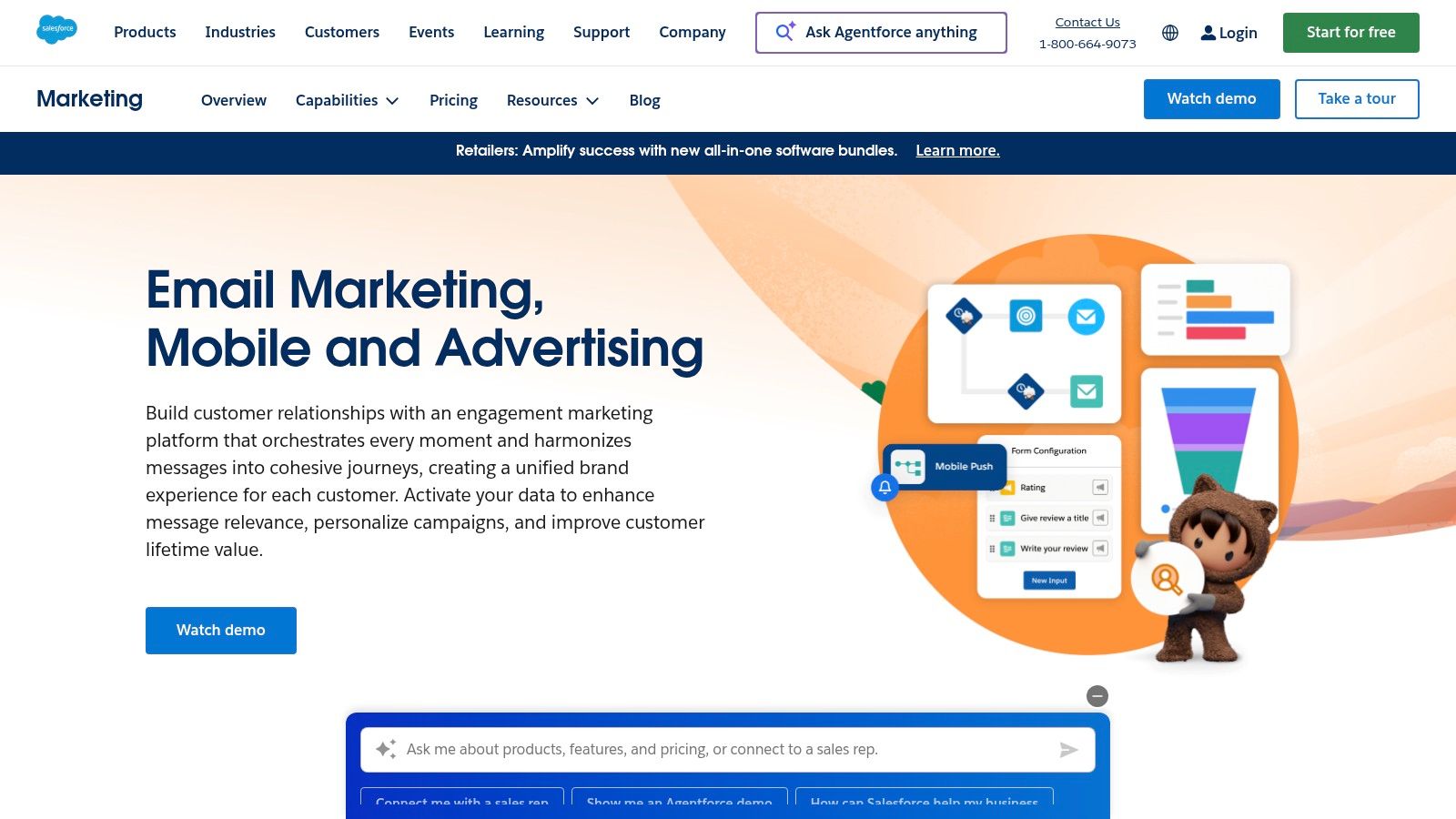
The platform's Engagement Studio provides a visual canvas for building out complex nurture campaigns that respond to prospect behavior. This functionality is supported by robust lead scoring and grading, allowing teams to prioritize leads based on both their fit and their engagement with content. Higher tiers introduce advanced analytics, account-based marketing (ABM) dashboards, and the ability to manage separate business units, which is critical for larger enterprises with distinct divisions. This direct line of sight from marketing content to sales opportunity is its defining characteristic.
Core Features & Use Case
- Ideal Use-Case: A sales-driven B2B company deeply embedded in the Salesforce ecosystem that needs to orchestrate and measure content-driven nurture campaigns against sales pipeline and revenue.
- Key Features: Engagement Studio for multi-step nurture campaigns, lead scoring and grading functionality, and B2B Marketing Analytics dashboards on higher tiers.
- Pricing: Begins at $1,250/month (Growth) for up to 10,000 contacts, scaling to $15,000/month (Premium), billed annually.
- Pros: The native integration with Salesforce CRM is unmatched, and the platform has clear tiering for common B2B needs.
- Cons: Pricing scales with the number of contacts, and some advanced features and analytics are reserved for more expensive plans.
Website: https://www.salesforce.com/products/marketing-cloud/account-engagement/
5. Semrush
Semrush is a foundational B2B content marketing tool, functioning as a comprehensive SEO and competitive intelligence suite. It's built for marketers who need to ground their content strategy in hard data, from initial topic research to post-publication performance tracking. The platform's real power for B2B lies in its ability to uncover what an audience is searching for, how competitors are ranking for those terms, and the precise steps needed to outrank them.
Unlike simple keyword finders, Semrush connects search data to actionable content workflows. Its Keyword Magic Tool helps build topic clusters, while the SEO Content Template provides on-page optimization targets based on top-ranking rivals. The Site Audit feature is critical for maintaining technical health, ensuring that great content is actually discoverable. For those looking to convert the traffic they gain, pairing strong SEO with high-value offers is key; learning how to create content upgrades for lead growth can turn search visibility into tangible leads.
Core Features & Use Case
- Ideal Use-Case: A B2B marketing team focused on building organic authority and using data-driven insights to guide content ideation, optimization, and competitive positioning.
- Key Features: Keyword research and topic clusters, on-page SEO suggestions, competitive analysis and backlink audits, and ContentShake AI for SEO-aware content creation.
- Pricing: Tiers range from $129.95/month (Pro) to $499.95/month (Business), with custom enterprise plans available.
- Pros: An all-in-one research and monitoring platform that reduces tool sprawl. The data coverage is extensive and updated frequently.
- Cons: The price point and breadth of features can be overkill for very small teams or those just starting their content programs.
Website: https://www.semrush.com
6. Ahrefs
Ahrefs is a premier SEO platform that B2B content marketers rely on for competitive research, keyword discovery, and performance tracking. Its strength lies in its massive backlink index and intuitive research tools, which allow teams to deconstruct competitor strategies and identify high-value content opportunities. For B2B, this means validating niche topics, finding gaps in the sales funnel content of rivals, and building a data-backed editorial calendar designed to attract qualified traffic.
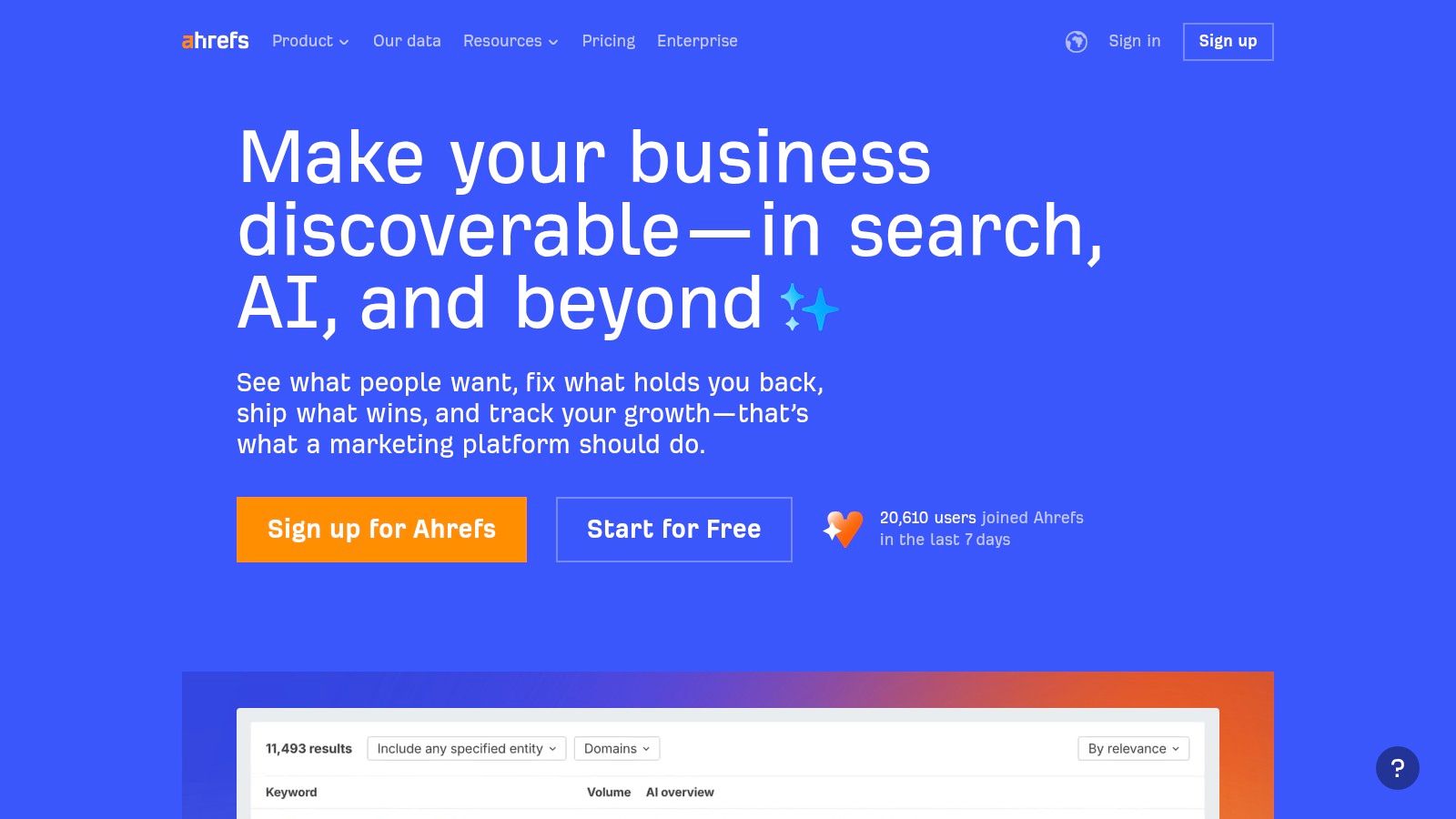
Unlike all-in-one marketing suites, Ahrefs is a specialized instrument for the planning and measurement phases of the content lifecycle. Its Content Explorer tool is particularly effective for finding proven content formats by topic, filtering by traffic value, and identifying articles with high social engagement but low backlink counts-a clear opportunity for outreach. While it's one of the essential b2b content marketing tools for organic growth, it must be paired with a CRM or marketing automation platform to nurture the leads it helps generate.
Core Features & Use Case
- Ideal Use-Case: A B2B company focused on driving organic traffic and using SEO data to guide its content strategy, from top-of-funnel blog posts to bottom-of-funnel comparison pages.
- Key Features: Site Explorer for backlink and traffic analysis, Keywords Explorer for topic research, Content Explorer for content gap analysis, and Rank Tracker for performance monitoring.
- Pricing: Begins with a free Ahrefs Webmaster Tools offering, with paid plans starting from $99/month (Lite) to $999/month (Enterprise).
- Pros: Industry-leading data quality and an intuitive research workflow. Excellent for reverse-engineering what works for competitors.
- Cons: Costs can escalate with more users or higher usage limits. It is a dedicated SEO tool and requires integration with other systems for lead nurturing and activation.
Website: https://ahrefs.com
7. BuzzSumo
BuzzSumo is a content research and digital PR platform designed to give marketers a competitive edge before a single word is written. Its primary function is to analyze massive amounts of web content to reveal what topics are trending, which formats perform best in a specific niche, and what questions your audience is asking. For B2B content teams, this data is crucial for de-risking content production by focusing efforts on topics with proven audience engagement.
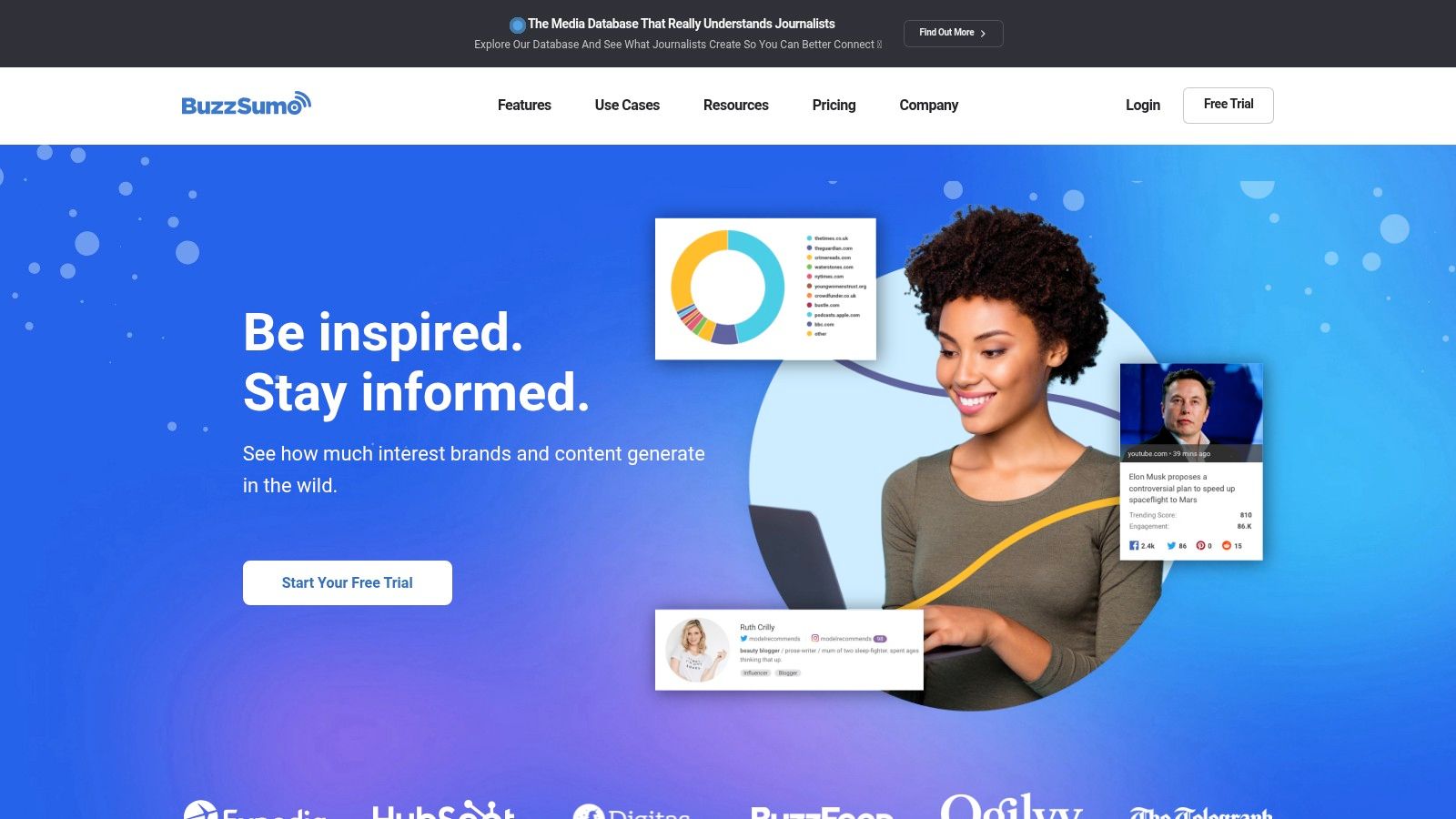
Unlike creation suites, BuzzSumo excels at the ideation and amplification stages. The Content Analyzer shows you top-performing articles for any keyword or domain, complete with backlink and social share data. This insight is critical for spotting content gaps or identifying successful formats to replicate. Its Question Analyzer, which pulls data from forums like Reddit and Quora, is perfect for finding the exact language customers use, making it one of the most practical b2b content marketing tools for building bottom-of-funnel content that answers specific pain points. The platform also includes a media database to find journalists and influencers who can amplify your content once it's published.
Core Features & Use Case
- Ideal Use-Case: A B2B marketing team that needs to validate content ideas with data before production and build a distribution strategy that includes influencer and PR outreach.
- Key Features: Content Analyzer for topic and competitor research, Trending feeds, Question Analyzer, Media Outreach database, and Backlinks tool.
- Pricing: Ranges from $199/month (Content Creation) for core research to $999/month (Enterprise) for full PR and media features.
- Pros: Provides fast, actionable insight into what resonates with your audience. Excellent for combining content strategy with digital PR efforts.
- Cons: Higher-tier plans are expensive, primarily benefiting teams with a strong PR function. It is purely a research and outreach tool, not for content creation or publishing.
Website: https://buzzsumo.com
8. PathFactory
PathFactory is a B2B content intelligence and experience platform designed to guide self-serving buyers through personalized content journeys. It addresses the common problem of disconnected content engagement by transforming static resource centers into dynamic, measurable pathways. For B2B content marketing teams, its key function is to understand how specific assets influence pipeline and revenue, moving beyond simple clicks and downloads to capture deep engagement signals.
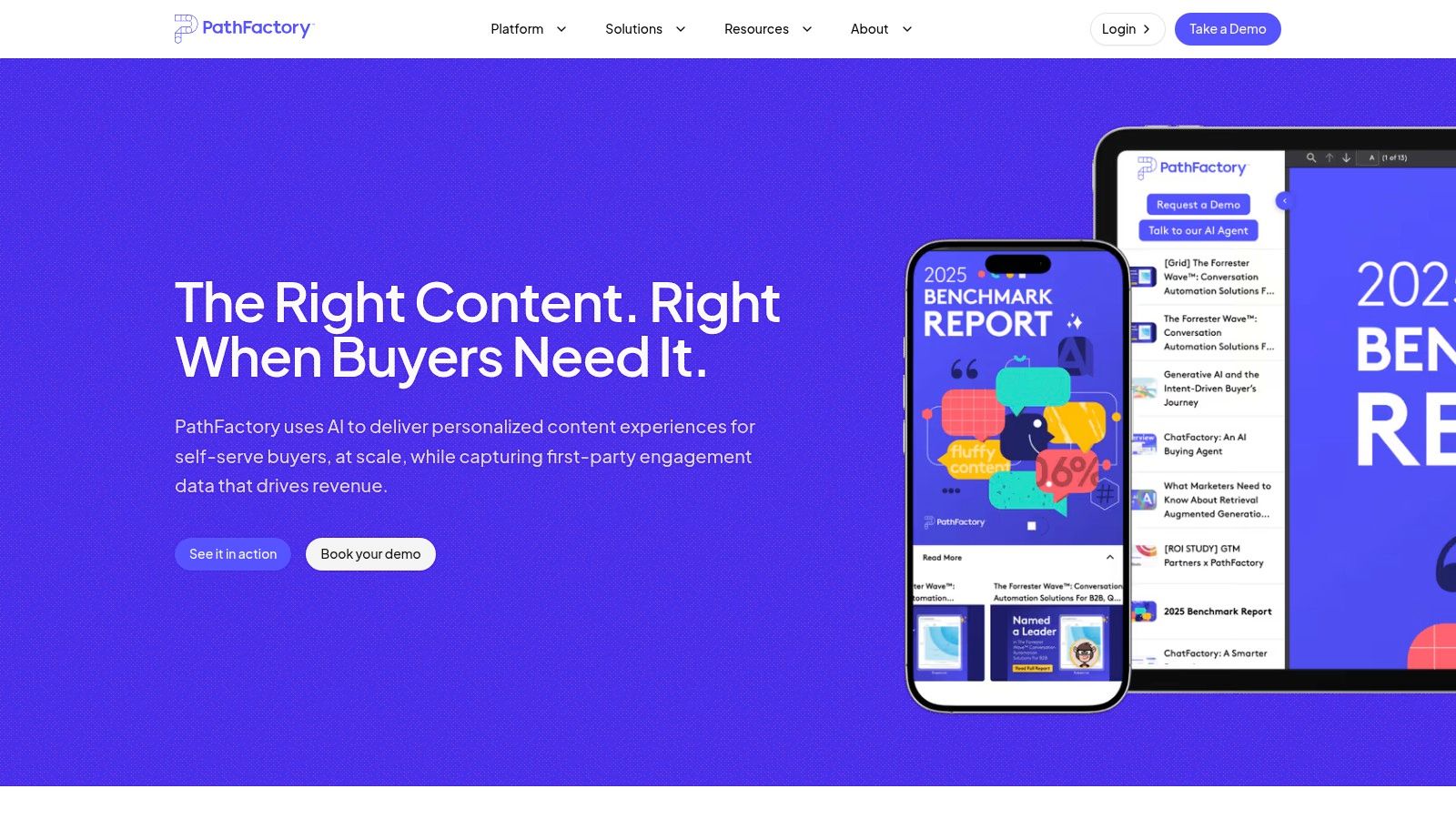
The platform excels at surfacing the "next best asset" for a visitor, using AI to recommend relevant content and keep prospects engaged on your domain. Its ChatFactory feature introduces generative AI buying agents that interact with visitors, surfacing helpful content and capturing intent directly within the chat. This first-party data is then passed to integrated MAP/CRM systems, enriching lead profiles with precise content consumption details, making it a powerful tool for account-based marketing (ABM) and demand generation programs.
Core Features & Use Case
- Ideal Use-Case: B2B organizations with a substantial content library that need to activate it for ABM, personalize the buyer's journey at scale, and gather deep engagement data to accelerate pipeline.
- Key Features: AI-powered content journeys and personalized hubs, ChatFactory generative AI agents, next-best-asset recommendations, and rich first-party engagement data.
- Pricing: Based on custom quotes. Pricing is not publicly listed and requires a consultation.
- Pros: Converts static content hubs into measurable, guided experiences and delivers rich engagement data that is directly tied to pipeline.
- Cons: Quote-based pricing can be a barrier for smaller teams. Requires significant change management and strategic planning to design and implement effective content journeys.
Website: https://pathfactory.com
9. Uberflip
Uberflip is a content experience platform designed to help B2B marketers move beyond static PDF downloads and disconnected blog posts. It allows teams to package existing content-from articles and videos to case studies and whitepapers-into curated, personalized destinations called "streams." This approach is built to accelerate buyer education by guiding prospects through a logical content journey, rather than leaving discovery to chance.
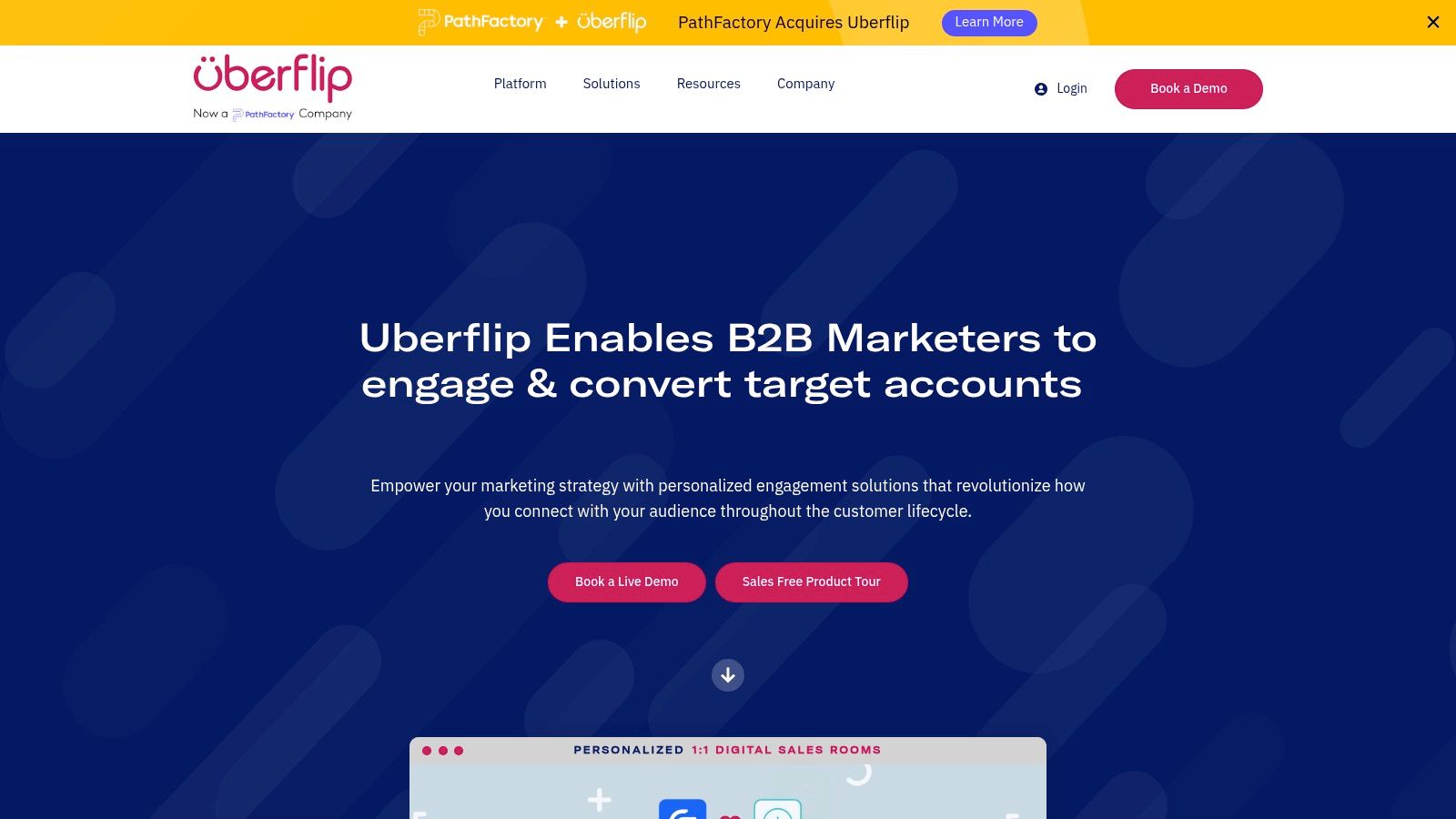
Now part of PathFactory's portfolio, Uberflip's core strength lies in its deep integrations with the B2B martech stack, especially MAP, CRM, and ABM platforms. It uses first-party and third-party intent data from sources like 6sense or Demandbase to dynamically personalize these content streams for specific accounts or visitor segments. This makes it a powerful tool for account-based marketing strategies, ensuring target accounts receive the most relevant assets to move them through the sales funnel. By focusing on engagement within these hubs, marketers can better measure which content actually influences pipeline and revenue.
Core Features & Use Case
- Ideal Use-Case: A B2B marketing team focused on ABM or demand generation that needs to create personalized content destinations for target accounts without extensive development time.
- Key Features: No-code content stream and landing page builder, deep MAP/CRM/ABM integrations, account-level analytics, and personalization based on intent data.
- Pricing: Pricing is not publicly listed and is provided via a custom quote after a sales demo.
- Pros: Significantly shortens the time to build and launch campaign destinations; provides clear measurement on which assets drive account progression and engagement.
- Cons: The custom pricing model can be a barrier for smaller teams. It requires strong content operations discipline to manage and tag assets effectively for personalization.
Website: https://www.uberflip.com
10. 6sense
6sense moves beyond traditional content marketing tools by functioning as an AI-powered Account-Based Marketing (ABM) and revenue platform. Its primary purpose for content marketers is to identify which accounts are actively in-market for your solution, allowing you to aim your content with precision. Instead of a "spray and pray" approach, 6sense uses its "Signalverse" of predictive intent data to prioritize accounts and buying groups, ensuring your valuable content reaches prospects at the exact moment they are researching.
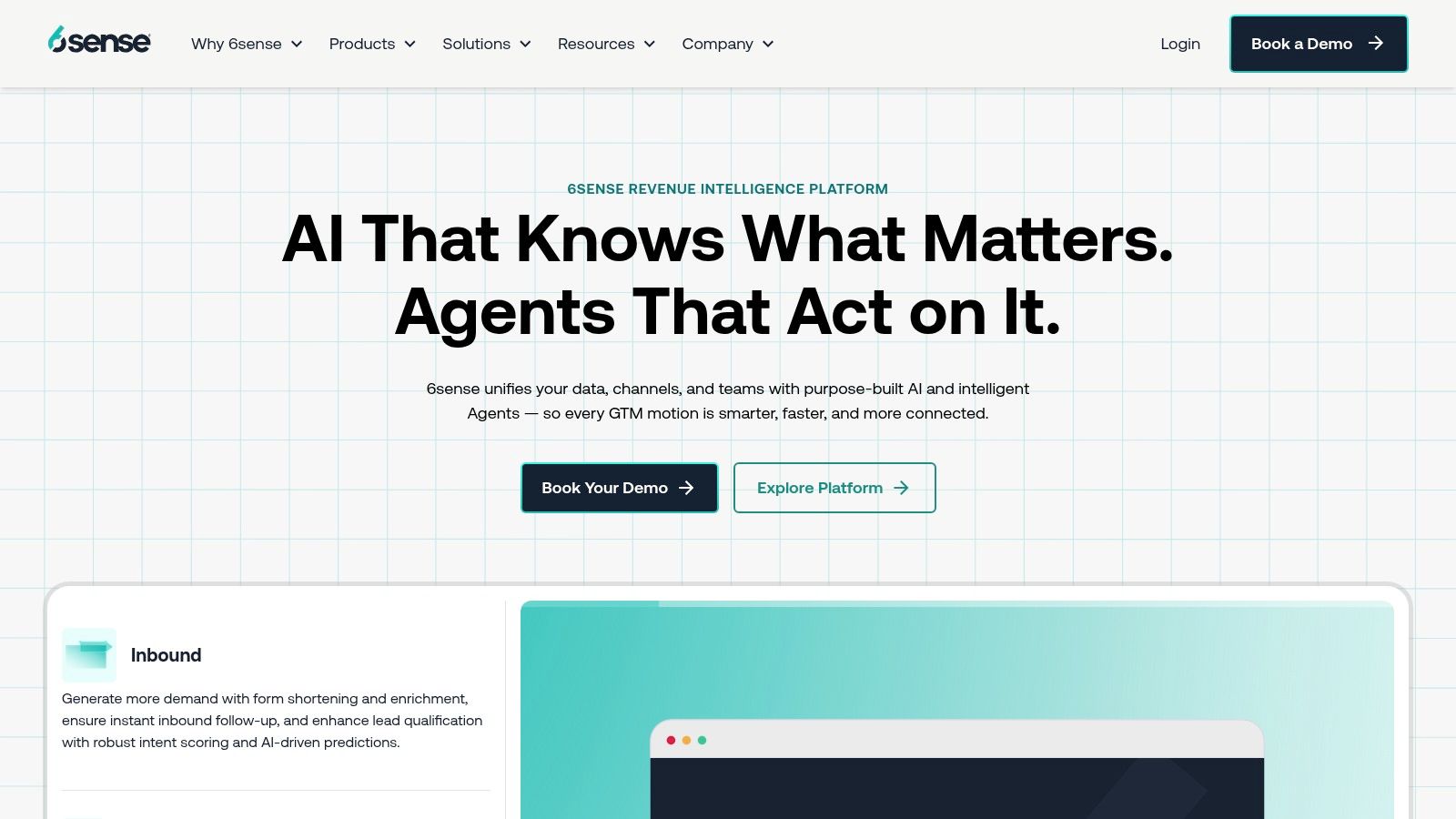
The platform connects this powerful intent data directly to action. Marketers can orchestrate cross-channel plays across digital ads, email, web personalization, and sales outreach from a single interface. This means you can serve a specific whitepaper to an account showing early-stage interest, then trigger a sales alert when their engagement deepens. By tying anonymous website visitor identification and contact data together, it answers the critical question of which accounts are engaging with your content and how to act on it. While it's a powerful tool on its own, its effectiveness is amplified by pairing it with top-tier data enrichment services to maintain a clean and complete data foundation.
Core Features & Use Case
- Ideal Use-Case: Enterprise or high-growth B2B companies with a defined Ideal Customer Profile (ICP) looking to focus their content and ad spend on accounts with proven buying intent.
- Key Features: Predictive intent and pipeline scoring, web visitor identification, automated orchestration of cross-channel plays, and Sales Intelligence with contact/company data.
- Pricing: Primarily enterprise-level contracts with custom pricing. A significant annual investment is typical. They offer a free tier for their Sales Intelligence product.
- Pros: Aligns content activation directly to in-market intent signals, reducing wasted spend. Automates complex, cross-channel journeys for target accounts.
- Cons: Enterprise-focused pricing puts it out of reach for many smaller businesses. Requires a mature marketing and sales operation to fully implement and see value.
Website: https://6sense.com
11. Demandbase
Demandbase is a sophisticated go-to-market platform built for Account-Based Marketing (ABM). It moves beyond individual lead metrics, focusing instead on identifying and engaging entire buying groups within target accounts. The platform unifies intent data, advertising, web personalization, and sales activities, making it one of the more powerful b2b content marketing tools for teams aiming to prove their content's direct influence on high-value pipeline.
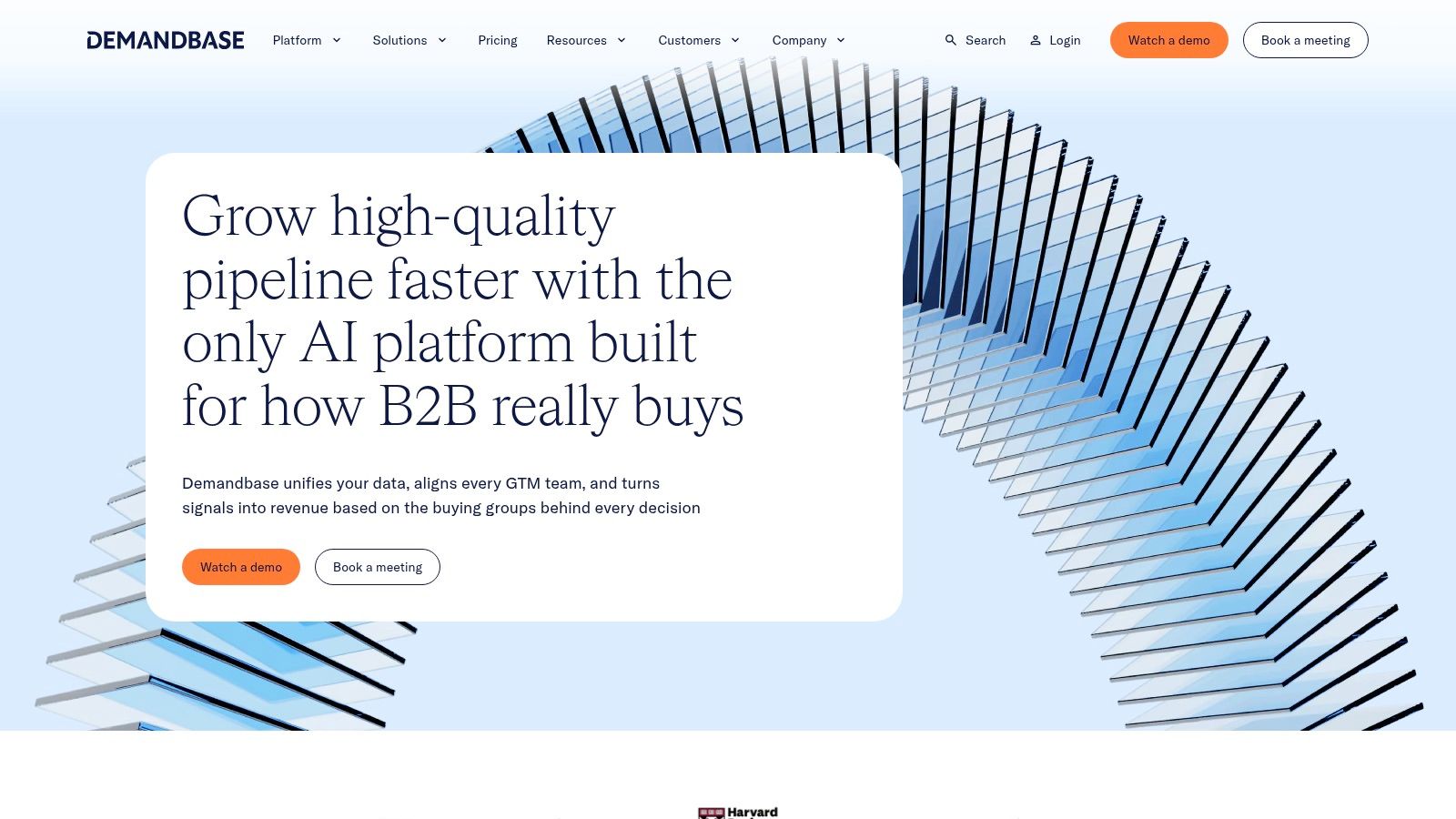
Its core strength lies in its "Pipeline AI," which helps marketers pinpoint in-market accounts and understand the composition of their buying committees. This allows content to be orchestrated precisely across channels, from targeted ads to personalized website experiences, all based on the account's stage and interests. The platform's open architecture ensures it can integrate with your existing CRM, marketing automation, and content systems, providing a central hub for executing and measuring complex ABM campaigns.
Core Features & Use Case
- Ideal Use-Case: An enterprise B2B company with a defined list of target accounts that needs to coordinate content across marketing and sales to influence buying committees and measure pipeline impact.
- Key Features: In-market account identification, buying-group views, multi-channel orchestration (ads, web, sales), and deep integrations with CRM and marketing automation platforms.
- Pricing: Quote-based pricing is available through their sales team. It's generally positioned for mid-market to enterprise companies, with costs reflecting the platform's advanced capabilities.
- Pros: Provides clear, actionable ABM workflows from data to execution. Directly connects content marketing activities to account-level pipeline and revenue.
- Cons: Can be expensive and often requires a dedicated team or expert for initial setup and ongoing management. The implementation effort is significant compared to simpler tools.
Website: https://www.demandbase.com
12. Bombora
Bombora is not a content creation tool but an industry-leading third-party B2B intent data provider. It identifies which companies are actively researching topics relevant to your business, allowing you to prioritize accounts for marketing and sales outreach. This information is sourced from a massive data co-op of over 5,000 B2B websites, providing insight into which accounts are showing "Company Surge" activity around specific keywords, giving your content a pre-qualified audience.
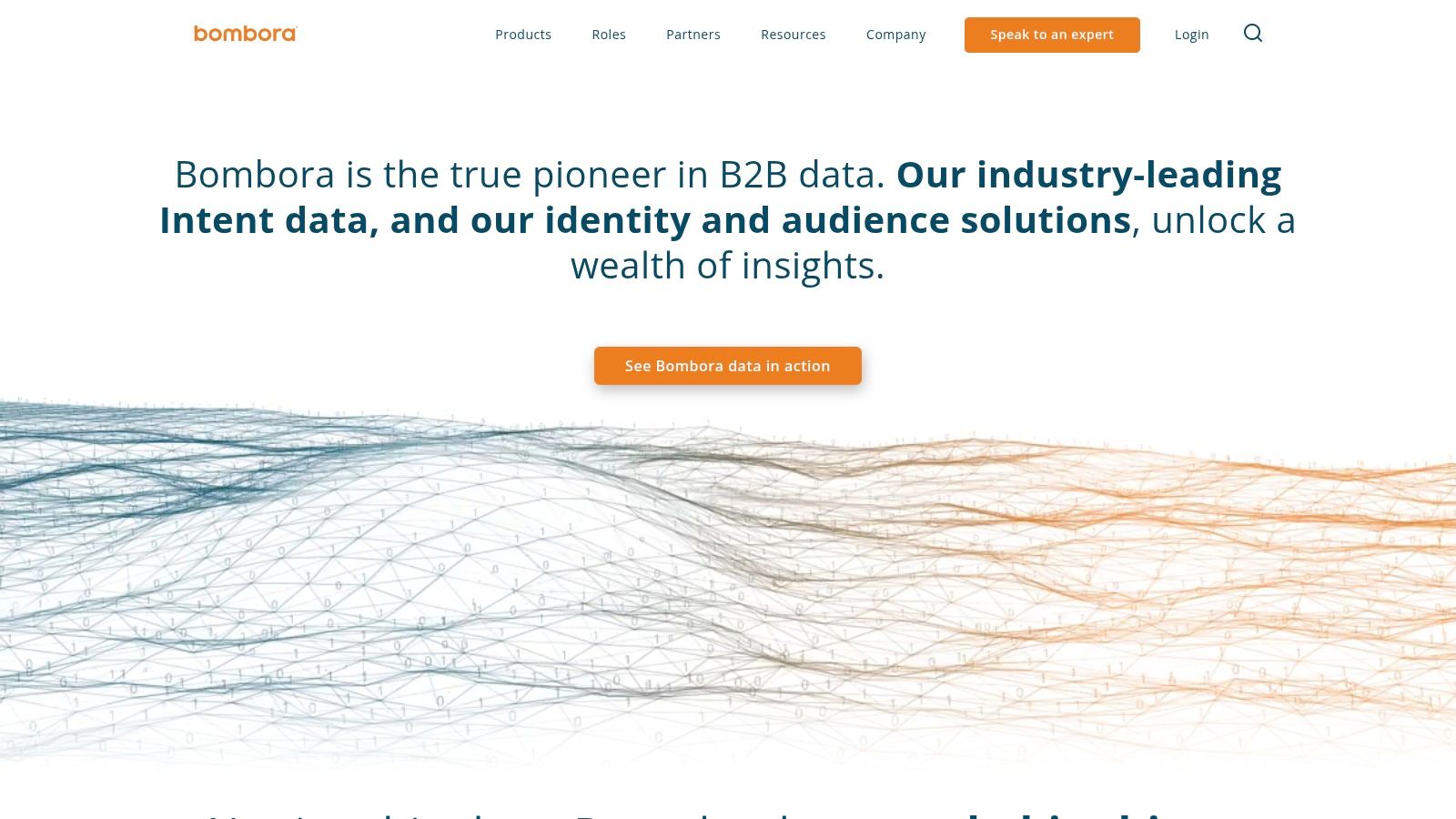
The power of Bombora lies in its ability to focus your content marketing efforts. Instead of a "spray and pray" approach, you can target advertising, personalize website content, and trigger sales outreach to accounts that are already in-market. By integrating Bombora's data into your CRM or marketing automation platform, you can create dynamic audiences for your campaigns, ensuring your white papers, case studies, and webinars reach decision-makers at the exact moment they are looking for a solution. This makes it one of the most strategic b2b content marketing tools for account-based marketing programs.
Core Features & Use Case
- Ideal Use-Case: A B2B organization with a defined Ideal Customer Profile (ICP) looking to implement or scale an ABM strategy by targeting accounts showing active buying signals.
- Key Features: Company Surge analytics, a large B2B data co-op, extensive topic taxonomy, and native integrations with Salesforce, HubSpot, and ad platforms.
- Pricing: Pricing is entirely custom and quote-based, depending on the number of topics, accounts monitored, and integration points.
- Pros: Delivers high-quality, consent-based intent data that is widely recognized in the industry. It significantly improves content targeting relevance and sales efficiency.
- Cons: Requires a dedicated budget and internal enablement to properly operationalize the data; it's not a plug-and-play solution for small teams.
Website: https://bombora.com
B2B Content Marketing: Top 12 Tool Comparison
Product
Core features ✨
Quality & UX ★
Price / Value 💰
Best for 👥
Breaker 🏆
✨ Automated list-expansion, AI enrichment, TruSend deliverability, CRM & sponsorship integrations
★★★★☆ Real-time analytics; inbox-focused deliverability & hygiene
💰 Pay-per-new-engaged-subscriber; Starter (100 new subs, 50k sends); 7‑day trial & white‑glove
👥 B2B growth teams, agencies, PLG marketers
HubSpot Marketing Hub
✨ Drag-and-drop emails/pages, workflows, native CRM attribution
★★★★☆ Unified UX; strong reporting; CRM-native
💰 Contact-based tiers (scales with contacts/users)
👥 Content-led B2B teams, SMB → mid-market
Adobe Marketo Engage
✨ Advanced lead/account scoring, smart campaigns, AI helpers
★★★★★ Enterprise-grade automation; flexible personalization
💰 Quote-based enterprise pricing
👥 Large enterprises with dedicated ops
Salesforce MC Account Engagement (Pardot)
✨ Engagement Studio, scoring/grading, B2B analytics
★★★★☆ Tight Salesforce sync; robust B2B reporting
💰 Contact-scaled pricing; higher tiers add features
👥 Orgs standardized on Salesforce; sales-aligned teams
Semrush
✨ Keyword/topic research, site audit, competitive intelligence
★★★★★ Broad SEO data; frequent updates
💰 Subscription tiers; strong value for research
👥 SEO & content teams planning distribution
Ahrefs
✨ Backlink index, Site/Keyword/Content Explorer, rank tracking
★★★★★ Best-in-class backlink analysis & research UX
💰 Subscription tiers; costs rise with usage
👥 SEO professionals and competitive researchers
BuzzSumo
✨ Content analyzer, trending feeds, media & influencer database
★★★★☆ Fast insight into what resonates; PR-friendly
💰 Tiered pricing; PR modules add cost
👥 Content marketers & PR/outreach teams
PathFactory
✨ AI-powered content journeys, ChatFactory, revenue-aligned analytics
★★★★★ Converts hubs into measurable guided journeys
💰 Quote-based (enterprise)
👥 ABM & demand-gen teams measuring asset impact
Uberflip
✨ Curated content streams, no-code builder, MAP/ABM integrations
★★★★ Improves discoverability; quick campaign destinations
💰 Demo-led / quote pricing
👥 Campaign teams building resource hubs
6sense
✨ Predictive intent (Signalverse), visitor ID, orchestration
★★★★★ Strong in-market signals & cross-channel plays
💰 Enterprise pricing; significant investment
👥 Enterprise ABM & revenue ops teams
Demandbase
✨ Pipeline AI, in-market account ID, ads/web activation
★★★★★ Unified ABM workflows; pipeline measurement
💰 Quote-based; enterprise implementation
👥 ABM teams seeking account-level activation
Bombora
✨ Company Surge intent data, large data co-op, CRM integrations
★★★★★ High-coverage intent signals for targeting
💰 Custom pricing; requires enablement
👥 ABM & demand teams needing intent signals
From Tools to System: How to Build Your B2B Content Engine
We’ve explored a dozen powerful B2B content marketing tools, from foundational automation platforms to advanced intent data providers. But a list of tools is not a strategy. The real advantage comes from selecting and integrating these individual applications into a cohesive system, an engine that transforms your content efforts from a series of disjointed campaigns into a predictable revenue-generating machine. For the operating model behind the stack, start with our explainer on what a B2B content engine is.
The tools covered in this guide fall into distinct categories, each mapping to a crucial stage of the B2B content lifecycle:
- Core Automation & Growth: The central nervous system. Tools like HubSpot, Marketo, and Pardot manage your audience data, while platforms like Breaker are built specifically to accelerate audience and newsletter growth.
- SEO & Research: Your intelligence layer. Semrush, Ahrefs, and BuzzSumo help you understand what your audience is searching for and what content is performing best.
- Content Experience: How you present your value. PathFactory and Uberflip move beyond static PDFs to create personalized, binge-worthy content journeys that guide prospects toward a decision.
- Account-Based & Intent Data: The targeting mechanism. 6sense, Demandbase, and Bombora identify which accounts are actively in-market, allowing sales and marketing to focus their efforts with precision.
Building Your Stack: Starter vs. Enterprise
The right combination of B2B content marketing tools depends entirely on your team's size, budget, and maturity. A common mistake is over-investing in complex enterprise software before the foundational processes are in place.
The Starter Stack
For a small marketing team, a consultant, or a growing business, the focus should be on agility and direct impact. A lean, effective stack might look like this:
- Core: A native CMS (like Webflow or WordPress) for content creation.
- Growth: Breaker to build and monetize a newsletter audience directly.
- Research: Semrush or Ahrefs for keyword research and competitive analysis.
This stack is cost-effective and prioritizes the two most important functions: creating discoverable content and building a direct relationship with your audience.
The Enterprise Stack
For a larger organization with dedicated teams and a significant budget, the goal is scale, personalization, and deep sales alignment. An enterprise-grade stack could include:
- Core Automation: Marketo or Pardot for sophisticated lead nurturing and scoring.
- Content Experience: PathFactory to create personalized resource hubs and track content engagement at the account level.
- Intent Data: 6sense or Demandbase to identify in-market accounts and orchestrate cross-channel campaigns.
- Research: Ahrefs for deep technical SEO and backlink analysis.
This combination allows for highly targeted, account-based marketing programs informed by real-time buyer intent and deep content analytics. To effectively operate at this scale, understanding and implementing the latest 10 Enterprise B2B Content Marketing Best Practices is crucial for maximizing your return on this significant technology investment.
Your Next Step: Solve Your Biggest Bottleneck First
The most important takeaway is this: don’t try to solve every problem at once. Instead of feeling overwhelmed by the options, start by performing an honest assessment of your current content marketing program.
Identify your single biggest bottleneck.
- Is it audience growth? Are you struggling to build a subscriber list?
- Is it content discovery? Is your excellent content failing to rank or get seen?
- Is it sales alignment? Does your sales team complain about lead quality or lack of insight?
Once you pinpoint that primary pain point, select the one tool from this list that directly addresses it. If your problem is audience growth, start with a tool like Breaker. If it's SEO, choose Semrush. If it's proving content ROI to sales, look at PathFactory. Start small, master the tool, demonstrate its value, and then build your stack layer by layer. This methodical approach ensures each new tool adds measurable value, turning your collection of software into a powerful, integrated content engine.
Ready to fix your biggest bottleneck and start building a high-growth audience? Breaker is the B2B content marketing tool designed to help you launch, grow, and monetize your newsletter. Turn your expertise into your most valuable marketing channel by visiting Breaker to get started.
Keep reading
All articlesNewsletter Analytics: Which Metrics Actually Matter in 2026
Open rate and clicks don't predict buyers. Learn the 7-step method to track click depth, recency, and topic affinity for a revenue-predictive intent score.
Newsletter Segmentation Strategy: Increase Engagement in 2026
Build a data-driven newsletter segmentation strategy using behavior, intent score, and topic affinity to lift opens and clicks. Step-by-step guide.
How to Grow Newsletter Subscribers with Qualified Leads in 2026
Discover 8 channels to grow engaged newsletter subscribers in 2026, with real cost-per-engaged-subscriber data to focus your list-building strategy.