
12 B2B Email Drip Campaign Templates & Tools to Drive Growth in 2026
Unlock growth with our curated B2B email drip campaign templates. Get actionable copy, timing, and tool insights to automate your lead nurturing and sales.
Email drip campaigns are a fundamental part of B2B marketing automation. They work around the clock to turn new leads into qualified opportunities, guide trial users toward paid conversion, and keep existing customers engaged. However, creating these sequences from a blank slate is a major drain on resources, requiring significant time for strategy, copywriting, and setup. This is where a solid collection of email drip campaign templates becomes invaluable.
This resource is designed to be your go-to playbook. We've compiled a complete set of actionable templates for the most critical B2B scenarios, including welcome series, lead nurturing, trial-to-paid conversion, churn prevention, and sales follow-ups. Instead of just theory, you'll get the real components you need to get started fast.
Inside, you will find:
- Full email copy snippets you can adapt.
- Recommended timing and cadence for each message.
- Key performance benchmarks to measure success.
- Clear instructions for implementing these sequences in platforms like Breaker.
We’ll also analyze the top marketing automation platforms, from HubSpot and ActiveCampaign to Mailchimp and Klaviyo, that offer these kinds of templates built-in. This will help you select the right toolset for your specific automation goals. By the end, you'll have everything required to build and launch effective drip campaigns that produce tangible results, helping you move from manual outreach to automated growth. Let's get started.
1. HubSpot Marketing Hub
HubSpot Marketing Hub is an all-in-one platform where the power lies in its deep integration with a native CRM. This connection makes it a standout choice for B2B companies whose drip campaigns must be closely aligned with sales activities and a long customer journey. Instead of just offering standalone email drip campaign templates, HubSpot provides entire pre-built workflows. These can include branching logic based on contact properties or behaviors, task creation for sales reps, and updates to CRM records, all triggered from a single automated sequence.
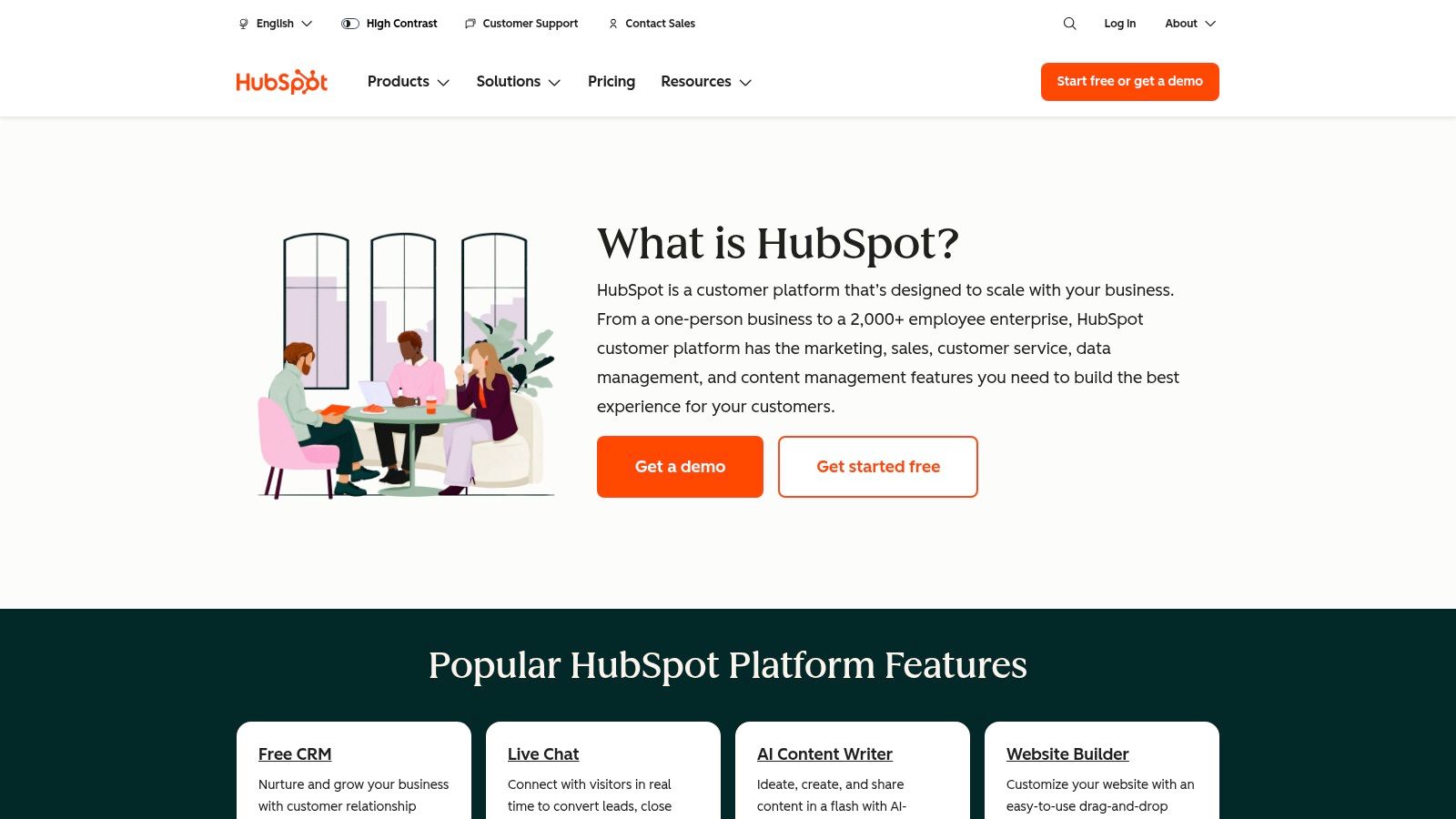
The visual workflow builder is a core feature, allowing you to map out complex multi-channel sequences that go beyond email to include internal notifications and data management. For a B2B growth marketer, this means you can build a trial-to-paid sequence that not only sends nurturing emails but also notifies a sales rep when a user engages with a high-value feature.
Key Details & Considerations
- Best For: B2B companies needing tight sales and marketing alignment.
- Unique Feature: The visual workflow builder is connected directly to a native CRM, forms, and analytics, providing a single source of truth for contact engagement.
- Pricing: The platform's pricing is a significant factor. It scales based on your number of marketing contacts and the feature tier you select (Starter, Professional, Enterprise), which can become costly for fast-growing businesses.
- Limitation: While powerful, the sheer number of features can present a steep learning curve for teams new to marketing automation.
Its extensive documentation and vast ecosystem of service partners offer strong support. This makes HubSpot a reliable, albeit premium, option for executing sophisticated B2B drip strategies.
Website: https://www.hubspot.com/marketing
2. ActiveCampaign
ActiveCampaign excels by offering a massive library of importable "automation recipes," which serve as powerful email drip campaign templates. This approach provides a significant advantage for teams wanting both a quick start and the capacity for future complexity. You can launch a campaign in minutes by importing a proven recipe, making it ideal for consultants or growth teams needing immediate results without building from scratch.
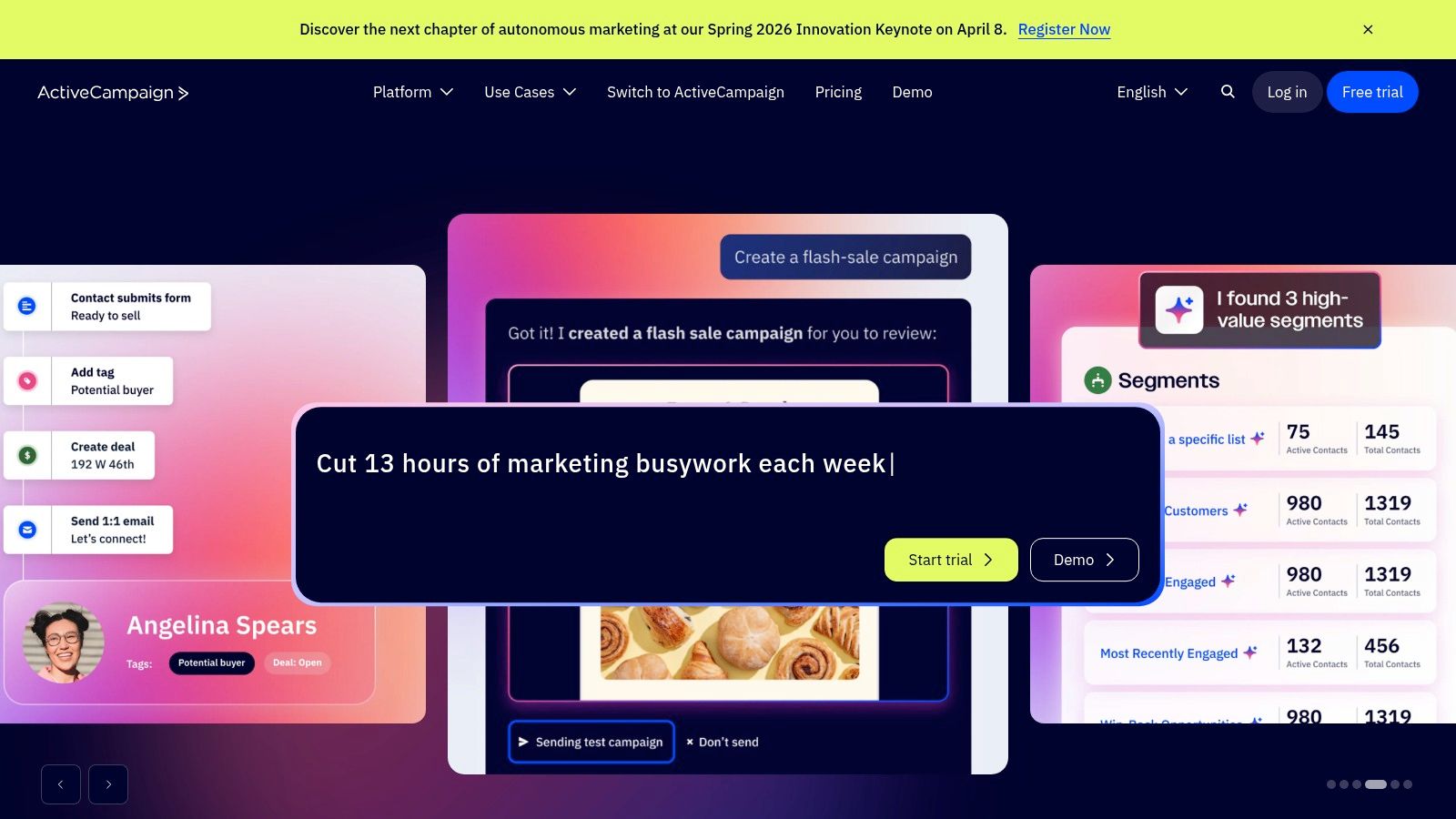
Unlike platforms that only offer email sequences, ActiveCampaign's recipes are true automations. They can include engagement tagging, split-path logic based on user actions, and goal-setting to pull users forward in a sequence once they convert. The visual builder allows you to see this logic clearly and modify pre-built recipes or create your own intricate, multi-branch journeys that scale with your business needs.
Key Details & Considerations
- Best For: B2B teams and consultants who need to deploy proven drip sequences quickly but require the power to build more complex automations later.
- Unique Feature: An extensive library of over 200 pre-built automation recipes and a public Marketplace where users can share their own. The ability to import automations via a share link is a standout for fast setup.
- Pricing: Plans are based on the number of contacts and feature set (Plus, Professional, Enterprise). It's generally more accessible at lower tiers than all-in-one suites, but costs rise with contact list growth and advanced features.
- Limitation: While importing recipes is simple, the learning curve can become steep when you start customizing them with advanced conditions, goals, and split logic.
ActiveCampaign’s strength is its balance between accessibility and depth. It provides the templates to get started fast and the automation engine to support sophisticated, behavior-driven B2B marketing as you grow.
Website: https://www.activecampaign.com
3. Mailchimp
Mailchimp is a widely recognized entry point into email marketing, offering an approachable platform for small teams and mid-market companies. Its strength lies in providing pre-built customer journey templates for common flows like welcoming new subscribers, re-engaging inactive contacts, and recovering lost customers. Instead of requiring users to build complex logic from scratch, Mailchimp offers ready-made email drip campaign templates that can be activated quickly. This makes it a great choice for businesses that need to implement standard automated sequences without a steep learning curve or a dedicated automation specialist.
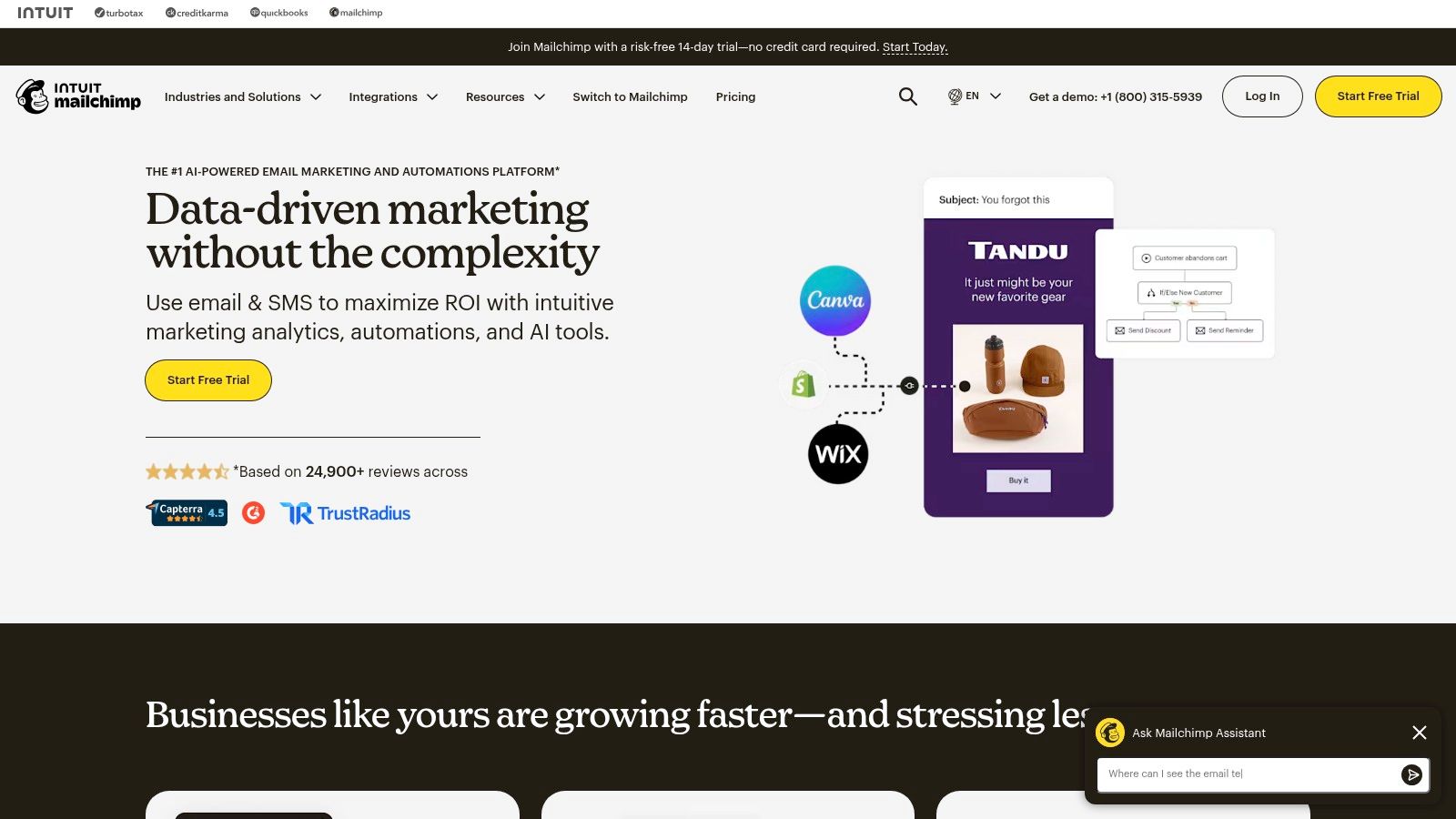
The drag-and-drop Customer Journey Builder allows for customization beyond the initial templates, letting you map out multi-step email sequences and configure steps based on ecommerce store or product activity. For a B2B marketer with a simple sales funnel, this means you can set up a nurture sequence that sends different messages based on whether a contact has visited a specific pricing page or downloaded a resource. Its broad ecosystem of integrations ensures it connects with many popular CRM and ecommerce platforms.
Key Details & Considerations
- Best For: Small to mid-market businesses needing straightforward automation and pre-built journeys.
- Unique Feature: The pre-built journey templates provide an excellent starting point for teams new to automation, dramatically speeding up the implementation of common drip campaigns.
- Pricing: Mailchimp's pricing is tiered, with feature access and send limits tied directly to your plan (Free, Essentials, Standard, Premium). Advanced automation features are restricted to higher-paid tiers, which can be a deciding factor as your needs grow.
- Limitation: While the builder is easy to use, the logic and branching capabilities are less advanced compared to more enterprise-focused platforms, making it restrictive for highly complex or multi-channel B2B funnels.
Its user-friendly interface makes it a practical option for getting essential B2B drip campaigns running with minimal technical overhead.
Website: https://mailchimp.com
4. Klaviyo
While often associated with e-commerce, Klaviyo’s automation engine is a powerhouse for any business focused on behavior-driven communication. Its core strength lies in a massive library of over 60 pre-built automated "flows," which are essentially advanced email drip campaign templates. These flows come with pre-configured branching logic based on user actions, such as viewing a product, starting a checkout, or engaging with an SMS message. This makes it an exceptional tool for sophisticated lifecycle and abandonment drips that can be adapted for B2B SaaS trials or product-led growth funnels.
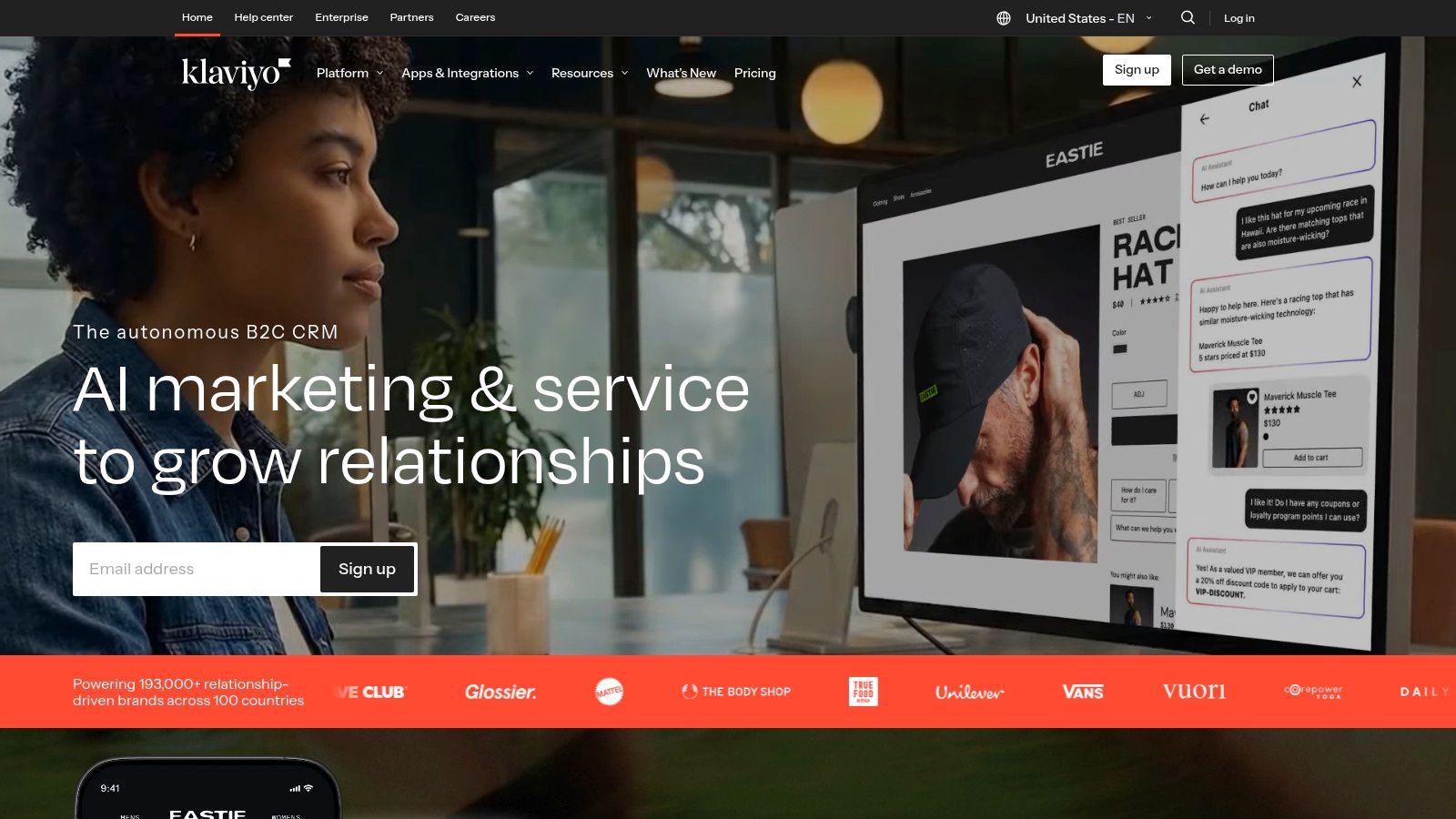
The platform stands out for its native multi-channel capabilities. A single automated flow can seamlessly incorporate email, SMS, push notifications, and even webhook actions to update external systems. For a product-led growth team, this means a trial onboarding sequence can send an initial welcome email, follow up with an SMS tip a day later, and trigger a push notification when a user unlocks a key feature, all from one visual builder. This integrated approach to messaging is a significant advantage.
Key Details & Considerations
- Best For: Product-led companies and B2B marketers needing multi-channel, behavior-driven automation.
- Unique Feature: The extensive library of pre-built flows includes complex, behavior-based splits and multi-channel actions (email, SMS, push, webhook) right out of the box.
- Pricing: The free tier is generous, but pricing scales with contact list size and email/SMS volume, which can become expensive for companies with large audiences or high-frequency messaging.
- Limitation: The platform is heavily geared toward user actions and events. Businesses with very long, static sales cycles might find its event-based model less intuitive than a contact property-based system.
Klaviyo’s robust feature set and focus on behavioral triggers make it a top choice for executing dynamic drip campaigns that respond directly to user engagement across multiple touchpoints.
Website: https://www.klaviyo.com
5. Drip
Drip takes a template-first approach to automation, making it particularly accessible for e-commerce brands and marketers who want to deploy campaigns quickly. The platform’s core strength is its extensive in-app catalog of pre-designed workflow templates. This allows users to find and implement complete sequences for common use cases like welcome series, win-back campaigns, and abandoned cart reminders without building them from scratch.
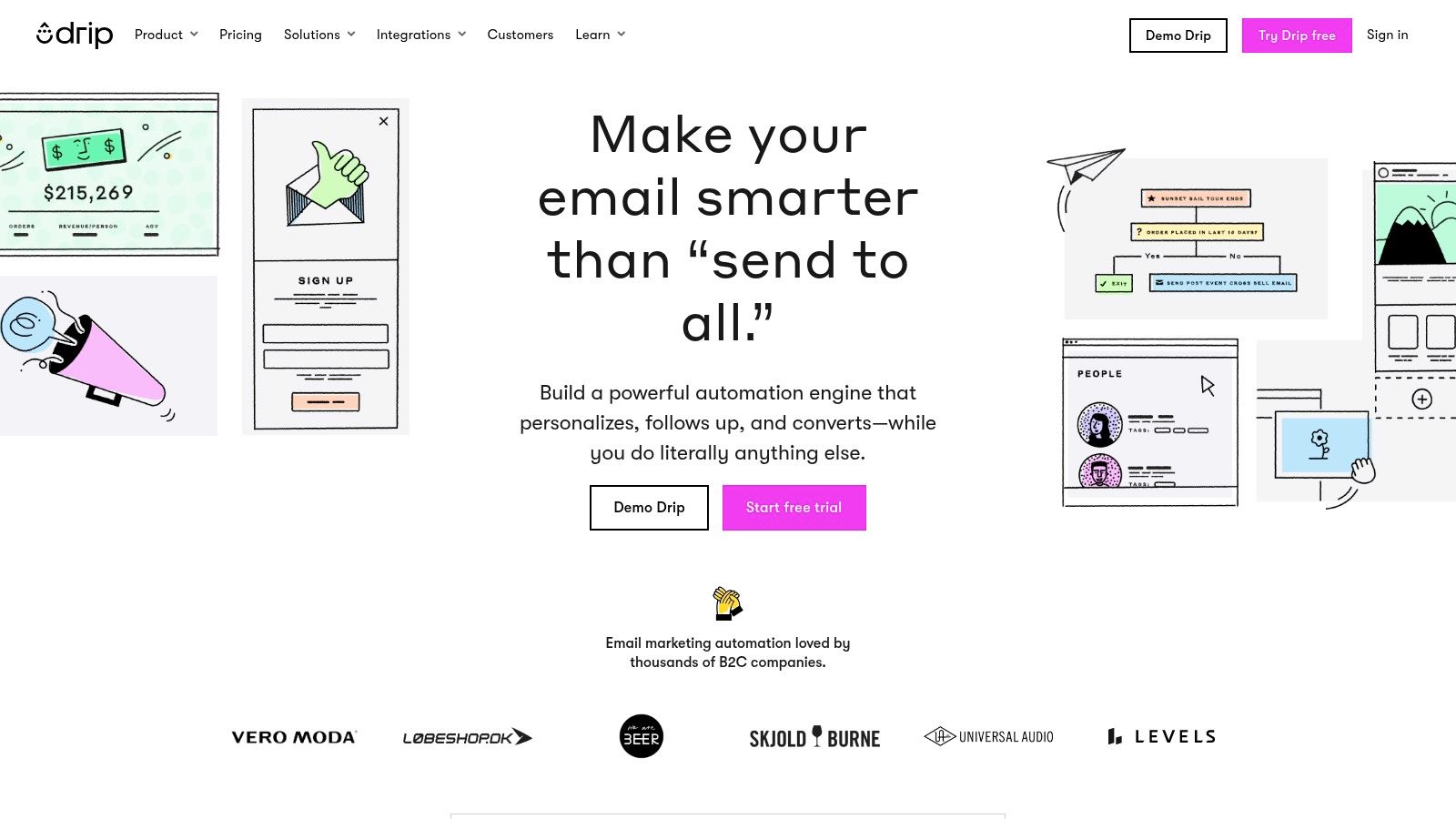
Unlike platforms that start with a blank canvas, Drip guides you through industry-specific sets, such as for travel or hospitality, where email nodes are pre-configured. This guided setup, combined with a visual builder for customization, strikes a balance between ease of use and flexibility. The "Quick Send" template is another practical feature for simple trigger-and-send automations, removing unnecessary complexity for straightforward tasks.
Key Details & Considerations
- Best For: E-commerce businesses and marketers prioritizing speed and ease of setup.
- Unique Feature: An extensive, searchable library of email drip campaign templates and workflows organized by industry and use case, allowing for rapid deployment.
- Pricing: Drip’s pricing is based on the number of contacts in your account. The single plan includes all features, so cost scales transparently as your audience grows, starting from a base monthly fee.
- Limitation: The platform’s features and templates are heavily geared toward e-commerce. B2B companies may find the terminology and pre-built logic less suited to their needs and may need to verify its fit for a non-retail sales cycle.
Drip’s focus on providing ready-made solutions makes it a strong contender for teams that need effective automation without a significant investment in initial setup and configuration.
Website: https://www.drip.com
6. Omnisend
Omnisend specializes in rapid deployment for ecommerce businesses, offering a gallery of fully prebuilt automation workflows that can be launched in minutes. Instead of building from scratch, users can immediately access ready-made email drip campaign templates for welcome series, cart abandonment, cross-selling, and customer reactivation. This focus on time-to-value makes it a strong choice for online stores that need to implement core lifecycle marketing without a long setup period.
The platform provides complete flows with pre-written messages, subject lines, and timing delays, all optimized for ecommerce triggers. Its editor allows for quick customization and reuse of branded templates across different automations, which helps maintain brand consistency. For a direct-to-consumer brand, this means a new welcome drip or browse abandonment sequence can be running and generating revenue on the same day you sign up.
Key Details & Considerations
- Best For: Ecommerce and direct-to-consumer brands needing fast, effective lifecycle automations.
- Unique Feature: A library of fully built-out automation recipes (triggers, delays, and messages included) allows for exceptionally fast implementation of proven ecommerce sequences.
- Pricing: Omnisend offers a free plan for up to 250 contacts, with paid plans (Standard, Pro) scaling based on contact list size and feature access, such as advanced reporting and SMS credits.
- Limitation: The heavy focus on ecommerce means B2B companies may find the pre-built templates for lead nurturing or sales enablement too generic, requiring significant customization to fit their use case.
Its clean interface and straightforward workflow setup reduce the initial learning curve. This makes Omnisend a practical and accessible option for any ecommerce business aiming to quickly install essential email drip campaigns.
Website: https://www.omnisend.com
7. GetResponse
GetResponse positions itself as an all-in-one marketing platform where the primary draw is its extensive library of pre-built automation workflows. For teams wanting to quickly launch campaigns without building from scratch, GetResponse offers a significant head start. Its collection of over 40 ready-made email drip campaign templates covers common use cases like welcome series, lead nurturing, and post-purchase follow-ups, making it an excellent choice for businesses that prioritize speed and efficiency.
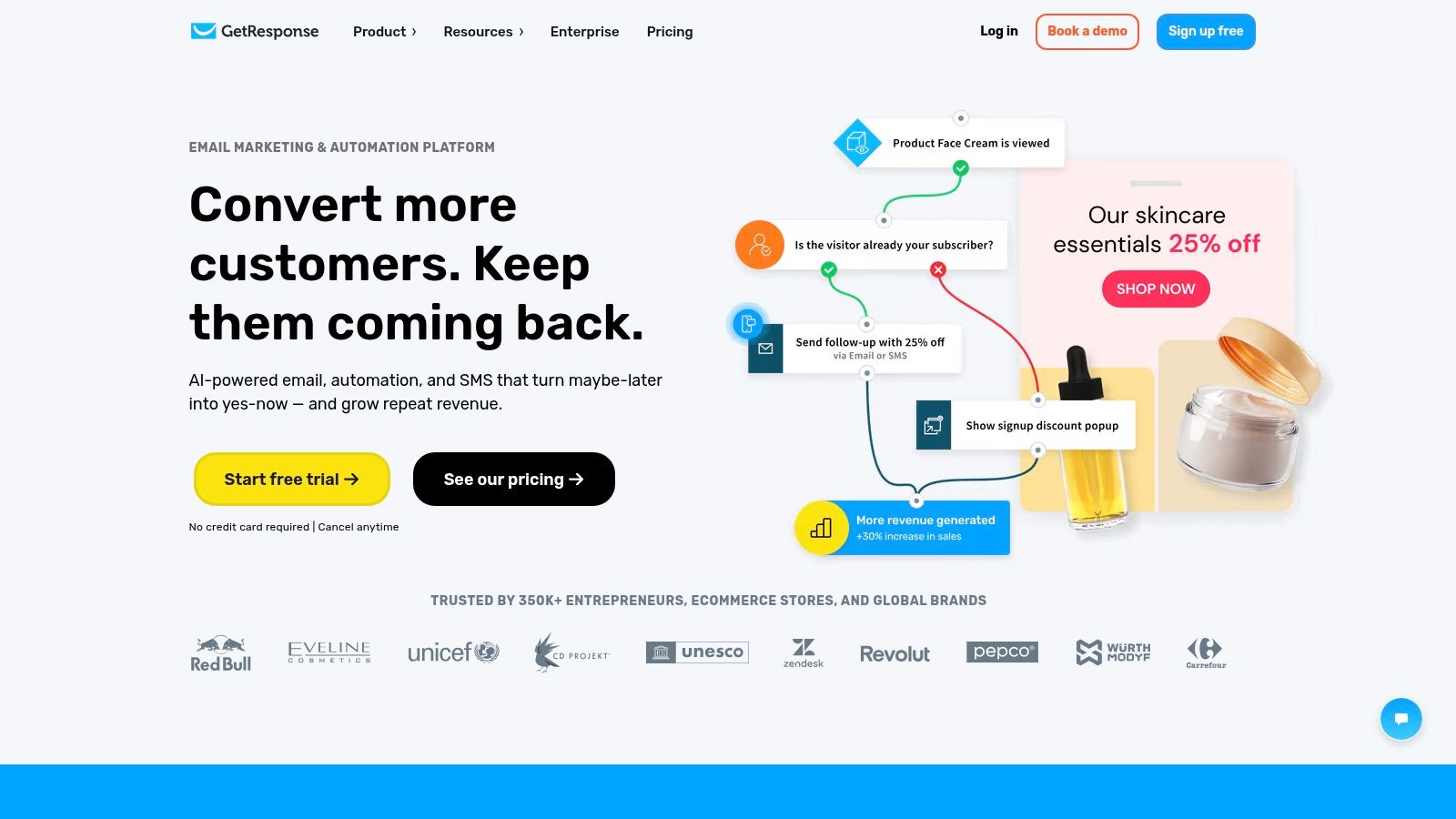
Unlike platforms focused solely on email, GetResponse integrates its automation engine with landing pages, conversion funnels, and forms. This allows marketers to build and automate an entire customer journey from a single dashboard. For example, you can use a template to trigger a drip sequence the moment a new contact signs up through a GetResponse landing page, creating a connected user experience from the first touchpoint.
Key Details & Considerations
- Best For: Small to mid-sized businesses wanting a broad toolkit with ready-to-use automation templates.
- Unique Feature: A large library of over 40 pre-built marketing automation workflows that can be customized or used out of the box.
- Pricing: GetResponse offers competitive entry-level pricing for its feature set, but costs increase as your contact list grows and you require more advanced automation features found in higher-tier plans.
- Limitation: While the template library is a strong asset, users seeking highly complex, multi-layered branching logic may find the builder less flexible than more enterprise-focused alternatives.
The balance between pre-built resources and customization options makes GetResponse a practical platform for teams that need to execute effective drip campaigns without a steep learning curve or a dedicated automation specialist.
Website: https://www.getresponse.com
8. MailerLite
MailerLite prioritizes simplicity and speed, making it an excellent choice for creators, small businesses, and marketers who need to launch effective campaigns without a steep learning curve. Its strength lies in providing a clean, intuitive platform where setting up an automated sequence is a straightforward process. Rather than overwhelming users with complex features, MailerLite offers one-click email drip campaign templates for common scenarios like welcome series or simple onboarding, which can be quickly customized and activated.
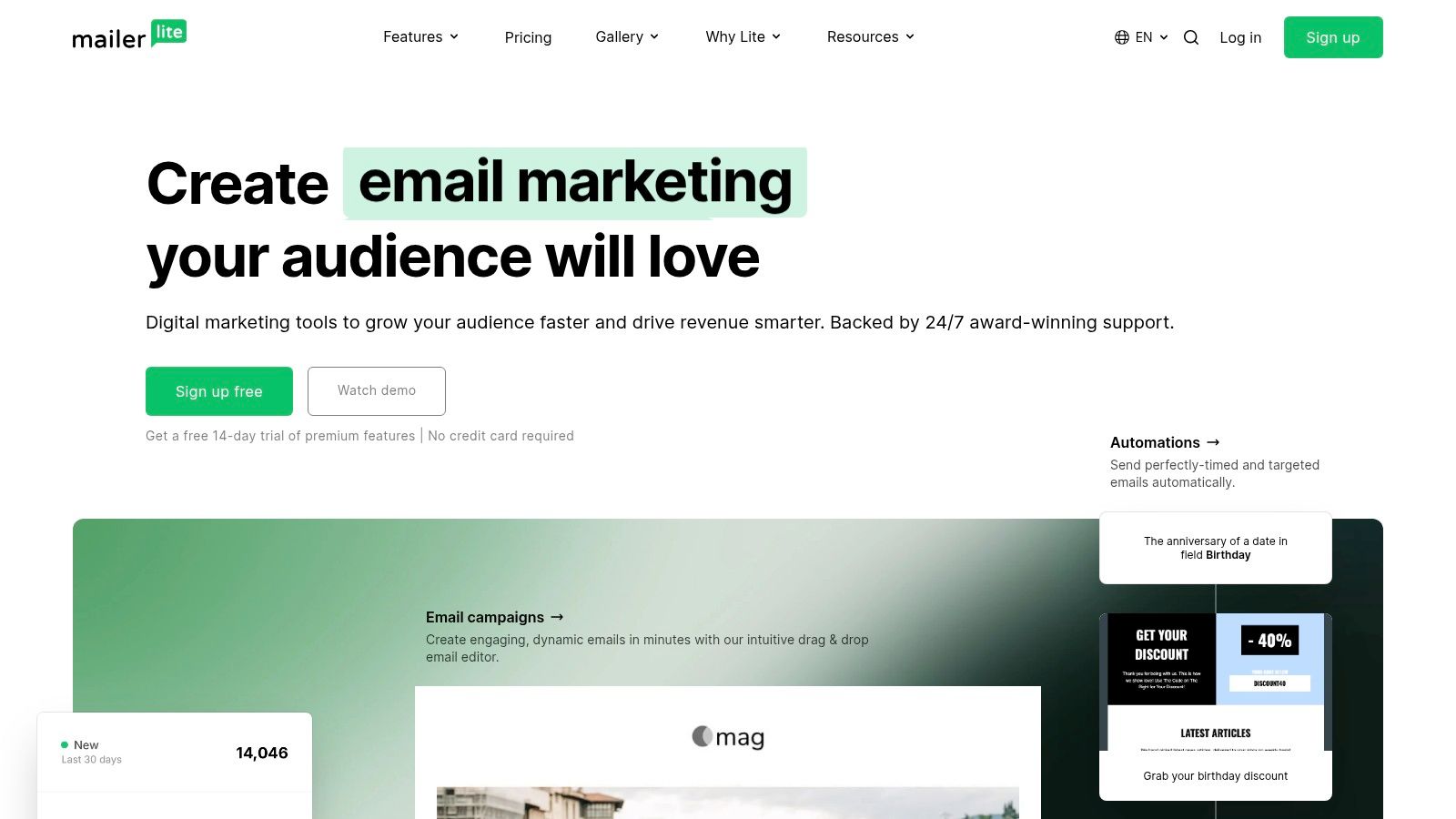
The platform is designed around ease of use, from its simple automation builder to its integrated landing pages and forms. This allows a solo marketer or small team to build an entire lead capture and nurture funnel within a single, cohesive environment. For example, you can create a sign-up form for an ebook, embed it on a landing page, and have new subscribers automatically enter a welcome drip sequence, all within minutes.
Key Details & Considerations
- Best For: Small businesses, newsletter creators, and startups needing a fast and affordable solution.
- Unique Feature: One-click automation templates are pre-built for common use cases, letting you fill in your content and go live almost immediately.
- Pricing: MailerLite is known for its competitive and transparent pricing, especially for businesses with smaller email lists. It offers a generous free plan for up to 1,000 subscribers, with paid plans scaling affordably.
- Limitation: The platform lacks the advanced segmentation, A/B testing capabilities, and in-depth analytics found in more enterprise-focused tools. Its list hygiene features are also more basic.
MailerLite is a powerful starting point for those new to email automation or for businesses whose needs don't justify the cost and complexity of higher-tier platforms.
Website: https://www.mailerlite.com
9. Brevo (formerly Sendinblue)
Brevo, the platform previously known as Sendinblue, offers a balanced approach to automation that is particularly friendly to businesses with large contact lists but variable sending needs. Its strength lies in a pricing model based on email volume rather than contact count. This structure makes it a cost-effective solution for companies that maintain a big audience but engage them with targeted, less frequent email drip campaign templates, such as re-engagement or seasonal offer sequences.
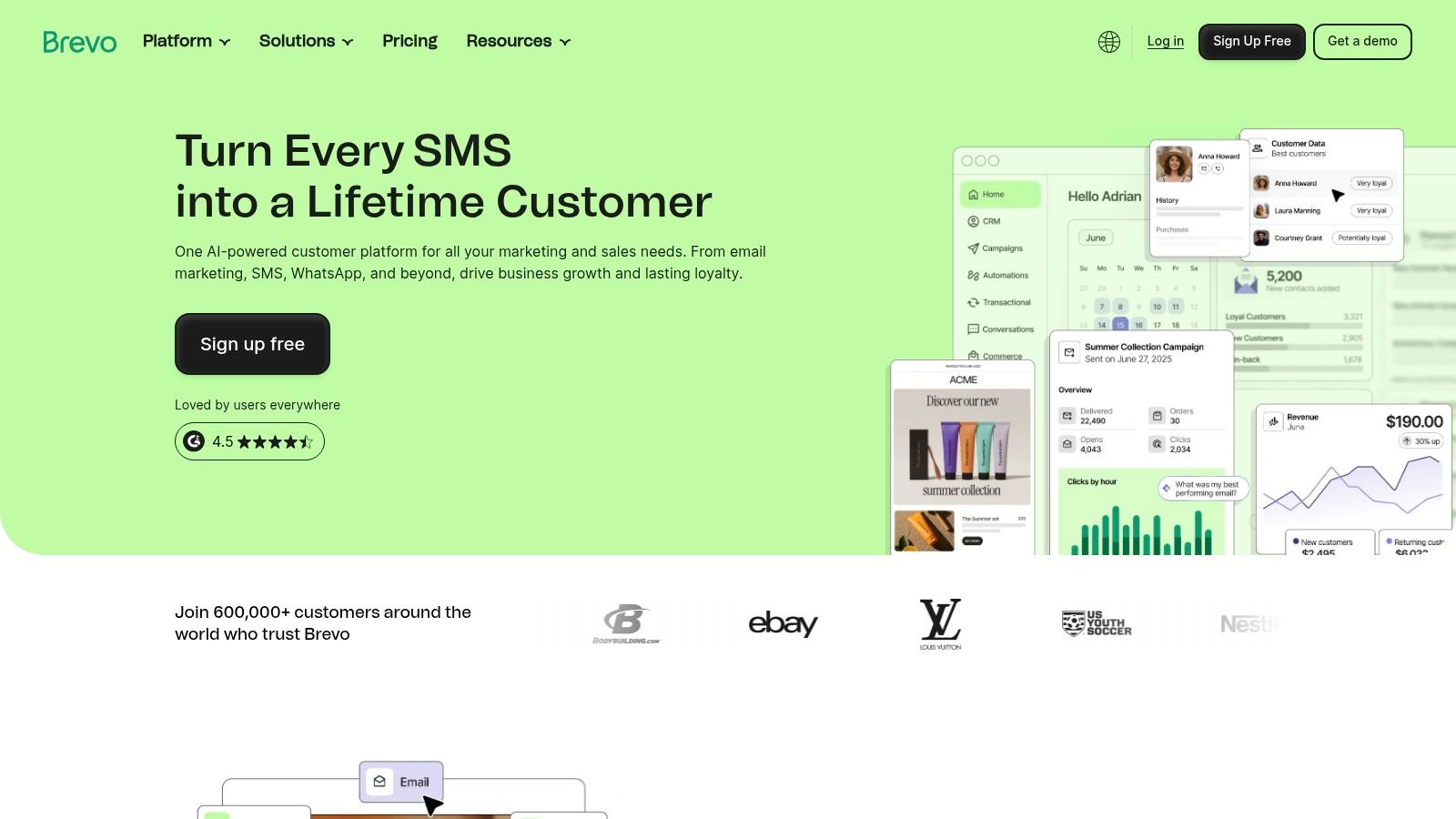
The platform provides a library of pre-built automation scenarios that serve as an excellent starting point for marketers new to drip campaigns. These templates cover common use cases like welcome series and anniversary emails. For more specific needs, users can build custom workflows using an intuitive builder that supports event-triggered logic, such as a user visiting a specific page or completing a purchase. This allows for the creation of responsive and timely communication flows without a significant initial investment.
Key Details & Considerations
- Best For: Businesses with large contact lists but moderate or inconsistent email sending volumes.
- Unique Feature: The pricing model scales by the number of emails sent, not the number of contacts stored, offering a key cost advantage for specific use cases.
- Pricing: A free plan is available with a daily sending cap. Paid plans (Starter, Business) unlock higher sending limits, advanced automation features, and remove Brevo branding.
- Limitation: Advanced automation capabilities and A/B testing for workflows are reserved for higher-tier plans, which may limit teams on a tighter budget.
Brevo's solid core features and straightforward interface provide a gentle entry into the world of marketing automation. It’s a practical choice for executing essential drip strategies effectively while keeping a close eye on costs.
Website: https://www.brevo.com
10. Campaign Monitor
Campaign Monitor excels with its user-friendly drag-and-drop journey builder and a strong focus on design quality. It is a great choice for businesses that prioritize visually appealing newsletters and straightforward automated sequences. The platform’s refreshed email and template builder, combined with a large catalog of responsive email drip campaign templates, makes it easy to launch professional-looking campaigns without needing a designer.
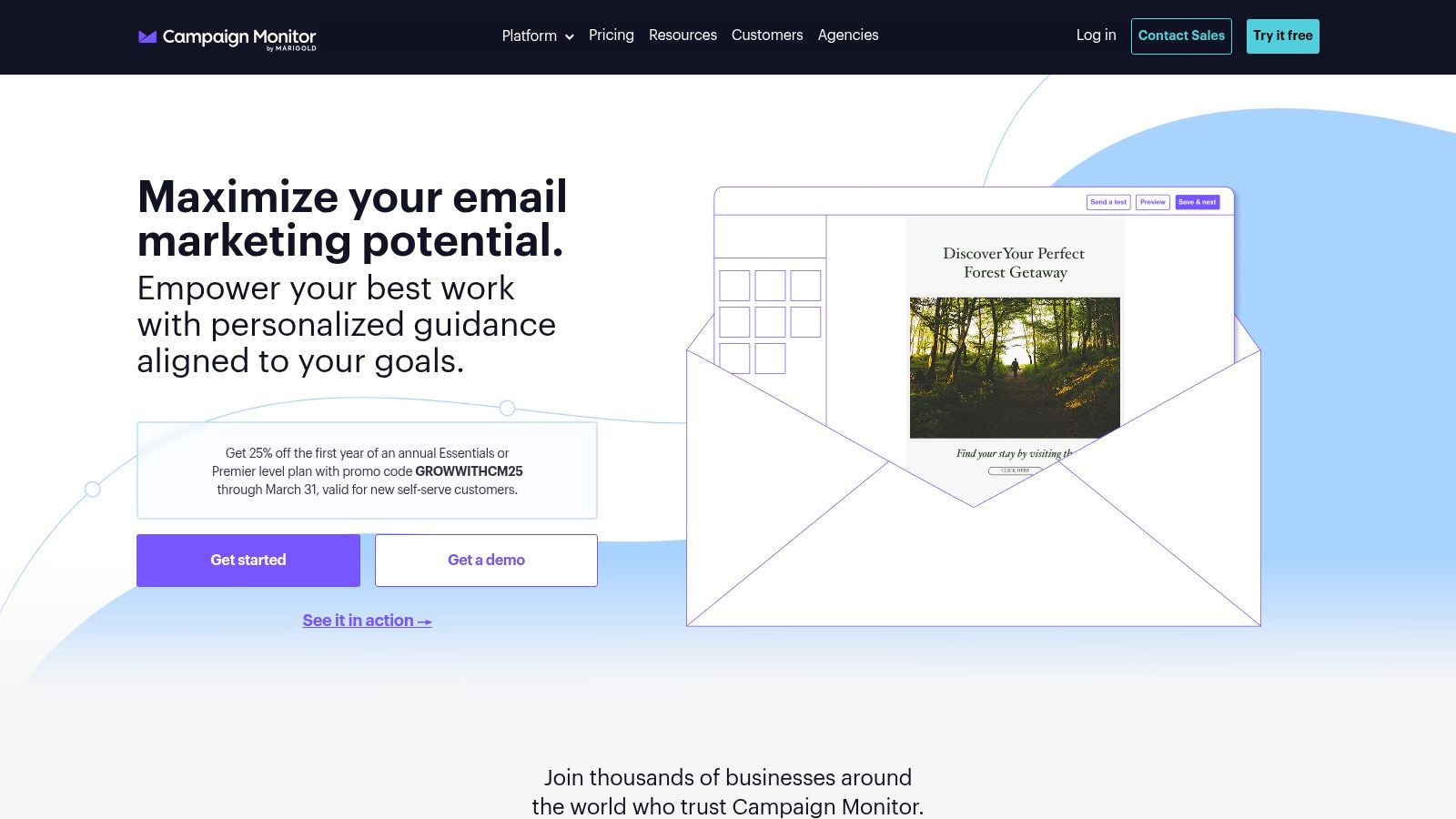
The journey builder is particularly effective for setting up foundational drip campaigns. It offers clear starter options, such as pre-configured "Welcome journeys," that guide new users through the setup process. This makes Campaign Monitor an accessible option for teams who need to implement essential drips, like onboarding or re-engagement series, but don't require the complex conditional logic found in more specialized automation platforms.
Key Details & Considerations
- Best For: Marketers and newsletter creators who value high-quality email design and simple automation.
- Unique Feature: The combination of a visually intuitive journey builder with a vast library of well-designed, mobile-responsive email templates.
- Pricing: The cost is subscriber-based, which can become a considerable expense as your contact list grows, making it important to monitor list health and size.
- Limitation: While excellent for foundational sequences, its automation capabilities are lighter compared to dedicated B2B marketing automation tools, lacking deep CRM integrations or complex multi-path logic.
Its reputation for strong deliverability and beautiful templates makes it a solid contender for brands where email aesthetics are a core part of the customer experience.
Website: https://www.campaignmonitor.com
11. Constant Contact
Constant Contact is a well-established player in the email marketing space, known for its straightforward approach and strong support for small businesses. It earns its spot on this list by providing a simple and accessible entry point into automation. Rather than overwhelming users with complex logic, the platform focuses on ready-to-use email drip campaign templates for the most common use cases, such as welcome series, birthday messages, and cart abandonment reminders, making it ideal for teams that need to get reliable drip sequences running quickly.
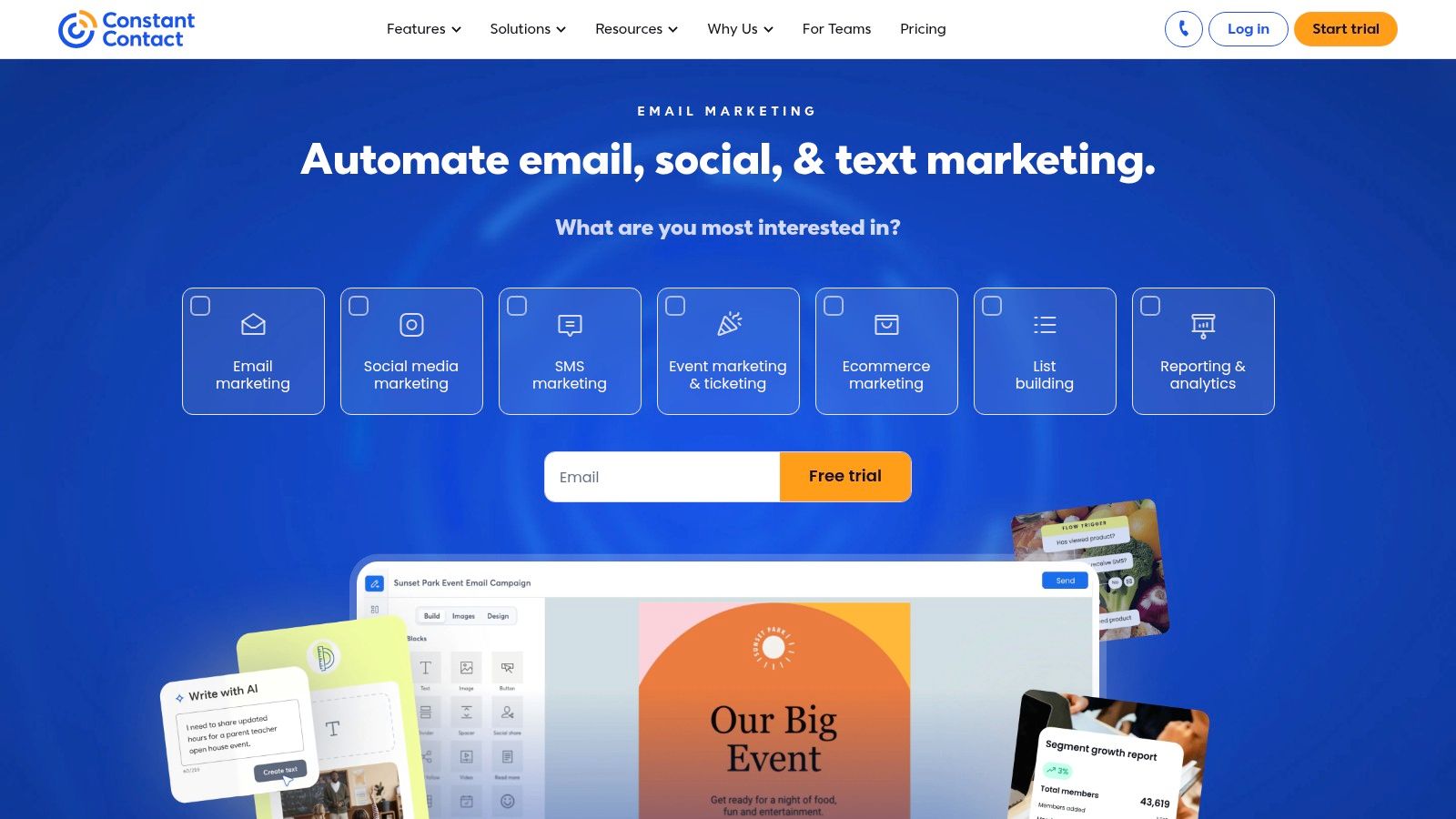
The platform automatically creates a default welcome email flow for every new list, giving new users an immediate starting point. Its visual automation path builder is easy to understand, allowing marketers to set up linear sequences based on time delays or simple triggers without a steep learning curve. This focus on simplicity makes it a solid choice for B2B consultants or small marketing teams who prioritize execution speed over intricate multi-path journeys.
Key Details & Considerations
- Best For: Small to medium-sized businesses and consultants seeking simple, reliable automation setups.
- Unique Feature: The combination of pre-built automation templates for common scenarios and an extensive library of email design templates gives users a fast path from concept to launch.
- Pricing: Constant Contact's pricing is contact-based and tiered (Lite, Standard, Premium). Key automation features are gated behind the Standard and Premium plans, so you must select the appropriate tier to access drip campaign functionality.
- Limitation: The automation capabilities are not as granular as those found in dedicated marketing automation platforms. Reporting and branching logic are less advanced, which may be a constraint for data-driven teams needing deep behavioral segmentation.
With its long market history and US-based customer support, Constant Contact represents a dependable, if less powerful, option for foundational email drip marketing.
Website: https://www.constantcontact.com
12. Customer.io (Journeys)
Customer.io is a data-driven messaging platform where the power comes from its visual workflow canvas, Journeys. It's built for SaaS and product-led teams that need granular, event-driven control over their campaigns. Rather than offering a large library of pre-built email drip campaign templates, Customer.io focuses on providing reusable components and a flexible data model. This allows you to construct highly specific sequences from scratch, triggered by precise user actions within your product.
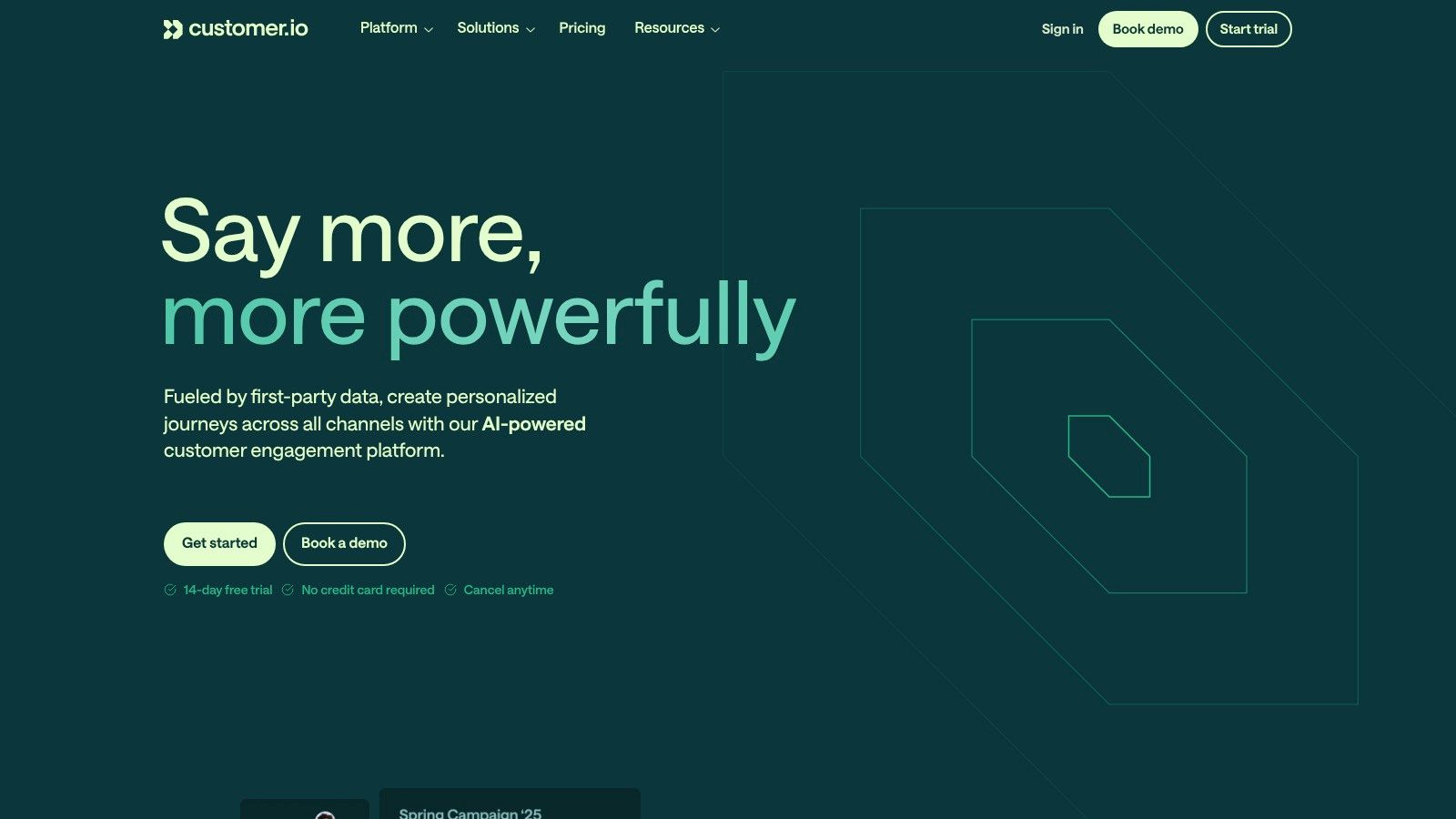
The platform excels at multi-channel drips, integrating email, SMS, push notifications, and in-app messages into a single, cohesive workflow. For a product-led growth team, this means you can build a trial onboarding sequence that sends a welcome email, followed by an in-app message pointing to a key feature, and then a push notification if the user hasn't logged in for three days. The visual builder and message libraries make it easy to duplicate and adapt these complex flows for different segments.
Key Details & Considerations
- Best For: Product-led and SaaS teams needing event-driven control for complex user journeys.
- Unique Feature: The visual workflow builder supports sophisticated, multi-channel messaging (email, SMS, push, in-app) based on real-time event data from your product.
- Pricing: Pricing is based on the number of user profiles and messages sent per month. It can be cost-effective for startups but scales significantly with high message volumes and large user bases.
- Limitation: It offers fewer one-click, canned drip templates compared to more traditional ESPs. The system requires a more DIY approach upfront to build your own reusable campaign assets.
Its strength lies in giving technical marketers the tools to build precisely what they need, making it a top choice for executing event-based nurture and product adoption strategies.
Website: https://customer.io
Top 12 Email Drip Template Comparison
Product
Core features
UX & Quality (★)
Pricing & Value (💰)
Target audience (👥)
Standout strengths (🏆 / ✨)
HubSpot Marketing Hub
Visual workflows, native CRM, campaign templates
★★★★ — robust analytics
💰 Scales with contacts; can be costly
👥 B2B teams, sales‑aligned orgs
🏆 CRM + sales alignment ✨ extensive templates & docs
ActiveCampaign
200+ automation recipes, branching logic
★★★★ — powerful but steeper learning
💰 Mid‑range; good ROI with automation
👥 SMBs → mid‑market growth teams
🏆 Shareable recipes/Marketplace ✨ fast time‑to‑value
Mailchimp
Journey builder, drag‑drop, e‑commerce steps
★★★ — easy onboarding
💰 Free/low tiers limited; higher tiers unlock features
👥 Small teams & mid‑market
🏆 Broad integrations ✨ quick common flows
Klaviyo
Ecommerce flows, behavior splits, multi‑channel
★★★★ — behavior‑driven
💰 Can scale expensive with audience size
👥 Ecommerce & lifecycle teams
🏆 Rich behavior flows ✨ strong email+SMS tooling
Drip
Template‑first workflows, industry sets, visual builder
★★★ — template‑led ease
💰 Mid‑tier; ecommerce focus
👥 Ecommerce brands & retailers
🏆 Industry templates ✨ reusable guided nodes
Omnisend
Fully prebuilt ecommerce flows, subject suggestions
★★★ — very fast TTV
💰 Affordable for ecommerce starters
👥 Ecommerce & lifecycle marketers
🏆 Ready‑made flows ✨ rapid launch templates
GetResponse
40+ automation templates + landing pages & funnels
★★★ — broad toolkit
💰 Competitive entry levels; upsell for advanced
👥 SMBs & marketers needing funnels
🏆 All‑in‑one funnels ✨ varied template library
MailerLite
One‑click automations, simple editor, landing pages
★★★ — very easy to use
💰 Very affordable for small lists
👥 Small businesses & creators
🏆 Simplicity & price ✨ quick sequence setup
Brevo (Sendinblue)
Prebuilt workflows, event triggers, volume pricing
★★★ — solid starter experience
💰 Volume‑based (by sends) — cost‑effective in some use cases
👥 SMBs with big lists/low send volumes
🏆 Volume pricing model ✨ multi‑language templates
Campaign Monitor
Drag‑drop journeys, responsive template catalog
★★★★ — high design quality & deliverability
💰 Scales with subscribers
👥 Design‑focused marketers & newsletter teams
🏆 Design & deliverability ✨ large responsive templates
Constant Contact
Ready automation templates, simple path builder
★★★ — straightforward & supported
💰 SMB‑friendly pricing
👥 Small businesses seeking reliability
🏆 Ease of use & support ✨ extensive template gallery
Customer.io (Journeys)
Data‑driven visual canvas, multi‑channel & event control
★★★★ — granular, developer‑friendly
💰 Usage/volume pricing; more DIY
👥 Product‑led SaaS & engineering teams
🏆 Event‑driven precision ✨ reusable assets & flexibility
Drip Campaign Template: Where to Start
A drip campaign template is a pre-built email sequence with the trigger, the send order, the timing between messages, and the exit condition already defined, so you only fill in the copy and the audience. The twelve platforms above all ship them, but the right starting template depends less on the tool than on your goal, how fast you need to launch, and what your stack can see about each contact.
Beginner: one trigger, one goal
- Welcome series (3 emails over 7 days). Trigger on signup, deliver the promised resource, introduce one core idea, and end with a single ask. Launch this one first: every list needs it and it needs no behavioral data.
- Lead magnet follow-up (4 emails over 10 days). Trigger on a guide or template download, expand on the topic, share a related customer story, and close with a low-friction next step such as a checklist or a short call.
Intermediate: branches on behavior
- Trial-to-paid (5 emails over 14 days). Trigger on trial start, branch on whether the key activation step happened, and switch from education to objection handling for accounts that stalled.
- Webinar or event follow-up (3 emails over 5 days). Split attendees from no-shows on day one: attendees get the recording plus the next step, no-shows get the recording plus a reason to watch. Our B2B drip campaign workflows guide covers how to build the split.
Advanced: scored and multi-threaded
- Churn prevention (4 emails over 21 days). Trigger on a usage drop or a renewal date 60 days out, personalize around the features the account actually uses, and hand the thread to a customer success manager if engagement does not recover. See the personalization guide for drip campaigns for the data this needs.
- Account-based sales sequence (6 touches over 18 days). Run parallel drips to two or three contacts at a target account, coordinate timing so the messages reinforce each other, and stop every thread the moment a meeting is booked.
How to choose
Match the template to three things. Goal: conversion templates need behavioral triggers, relationship templates need only a signup. Timeline: if you need to ship this month, start with a beginner template on the data you already collect. Stack: choose a template your CRM and email platform can run without manual exports, then upgrade to branching once the events are flowing. The comparison table above shows which platforms support the branching and scoring that the advanced templates depend on.
How to Structure the Data Behind a Drip Campaign Workflow
The templates above give you the copy and cadence. What makes them run correctly is the email marketing automation workflow data structure underneath: the fields, events, and memberships your platform can see when it decides who enters a drip, which branch they take, and when they exit. Get that structure wrong and even a great template sends the wrong email to the wrong person.
Every drip campaign workflow reads from three kinds of data:
- Contact properties: slowly changing fields such as company, role, industry, plan tier, and lifecycle stage. Use them to decide which drip a contact belongs in.
- Events: timestamped actions such as signed up, opened, clicked, visited pricing, started a trial, or went quiet. Use them as triggers and as the conditions inside a sequence.
- Memberships: the lists, segments, tags, and active workflows a contact is in. Use them for exclusions, so a lead in a sales sequence is not also receiving a nurture drip.
Data structures by level
Beginner: one trigger, one tag. A welcome drip needs only a signup event and a "welcome complete" tag at the end. Keep the schema to the handful of fields you will actually use in copy, such as first name and company.
Intermediate: properties plus engagement events. A lead-nurturing drip branches on what the contact did. That means a stored "downloaded guide" event, an "opened last email" condition, and a lifecycle-stage field the sequence updates as the contact moves from subscriber to MQL.
Advanced: CRM-synced objects with scoring. Trial-to-paid and churn-prevention drips depend on product usage events and account-level fields that live in your CRM or product database. Map which system owns each field, sync it before the split runs, and feed a lead score so the drip can hand hot accounts to sales instead of sending email seven.
A sample drip campaign database schema
If you are building or auditing the workflow in a CRM or a data warehouse rather than a point-and-click builder, the same three data types map onto a small database schema:
- contacts: id, email, first_name, company, role, industry, plan_tier, lifecycle_stage, created_at, unsubscribed_at
- events: id, contact_id, event_type (signed_up, opened, clicked, visited_pricing, trial_started), occurred_at, metadata
- memberships: contact_id, list_or_tag, added_at, removed_at
- workflow_enrollments: contact_id, workflow_id, current_step, entered_at, exited_at, exit_reason
Every trigger is a query on events, every split is a query joining contacts and events, and every exclusion is a check against memberships and active enrollments. Keep timestamps on everything: "opened in the last 7 days" is the most common split, and it needs occurred_at, not a boolean.
Extending the data model to push notifications and other channels
A growing share of drip sequences are no longer email-only. If a workflow can also send a push notification, an SMS, or an in-app message, the same trigger, workflow, sequence, and step hierarchy still applies, but the data model needs a few additions:
- A channel on every step. Add channel (email, push, sms, in_app) and a fallback_channel to each sequence step, so the workflow can try push first and fall back to email if the notification is not opened within a set window.
- Devices and push tokens. devices: id, contact_id, platform (ios, android, web), push_token, opted_in_at, last_seen_at. A contact can own several devices, and tokens expire, so this cannot be a column on contacts.
- Consent per channel. Replace a single unsubscribed_at with channel_preferences: contact_id, channel, status, updated_at. An email opt-out should not silence transactional push, and the reverse is also true.
- A unified sends log. sends: id, enrollment_id, step, channel, status (queued, sent, delivered, opened, failed), sent_at. Frequency caps and "do not message twice in 24 hours" rules are queries on this table across all channels.
The trigger logic does not change: an event arrives, the workflow checks properties and memberships, and the next step fires. What changes is that the step now chooses a channel, so keep channel selection inside the step rather than building a separate workflow per channel.
How to choose the right structure
- Match the goal. Conversion drips need behavioral events, onboarding drips need product milestones, and re-engagement drips need last-activity timestamps.
- Match the timeline. If you need to launch this month, build on the fields you already collect and add events later.
- Match the stack. Pick the structure your CRM, newsletter platform, and product analytics can share without manual exports. Our guides to CRM workflows for email campaigns and lead scoring automation cover the sync patterns, and the anatomy of an email marketing automation workflow breaks down triggers, splits, and actions in detail.
From Templates to Revenue: Your Next Steps in Automation
You've just navigated a comprehensive playbook of B2B email drip campaign templates, from welcoming new users to preventing customer churn. We’ve broken down the strategy, timing, and copy for six critical sequences and explored the platforms, like HubSpot, ActiveCampaign, and Customer.io, that can bring them to life. The gap between knowing what to do and actually generating revenue is now smaller than ever. The key takeaway is that effective email marketing isn't about sending more emails; it’s about sending the right emails at the right time.
The power of these sequences lies in their structure and purpose. A well-designed welcome series builds immediate trust, while a strategic trial-to-paid campaign directly addresses user friction and highlights value, converting free users into paying customers. The most successful growth teams don’t see these as separate tactics but as interconnected parts of a cohesive customer journey. Your next step is to identify the single biggest bottleneck in your funnel and apply the corresponding template.
Prioritizing Your First Campaign
Before you get lost in the possibilities, focus on a single, high-impact starting point. Don't try to build all six campaigns at once. Ask yourself:
- Where is the most significant drop-off? Is it between sign-up and initial product engagement? Or perhaps between an active trial and a paid subscription? Let data guide your decision.
- What is the lowest-hanging fruit? A sales follow-up sequence might be the quickest to implement and show a direct return if your sales team is struggling with manual outreach.
- Which campaign aligns with your current business goals? If your primary objective is to increase new user activation, the Welcome Series is your clear priority. If it's to reduce revenue loss, the Churn Prevention campaign is essential.
Once you’ve chosen your first target, take the corresponding template from this guide and make it your own. Adapt the tone to match your brand’s voice. Refine the copy to speak directly to your Ideal Customer Profile (ICP). Remember, these are not rigid scripts but flexible frameworks designed for adaptation.
Beyond the Template: Implementation and Measurement
Selecting a tool is a critical step, but it’s what you do with it that matters. Whether you opt for an all-in-one solution like HubSpot or a more specialized platform like Klaviyo, the principles of successful implementation remain the same.
- Integrate Your Data: Your drip campaigns are only as smart as the data feeding them. Ensure your chosen tool connects seamlessly with your CRM, product analytics, and other data sources to enable precise segmentation and personalization.
- Start Small and Test: Implement your first email drip campaign template with a small segment of your audience. A/B test one variable at a time, such as the subject line, the call-to-action (CTA), or the timing between emails.
- Define Your Success Metrics: What does success look like for this campaign? Is it a higher open rate, an improved trial-to-paid conversion rate, or more booked demos? Establish clear benchmarks before you launch so you can measure performance accurately.
The most effective email automation is not a “set it and forget it” strategy. It is a continuous cycle of launching, measuring, learning, and optimizing. By taking one of these proven email drip campaign templates and committing to this iterative process, you can build a reliable system that nurtures leads, converts users, and drives predictable growth for your business.
Ready to put these templates into action? The most powerful drip campaigns start with a steady stream of qualified leads, and Breaker automates that process for you. It identifies and enriches contacts who fit your ideal customer profile, then syncs them directly into your email platform, giving your new campaigns the high-quality audience they need to succeed. Get started for free and begin building your revenue engine today at Breaker.
Keep reading
All articlesBreaker for B2B, SME and Consumer Newsletter Senders
Learn how B2B, SME, and consumer audiences differ in newsletters, plus a framework for segmenting, messaging, and monetizing each without losing relevance.
What Is a B2B Content Engine
Learn what a B2B content engine is, how it differs from a content calendar or strategy, and why it's essential for AI-driven search in 2026.
8 Best Email Tracking Software Tools in 2026
Compare 8 top email tracking tools for 2026, how tracking pixels work, and why Apple's privacy rules make open rates unreliable. See our top pick.