
Email Sender Reputation: Your Guide to the Inbox in 2026
Don't let a bad email sender reputation tank your ROI. Learn how ISPs score you, what signals to track, and how to protect your deliverability for B2B growth.
You wrote the campaign carefully. The audience fit looked right, the offer was strong, and the creative team signed off fast. Then the send goes out and performance falls apart.
At that point, most B2B teams look at subject lines, send time, or copy. Sometimes those are the problem. Often they aren't. The bigger issue is that mailbox providers may have already decided they don't trust you enough to place your message in the inbox.
That trust system is what email sender reputation really is. And in 2026, it matters even more for growth teams that are expanding volume, testing new ICPs, or sending from multiple domains. If you're scaling a newsletter, pushing outbound nurture harder, or adding new acquisition sources, reputation stops being a background technical detail. It becomes a growth constraint.
Why Your Emails Are Landing in Spam
A common B2B failure pattern looks like this. A team grows fast, imports a bigger segment, launches a new sequence, and expects pipeline to follow. Delivery looks fine because messages were accepted. But the result is poor inbox placement, weak engagement, and leads that never saw the campaign.
That gap between “sent” and “seen” is where email sender reputation does its damage.
Mailbox providers don't treat sender trust as a vague brand signal anymore. It became a formalized, measurable concept as providers increasingly relied on sender-level scoring to decide inbox placement, spam filtering, or blocking. Modern guidance describes reputation as a score tied to a sending domain and IP address, commonly expressed on a 0 to 100 scale, and shaped by sending history, engagement, complaints, and bounces, as explained in OneSignal's overview of sender reputation.
The frustrating part is that the campaign can still look good internally
Your CRM says contacts were loaded. Your ESP says messages were delivered. The team sees no major error. But if your reputation slips, providers start routing your email away from the inbox before recipients ever have a chance to engage.
That's why spam placement often gets misdiagnosed as a content issue when it's really a trust issue.
Practical rule: If several campaigns underperform at once, assume a reputation problem before you assume a copy problem.
Teams dealing with this usually need two things. First, a clean diagnosis of why placement is breaking. Second, a practical recovery path. A useful companion read is Refgrow on preventing email spam, which focuses on the inboxing side of the problem.
If you're already in the middle of a deliverability dip, this breakdown of why emails go to spam helps frame the issue in operational terms rather than generic marketing advice.
Why growth teams feel this first
A small sender can coast for a while. A scaling B2B team usually can't.
When you add volume, test a new audience, or revive older contacts, reputation moves from hidden infrastructure to a frontline metric. The campaign doesn't fail because email stopped working. It fails because the mailbox provider no longer sees your domain and sending behavior as reliable.
Understanding Email Sender Reputation
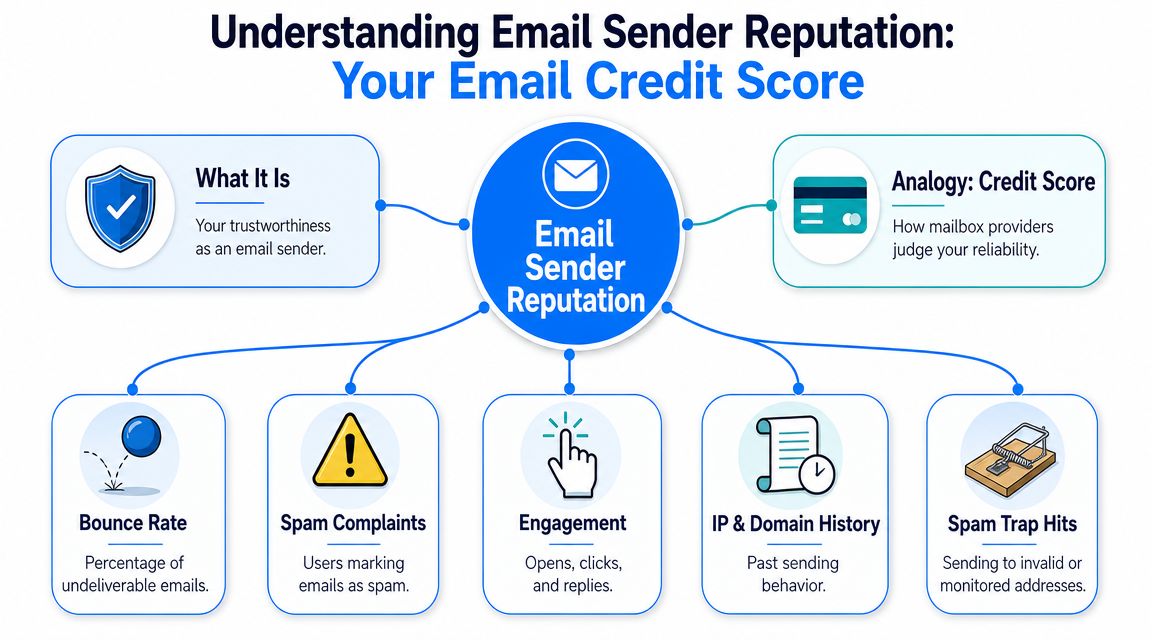
Think of email sender reputation like a credit score for your sending operation. Mailbox providers aren't reading your brand deck and deciding whether they like you. They're watching behavior and assigning trust based on what they observe over time.
If you send consistently, keep lists clean, and generate healthy engagement, you build trust. If you send erratically, trigger complaints, or keep hitting invalid addresses, that trust drops.
It has two parts, not one
Email sender reputation is a combined assessment of IP reputation and domain reputation, and providers infer it from signals like bounce rate, spam complaints, engagement, sending history, and unsubscribe rate, as outlined in Mailtrap's explanation of sender reputation.
Here's the practical distinction:
- IP reputation follows the infrastructure used to send.
- Domain reputation follows the identity recipients see in the From address and the broader history associated with that domain.
Older deliverability advice often over-focuses on IP hygiene. That still matters, but it misses how mailbox systems now evaluate the sender identity itself.
Why domain reputation matters more than many teams realize
For B2B growth teams, domain reputation is often the primary control surface. You can change platforms, rotate infrastructure, and adjust campaign settings, but if the domain itself develops a weak trust profile, inboxing remains difficult.
That domain-level trust issue also has broader implications for how your brand is perceived online. If you want a non-email parallel, this look at how domain reputation affects SEO is useful because it shows that domain trust isn't isolated to one channel.
Your domain is your sending brand in the eyes of the mailbox provider. If that identity becomes noisy, every future campaign starts from a weaker position.
A simple way to think about it
Use this mental model:
Reputation component
What it answers
IP reputation
Can this sending infrastructure be trusted?
Domain reputation
Can this brand identity be trusted?
Behavioral signals
Do recipients actually want these emails?
For most modern B2B teams, the winning move isn't obsessing over one score. It's managing the full picture. Infrastructure, domain policy, and recipient response all feed the same trust decision.
How Mailbox Providers Calculate Your Reputation Score
Mailbox providers don't publish a simple formula, but the broad pattern is clear. They combine technical identity with behavioral evidence and then decide whether your messages deserve inbox placement.
That means email sender reputation is not static. It's inferred from what providers see across your sends.
The signals that help you
Positive reputation usually comes from steady, believable sending behavior. Providers look for patterns that suggest your emails are expected and useful.
A few signals generally work in your favor:
- Consistent sending history that doesn't jump wildly from one campaign to the next
- Healthy engagement such as opens, clicks, and replies
- Low friction exits where people unsubscribe instead of marking mail as spam
- Stable audience quality with fewer invalid or abandoned addresses
Good senders don't just have polished templates. They create a pattern of expected communication.
The signals that hurt you fast
Mailtrap notes that providers assess reputation through a combination of IP reputation and domain reputation, using behavioral signals such as bounce rate, spam complaints, engagement, sending history, and unsubscribe rate in the process of judgment, which is why those operational metrics matter so much in practice.
In real campaigns, these are the signals that tend to suppress placement first:
- Bounce problems
Too many invalid addresses tell providers your acquisition or list maintenance is weak.
- Spam complaints
This is the strongest “I did not want this” signal a user can send.
- Engagement decay
If more recipients ignore your emails over time, providers infer your relevance is dropping.
- History mismatches
A sender that usually behaves one way and suddenly behaves another can look risky.
Why unsubscribe rate matters differently
Unsubscribes feel painful to marketers, but they aren't always the enemy. In many cases, a clean unsubscribe is healthier than a spam complaint. If the message isn't wanted, you want the recipient to opt out cleanly instead of damaging your trust signals.
An unsubscribe means “stop sending.” A complaint means “this sender shouldn't have reached me in the first place.”
That distinction matters when teams hide opt-outs, make preferences confusing, or keep pushing broad campaigns into weak-fit audiences.
Technical setup is the floor, not the win
Authentication still matters because providers need to verify that your domain and infrastructure are legitimate. But authentication alone won't rescue poor behavior.
A lot of teams make this mistake. They configure the basics, assume they're covered, and then damage reputation through bad targeting, stale lists, or a sudden volume jump. Mailbox providers don't reward a technically correct sender if recipient behavior says the mail isn't wanted.
So the practical way to think about scoring is simple. Providers ask:
Question providers infer
What they watch
Is this sender legitimate?
Domain and IP identity, authentication, history
Is this sender predictable?
Volume consistency, cadence, sending pattern
Is this sender wanted?
Engagement, complaints, unsubscribes, bounces
If you want better inbox placement, improve the answers to those questions.
Measurable Signals and Benchmarks You Must Track
Many organizations don't need more dashboards. They need to know which numbers deserve attention and what counts as a warning sign.
For sender reputation, two thresholds matter more than most vanity metrics. Salesforce recommends targeting bounce rates below 2% and complaint rates below 0.1%, while ZeroBounce flags anything above 2% bounce rate as a warning sign in its summary of sender reputation monitoring at ZeroBounce's sender reputation guide.
Email Reputation Health Check
Metric
Good Reputation (Target)
Poor Reputation (Warning Sign)
Bounce rate
Below 2%
Above 2%
Complaint rate
Below 0.1%
Rising beyond 0.1%
Sending consistency
Stable cadence
Sudden spikes or erratic campaigns
Engagement trend
Steady or improving
Declining across multiple sends
Audience quality
Verified, current, segmented
Old, broad, mixed-quality lists
That table is more useful than a long checklist because it reflects how providers judge senders. Branding polish won't offset bad list quality. Clever copy won't offset repeated complaint spikes.
The tools worth checking
You don't need to guess where reputation stands. Industry guidance points to a few practical monitors:
- Google Postmaster Tools for Gmail-specific visibility
- Microsoft SNDS for Microsoft environments
- Sender Score as a broader benchmark against the wider email ecosystem
Used together, these tools help you separate a content issue from a reputation issue.
What to watch week to week
The most useful pattern isn't one bad campaign. It's a trend.
Look for:
- Bounce creep that suggests your list source quality is slipping
- Complaint pockets tied to a specific segment, campaign type, or acquisition source
- Engagement drift after you broaden targeting or increase frequency
- Placement issues by provider that show Gmail and Microsoft don't view you the same way
If your team needs a more complete operational view, this guide to email campaign performance metrics helps put sender-reputation metrics in context with the rest of campaign analysis.
Watch the trend, not just the campaign. Reputation usually weakens through repeated small failures before it breaks in a way everyone notices.
A note on list decay
OneSignal notes that roughly 28% of an average list decays every year in its discussion of sender reputation and list quality. That matters because even a previously healthy B2B list degrades if the team keeps sending without cleaning, suppressing, and requalifying contacts.
The implication is straightforward. Reputation management isn't a one-time setup task. It's a maintenance discipline.
Best Practices for Building and Maintaining a Strong Reputation
Strong email sender reputation comes from disciplined operations, not hacks. The basics still work, but they only work when applied consistently during normal periods and during growth.
That second part is where many B2B teams get into trouble.
What works in steady state
The proven habits are boring, which is part of why teams skip them.
- Use clear permission standards so new contacts expect to hear from you.
- Make unsubscribing easy so unhappy recipients leave cleanly instead of filing complaints.
- Clean the list regularly to remove invalid, stale, and clearly unengaged contacts.
- Segment by fit and engagement instead of sending every message to everyone.
These habits don't feel dramatic, but they create the clean behavioral pattern mailbox providers reward.
If you want a broad operational checklist from another practitioner angle, the Machine Marketing email deliverability guide is a useful companion read.
What breaks reputation during growth
Growth changes the risk profile.
Industry guidance consistently warns against large-send volume spikes and recommends gradual ramp-up, consistent cadence, and segmentation. That means a fast-growing newsletter or B2B program can hurt inbox placement by expanding into less-engaged contacts faster than it can preserve trust, as described in Dotdigital's guidance on sender reputation.
This is the practical trade-off:
Growth move
Reputation risk
Expanding list sources quickly
Lower average engagement and more invalid addresses
Reaching into a broader ICP
More “not relevant” signals from recipients
Rebranding or changing domains
Loss of historical trust continuity
Increasing send frequency
Higher complaint and unsubscribe pressure
How to scale without tripping filters
When volume is rising, don't treat all contacts as equal.
A safer pattern looks like this:
- Start with your most engaged and best-fit segments.
- Add adjacent segments gradually, not all at once.
- Hold cadence steady long enough to observe provider response.
- Pull back quickly if one provider starts degrading faster than the others.
This is also where tooling matters. Platforms such as Breaker's deliverability best practices guide discuss list hygiene, validation, and reputation monitoring as ongoing controls rather than cleanup tasks after the fact.
The mindset shift that helps most
A lot of older advice treats reputation as a technical setup problem. Authenticate the domain, warm the IP, and you're done.
That mindset is outdated. Modern reputation is behavioral.
The inbox isn't judging your intentions. It's judging your consistency, your audience quality, and how recipients react when your messages arrive.
Teams that accept that tend to do better. They stop chasing tricks and start managing sender trust the same way they manage pipeline quality. Deliberately, continuously, and with tighter feedback loops.
A Playbook for Recovering a Damaged Sender Reputation
If your sender reputation is already damaged, don't keep pushing volume and hope the next campaign fixes it. That usually makes recovery slower.
Start by slowing down enough to see the pattern clearly.
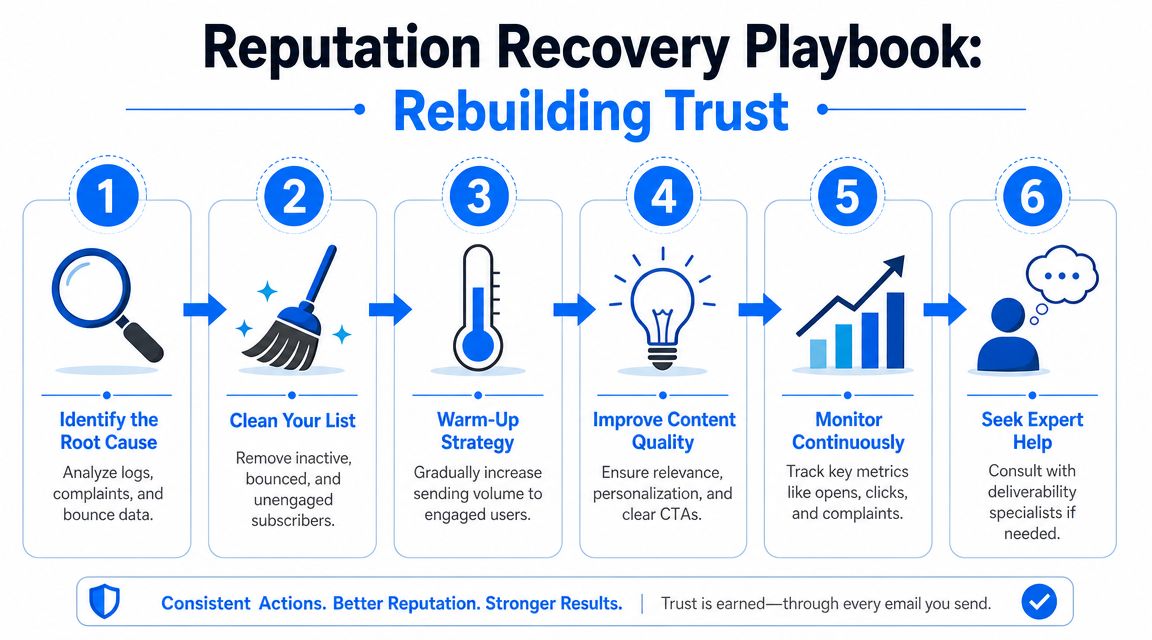
Step one is triage
Pause broad sends and inspect the likely sources of damage:
- Bounce clusters from poor list quality or recent imports
- Complaint spikes tied to a campaign, segment, or new acquisition source
- Engagement collapse after frequency increases or audience expansion
- Provider-specific problems where one mailbox ecosystem turns against you before others do
Don't try to fix everything at once. Find the dominant failure mode first.
Rebuild from your smallest trusted base
Recovery usually works best when you narrow the audience aggressively and send only to the people most likely to respond positively.
That means:
- suppressing weak or stale segments
- removing obvious invalids and repeated non-responders
- focusing on recipients with recent signs of interest
- restoring a steady cadence instead of erratic bursts
When reputation is weak, broad reach is the wrong goal. Trusted reach is the right goal.
A short walkthrough can help if your team wants a visual reset process:
Improve the mail before you scale the mail
Don't use recovery as only a list-cleaning exercise. Review the email itself.
Ask practical questions:
Recovery question
Why it matters
Is the audience expecting this message?
Unexpected email drives complaints
Is the content relevant to this segment?
Weak fit lowers engagement
Is the unsubscribe path obvious?
Friction increases spam reports
Is the cadence believable?
Abrupt changes can prolong distrust
Once performance stabilizes with the engaged core, expand carefully. Reputation can recover, but mailbox providers usually want to see sustained better behavior before restoring trust broadly.
How Breaker Proactively Manages Your Sender Reputation
Manual reputation management is possible. It's also easy to get wrong when a B2B team is juggling campaign production, segmentation, list growth, and reporting at the same time.
The operational challenge has changed because sender reputation is increasingly domain-centric, not just IP-centric. Google and Yahoo's 2024 bulk-sender requirements pushed the market toward stronger authentication, one-click unsubscribe, and complaint-rate discipline, making domain trust and policy compliance a bigger lever than many older guides explain, as noted in Mailgun's analysis of sender reputation.
What a platform should do for you
For a growth team, the right platform should reduce the number of ways you can accidentally damage trust.
That usually means helping with:
- List hygiene so weak addresses don't keep cycling back into campaigns
- Reputation monitoring so early warning signs surface before placement collapses
- Send discipline so volume and segmentation stay controlled during growth
- Compliance support so unsubscribe handling and authenticated sending stay aligned with provider expectations
Breaker fits into that category as a newsletter platform for B2B growth teams that combines sending, list expansion, analytics, and deliverability controls like TruSend, hygiene workflows, and reputation monitoring. That's useful if the problem you're solving isn't just campaign execution, but growth without wrecking inbox placement.
Why this matters for modern B2B teams
The old model assumed deliverability was a setup task owned by one technical person. The current model is different. Reputation shifts when marketing expands target segments, when sales ops imports new contacts, when acquisition changes lead quality, or when a team starts pushing more sends through the same domain.
So the practical win isn't “more features.” It's fewer blind spots.
A team that can see reputation signals early, clean the audience continuously, and keep domain-level trust intact has a much better chance of scaling email without the usual spam-folder surprise.
If your team wants a cleaner way to grow newsletter-driven pipeline without losing control of deliverability, Breaker is worth evaluating. It brings sending, audience growth, list hygiene, and reputation monitoring into one workflow so you can spend less time diagnosing inbox issues and more time improving the emails people want.
Keep reading
All articlesNewsletter Agency Services: How Agencies Scale Client Newsletters
Managing multiple client newsletters? Learn what a true newsletter agency platform needs to prevent list mixing, voice drift, and invisible ROI.
Building Owned Audiences: Move Followers to Your Newsletter in 2026
Social platforms can vanish overnight. Learn how to convert Instagram, TikTok, and YouTube followers into a newsletter list you actually own.
Newsletter Analytics: Which Metrics Actually Matter in 2026
Open rate and clicks don't predict buyers. Learn the 7-step method to track click depth, recency, and topic affinity for a revenue-predictive intent score.