
Best Day to Send Email: A Data-Backed Guide for 2026
What is the best day to send email? We analyze 2026 data for B2B marketers to go beyond 'Tuesday' and find optimal days for opens, clicks, and conversions.
The most repeated advice in email marketing is also one of the least useful. “Send on Tuesday at 10 AM” sounds precise, but it hides the core question.
The best day to send email depends on what you want the recipient to do.
If you want opens, one set of patterns matters. If you want clicks, replies, or booked meetings, a different set matters. If you’re sending to product-led growth teams, consultants, or enterprise sellers, their work rhythms matter too. The same send schedule won’t fit all three.
That’s why broad benchmarks help only as a starting point. Good operators don’t ask for a universal best day. They ask which day fits the goal, audience, and buying context of the campaign.
Why 'Tuesday at 10 AM' Is Outdated Advice
“Tuesday at 10 AM” became popular because it was directionally right for a long time. Midweek business hours are safer than Monday backlog or Friday drift.
But the rule breaks down once you stop measuring success by opens alone.
A newsletter for a warm audience isn’t the same as a cold outbound sequence. A product update for PLG operators isn’t the same as a webinar invite for enterprise sales leaders. One email asks to be read. Another asks for a decision. Another asks for a reply.
One benchmark can't serve every intent
The problem with one-size-fits-all advice is that it treats all inbox behavior as identical. It isn’t.
People use email differently depending on the moment:
- Planning mode: Earlier in the week, many professionals are organizing priorities, scanning industry content, and deciding what deserves attention.
- Action mode: Later in the week, some campaigns do better when the ask is immediate and concrete.
- Triage mode: On Monday, recipients clear backlog first and defer lower-priority reads.
- Low-competition mode: Off-hours can work better than expected for specific audiences who finally have space to catch up.
The useful question isn't “what day gets the most opens?” It's “what day matches the behavior I need from this audience?”
What works in 2026
The better approach is simple:
- Start with a benchmark window, not a magic timestamp.
- Match the day to the email's job.
- Segment by audience role before you segment by time.
- Test against your own history until the pattern is obvious.
That shift matters more now because inboxes are crowded and schedules are less uniform than they used to be. Hybrid work, global teams, and after-hours reading have made old timing rules less reliable.
The marketers who outperform don’t ignore timing. They stop treating it like folklore.
The Midweek Advantage Data-Backed Reasons for Peak Engagement
The old advice isn’t useless. It’s just incomplete.
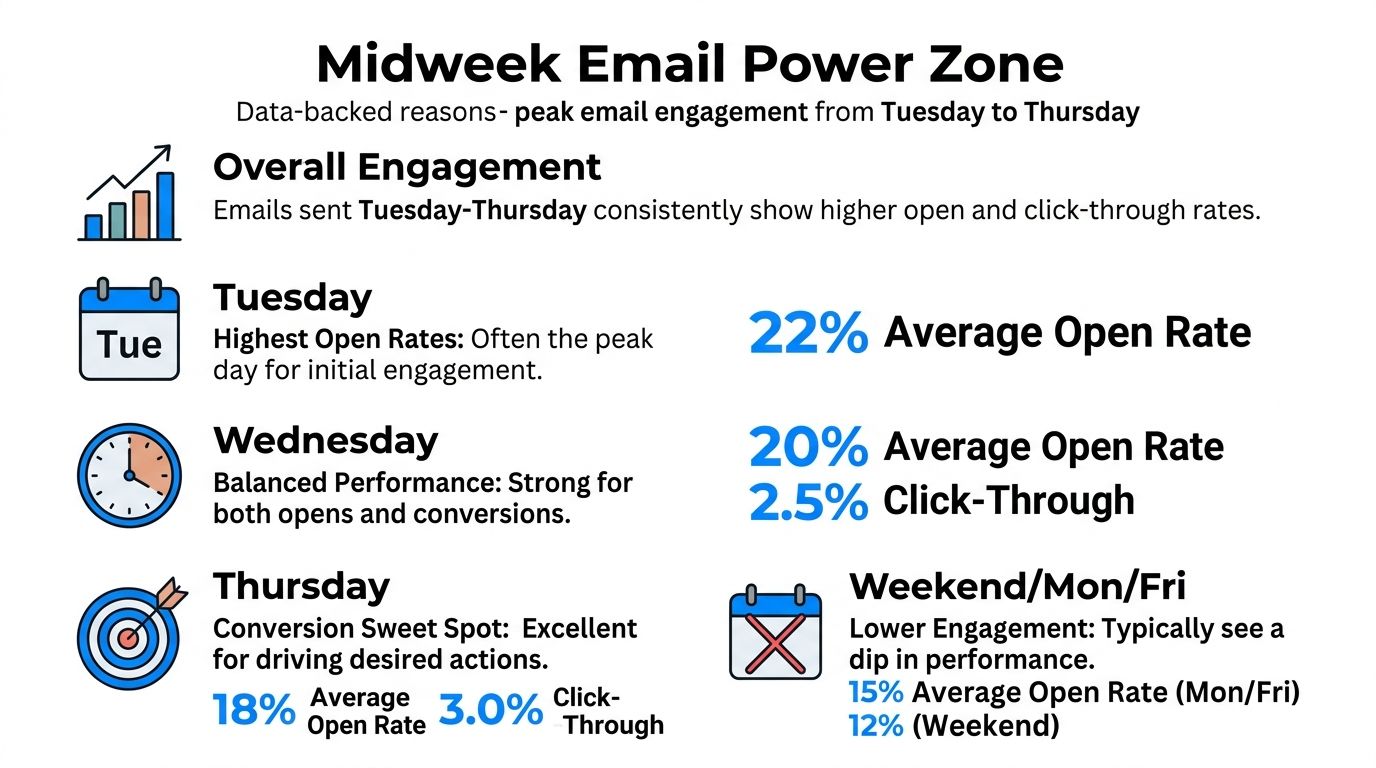
There is still a strong case for midweek sends, especially when the goal is general engagement. A large body of email data points to the same pattern: Tuesday through Thursday is the high-performance zone for many marketing emails.
According to a consolidated review of large-scale studies, including HubSpot and Moosend, Tuesday is the strongest day for opens, and midweek days consistently outperform the rest of the week (Mailshake).
Why midweek works
This pattern makes sense in practice.
Monday is inbox cleanup. People return to a pile of internal threads, customer requests, Slack spillover, and things they ignored over the weekend. Your newsletter competes with operational noise.
Friday is different. The inbox may be lighter, but attention is weaker. People are wrapping tasks, moving meetings, and mentally shifting out of work mode.
Tuesday through Thursday sits in the middle. Recipients are active, focused, and more likely to give a non-urgent email real attention.
The psychology behind the pattern
Think of send timing in terms of attention quality, not just availability.
- Monday attention is reactive: recipients sort, defer, and prioritize.
- Midweek attention is evaluative: they have enough context to engage with useful information.
- Friday attention is selective: only urgent or highly relevant messages break through.
That’s why educational newsletters, product updates, and thought-leadership emails perform well in the midweek window. They benefit from a reader who has enough headspace to absorb information.
If you’re trying to improve email open rates, midweek timing is one of the easiest variables to test before rewriting your whole program.
General benchmark by weekday
Day
Open Rate Rank
Click-Through Rate Rank
Best For
Tuesday
Highest
Strong
Newsletters, content launches, broad B2B engagement
Thursday
High
Strong
Mid-funnel campaigns, action-oriented sends
Wednesday
High
Strong
Balanced performance
Monday
Mixed
Moderate
Select outreach, not broad newsletter sends
Friday
Lower for general engagement
Mixed
Selective campaigns, niche audience tests
Sunday
Lower for general marketing volume
Situational
Low-competition tests
Saturday
Lowest in broad benchmarks
Lower
Usually not the first choice for standard B2B sends
Use the window, not just the winner
The mistake is overfitting to Tuesday.
Some teams get obsessed with picking the single top-ranked day when the smarter move is to use Tuesday, Wednesday, and Thursday as a testing band. That gives you room to vary by list quality, message type, and campaign objective.
Practical rule: If you have no audience data yet, start with Tuesday through Thursday and treat that range as your control group.
That’s the baseline. It’s useful. It just isn’t the whole strategy.
Matching Your Send Day to Your Goal Engagement vs Conversion
The best day to send email changes once you define the job of the campaign.
If the email’s job is engagement, you’re optimizing for attention. If the job is conversion, you’re optimizing for action. Those aren’t the same behavior, and they rarely peak under the same conditions.
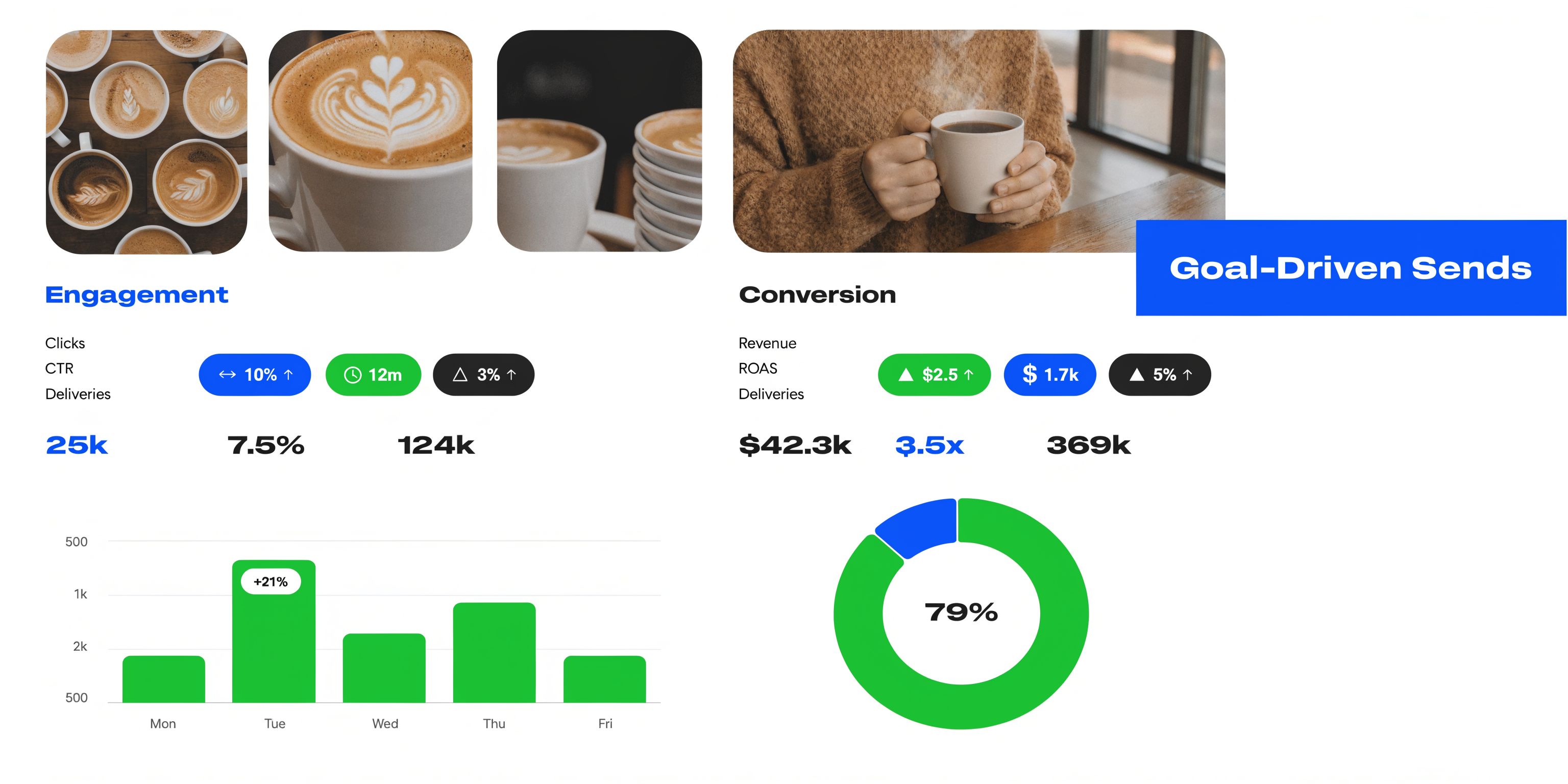
A useful way to think about it is this. Early-week emails help people plan. Later-week emails can help people commit.
According to the analysis summarized by Inbox Zero, educational content tends to perform better earlier in the week, while action-oriented campaigns see stronger click behavior later in the week (Get Inbox Zero).
When to prioritize engagement
Engagement-focused emails include:
- newsletters
- industry roundups
- product education
- founder notes
- thought leadership
- feature awareness
These messages ask for time and attention more than immediate action. They do better when readers are setting priorities and looking for useful inputs.
For this category, early-to-midweek is the right place to start.
When to prioritize conversion
Conversion-focused emails include:
- webinar registrations
- demo requests
- launch announcements
- trial activation nudges
- deadline-driven offers
- event reminders
These emails need the reader to click, register, reply, or forward. They benefit from moments when the recipient is more willing to complete a task, not just skim a subject line.
That’s why open rate alone can mislead you. A campaign can “win” on opens and still lose on the metric that matters.
Choose the KPI before you choose the day
A lot of bad send-time decisions come from measuring the wrong thing.
If you’re deciding between two schedules, define the primary metric first. For newsletters, that may be opens or click-to-open rate. For pipeline campaigns, it might be replies, registrations, or assisted conversions. This breakdown of email campaign performance metrics is the kind of scorecard teams should set before testing timing.
Don’t ask whether Tuesday beat Thursday. Ask whether the Tuesday audience read, clicked, and moved closer to revenue.
A simple decision filter
Use this filter before scheduling:
Campaign type
Primary goal
Better starting window
Newsletter
Engagement
Earlier in the week
Educational nurture
Engagement
Earlier in the week
Webinar invite
Conversion
Later in the midweek window
Product launch CTA
Conversion
Later in the week
Sales follow-up
Response
Depends on audience and urgency
Effective send timing becomes strategy instead of superstition.
Tailoring Send Times for High-Value B2B Audiences
Audience matters as much as intent.
A PLG operator, a fractional CMO, and an enterprise seller don’t open email in the same mental state. They don’t scan for the same signals. They don’t act on the same days.
General benchmarks tell you where to begin. Audience-specific hypotheses tell you where to win.
Enterprise sales audiences
Cold outreach follows a different rhythm than newsletter marketing.
In B2B cold email, Monday led performance in Siege Media’s 2025 study of more than 85,000 personalized emails, including a 2.8% reply rate (Siege Media). That tracks with how many managers and sales leaders work. They start the week triaging priorities, booking conversations, and deciding what deserves follow-up.
For outreach to enterprise sales leaders, Monday is a serious testing day, especially for concise messages with a direct business ask.
This doesn’t mean your newsletter should go out on Monday. It means cold email and marketing email should not share the same schedule by default.
PLG teams and growth marketers
PLG teams behave differently from pure sales audiences.
They spend midweek evaluating experiments, reviewing onboarding friction, discussing activation, and scanning ideas they can apply. That makes them more receptive to educational emails, operator-led newsletters, teardown content, and practical product lessons when attention is stable.
For this segment, useful hypotheses include:
- Tuesday or Wednesday for newsletters that teach
- Thursday for action-oriented content like event signups or tactical downloads
- Local-time scheduling for distributed product teams across regions
Consultants, creators, and fractional CMOs
This group has a less traditional inbox pattern.
They may spend the weekday in client work and only catch up on industry reading after hours. That’s why the blanket rule to avoid weekends doesn’t always hold. MailerLite’s 2026 analysis found 49.7% average open rates on Fridays at 6 PM and 48.9% on Saturdays at 9 AM, which is why off-hour professional sends deserve testing for the right audiences (as cited in the Siege Media summary above).
Build audience-specific hypotheses, not generic rules
A good test matrix for high-value B2B segments looks more like this:
- PLG audience: Start with midweek educational sends and later-week CTA emails.
- Enterprise sales audience: Test Monday for cold outbound, then compare with Tuesday follow-ups.
- Consultants and creators: Test Friday evening or Saturday morning for thought leadership and curated newsletters.
Your list quality matters here too. Timing won’t fix poor targeting. If the audience definition is fuzzy, results will stay noisy. That’s why a clear ideal customer profile in marketing matters before you start optimizing send days.
Some of the best-performing “weird” send times work because inbox competition is lighter, not because the audience suddenly changed.
The broad lesson is simple. Don’t ask whether weekends are bad. Ask which audience segments finally have time to read.
How to Build Your Own Send Time Testing Framework
Benchmarks are useful. They are not your operating system.
The only reliable way to find your best day to send email is to build a repeatable testing process and stick to it long enough for patterns to emerge.

Start with one clear hypothesis
Don’t test random times because a dashboard gives you the option.
Write a simple hypothesis based on audience and goal. Examples:
- For a warm PLG newsletter, Tuesday may beat Thursday on opens.
- For a webinar invite, Thursday may beat Tuesday on clicks.
- For consultant audiences, Friday evening may beat Wednesday morning on total engagement.
That gives the test a reason to exist.
Keep the test clean
Teams pollute timing tests by changing too many variables at once.
Control for:
- Subject line: Keep it the same unless you are running a separate subject-line experiment.
- Audience segment: Compare similar groups, not a mix of customers, prospects, and partners.
- Email content: Same offer, same CTA, same layout.
- Measurement window: Judge both sends after the same amount of time.
If you need a practical walkthrough, this guide on A/B testing email campaigns for higher engagement and ROI covers the mechanics well.
Match the metric to the campaign
Pick one primary KPI and one secondary KPI.
For example:
Campaign type
Primary KPI
Secondary KPI
Newsletter
Open rate
Click-to-open rate
Webinar invite
Click rate
Registration rate
Cold outbound
Reply rate
Open rate
Product update
Click-to-open rate
Feature adoption signal
A common pitfall in timing tests occurs here. Teams claim a winner because opens were higher, even when the business outcome was weaker.
One more practical reference is worth keeping handy while your team sets up tests:
Run the test long enough to trust it
One send tells you very little.
Run the same comparison over multiple sends, especially if your audience size is modest or your content changes week to week. Consistency matters more than speed here. You’re trying to detect behavior, not force a verdict.
A useful testing framework removes ego from scheduling. The calendar wins only if the metric wins.
After a few rounds, you’ll find one of three outcomes. There’s a clear winner, there’s no meaningful difference, or the winner changes by email type. All three are useful answers.
Optimizing Your Schedule with Breaker's Growth Engine
Advanced timing strategies are easy to describe and hard to run manually.
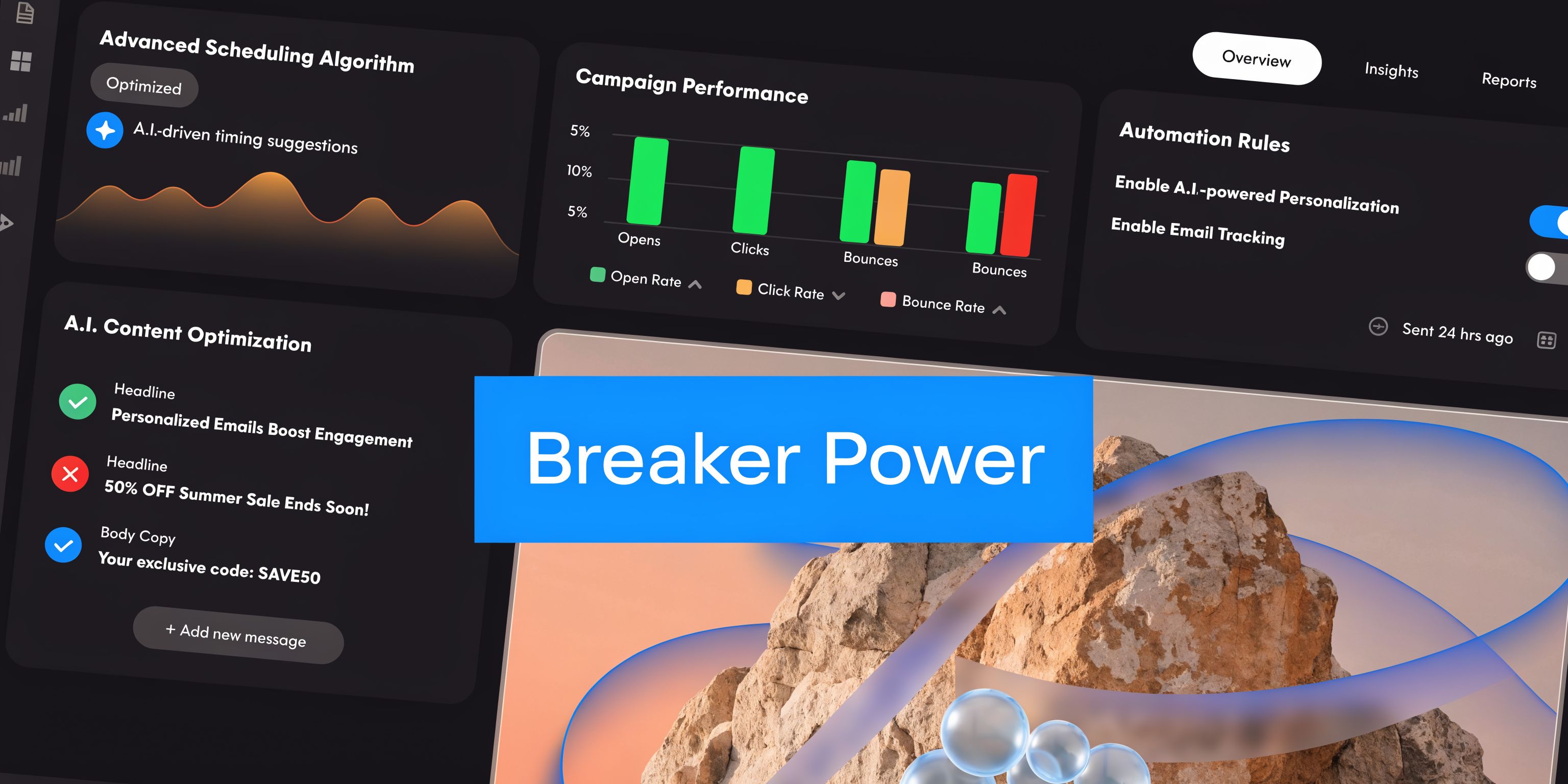
The friction appears quickly. You need the right audience segments, accurate list hygiene, clear reporting, and a way to schedule by recipient time zone without creating operational chaos. That’s where a modern platform starts to matter.
Good timing needs clean targeting
If you send the right email on the right day to the wrong list, performance still suffers.
A platform built for B2B growth needs to help with:
- Audience definition: clean ICP targeting by role, company type, and relevance
- List hygiene: suppression of poor-fit or risky contacts
- Deliverability support: better odds that timing matters because the email lands in the inbox
- Fast reporting: opens, clicks, subscriber growth, and ROI in one place
Without that foundation, teams tend to misread send-time tests because they’re measuring list quality problems.
Time zones change the answer
The “best day” gets more complicated once your audience spans North America, Europe, and APAC.
For global B2B audiences, a follow-the-sun approach matters. Twilio’s guidance highlights staggered sends based on recipient location, and the verified summary notes that Sunday evening low-competition windows can reach open rates as high as 48.9% in emerging 2026 data (Twilio).
That matters for teams sending across multiple regions. A single EST blast can land at a useful hour for one market and a dead zone for another. Timezone-normalized scheduling fixes that.
What practical optimization looks like
A strong workflow looks like this:
- Segment by audience first: PLG operators, enterprise sales, consultants, and creators should not sit in one timing bucket.
- Assign the campaign goal: engagement, conversion, or reply.
- Schedule by local time: especially for multi-region lists.
- Review results quickly: if Thursday beats Tuesday for one segment, update the rule and keep moving.
The core value isn’t just automation. It’s making a nuanced send strategy feasible at scale without turning your newsletter program into a spreadsheet project.
Frequently Asked Questions About Email Send Times
Should I avoid holidays and long weekends?
Yes, for standard B2B sends.
If the email isn’t urgent, move it. Holiday periods distort normal work patterns, and your benchmark data becomes less useful. If you do send, treat it as a separate test rather than comparing it directly with a regular workweek campaign.
Is the best day different for cold outreach and newsletters?
Yes.
Cold outreach performs on a different rhythm than newsletter sends. As covered earlier, Monday can be a strong day for cold email in B2B, while newsletters and educational emails fit better in the midweek engagement window.
Should I resend to non-openers?
Sometimes, but only if the email matters.
Use a different subject line and leave enough time between sends that the resend doesn’t feel accidental. This works best for launches, events, or high-value content. It’s less useful for routine newsletters unless the topic was especially strong.
Is weekend sending ever a good idea for B2B?
It can be.
Weekend and off-hour sends are worth testing for consultants, creators, founders, and other audiences who catch up outside standard office hours. Don’t assume weekend behavior is bad just because it’s less common.
If I can only test one thing, what should I test first?
Test day of week before fine-tuning hour.
That produces clearer learning faster. Once you know the right day range, then optimize the time within it.
If you want to put this into practice without juggling segmentation, scheduling, list growth, and reporting across multiple tools, Breaker gives B2B teams one place to build newsletters, expand the right audience, monitor performance, and optimize sends with less guesswork.
Keep reading
All articlesB2B Lead Generation via Newsletter: What Actually Works
Cold outbound is losing steam. See 7 proven newsletter tactics for B2B lead generation, from gated content to sponsorship swaps, that beat cold outreach.
How to Write a Newsletter with AI: Step-by-Step Guide 2026
Learn how to write a newsletter with AI the right way: a 7-step process to train, calibrate, and edit AI drafts that still sound like you.
How to Boost Conversions With Your Email Newsletter
Turn your newsletter into a conversion engine. See 2026 benchmarks, CTR vs CVR explained, and the fixes most email guides skip.