
How to Create a Mailing List: A B2B Growth Playbook
Learn how to create a mailing list that drives B2B growth. Our step-by-step guide covers ICP, tools, acquisition, compliance, and list hygiene for real results.
Leads are uneven. Paid channels get expensive without warning. Social reach looks healthy one month and disappears the next. Most B2B teams respond by trying to get more top-of-funnel volume, but that usually creates a mess: more names, weaker fit, lower engagement, and a list that gets harder to use every quarter.
A mailing list fixes that only if you build it like an asset, not a bucket.
That's the core difference behind how to create a mailing list that effectively helps pipeline. You're not collecting emails for vanity. You're building a permission-based database of people who match your market, want what you publish, and can be segmented, nurtured, and reactivated without depending on an algorithm.
In B2B, that matters because your list is one of the few channels you can control directly. If the people on it are the right people, your email program becomes more predictable. If they're the wrong people, email turns into another noisy channel with hidden deliverability problems. Teams that want a stronger operating model usually pair list growth with automation from day one, and this is a good place to learn email list automation tips that connect capture, onboarding, and follow-up into one system.
If you need a quick primer on the mechanics of grouped email sending, this breakdown of an email distribution list is useful. But mechanics are only the surface. The harder and more valuable job is building a list that stays relevant, compliant, and usable over time.
Building Your Most Valuable Marketing Asset
A B2B mailing list is more than a sending channel. It's a direct audience you can organize, segment, and activate without asking a platform for permission.
That changes how you should think about growth. A large list of weak-fit contacts looks impressive in a dashboard, but it doesn't help sales, doesn't improve campaign learning, and often creates downstream inbox issues. A smaller list of exact-match subscribers is usually more useful because the signal is cleaner. You learn faster which topics convert, which offers attract your market, and which segments deserve more budget.
Why control matters more than reach
Most acquisition channels are rented. Search rankings move. Paid costs fluctuate. Social distribution is outside your control. An email list is different because the relationship is direct. Someone opted in, expects to hear from you, and can be tagged based on what they asked for or how they engaged.
That gives B2B teams three advantages:
- Better message-market feedback because replies, clicks, and content consumption come from people who chose to be there.
- Stronger audience memory because you're not starting from zero every campaign.
- More durable performance because you can keep refining segments instead of buying attention from scratch every month.
Practical rule: Judge your list by subscriber fit, engagement quality, and downstream sales usefulness. Subscriber count comes later.
What a high-value list actually looks like
The best lists aren't broad. They're intentionally constructed around consent, relevance, and maintenance. The subscriber understands why they joined. Your team understands what segment they belong to. Your systems know what to send next.
That's the frame for the rest of the playbook. If you approach how to create a mailing list as a growth asset, every decision gets sharper: who to attract, what to offer, which tools to use, what to automate, and when to remove people who no longer belong.
Laying the Foundation with Your Ideal Customer Profile
Most list-building problems start before the first form goes live. Teams launch a newsletter, add a generic signup box, and hope the right people show up. That rarely works in B2B because broad messaging attracts broad interest, and broad interest doesn't usually become qualified demand.
Your list should be built for a specific buyer environment. That means defining an Ideal Customer Profile, then translating it into acquisition criteria.
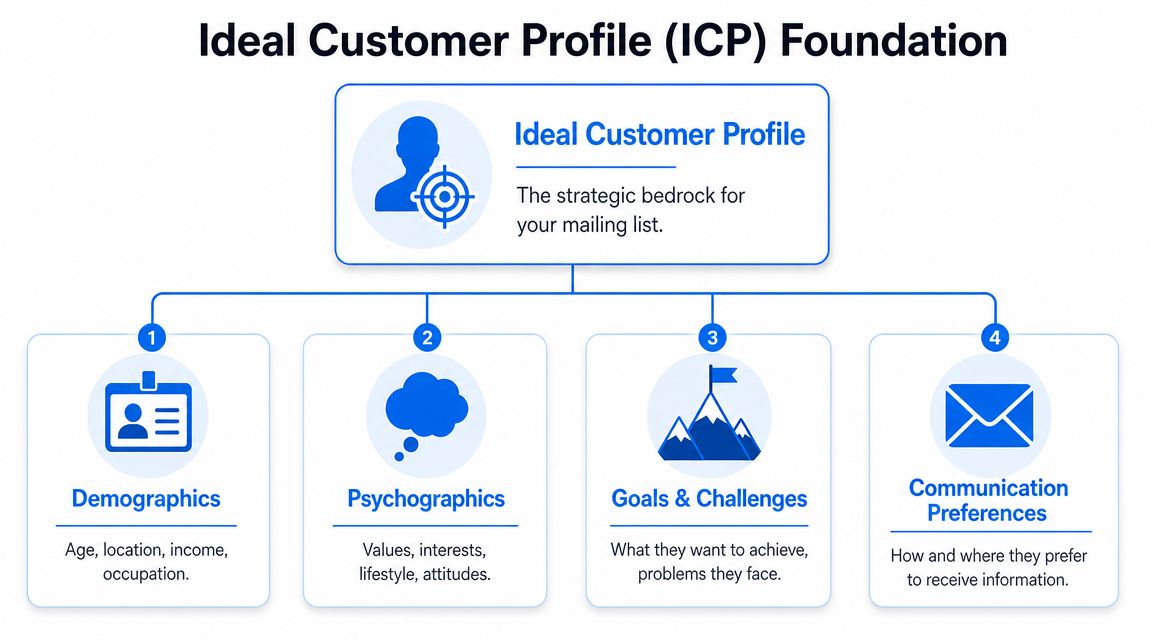
A useful starting point is this guide to what is ICP in marketing, especially if your team still mixes buyer persona language with company-level targeting. For list building, the difference matters. You need to know both the company you want and the person inside it who will subscribe.
Define the profile in acquisition terms
A workable ICP for email growth includes more than industry and company size. It should answer questions your form, offer, and segmentation system can act on.
Use these lenses:
- Firmographics such as industry, business model, and market segment. A B2B SaaS buyer and a services buyer may both care about growth, but they won't respond to the same lead magnet.
- Role and seniority so the content matches the reader's real job. A founder wants strategic advantage. An operator may want templates and process.
- Technographics when your offer depends on the tools they already use. This matters for integration-led content and migration offers.
- Trigger conditions such as hiring a sales team, launching outbound, adding lifecycle marketing, or entering a new market.
- Information preference so you know whether they're likely to sign up for reports, tactical playbooks, webinars, or short operator emails.
If your definition can't shape what someone sees on the signup page, it's still too vague.
Set the job of the list
Not every B2B mailing list has the same purpose. Some lists support demand generation. Others support founder-led thought leadership. Others exist to move product-qualified accounts toward a sales conversation. The list goal should decide your acquisition strategy.
A simple planning table helps:
List objective
What you collect for
What the subscriber expects
Lead nurturing
Ongoing education and category framing
Useful guidance over time
Direct sales support
High-intent contacts tied to offers or demos
Relevant follow-up and clear next steps
Thought leadership
Audience building among strategic buyers
Strong ideas and consistent perspective
Customer expansion
Product education and use-case depth
Practical value after signup
A list without a job becomes a content dumping ground.
Build segmentation into the foundation
Industry guidance recommends using sign-up forms on websites, landing pages, and social profiles, then filtering or tagging contacts by source and behavior, with a focus on quality, relevance, and volume, in that order according to Zendesk's email list guidance.
That order matters. It means your first question isn't “How do we grow faster?” It's “Which sources bring the right people, and how will we identify them after signup?”
The subscriber source is part of the subscriber profile. A webinar lead, a product blog subscriber, and a social bio signup may all fit your ICP, but they rarely want the same first email.
What this changes in practice
Once the ICP is clear, your list-building decisions get simpler:
- Your lead magnet becomes narrower
- Your landing pages become more credible
- Your paid targeting gets less wasteful
- Your welcome flow can branch based on known intent
That's the foundation behind how to create a mailing list in B2B. You're not trying to attract everyone willing to type an email address. You're trying to attract the right accounts, through the right promise, at the right point in their buying journey.
Choosing and Configuring Your B2B Tech Stack
Your mailing list doesn't live inside one tool. It lives inside a system. If the stack is clumsy, subscribers fall through gaps, tags get lost, and sales can't tell where anyone came from. Good setup avoids that.
The core decision is whether to use a traditional ESP, a CRM-centered workflow, or an integrated platform that combines capture, sending, and growth. Each can work. The right choice depends on how much complexity your team can manage.
What you need the stack to do
At minimum, your setup should handle five jobs well:
Component
What it must do
What breaks if it doesn't
Email platform
Send campaigns and automations reliably
Onboarding and nurture become manual
Form and landing page layer
Capture subscribers with low friction
Conversion drops before email starts
CRM or contact database
Store source, segment, and lifecycle data
Sales and marketing lose context
Integration layer
Pass subscriber data between systems
Records drift and tags go missing
Deliverability controls
Support reputation and list health
Good emails stop reaching inboxes
If one tool can cover several of those jobs without creating blind spots, that's usually better than stitching together too many point solutions early.
Comparing practical options
A lean B2B team can start with a standard ESP plus embedded forms and CRM sync. That's enough if the motion is simple and subscriber growth is mostly organic.
A more advanced team may want a platform that handles both sending and audience growth. For example, Breaker combines newsletter sending with B2B list expansion, ICP targeting, analytics, data hygiene, and deliverability management inside one workflow. That's useful when the list itself is part of your acquisition engine rather than just a broadcast destination.
If your revenue team already relies heavily on commerce or lifecycle tools, data unification becomes the bigger issue. In that case, it helps to Unify Klaviyo customer data so attribution and subscriber behavior aren't split across systems.
How to configure it without creating friction
Most list-building losses happen at setup. Teams ask for too much data, create too many disconnected forms, or route every signup into the same generic sequence.
Keep the initial architecture simple:
- Use one primary source of truth for subscriber records.
- Name forms by channel and offer so source reporting stays clean.
- Pass tags at the moment of signup instead of trying to reconstruct intent later.
- Connect one welcome automation per core offer or audience type.
- Keep forms short and collect extra detail later through behavior or progressive profiling.
A good stack shouldn't just store contacts. It should preserve context. That's what makes segmentation, handoff, and campaign relevance possible later.
Designing Your Subscriber Acquisition Engine
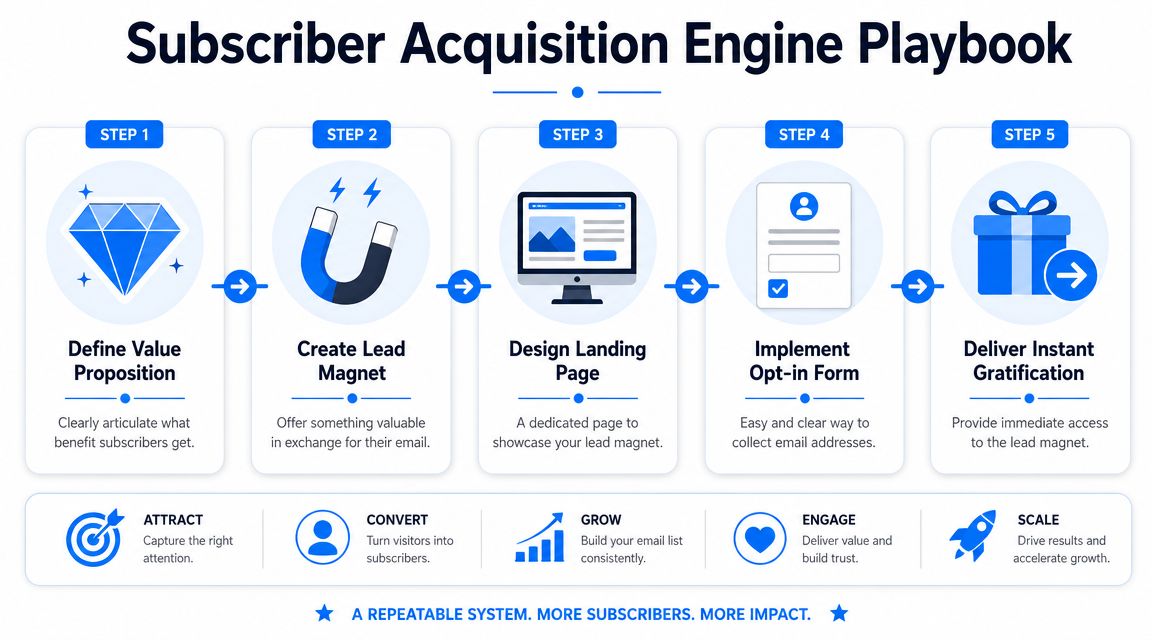
People don't join B2B mailing lists because they admire your form builder. They join because the offer is useful enough to exchange attention and contact information for it. That exchange is the engine.
When teams ask how to create a mailing list, they usually focus on placement. Where should the form go? Which channel should we use? The better question is why a qualified buyer would subscribe right now.
Build the offer before you scale the traffic
A B2B lead magnet should solve a near-term problem for your ICP. Not a broad educational topic. Not a generic ebook. Something a buyer can use quickly.
Strong examples include:
- Templates for outbound, onboarding, reporting, or stakeholder updates
- Recorded webinars tied to a specific workflow or market problem
- Operator playbooks that show exactly how a team handles a recurring process
- Checklists for launches, audits, migrations, or campaign reviews
- Interactive tools that help estimate effort, readiness, or channel fit
The narrower the problem, the stronger the subscriber signal.
A weak lead magnet creates list growth without list value. You'll get contacts, but you won't get clarity about who actually belongs in future campaigns.
Use dedicated capture points
A high-performing acquisition method involves capturing emails via dedicated landing pages and lead magnets, then segmenting by source. That matters because initial source quality affects open and click behavior, and importing unverified contacts too early can hurt inbox placement, as noted in Podia's email list guidance.
That's why dedicated pages outperform scattered asks in many B2B programs. They let you align one audience, one problem, one promise, and one CTA.
Use a mix of these capture points:
- Landing pages for campaigns, paid traffic, webinars, and lead magnets
- Embedded forms on high-intent blog posts or product education pages
- Social profile links for founders, creators, and brand accounts
- Checkout or product opt-ins when the subscriber relationship extends post-purchase
- QR-based signup flows for events and field marketing
This is also where a sharper social funnel helps. If you promote offers through creator-led channels or brand profiles, Linkie's conversion playbook for bio links is a practical reference for reducing friction between profile visits and signup.
For more channel-specific tactics, these email list building strategies cover ways to match acquisition methods to audience intent.
A quick walkthrough helps visualize the mechanics before launch:
Mix organic and paid distribution carefully
Organic acquisition is slower, but it often produces stronger context because the subscriber usually consumes content before opting in. Paid acquisition can scale, but only when the offer and audience match are already proven.
A practical sequence looks like this:
- Test the lead magnet organically through your site, newsletter mentions, founder posts, or webinar invites.
- Check signup quality by source rather than just counting conversions.
- Expand paid distribution only after the welcome flow and segmentation model are working.
- Retire weak sources early if they create low-fit or low-intent signups.
The acquisition engine works when every channel feeds a list you'd want to email next month, not just a list that got bigger this week.
Automating Your Onboarding and Welcome Sequence
The moment after signup tells you almost everything. If a new subscriber doesn't receive what they expected, trust drops immediately. If they do receive it, and the next message feels useful, the relationship starts correctly.
That's why the welcome sequence carries more weight than it often receives. The first few sends shape engagement, segmentation, and future inbox placement.
What should happen right after signup
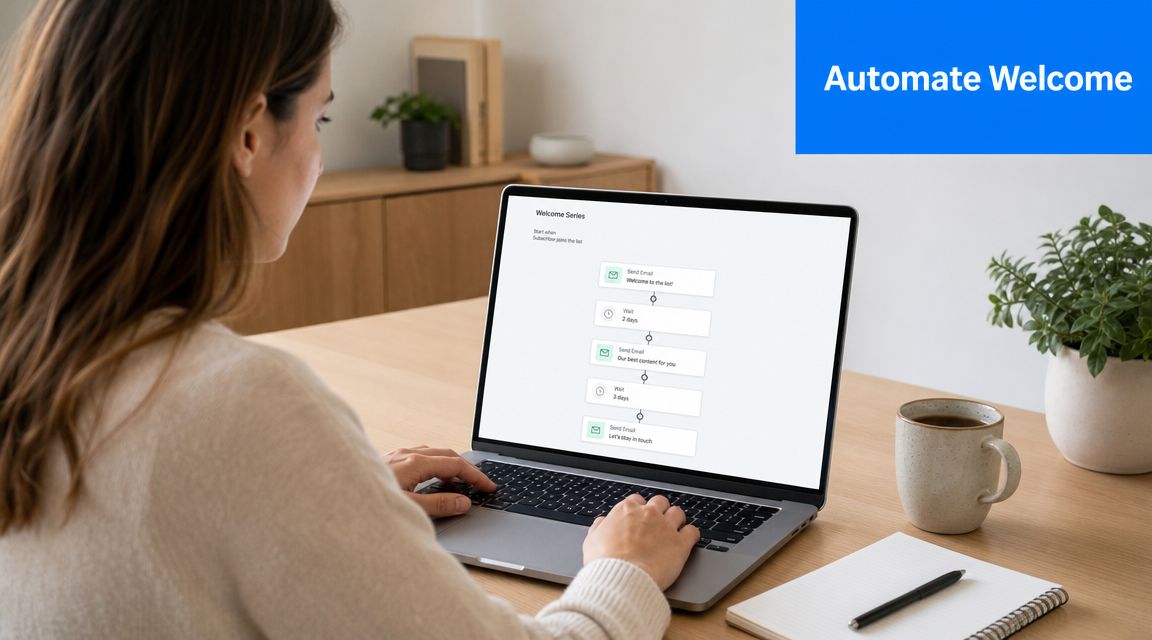
A practical B2B onboarding flow usually starts with consent confirmation, then moves quickly into value delivery and signal collection.
The sequence often looks like this:
Message
Purpose
What to include
Confirmation email
Verify intent if using double opt-in
Clear action and no distractions
Welcome email
Deliver the promised asset or benefit
Immediate value and expectation setting
Follow-up email
Deepen relevance
Related resource or use-case content
Segmentation prompt
Learn intent
Topic choice, role cue, or CTA path
Early nurture email
Build habit
One strong idea or practical lesson
One operational benchmark is worth taking seriously. Welcome emails can generate around 4× the opens and 5× the clicks of standard email campaigns, according to the benchmark cited by one.com's mailing list guide. That's why the initial sequence isn't a formality. It's a performance window.
How onboarding improves list quality
Think about two subscribers.
The first downloads a benchmark template from a landing page. They get the file instantly, then a short welcome email that explains what else they'll receive and how often. The second email offers a related checklist for team reporting. If they click, they're tagged for operational content.
The second subscriber joins from a founder's social profile because they want strategic commentary. They shouldn't get the exact same follow-up. They need a different path, one that reflects the original reason they subscribed.
That's the hidden job of onboarding. It doesn't just greet the subscriber. It starts sorting the list.
Send the promised value first. Ask for more attention second. New subscribers will give you more information if the first interaction proves you understood why they signed up.
Common mistakes in welcome automation
The failures are usually predictable:
- Delaying delivery of the promised asset
- Sending one generic sequence to every source
- Asking for too much too early
- Ignoring behavioral signals like clicks and non-clicks
- Failing to set expectations around frequency and content type
A good welcome flow is short, specific, and responsive. It should confirm consent, deliver value, and capture enough signal to make the next campaign more relevant than the last.
Mastering List Hygiene, Compliance, and Optimization
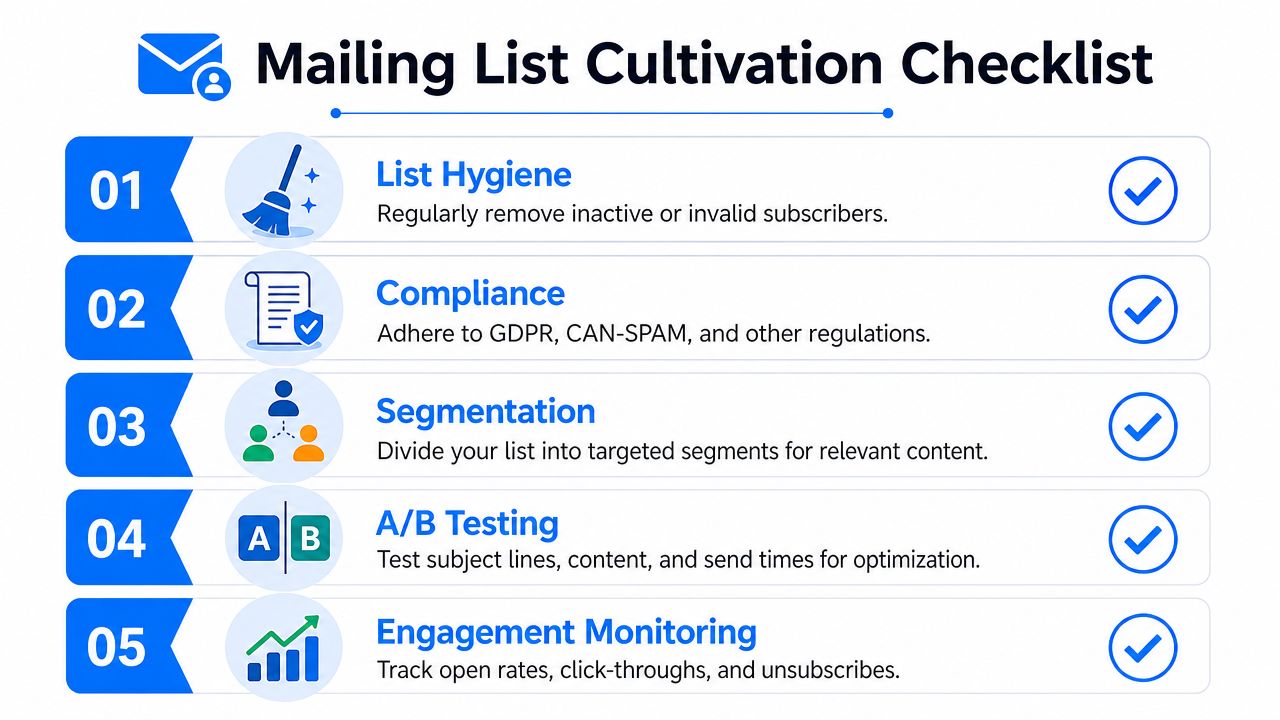
A mailing list isn't finished when the form works. That's when the maintenance starts. If you ignore hygiene and compliance, the list gradually becomes less useful, less trustworthy, and harder to deliver to.
A subtle performance loss impacts many B2B teams. They keep adding contacts, but they don't remove the wrong ones, don't maintain consent records properly, and don't treat engagement decay as a list-building issue. It is one.
Protect deliverability with hygiene discipline
Source quality matters more than raw volume. Permission-based collection, clear tagging, and regular pruning keep your active audience usable.
A strong operating standard includes:
- Collect through explicit opt-in rather than purchased addresses. Modern guidance stresses consent-first collection, clear subscriber value, and easy unsubscribes. That aligns with the baseline requirements established by the CAN-SPAM Act, which took effect in 2004.
- Store proof of consent so your team can show where and how a subscriber joined.
- Use double opt-in when list quality matters more than speed.
- Suppress or remove low-engagement segments carefully instead of continuing to send indefinitely.
- Keep unsubscribe mechanisms functional and easy to use.
The contrarian truth is simple: a smaller, maintained list is usually more commercially useful than a bigger neglected one.
Treat compliance as operating infrastructure
Privacy rules have made email collection more operationally serious. With privacy requirements tightening, including the EU's Data Act becoming applicable in September 2025, the challenge is no longer just putting a form on a page. It's building a list that can survive legal review and deliverability scrutiny, as discussed in Beehiiv's list-building article.
That has practical implications:
Compliance area
What teams should do
Consent capture
Make the opt-in clear and specific
Data records
Keep evidence of source and signup event
Data minimization
Ask only for information you need now
Cross-source merging
Review how imported and enriched data was obtained
Withdrawal handling
Honor unsubscribes quickly and completely
If your team buys, enriches, or merges lead data from multiple sources, legal review should happen before broadcast, not after complaints.
Compliance isn't separate from list growth. It shapes which subscribers you can safely use, how long you can keep them active, and whether your list remains a real asset.
Optimize the list, not just the email
Optimization goes beyond subject lines. The more useful questions are:
- Which acquisition sources produce subscribers who stay engaged?
- Which lead magnets attract the right role but the wrong urgency?
- Which segments stop engaging and should move to a lighter cadence?
- Why are people unsubscribing from specific sequences?
A list improves when you learn from those patterns and change acquisition, onboarding, and segmentation accordingly. That's the advanced version of how to create a mailing list. You build it, but you also keep re-qualifying it.
If you want one platform that combines sending with B2B audience growth, Breaker is built for that workflow. Teams can run newsletters, define their ICP, add compliant subscriber growth, monitor analytics, and manage deliverability in one place instead of splitting list building across disconnected tools.
Keep reading
All articlesHow to Boost Conversions With Your Email Newsletter
Turn your newsletter into a conversion engine. See 2026 benchmarks, CTR vs CVR explained, and the fixes most email guides skip.
Drip Campaign Template: Ready-to-Use Email Sequences
Get 6 ready-to-paste drip campaign templates with subject lines, body copy, and send timing—plus a step-by-step guide to building your own.
Post-Webinar Survey Questions Template (2026)
30+ post-webinar survey questions with NPS, CSAT, and CES templates, plus timing and length tips to boost completion and qualify leads faster.