
Master Your Email Distribution List Strategy
Transform your email distribution list into a powerful growth engine. Learn modern strategies to build, segment, and scale your B2B list.
If you’ve ever used a simple email group to blast a message to your team, you’ve used an email distribution list. But in B2B marketing, that basic concept has evolved far beyond a simple broadcast tool. It's now a dynamic growth engine for generating leads, managing contacts automatically, and personalizing every touchpoint.
What Is A Modern Email Distribution List?

Forget the dusty, static phone book analogy. A modern email list is nothing like a fixed directory for mass sending. Think of it less like a list and more like a smart, self-updating database that learns from every single interaction your audience has with your brand.
Sure, the core function is the same—sending one email to many people. But its strategic role has completely changed. Traditional lists are often static, require manual updates, and go stale almost immediately. That leads to a ton of wasted effort.
A real-world audit of an Exchange Online tenant revealed a shocking truth: over a 90-day period, 91.36% of the 81 distribution lists analyzed were completely dormant. Not a single message was sent or received.
This data pinpoints a huge problem. When lists aren't actively managed or woven into your daily workflows, they become digital graveyards that offer zero value. A modern list, by contrast, is a living, breathing asset.
The Evolution From Static Directory To Growth Engine
The key difference is simple: dynamics. A traditional list is like a snapshot, capturing your contacts at one specific moment in time. A modern list, managed through a growth-focused platform, is more like a live video feed, constantly updating based on new data and behaviors.
This shift delivers some major advantages for B2B marketers:
- Automatic Updates: New subscribers from your website forms or paid ad campaigns get added seamlessly, no manual data entry required.
- Intelligent Grouping: Contacts are automatically segmented based on their interests, job titles, or how they engage with your content.
- Data Enrichment: Basic contact info gets enhanced with valuable details like company size or industry, paving the way for hyper-relevant targeting.
To put it in perspective, let's quickly compare the old way with the new.
Traditional Vs Modern Email List Approaches
Feature
Traditional Distribution List
Modern Growth List
Updates
Manual; requires constant exporting and importing
Automatic; syncs with forms, CRM, and other tools
Segmentation
Basic and manual; often one large, undifferentiated list
Dynamic; automatically groups contacts by behavior, role, etc.
Data
Static; what you see is what you get
Enriched; constantly adds new data points for better targeting
Purpose
Broadcasting; sending one-way messages
Nurturing; building relationships and driving conversions
ROI
Low; high unsubscribe rates and low engagement
High; drives predictable revenue and pipeline growth
This table makes the contrast clear. The old approach is an administrative task, while the modern approach is a strategic revenue driver.
Why This Shift Matters For B2B Marketing
Moving from a passive directory to an active growth tool is a game-changer. It transforms the humble email list from a chore into a powerful machine for creating consistent, predictable leads. Instead of just "blasting" a generic message to everyone, you can nurture specific segments with content they actually care about.
This targeted approach is the backbone of effective marketing and sales today. To get the full picture of how this fits into a broader strategy, it’s worth reviewing some general B2B email marketing best practices. Understanding why you need to adopt sophisticated list management sets the stage for building a genuine revenue channel—not just an email-sending tool.
Email Distribution Technology: Formats and How Lists Actually Send
"Email distribution list" describes a strategy, but the technology underneath varies a lot. The distribution format you pick decides how your list scales, how it looks in the inbox, and whether it lands there at all.
Distribution technologies, compared
- Mail server groups (Microsoft 365 distribution groups, Google Groups). One alias expands to every member on the mail server. Free and fine for internal announcements, but there is no unsubscribe, no analytics, and large sends get throttled or flagged as spam.
- Mailing list managers (Mailman, Groups.io). Built for discussion lists where members reply to all and archives are kept. Rarely the right fit for marketing.
- Newsletter platforms and ESPs (Breaker, Mailchimp, Brevo). Each recipient gets an individual message from authenticated sending infrastructure, with segmentation, tracking, unsubscribe handling, and deliverability tooling. This is the standard for any external list.
- CRM-driven sends (HubSpot, Salesforce Marketing Cloud). Distribution driven by CRM fields and deal stages. Powerful for sales-aligned nurture, heavier to run for a regular newsletter.
- API and transactional senders (SendGrid, Postmark, Resend). Programmatic one-to-one email triggered by your product. Usually paired with a newsletter platform rather than replacing it.
Message formats
- Plain text: highest deliverability and a personal feel, with no layout or tracking pixels. Good for sales-style sequences.
- HTML: full design, images, and click tracking. Every platform sends a multipart message with a plain-text version alongside it.
- AMP for Email: interactive elements inside the email, supported by Gmail and a few other clients. Niche for B2B.
- RSS-to-email: the platform builds the send automatically from a feed. Ideal for blogs and content teams; see our RSS to email guide.
How to choose
Use a mail server group only for internal, reply-all style communication. Use a newsletter platform for anything sent to customers or prospects, because authentication (SPF, DKIM, and DMARC), list hygiene, and reporting come built in. Our comparison of plain text versus HTML email helps with the format decision.
How To Build A High-Value Email List
A great email list doesn't just materialize—it's carefully built, one high-quality subscriber at a time. The real goal isn't just to rack up a high contact count, but to attract people who genuinely want to hear from you and fit your Ideal Customer Profile (ICP). It all starts with giving them something valuable right from the get-go.
Think of it as a fair exchange. You’re asking for access to their inbox, a closely guarded space. In return, you need to offer something they actually want. This is where lead magnets come in—high-value resources offered in exchange for an email address.
These aren't just random freebies. They act as a filter, pulling in prospects who have a specific problem you can solve, making them the perfect starting point for building a quality list.
Proven Subscriber Acquisition Strategies
To turn casual website visitors into loyal subscribers, you need to make saying "yes" both easy and worthwhile. Here are a few battle-tested strategies that work:
- High-Converting Website Forms: Sprinkle simple, clear opt-in forms across your site’s hotspots—your blog, homepage, and resource hub are great places to start. Research shows that sticking to just three form fields can push conversion rates to 25% or higher.
- Irresistible Gated Content: Offer up exclusive content that visitors can only get by sharing their email. Think in-depth white papers, reports packed with original data, or a comprehensive e-book that solves a real problem.
- Webinar Registrations: Host webinars that tackle a major pain point for your target audience. The sign-up process is a natural way to collect email addresses from people who are already raising their hands to learn from you.
- Targeted Paid Campaigns: Run paid ads on platforms like LinkedIn to get your lead magnets in front of professionals who match your ICP based on their job title, industry, or company size.
When you focus on these value-first methods, you ensure your list is filled with high-potential leads from day one. You can explore these methods in more detail in our full guide to modern email list building strategies.
Navigating Compliance With Confidence
As you grow your list, compliance isn’t just a legal hoop to jump through—it’s the foundation of trust and a key factor in protecting your sender reputation. Ignoring rules like GDPR in Europe or the CAN-SPAM Act in the U.S. can land you with hefty fines and torpedo your deliverability.
The guiding principle behind all these regulations is simple: consent. You must have clear permission before you send a single marketing email.
Never, ever buy an email list or add contacts without their explicit opt-in. It’s not just against the rules; it’s a surefire way to get slammed with spam complaints, wreck your brand, and kill your engagement. An uninterested audience isn't an asset, it's a liability.
To stay on the right side of the law, be transparent. Tell people exactly what you'll be sending them and how often. The gold standard is using a double opt-in process. This is where a new subscriber gets a confirmation email and has to click a link to be added to your list. It confirms their interest and keeps your list clean and full of people who actually want to be there.
Mastering List Segmentation And Personalization
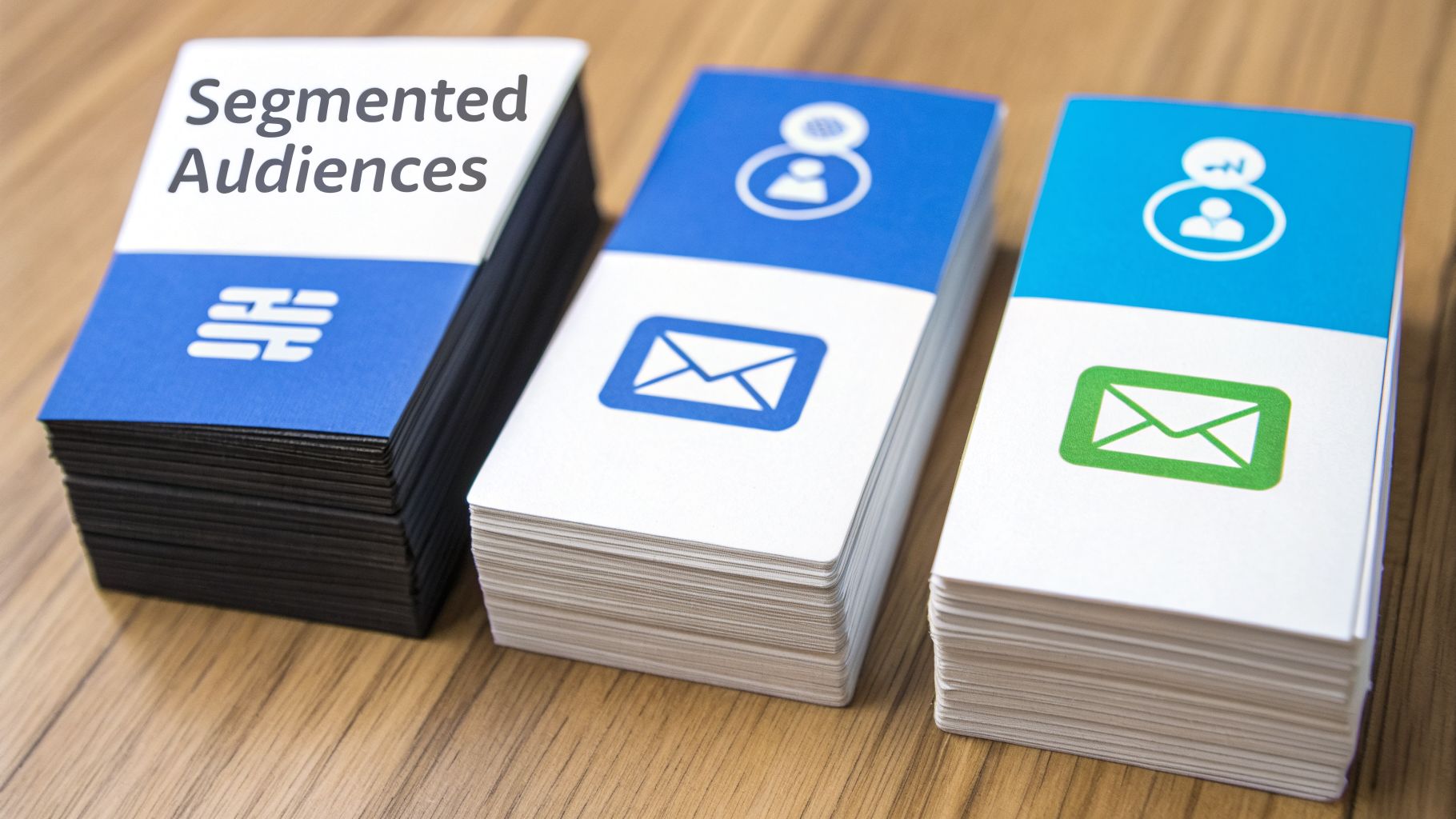
Sending the same generic email to your entire list is a surefire way to kill engagement. Think of a static list like an old-school radio station—one broadcast goes out to everyone, whether they like the music or not. A segmented list, on the other hand, is like having different channels for different genres, making sure every listener gets exactly what they came for.
The goal here is to stop shouting at the crowd and start having meaningful conversations. This is what separates newsletters that get ignored from those that become powerful lead generation engines. It's the difference between being inbox noise and becoming a trusted resource.
Why Basic Segmentation Is Not Enough
Splitting your list into a few broad categories is better than nothing, but real personalization goes much deeper. For B2B audiences, powerful segmentation hinges on specific, actionable data that reflects a subscriber's professional world and where they are in their journey with you.
Without that level of detail, you’re just scratching the surface. True success comes from understanding the subtle differences within your audience and tailoring your message to fit.
The core idea is to transform your email distribution list from a simple address book into an intelligent system that delivers hyper-relevant content. This approach turns subscribers into engaged readers and, ultimately, qualified leads.
This is where the cracks in traditional systems start to show. For example, many companies still lean on internal platforms like Microsoft 365, which have strict limits that make scaling a nightmare. A single distribution list is capped at 100,000 members, and messages sent to lists with over 5,000 members are throttled. For a growing business, that’s a major bottleneck. You can dig into these platform-specific headaches on Microsoft's community forums.
Powerful B2B Segmentation Criteria
To create campaigns that actually get read, you need to group your audience using meaningful business attributes. This allows you to speak directly to their specific pain points, challenges, and goals.
Here are some of the most effective criteria for B2B segmentation:
- Job Title or Role: A CTO cares about different things than a marketing manager. Segmenting by role lets you adjust the technical depth and angle of your content.
- Industry: A manufacturing firm's problems are worlds away from a SaaS startup's. Industry-specific content proves you understand their reality.
- Company Size: A small business owner is looking for practical, budget-friendly fixes, while an enterprise executive is focused on scalability and enterprise-level integrations.
- Engagement Level: Separate your most active readers from those who are drifting away. This lets you send re-engagement campaigns to inactive subscribers or special offers to your biggest fans.
By layering these criteria, you can create incredibly specific audience segments and deliver messages that feel personal and valuable. If you want to go even deeper, our guide on B2B audience segmentation strategies covers more advanced techniques.
Moving To Dynamic And Automated Segmentation
The most effective email strategies run on dynamic segmentation, where your lists update automatically as subscriber data changes. For instance, a contact in the "prospect" segment can instantly move to the "customer" segment after making a purchase. This ensures they get the right onboarding content instead of another sales pitch.
This kind of hands-off automation is powered by two key pieces of tech:
- CRM Integration: Syncing your email platform with your CRM ensures sales and marketing data flows freely between them. This creates a single, unified profile for every contact.
- Data Enrichment: This process takes the information you have—like a simple email address—and layers on additional data from third-party sources. Suddenly, you have their company name, job title, and industry, which is the fuel you need for precise segmentation.
With these tools working together, your email distribution list becomes a living, intelligent asset. It adapts in real-time to what your users do and what you learn about them, letting you deploy hyper-relevant campaigns at scale without all the manual work. This is how you turn a simple list into a serious engine for business growth.
Maintaining A Healthy And Engaged List
Your email list isn't a static asset; think of it more like a garden. If you don't regularly pull weeds and nurture the plants you want to keep, it’ll quickly get overgrown and stop producing. This "weeding" process is what we call list hygiene, and it’s absolutely critical for protecting your sender reputation and getting any real impact from your marketing.
Ignoring list hygiene is one of the fastest ways to kill your deliverability. When email providers like Gmail and Outlook see your messages bouncing from dead addresses or getting flagged as spam, they start marking you as a low-quality sender. Before you know it, all your hard work lands straight in the junk folder.
Key Indicators Of List Health
To keep your list in top shape, you need to watch a few key metrics. They act as an early warning system, flagging problems before they get out of hand.
- Bounce Rate: This is the percentage of emails that never made it to the inbox. A hard bounce means the email address is flat-out invalid and needs to be removed immediately. A soft bounce is a temporary problem (like a full inbox), but if it keeps happening to the same address, it’s a sign of a dead contact.
- Spam Complaint Rate: This tracks how many people are hitting the "spam" button on your emails. A high complaint rate is a massive red flag for email providers and a clear signal that your content isn't hitting the mark or you don't have proper consent.
- Engagement Metrics: This covers your open and click-through rates. When these numbers start to dip, it’s a sign that your audience is tuning out.
Keeping these numbers healthy is non-negotiable. For a deeper dive into the technical side of things, our complete guide on email deliverability best practices covers this in much more detail.
Practical List Hygiene Workflows
Monitoring metrics is one thing, but you have to act on what you see. The two most important habits to build are re-engaging subscribers who have gone quiet and, just as importantly, letting go of those who don't come back.
A re-engagement campaign is a short email series you send to subscribers who haven't opened your emails in a while—usually 90-180 days. The goal is simple: win them back with a great offer or just ask if they still want to hear from you. If they click or reply, fantastic. If they don't, it’s time to say goodbye.
Removing inactive subscribers feels wrong—why would you shrink a list you worked so hard to build? But keeping them hurts you. They drag down your engagement rates, hurt your sender score, and increase the odds your emails get flagged, which ultimately damages your ability to reach the people who actually want to hear from you.
This manual process of tracking, segmenting, and cleaning can be a massive time-suck. For most product-led growth teams, that inefficiency is a major bottleneck. This is where modern newsletter platforms like Breaker create a sharp contrast, automating list expansion and hygiene while integrating directly with your CRM to track ROI.
In the European and US B2B markets, where newsletters are projected to drive 25% of all leads, these automated workflows are what make scaling possible. You can learn more about how advanced newsletter platforms outperform traditional distribution lists by exploring the data on marketing efficiency. This focus on automation is what keeps your email list a clean, engaged, and profitable asset.
Turning Your List Into A Lead Generation Machine
An email list isn't just a way to send updates. It’s a predictable, scalable revenue engine you can build and control. When you connect the dots—from attracting the right subscribers to nurturing them with intent—you transform your audience into a steady stream of qualified leads for your sales team.
You’ve already done the hard work of attracting subscribers who fit your Ideal Customer Profile (ICP), segmenting them with relevant data, and keeping your list clean. Now it's time to put that asset to work with a structured B2B growth workflow.
The B2B Growth Workflow: From Subscriber To Lead
This isn't about blasting random emails. It's a repeatable process designed to guide new subscribers from initial interest to sales-readiness. You’re delivering the right content at the right time to build trust and prove your value, making the eventual sales call feel like a natural next step.
Here’s a practical look at how it works:
- Acquisition & Onboarding: A prospect downloads a report and joins your list. They immediately get a welcome email delivering the asset and setting expectations for what’s next.
- Targeted Nurturing: Over the next few weeks, they receive a short, automated series of emails tailored to their interests—based on the report they downloaded. This content speaks directly to their pain points and subtly positions your solution as the answer.
- Engagement Tracking: Your email platform is your silent partner, watching their behavior. Did they click a link to a case study? Did they check out your pricing page? These are buying signals.
- Sales Handoff: Once a subscriber hits a certain engagement score, they become a Marketing Qualified Lead (MQL). Their profile, full of context, is automatically sent to your CRM for a salesperson to take over.
This system ensures no warm lead ever falls through the cracks. It also means your sales team spends its valuable time talking to educated prospects, not cold-calling. Beyond nurturing, you can also accelerate growth by integrating powerful email marketing strategies for SaaS growth to activate new users and partners.
Using Analytics To Optimize Performance
You can’t improve what you don’t measure. Real-time analytics are the feedback loop you need to constantly refine your campaigns and prove your ROI. Forget guessing what works; data lets you make confident decisions that directly tie back to revenue.
An email list without analytics is like driving blind. The data is your GPS. It tells you where you’re going, how fast you’re getting there, and when you need to take a different route.
Focus on the metrics that truly matter. Digging into your analytics will tell you a story about how relevant your content is and how engaged your audience has become.
To drive meaningful results, you need a healthy, engaged list in the first place. The process below is a simple but effective way to maintain that health.
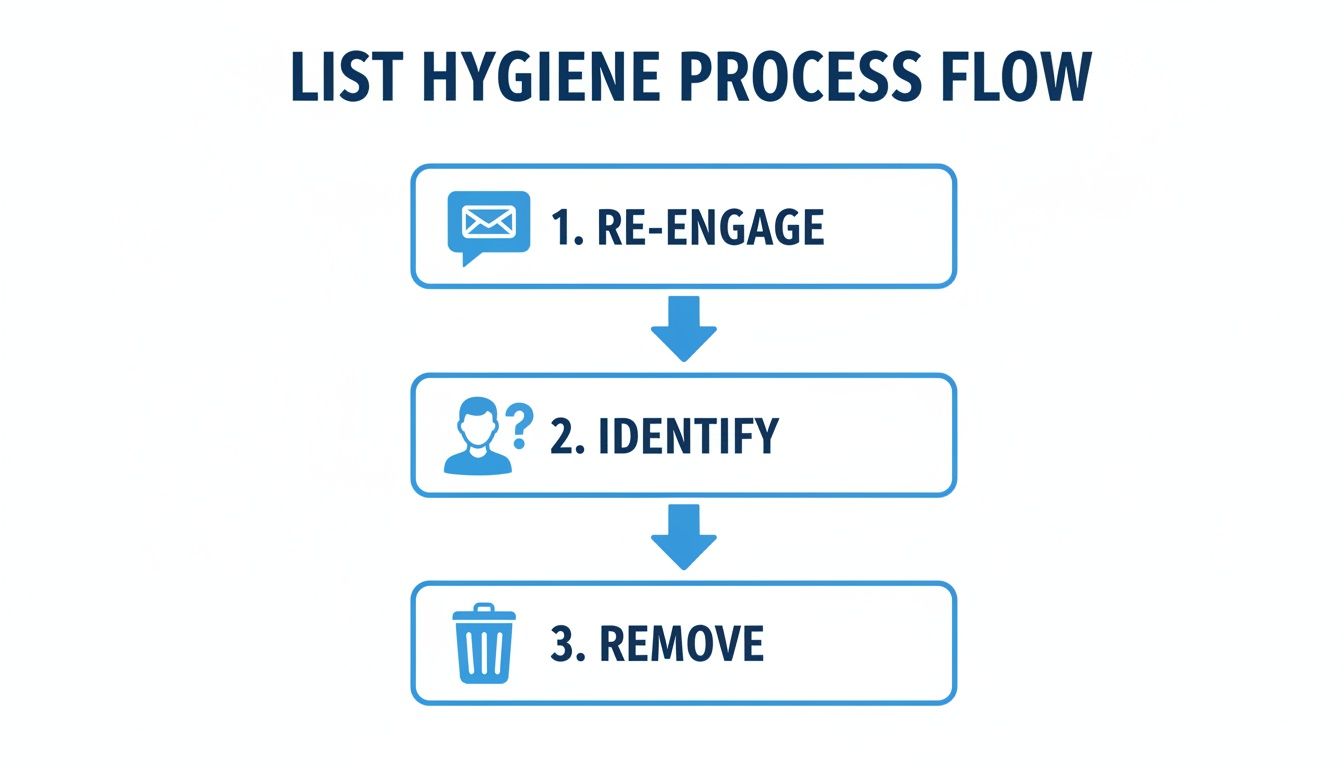
As you can see, it's about systematically re-engaging subscribers, identifying who is no longer interested, and cleanly removing them to protect your sender reputation. A healthy list is the foundation for everything else.
Key Metrics For Newsletter Performance
While every campaign is different, a handful of core metrics will give you a clear picture of your newsletter's health and its contribution to your growth goals. Tracking these numbers consistently helps you spot trends, diagnose problems, and double down on what's working.
Metric
What It Measures
Why It Matters For B2B Growth
Open Rate
The percentage of subscribers who opened your email.
Shows subject line effectiveness and brand recognition. A low rate could signal list fatigue or deliverability issues.
Click-Through Rate (CTR)
The percentage of subscribers who clicked a link in your email.
Measures how compelling your content and call-to-action are. High CTR is a strong indicator of audience engagement.
Conversion Rate
The percentage of subscribers who completed a desired action (e.g., booked a demo, downloaded a resource).
This is the money metric. It directly ties your email efforts to business outcomes like lead generation and sales.
Unsubscribe Rate
The percentage of subscribers who opted out after receiving your email.
A sudden spike can indicate a mismatch between content and audience expectations or sending too frequently.
List Growth Rate
The rate at which your list is growing over time.
A healthy growth rate shows your acquisition efforts are working and your brand is attracting new, relevant prospects.
By keeping a close eye on these metrics, you can move from simply sending emails to strategically building a predictable revenue channel.
The Power Of CRM Integration And Monetization
A seamless CRM integration is the final piece of the puzzle, connecting your marketing activity directly to sales outcomes. When your email platform "talks" to your CRM, every lead's entire history—every open, click, and page visit—is right there for the sales team to see. That context is gold. It empowers them to have smarter, more relevant conversations.
As your list matures into a valuable business asset, you can also explore direct monetization. Engaged, niche audiences are a valuable commodity.
- Sponsorships: Sell dedicated placements in your newsletter to non-competing companies that want to reach your audience.
- Affiliate Marketing: Promote relevant tools or services and earn a commission on any sales that come from your unique links.
Ultimately, a modern email distribution list is so much more than a sending tool. When managed with the right strategy, it becomes a core pillar of your business—a predictable revenue channel that you own and control completely.
Not all email platforms are the same, and the one you pick will draw the line between a simple newsletter and a serious growth engine for your business. It's a strategic choice. The wrong tool can box you in, while the right one can become your most predictable source of new leads.
The decision really comes down to one question: are you just sending emails, or are you trying to grow your business? Your answer will point you toward either a traditional Email Service Provider (ESP) or a modern newsletter growth platform.
ESPs Vs. Growth Platforms
A traditional ESP is like a reliable delivery truck. It's built to get your message from point A to point B, period. Think basic list management, sending campaigns, and simple analytics. They’re great if you just need to talk to an audience you already have.
A modern growth platform is more like an entire logistics network. It has the delivery truck, but it also includes the infrastructure to find new customers, learn more about them, and track their entire journey from subscriber to signed contract. Platforms like Breaker aren’t just built to send emails—they’re designed to actively find and add people who match your Ideal Customer Profile (ICP) to your list.
The core difference is focus. ESPs focus on the act of sending. Growth platforms focus on the business outcome of sending—turning your audience into qualified leads and measurable ROI.
This becomes obvious once you start comparing their features, how they charge you, and what they offer for building your subscriber base.
Key Differentiators To Consider
When you're looking at your options, think about where you want to be in a year, not just today. A simple tool might look appealing now, but it can create huge headaches when you're trying to scale.
Here are the three most important areas to compare:
- Subscriber Acquisition: A traditional ESP gives you a generic sign-up form and wishes you luck. A growth platform, on the other hand, comes with built-in tools that use targeted expansion to deliver engaged, exact-match subscribers directly to your list.
- Pricing Model: Most ESPs make you pay for every single contact you store, even if they haven't opened an email in years. Modern platforms often use a smarter model, charging you only for newly acquired or highly engaged subscribers. Their pricing is aligned with your growth.
- Analytics & ROI: Basic platforms give you open and click rates. That’s table stakes. A growth-focused platform connects those metrics to what actually matters—showing you the full ROI of your newsletter and its direct impact on leads and revenue, without making you dig through a dozen different reports.
Choosing the right platform is a foundational step. If your goal is just to send updates to a list you’ve already built, a traditional ESP is perfectly fine. But if you’re aiming to build a predictable lead generation machine, you need a system designed from the ground up for that exact purpose.
Frequently Asked Questions About Email Distribution Lists
Even with a solid plan, managing an email list brings up questions. Getting straight answers helps you sidestep common pitfalls and keep your focus on what matters: growth. Here are a few questions we hear all the time from B2B marketers.
How Often Should I Clean My Email Distribution List?
Think of list hygiene like regular maintenance—it keeps your email engine running smoothly. You should clean your list at least quarterly.
The process is pretty straightforward. First, immediately remove any hard bounces. These are dead-ends—permanently invalid addresses that will only hurt your deliverability.
Next, run a re-engagement campaign for anyone who hasn't opened an email in the last 90-180 days. If they bite, great! Keep them. If they stay silent after the campaign, it's best to remove them. This protects your sender reputation and makes your performance metrics far more accurate.
What Is The Difference Between A Distribution List And A Shared Mailbox?
While both help with group communication, they solve very different problems. Think of a distribution list as a broadcast tool. It’s a single address (newsletter@company.com) used to send a one-way message to the individual inboxes of many people. It’s perfect for newsletters, product updates, and announcements.
A shared mailbox, on the other hand, is a single, central inbox that multiple people can access. It's built for two-way conversations, like a support@company.com or sales@company.com address. Anyone on the team can see incoming messages and reply, ensuring nothing falls through the cracks.
Key Takeaway: Use a distribution list for one-to-many announcements. Use a shared mailbox when a team needs to manage two-way conversations from a single email address.
Can I Add People To My List Without Their Permission?
Let’s make this simple: absolutely not.
Adding contacts to your marketing list without their explicit consent isn't just bad practice; it's illegal. Regulations like GDPR in Europe and the CAN-SPAM Act in the U.S. require you to get clear permission (an opt-in) before sending marketing emails.
Ignoring this will wreck your sender reputation, lead to a flood of spam complaints, and expose you to serious legal and financial penalties. Always build your list with confirmed consent—it's the only way to build a sustainable asset.
Ready to turn your email list into a predictable growth engine? Breaker combines powerful email sending with automated list expansion, delivering engaged, exact-match subscribers directly to you. Start your free 7-day trial today!
Keep reading
All articlesHow to Boost Conversions With Your Email Newsletter
Turn your newsletter into a conversion engine. See 2026 benchmarks, CTR vs CVR explained, and the fixes most email guides skip.
Drip Campaign Template: Ready-to-Use Email Sequences
Get 6 ready-to-paste drip campaign templates with subject lines, body copy, and send timing—plus a step-by-step guide to building your own.
Post-Webinar Survey Questions Template (2026)
30+ post-webinar survey questions with NPS, CSAT, and CES templates, plus timing and length tips to boost completion and qualify leads faster.