
SEO Copywriting Training: Master B2B Content Creation
Elevate your content with our SEO copywriting training. Master key concepts & advanced techniques to create B2B content that ranks & converts.
You publish a strong B2B article or newsletter issue. The insights are solid. Sales has stories to tell. Product has real differentiation. Then the piece goes live and disappears into the archive because it wasn't built for how people search.
That problem usually doesn't come from weak writing. It comes from a gap between content creation and search-aware content design.
Teams still treat SEO copywriting as something one specialist does at the end. Add a keyword, trim a title, maybe update a meta description, then move on. That workflow fails because search performance is mostly decided before drafting starts. By the time a writer is polishing sentences, the bigger choices have already been made. Wrong query, wrong angle, wrong structure, wrong promise.
For B2B marketers, SEO copywriting training isn't just about rankings. It's about making blog posts, newsletters, lead magnets, comparison pages, and product education assets easier to discover, easier to summarize, and easier to remember.
Why Your Team Needs SEO Copywriting Skills Now
A lot of B2B teams are producing expensive content with no repeatable distribution advantage. One marketer writes the blog. Another repurposes it for email. Someone on demand gen asks for a CTA swap. Then everyone wonders why a high-effort piece didn't generate qualified interest.
The hidden cost isn't only traffic. It's wasted editorial time, missed newsletter sign-ups, weaker lead capture, and a content library that never compounds. When a team doesn't understand search intent, SERP patterns, and on-page structure, every article becomes a standalone gamble.
Informal writing habits don't scale
What worked when your company had one founder writing occasional thought leadership won't work when you have a content calendar, multiple stakeholders, and revenue targets. Teams need a common operating model. Writers need to know how to choose topics. Editors need a review standard. Marketing leads need a way to judge whether a piece deserves to exist before resources go into it.
That's why formal training matters. SEO copywriting has become a productized skill category, not just a loose craft. In one market roundup, Yoast's SEO Copywriting Course is listed at $118.80 per year and takes 8 to 10 hours to complete, while private instructor-led training in the same market is priced at $395 for 90 minutes of coaching, according to Mirasee's review of SEO copywriting courses.
Those price points matter because they show how businesses now treat this skill. It's trained, scoped, bought, and expected.
Practical rule: If your team publishes regularly, SEO copywriting is not a nice-to-have writing enhancement. It's production discipline.
The business case is straightforward
A trained team makes better decisions earlier. They stop assigning topics based only on internal opinion. They stop publishing newsletter content that can't be discovered outside the inbox. They stop writing blog posts that say useful things but bury the answer under vague intros and generic subheads.
The payoff is operational before it's analytical:
- Better topic selection means your team chooses themes buyers already care about.
- Stronger structure means readers can scan, extract, and trust your answer faster.
- Clearer calls to action mean educational content supports lead generation instead of sitting apart from it.
- Shared standards mean fewer rewrite cycles between writers, editors, SEO leads, and executives.
What untrained teams usually get wrong
Most underperforming content teams aren't lazy. They're using the wrong sequence.
Common habit
What it causes
Better approach
Pick a topic because leadership likes it
Low search fit
Validate demand and intent first
Draft from a blank page
Weak structure
Build around SERP patterns and buyer questions
Add SEO after writing
Forced optimization
Bake optimization into the outline
Judge success only by clicks
Narrow view of impact
Include answer usefulness and brand recall
If you want predictable content performance, you need trained writers who can connect search behavior, editorial judgment, and conversion intent. That's the baseline now.
The SEO Copywriting Framework Your Team Can Follow
The teams that improve fastest don't rely on inspiration. They use a workflow. Not because content is mechanical, but because good SEO writing depends on making the right decisions in the right order.
Bruce Clay's training materials describe a practical sequence that starts with search intent and SERP analysis, moves into outlining, then writing and rewriting against an on-page checklist, and ends with publishing and iterative improvement through analytics in a process that includes keyword research, semantic terms, meta tags, structured data, and test-and-iterate optimization, as outlined in Bruce Clay's SEO copywriting training.
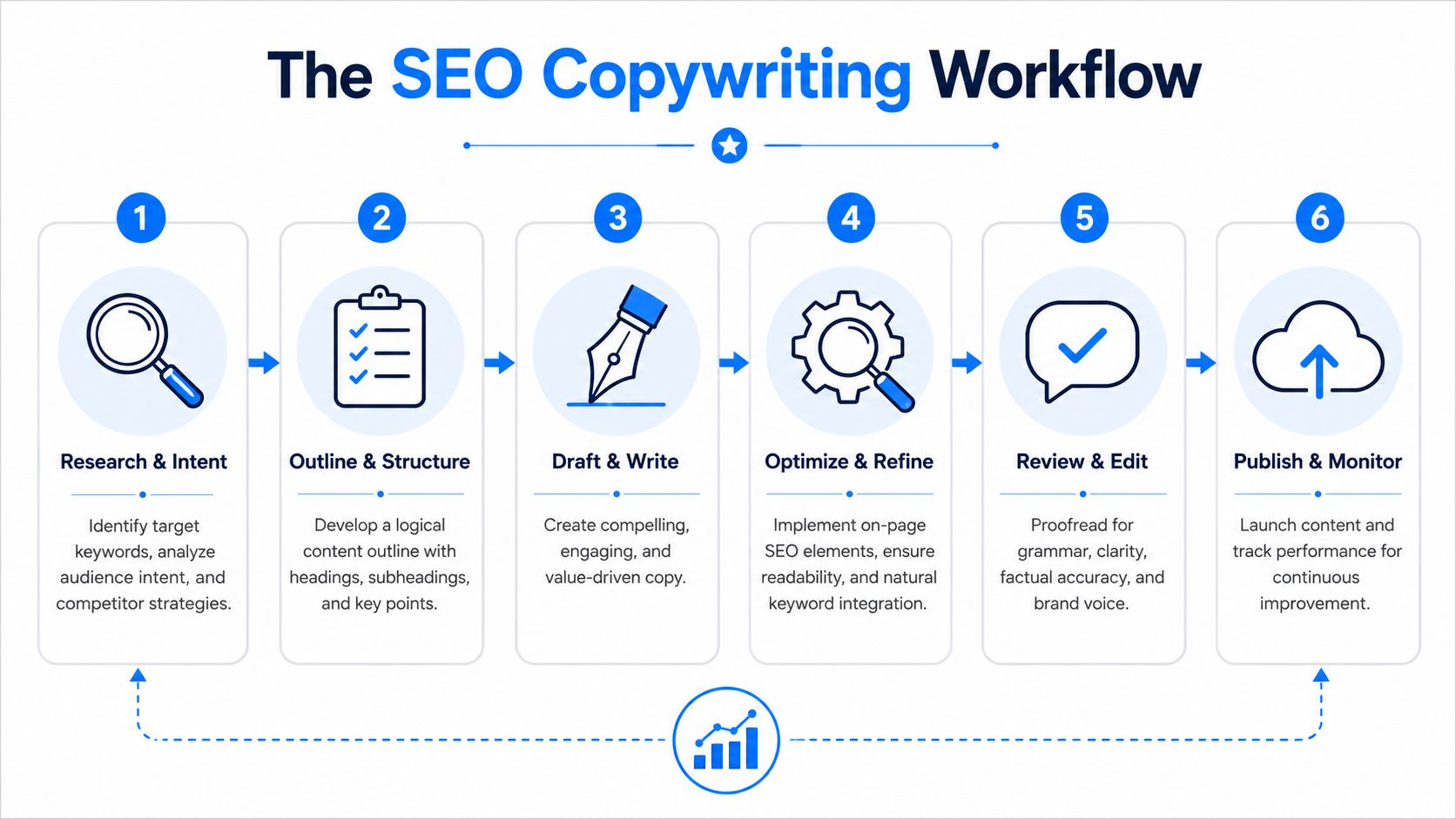
Start with intent, not keywords alone
Before a writer touches the draft, someone needs to answer a simple question. What is the searcher trying to get done?
In B2B, that's rarely just "learn about a topic." The user may be evaluating vendors, comparing approaches, building an internal case, solving an implementation issue, or looking for proof that a method is credible. A keyword list without that context leads to content that ranks poorly or attracts the wrong audience.
A good way to sharpen this stage is to study how AI-driven search is changing content requirements. A practical companion resource is LucidRank's guide to AI search content strategy, especially if your team is adapting from classic blue-link SEO toward answer-oriented discovery.
Build the outline before writing the prose
The outline is where most content wins or loses. If the structure mirrors what the SERP rewards and improves on it, the draft has a chance. If the outline is vague, the final article usually turns into a polished mess.
A useful team rule is to require these before drafting starts:
- Primary intent match with a clear statement of who the piece is for
- SERP observations about what top-ranking pages are doing well or poorly
- Section plan that answers the main query early, then expands logically
- Conversion path that fits the reader's stage, such as newsletter sign-up, template download, or demo exploration
Write, refine, then monitor
Once the outline is right, drafting gets easier. The writer's job becomes execution, not discovery. They can focus on clarity, specificity, examples, and sentence-level persuasion because the strategic choices are already settled.
After publication, treat the piece as a living asset.
A post that doesn't improve after launch is usually a post the team never learned from.
That means reviewing how the title performs, whether the intro answers the query, where readers drop off, which sections attract engagement, and whether the CTA belongs in that piece at all. Good SEO copywriting training doesn't end at publish. It teaches teams to revisit pages with evidence instead of ego.
Module 1 Mastering the Foundations of Search
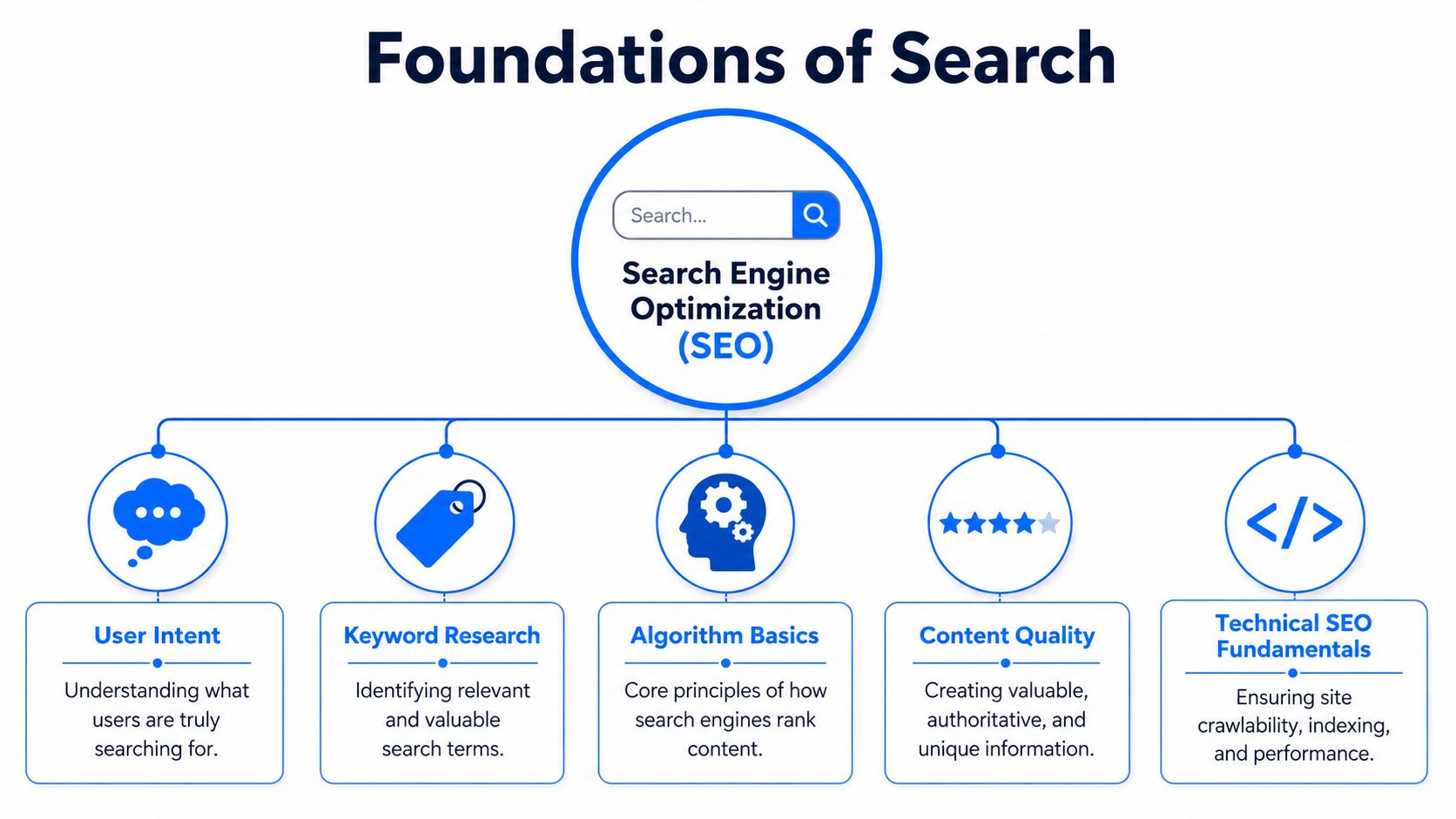
Most weak SEO content starts with a false assumption. The writer thinks the job is to insert the right keyword often enough for Google to understand the page. That approach is outdated and usually produces stiff copy.
Modern SEO copywriting starts with search intent and semantic coverage.
Understand the job behind the query
When a B2B buyer searches, they're often moving through a decision process. A query can signal early education, active evaluation, or implementation friction. If your page doesn't match that stage, it won't feel useful even if the keyword is technically present.
Here's a simple working model for teams:
- Informational queries ask for understanding. Example: a marketer looking for guidance on newsletter segmentation strategy.
- Commercial queries compare approaches or vendors. Example: a team evaluating content optimization platforms.
- Transactional queries show readiness to act. Example: someone searching for a software category plus pricing or demo terms.
- Navigational queries aim to reach a specific brand, tool, or known resource.
Writers don't need to label every query in the final draft. They do need to know what type of need the page serves.
Stop stuffing. Start covering the topic properly
One recorded masterclass captures the shift well. The presenter says a "blog or news article" should contain at least 600 words, warns that repeating the same term everywhere is keyword stuffing, recommends using 10 to 30 related keywords, and notes that a 160-character meta description can support click-through performance, as described in this SEO writing masterclass on YouTube.
That guidance matters because it pushes teams away from one-phrase obsession. Good pages use the language a real expert would naturally use. If you're writing about B2B SEO, you should also expect relevant terms around search intent, on-page optimization, topic clusters, internal linking, lead generation content, and related concepts to appear naturally.
For teams building a stronger strategy foundation, this guide to B2B SEO marketing is a useful internal reference point for aligning search work with pipeline goals.
Read the SERP before you write
A search results page is a briefing document. It tells you what Google currently believes satisfies the query.
Train your team to review:
SERP element
What it tells you
Standard results
The dominant content format
Featured snippets
The concise answer style Google can extract
People Also Ask
Adjacent questions worth covering
Comparison pages
Commercial evaluation intent
Vendor pages
Strong buying intent
This step is especially useful for newsletter and lead-gen content. A strong newsletter article often comes from a search-first article that has been adapted for subscribers. If the source article isn't aligned to search intent, the repurposed email starts from a weaker asset.
Write the answer people came for first. Then earn the right to teach the wider topic.
Module 2 Writing and Structuring Content That Ranks
Writers usually hear two bad pieces of advice. "Write for humans, not search engines." Or the opposite. "Write for SEO."
In practice, strong B2B content does both. It gives the reader a fast answer, then builds trust through structure, specificity, and momentum. Search visibility follows from that alignment.

Open with a useful answer
The intro doesn't need throat-clearing. It needs orientation. In B2B, readers are busy and skeptical. If your first paragraphs only say the topic is "important and relevant to current operations," you've lost momentum.
A better opening for a lead-gen article does three things:
- States the problem in plain language.
- Gives the reader a direct answer or point of view.
- Signals what's different about your take.
For example, if you're writing an article that supports a newsletter signup around demand generation, don't start with a generic history of content marketing. Start with the operational problem. Teams publish a lot, but most pieces aren't discoverable, extractable, or tied to conversion intent.
Use headings as promises
Subheads aren't decoration. They're decision points. Readers scan them to decide whether your page deserves their time.
Weak H2:
- Benefits of SEO
- Best Practices
- Final Thoughts
Stronger H2:
- Why intent mismatch kills qualified traffic
- How to turn a newsletter topic into a search asset
- Where to place CTAs without breaking the reading flow
This is one reason a lot of search content underperforms after ranking. It may win the click but lose the reader because the internal structure is lazy.
A useful external reference for newer writers is Baslon Digital's SEO content guide, especially for seeing how search optimization and conversion thinking can sit in the same piece.
Make the body easy to extract
If AI systems, search engines, and busy readers are all trying to parse your page quickly, clean structure matters more than cleverness.
Use these editorial habits:
- Short paragraphs so the eye keeps moving
- Direct topic sentences so each section reveals its point early
- Lists and tables when comparison is easier than prose
- Concrete examples drawn from real B2B workflows
- Natural repetition of core concepts without robotic duplication
One of the simplest upgrades for teams is to connect content structure with funnel role. This article on funnel content marketing is a useful internal resource because it helps writers understand when a piece should educate, compare, or convert.
Write the title tag and meta description like a marketer
A title isn't just an SEO field. It's ad copy for the SERP. The same goes for the meta description.
Good title habits:
- Lead with the topic people searched for
- Add a real angle or use case
- Avoid vague language that could describe any article
Good meta description habits:
- Summarize the value clearly
- Reinforce relevance
- Give a reason to click now
A quick craft refresher helps here:
Edit for flow, not just grammar
A clean draft isn't necessarily a strong draft. During review, ask harder questions:
- Does the page answer the main query early enough?
- Would a skim reader still get the value?
- Do the examples sound like real B2B work or generic marketing filler?
- Is the CTA aligned with the reader's stage?
Good SEO copywriting training teaches teams to edit for usefulness first. Grammar matters. So does brand voice. But if the structure doesn't carry the reader from question to answer to next step, the page won't perform the way it should.
Module 3 Advanced Techniques and B2B Applications
Once your team can produce solid single articles, the next challenge is authority. Not abstract "thought leadership." Actual topic authority built through connected assets that solve related problems for the same buyer.
Here, SEO copywriting becomes a content system.
Build topic clusters around buying conversations
In B2B, buyers rarely convert after reading one page. They move between problem framing, solution education, internal validation, and vendor comparison. Your content should mirror that path.
A simple cluster might include:
- A pillar page on a broad category
- Supporting articles answering common objections
- Comparison pages for evaluation-stage searchers
- Newsletter editions that repurpose timely insights from those assets
- Lead magnets tied to implementation concerns
This creates a useful overlap between search and email. Search brings in readers with active intent. Newsletter content keeps the relationship going. Lead-gen content gives the team a conversion path without forcing every page to sell immediately.
Go deeper when the topic deserves it
For advanced work, shallow coverage usually loses. Jacob McMillen explicitly points to a 3,000-word article as a benchmark for in-depth topic coverage when the goal is to sustain value, engagement, and structure across the piece, as discussed in Jacob McMillen's SEO copywriting approach.
That doesn't mean every article should chase length. It means your team should recognize when a topic demands enough depth to become a real resource. In B2B, high-stakes topics often do.
A short post may work for a narrow product update. It usually won't be enough for:
- category education
- implementation guides
- strategic comparisons
- process explainers
- complex newsletter companion pieces
Depth works when it's earned by the reader's problem, not by the writer's word count target.
Write for lead generation without wrecking the page
Many B2B teams overcorrect here. They either hide the CTA so carefully that nobody acts, or they insert a hard sales pitch every few paragraphs and kill trust.
A better approach is to match the CTA to the section's job.
Content type
Reader mindset
Better CTA
Educational article
Learning and framing
Subscribe for more practical guidance
Comparison page
Evaluating options
Download a checklist or request details
Implementation guide
Solving active problems
Get the template, worksheet, or playbook
Product-adjacent explainer
Connecting strategy to solution
Book a demo or talk to the team
If your team needs help choosing the stack behind this kind of content engine, this overview of B2B content marketing tools is a practical internal resource for mapping workflows across planning, production, and distribution.
Use answer blocks to win more SERP real estate
One of the most useful advanced habits is writing concise answer blocks within a longer article. These are short, direct responses to likely sub-questions. They help with snippets, improve scan value, and prepare the page for AI extraction.
For example, inside a long article on newsletter growth, add a short section that directly answers "what makes a B2B newsletter convert subscribers into leads?" Then expand below it with examples, trade-offs, and implementation detail.
That style serves two audiences at once. The hurried reader gets a fast answer. The serious buyer gets the full context.
Future-Proofing Your Skills Writing for AI and Humans
A lot of SEO training still treats the goal as getting the click. Rank the page, win the visit, optimize the funnel. That model isn't useless, but it's incomplete now.
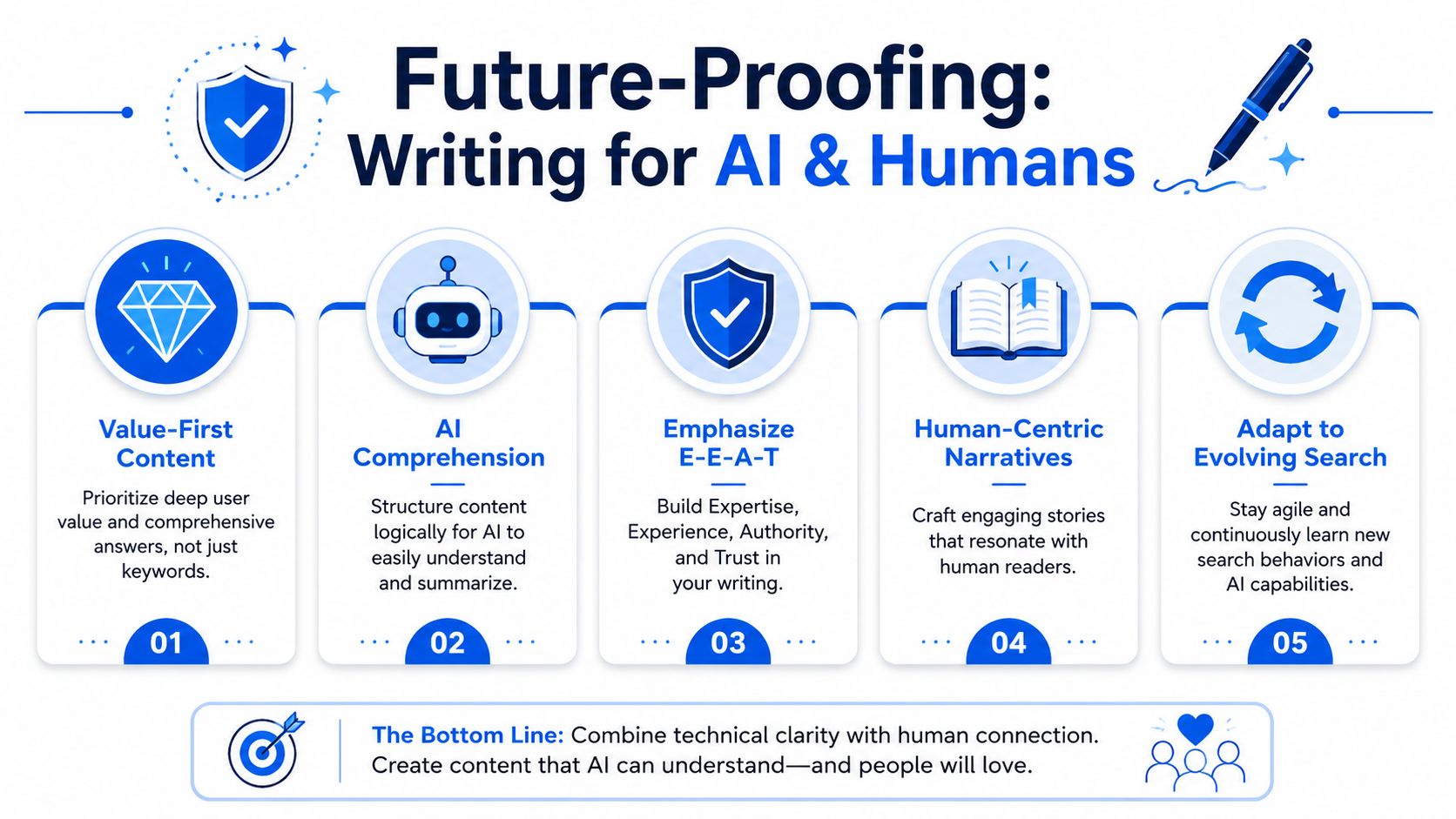
Yoast notes a major training gap here. Existing SEO copywriting guidance still focuses heavily on keyword research and readable copy, while newer discovery behaviors are being shaped by AI interfaces and summarized search results. The result is that query satisfaction without a click has become a real content objective, as discussed in Yoast's view on SEO copywriting training.
Write for answer extraction
If AI systems are summarizing pages, your content needs to be easier to quote, easier to interpret, and easier to trust.
That means:
- Lead with direct answers before long explanations
- Use descriptive subheads that clearly map to user questions
- State claims cleanly instead of hiding them in fluff
- Organize comparisons and definitions in extractable formats like lists and tables
- Support authority signals through clear expertise and consistent editorial standards
This doesn't mean writing robotic content. It means making your expertise legible.
Brand recall matters more than raw traffic
In an AI-shaped SERP, some readers may get what they need without visiting your site. That's frustrating if your only KPI is sessions. It's less frustrating if your brand is the one associated with the useful answer.
That's the shift many teams still haven't absorbed. The goal isn't only click capture. It's becoming the source buyers remember when they move from research to shortlist.
If a search result or AI summary uses your framing, your content has created value even before the visit.
Train your team on trust signals
Human readers and AI systems both need clarity about who is speaking and why they should believe the content. That's where practical interpretations of E-E-A-T help. Show real expertise. Use examples that sound lived-in. Avoid generic claims your competitors could copy. Keep your editorial standards high enough that a page reads like a credible operating guide, not a stitched summary.
For B2B marketers, that often means writing from actual workflow knowledge:
- how teams brief content
- how newsletters support pipeline
- where handoffs fail
- which CTAs fit which stage
- what happens after publication
The more your content reflects real operating experience, the more defensible it becomes in both classic search and AI-mediated discovery.
If your team is turning newsletters into a lead-gen engine, Breaker helps you do more than send campaigns. It gives B2B marketers a way to grow the right audience, launch targeted newsletter programs, and track what drives subscriber growth and pipeline.
Keep reading
All articlesWhy Scraped Email Lists Fail GDPR Compliance in Any ESP
Scraped email lists break GDPR Articles 6 & 7, risk €20M fines, and get your ESP account suspended. Learn the legal reality and the compliant path forward.
B2B Newsletter Strategy for Marketers Who Sell to Niche Pros
Build a B2B newsletter that drives real pipeline. Covers audience definition, content structure, frequency, deliverability, and ROI measurement.
The Subscriber Acquisition Channels That Actually Move the Needle for B2B Newsletters
Every B2B newsletter eventually runs into the same wall: content is going out reliably, the format works, and the list still isn't growing fast enough.