
B2B SEO Marketing: Drive Pipeline & Authority
Master B2B SEO marketing. Go beyond traffic, map content to buyers, build authority, & integrate SEO with CRM to drive measurable pipeline.
Paid performance is less forgiving than it was a few years ago. CPL targets tighten, branded demand gets mistaken for channel success, and teams keep publishing content that wins impressions but never makes it into a pipeline review.
That is usually the moment when b2b teams revisit b2b seo marketing. Not as a side project for the blog, but as a way to build a demand engine that compounds. The shift matters. SEO can no longer be judged by traffic screenshots and rank trackers alone. In a serious b2b program, the job is to attract the right accounts, capture them, nurture them, and connect that journey to opportunities and revenue in the CRM.
Beyond the Buzzword What B2B SEO Really Means for Growth
B2B SEO is often treated like a publishing calendar plus a technical audit. That is too small a view.
In practice, b2b seo marketing is the system that helps a company get discovered during research, earn trust before a sales call, and stay present across a long buying cycle. The best programs do not stop at “we ranked.” They turn search into subscriber growth, first-party audience ownership, and sales-qualified demand.
That framing matters because organic search is not a minor assist channel. Organic search drives over half of inbound leads, contributes 44.6% of B2B revenue, and B2B SEO delivers an average ROI of 702% over three years according to SalesHive’s B2B SEO analysis. The same analysis notes that organic search generates twice as much revenue as other channels for B2B companies.
Those numbers explain why strong teams stop asking, “How do we get more traffic?” and start asking better questions:
- Which topics attract buying committees, not casual readers?
- Which pages convert search demand into newsletter subscribers or demo intent?
- Which workflows push those contacts into the CRM with source context intact?
- Which content influenced pipeline, even if it was not the final touch?
SEO is an asset, not a campaign
Paid campaigns rent attention. SEO builds an asset base.
A useful article, a comparison page, a well-structured implementation guide, or a problem-solving template can keep bringing in relevant visits long after publication. If those visits feed an email program and the email program feeds the CRM, search stops being a top-of-funnel silo and becomes part of revenue infrastructure.
What does not work anymore
A lot of legacy advice still circulates, and much of it underperforms in B2B:
- Volume-first keyword targeting: High traffic topics with weak buying intent create noisy reporting.
- Blog-only SEO: Buyers do not make decisions from educational posts alone. They need comparison pages, use case pages, pricing context, implementation content, and proof.
- Last-touch reporting: It strips away the role SEO played in the early research stage.
- Disconnected nurture: If organic visitors are not captured into an owned audience, much of SEO’s value leaks away.
Key takeaway: In B2B, SEO should be designed to create pipeline visibility. Rankings are useful. Revenue attribution is better.
Understanding the B2B vs B2C SEO Divide
B2B SEO and B2C SEO use the same search engines, but they operate under different economics.
The simplest analogy is this. B2B SEO is spear fishing. B2C SEO is net fishing. One aims at a narrower set of high-value opportunities. The other often relies on broader reach and higher transaction volume.
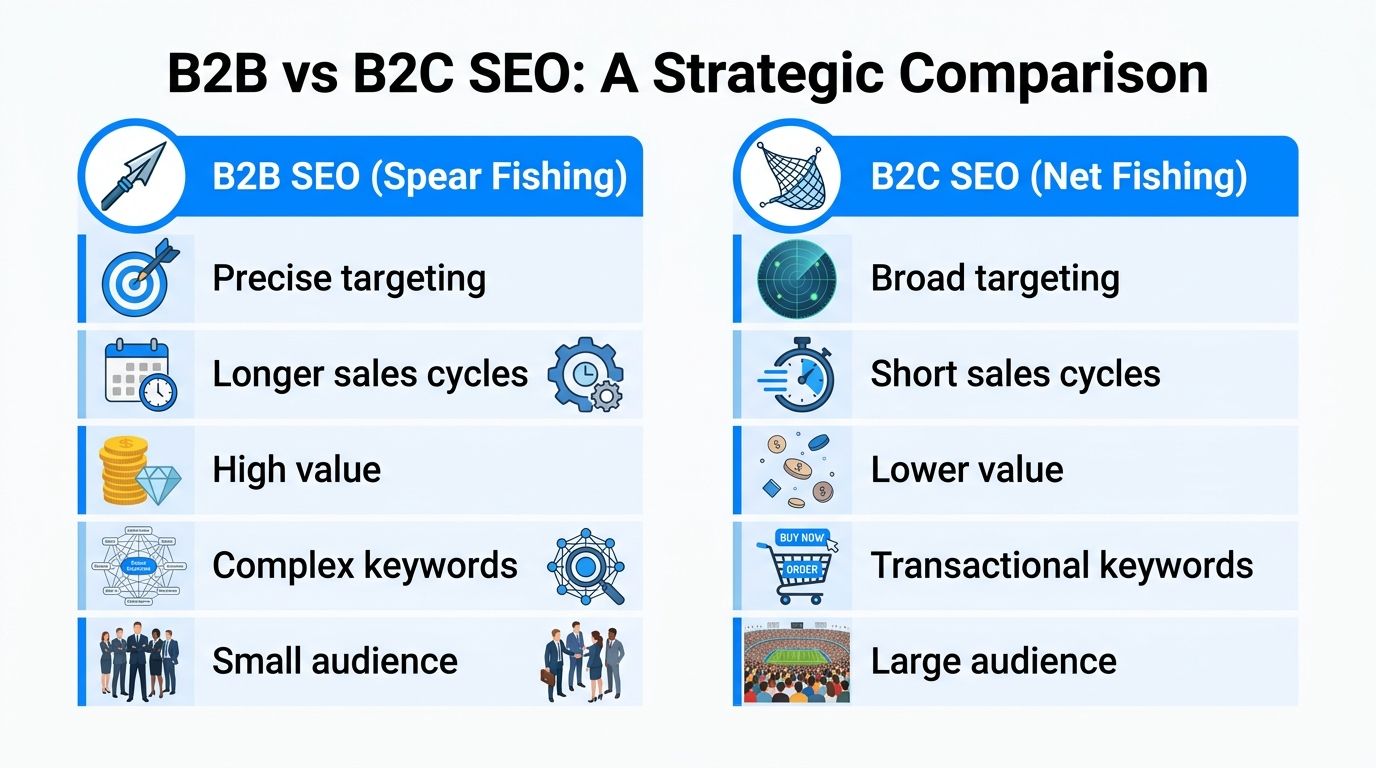
A B2C brand can succeed with broad visibility around product terms, trends, and impulse-friendly searches. A B2B company usually cannot. It needs to persuade multiple stakeholders over time. The content must help a practitioner, a manager, and often an executive sponsor reach confidence together.
Why B2C playbooks fail in B2B
A lot of underperforming b2b seo marketing programs copy consumer tactics:
- publish broad explainer content with little commercial relevance
- chase high-volume terms that bring students, job seekers, and competitors
- optimize category pages without creating buying-stage content
- report success through sessions instead of pipeline influence
That usually creates a dashboard that looks healthy and a sales team that feels none of it.
B2B vs. B2C SEO At a Glance
| Factor | B2B SEO (Business-to-Business) | B2C SEO (Business-to-Consumer) |
|---|---|---|
| Buyer | Buying committee, multiple stakeholders | Individual consumer |
| Intent | Problem-aware, evaluation-driven, risk-conscious | Faster purchase or browsing intent |
| Sales cycle | Longer, research-heavy, approval-based | Shorter, simpler, more direct |
| Keyword style | Niche, long-tail, use-case and comparison focused | Broader, product and category focused |
| Content needed | Guides, comparisons, implementation pages, proof assets | Category pages, product pages, reviews, lifestyle content |
| Conversion path | Form fill, demo, newsletter signup, sales conversation | Purchase, add-to-cart, lead form |
| Measurement | Pipeline influence, MQL to SQL quality, revenue contribution | Orders, conversion rate, revenue per session |
The keyword difference is strategic
B2C teams can often start with what people want to buy. B2B teams need to start with what people need to solve.
That leads to a different content mix. Instead of only targeting category terms, B2B companies need pages for pain points, workflows, integrations, alternatives, compliance questions, implementation concerns, and stakeholder objections.
Committee buying changes everything
A search visit in B2B often represents one person doing research for several others. The operations lead might search for workflow impact. The marketing lead may search for speed and reporting. Procurement may look for vendor trust signals. IT may care about implementation and security language.
That is why narrow SEO briefs outperform generic ones. You are not writing for “the market.” You are writing for the people who need to carry the deal internally.
Practical rule: If a keyword can bring the wrong audience faster than the right audience, it needs stronger qualification in the page angle, title, and CTA.
Building Your Strategic B2B SEO Framework
The strongest programs are built on a simple structure. Audience, Authority, and Alignment. If one pillar is weak, the whole engine becomes harder to scale.
B2B companies are already investing accordingly. They typically dedicate 11-15% of marketing budgets to SEO, 46% are increasing content budgets, and 61% rank SEO as their top inbound priority according to RevenueZen’s B2B SEO statistics roundup. The money is there. The gap is usually strategy discipline.
Audience starts with ICP depth
Most SEO strategies fail before keyword research begins. The ICP is too vague.
“Mid-market SaaS” is not an ICP. “VP of Marketing at a PLG SaaS company with a lean lifecycle team and pressure to show sourced pipeline” is closer. That level of specificity changes the entire keyword set, the examples you use, the objections you answer, and the CTA you place on the page.
A practical process looks like this:
- Pull customer interviews and sales calls: Look for repeated phrases, not just themes.
- Break out the buying committee: User, manager, technical evaluator, budget owner.
- Map jobs-to-be-done: What each person is trying to accomplish.
- Translate those needs into search language: Questions, comparisons, implementation concerns, and vendor evaluation terms.
If your team needs a concrete set of ideas for narrowing the strategy, this collection of actionable SEO strategies for SaaS is useful because it stays close to practical execution rather than generic SEO advice.
Authority is built page by page
Authority in B2B does not come from publishing endlessly. It comes from becoming unusually helpful in a narrow area. It also helps to show who is behind the advice: about the author pages that state real credentials give readers and search engines a reason to trust it.
That means choosing a topic territory where your company can credibly win. A CRM consultancy might own content around migration risk, RevOps workflows, and handoff reporting. A fintech platform might focus on reconciliation complexity, security expectations, and implementation planning.
Authority tends to strengthen when you publish these page types together:
- Pillar content: Core guides around the central problem space
- Cluster pages: Supporting pages for specific questions and subproblems
- Commercial pages: Solution, use case, integration, and comparison pages
- Trust pages: Case studies, methodology pages, expert bios, and clear proof points
For teams shaping the broader stack around content operations, this resource on https://joinbreaker.ai/blog-posts/b-2-b-content-marketing-tools is a practical reference because it connects tooling choices to execution capacity.
Alignment often determines if teams win or drift
SEO gets expensive when every department wants something different from it.
Marketing wants traffic. Sales wants meetings. Leadership wants revenue. Product marketing wants positioning. Content wants editorial freedom. None of those are wrong, but unaligned goals create a scattered roadmap.
A healthier model is to assign each SEO initiative to a business outcome before work starts.
SEO initiative
Primary business objective
Secondary objective
High-intent comparison page
Demo creation
Sales enablement
Deep educational guide
Newsletter subscriber growth
Category education
Integration page
Product-qualified lead support
Partner visibility
Implementation article
Pipeline acceleration
Customer confidence
Three questions before you greenlight a page
Does this attract the right account type
The topic should align with the problems your best customers face. If it attracts broad curiosity but weak fit, it belongs lower on the roadmap.
Can this page move someone forward
Good B2B content does not only answer a question. It gives a reader a next step, such as subscribing, booking time, comparing options, or downloading a practical asset.
Will we be able to measure its influence
If the page has no clear CTA, no CRM capture path, and no reporting plan, it will probably be judged by traffic alone.
A strong SEO framework is selective. It says no to pages that may rank but will not help the business.
Mapping Content and Keywords to the B2B Buyer Journey
Most B2B teams do not have a traffic problem. They have a journey design problem.
They publish educational content for awareness, then expect those same readers to jump straight to a demo. That is rarely how real B2B buying works. Buyers need different content at different moments, and each page should point to the next logical step.
Top of funnel content should earn attention and capture it
Top-of-funnel SEO exists to meet buyers early, when they are naming a problem, researching options, or trying to understand a shift in the market.
Useful formats include:
- Problem-solving guides: Explain the issue in plain language and frame the cost of inaction
- Operational how-tos: Walk through a process the target reader already cares about
- Glossary-plus pages: Not thin definitions, but terms explained with strategic context
- Thoughtful opinion pieces: Strong points of view tied to lived operational reality
The mistake here is weak capture. If your educational content has no newsletter CTA, no useful next resource, and no way to identify the visitor later, the value remains anonymous.
A better move is to offer a natural conversion point. That might be a newsletter signup for ongoing insight, a template, a checklist, or a role-specific guide.
For teams that need to sharpen audience definition before they map topics, https://joinbreaker.ai/blog-posts/what-is-icp-in-marketing is a useful reference because content quality improves fast once the ICP is concrete.
Mid-funnel content should reduce evaluation friction
Often, programs are too thin at this stage. A buyer has moved past awareness and now needs proof, contrast, and implementation clarity.
Pages that work well in this layer include:
| Content type | What it answers | Typical CTA |
|---|---|---|
| Comparison pages | Which option fits us best | Book demo or talk to sales |
| Alternatives pages | What else should we consider | Product tour or contact sales |
| Use case pages | Can this solve our specific workflow | Request consultation |
| Integration pages | Will this fit our stack | Talk to solutions team |
| Webinar recap pages | How does this work in practice | Subscribe or watch full session |
This is also the stage where sales input becomes especially valuable. Repeated objections often become your best SEO pages. If prospects keep asking about implementation complexity, migration timing, internal adoption, or vendor fit, those topics belong on the site.
Tip: Good mid-funnel content sounds like a strong sales engineer and a clear buyer’s guide combined.
Bottom-of-funnel content should remove decision risk
Bottom-of-funnel SEO is not just pricing pages. It includes every page that helps a buyer justify the decision internally.
Strong BOFU assets often include:
- pricing and packaging explanations
- implementation timelines
- onboarding expectations
- security or trust information
- procurement-friendly summaries
- role-specific value pages
- direct competitor comparisons
The best pages here do not oversell. They answer the awkward questions. That honesty tends to improve conversion quality.
Topic clusters make the journey easier to follow
A good content architecture lets a reader move naturally from broad education to commercial evaluation. That is where topic clusters and internal linking matter.
One practical model is:
- Pillar page around a major problem space
- Supporting posts for subtopics, use cases, and objections
- Commercial pages linked where the buyer may want a solution
- Capture points through newsletter signup, demo, or downloadable asset
This structure helps search engines understand your expertise, but it also helps buyers continue researching without leaving your site.
Structured data is a quiet advantage
Structured data is not glamorous, but it is one of the cleaner ways to improve visibility and click-through rate.
Pages with structured data appear with rich results 4x more often and can see 20-30% higher CTR, while only 10-15% of B2B sites use it fully according to Onely’s B2B SEO research.
That creates a practical opening for B2B teams that implement schema with intent. FAQ schema works well on decision-stage pages. HowTo schema can support implementation content. Article and Organization schema help reinforce context and credibility.
Where to apply schema first
- FAQ sections on commercial pages
- How-to implementation articles
- Long-form guides with strong author context
- Company-level pages that clarify who you are and what you do
Schema will not rescue weak strategy. It does, however, make already good pages more competitive in the results.
Mastering Technical SEO and Authority Building in B2B
A lot of B2B teams overinvest in content production and underinvest in technical readiness. That creates a frustrating pattern. Good pages are published, but they load slowly, render poorly, get indexed inconsistently, or send weak authority signals.
That is why technical foundations deserve executive attention, not just specialist attention.

Technical onsite optimization is ranked as the most effective SEO tactic by 59% of experts, and achieving a sub-2-second load time can reduce abandonment by 32% according to Oliver Munro’s roundup of B2B SEO statistics. The same source notes that 40% of B2B companies lack internal technical SEO expertise.
Technical issues that matter most in B2B
B2B websites often grow unevenly. Marketing launches pages in a CMS, product launches documentation elsewhere, regional teams create duplicates, and developers change templates without considering crawl behavior.
The issues with the biggest practical impact tend to be these:
Crawlability and indexation
If important pages are hard to crawl or accidentally excluded, the rest of the strategy cannot perform. Watch for orphan pages, duplicate variants, thin archives, and JavaScript-heavy templates that make content harder for search engines to process.
Speed and mobile UX
A slow site damages both ranking potential and conversion quality. This matters even more when high-intent visitors land on comparison, pricing, or solution pages and need to move quickly.
Internal linking
Internal linking is often treated like housekeeping. In B2B, it is strategic distribution. A strong pillar page should route authority and reader attention to the use case, comparison, and conversion pages that matter.
Site structure
When products, industries, use cases, and resources are organized clearly, both buyers and search engines understand the business faster. Messy architecture creates friction no content refresh can solve.
Authority building without spammy link chasing
B2B link building works best when it looks like reputation building.
The strongest links usually come from relevance, not volume. A respected industry publication, partner ecosystem page, niche podcast recap, or expert guest contribution often matters more than a generic placement on a weak site.
A practical authority program usually includes:
- Digital PR: Publish contrarian insights, original perspectives, or expert commentary worth citing
- Guest contributions: Write for publications your buyers already trust
- Partnership pages: Create co-marketing assets and integration references
- Podcast appearances: Turn subject matter expertise into branded mentions and links
- Executive visibility: Encourage SMEs to contribute commentary where the industry already gathers
If your team wants a grounded walkthrough of the basics, this guide on how to improve domain authority is a reasonable supplement because it stays focused on the practical actions that support trust and visibility.
Key takeaway: Publish less generic content and do more reputation-building around the pages that already deserve to rank.
What works better than mass outreach
Mass guest post outreach usually creates a lot of activity and not much authority.
These approaches tend to hold up better:
Weak approach
Stronger approach
Generic outreach asking for backlinks
Offer a credible expert point of view to an industry publication
Low-value directory submissions
Earn mentions through partnerships and ecosystem pages
Publishing thought leadership with no distribution
Pair expert content with PR and targeted outreach
Building links only to blog posts
Support commercial and category-adjacent pages too
Technical excellence makes your content eligible to perform. Authority building gives search engines a reason to trust it.
B2B SEO Marketing: How to Choose Your Approach
The framework above tells you what a program needs. The next decision is how to run it. Teams weighing b2b seo marketing in 2026 are mostly deciding three things: who does the work, what kind of SEO to lead with, and how to handle AI search.
Who does the work
- In-house: best once you have product-marketing depth and at least one person who can own it full time. Slowest to ramp, strongest on subject-matter accuracy.
- Agency: best for technical audits, link building, and content volume. Watch for generic content that wins impressions but never reaches a pipeline review.
- Fractional or hybrid: a strategist sets the plan and your team writes. The most common fit for Series A to C companies with a small marketing team.
What kind of SEO to lead with
- Content-led: for companies whose buyers research heavily before a demo. Lead with buyer-journey content mapped to ICP problems.
- Technical-led: for large sites, marketplaces, or docs-heavy products where crawl, speed, and structure are the bottleneck.
- Product-led: for tools with free tiers or templates. Lead with pages that let searchers use the product, such as calculators, generators, and template libraries.
How to handle AI search
AI Overviews and answer engines now resolve a share of B2B queries without a click. Two things hold up: pages with a clear, quotable answer near the top of each section, and brand mentions on third-party sites the models cite. Track branded search and referrals from AI assistants alongside rankings, and treat your newsletter as the place to capture the readers search no longer sends.
A simple decision rule
Pick the approach that matches your bottleneck. No traffic: go content-led. Traffic but no leads: fix the journey and the conversion pages. Leads but no pipeline: connect SEO to CRM data, which the next section covers. For writing that converts once the strategy is set, see SEO copywriting training, and for the tactics that pair with search, our guide to B2B demand generation tactics.
Measuring SEO ROI and Integrating with Your Growth Stack
The biggest reporting mistake in b2b seo marketing is treating SEO like a final-click channel.
That is not how B2B buying works. A buyer may discover your company through search, subscribe to your newsletter, return through email, visit the site again through direct traffic, attend a webinar, and only then request a demo. If your reporting only credits the final session, SEO looks weaker than it is.

B2B buyers perform around 12 searches before engaging a brand, and last-touch attribution misses SEO’s early influence. Top-of-funnel content discovered through search can boost later conversion rates by 25-40% according to CXL’s analysis of B2B content marketing challenges.
The right KPI stack
Traffic is not useless. It is just incomplete.
A serious measurement model tracks SEO through the funnel:
- Organic subscriber acquisition: Who entered your owned audience from search
- Organic MQLs: Qualified leads sourced from organic sessions
- Organic-influenced SQLs: Opportunities where SEO played an earlier role
- Pipeline influence: Revenue opportunities touched by organic-origin contacts
- Customer value by source: Whether organic-acquired accounts become strong customers
CRM integration matters at this point. Once a visitor fills out a form, subscribes to an email program, or engages with a resource, that source context needs to move into the CRM and stay attached as the lead progresses.
A cleaner model for newsletter-led SEO
Newsletter-led growth solves a common SEO problem. Most organic traffic is anonymous until someone converts. Email capture turns that anonymous visit into an identifiable relationship.
A practical flow looks like this:
- A prospect finds a search-driven page
- The page offers a useful next step, such as a newsletter specific to the role or problem
- The contact enters an email nurture sequence
- Email engagement data syncs into the CRM
- Sales sees both the original organic touch and the nurture history
- Opportunity reporting reflects influence, not just last click
That creates a much clearer picture of how SEO contributes to pipeline. It also improves follow-up quality. Sales can see what the contact searched for, what they subscribed to, and which topics they kept engaging with.
For teams tightening those handoffs, https://joinbreaker.ai/blog-posts/marketing-automation-for-b-2-b is a useful operational reference because it connects automation design to lead management discipline.
What to tag and sync
The mechanics matter. If source data is sloppy at capture, attribution gets muddy later.
Track and preserve at least these fields:
Data point
Why it matters
Original source and medium
Distinguishes organic from later direct or email returns
Landing page
Shows which SEO asset started the relationship
Conversion asset
Identifies which CTA turned the visit into a known lead
Role or segment data
Helps route nurture and sales outreach correctly
Email engagement
Adds context about real interest after first visit
Reporting views executives trust
A clean executive view usually includes a few simple questions:
Which organic pages generated qualified contacts
Not all organic conversions are equal. Break this out by page type, not just by total volume.
Which contacts from organic became real opportunities
This is the point where SEO starts to earn organizational credibility. You are no longer showing sessions. You are showing movement into sales stages.
Which email nurtures increased progression
When SEO and newsletter workflows are connected, you can evaluate whether post-conversion nurture improved meeting creation, deal velocity, or opportunity quality quantitatively and qualitatively within your own reporting model.
A brief explainer on attribution can help internal alignment, especially when the team is used to last-click dashboards:
What not to report in isolation
These metrics often mislead when shown alone:
- Total organic traffic
- Average rankings across a giant keyword set
- Impressions without conversion context
- Newsletter opens without downstream CRM outcomes
Practical rule: If a metric cannot help explain pipeline creation, progression, or revenue influence, it should not lead the SEO report.
A key advantage of integrating SEO with email and CRM workflows is not cleaner charts. It is operational. Marketing learns which topics attract real buyers. Sales gets richer context. Leadership sees why content investment compounds over time.
Moving from Traffic Metrics to Pipeline Revenue
A mature b2b seo marketing program behaves less like a publishing machine and more like a revenue system.
It targets the right audience instead of the biggest keyword. It builds authority in a narrow territory instead of chasing every adjacent topic. It creates pages for real buying stages, not just awareness. It protects technical performance so strong content can rank. And it captures organic demand into owned channels and CRM workflows so the business can measure what happened next.
That last part is where many teams still leave money on the table. They drive search visits, but they do not turn enough of that attention into an audience they can keep reaching. Or they capture leads, but fail to preserve the original source context as contacts move through nurture and sales. That is how SEO gets undervalued.
The better approach is more disciplined. Treat search as the front door, email as the relationship layer, and the CRM as the source of truth. When those three systems work together, SEO stops being a vanity channel and becomes a dependable contributor to pipeline.
There is no shortcut hidden inside this. SEO still takes time. Authority still has to be earned. Technical debt still slows progress. But the payoff is different from rented demand. You build assets, audience, and attribution clarity at the same time.
If your current program is producing rankings without revenue evidence, the fix is usually not “more content.” It is tighter alignment between search intent, conversion design, newsletter nurture, and CRM reporting.
If you want to turn organic traffic into an owned B2B audience and track its impact more clearly, Breaker is built for that job. It combines newsletter publishing, list growth, CRM integrations, deliverability support, and real-time performance reporting so growth teams can connect content, email, and pipeline without stitching together a fragile workflow.
Keep reading
All articlesHow to Write a Newsletter with AI: Step-by-Step Guide 2026
Learn how to write a newsletter with AI the right way: a 7-step process to train, calibrate, and edit AI drafts that still sound like you.
How to Boost Conversions With Your Email Newsletter
Turn your newsletter into a conversion engine. See 2026 benchmarks, CTR vs CVR explained, and the fixes most email guides skip.
Drip Campaign Template: Ready-to-Use Email Sequences
Get 6 ready-to-paste drip campaign templates with subject lines, body copy, and send timing—plus a step-by-step guide to building your own.