
B2B Newsletter Subject Lines That Actually Get Opened
Stop guessing. Learn the data-backed formulas and psychological triggers behind B2B newsletter subject lines that drive opens, engagement, and growth.
Your newsletter’s subject line is more than just a title; it's the single most important piece of copy you'll write. A great one earns the click that makes all your other content matter. A bad one? It guarantees your hard work goes straight to the trash, unread.
Why Your Subject Line Is More Important Than Your Newsletter

That might sound like an exaggeration, but the data doesn't lie. You could write the most insightful, game-changing B2B newsletter in your industry, but if the subject line fails, your effort is completely wasted. It’s the gatekeeper standing between your brilliant content and your busy audience.
Think about the average professional’s inbox. They're drowning in hundreds of emails competing for attention every single day. Your subject line gets a two-second glance, at best, to make its case. It has to cut through that noise with a crystal-clear promise of value. This is exactly where most marketers stumble—they pour 90% of their energy into the newsletter body and only 10% into the one line that decides if it even gets opened.
The Gatekeeper to Engagement and ROI
I like to think of a subject line as the cover of a book. It’s the first impression, the hook, and the summary all rolled into one. A compelling cover makes you pick the book up off the shelf; a dull one means you walk right past it. The exact same thing happens in the inbox.
This single line of copy has a direct, measurable impact on all the metrics that matter:
- Open Rates: This is the most obvious one. It’s a direct grade on your subject line’s performance.
- Deliverability: Spammy or clickbait-style subject lines don’t just get ignored—they get filtered. Your email might never even reach the inbox.
- Click-Through Rates (CTR): A great subject line sets clear expectations. When you deliver on that promise, you get a more engaged reader who is far more likely to click your links.
- Return on Investment (ROI): It all connects. Higher opens and clicks lead to more leads, conversions, and revenue, driving a real impact on your bottom line.
Your subject line isn't just an administrative checkbox; it's a strategic weapon. Getting it right is the highest-leverage thing you can do to boost your newsletter's performance.
Whether you're running campaigns in-house or working with professional email marketing services, truly understanding the power of a subject line is the key to building momentum. Every single send is a test of your ability to capture attention in an incredibly crowded space.
The rest of this guide will give you a practical framework for crafting subject lines that consistently win that test.
The Psychology Behind High-Performing Subject Lines

To write a subject line that actually gets opened, you need to get inside your reader's head. Every professional scans their inbox making a split-second decision for each email: "Is this worth my time?" Your subject line is your only shot at getting a firm "yes."
This isn't about shady manipulation. It’s about understanding the mental shortcuts people use to filter out the noise. When your subject line taps into these shortcuts, you don’t just get noticed—you signal immediate value and start building trust before they even click.
One of the simplest and most effective ways to do this is with numbers. Our brains are wired to spot digits in a sea of letters. They break up the visual pattern of an inbox and create an instant hook.
Why Numbers and Data Command Attention
In a B2B setting, numbers are more than just eye-candy; they signal authority and tangible value. A vague promise of “new insights” is easy to scroll past. But a specific number? That creates a concrete hook that makes people curious.
Just look at the difference here:
- Before: New Q1 Report
- After: New Data Reveals 34% Higher Engagement in Q1
The second version isn't just more interesting—it’s more compelling because it quantifies the value inside. It tells a busy professional exactly what they stand to gain, making the decision to open the email feel like a no-brainer.
This works especially well for B2B audiences, who live and breathe actionable data. When you use phrases like "New data shows" or "Our study found," you're speaking their language. You're promising evidence, not just opinions, and that's precisely what decision-makers are looking for.
In an inbox flooded with generic content, data-driven subject lines act as a filter for value. They tell your subscribers that your content isn't just fluff—it's backed by research and offers a concrete takeaway.
The proof is in the performance. A 2026 study found that subject lines with numbers can lift open rates by around 36%. It works because numbers convey credibility and set clear expectations, which is a huge advantage when you're trying to reach a discerning B2B reader. You can dig into the specifics of how data influences open rates in the full research from EmailWiz.ai.
Leveraging Cognitive Biases for Better Opens
Beyond just adding a number, you can tap into a few other cognitive biases to make your subject lines nearly irresistible. These are the mental shortcuts that influence our decisions every single day.
Curiosity Gap
This is the sweet spot between what someone knows and what they want to know. A great subject line opens this gap just enough to make the reader need to find the answer inside your email. You're teasing a piece of information without giving it all away.
- Example: "The one metric our top users ignore"
- Example: "Why your best content isn't converting"
These lines create an intellectual itch that can only be scratched by clicking "open."
Social Proof
Let’s face it, people are heavily influenced by what others are doing. Using social proof in a subject line signals that others have already found your content valuable, which lowers the perceived risk of opening it.
- Example: "Join 15,000+ marketers reading this week's insights"
- Example: "What our fastest-growing customers do differently"
This approach basically borrows credibility from your existing audience to attract new readers. You’re framing your newsletter not just as content, but as a community of experts. By understanding these simple psychological triggers, you can go from writing decent subject lines to crafting ones that consistently drive engagement.
Moving Beyond First-Name Personalization
Let's be honest: generic is the enemy of engagement. Simply dropping a subscriber’s first name into a subject line might have felt personal five years ago, but in 2026, B2B audiences see right through it. They expect more.
True personalization goes much deeper. It’s how you show you’ve done your homework. A well-crafted subject line proves you understand a subscriber’s specific challenges, their industry, or even their recent interactions with your brand. It’s a powerful signal that the content inside isn't just more noise but a valuable, specific insight worth their time.
The impact here isn't small. According to recent research on subject line effectiveness, a staggering 72% of consumers are more likely to open emails with personalized subject lines. This is especially true in B2B, where relevance is everything. Modern platforms are even using AI to write subject lines that can boost open rates by 5-10% by tapping into real-time subscriber data.
A Framework for Deeper Personalization
Moving beyond the {{first_name}} token means using the different types of data you already have about your subscribers. Think of it as painting a more complete picture of who you're talking to. By segmenting your audience based on these attributes, you can write subject lines that feel uniquely relevant.
Here are the key data points to start with:
- Behavioral Data: This is gold. It tracks how subscribers interact with your website, product, or past emails. Did they just read a specific blog post or attend your latest webinar?
- Company Information: Details like company size, industry, or even the tech stack they use can be incredibly powerful personalization tools.
- Lifecycle Stage: A new lead just discovering your brand needs a completely different message than a long-time, loyal customer. Your subject lines should reflect where they are in their journey.
A subject line that mentions a specific pain point for your subscriber's industry or hints at their recent activity on your site makes them feel seen. The goal is to prove you value their attention, not just their email address.
Personalization in Action
So, how does this look in the real world? Let’s say you're a SaaS company sending out your weekly newsletter. Instead of one generic subject line for thousands of people, you could create a few different versions based on who you're talking to.
Scenario: Segmenting by Industry
Imagine your newsletter features a case study about a manufacturing company that boosted its efficiency using your software.
- Generic: New Case Study: How Acme Corp Increased Efficiency
- Personalized (for Manufacturing): A new benchmark for manufacturing efficiency
- Personalized (for Retail): An efficiency lesson from the manufacturing floor
The first personalized version speaks directly to your manufacturing audience. The second reframes the exact same content to spark curiosity for a totally different vertical. Both are far more compelling than the generic original.
Scenario: Segmenting by Behavior
What if a user recently attended your webinar on "Improving Team Collaboration"?
- Generic: This week's tips for better teamwork
- Personalized: Next steps after the collaboration webinar
This behavioral trigger makes the email feel like a direct and helpful follow-up, not just another random broadcast. It acknowledges their recent action and promises timely, relevant information.
By applying these layers of segmentation, you transform your newsletter from a one-to-many megaphone into a series of one-to-one conversations. For a deeper dive into these strategies, check out our ultimate guide to B2B subject line personalization to build out a complete framework. The effort pays off with higher open rates, better engagement, and a much stronger relationship with your audience.
Battle-Tested Formulas for B2B Newsletters
Knowing the theory behind a good subject line is one thing, but actually writing one under pressure is another. To get past that blinking cursor, you need a toolkit of proven formulas you can turn to again and again.
Think of these less as rigid rules and more as a chef's favorite recipes. You can follow them to the letter or add your own twist based on your audience and brand. They’re your starting point for crafting a compelling subject line in minutes, not hours.
Here are some of the most effective frameworks we see top B2B teams using right now.
The Intriguing Question
Questions are magnetic. Our brains are hardwired to seek answers, and a well-posed question in an inbox creates an open loop that begs to be closed. It’s one of the oldest tricks in the copywriting book because it flat-out works.
For a B2B audience, this tactic is most powerful when it pokes at a familiar pain point or hints at a surprising piece of wisdom. You're not just asking a question; you're starting a conversation about a problem they think about every day.
- For Sales Leaders: Are you making these forecasting mistakes?
- For Marketers: Why isn't your best content converting?
- For Founders: Is your team ready for this market shift?
This approach taps directly into the curiosity gap, promising that a valuable answer is just one click away.
The Benefit and Timeframe
Busy professionals crave one thing above all: efficiency. This formula cuts right to the chase by pairing a clear benefit with a specific, tangible timeframe.
It doesn’t just tell them what they'll get, but how fast. Quantifying the outcome like this is incredibly persuasive in B2B, where time is money. The more specific your promise, the more believable it becomes.
- Productivity Tool: Plan your next marketing campaign in 15 minutes
- Educational Content: Learn the basics of SQL before your next meeting
- Financial Software: Close your books 3 days faster this month
This turns a vague promise of "being more efficient" into a concrete result they can actually picture achieving.
A confused reader will always delete your email. Never sacrifice clarity in an attempt to be clever. Your subject line's primary job is to entice the reader to open the email by being direct and valuable.
The Mistake and Consequence
No one wants to be the one making a costly mistake or falling behind the competition. This formula taps into loss aversion—the psychological principle that we’re more motivated by avoiding a loss than by gaining something of equal value.
You highlight a common mistake and hint at the negative outcome, creating a sense of urgency. This positions your newsletter as the crucial insight they need to sidestep a potential disaster, which is especially powerful for an audience of decision-makers paid to mitigate risk.
When you're trying to choose the right approach, it helps to see the underlying psychology. These formulas work because they connect with fundamental human drivers.
B2B Newsletter Subject Line Formulas
Formula Type
Structure / Principle
B2B Example
Mistake to Avoid
[Common Mistake] + [Negative Consequence]
Don't let bad data sink your Q3 forecast
Social Proof
[Number of People] + [Shared Action/Interest]
Join 25,000+ marketers reading this week's trends
Direct Value Prop
[Action Verb] + [Clear Benefit]
Steal our proven templates for your next launch
Each of these structures triggers a different response, but they all share one goal: making the value inside your email impossible to ignore.
The Surprising Stat
Numbers grab attention, but surprising numbers stop people in their tracks. This formula uses a shocking or counterintuitive statistic to challenge a reader’s assumptions about their industry.
It's a fantastic way to signal that your content isn't just rehashed advice—it's fresh, data-backed intelligence. The key is that the stat must be genuinely eye-opening. A boring number won't cut it. You want them to think, "Wow, I had no idea. I need to know more."
- HR Tech: Your top performers are 74% more likely to quit
- Cybersecurity: 1 in 3 SMBs will face this threat in 2026
- Content Marketing: 82% of your blog traffic is wasted. Here's how.
These subject lines create instant credibility. You’re not just sharing an opinion; you’re presenting a fact that demands their attention. It immediately frames your newsletter as a source of valuable intelligence, not just another marketing email.
Optimizing for Mobile Inboxes and Deliverability
A brilliant newsletter subject line is worthless if it gets cut off on a smartphone or, even worse, lands in the spam folder. It’s easy to get caught up in crafting the perfect hook, but the technical details of how your subject line is delivered and displayed are just as important as the words you choose.
With most professionals now glued to their phones, mastering this part of the process is non-negotiable. You’re competing in a fast-scroll environment where every character matters. A subject line that’s too long gets butchered, turning your clever opening into a confusing mess.
Finding the Sweet Spot for Subject Line Length
So, what's the perfect length? The honest answer is, it depends. This is a moving target that changes based on who you're talking to.
For example, a recent analysis from MailerLite found that while the average subject line is about 6 words, the highest performers are often much shorter—just 2-4 words. But don't take that as a universal rule. If you're targeting journalists, longer subject lines of 9-13 words can actually pull open rates as high as 40.71%.
For most of us in B2B marketing, the safest bet is to aim for under 50 characters. This is a solid guideline to make sure your full message is visible on the majority of mobile email clients. Plus, shorter subject lines have been shown to boost click-through rates by around 45% on mobile.
Your subject line is the headline. Your preview text is the subheadline. Use them together to tell a more complete story and give readers a second reason to open your email.
Using Preview Text as a Strategic Extension
Preview text—that little snippet of copy that shows up right after your subject line—is one of the most underused assets in email marketing. Too many marketers just let it default to "View this email in your browser," which is a massive wasted opportunity.
Think of your preview text as a strategic partner to your subject line. It’s your chance to add context, spark curiosity, or slip in a secondary benefit.
- Subject Line: A new benchmark for manufacturing efficiency
- Preview Text: See how Acme Corp cut production waste by 18% with one simple change.
- Subject Line: Are you making these forecasting mistakes?
- Preview Text: Our new guide breaks down the three most common errors we see sales teams make.
This one-two punch gives you more real estate to capture attention without stuffing your subject line.
Avoiding the Spam Filter Trap
Finally, let's talk about the elephant in the room: spam filters. Even the most perfectly crafted subject line won't do you any good if it never makes it to the primary inbox. Internet Service Providers (ISPs) have sophisticated filters, and certain words and formatting choices are major red flags.
To keep your emails out of the spam folder, steer clear of these common triggers:
- Aggressive Sales Language: Words like "Free," "Buy now," "100%," and "Act now" can set off alarms.
- Excessive Punctuation: Using multiple exclamation points (!!!) or question marks (???) looks unprofessional and spammy.
- ALL CAPS: WRITING IN ALL CAPS IS THE DIGITAL EQUIVALENT OF SHOUTING. It’s a guaranteed way to annoy readers and alert spam filters.
- Unusual Characters: Going overboard with special characters or even too many emojis can hurt your deliverability.
Ensuring your emails consistently reach the inbox is a foundational piece of any successful newsletter strategy. For a deeper dive on this, explore our guide to email deliverability best practices. Paying attention to these technical details is what gives your creative efforts the best possible chance to shine.
Building a Smarter A/B Testing Framework
Stop guessing what your audience wants. It's time to build a system that gives you real answers. A smart A/B testing framework isn’t about running one-off tests—it’s about turning every newsletter you send into a chance to learn something new.
This is how you get those small, incremental improvements that add up to massive gains in your open rates over time. The goal is to run smart tests, not just random ones. A disciplined approach ensures your results are solid and helps you build an internal library of what actually gets your audience to click.
Designing Your First Subject Line Test
Every good test starts with a solid hypothesis. Before you touch anything, you have to be crystal clear on what you’re testing and what you expect to see. A strong hypothesis sounds like this: "We believe a question in the subject line will get a higher open rate than a statement because it sparks curiosity."
Once you've got your hypothesis, you need to isolate one—and only one—variable. I've seen it a thousand times: people test length, tone, and personalization all at once. Your results will be a mess, and you'll have no idea what actually moved the needle.
Pick one of these common variables to start:
- Tone: Professional vs. Casual (e.g., "New Data Available" vs. "Check out what we found")
- Format: Question vs. Statement (e.g., "Are you making this mistake?" vs. "The #1 mistake to avoid")
- Content: Benefit-driven vs. Curiosity-driven (e.g., "Cut your costs by 15%" vs. "The one metric everyone ignores")
- Personalization: First name/company vs. a generic subject line
Pro Tip: Always test your new idea against your current "champion"—your best-performing subject line style. This forces you to constantly raise the bar and beat your own benchmarks, not just test for the sake of it.
Interpreting Results with Confidence
Once your test has run on a small slice of your list (usually 10-20%), your email platform will pick a winner based on open rates. Don’t just stop there. You need to log the results in a simple spreadsheet.
Track the variable you tested, both subject lines, their open rates, and which one came out on top. This simple habit is what separates the pros from the amateurs.
This process is a key part of a larger mobile-first optimization strategy.
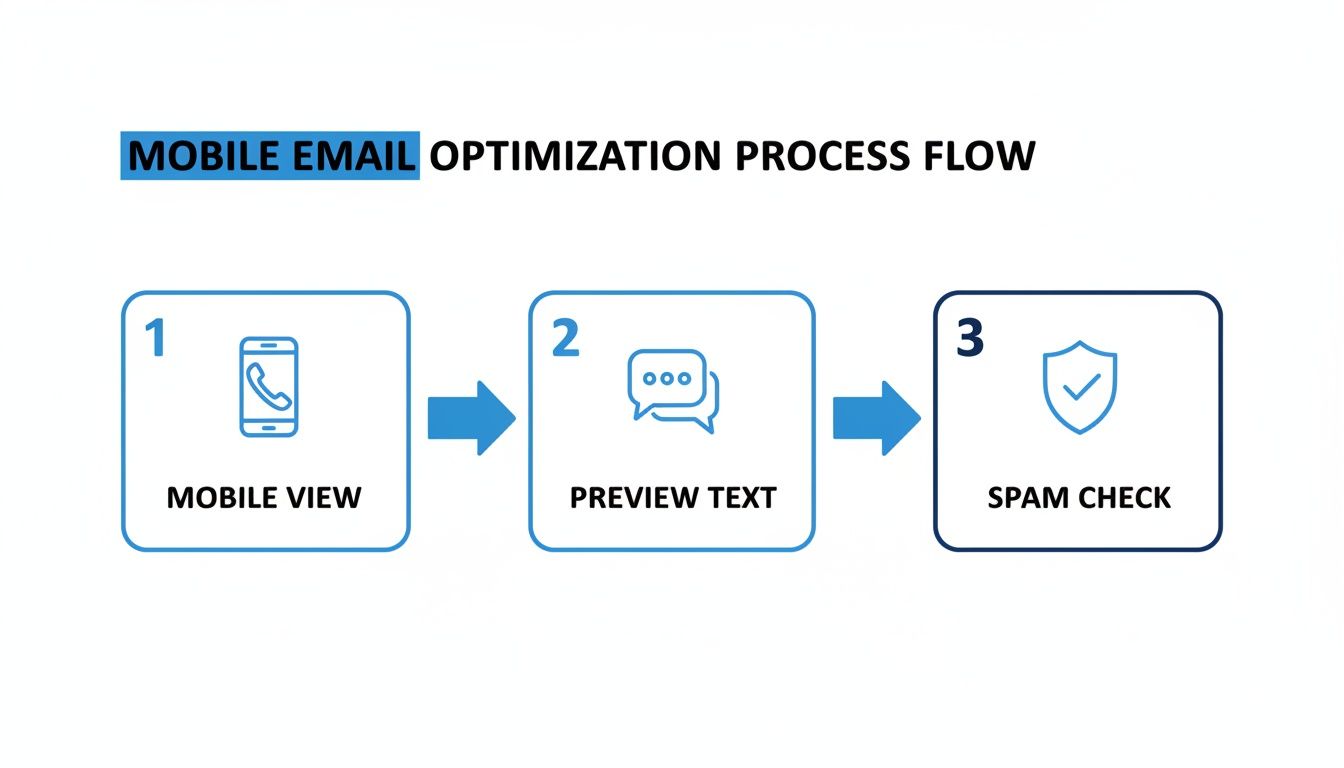
As this shows, effective testing isn’t an isolated task—it’s a core piece of a multi-step optimization workflow. Over time, that tracking sheet becomes your playbook, revealing clear patterns about what your audience truly cares about.
For a deeper dive into the mechanics, you can learn more about A/B testing email campaigns for higher ROI in our dedicated guide. This is how you stop the guesswork and build a reliable growth engine for your newsletter.
Your B2B Subject Line Questions, Answered
Even with the best framework, you'll always have lingering questions. I get it. Writing subject lines is part art, part science, and a few specific scenarios always seem to trip marketers up.
Here are some quick-fire answers to the questions I hear most often from B2B teams trying to nail their newsletter game.
How Often Should I A/B Test?
For a weekly newsletter, a good rhythm is to run one meaningful A/B test per month. That pace gives you enough runway to gather statistically sound data without burning out your team or your audience. If you send less frequently, just aim to test every other send.
The key is consistency. Always test one variable at a time—like a question vs. a statement—so you know exactly what moved the needle. Over time, you’ll build a "winner's playbook" that's perfectly tuned to what makes your subscribers click.
Are Emojis Okay for B2B Subject Lines?
Yes, but with a big caveat: use them strategically. A well-placed emoji can absolutely make your email stand out in a sea of text-only subject lines. But whether it works depends entirely on your brand voice and your audience’s expectations.
A good rule of thumb in B2B is to use emojis that are directly relevant and not just decorative. For instance, a 📊 for a data report or a 🚀 for a product launch makes sense. Before you go all in, run a simple A/B test with and without an emoji to see how your list responds.
What's a Good B2B Newsletter Open Rate?
This is the million-dollar question, isn't it? While industry benchmarks are all over the place, a solid target for a B2B newsletter is somewhere in the 25-35% range. If you have a highly engaged, niche list, you might even see rates north of 40%. The global average in 2026 hovered around 42%, but that figure is skewed by B2C, which plays by different rules.
Here’s my advice: stop chasing a universal number. The only metric that truly matters is your own. Your primary goal should be to consistently improve your open rate month over month by applying the personalization and testing strategies we’ve covered. That’s how you build real, sustainable engagement.
Keep reading
All articlesHow to Boost Conversions With Your Email Newsletter
Turn your newsletter into a conversion engine. See 2026 benchmarks, CTR vs CVR explained, and the fixes most email guides skip.
Drip Campaign Template: Ready-to-Use Email Sequences
Get 6 ready-to-paste drip campaign templates with subject lines, body copy, and send timing—plus a step-by-step guide to building your own.
Post-Webinar Survey Questions Template (2026)
30+ post-webinar survey questions with NPS, CSAT, and CES templates, plus timing and length tips to boost completion and qualify leads faster.