
AI Powered Lead Generation: Build Your B2B Pipeline
Unlock growth with AI powered lead generation. Build a predictable B2B pipeline with cutting-edge strategies, data, and compliance for 2026 success.
Some quarters, lead generation feels manageable. Then it swings the other way. Your team spends weeks building lists, writing outbound, chasing webinar signups, and handing leads to sales, only to find that pipeline quality is uneven and forecasting still feels fragile.
That feast-or-famine cycle usually has one root cause. The system depends on too much manual work and too little real-time decisioning. Lists age. Signals get missed. Good prospects arrive, but no one prioritizes them fast enough. Average-fit leads get the same attention as high-intent accounts.
That's why AI powered lead generation matters now. Done well, it doesn't just speed up prospecting. It changes lead gen from a series of disconnected tasks into an operating system for finding, qualifying, and engaging the right accounts at the right time.
From Unpredictable Pipeline to Automated Growth
Traditional B2B lead generation breaks down in familiar ways. One campaign overperforms, sales gets excited, and then the next month everything stalls. Teams respond by adding more activity. More list building, more follow-up, more tools, more meetings. But activity doesn't fix weak prioritization.
AI powered lead generation changes the model. Instead of asking reps and marketers to manually decide who matters most, the system helps identify fit and intent continuously. That matters because the payoff isn't just operational convenience. Businesses using AI in lead generation have seen a 50% increase in sales-ready leads and customer acquisition costs reduced by up to 60%, according to Martal's lead generation statistics.
What actually becomes more predictable
The biggest shift is not volume. It's consistency.
When AI is connected to your CRM, enrichment layer, outreach workflow, and routing rules, your pipeline starts to behave more like a managed system and less like a set of campaigns. That often means:
- Faster qualification: High-intent leads get surfaced earlier.
- Less wasted sales effort: Reps spend less time on low-probability accounts.
- Better channel alignment: Marketing and sales work from the same signals.
- Cleaner follow-through: Automation closes the gap between interest and action.
A lot of teams first encounter this idea through broader marketing automation for B2B growth. The difference with AI is that automation stops being purely rule-based. It starts adapting to signals, patterns, and changing account behavior.
Practical rule: If your lead gen process only gets better when you add more people, you don't have a scalable system yet.
Predictable growth comes from a workflow that keeps learning. That requires cleaner data, tighter targeting, and a willingness to measure quality instead of celebrating raw lead counts.
What AI Powered Lead Generation Really Is
A lot of marketers hear “AI” and picture a writing assistant, a chatbot, or a prospecting tool with a new label. That's too narrow. AI powered lead generation is better understood as a system that combines data, prediction, and workflow automation to help your team identify and act on the best opportunities.
The simplest analogy is this. Traditional lead gen is a paper map. You can use it, but you do most of the work yourself. AI lead gen is a GPS. It uses live conditions, recalculates when things change, and helps you move faster without guessing.
It's not one tool
A single platform can help, but the primary value comes from how the pieces work together.
An AI-driven lead gen system usually does three jobs in sequence:
- It identifies relevant accounts and contacts.
- It qualifies them using fit and intent signals.
- It triggers the next action, such as routing to sales, enrolling in nurture, or launching outbound.
That's why buying a database alone won't solve the problem. Neither will adding generative email copy on top of weak targeting. If the workflow underneath is broken, AI will scale the broken parts.
What it looks like in practice
A useful way to pressure-test your setup is to compare it with proven effective lead generation strategies that already balance audience definition, messaging, and conversion paths. AI doesn't replace those fundamentals. It sharpens them.
Here's the practical difference between old and new approaches:
Approach
How it works
Typical weakness
Manual lead gen
Teams build lists, score leads by hand, and run static sequences
Slow updates, inconsistent follow-up
Basic automation
Rules trigger emails or routing based on fixed conditions
No real judgment about lead quality
AI-powered system
Signals update profiles, scores shift, and actions adapt automatically
Depends heavily on data quality and governance
AI lead gen works best when marketers treat it like workflow design, not software shopping.
If your team still asks, “Which tool should we buy?” too early, you'll usually get poor implementation. The better question is, “What decisions should the system make automatically, and what data does it need to make them well?”
That's where AI becomes useful. Not as a buzzword, but as infrastructure for better pipeline decisions.
The Technology Driving Modern Lead Generation
Most AI lead gen products look similar on the surface. They promise better leads, faster outreach, and less manual work. Under the hood, they usually rely on three moving parts: signal collection, predictive decisioning, and automated execution.
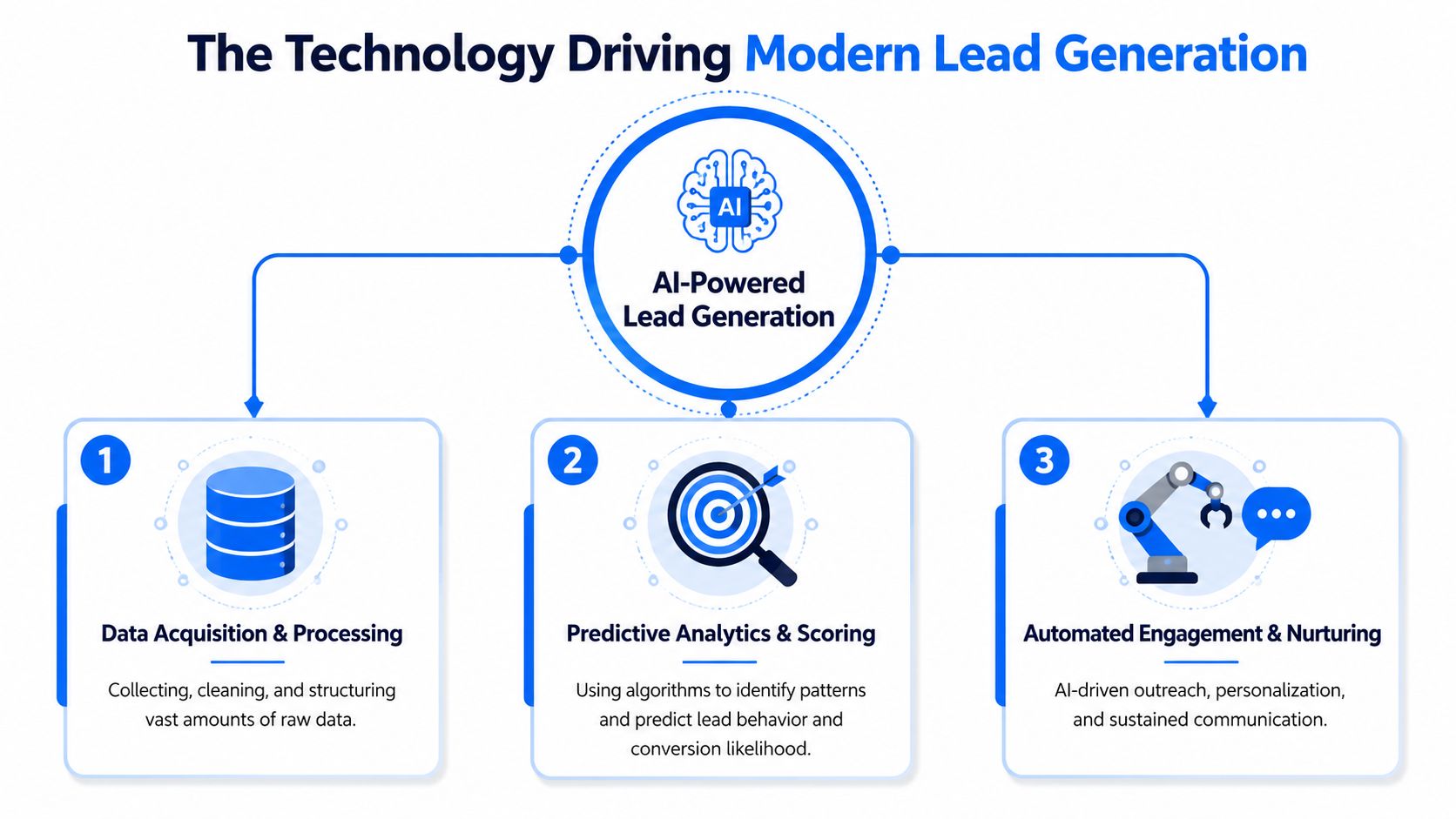
Data acquisition and processing
The first layer is data. Without it, nothing downstream works.
AI-powered lead generation systems typically combine continuous enrichment, predictive lead scoring, and automated outreach. They pull verified contacts, technographics, hiring, funding, news signals, and behavioral intent such as repeat visits or time on the pricing page, then rank leads by fit and buying intent, as described in AISDR's overview of AI lead generation tools.
That's a more useful input set than a static CSV exported three months ago.
Examples of signals that matter:
- Company fit: Industry, size, geography, business model
- Tech stack context: What software a company appears to use
- Change signals: Hiring spikes, new funding, leadership changes
- Behavioral intent: Repeated visits, pricing-page engagement, content consumption
Predictive analytics and scoring
Once those signals are available, the next job is ranking. Which leads deserve attention now, and which should wait?
In this domain, many teams benefit from a broader mindset around optimizing operations with AI. The goal isn't just smarter scoring. It's better operational timing.
A basic manual model might assign fixed points to job title, company size, and form fills. A predictive model looks for combinations that historically align with real buying motion. That can include things marketers often miss, such as a target account returning to the site after a funding event or multiple stakeholders showing engagement in a short window.
Automated engagement and nurturing
The third layer is action. Scores only matter if they change what happens next.
A modern workflow might do any of the following:
- Route hot accounts directly to an SDR or AE
- Launch a personalized sequence based on segment and signal type
- Push lower-intent leads into a nurture path
- Trigger CRM updates so marketing and sales see the same context
For teams comparing vendors, it helps to review different B2B lead generation platforms through this three-part lens. Don't just ask whether a platform has AI. Ask what data it ingests, how it decides, and what actions it can take.
The strongest systems don't just generate names. They reduce decision lag between signal and response.
That's what makes AI useful in lead generation. It shortens the distance between “this account looks promising” and “the right follow-up already happened.”
Designing Your AI Lead Generation Strategy
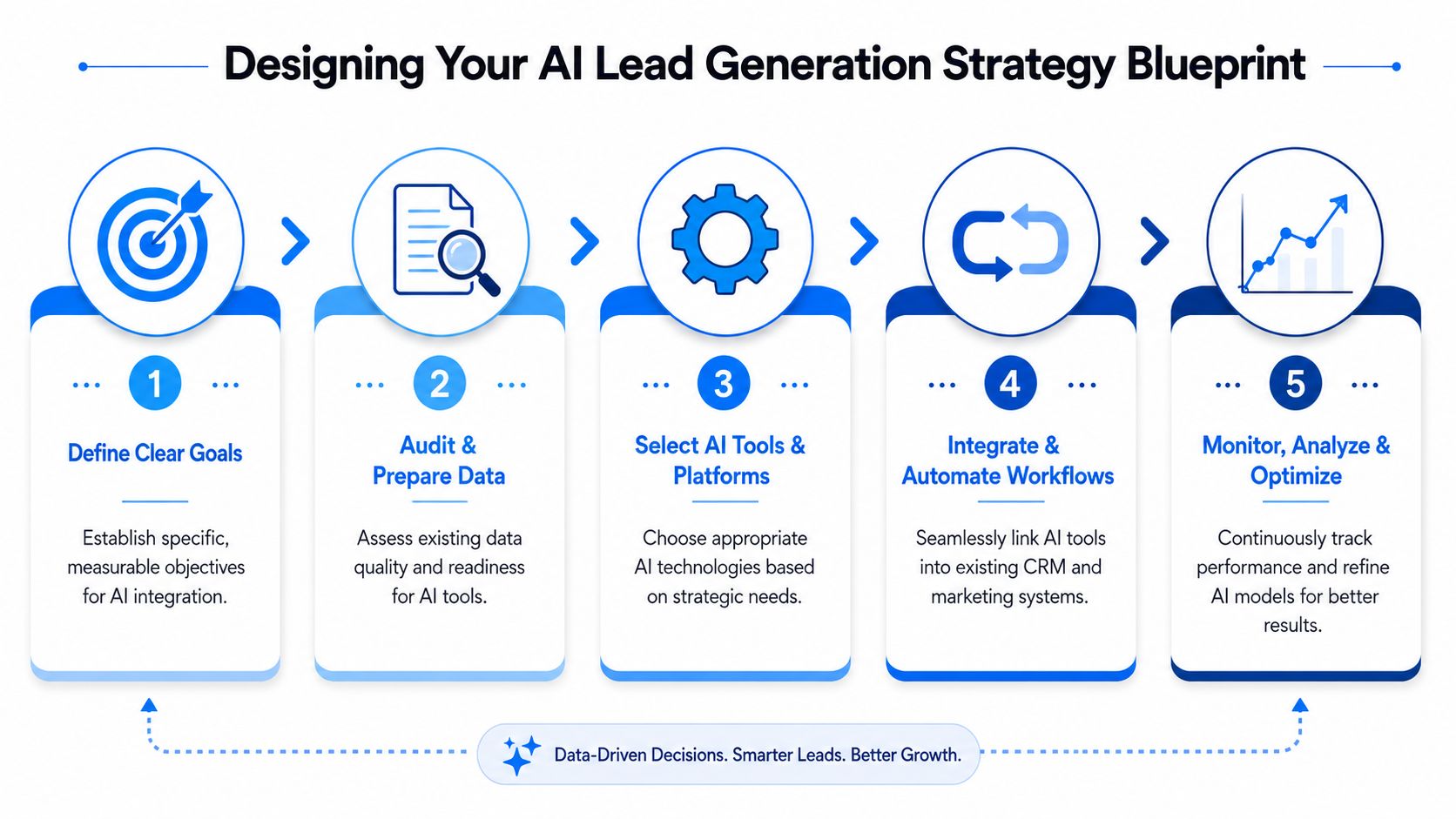
Most failed AI implementations aren't technology failures. They're strategy failures. Teams buy software before they define the audience, the workflow, or the business outcome they're trying to improve.
Start with the outcome. Not “use AI,” but something concrete like improving newsletter subscriber quality, tightening MQL-to-SQL flow, or helping sales focus on in-market accounts.
Start with ICP clarity
If your ideal customer profile is vague, AI will automate vagueness.
Define the accounts you want. That usually means being explicit about company attributes, buyer roles, deal environment, and exclusions. If you need a tighter framework, this guide on what an ICP means in marketing is a useful reference point.
A practical ICP for AI workflows usually includes:
- Firmographic boundaries: Company size, industry, region
- Role targeting: Economic buyer, champion, operator, influencer
- Buying context: Typical problems, timing triggers, urgency indicators
- Negative filters: Segments that convert poorly or create churn
Map the strategy to a channel and use case
Not every lead gen motion should be built the same way. A newsletter growth engine needs different signals and workflows than direct sales outreach.
Here's a simple way to separate them:
Use case
Primary goal
Best AI role
Newsletter audience growth
Add engaged subscribers that match your ICP
Targeting, enrichment, segmentation
Demand generation for sales
Identify and route in-market accounts
Intent detection, scoring, routing
For a newsletter-led strategy, the AI system should focus on audience fit and engagement likelihood. You want subscribers who resemble your target buyers and are likely to interact with future sends.
For sales-led demand gen, the emphasis shifts. The system should identify accounts with credible buying signals, prioritize them, and push them into the right motion without manual review bottlenecks.
Build rules before prompts
A common mistake is relying too heavily on AI-generated copy before defining operational rules. Messaging matters, but workflow matters more.
Set the conditions first:
- Which accounts enter the system
- Which data points must be present
- What qualifies as high intent
- Which action follows each score or segment
Field note: The best AI lead gen strategies look boring on a whiteboard. Clear inputs, clear thresholds, clear handoffs.
That's a good sign. The flashy part comes later. The durable advantage comes from strategy that translates into repeatable execution.
Your Practical Implementation Guide
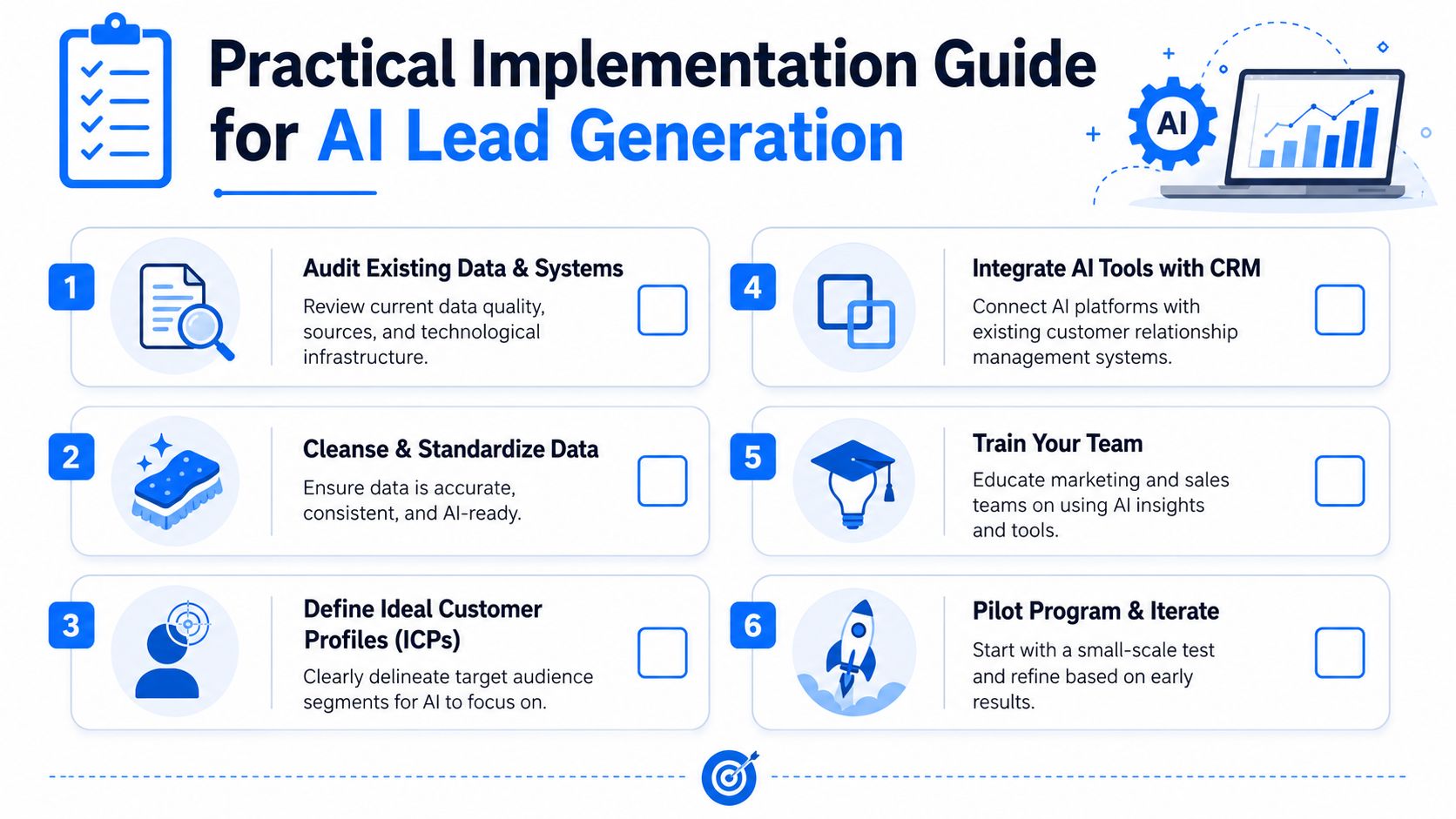
Execution starts with cleanup, not campaigns. If your CRM is fragmented, your contact records are stale, or ownership rules are unclear, AI won't fix that. It will amplify it.
The first implementation milestone is data readiness. That means centralizing records, removing obvious duplicates, standardizing fields, and deciding which systems are the source of truth.
Audit before you automate
Start with a working audit across CRM, MAP, enrichment tools, and outbound platforms.
Check for these issues first:
- Missing ownership logic: Leads arrive, but routing is inconsistent
- Stale records: Contacts remain in active workflows long after role changes
- Field sprawl: Teams track the same concept in multiple properties
- Disconnected systems: Sales and marketing see different lead status history
A practical benchmark matters here. A hard bounce rate under 3% is a useful data-quality threshold for AI lead gen implementation. If your database is above that mark, the contact data is likely too stale for reliable scoring or outreach, according to ZoomInfo's guidance on AI lead generation tools.
That number is worth taking seriously because deliverability problems often reveal deeper data issues.
Integrate the workflow in stages
Don't wire everything at once. Start with one use case and one audience.
A sensible rollout often looks like this:
- Connect the core systems: CRM, enrichment source, outreach platform, analytics
- Define scoring inputs: Fit criteria, behavior signals, exclusions
- Set routing and action rules: Sales handoff, nurture, suppression, alerts
- Launch a pilot audience: One segment, one sequence, one review cadence
Before scaling, spend time watching how records move. Look at enrichment completeness, scoring consistency, and whether sales agrees with the surfaced leads.
A useful primer if you want a visual walkthrough is below.
Use continuous enrichment, not one-time imports
This is one of the clearest line-items between mediocre implementation and strong implementation.
One-time list uploads decay fast. People change jobs. Companies change priorities. Intent disappears. Continuous enrichment keeps records current enough for AI systems to make better scoring and routing decisions.
That also affects lead-to-MQL quality. If the model is making decisions with fresh company and contact data, your handoffs become more credible.
Measure the right outcomes
Avoid vanity metrics in the first phase. More leads doesn't mean a better system.
Track indicators such as:
- Lead-to-meeting quality: Are surfaced leads accepted by sales?
- Stage progression: Do AI-prioritized leads move forward cleanly?
- Deliverability health: Are bounce patterns improving or getting worse?
- Operational trust: Do reps act on the scores, or ignore them?
Good implementation feels disciplined. It usually starts smaller than teams want, but that's what keeps the system reliable when volume grows.
Common Pitfalls and How to Avoid Them
The easiest way to fail with AI lead gen is to assume more automation automatically means better pipeline. It doesn't. AI can increase output quickly, but output alone isn't the point.
A key question is whether conversion quality improves or whether you've created nothing more than increased activity.
Pitfall one, bad data in a smarter wrapper
A stale CRM paired with AI outreach is still a stale CRM problem. You just reach the wrong people faster.
Do this: centralize your data, clean core fields, and decide which records are trustworthy enough to enter AI workflows.
Not that: upload a large legacy list and hope the model sorts it out.
Pitfall two, over-personalization without governance
Modern AI lead-gen stacks combine research, enrichment, and automated outreach, but the differentiator is data maturity, verification, and governance. That matters because tools can now generate highly personalized emails at scale, which increases the risk of brand inconsistency or regulatory exposure if hygiene and consent practices are weak, as discussed in this analysis of AI-powered lead generation risk.
That risk shows up fast in real campaigns. Messages can become too familiar, too assumptive, or inaccurate.
A better operating standard:
- Review dynamic fields: Make sure personalization tokens pull clean data
- Set brand boundaries: Define tone, claims, and prohibited phrasing
- Apply consent logic: Don't let automation bypass regional or internal rules
If the message feels clever but the data behind it is weak, prospects notice immediately.
Pitfall three, assuming AI is working without proving it
This is the most common strategic mistake. Teams launch AI scoring or AI outreach, see more activity, and call it success.
Guidance on this issue is straightforward: start with clean, centralized CRM data and test one or two use cases against a control group over 60 to 90 days, as recommended in ROMI Associates' discussion of AI-driven lead gen validation.
Use a simple comparison framework:
Bad validation
Better validation
“The tool sent more emails”
“The pilot group produced better downstream quality”
“Reps liked the interface”
“Sales accepted more routed leads from this workflow”
“Lead volume increased”
“Lead-to-opportunity quality held or improved”
The teams that win with AI are usually the least sentimental about it. They test, compare, and keep only what improves the funnel.
The Future of B2B Growth A Breaker Use Case
The future of B2B growth won't belong to teams with the most tools. It will belong to teams with the cleanest systems. AI powered lead generation works when data quality, enrichment, targeting, outreach, and governance operate together.
That's the practical lesson many teams miss. The stack can look advanced and still underperform if the workflow is messy. Clean records, verified audience inputs, and well-defined automation rules matter more than novelty.
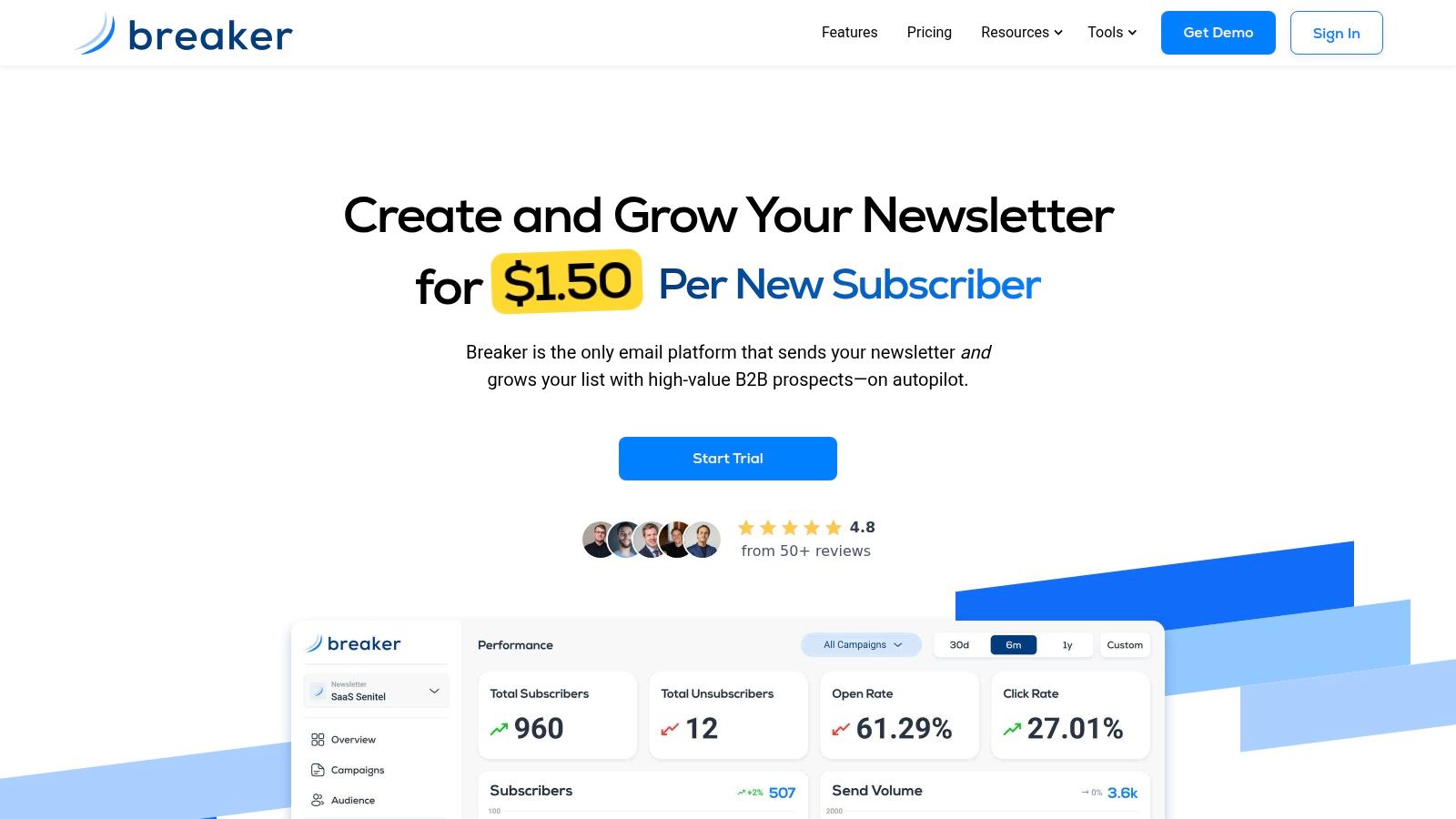
A useful example is newsletter-led growth. Instead of treating the newsletter as a passive content channel, an AI-driven system can treat it as a lead engine. The workflow identifies an exact-match B2B audience, enriches and verifies records, filters for relevance, and helps add engaged subscribers who fit the target profile. That turns list growth into a structured acquisition motion rather than a hope-based promotion tactic.
The broader principle holds across channels. AI is most valuable when it supports a governed system that knows who to target, what data to trust, and when to act.
If you're moving from manual lead gen to AI, don't start by asking how to automate more. Start by asking how to make the pipeline more trustworthy.
If you want to turn a B2B newsletter into a real acquisition channel, Breaker is built for that job. It combines email sending, AI targeting, enrichment, list growth, data hygiene, and deliverability controls so growth teams can add exact-match, engaged subscribers and track results without stitching together a fragmented stack.
Keep reading
All articlesNewsletter Agency Services: How Agencies Scale Client Newsletters
Managing multiple client newsletters? Learn what a true newsletter agency platform needs to prevent list mixing, voice drift, and invisible ROI.
Building Owned Audiences: Move Followers to Your Newsletter in 2026
Social platforms can vanish overnight. Learn how to convert Instagram, TikTok, and YouTube followers into a newsletter list you actually own.
Newsletter Analytics: Which Metrics Actually Matter in 2026
Open rate and clicks don't predict buyers. Learn the 7-step method to track click depth, recency, and topic affinity for a revenue-predictive intent score.