
Advertise in Newsletters: B2B Success Playbook
Learn to advertise in newsletters effectively. This B2B marketer's playbook covers partner selection, ad creative, pricing, & measuring true ROI.
Your paid social campaigns are getting more expensive. Search still captures demand, but it does not create it. Sponsorships have worked in bursts, then stalled because nobody built a system around them.
That is where many B2B teams are right now.
If you want to advertise in newsletters successfully, treat it like a repeatable acquisition channel, not a one-off media buy. The teams that get value from newsletter ads do a few things differently. They pick formats based on funnel stage, buy against audience fit instead of vanity reach, negotiate around outcomes, and connect every placement back to pipeline.
A newsletter ad can look simple from the outside. A logo, a few lines of copy, one CTA. But the mechanics underneath are not simple. Trust transfer matters. Placement matters. Landing page continuity matters. Attribution matters even more.
Why Newsletter Advertising Is Your Next Growth Channel
A lot of B2B marketers are trying to solve the same problem with the same channels. They bid against each other on search, chase intent on social, and keep explaining away rising acquisition costs as normal.
Newsletter advertising changes the setup because you are not renting a fleeting impression inside a feed. You are entering a habit. A reader subscribed on purpose, opened on purpose, and is consuming content from a publisher they already trust.
That trust is why this channel deserves more budget attention. Email newsletters are used by 81% of B2B marketers, and email generates 40 times more customers than Facebook and Twitter combined, according to beehiiv’s email newsletter statistics roundup. Those two facts matter together. Adoption is already mainstream, and the customer-generation gap versus social is not subtle.
What makes newsletter ads different
The core advantage is context.
A newsletter is usually opinionated, curated, and recurring. Readers know what they signed up for. When your offer appears in that environment and matches the audience’s pain points, your ad feels less like interruption and more like a recommendation.
That has practical implications:
- You borrow trust: A respected operator or publisher filters attention for you.
- You reach a defined audience: Good newsletters usually have a tight editorial promise.
- You get cleaner feedback: Performance tends to reflect message-market fit more clearly than broad paid distribution.
Newsletter ads work best when the audience would plausibly say, “This is for people like me,” within a few seconds.
Why growth teams are shifting budget
The appeal is not just better attention. It is better signal.
When a newsletter sends qualified traffic, you can inspect what happened after the click. Did visitors convert? Did they book demos? Did they become opportunities in your CRM? That is a stronger foundation than channels where volume is easy to buy but intent is fuzzy.
For B2B lead gen, that makes newsletters useful across the funnel. Some placements build awareness inside a category. Others drive webinar registrations, lead magnets, trial starts, or direct demo demand. The key is not buying one ad and hoping. The key is building a program that compounds what you learn from each send.
Choosing Your Ad Format
The format shapes everything. Creative length. Reader experience. Publisher workflow. Pricing logic. Expected outcome.
If you choose the wrong format, even a strong offer underperforms.
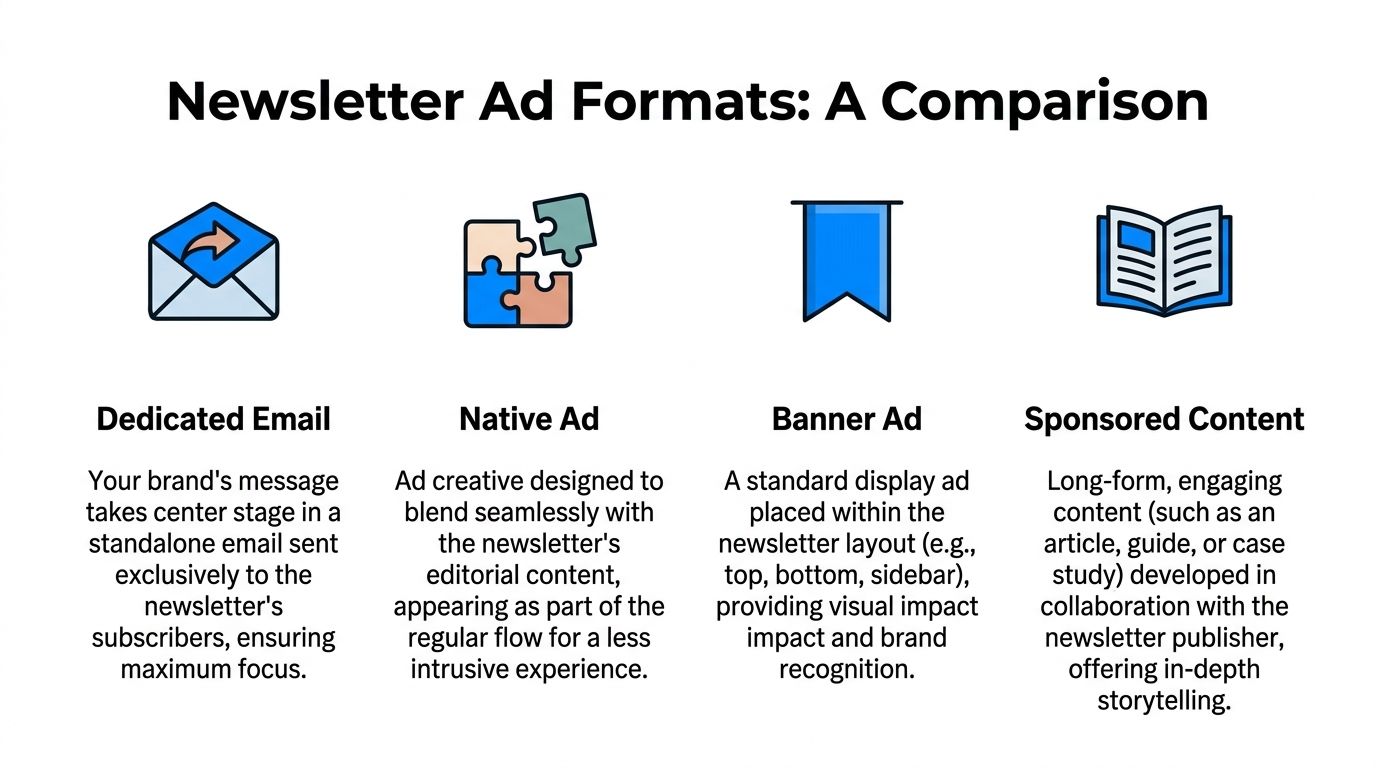
The market is broad enough now that format choice matters more than ever. On beehiiv, the number of creators grew significantly from 2022 to 2023, indicating a substantial increase, which means more inventory and more niche publications to evaluate qualitatively by use case.
Four formats worth knowing
Dedicated email is the highest-control option. Your message owns the send. There is no competition from the publisher’s other stories or links.
Use it when the ask is big. Product launch. Webinar push. Event registration. Time-sensitive offer. It gives your campaign room to explain itself.
The trade-off is friction. Dedicated sends usually require stronger trust from the publisher and a stronger brief from you. If your message is weak, the format exposes it.
Native ad is the workhorse format for many B2B teams. It appears inside the normal flow of the newsletter and matches the publication’s tone and pacing.
This is often the safest place to start when you advertise in newsletters. Native placements feel less disruptive, and readers are more willing to engage when the copy sounds like it belongs.
Banner ad is useful when visual recall matters more than immediate action. If your goal is brand visibility or repeated exposure across multiple issues, a banner can work. It is rarely my first choice for direct response in B2B because banners usually ask the reader to context-switch.
Sponsored content works when the product needs narrative. If your category is nuanced, or your offer is easier to understand through a story, collaboration, or mini-article, long-form sponsored content can justify the extra effort.
Match format to goal
Here is the simplest way to choose:
Format
Best For
Pros
Cons
Typical Pricing
Dedicated Email
Launches, webinars, high-intent pushes
Full attention, more room for context, strong direct-response potential
Higher creative burden, can feel promotional if misaligned
Flat rate, CPM, or custom package
Native Ad
Ongoing demand gen, list growth, trials
Blends with editorial, easier to test repeatedly, lower disruption
Less space to educate, success depends on copy discipline
Flat rate, CPM, or sponsorship bundle
Banner Ad
Awareness, repeated exposure, retargeting support
Simple asset requirements, strong visual presence
Lower intent, easy to ignore, weak fit for complex offers
Flat rate or CPM
Sponsored Content
Category creation, thought leadership, complex products
Rich storytelling, high trust transfer, supports mid-funnel education
Slower to produce, depends on publisher collaboration
Flat rate or custom package
My default recommendation
If you are building a repeatable program, start with native placements and layer in dedicated sends once you know your angle works.
Native ads create a cleaner testing loop:
- headline
- opening line
- CTA
- landing page
- audience fit
You can run several placements across multiple newsletters without overcommitting to one expensive send.
A good rule is simple. Buy dedicated sends when you already know the audience-message pairing works. Use native placements to discover that pairing first.
What usually works and what usually does not
Formats perform when they respect the reader.
What works:
- native copy that sounds like the newsletter
- one clear offer
- one main CTA
- landing pages that continue the exact promise made in the ad
What does not:
- forcing enterprise language into a conversational publication
- using banner creative to explain a complex product
- asking for a demo before the audience knows why they should care
- buying the biggest list instead of the most relevant one
Finding and Vetting the Right Newsletter Partners
Many newsletter ad failures are partner-selection failures disguised as creative problems.
The copy was fine. The CTA was fine. The landing page was fine. But the audience was wrong, too broad, too early-stage, or not engaged enough to matter.
Start with ICP fit, not inventory volume
Begin with your true buyer, not your dream publisher list.
Write down the essentials:
- job titles or functions you need to reach
- company stage or size
- region
- pain points
- buying trigger
- level of sophistication around your category
Then map newsletters against that profile. Marketplaces such as Paved and LiveIntent can help you discover inventory faster. Manual research still matters because many of the strongest opportunities are tucked inside creator-led or operator-led newsletters that do not look polished but have the right readership.
If you need a sense of what strong B2B newsletters look like in practice, this roundup of B2B newsletter examples is a useful starting point for pattern recognition.
Vet the publication like a media buyer
A newsletter partner should be able to answer straightforward questions without hand-waving.
Ask about:
- Audience makeup: who reads it, in practical terms
- Editorial focus: what readers expect each issue
- Ad placement: where your ad appears and how often they sell that slot
- Send cadence: weekly, monthly, or event-driven
- List hygiene: how they handle inactive subscribers
- Ad disclosure: how sponsored placements are labeled
- Reporting: what they share after a campaign
You do not need a glossy media kit. You need clear answers.
Look for signs of audience quality
Some newsletters have a small but highly relevant readership. Others look large but send weak traffic because the audience is loose or stale.
Good signs:
- the publisher can describe the audience without generic phrases
- the editorial voice is consistent
- recent issues show active curation, not filler
- the ad inventory is not overcrowded
- your offer has a natural reason to appear there
Weak signs:
- they keep selling “reach” but cannot explain audience composition
- every issue is packed with promotions
- ad examples look copied from display ads
- they avoid talking about reporting or post-send performance
Ask for recent issues before you buy. Reading three to five sends tells you more than a polished pitch deck.
Assess whether the newsletter can target subsets
One of the most overlooked buying advantages is audience segmentation.
Some publishers only sell broad placements. Others can target by geography, role, behavior, or a focused sub-newsletter. That matters because advertisers often overpay when a publication cannot isolate the slice of the audience that matches the ICP.
A publisher with segmented inventory usually gives you better control over message relevance. That is especially useful in B2B when one product speaks to revenue leaders, another to marketing ops, and another to founders.
Do not ignore deliverability and compliance
A newsletter ad is only useful if it gets seen in the inbox and handled responsibly.
You want partners who take list quality seriously, remove inactive readers, and maintain clear advertising disclosures. A well-run publication protects both the reader relationship and your brand reputation.
I also pay attention to whether the ad experience feels honest. If the newsletter sneaks promotions into the body with no disclosure, readers notice. That hurts long-term performance for everyone.
A practical short list before signing
Before you commit budget, confirm these points:
- Audience fit is explicit
The publisher can explain who reads and why they subscribed.
- Editorial trust is visible
Recent sends show a point of view, not just link aggregation.
- Ad inventory is disciplined
You are not one of five sponsors fighting for the same click.
- Targeting exists where needed
They can isolate the audience segment that matters.
- Reporting is usable
You will get enough data to compare placements and improve future buys.
When you advertise in newsletters, the right partner saves you months of false negatives. The wrong one teaches the wrong lesson.
Crafting Ad Creative and CTAs That Convert
The best newsletter ad rarely looks like an ad first. It looks like a relevant idea that belongs in the issue.
That does not mean vague brand language. It means clarity, speed, and fit.
Start with the audience problem, not your product
Many weak newsletter ads open with who the company is. Strong ones open with the problem the reader already has.
Bad approach:
“We’re an all-in-one platform for go-to-market teams...”
Better approach:
“If your outbound pipeline depends on stale data, your reps are wasting time before the first touch.”
That second version earns attention because it names a pain point. It also gives the reader a reason to continue without forcing them to parse a category label.
Write for the skim
Newsletter readers move fast. They scan headers, jump to bolded phrases, and decide quickly whether to click.
Your copy should be:
- short enough to absorb in seconds
- specific enough to signal relevance
- direct enough to make the next action obvious
The structure I like most is simple:
- line one identifies the problem or opportunity
- line two introduces the mechanism or outcome
- line three tells the reader what to do next
Make the ad feel native
The publisher’s tone matters. A highly analytical newsletter supports one style. A founder-led newsletter with strong personality supports another.
Adapt to the publication without mimicking it awkwardly.
What that usually means:
- use plain language
- avoid blochure phrases
- match the tempo of the newsletter
- keep your CTA aligned with the issue’s level of intent
If the publication is thoughtful and tactical, a loud promo line feels out of place. If the publication is fast and punchy, a long abstract paragraph loses.
A creative review should always include one question: Would a regular reader feel this was useful, or just inserted?
Here is a useful walkthrough before you build your next placement:
Use one dominant CTA
Many newsletter ads lose clicks because the advertiser tries to do too much. Book a demo. Read a guide. Follow on LinkedIn. Start a trial. Join a webinar.
That is too many jobs for one placement.
Pick the CTA that matches audience temperature:
- cold audience: guide, benchmark, checklist, useful asset
- warm audience: webinar, product walkthrough, case-led page
- high-intent audience: trial or demo
If you have to include a secondary option, make sure the primary one is unmistakable.
One ad should drive one action. Clarity beats choice.
Visuals matter more than many teams think
Creative teams sometimes treat the image as optional. It is not. Relevant visuals can help the reader process the offer faster and decide whether to engage.
Including relevant images in an email campaign can increase click-through rates by 42%, according to beehiiv’s analysis on why newsletter advertising outperforms social ads.
That does not mean decorative screenshots or generic stock art. The image should do one of three jobs:
- preview the asset
- clarify the product
- reinforce the outcome
For example, if you are promoting a benchmark report, show the report cover and a meaningful snippet. If you are promoting software, show the part of the workflow that matters to the reader’s problem. If you are promoting an event, use the speaker or topic angle that creates interest.
Creative patterns that usually convert
A few patterns show up repeatedly in strong placements.
Problem-first copy
Lead with the pain point, bottleneck, or wasted motion the audience recognizes. This is the safest structure for cold placements.
Outcome-first copy
Lead with what changes after the click. This works better when the audience already understands the category.
Curiosity with constraint
Use a specific promise without overhyping it. Readers respond to concrete intrigue, not mystery-box copy.
Examples of useful CTA directions:
- get the benchmark
- see the workflow
- watch the teardown
- compare your current approach
- book a custom walkthrough
Creative mistakes that drag performance
The common misses are easy to spot:
- too much brand setup before the value prop
- multiple product claims fighting each other
- generic visual assets
- CTA language that is vague or premature
- ad copy that ignores the publisher’s voice
A newsletter audience does not give you much time. Respect that, and the placement has a chance. Waste it, and even a good list will not save the campaign.
Navigating Pricing Models and Negotiation
Many teams ask the wrong opening question.
They ask, “What does this newsletter charge?”
The better question is, “What pricing structure matches the outcome we want?”
The common pricing models
Newsletter pricing is usually built around a few standard models.
Flat-rate sponsorships are simple. You pay for a placement in an issue or package across several sends. This works well when the audience fit is strong and you want predictable buying.
CPM deals are tied to send volume or impressions. They can make sense for awareness campaigns, but they often hide a problem in B2B. You may pay efficiently for exposure while learning very little about actual pipeline impact.
CPC or performance-driven arrangements shift more risk toward outcomes. These can be useful for testing, but they require tight tracking and clear agreement on what counts.
If you are still sizing a budget, our breakdown of email ads cost covers what sponsorships, CPM deals, and software typically run in 2026.
Why modern buyers should push beyond flat placements
A one-off flat fee is easy to buy and hard to evaluate. If performance is weak, both sides can blame something different. Audience. Creative. Offer. Timing.
That is why I like outcome-aligned structures whenever the publisher is open to them.
Examples include:
- pay-per-lead
- pay-per-qualified-action
- pay-per-subscriber when list growth is the goal
- hybrid deals with a smaller base fee plus performance upside
These models are not universally available, but they create better incentives. The publisher has a reason to help with placement quality and audience fit. The advertiser gets less downside from a pure guessing game.
Segmentation should influence what you pay
Not all inventory inside one newsletter deserves the same rate.
Data indicates that segmented email campaigns can achieve higher open rates than non-segmented campaigns, which is why targeting capability should affect pricing and negotiation terms qualitatively in your favor. If the publisher can isolate the audience by role, location, or engagement, that added relevance has real buying value.
When I review pricing, I do not just compare cost. I compare:
- whether the audience can be segmented
- whether the ad appears in a premium slot
- whether the send is exclusive or crowded
- whether the publisher will adapt creative with you
- whether post-campaign reporting is usable
If you need a frame for evaluating what publishers charge, this guide on newsletter ad rates helps translate rate-card language into practical buying decisions.
What to negotiate besides price
The line item matters less than the structure around it.
Negotiate for:
- category exclusivity in the issue
- creative approval timing
- make-good terms if placement changes
- access to segmented inventory
- package discounts for multiple tests
- reporting fields you need
A publisher who refuses every operational detail is harder to work with later, even if the rate looks attractive upfront.
Good negotiation improves learning, not just cost. A cheaper buy with weak reporting is often more expensive in the long run.
How I think about pricing in practice
For top-of-funnel awareness, flat sponsorships and CPM can be acceptable if the publication is highly aligned.
For lead generation, I prefer structures that move closer to outcomes. If the publisher cannot support that directly, I compensate by tightening the landing page, tracking setup, and qualification criteria on my side so I can judge efficiency after the click.
The point is not to force every buy into one model. The point is to stop treating newsletter inventory as interchangeable. It is not.
Measuring True ROI and Optimizing Campaigns
Open rate is useful. Click rate is useful. Neither answers the question your finance team or revenue leader cares about.
Did this campaign create pipeline?
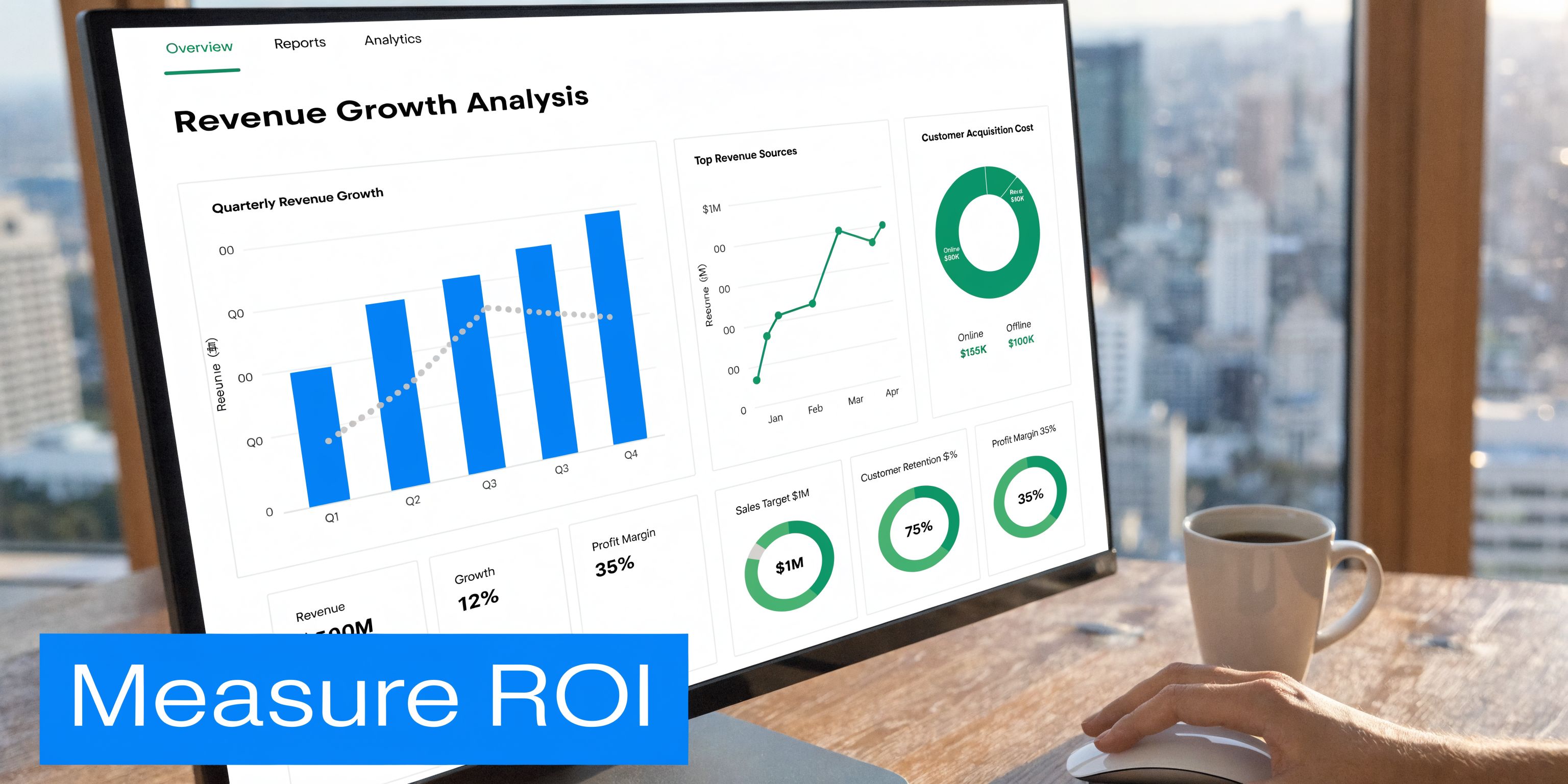
Many B2B marketers struggle with newsletter ad measurement because most advice stops at surface-level engagement and ignores CRM integration, as noted in beehiiv’s discussion of newsletter growth channels and analytics gaps.
Vanity metrics do not build a program
A campaign can produce solid click volume and still fail commercially.
Here is why:
- traffic may not match the ICP
- landing pages may convert the wrong visitor type
- form fills may not become qualified pipeline
- opportunities may come from the campaign indirectly, not directly
If you stop measurement at opens or clicks, you cannot tell the difference between an ad that looked healthy and an ad that worked.
Build an attribution spine before you spend
Before the first campaign launches, set up a tracking structure that can survive a long B2B sales cycle.
My baseline stack includes:
- UTM parameters for every newsletter, issue, and creative variant
- a dedicated landing page or tightly matched page path
- hidden fields or campaign capture in forms
- CRM fields that preserve original source and campaign name
- a dashboard that rolls ad source into opportunity and revenue reporting
The goal is not perfect attribution. The goal is decision-ready attribution.
You want to answer questions like:
- which publishers create qualified pipeline
- which formats create meetings but not opportunities
- which offers generate low-quality form fills
- which creative angles influence later-stage conversion
Measure by funnel stage
Do not force one metric to serve the entire funnel.
A cleaner framework looks like this:
Early signal
Use these to judge whether the placement earned attention:
- clicks
- click-to-landing-page behavior
- bounce rate on the page
- asset engagement
- reply or branded-search lift, if you monitor it qualitatively
Mid-funnel quality
At this stage, many programs separate good traffic from noisy traffic:
- form completion quality
- meeting rate
- sales acceptance
- opportunity creation
Revenue outcome
This is the level that justifies scaling:
- pipeline influenced
- pipeline sourced
- closed revenue
- time-to-opportunity by publisher or format
Not every campaign will generate immediate sourced revenue. That is normal in B2B. But every campaign should improve your understanding of where revenue is likely to come from.
Use dedicated pages when you need cleaner reads
A dedicated landing page is not always necessary, but it is often useful.
Use one when:
- the audience needs a specific angle
- the publisher serves a distinct vertical
- you are testing a specific message
- you want fewer attribution conflicts
Custom pages reduce leakage. They also make post-click diagnosis easier. If performance drops, you can tell whether the issue came from the audience, the creative, or the page.
Optimization should follow a repeatable loop
Many teams “optimize” by changing everything after one disappointing send. That destroys signal.
Keep the loop tighter:
- hold the audience constant and test creative
- hold the offer constant and test publishers
- hold the publisher constant and test landing page alignment
- review CRM outcomes before scaling spend
If a publisher drives clicks but weak lead quality, test a narrower offer. If a publisher drives high-quality leads but low volume, buy more frequency or ask about segmented inventory. If the traffic is good but conversion is poor, the page probably needs work.
Compare placements on business value, not media metrics
Here, a proper dashboard matters. One option teams use is a system that combines sending, subscriber growth, targeting, and ROI visibility in one place. Breaker is one example, alongside your CRM and analytics stack, when you need campaign data connected to downstream performance rather than isolated inside email reporting.
The important part is not the brand name. It is the operating model:
- campaign data must flow into pipeline review
- performance must be visible by publisher and creative
- list growth and lead quality must be separated
- optimization decisions must happen from revenue signals, not just email metrics
For a practical benchmark on what to watch after the click, this overview of email campaign performance metrics is a useful reference.
If you cannot trace newsletter spend into your CRM, you are not running a channel. You are buying placements and hoping the story works out later.
What to do after the first few campaigns
By this point, the program should stop being publisher-led and start becoming model-led.
Review your campaigns by these dimensions:
- publisher
- audience segment
- format
- offer
- CTA
- landing page
- pipeline outcome
Patterns will emerge fast. Some newsletters produce efficient awareness but weak conversion. Some produce fewer clicks but much better sales conversations. Some are perfect for thought leadership but poor for direct demo asks.
That is how newsletter advertising becomes scalable. Not by finding one lucky sponsorship, but by building a system that identifies which combinations create revenue and which combinations only create activity.
If you want a cleaner way to run newsletter acquisition with targeting, list expansion, deliverability controls, and ROI visibility tied to engaged subscribers, Breaker is one option to evaluate alongside your CRM and sponsorship workflow.
Keep reading
All articlesHow to Boost Conversions With Your Email Newsletter
Turn your newsletter into a conversion engine. See 2026 benchmarks, CTR vs CVR explained, and the fixes most email guides skip.
Drip Campaign Template: Ready-to-Use Email Sequences
Get 6 ready-to-paste drip campaign templates with subject lines, body copy, and send timing—plus a step-by-step guide to building your own.
Post-Webinar Survey Questions Template (2026)
30+ post-webinar survey questions with NPS, CSAT, and CES templates, plus timing and length tips to boost completion and qualify leads faster.