
How to Sell an Ebook on Amazon: A 2026 Guide
Learn how to sell an ebook on Amazon with our step-by-step 2026 guide. We cover niche validation, KDP setup, pricing strategy, marketing, and common pitfalls.
Most advice about how to sell an ebook on Amazon starts too late. It starts with formatting, uploading, and launch checklists, as if the hard part is pressing the publish button.
It isn't.
A significant risk is spending weeks or months writing a book that never had a commercial case to begin with. Amazon can reward a strong product, but it does not rescue a weak topic, fuzzy positioning, or a book aimed at readers who were never searching for it. If you want to sell an ebook on Amazon as a business asset, you need to think like a publisher before you think like a writer.
That changes the order of operations. Validate demand first. Build the book around a specific buyer problem. Use Amazon because it fits the economics and reach you want, not because every self-publishing guide assumes it's the default answer.
Validate Your Ebook Idea Before You Write
Most failed ebook launches are concept failures disguised as marketing failures. Authors blame ads, reviews, or the algorithm when the actual problem was simpler. The market never clearly asked for the book.
Stop choosing topics by interest alone
Being interested in a topic isn't enough. Expertise helps. Passion helps. Neither one guarantees demand on Amazon.
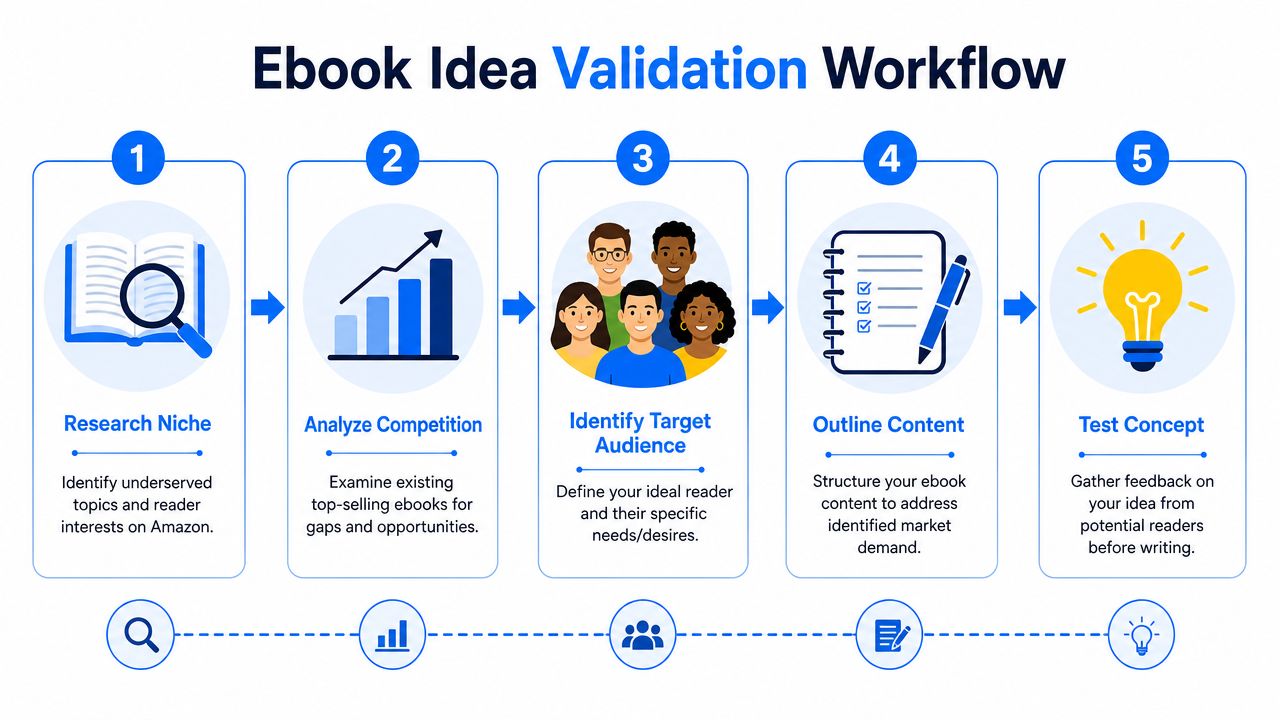
A better filter comes from niche research used by experienced self-publishers. One practical method is to look for Kindle topics where the top results have fewer than 50 reviews and are several years old, then confirm rising interest through Google Trends and unanswered questions in communities like Reddit or Quora, as outlined in Reedsy's guide to selling ebooks on Amazon. That combination matters because it suggests readers care, but incumbents may be weak, dated, or under-serving the topic.
If you're coming from a creator or consultant background, the same logic applies to broader digital product planning. A useful companion read is this guide on how to make digital products, especially if your ebook is one piece of a larger offer stack.
Use a validation screen before outlining
Run every idea through a simple commercial screen:
- Search the exact problem on Amazon
Use buyer language, not your internal jargon. A consultant might search "sales discovery questions" while a buyer may search "B2B sales call script."
- Check whether current winners look tired
Old covers, dated subtitles, weak positioning, and stale examples are openings. A market with books that still rank but feel behind the moment is often healthier than a market with no books at all.
- Read low-star and mid-star reviews
One-star reviews show frustration. Three-star reviews are often better because buyers explain what was useful and what was missing.
- Scan community questions
Reddit, Quora, niche Facebook groups, and comment threads tell you how people describe the problem in their own words.
- Test the promise before writing
Turn the idea into a landing page headline, webinar topic, newsletter issue, or short PDF lead magnet. If nobody responds, your book angle probably isn't sharp enough.
Practical rule: Don't write a full manuscript until you can state the reader, the problem, and the outcome in one sentence.
What an underserved niche actually looks like
Underserved doesn't mean empty. Empty can mean no demand.
An underserved niche usually has these traits:
- Visible demand: People are buying books on the topic.
- Weak offers: Existing titles are generic, outdated, or too broad.
- Specific reader pain: Buyers want help with one concrete job, not a vague category.
- Room for a sharper angle: You can define a clearer audience or outcome than current books do.
A strong ebook idea sounds narrow enough to buy. "Email marketing" is broad. "Newsletter onboarding for B2B SaaS" is saleable. "Leadership" is broad. "First-time manager feedback scripts" is saleable.
A good Amazon ebook doesn't just inform. It solves a problem a buyer already knows they have.
That distinction saves time. It also gives you cleaner metadata, a stronger cover concept, and a far easier launch.
Prepare Your Ebook for a Professional Launch
Once the idea is validated, production quality becomes a commercial advantage. Readers can forgive a short book. They rarely forgive a sloppy one.
Build three assets, not just a manuscript
A professional launch depends on three separate assets:
- The manuscript
- The formatted ebook file
- The cover
Treat each one as a revenue driver.
The manuscript has to match the promise made by the title and product page. That sounds obvious, but many ebooks drift. The title sells a tactical outcome. The interior delivers broad theory. That mismatch produces weak reviews and poor read-through.
Edit to the level the book actually needs
Not every ebook needs the same editing stack. Match the investment to the product.
Editing layer
What it fixes
When it's most useful
Developmental editing
Structure, argument, missing sections, positioning
Early drafts, complex nonfiction, books with a big promise
Copy editing
Clarity, consistency, grammar, sentence flow
Most business and nonfiction ebooks
Proofreading
Typos, punctuation, final cleanup
Final stage before upload
A short tactical ebook may only need strong copy editing and proofreading. A book built to establish authority, generate consulting leads, or support a premium service usually needs deeper developmental work. If the book is part of your brand, weak structure is not a minor issue. It signals weak thinking.
For drafting and revision support, many authors now combine human editing with modern writing software. If you're comparing your stack, this roundup of apps for writers is a useful place to sort tools by the job they do.
Format for Kindle readability, not just file acceptance
Amazon may accept multiple file types, but acceptance isn't the same as a clean reading experience. The job is to produce a file that behaves properly on Kindle devices and apps, with reliable chapter breaks, consistent paragraph spacing, a functioning table of contents, and readable image placement.
Use Kindle Create if you want a straightforward in-house workflow. If design quality matters and you don't want layout surprises, hire a formatter who has worked specifically with Kindle files. EPUB and KPF workflows are both common. What matters is the final reading experience.
Common formatting mistakes include:
- Manual spacing and tabs that break on mobile devices
- Inconsistent heading styles that damage navigation
- Large images that create awkward page flow
- No preview check across device simulations
Your cover is a conversion asset
Authors often treat the cover as a personal expression project. On Amazon, it's closer to ad creative.
Most buyers first see your cover as a thumbnail next to competing books. At that size, subtle illustration work disappears. Clear typography, strong contrast, and category-appropriate design win more often than cleverness.
Use these filters when reviewing a cover:
- Can the main title be read at thumbnail size
- Does it look like it belongs in the category you want to win
- Does it signal the outcome quickly
- Would a buyer trust it next to current bestsellers
A poor cover doesn't just lower clicks. It can drag down everything else because weak click-through sends a bad signal before readers ever sample the content.
Navigate the KDP Dashboard and Upload Process
The KDP dashboard is simple on the surface and strategically important underneath. Most fields look administrative. Several of them influence whether Amazon understands your book well enough to show it to the right buyers.
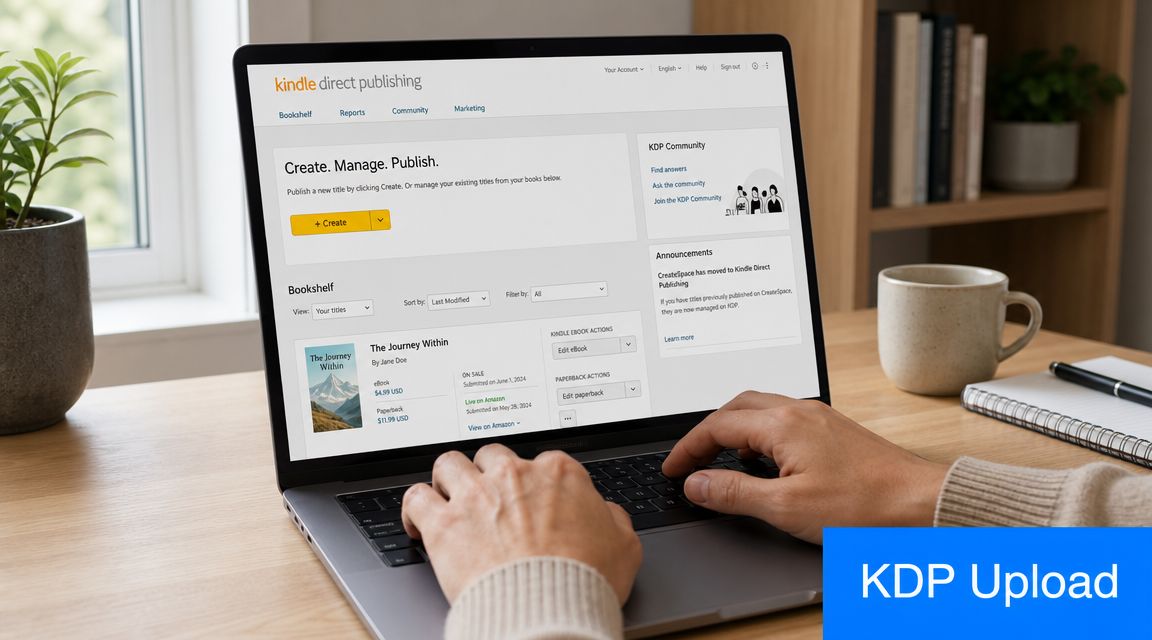
Set up the account like a business owner
Before you upload anything, complete the account basics carefully. That includes identity details, tax information, and payment setup. If you're publishing under a company entity, make sure the account structure matches how you want income and rights handled.
Then build the title listing with intent. KDP breaks the process into details, content, and pricing, but the key business fields sit in the details section.
Metadata decides whether the right reader ever sees the book
Amazon's discovery system responds heavily to metadata and early traction. Guidance from practitioner sources notes that books using competitive category selection, keyword-aligned titles, and launch traffic are more likely to gain long-term visibility, as explained in Kill Zone's Amazon ebook publishing advice.
That means your title, subtitle, categories, keywords, and description aren't packaging polish. They're routing instructions.
Use this approach:
- Title and subtitle: Lead with buyer language. Avoid vague branding phrases unless you already have audience recognition.
- Book description: Write for conversion first. Short paragraphs, bold emphasis where useful, clear outcome, clear audience.
- Keywords: Use search phrases tied to reader intent, not generic category labels.
- Categories: Pick categories where your book fits cleanly and can compete for visibility.
If you're also producing print editions, a cover sizing tool saves expensive mistakes. The essential tool for self-publishing authors from BeYourCover is useful for checking KDP cover dimensions before final export.
Make the upload process boring
Boring is good here. The upload should feel procedural, not improvisational.
Use a preflight checklist:
- Final manuscript file approved
- Cover exported in the correct format
- Description proofread in plain text before adding basic HTML
- Author name and contributor fields checked
- Keywords and categories chosen before opening the form
A lot of listing errors happen because authors write the description inside KDP, guess at keywords on the spot, or upload a file they haven't previewed recently.
Your first upload should look like version control, not last-minute assembly.
Later in the process, a walkthrough can help if you want to compare your screen to a live example:
One more operational point matters. Category and keyword choices are not static forever, but changing them later is not a substitute for getting them right early. A weak launch with weak metadata usually stays weak longer than it should.
Set Your Price and Royalty Strategy for Profitability
Pricing is where many ebook businesses go awry. Authors focus on what feels fair, what competitors charge, or what sounds premium. Amazon cares about structure, and KDP's royalty structure makes pricing a financial decision first.
Understand the royalty math before you set the list price
For Kindle ebooks, the royalty rate is highly sensitive to price. Books priced from $2.99 to $9.99 generally qualify for a 70% royalty, while books priced below $2.99 or above $9.99 typically earn 35%, according to Payhip's KDP pricing overview. The same source gives a common example: a $4.99 ebook at 70% yields about $3.49 per sale before delivery fees.
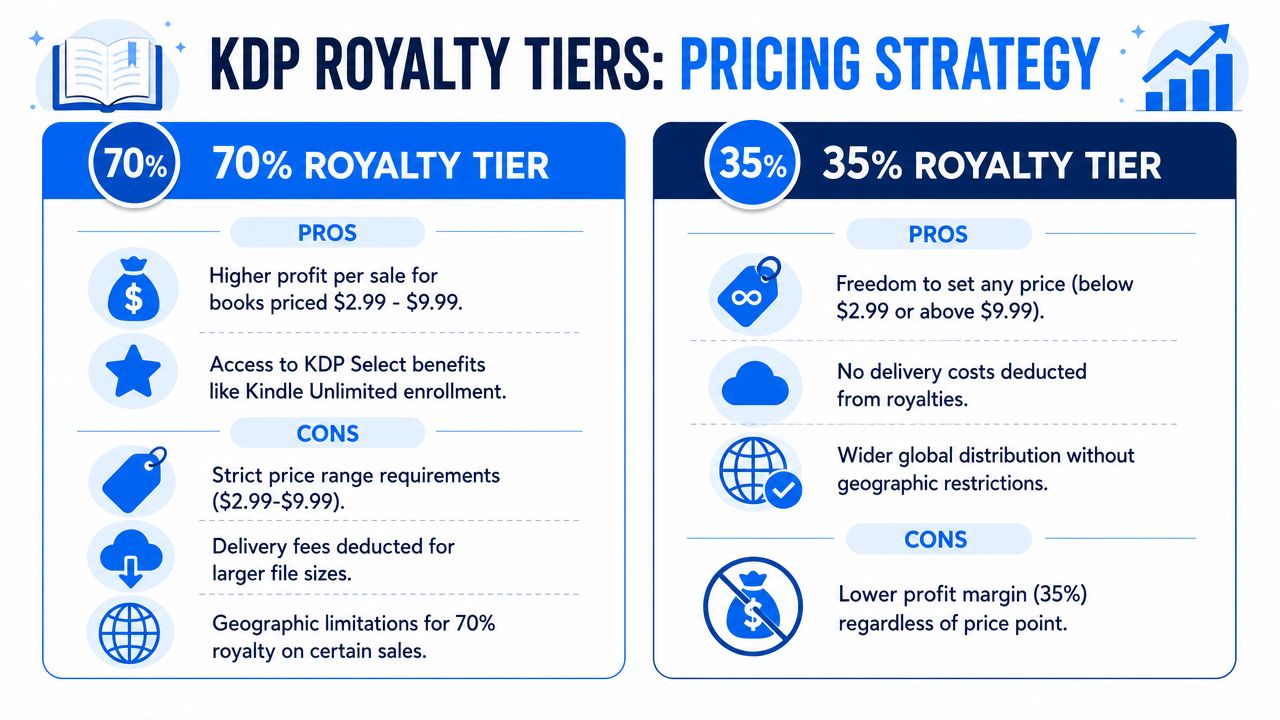
That one pricing band changes the economics of your whole launch. If you're buying traffic, using newsletter swaps, or paying for cover and editing, margin discipline matters.
Pick the model that fits the role of the book
Not every ebook should maximize per-unit royalty. Some books exist to generate leads, support a larger service, or feed readers into a series. Others need to stand alone as a profit center.
Use this decision table:
Book role
Better pricing logic
Risk to watch
Lead generation book
Lower-friction pricing can make sense if the backend offer is strong
Going too low can trap you in the 35% tier
Standalone profit book
Stay in the 70% band if possible
Overpricing for authority and cutting margin
Series entry point
Use price strategically to drive read-through
Treating book one as the profit center
Specialist B2B nonfiction
Test whether Amazon pricing fits the business model at all
Undervaluing a niche audience willing to pay more elsewhere
Decision lens: Don't ask, "What should this book cost?" Ask, "What job is this book doing in the business?"
KDP Select is a distribution decision, not a default box to tick
KDP Select can make sense when you want Amazon-centric visibility and are willing to trade distribution freedom for that ecosystem. It can also be the wrong move if your book supports direct sales, bundles, course access, or client acquisition outside Amazon.
The mistake is treating Select like a free bonus. It isn't. It's a channel commitment.
If your audience already knows you through consulting, a newsletter, or a niche community, exclusivity may limit stronger downstream economics. If you're building from scratch and want Amazon-native discovery, the trade can be worth it.
Price with acquisition cost in mind
A common failure pattern looks like this:
- The author prices too low for "more sales"
- The book falls into a weaker royalty structure
- Paid traffic becomes harder to justify
- The author concludes that Amazon ads don't work
In reality, the pricing made profitability harder before the first click.
If you sell an ebook on Amazon with any paid promotion behind it, model the likely margin first. A healthy royalty tier gives you more room to test ads, run launch promos, and recover production costs without needing unrealistic volume.
Build Your Launch Plan and Ongoing Marketing Engine
Publishing is not the event. Demand generation is the event.
Amazon is still the obvious priority channel for many ebook sellers because of sheer reach. A 2026 industry summary estimated Amazon at about 67% of the U.S. ebook market, with its broader global book business around $28 billion annually, according to Automateed's Amazon book sales summary. That scale is why launch momentum matters so much. You're entering a large marketplace, not posting a file into a vacuum.
Launch for concentrated momentum
The first objective is not broad awareness. It's concentrated proof of buyer interest.

A useful launch stack usually includes:
- An advance reader group: People who can read early and leave honest reviews once the book is live.
- An email sequence: Announce the problem, the promise, and the launch window. Don't just send one "my book is out" message.
- A content runway: Publish excerpts, frameworks, and related insights before launch so the book feels familiar, not sudden.
- A reason to act now: Launch pricing, bonus resources, or relevance tied to a timely problem.
If you already publish email content, treat the ebook as an extension of your audience-building system. Many authors get more durable results when the Amazon launch is supported by a newsletter rather than social posts alone. If you want ideas for turning the book into list growth, these lead magnet examples are useful for building companion assets around the title.
Use Amazon Ads with restraint and intent
Amazon Ads can help, but they are most effective when the listing already converts. Ads do not fix weak packaging. They amplify it.
Start small. Focus on search terms tightly related to your book's promise and buyer language. Monitor which keywords produce clicks from the right readers, then tighten the campaign around those signals. If you want a tactical walkthrough, Headline's guide to Amazon book ads is a practical reference for campaign setup and optimization.
Build a system, not a one-week burst
The strongest ebook businesses don't rely on one launch spike. They create a repeatable loop:
- Publish useful content related to the book
- Send that traffic to the Amazon listing
- Watch what messages convert
- Feed those insights back into ads, descriptions, and future content
That loop is what turns a book into an asset.
Traffic you control usually converts better over time because you can shape the promise before the Amazon click.
Off-platform traffic matters most for nonfiction, consulting, and B2B-adjacent books. Those readers often need more framing than fiction buyers do. A newsletter issue, podcast appearance, webinar, or short training can do that framing far better than the Amazon product page alone.
Analyze Performance and Troubleshoot Common Pitfalls
Most authors look at KDP reporting like a scoreboard. That mindset slows growth. The dashboard is more useful as a diagnostic panel.
Read the numbers as signals, not praise or blame
If sales are low, don't jump straight to "the book failed." Work backward.
Use a simple diagnostic chain:
Signal
Likely issue
First fix to test
Low impressions
Weak discoverability
Rework title, subtitle, keywords, categories
Impressions but weak clicks
Cover or title isn't competitive
Redesign cover or sharpen positioning
Clicks but weak sales
Description, sample, or promise mismatch
Rewrite listing copy and opening pages
Sales but poor reviews
Book under-delivers on expectation
Tighten content, structure, and positioning
Ad spend with poor returns
Traffic quality or margin problem
Narrow targeting and reassess price economics
If you're managing paid campaigns around the book, basic discipline around measuring marketing ROI helps separate channel issues from offer issues. Too many authors blame ads for what is really a conversion problem on the listing.
Fix the common failure modes fast
Three issues show up constantly.
Weak metadata
If Amazon doesn't understand the book, the right buyer won't either. Titles that are too clever, subtitles that avoid keywords, and vague descriptions usually suppress discoverability and clicks.
A cover that doesn't convert
A good book can still stall if the cover looks amateur or miscategorized. The fix is not "make it prettier." The fix is making it more legible, more category-aligned, and more explicit about the kind of reading experience or outcome offered.
No early review plan
Books with no review strategy often launch into silence. That doesn't mean gaming the system. It means organizing ethical early readership so buyers see enough social proof to trust the purchase.
The fastest way to improve performance is to fix the first broken step in the buyer journey, not to add more marketing on top.
Decide whether Amazon should stay the main channel
This is the strategic question most Amazon guides avoid. Amazon is powerful, but it isn't always the best economic home for the product.
Direct-sale platforms can let authors keep 95%+ of revenue, which makes channel choice highly consequential for authors with an existing audience or higher-priced specialist content, as noted in SendOwl's direct ebook selling guide. For B2B nonfiction, training material, or books tied to consulting offers, owning the customer relationship can matter more than Amazon discovery.
That doesn't make Amazon a bad choice. It makes it one channel among several.
Use Amazon when you want reach, search intent, and marketplace discovery. Lean harder into direct sales when you already control demand, need higher margins, or want the book to feed a broader commercial funnel.
If your ebook strategy depends on email, audience ownership, and measurable pipeline impact, Breaker can help you build the newsletter engine behind it. It's designed for growth-minded teams that want to expand the right audience, send consistently, and track performance without stitching together a fragile stack.
Keep reading
All articlesNewsletter Agency Services: How Agencies Scale Client Newsletters
Managing multiple client newsletters? Learn what a true newsletter agency platform needs to prevent list mixing, voice drift, and invisible ROI.
Building Owned Audiences: Move Followers to Your Newsletter in 2026
Social platforms can vanish overnight. Learn how to convert Instagram, TikTok, and YouTube followers into a newsletter list you actually own.
Newsletter Analytics: Which Metrics Actually Matter in 2026
Open rate and clicks don't predict buyers. Learn the 7-step method to track click depth, recency, and topic affinity for a revenue-predictive intent score.