
How to Improve Click Through Rates for B2B Marketing Success
Learn how to improve click through rates with proven B2B strategies. Get actionable advice on segmentation, CTAs, and testing to boost engagement.
If you're staring at a low click-through rate (CTR), you're not alone. It's a common frustration in B2B email marketing, but the good news is that it’s entirely fixable. Before you can improve your numbers, though, you need a realistic benchmark. While it's tempting to chase industry averages, your real goal should be to consistently beat your own past performance.
This is where a strategic shift makes all the difference. To lay a solid foundation for better engagement, it’s worth a quick refresher on how to create email marketing campaigns that are built for growth from day one.
Ditch Campaigns for Automated Flows
The single most impactful change you can make to your email strategy is moving away from manual, one-off campaigns and embracing automated sequences, or "flows." These are pre-built series of emails triggered by a subscriber's specific action—like signing up, visiting a pricing page, or going inactive for a while.
The performance gap between these two methods is staggering. While the average email campaign CTR often hovers around a disappointing 2.1%, automated flows tell a much different story. Recent analysis of over 183,000 brands found that standard campaigns averaged a CTR between 1.69% and 2.09%. In contrast, automated flows hit an impressive 5.58%.
That's a massive difference.
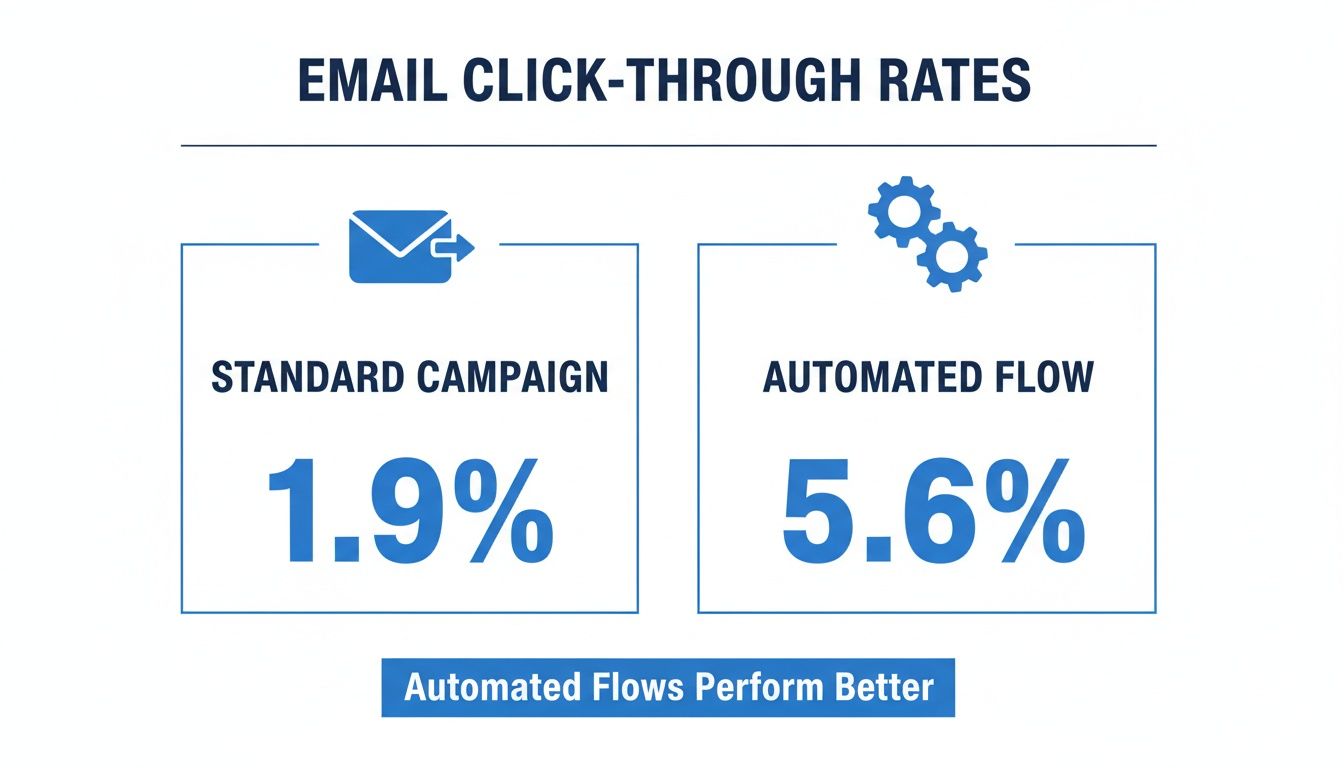
The data is clear: automated flows aren't just a small improvement. They deliver nearly 3x the engagement of standard campaigns, making them the perfect place to start boosting your CTR.
Quick Wins with Automation
Automated flows work because they meet subscribers at the perfect moment with a message that's directly relevant to their behavior. Instead of guessing what your audience wants, you're responding to their actions in real-time.
By automating your outreach, you put the right message in front of an engaged, ideal audience from the very first interaction. This is how you turn a simple newsletter into a reliable lead generation machine.
Here are a few quick wins to get you started on the right foot.
Quick Wins to Boost Your Email CTR
This table breaks down some of the most impactful strategies you can implement right away to start seeing better click-through rates.
Strategy
Expected Impact
Best For
Welcome Series
High
Every business with new subscribers. It's your best chance to make a strong first impression.
Re-engagement Drip
Medium-High
Cleaning your list and winning back subscribers who have gone cold (inactive for 60-90 days).
Cart Abandonment Flow
Very High
E-commerce or SaaS businesses where users add items to a cart or start a checkout process.
Post-Purchase Follow-up
High
Businesses looking to increase customer loyalty, gather reviews, or upsell related products.
Focusing on these automations gives you the biggest bang for your buck and sets a solid foundation for more advanced tactics later on.
Two of the easiest and most effective flows to set up are the welcome series and the re-engagement drip.
- The Welcome Series: This is typically a sequence of 3-5 emails sent to new subscribers. It’s your best opportunity to introduce your brand, set expectations, and drive an initial action while their engagement is at its peak.
- The Re-engagement Drip: This automated flow targets subscribers who haven't opened or clicked an email in 60-90 days. It gives you one last chance to win them back with a compelling offer or, failing that, to clean your list and improve your overall deliverability.
Crafting Subject Lines That Demand a Click
Let's be honest—your subject line is the only thing standing between your email and the trash folder. No matter how incredible your content is, a weak subject line means it’s dead on arrival. If you want to boost your click-through rates, you have to win the open first. That starts with a subject line that’s impossible to ignore.
Forget the generic, one-size-fits-all advice you've read a thousand times. The psychological triggers for B2B are different. A subject line for a product-led growth (PLG) company needs a different vibe than one for a high-touch enterprise sales lead. The real key is matching your tone and offer to what your specific audience segment actually cares about.
For instance, a PLG user will likely click on a benefit-driven subject line that teases a cool new feature. An enterprise prospect? They're more interested in something that speaks to a specific business pain point or a clear ROI metric.
Go Beyond the Open with Preview Text
Your preview text is your subject line's crucial wingman. It's that little snippet of text you see right after the subject line in most email clients. If you're still wasting that space with "View this email in your browser," you're leaving clicks on the table.
Instead, use it to expand on the subject line's promise. Think of it as a one-two punch. The subject line grabs their attention, and the preview text creates a little bit of mystery or deepens the intrigue, making a click almost a reflex.
Your subject line and preview text should work together to tell a micro-story. The subject line is the hook; the preview text delivers the cliffhanger that makes people need to know what happens next.
Here’s what that looks like in action:
- Subject: New Report: The State of B2B Lead Gen
- Preview Text: We analyzed 50,000 campaigns. The #1 mistake marketers are making might surprise you…
This combo piques curiosity and gives them a very specific reason to open the email—they want to find out what that mistake is. Just as subject lines are vital for emails, crafting powerful headlines and descriptions for digital ads is key to grabbing attention and driving clicks across every channel you use.
Formulas That Drive Clicks in B2B
While creativity is great, you don't always have to reinvent the wheel. Proven formulas give you a reliable foundation to build on. Here are a few structures I’ve seen work consistently for B2B audiences that you can adapt for your own campaigns.
1. The "Problem and Agitate" Formula
This one works wonders for consulting or solution-focused services. You name a common pain point and then twist the knife just a little to show you get it.
- Example: Your Q4 pipeline looking a little thin? Here’s how to fix it.
2. The "Social Proof" Formula
Nothing builds credibility faster than letting your customers or data do the talking for you. This is a go-to for case study promotions or established brands.
- Example: See how [Competitor] increased their demo requests by 40%
3. The "Direct and Urgent" Formula
Use this for time-sensitive offers, webinar registrations, or event announcements. The goal is to create genuine urgency without sounding spammy. Deadlines and numbers are your best friends here.
- Example: Only 24 hours left to register for our marketing automation workshop
For a deeper dive, our dedicated guide covers more on email subject line best practices. When you use these frameworks correctly, you’ll see your open rates climb, giving your amazing content a real shot at earning that click. The goal is to be so specific, relevant, and intriguing that your subscriber feels like they’ll miss out if they don't open your email right now.
Driving Clicks With Smart Segmentation and Personalization

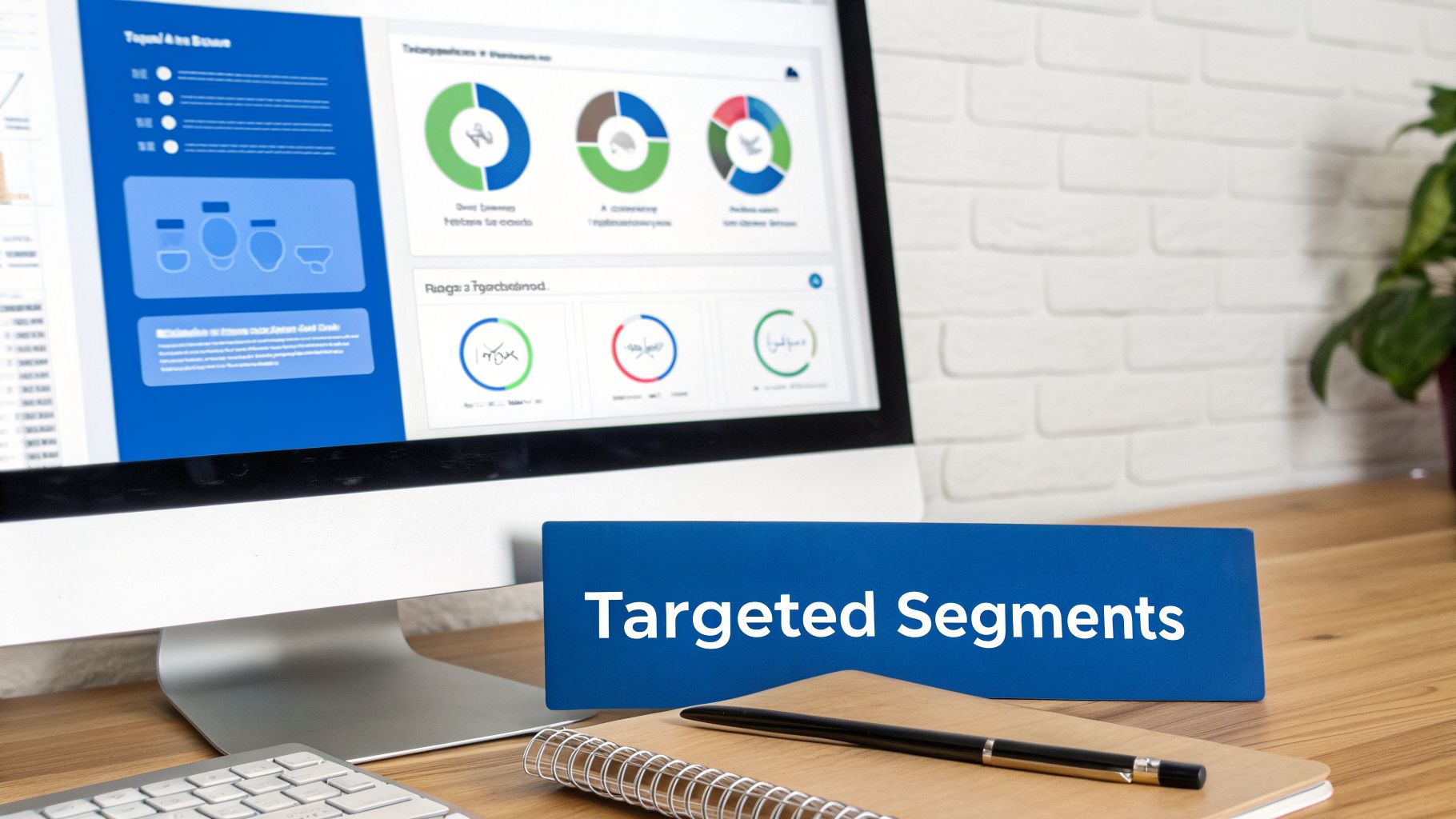
Sending the same generic email to your entire list is a guaranteed way to kill your click-through rate. In B2B marketing, relevance is everything. If you want to see your CTR climb, you have to stop broadcasting and start narrowcasting with smart segmentation and personalization.
It’s all about delivering the right message to the right person at just the right time.
True personalization goes way beyond just slotting a {{first_name}} tag into your greeting. It’s about tailoring the whole experience—from the subject line to the final call-to-action—based on who your subscribers are and what they’ve done. This is how you make your audience feel seen and understood, which is the first step to earning their click.
Go Beyond Basic Demographics
Segmenting by industry, company size, or job title is a solid starting point, but the real magic happens when you layer in behavioral data. Behavioral segmentation is all about grouping subscribers based on their actions, or even their inactions. This data tells you exactly what they care about, making your content dramatically more relevant.
Think about it: an email about "advanced analytics features" is going to land much better with a segment of power users who have logged into your product 10+ times this month than with brand-new subscribers. This approach lets you create highly specific micro-segments that line up perfectly with each stage of the buyer journey.
Here are a few powerful behavioral segments you can build:
- Most Engaged Users: Subscribers who consistently open and click your emails. Send them your best content, new feature announcements, or early access offers.
- Website Visitors: People who have visited specific pages, like your pricing or case study sections. You can target them with content that speaks directly to their demonstrated interest.
- Inactive Subscribers: Users who haven't opened an email in 90 days. Isolate them for a re-engagement campaign to win them back or remove them to keep your list clean.
- Feature Adopters: Users who have started using a specific feature in your product. Send them tips, best practices, or case studies related to that feature to drive deeper adoption.
By creating these smaller, more focused groups, you can ensure the content and CTAs you send are a perfect match. For a complete playbook on this, check out our in-depth guide to B2B audience segmentation strategies.
Tailor Content for High-Value Industries
Another powerful way to boost your CTR is to customize content for specific industries. The needs and language of an IT director are completely different from those of a marketing manager. When your email speaks their language and addresses their unique pain points, your CTR will naturally follow.
This isn't just a theory; the data backs it up. For instance, recent industry benchmarks show that B2B sectors with highly specific needs respond strongly to targeted content. In 2026, the IT and Software Services industry showed a robust 4.43% CTR, far outpacing the 2.86% seen in general ecommerce. The Advertising and Marketing sector followed with a healthy 3.29% CTR, proving that hyper-relevant content wins. You can explore more about these industry email marketing benchmarks on Designmodo.com.
Don't just send a generic case study. Send an IT-focused case study to your IT segment and a marketing-focused one to your marketing segment. The small effort of swapping out a link and a headline can lead to a significant lift in engagement.
Practical Personalization in Action
Let’s imagine you're a SaaS company with a new project management feature. Instead of a single blast to everyone, you could create two distinct segments.
Segment 1: "Power Users"
- Who they are: Subscribers who have logged in 5+ times in the last week.
- Personalized Angle: Focus on efficiency and advanced capabilities.
- Subject: A better way to manage your team's projects
- CTA: "Explore the New Feature"
Segment 2: "Trial Users"
- Who they are: Subscribers who signed up for a trial in the last 14 days but haven't used the core project management tools.
- Personalized Angle: Focus on education and getting started.
- Subject: New to [Your Company]? Start your first project in 5 minutes.
- CTA: "Watch the Quickstart Video"
By splitting your audience this way, you're not just sending an email; you're providing a solution tailored to each user's context. This level of relevance is what turns a passive subscriber into an active clicker and, eventually, a loyal customer.
Designing Calls to Action That Get Clicked
You've personalized your email and crafted compelling content for the right audience. Now for the final, crucial step: guiding them to click. This is where your call-to-action (CTA) either makes or breaks your entire effort.
A weak or confusing CTA can stop even the most interested subscriber in their tracks. It’s the last hurdle between your reader’s intent and a valuable conversion, and getting it wrong means you lose them at the very last second. Crafting a CTA that gets clicked is a mix of art and science, blending sharp copy, smart design, and strategic placement.
Write Copy That Inspires Action
The words on your CTA button matter far more than you think. Vague, passive phrases like "Learn More" or "Click Here" are dead weight. Your subscribers are busy; they need to know exactly what they’ll get when they click. Your CTA copy needs to be a clear, concise promise of value.
Think in terms of action and outcome. Instead of a generic verb, use one that paints a picture of the result. This small shift reframes the click not as a chore, but as a benefit waiting to be claimed.
For instance, look at the difference:
- Weak: Learn More
- Strong: Get the Free Report
- Weak: Submit
- Strong: Start My Free Trial
The stronger versions are specific, benefit-driven, and create a sense of ownership. They instantly answer the reader's unspoken question: "What's in it for me?"
Use Design to Create a Clear Visual Path
Your CTA has one job: to stand out. If it blends in with the rest of your email, it will get ignored. This is a real phenomenon known as "CTA blindness," where a reader's eye scans right over the button because it doesn't command attention.
You can fight this with a few smart design choices.
Color and Contrast
There’s no single "best" color for conversions. The most effective color is simply one that contrasts sharply with your email’s background and surrounding text. If your email has a white background and blue text, a bright orange or green button will pop. The goal is to make the button impossible to miss.
Size and Shape
Your CTA button should be large enough to be easily tapped on mobile devices without feeling obnoxious. A clean rectangle with slightly rounded corners is a classic, effective choice—it feels familiar and instantly clickable to most users.
A great CTA doesn't just ask for a click; it directs the reader's gaze and makes the desired action feel like the most natural next step. Create a visual hierarchy that leads the eye directly to the button.
Strategically Place Your CTAs
Where you put your CTA is just as important as what it looks like. The old advice was to always place it "above the fold," but the reality is more nuanced. The best placement actually depends on how complex your offer is.
Here’s a simple framework I follow:
- For Simple, Low-Commitment Actions: If you have a straightforward ask (like "Read the Blog Post"), placing a prominent CTA near the top works great. The reader already gets the value proposition and doesn't need much convincing.
- For Complex, High-Commitment Actions: If you're asking for something bigger (like "Request a Demo" or "Buy Now"), you need to build your case first. Present your value, handle potential objections, and then place the CTA after you've given them enough information to justify the click. In these emails, a CTA near the bottom is often far more effective.
Don't be afraid to use a mix of button CTAs and simple text links. A big, bold button can be your primary CTA, while text links can handle secondary actions, like linking to your social media or a related article. This creates a clear hierarchy and prevents your email from feeling like a wall of competing links—a key part of how to improve click through rates in any campaign.
Using A/B Testing to Systematically Improve Your CTR
Guesswork has no place in a serious marketing strategy. If you want to truly improve your CTR, you have to stop assuming you know what your audience wants and start collecting hard data. This is where A/B testing, or split testing, becomes your most powerful tool.
The idea is simple: pit two versions of an email element against each other to see which one performs better. By systematically testing parts of your emails, you can rack up small wins that compound into massive improvements over time. This approach turns your email program into an optimization engine, where every send gives you the data to make the next one even better.
What Should You Test to Improve Your CTR?
The testing possibilities are nearly endless, but you need to be strategic. Start with the elements that have the most direct impact on clicks. Focus your energy on these high-leverage variables first, and once you’ve optimized the major components, you can move on to more subtle tweaks.
Here are the most critical variables to test:
- Subject Lines: Test different emotional triggers, lengths, or formats. For example, does a question outperform a direct statement?
- CTA Copy: Compare action-oriented phrases. Does "Get the Guide" get more clicks than "Download Now"? The only way to know for sure is to test.
- CTA Design: Pit a bright, high-contrast button against a more subdued one. Or test a button against a simple text link.
- Content Format: Does a long-form, educational email get more action than a short, punchy one with a single link?
- Send Time & Day: Test sending your newsletter on Tuesday morning versus Thursday afternoon to find your audience's engagement sweet spot.
Remember, the key is to isolate a single variable in each test. This allows you to confidently attribute any change in performance to that specific element. For more practical guidance, check out our detailed overview of A/B testing email campaigns for higher engagement.
Building a Rigorous Testing Framework
A successful A/B test is more than just sending two different emails. It requires a structured approach to ensure your results are reliable and not just a product of random chance. A flimsy testing process will give you faulty data and lead you to make the wrong decisions.
To run a test you can actually trust, follow these core principles.
- Isolate One Variable: This is the golden rule. If you test a new subject line and a new CTA in the same email, you'll have no idea which change was responsible for the results. Test one thing at a time.
- Use a Sufficient Sample Size: Testing on a tiny segment of your list can lead to statistically insignificant results. You need enough subscribers in each test group to smooth out random fluctuations and get a reliable outcome.
- Define Your Success Metric: Before you launch the test, decide what you're measuring. For CTR, your primary metric is obviously clicks, but you might also track secondary metrics like click-to-open rate (CTOR).
- Run the Test Long Enough: Let the test run until you have a clear winner or until you've reached statistical significance—typically a 95% confidence level. Most email platforms will calculate this for you, so let the machine do the heavy lifting.
A/B testing is not about finding a single "perfect" formula. It's about building a continuous loop of hypothesizing, testing, learning, and iterating. Each test, whether it wins or loses, provides a valuable insight into your audience's preferences.
Moving Beyond Clicks to Business Impact
Improving your click-through rate is a fantastic goal, but let's be honest, it's a means to an end. The real objective is to drive business outcomes like demo requests, trial sign-ups, or sales.
For example, a test might show that a subject line with a sense of urgency gets a 15% higher CTR. That’s a great win. But the next question you have to ask is whether that increase in clicks led to a corresponding increase in conversions on your landing page. Sometimes, a "clickbait" style CTA might boost clicks but attract a less qualified audience that doesn't convert.
By tracking the entire funnel from open to conversion, you ensure your optimization efforts are not just boosting vanity metrics but are actually contributing to revenue. This is how you transform your newsletter from a simple communication channel into a predictable engine for business growth.
Protecting Your CTR With Strong Deliverability
You can craft the perfect subject line, personalize every sentence, and design a brilliant call-to-action. But if your email lands in the spam folder, none of it matters.
You can’t get a click if your audience never sees the message. That's why deliverability is the unsung hero of a great click-through rate. It's the technical foundation all your creative work is built on.
Good deliverability signals to Internet Service Providers (ISPs) like Gmail and Outlook that your emails are legitimate and wanted. When it’s poor, they start diverting your messages straight to spam. Think of it as your sender reputation—every email you send is graded, and a bad score can take months of hard work to repair.
Maintain a Healthy and Engaged List
The single most critical factor for good deliverability is a clean, engaged email list. Blasting emails to a list full of inactive, invalid, or unengaged addresses is a massive red flag for ISPs. It makes you look like a spammer, and that’s a quick way to get your domain blacklisted.
Regular list hygiene is the answer. This isn't a one-and-done task; it’s an ongoing process.
- Remove Inactive Subscribers: If someone hasn't opened or clicked an email in 90-120 days, it’s time to say goodbye. Run a re-engagement campaign to give them one last chance to stay, but if they don't respond, remove them. A smaller, engaged list will always outperform a large, inactive one.
- Validate New Subscribers: Use a double opt-in process or an email validation service like the one built into Breaker to ensure new subscribers are giving you real, typo-free email addresses. This stops bad data from poisoning your list from the start.
This consistent cleanup keeps your list healthy and proves to email providers that your content is actually wanted.
A clean email list is your first line of defense against the spam folder. It proves to ISPs that you’re sending content people actually want to receive, which directly protects your ability to get clicks.
Implement Technical Authentication Protocols
Beyond keeping your list clean, there are some technical setups that work behind the scenes to prove you are who you say you are. These authentication protocols are like a digital passport for your emails.
Without them, you’re an anonymous sender, and receiving servers have no reason to trust you. That’s an easy way to get flagged as suspicious.
There are three key protocols you absolutely need to have in place:
- SPF (Sender Policy Framework): This is a simple record that lists which mail servers are approved to send email on behalf of your domain.
- DKIM (DomainKeys Identified Mail): This adds a digital signature to your emails. When the email arrives, the receiving server can check this signature to make sure the message wasn't altered in transit.
- DMARC (Domain-based Message Authentication, Reporting & Conformance): This protocol builds on SPF and DKIM. It tells servers what to do with emails that fail those checks—like rejecting them outright or sending them to spam.
These might sound overly technical, but most modern email platforms manage the heavy lifting for you. Your job is to just make sure they are configured correctly for your domain. Taking these steps ensures your carefully crafted emails actually land where they can be seen and clicked.
Common CTR Questions, Answered
Even with the best playbook, you’re bound to run into questions when you start digging into your click-through rates. Here are some of the most common ones I hear from B2B marketers, with straightforward answers to get you on the right track.
What Is a Good Click-Through Rate for B2B Email?
This is the million-dollar question, and the honest answer is: it depends. While you’ll see industry benchmarks floating around 2-3%, that’s just a baseline. A "good" CTR is really a moving target based on your specific industry and how well you know your audience.
For a well-segmented B2B list, especially in a technical field like software or IT services, hitting 4-5% is a solid, achievable goal. That's a sign you're delivering relevant content.
Of course, the top performers—the ones using hyper-personalization and smart automation—can push those numbers to 8% or even higher.
The only benchmark that truly matters is your own. Stop chasing abstract industry averages and focus on beating your last send. A consistently rising CTR is the clearest sign of a healthy, effective email program.
How Often Should I A/B Test My Emails?
Think of A/B testing as a constant, low-level hum in your email marketing engine. It shouldn't be a massive, one-off project. A great rhythm is to test one key variable with each major campaign or new automated email you build.
For instance, you could test your subject line this week. Next week? Pit two different CTA button designs against each other. This methodical approach, even on a small scale, compounds over time. You’ll build a library of real-world insights that lead to major, sustainable gains in your click-through rate.
Will Focusing on CTR Hurt My Other Email Metrics?
Absolutely not. In fact, it almost always lifts everything else up with it. The strategies that drive clicks—better personalization, more valuable content, and crystal-clear calls to action—are the exact same things that create an engaging, high-quality email experience.
When subscribers learn to trust that your emails deliver value, your open rates naturally climb. Because you’re sending more relevant messages, your unsubscribe rates will drop. A high CTR isn't an isolated metric; it's a powerful signal that your entire email strategy is working.
Ready to stop guessing and start growing? Breaker combines powerful email sending with automatic list expansion to turn your B2B newsletter into a reliable lead generation engine. Find your next 100 engaged subscribers with a free 7-day trial.
Keep reading
All articlesBreaker for B2B, SME and Consumer Newsletter Senders
Learn how B2B, SME, and consumer audiences differ in newsletters, plus a framework for segmenting, messaging, and monetizing each without losing relevance.
What Is a B2B Content Engine
Learn what a B2B content engine is, how it differs from a content calendar or strategy, and why it's essential for AI-driven search in 2026.
8 Best Email Tracking Software Tools in 2026
Compare 8 top email tracking tools for 2026, how tracking pixels work, and why Apple's privacy rules make open rates unreliable. See our top pick.