
How to Get Emails A Modern B2B Growth Guide
Learn how to get emails for B2B growth. This guide covers targeting, lead magnets, conversion tactics, and scalable list-building strategies for 2026.
To really succeed at getting emails, you need to start with two things: defining your ideal customer and then creating a valuable resource they’ll gladly trade their email for. This is the foundation. It’s what ensures you attract high-quality subscribers who are actually interested in what you do, rather than just a list of random contacts.
Build Your Foundation for B2B Email Acquisition
Before you even think about the tactics for getting emails, you have to lay the proper groundwork. Just throwing a "subscribe to our newsletter" form on your website is a fast track to a low-quality, disengaged list.
Real email acquisition, especially in B2B, is about attracting the right people, not just any people. Getting this initial strategy right is what separates a thriving email list that actually drives revenue from a dead-end database that just sits there.
The whole process comes down to three key steps: defining your audience, understanding their journey, and making them an offer they can't refuse.
This simple visual breaks down the foundational flow for successful email acquisition.
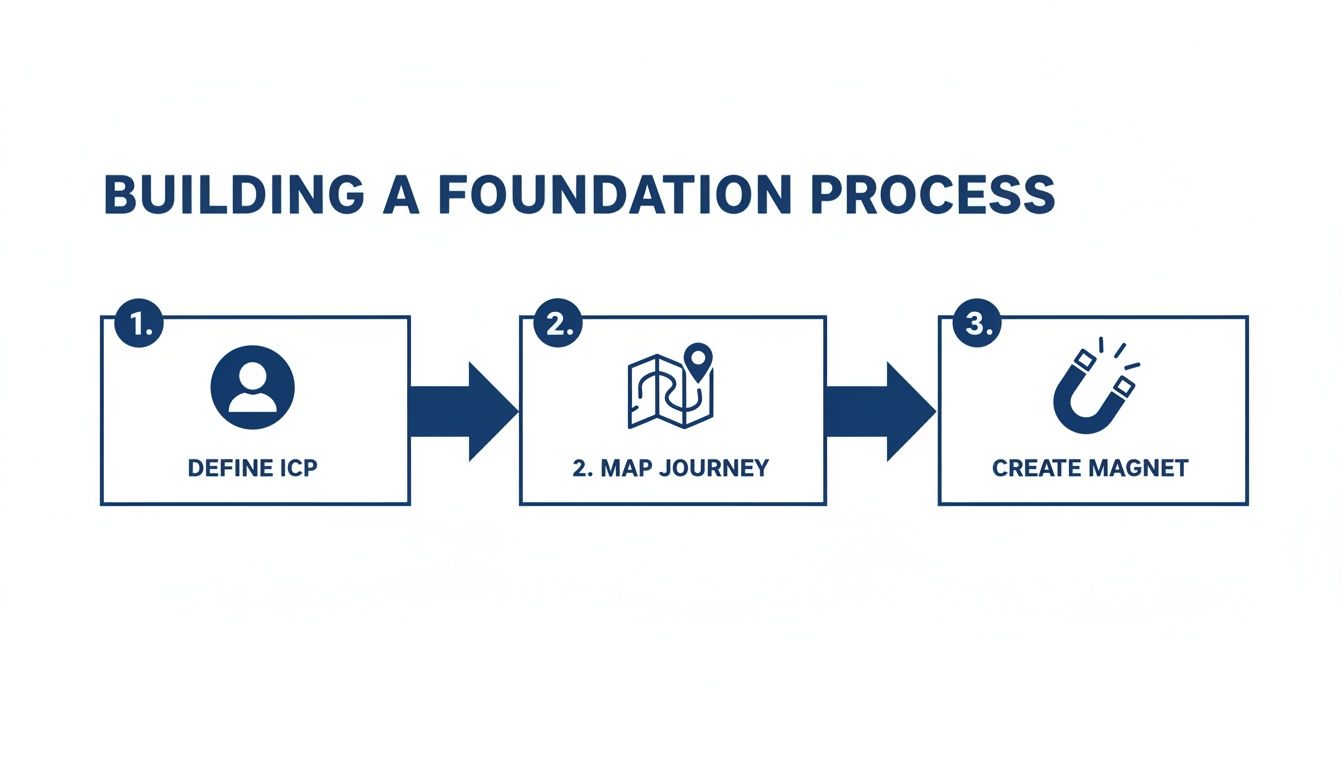
As you can see, it all begins with the customer. From there, you map their experience and create a value exchange—that’s the secret to building a list of people who want to hear from you.
Define Your Ideal Customer Profile
An Ideal Customer Profile (ICP) is so much more than just a list of job titles and company sizes. A truly effective ICP gets into the psychology of your target audience. You need to know their daily frustrations, their professional ambitions, and the specific problems keeping them up at night.
For instance, instead of targeting a generic "Marketing Manager at a SaaS company," a sharp ICP looks more like this: "Sarah, a Marketing Manager at a Series B SaaS startup with 50-200 employees. She's struggling to prove marketing ROI to her CEO and is desperate for efficient, scalable lead gen tactics that don't need a huge team." See the difference?
Key Takeaway: Your ICP should feel like a real person. When you know your target audience that well, you can create content and offers that hit on their most urgent needs, making the decision to hand over their email a no-brainer.
Map the Customer Journey
Once you know who you're talking to, you need to figure out when and where to pop up on their radar. Mapping the customer journey means outlining the typical path a prospect takes, from having no idea who you are to becoming a loyal customer.
This journey usually has a few key stages:
- Awareness: The prospect first realizes they have a problem. They’re probably searching for high-level info, like "how to improve lead quality."
- Consideration: Now they're actively researching solutions. Their searches get more specific, like "best lead magnet ideas for B2B."
- Decision: The prospect is ready to make a call. They are comparing vendors and looking for proof, like case studies or demos.
Understanding this path lets you place your email opt-in forms at the moments of highest intent. Someone in the awareness stage might jump on a simple checklist, while a person in the decision stage is going to want a deep-dive case study.
Create a High-Impact Lead Magnet
A lead magnet is that specific, valuable thing you offer in exchange for an email address. Let's be honest, people read blogs and engage with brands to learn something. Your lead magnet has to deliver on that promise by helping them solve a real problem or get something done.
This is why generic offers like "subscribe to our newsletter" have abysmal conversion rates—the value is totally unclear. A great lead magnet is specific, actionable, and gives the user an immediate win.
Here are a few high-performing B2B examples I've seen work time and again:
- The Checklist: A "10-Point Pre-Webinar Launch Checklist" for an overworked event marketer.
- The Template: A "Quarterly Marketing Budget Template" for a marketing manager struggling with planning.
- The Mini-Course: A "3-Day Email Course on Cold Outreach" for a sales rep trying to hit quota.
Each of these examples targets a specific person with a precise solution. The more you tailor your lead magnet to your ICP's pain points, the more emails you'll get from the people who matter. This foundational work is what makes every other acquisition tactic you try actually stick.
Design Opt-In Experiences That Actually Convert

Your website is prime real estate for growing your email list. But let's be honest, that tiny "subscribe" link hiding in your footer isn't going to cut it. It’s the digital equivalent of whispering your sales pitch in a packed stadium.
To actually get visitors to hand over their email, you need to create opt-in experiences that are both impossible to miss and genuinely valuable. This isn't about passive collection; it's about actively designing moments where sharing an email feels like the most natural next step for your visitor.
Strategic Placement Is Everything
Where you ask for an email is just as critical as what you’re offering. Placing the right form in the right place at the right time is the secret to boosting conversions without annoying your visitors.
Different form types serve different purposes, and you need a mix of them in your arsenal.
- Embedded Forms: These are your workhorses, living directly inside your content. Think of a form at the end of a blog post or on a resources page. They work because they catch people at their peak interest, right after they’ve consumed relevant content.
- Pop-Ups: I know, I know. But when done right, timed or exit-intent pop-ups are incredibly effective. A well-placed pop-up offering a guide on "increasing marketing ROI" on a relevant post can hit conversion rates of 5-10%. Why? It's a direct solution to a problem the reader is thinking about right now.
- Slide-Ins: These are the friendlier cousins of pop-ups. A form that slides in after a user scrolls 60% down a page is a great way to target your most engaged readers without interrupting their flow. They’re already invested in what you have to say.
- Header or Footer Bars: Think of these as persistent but polite reminders. They’re perfect for site-wide offers like a webinar registration or a general newsletter sign-up because they don't get in the way.
The trick is to match the form’s assertiveness with the visitor's engagement. A first-time visitor might only tolerate a subtle footer bar, but someone who’s devoured three of your articles is likely ready for a more direct, targeted offer.
The Anatomy of a High-Converting B2B Landing Page
For your most valuable lead magnets, you need to roll out the red carpet with a dedicated landing page. This is a distraction-free zone with one single, solitary goal: getting that email address.
A great B2B landing page isn't about flashy design. It’s about clarity, persuasion, and making the decision to sign up a no-brainer.
A landing page for a B2B audience should function like a great sales pitch. It needs to quickly identify a pain point, present a clear solution, and make the next step incredibly easy. The less friction, the higher the conversion.
Let’s imagine a landing page for a "B2B Sales Template." Here’s what makes it work:
- A Killer Headline: Forget "Download Our Template." Go for "Close More Deals This Quarter with Our Proven Sales Template." It’s sharp, benefit-driven, and speaks directly to what your prospect wants.
- Scannable Copy: No one reads walls of text. Use bullet points to spell out the value. "What's inside: a plug-and-play email sequence, a deal-tracking dashboard, and a script for handling objections." This makes the value tangible.
- Rock-Solid Social Proof: A testimonial or a few logos go a long way. Seeing "Used by sales teams at Stripe & Asana" is an instant credibility booster that melts away hesitation.
- A Brutally Simple Form: Ask only for what you absolutely need—usually just a work email. Every extra field is a conversion killer. In fact, research shows that cutting form fields from four to three can boost conversions by 50%.
- A Compelling Call-to-Action (CTA): The button copy should reinforce the value. Ditch "Submit" for something like "Get the Template Now" or "Unlock My Free Resource."
Focusing every single element on that one action is how you guide visitors exactly where you want them to go. If you want more inspiration, our guide on crafting compelling lead magnet examples is packed with ideas you can put into action today.
To help you decide what to offer, consider how different lead magnets perform with different audiences.
Lead Magnet Effectiveness by B2B Audience
Choosing the right type of lead magnet is crucial. A template might be perfect for a hands-on manager, while a CEO might only have time for a high-level report. This table breaks down what tends to work best for various B2B roles.
Lead Magnet Type
Target Audience
Typical Conversion Rate
Best For
Templates & Checklists
Managers, Practitioners
15-25%
Providing practical, immediate-use tools.
Webinars & Workshops
Directors, VPs
10-20%
Demonstrating expertise on complex topics.
Industry Reports & Data
C-Suite, Strategists
8-15%
Establishing authority with original research.
Case Studies
Decision-Makers
5-12%
Proving ROI and real-world application.
Free Tools & Calculators
Technical Users
20-30%+
Delivering interactive value and solving a specific problem.
As you can see, the more interactive and immediately useful the asset, the higher the conversion rate tends to be. However, a lower-converting but highly-targeted asset like an industry report might attract more senior-level leads. It's all about matching the offer to the audience.
A/B Test Your Way to the Top
Look, designing your opt-in experience is not a "set it and forget it" task. The best marketers I know are constantly tinkering, testing, and refining. A/B testing is how you move from guesswork to data-driven decisions.
You don't have to overcomplicate it. Start with simple tests that can have a big impact:
- Test Your Headline: Pit a benefit-driven headline ("Generate More Leads") against a pain-point-focused one ("Struggling to Find Leads?").
- Test Your CTA Button: See what happens when you change the color (e.g., green vs. orange) or the text ("Download Now" vs. "Send Me the Guide").
- Test Your Form: What happens if you remove the "First Name" field and only ask for an email?
Even tiny wins add up. A 1% improvement in your opt-in rate across your entire website can translate into thousands of new, qualified emails over a year. That’s how you build a powerful, predictable growth engine.
Find Quality Emails Through Strategic Channels
Your website is now a conversion machine. The next step is to open the floodgates and drive the right kind of traffic to it. After all, the world’s best lead magnet is useless if your Ideal Customer Profile (ICP) never sees it.
The goal is to figure out where your ideal subscribers spend their time online and meet them there.
This calls for a blended approach. You need a strong organic game to attract subscribers over time and a smart paid strategy to get qualified leads on demand. The real magic happens when you weave these channels together into a predictable flow of high-quality emails.
Attract Subscribers with Organic Channels
Organic channels are all about building assets that pull in your ICP for the long haul. This isn't about quick wins; it's about cementing your brand as a trusted authority. When you consistently deliver value, people start seeking you out.
SEO-driven content is your workhorse here. People read blog posts to learn, and your content should be a masterclass in solving their problems. Create articles, guides, and resources that directly answer the questions your ICP is typing into Google.
Another powerful organic play is guest posting on respected industry blogs. Find the publications your target audience already reads and trusts. A high-value article not only puts your brand in front of a new, relevant audience but also lets you link back to your own landing pages.
Here are a few organic tactics that just plain work:
- SEO-Driven Content: Publish in-depth articles targeting keywords your ICP uses. A post like "How to Reduce Customer Churn for B2B SaaS" will attract exactly the right kind of reader.
- Guest Blogging: Write for established blogs in your niche. A single, well-placed guest post can drive hundreds of qualified subscribers if the content is top-notch and your lead magnet is a perfect fit.
- Community Engagement: Become a fixture in relevant online communities—think Reddit, industry forums, or Slack groups. Answer questions, offer advice, and become a genuinely helpful resource. People will naturally want to learn more about you.
Personal Insight: My LinkedIn profile has become one of my most effective tools for getting emails. I consistently share actionable tips, behind-the-scenes insights, and short-form content that solves a specific pain point for my target audience. This builds trust and authority, making it a natural next step for followers to subscribe to my newsletter for more in-depth content.
This strategy of consistently offering value in public is a slow burn, but it builds a loyal, engaged following that’s far more likely to convert.
Accelerate Growth with Paid Acquisition
While organic channels build long-term momentum, paid channels give you immediate, scalable results. When you need to hit a growth target or test a new offer quickly, paid acquisition is your best friend. The trick is to be hyper-targeted to avoid burning cash on irrelevant clicks.
Building an email list isn't just a good idea; it's essential. Research shows a staggering 89% of marketers say email is their top channel for lead generation, with four out of five choosing it over social media. With nearly half of the world's 4.73 billion email users checking their inbox daily, it’s prime real estate for any B2B brand. Industry research from sources like emailchef.com continually confirms its power. For Breaker users, this just underscores the need to use targeted acquisition to tap into this channel.
LinkedIn Ads are a B2B marketer's dream come true. The platform’s targeting is second to none, letting you zero in on prospects by job title, company size, industry, and even specific skills. Running an ad campaign that promotes a high-value webinar or a data-rich report to a curated audience is a surefire way to get quality emails.
Sponsoring relevant newsletters is another incredibly effective paid tactic. Find newsletters that your ICP already reads and loves. A sponsorship places your offer directly in front of an engaged, pre-qualified audience that already trusts the creator. It’s like getting a warm introduction at scale. You can also explore our detailed guide on modern email list building strategies for more ideas.
Finally, don't sleep on collaborative webinars. Partner with a complementary, non-competing brand that serves a similar audience. You both promote the webinar to your respective lists, effectively doubling your reach. At the end of the event, you can share the list of registrants (with their permission, of course), which means a significant influx of highly relevant contacts for both of you.
Automate and Scale Your List Growth
Relying on organic content and one-off paid campaigns is a great way to build a quality foundation for your email list. But let’s be honest—if you have ambitious growth targets, those methods alone won’t get you there fast enough. To truly scale and build a predictable pipeline, you need to put your list growth on autopilot.
This is where you move past the manual grind and start using automation. Today’s platforms offer a way to get emails at scale without sacrificing quality, using a performance-based model that feels completely different from just buying a cold, static list.
Go Beyond Manual Acquisition
When you rely solely on your website traffic or social media reach, you’re creating a natural ceiling for growth. You’re limited to the people who happen to stumble upon your brand. Automation shatters that ceiling by proactively finding your Ideal Customer Profile (ICP) across the web and adding them directly to your audience.
This isn't about scraping random contact details from the internet. It’s a sophisticated, compliant process that combines custom targeting, data enrichment, and proprietary signals to pinpoint individuals who are genuinely interested in what you have to say.
Think of it as the difference between fishing with a single line and using a smart, targeted net. Instead of waiting for one fish to bite, you're systematically capturing exactly the right kind of prospects from a vast ocean of possibilities.
This shift to automation is a game-changer for B2B teams. It turns list growth from a variable, often unpredictable activity into a consistent, measurable part of your marketing engine that fuels the sales pipeline without adding manual work for your team.
How Automated List Growth Works
So, how do platforms like Breaker find and add engaged, exact-match subscribers automatically? It all comes down to a multi-layered tech stack built for precision and compliance.
First, you define your ICP with incredible detail—job titles, industries, company size, even specific technologies they use. This sets the guardrails for who the system should find.
Next, an AI-powered engine scans a massive database of professional profiles and online behaviors, enriching basic data with intent signals. It identifies individuals actively researching topics related to your business, flagging them as high-interest prospects.
Finally, using its own data sets, the platform matches these high-intent individuals to verified email addresses. Every single contact goes through rigorous data hygiene and compliance checks to ensure they are valid, engaged, and have opted into third-party communications.
Here’s a look at how a targeting engine’s interface lets you dial in your exact audience.
This dashboard shows just how specific you can get, making sure every new subscriber is a perfect fit. The result is a performance-based model where you only get subscribers who match your criteria and are actively interested.
The Power of a Targeted, Growing Email List
In a world of cluttered social feeds and unpredictable algorithms, email remains the dependable workhorse for B2B growth. There are a staggering 4.73 billion email users globally, and 89% of marketers rely on it as their number one channel for lead generation. It’s a channel that outpaces social media by 40 times in customer acquisition effectiveness. For more on this, discover the latest insights on email's strategic importance.
This is the ocean that automated list growth taps into. Imagine a product-led growth team launching a newsletter. A platform like Breaker can automatically deliver subscribers who fit their ICP perfectly, fueling the top of the funnel consistently. Our own guide on B2B marketing automation digs deeper into how this directly supports revenue goals.
As you automate and scale, maintaining high deliverability and engagement is more critical than ever. To keep your campaigns effective and compliant as you grow, it’s worth reviewing some email marketing best practices. This approach gives marketing leaders and sales teams the power to achieve predictable subscriber growth, turning your email list into your most valuable marketing asset.
Measure ROI and Keep Your Emails Landing in the Inbox
Getting an email address is just the opening move. The real work starts now, and it boils down to two things that will make or break your long-term success: deliverability and measurement.
Without a solid grip on both, even the most brilliant acquisition strategies will ultimately fizzle out. You’re not just building a list; you’re building a relationship with your new subscriber and their inbox provider (think Gmail and Outlook). At the same time, you have to connect your list growth to real business outcomes. It’s about proving that getting emails directly translates to revenue.
Nail Your Onboarding and Deliverability
The first few emails a new subscriber gets are, by far, the most important. This is your small window to set expectations, deliver on your promise, and signal to inbox providers that your messages are wanted. A strong welcome sequence isn't just nice to have; it's non-negotiable.
This initial series—usually three to five emails sent over the first week—needs to accomplish a few key things:
- Deliver the Goods: Instantly send the lead magnet they just signed up for. Any delay is a red flag and creates a poor first impression.
- Introduce Your Brand: Briefly share your mission and what makes you different. Let them get to know the people behind the brand.
- Set Expectations: Tell them what you'll be sending and how often. Clarity prevents unsubscribes down the road.
- Ask for Engagement: Encourage a reply or ask them to add your email to their contacts. These actions are powerful, positive signals to providers.
This process of "warming up" a new subscriber is crucial for maintaining a high sender reputation and staying out of the dreaded spam folder.
The Discipline of List Hygiene
As your list grows, it will naturally accumulate dead weight. People change jobs, abandon old email addresses, or just lose interest. Regularly cleaning your list—a practice we call list hygiene—is essential for strong deliverability and accurate metrics.
A clean list means higher engagement rates, which tells email providers your content is valuable. On the other hand, a bloated, unengaged list tanks your open rates and signals that your emails might be spam.
Key Takeaway: Don't be afraid to remove unengaged subscribers. A smaller, highly engaged list is far more valuable than a massive list of contacts who never open your emails. It keeps your deliverability high and your costs low.
Consider running a re-engagement campaign for anyone who hasn't opened your last 10 emails. If they still don't bite, it's time to let them go.
Measure What Matters: From Acquisition to Revenue
Open and click-through rates are table stakes. To truly prove the value of your email acquisition efforts, you need to connect the dots directly to business goals. It's not enough to just count subscribers; you have to measure your email acquisition results with a clear tracking stack.
Let's talk ROI. For B2B growth marketers and enterprise sales teams, every dollar counts. In 2026, email marketing continues to deliver an impressive average return of $36 to $45 for every $1 invested. It also drives 4.24% of traffic to purchases, easily beating search at 2.49%.
To track this effectively, you need to look beyond surface-level metrics. The table below outlines the KPIs that truly matter for tying list growth to revenue.
Key Email Acquisition Metrics to Track
Here's a breakdown of the essential metrics for measuring the health and ROI of your email acquisition efforts, from top-of-funnel to bottom-line impact.
Metric
What It Measures
B2B Industry Benchmark
How to Improve It
Lead-to-Customer Rate
The percentage of email subscribers who become paying customers.
1-3%
Refine audience targeting, improve lead magnet quality, and optimize your onboarding sequence.
Cost Per Acquisition (CPA)
The total cost to acquire one new email subscriber from a specific channel.
Varies by channel (e.g., $5-$50+)
A/B test ad creatives and landing pages, focus on organic channels, and optimize form conversion rates.
Attributed Revenue
The amount of revenue directly generated from your email marketing campaigns.
Varies widely by industry
Use UTM parameters, integrate your ESP with your CRM, and track customer journeys from first click to sale.
Subscriber Lifetime Value (LTV)
The average revenue a single subscriber generates over their time on your list.
Varies widely
Increase engagement with valuable content, segment your list for personalized offers, and create loyalty programs.
These are the numbers that demonstrate the true power of your email list. Focus on improving these, and you'll have a clear line of sight from subscriber acquisition to business growth.
Real-time analytics dashboards, like those in platforms such as Breaker, are indispensable here. They let you visualize subscriber growth, track campaign performance, and monitor ROI without spending hours pulling manual reports. This data gives you the power to optimize your strategy on the fly and confidently show stakeholders how getting emails fuels the entire business.
Common Questions on Building Your Email List

Even with a solid plan, you're bound to run into a few common questions as you build out your email list. It happens to everyone.
Here, we'll tackle some of the big ones we hear all the time from B2B growth teams, cutting through the noise to give you practical answers.
What Is a Good Email Acquisition Rate for B2B?
Everyone wants to know the magic number, but the truth is, a "good" rate completely depends on the channel. An embedded form on a blog post might only convert at 1-2%, and that’s perfectly fine. A dedicated landing page for a high-value webinar, on the other hand, should be aiming much higher—think 15-25% or even more.
Instead of chasing a single metric, it's far more productive to benchmark your performance channel by channel and focus on steady improvement.
Here are a few realistic benchmarks to shoot for:
- Website Pop-Ups (Exit-Intent): A well-timed offer can capture 3-7% of departing visitors.
- Dedicated Landing Pages: This is where you should see your best performance. Aim for at least 10%, but know that top-tier pages can easily clear 25%.
- Paid Ad Campaigns: A successful LinkedIn ad campaign promoting a solid lead magnet can hit a form submission rate of 5-10%.
The key is to relentlessly A/B test your headlines, calls-to-action, and form fields. Even a tiny lift in conversion can create massive downstream effects.
Is It Better to Build or Buy an Email List?
Let’s settle this once and for all. In 2026, the answer is crystal clear: always build, never buy.
Buying a list is a relic of a bygone era. It's a dangerous shortcut that will almost certainly backfire, damaging your brand and your ability to even reach an inbox.
Think about it. Those purchased lists are cold, unvetted, and often full of outdated or fake addresses. Sending to them is a fast track to high bounce rates, spam complaints, and a trashed sender reputation. You also run a serious risk of violating privacy laws like GDPR.
Building a list is about earning trust and getting consent. Whether it's through organic content, paid ads, or an automated platform, you're connecting with people who have actually raised their hand and shown interest. It's the only sustainable way to build a list that converts.
And to be clear, modern acquisition platforms aren't "buying lists" in the old-school sense. They use a performance-based model to find and deliver engaged subscribers who perfectly match your ICP and have explicitly opted in. It's consent-based acquisition, not a static list purchase.
How Long Does It Take to Build a Quality Email List?
The timeline for building a great email list hinges entirely on your strategy, your budget, and how consistently you execute. There's no one-size-fits-all answer, but we can look at a few common scenarios.
If you're going all-in on organic content and SEO, be prepared to play the long game. It could easily take 6-12 months to get real traction and see a few hundred new subscribers rolling in each month. It's a slow burn, but it builds an incredibly strong foundation.
Want to speed things up? Adding paid channels like LinkedIn Ads or sponsoring relevant newsletters can pour fuel on the fire. A focused, well-funded campaign can bring in 500-1,000+ quality leads in just a couple of months.
If you need speed and predictability, automated list growth platforms are the most direct route. These services can start delivering hundreds of vetted, on-target subscribers within your first month, letting you scale consistently without all the manual grunt work.
Ultimately, the smartest approach is a blended one. Combine great organic content with targeted paid and automated acquisition for the best mix of speed, quality, and long-term, sustainable growth.
Ready to put your list growth on autopilot? Breaker combines powerful email tools with an automated targeting engine to deliver engaged, exact-match subscribers directly to your list. Start your free trial and get your first 100 subscribers on us.
Keep reading
All articlesPost-Webinar Survey Questions Template (2026)
30+ post-webinar survey questions with NPS, CSAT, and CES templates, plus timing and length tips to boost completion and qualify leads faster.
GDPR Consent Requirements for Purchased Email Lists
Purchased email lists rarely meet GDPR's consent bar. Learn the legal basis rules, PECR overlap, and safer alternatives before you hit send.
7 Email Platforms With Inbox Placement Testing & Suppression
Compare 7 email platforms that combine inbox placement testing with suppression management, scored on features, pricing, and best-fit sender size.