
How to Create Lead Magnets: Drive B2B Growth in 2026
Discover how to create lead magnets that attract high-intent B2B buyers. Our playbook covers ideation, design, distribution & optimization.
You've probably done this already. You picked a useful topic, opened Canva, drafted a polished PDF, added a form to your site, and waited for signups that never really came.
That's the trap with most advice on how to create lead magnets. It treats the asset like the hard part. In B2B, the hard part is choosing a problem sharp enough to attract the right buyer, packaging it so they can use it fast, and getting it in front of people before your organic traffic catches up.
A lead magnet that builds a real newsletter list doesn't just earn downloads. It attracts people with active problems, filters out casual browsers, and gives your follow-up emails a fighting chance. That means being narrower than feels comfortable, simpler than your brand team may want, and more aggressive about distribution than most content marketers are used to.
Find Your High-Impact Lead Magnet Idea
The fastest way to waste time is to start with a broad topic. “Demand generation.” “RevOps.” “Marketing strategy.” Those aren't lead magnet ideas. They're category labels.
High-converting assets usually come from a Problem-Snippet, not a content theme. The job is to isolate one painful micro-problem and solve that, clearly and quickly. In B2B marketing studies, lead magnets with a specific, actionable solution achieved 3.5x higher conversion rates than generic eBooks. That's the benchmark to keep in mind when you're deciding whether your idea is tight enough.

Hunt for an active problem, not an interesting topic
The best lead magnet ideas are already showing up in the language your buyers use every week. Look in places where people expose friction:
- Sales calls: Pull phrases from objection notes, lost deal summaries, and discovery transcripts.
- Customer support: Review repeated “how do I” questions from onboarding and adoption tickets.
- Client delivery work: Consultants and fractional CMOs usually hear the same blocked tasks across accounts.
- Communities: LinkedIn comments, Slack groups, Reddit threads, and niche communities often reveal urgent operational pain.
A good idea sounds like this: “ICP validation checklist for a Series B SaaS team before launching outbound.” A weak one sounds like this: “B2B growth guide.”
Practical rule: If the title could apply to five different job titles and ten different company stages, it's still too broad.
For a fractional CMO, that might mean skipping “go-to-market planning template” and creating “board update slide outline for pipeline recovery after a missed quarter.” The narrower asset feels smaller, but it often attracts the higher-intent subscriber because it maps to a real moment.
Validate before you build
You don't need a giant research project. You need proof that the problem is both painful and recurring.
Use a simple screen:
- Frequency: Have you seen the same problem in multiple conversations or accounts?
- Urgency: Does the problem block revenue, reporting, hiring, or launch execution?
- Specificity: Can you describe the fix in one sentence?
- Speed: Can the reader get value in one sitting?
If you can't explain the benefit in a short CTA, the idea probably isn't ready. The strongest concepts make an immediate promise. Enter your email, get the asset, apply it today.
A useful shortcut is to repurpose themes that already perform in your content. If one post consistently gets qualified traffic, there's a good chance the core insight can become a stronger gated asset. If you need inspiration for the shape those offers can take, this roundup of B2B lead magnet examples is a useful reference point.
Write the idea as an outcome
Don't title the asset by format first. Title it by the buyer's result.
Better naming patterns:
- Checklist to reduce launch mistakes before handoff
- Email templates for stalled deal follow-up
- Question bank for customer discovery calls
- One-page worksheet for newsletter sponsorship pricing
That framing forces clarity. It also prevents a common mistake in how to create lead magnets: building something educational but not usable.
The winning idea usually feels almost too small. That's a good sign. Buyers download assets they can apply, not assets they admire.
Choose a Format That Filters for Quality Leads
Format isn't a design choice. It's a screening mechanism.
A lot of teams choose formats based on what looks impressive in a campaign. But if your real goal is a stronger newsletter list, the format should shape who opts in. Some formats invite curiosity clicks. Others signal that the person downloading has a concrete job to do.
Use format friction on purpose
For enterprise sales, a plain-text Google Doc checklist with a clear, specific problem filters for 3x more qualified leads than a flashy interactive quiz, because quizzes attract more casual browsers and weaker intent. That trade-off matters if sales quality matters more than top-line signup volume.
At the same time, format testing still matters. In a GetResponse study, 27.5% of marketers reported the best results from written lead magnets, while 26.2% reported stronger conversion from video incentives. That near-parity suggests there isn't one universal winner. Matching format to buyer context matters more than chasing a trend, as noted in the GetResponse lead magnet format study.
Here's the practical takeaway. If the buyer is trying to complete a task, use a task-oriented asset. If the buyer needs orientation, education, or buy-in, video or a short workshop can work better.
Lead Magnet Format vs. B2B Goal
Format Type
Primary Goal
Effort to Create
Ideal for Attracting
Plain-text checklist
Lead quality
Low
Buyers with an immediate operational problem
Template
Lead quality and usability
Low to medium
Teams that want to implement something today
Short video walkthrough
Education and trust
Medium
Buyers who need context before action
Webinar or mini-training
Consideration-stage engagement
Medium to high
Stakeholders comparing approaches
Interactive quiz
Lead volume
Medium to high
Early-stage browsers and self-segmenting visitors
Pick the format by buying situation
A checklist works when the subscriber already understands the problem and wants a faster path to execution.
A template works when the subscriber knows what has to be produced but wants help doing it properly. Think outreach copy, planning docs, briefing forms, or scorecards.
A short video works when nuance matters. If the solution requires interpretation, a video can reduce confusion better than a PDF. Just keep it short enough to respect attention.
A webinar fits when multiple stakeholders are involved and the lead magnet has to educate, not just assist.
- Choose plain text when you want fewer but stronger subscribers.
- Choose a template when implementation speed is the value.
- Choose video when demonstration matters more than reference use.
- Avoid flashy interactivity unless broad awareness is the point.
If someone can use the asset inside their normal workflow, the format is probably right. If they have to “experience” it first, you may be optimizing for novelty.
One more filter helps. Ask whether the format creates productive friction. A one-page checklist about a painful B2B task often repels freebie seekers because it only appeals to people with that exact problem. That's a feature, not a limitation.
Produce and Package Your Asset for a Quick Win
Most lead magnets fail before launch because the team overbuilds them. They add extra sections, extra design rounds, and extra “value” until the asset stops feeling immediate.
A foundational rule is simple: the offer should be specific, fast to consume, and easy to gate. Practical guidance on lead magnet design recommends content that can be consumed quickly, often in about 5 to 10 minutes, because compact assets convert better than broad resources, according to this lead magnet design guide.
Repurpose what already works
The cleanest production workflow starts with existing proof. Don't begin from a blank page if you already have a post, Loom, webinar deck, workshop outline, or internal client document that gets repeated attention.
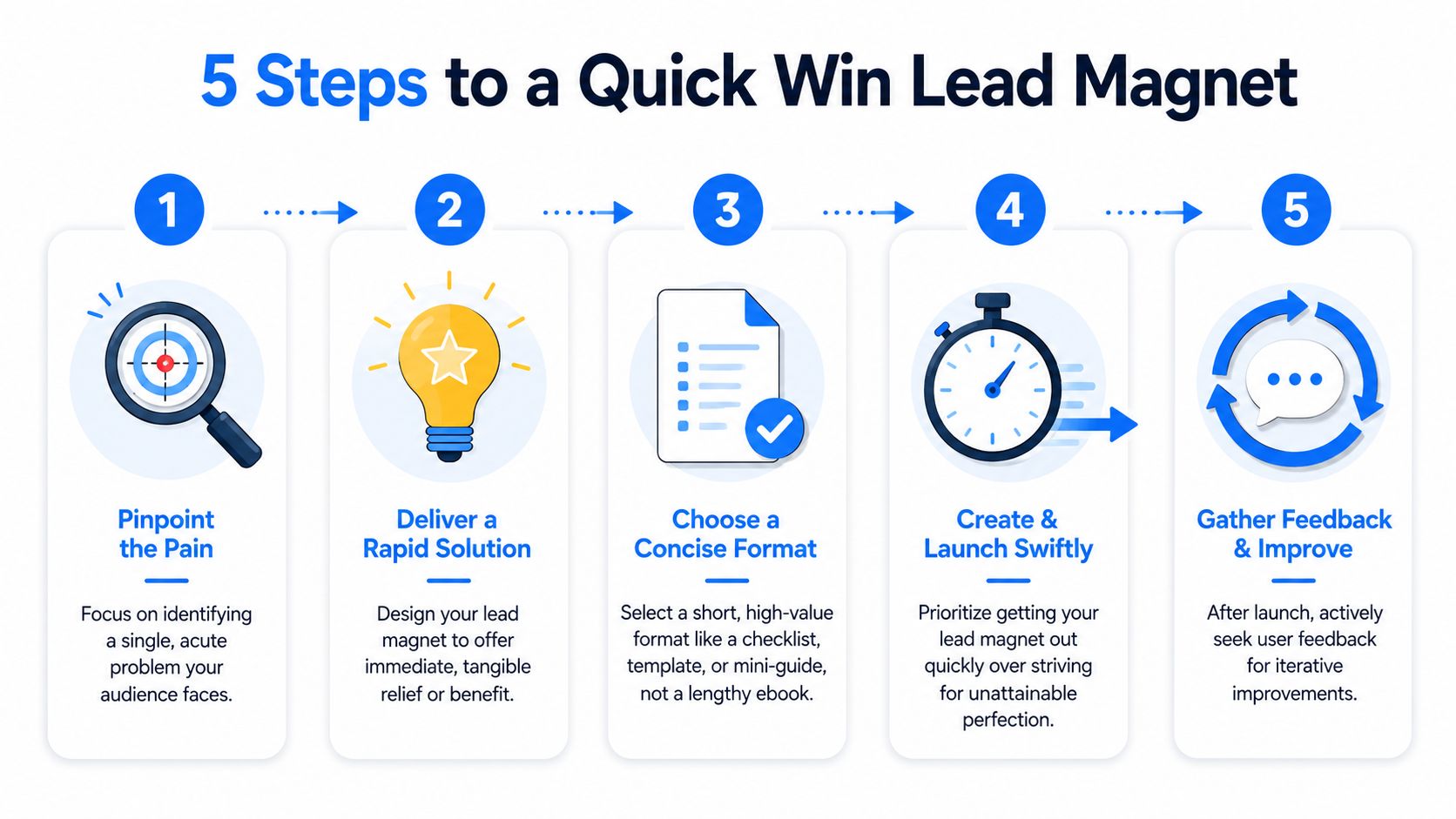
A practical repurposing flow looks like this:
- Find one strong source asset
Pick the blog post, training, or client-facing doc people already respond to.
- Strip it to one outcome
Remove the background explanation and keep the part that helps someone do the thing.
- Convert it into a working artifact
Turn the insight into a checklist, scorecard, prompt library, worksheet, or template.
- Add minimal framing
Include a title, a one-line “who this is for,” and short instructions.
- Ship the first usable version
Polish enough for clarity, not enough to delay launch.
Make it useful before you make it pretty
You don't need a designer to publish a lead magnet that performs. Google Docs, Notion, Canva, and Figma are all fine if the end result is easy to scan and easy to apply.
Use simple packaging rules:
- Front-load the value: The first screen should say what problem it solves and how to use it.
- Keep instructions short: A few bullets beat a dense introduction.
- Build for skimming: Short sections, obvious labels, and enough whitespace.
- Prefer plain language: Buyers don't need branding language inside a working checklist.
This is one area where agency teams often drift toward overproduction. If your team needs a better system for turning ideas into concise assets, this guide on how to create engaging content for agencies is useful because it focuses on clarity and output, not just aesthetics.
A lead magnet should feel like a shortcut, not a course.
Package the download for action
The asset itself isn't the only thing being judged. The download experience matters too. Name the file clearly. Keep the form lightweight. Deliver the resource instantly. If the user has to hunt through a confirmation sequence to find the thing you promised, you've already introduced unnecessary friction.
For most B2B teams, the right bar is this: can someone opt in, open the asset, and use it in the same work session? If yes, you're much closer to a lead magnet that feeds a newsletter with people who will consistently read your follow-ups.
Distribute and Promote Your Lead Magnet Effectively
A strong lead magnet with weak distribution is just a private document behind a form.
That's the part many lead magnet creators underestimate. They spend days building the asset and minutes thinking about traffic. In practice, the cold start problem is usually what kills performance. If you don't have an established audience, “publish it and wait” isn't a strategy.

For B2B, a micro-lead magnet distributed through paid, high-intent sponsored placements yields 3x higher conversion rates than a long-form ebook distributed through organic SEO, which can take 6 to 12 months to gain traction. That's why many polished assets underperform. The issue isn't always the content. It's the lack of immediate, targeted distribution.
Context beats generic placement
Where you place the offer matters as much as what the offer is. Contextual placement inside high-intent content consistently outperforms generic promotion. Someone reading a post about pipeline attribution is far more likely to download an attribution checklist than someone seeing a generic sidebar promo.
A few placements tend to work well:
- In-article CTAs inside related blog posts
- Content upgrades attached to a specific post or page
- Newsletter sponsorships in niche publications
- LinkedIn audience targeting aimed at a narrow ICP
- Partner swaps with adjacent operators serving the same buyer
If you want more structured thinking on where to put offers, this breakdown of distribution channels in marketing is a good planning resource.
Solve the cold start problem directly
If your site doesn't get much traffic yet, use a smaller asset and buy distribution in tight channels. Don't wait for SEO to rescue the campaign.
A practical cold-start playbook:
- Sponsor niche newsletters: Buy placements where your ICP already reads.
- Use LinkedIn carefully: Promote a narrowly framed lead magnet to a clearly defined role and company profile.
- Repurpose into posts: Turn the lead magnet into short LinkedIn posts and invite readers to grab the full version.
- Activate partners: Ask consultants, agencies, or creators with adjacent audiences to share it if it helps their readers.
A platform choice can help operationally. Teams using tools such as HubSpot, ConvertKit, Mailchimp, or Breaker can manage forms, email delivery, and subscriber growth workflows in one place rather than stitching together separate systems.
Write a CTA that promises a gain
A weak CTA kills demand even when the asset is strong. “Download now” doesn't tell the buyer why they should care.
A better CTA names the problem, the result, and the next step. For example:
- Get the checklist to tighten your ICP before launching outbound
- Enter your email to receive the email templates and use them today
- Download the one-page scorecard and review your funnel in one meeting
After the click, protect the first impression. Send the asset immediately. Make the confirmation email obvious. If deliverability is a concern, this guide to avoiding spam folders is worth reviewing before you scale promotion.
A short walkthrough can also help teams align on distribution mechanics before launch:
The first goal isn't reach. It's traction with the right people. Once a lead magnet proves it can attract your ICP, then you scale spend and placements.
This is why distribution deserves as much thought as creation. If you're learning how to create lead magnets for B2B, you're also learning how to create demand for the offer itself.
Measure Performance and Optimize for Growth
Downloads can mislead you. A lead magnet that pulls a lot of signups can still damage list quality if the wrong people enter your newsletter.
The cleaner way to evaluate performance is to track the full chain. Did the landing page convert? Did the new subscriber engage? Did the subscriber resemble your ICP? Did the lead create downstream sales activity or at least show meaningful buying intent?
Track a small set of useful metrics
You don't need a bloated dashboard. You need enough signal to judge both quantity and quality.
Monitor these:
- Landing page conversion rate to see whether the offer and page match.
- Cost per subscriber if you're using paid distribution.
- Open and click behavior from new subscribers to see whether the promise continues into the newsletter.
- ICP match rate based on role, company profile, and use case fit.
- Sales-relevant actions such as demo interest, reply rate, or deeper content consumption.
If your team needs clearer definitions for engagement metrics, this guide to email campaign performance metrics is a solid reference.
Run tests that reduce cognitive load
One of the most practical A/B tests for lead magnets is the form treatment itself. The protocol is to test a Gist, a short summary of three key points, against a static image on the form. Data shows that forms with a Gist increase conversion by 22% because they reduce cognitive load and pre-sell the value.
That matters because many pages still rely on a cover image to do the selling. In B2B, buyers usually respond better when the page tells them exactly what they'll get and how it helps.
Try tests like these:
Test Area
Variant A
Variant B
What You're Learning
Form support
Static image
Three-point Gist
Whether clarity beats visual packaging
Headline angle
Asset title
Outcome-focused promise
Whether buyers respond to format or result
CTA copy
Download now
Problem-plus-gain CTA
Whether the next step feels concrete
Form length
More fields
Essential fields only
Whether lower friction improves qualified opt-ins
If the page needs design to explain the value, the offer still isn't clear enough.
Close the loop into content strategy
A good lead magnet doesn't sit in isolation. It teaches you what your audience wants enough to trade an email for.
That learning should influence your newsletter topics, sponsored placements, and future assets. If one checklist attracts subscribers who open repeatedly and click into product-adjacent content, build more assets around that operational pain. If one flashy format drives signups but weak engagement, stop rewarding it.
Teams experimenting with automation can also use this testing loop to inform segmentation and follow-up. If you're exploring workflow support, these AI strategies for marketers offer practical ways to speed up analysis and iteration without turning the process into a black box.
The main point is simple. Don't optimize for the moment of capture alone. Optimize for what happens after the opt-in, because that's what determines whether your newsletter becomes a growth channel or just a larger database.
If you want to turn lead magnets into a repeatable newsletter growth engine, Breaker is built for that workflow. It combines email sending, forms, subscriber acquisition, targeting, analytics, and deliverability tools so B2B teams can grow a list and run campaigns without cobbling together a stack of separate systems.
Keep reading
All articlesB2B Newsletter Strategy for Marketers Who Sell to Niche Pros
Build a B2B newsletter that drives real pipeline. Covers audience definition, content structure, frequency, deliverability, and ROI measurement.
The Subscriber Acquisition Channels That Actually Move the Needle for B2B Newsletters
Every B2B newsletter eventually runs into the same wall: content is going out reliably, the format works, and the list still isn't growing fast enough.
Email Open Rate: What It Means and How to Improve It
Learn what email open rate really measures, how to calculate it, what a good benchmark looks like, and the tactics that actually lift opens in 2026.