
How Much Money Do Influencers Make: A 2026 Analysis
Curious how much money do influencers make? 2026 guide breaks down earnings by platform, follower count, and revenue stream with real data and expert tips.
Influencer income looks glamorous from the outside. The actual business is uneven, negotiated, and far more skewed than commonly understood.
The clearest reset comes from earnings distribution. One cited 2023 study reported that 25% of influencers earned $50,000-$100,000, 24% earned $100,000-$500,000, 19% earned $20,000 or less, and only 2% earned more than $1,000,000 according to Oberlo's breakdown of influencer earnings. That's the first thing to understand when asking how much money do influencers make. There isn't one clean answer. There's a wide spread, and the top end distorts everything.
The Reality of Influencer Income
Averages make influencer income sound simpler than it is. They hide the two facts that matter most in practice: earnings are concentrated, and most creators don't monetize in a straight line.
The Oberlo distribution is useful because it forces a better question. Instead of asking what influencers make on average, ask where a creator sits in the distribution, what revenue model they use, and whether their income comes from a few large deals or a steady stream of smaller ones. Those are very different businesses, even when two creators have similar audience sizes.
Why averages fail
A single “average influencer salary” is weak planning input. A small group of high earners lifts the mean, while a much larger group operates with inconsistent deal flow, small sponsorships, affiliate payouts, or no dependable monthly base at all.
That's why creators who benchmark themselves against headline numbers often misprice their work. Marketers make the opposite mistake when they assume a follower count should automatically map to a standard fee. In reality, pricing sits on top of niche demand, content format, audience trust, conversion potential, and how much usage a brand wants after the post goes live.
Practical rule: Treat influencer earnings like a portfolio business, not a salary.
A creator with a modest but commercially useful audience can outperform a larger creator with weak conversion. A B2B newsletter operator with a small list but strong buyer intent can also command better economics than a general lifestyle account with much broader reach.
What actually shapes earnings
Several levers matter more than people think:
- Audience intent: A smaller audience with purchase intent often beats a larger passive audience.
- Content format: Long-form YouTube, email newsletters, podcasts, and blogs often support stronger monetization than quick awareness posts.
- Commercial fit: Some categories attract repeat sponsorship demand. Others rely more heavily on affiliate or owned products.
- Negotiation skill: Usage rights, whitelisting, exclusivity, and bundling can change the value of the same core deliverable.
If you want a sponsorship-specific lens, SponsorRadar's report on creator earnings is a useful companion because it focuses on brand deal mechanics rather than celebrity folklore.
Influencer Pay Ranges by Follower and Platform
The simplest answer to how much money do influencers make is that rates usually rise with audience size, but they do not rise neatly. Platform, content depth, and deal structure matter just as much.
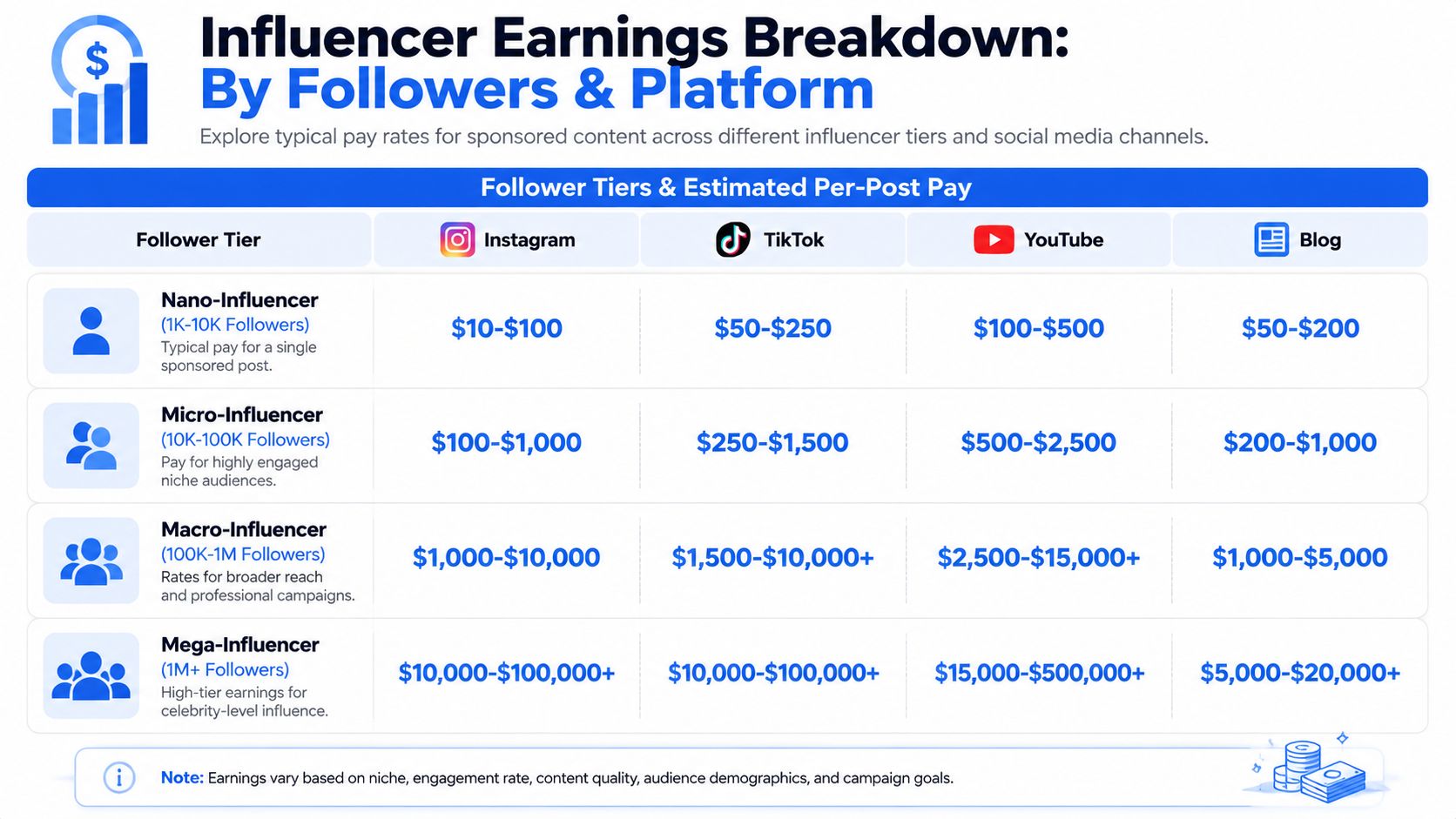
Industry reporting based on NeoReach data says about 48% of TikTok creators earn under $15,000 per year, while the same roundup cites Impact's typical 2025 flat-fee post rates of $500-$2,000 for nano creators, $2,000-$8,000 for micro creators, $8,000-$20,000 for mid-tier creators, and $45,000+ for mega or celebrity influencers. It also notes platform differences, with Lumanu reporting average payments of $2,228 on YouTube versus $1,429 on Instagram in its payout dataset, as summarized by ElectroIQ's creator pay analysis.
Estimated earnings by tier
Influencer Tier
Follower Count
Estimated Rate Per Post
Nano
Smaller audiences
$500-$2,000
Micro
Growing niche audiences
$2,000-$8,000
Mid-tier
Established creators
$8,000-$20,000
Mega or celebrity
Mass-market reach
$45,000+
That table is useful as orientation, not as a rate card. In active negotiations, brands don't buy followers alone. They buy a package of reach, relevance, content quality, audience fit, speed, usage rights, and confidence that the creator will deliver.
Why YouTube often pays differently
Lumanu's payout data adds an important layer. Across 255K payments totaling $420 million over 12 months, it reports an average payment of $1,645, roughly 701 payments per day, and more than $1.1 million in daily creator payouts. The same dataset reports average payment sizes of $2,228 on YouTube, $2,049 on TikTok, $1,459 on Facebook, and $1,429 on Instagram in Lumanu's creator compensation analysis.
YouTube often supports larger checks because the asset is heavier. A video usually takes more production time, stays discoverable longer, and gives brands more room for product explanation. Instagram can still work well, especially for visual consumer categories, but a Story or Reel often behaves more like a short-lived media placement than a durable content asset.
For creators building B2B audiences, newsletters deserve a place in the same conversation. Sponsorship value there often comes from audience specificity and buyer intent, not public follower count. If you're pricing newsletter inventory, this guide to newsletter ad rates is a practical reference point.
A second useful comparison comes from platform-specific monetization patterns. Teams evaluating where creator economics are strongest can discover social media monetization results and compare how different channels tend to support different deal structures.
Here's a quick video overview if you want a visual walkthrough of sponsorship income patterns.
Higher rates usually come from stronger commercial utility, not just bigger audience totals.
Beyond Sponsorships The 7 Influencer Revenue Streams
The creators with the most resilient businesses rarely rely on one income source. Sponsorships matter, but they're only one line on the P&L.
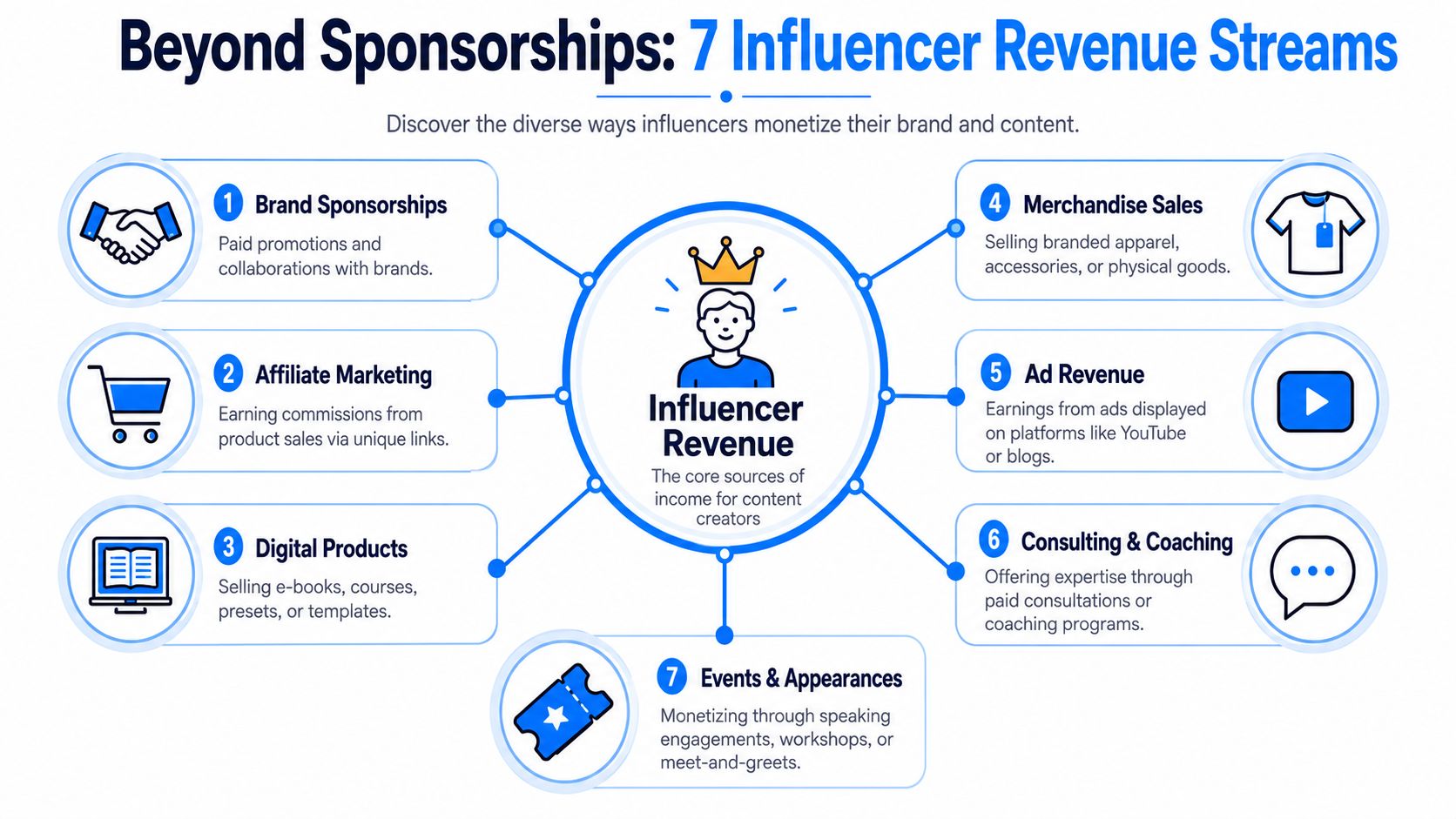
Brand sponsorships
This is the obvious one. A brand pays for access to audience attention through a post, video, mention, newsletter placement, event appearance, or content package. Sponsorships are attractive because they can produce large checks quickly. They're risky because pipeline gaps create volatile months.
Affiliate income
Affiliate works when a creator can move buyers, not just views. The economics differ from flat-fee sponsorships because payment happens after conversion. That can make affiliate unattractive for creators with weak purchase intent, but very powerful for those with trusted recommendations and strong product-market fit.
Platform ad revenue
Ad revenue is most relevant when a creator publishes on channels that share advertising income, such as YouTube or a monetized blog. It's useful because it turns a content library into recurring cash flow. It's limiting because creators don't control the platform's rules, inventory quality, or monetization policy.
Digital products
Courses, templates, playbooks, communities, swipe files, research packs, and niche tools turn expertise into owned margin. For B2B creators, this is often more scalable than merchandise. If a creator understands a repeatable workflow, there's a good chance that workflow can become a sellable product. This guide on how to make digital products is a good place to start if you're trying to package knowledge into something people will buy.
Merchandise and physical products
Consumer creators often extend their brand through apparel, accessories, or curated product lines. This can deepen loyalty, but fulfillment, inventory, support, and returns make it operationally heavier than digital revenue.
Paid newsletters and subscriptions
This revenue stream is underused in many discussions about creator earnings. Newsletters can support paid subscriptions, sponsorship slots, affiliate blocks, and premium research products. They also create direct audience ownership, which makes the business less dependent on algorithm changes.
For B2B creators, newsletters are often the bridge between content and commercial trust. A creator can publish on LinkedIn, YouTube, or X to attract attention, then use email to convert that attention into recurring revenue.
Consulting, coaching, events, and appearances
Some creators aren't just selling attention. They're selling expertise. That opens higher-trust revenue streams like advisory retainers, workshops, keynote speaking, executive coaching, or team training. These offers usually require authority and clarity more than mass reach.
A practical way to think about the seven streams:
- Fast cash: Sponsorships and appearances can produce near-term revenue.
- Compounding assets: YouTube libraries, blogs, newsletters, and digital products can keep working after publication.
- High-margin expertise: Consulting and premium education monetize what the creator knows, not just who follows them.
The strongest creator businesses turn audience trust into multiple products, not multiple posts.
How Influencer Deals Are Priced and Paid
Most deal confusion comes from mixing up the asset being sold. A creator might be selling reach, engagement, conversion, content production, or licensing rights. Each one supports a different pricing model.
Flat fees
Flat-fee deals are the most common. The brand pays a set amount for a defined deliverable, such as one YouTube integration, one Reel, or one newsletter ad slot. They're simple, easy to budget, and straightforward to invoice.
The weakness is that flat fees can underpay creators when a campaign performs well. They can also overpay from the brand side if the creator's audience doesn't respond.
CPM and CPE logic
CPM means the brand is effectively paying for impressions. CPE means the economics are tied more closely to interactions like likes, comments, shares, or clicks. Even when a contract doesn't explicitly say CPM or CPE, those models often sit underneath the negotiation.
That's why follower count is unreliable on its own. Brands care about what that audience does. A creator with lower headline reach but stronger engagement or click behavior can justify a better rate than a larger account with weak audience response.
Performance structures
Performance deals shift risk and upside. Beehiiv's summary notes that micro-influencers might earn $200-$1,000 per post, while affiliate commissions commonly run 5%-30% and some digital products pay 20%-50%, according to Beehiiv's overview of influencer monetization.
That structure works best when the creator has high buyer trust or a product that converts cleanly. It works badly when the audience is early-stage, broad, or trained for entertainment rather than action.
What changes the final price
A smart creator never prices only the post. They price the full commercial package.
- Usage rights: If the brand wants to reuse content in paid ads, the asset is worth more.
- Exclusivity: If the creator can't work with competitors, the rate should rise.
- Bundling: A Reel plus Stories plus newsletter mention is different from a one-off placement.
- Revision load: More approvals and edits increase production time.
- Speed: Rush work deserves rush pricing.
If you're formalizing deliverables and payment terms, these sponsorship package templates can help structure the offer before negotiations start.
A Look Inside Real Creator Businesses
Creator income is easier to understand when you stop picturing a generic influencer and start looking at actual business models.
Persona one, the B2B operator
This creator has a focused audience of operators, consultants, and software buyers. Their public content lives on LinkedIn and YouTube, but their real commercial engine is a newsletter. They don't chase every sponsorship inquiry. They only take products that fit the audience's workflow.
Their revenue mix is usually balanced across newsletter sponsorships, software affiliate partnerships, a paid premium edition, and occasional consulting tied to their expertise. The key advantage isn't celebrity. It's specificity. Advertisers care because the audience includes buyers, not just browsers.
This kind of creator often looks smaller than they are. Public follower counts may be modest, yet the business can be strong because the audience is commercially dense.
A narrow audience with clear intent can be easier to monetize than a broad audience with vague interest.
Persona two, the niche consumer educator
This creator works in fitness. They publish short-form social content for discovery, longer YouTube content for depth, and own a library of digital products such as training plans, guides, and a lightweight membership.
They still do brand deals, but sponsorships aren't the center of the company. Sponsored posts create cash flow. Their own products create margin. Affiliate links support recommendation content when the product fits. Community access and group coaching add a recurring layer.
What makes this model durable is that every content format has a job. Short-form reaches new people. Long-form builds trust. Email and product pages convert. The creator isn't trying to get rich from one post. They're moving people through a funnel.
What these businesses get right
Both personas avoid the same trap: building revenue around vanity metrics.
They focus on three questions:
- What does the audience reliably want next
- Which channel creates trust most efficiently
- Which offer the creator controls directly
That's the core business mechanic behind influencer income. The strongest creators don't merely attract attention. They route that attention into offers with repeatable economics.
How to Negotiate and Increase Your Earnings
Most creators don't have an earnings problem first. They have a packaging problem.
A creator who sends vague replies, inconsistent metrics, and no clear offer usually gets squeezed on price. A creator who shows audience fit, content quality, prior outcomes, and clean deliverables can negotiate from a stronger position. Brands respond to clarity.
What creators should do
- Build a real media kit: Include audience profile, core channels, sample work, and the types of campaigns you do best.
- Quote the package, not just the post: Include production time, revisions, usage, exclusivity, and cross-channel value.
- Keep proof organized: Save screenshots, click data, reply quality, sales anecdotes, and renewal history.
- Offer options: A good-better-best structure makes negotiation easier than a single take-it-or-leave-it number.
What marketers should do
Marketers get better outcomes when they stop treating creators like interchangeable inventory. The cheapest creator isn't always the cheapest outcome. If the campaign needs trust, explanation, or audience specificity, the right partner may cost more upfront and still produce better economics.
Use briefs that answer real questions. What matters most, awareness, clicks, leads, conversions, or reusable content? What rights do you need? Is this a one-off test or a relationship you want to scale? The clearer the brief, the faster rate negotiations become.
What usually increases rates
The biggest pricing improvements often come from terms around the content, not the base fee alone.
- Usage licensing: Brands should expect to pay more when they want ad rights.
- Exclusivity windows: Blocking competitor work has a cost.
- Series deals: Multi-touch campaigns can raise total contract value and improve performance consistency.
- Channel combinations: Newsletter plus social plus video often justifies a stronger package price.
Worth remembering: Negotiation works best when both sides can explain the business case, not just defend a number.
Managing Your Influencer Finances
A creator can close strong deals and still run a weak business. Cash flow, taxes, invoicing, and expense tracking decide whether income turns into something durable.
Treat creator earnings as business revenue from day one. Keep accounts organized. Track contracts, payment terms, software costs, contractor spend, travel, production expenses, and the tools used to run the business. When money comes in irregularly, planning matters more, not less.
The backend that keeps the business healthy
A few operating habits make a major difference:
- Separate business and personal money: It reduces confusion and makes tax prep far easier.
- Set aside tax funds as payments arrive: Waiting until filing season creates avoidable stress.
- Review receivables weekly: Late invoices are common in sponsorship work.
- Document every agreement: Scope creep usually starts where documentation ends.
For creators with Canadian tax obligations, this guide to Canadian late tax filing penalties is a practical reminder that admin mistakes have real costs.
The durable version of influencer income isn't built on one viral post. It's built on pricing discipline, offer clarity, owned channels, and clean financial operations.
If you're building a B2B creator business, a niche publication, or a sponsored newsletter, Breaker helps turn email into a real growth and revenue channel with audience expansion, analytics, deliverability support, and monetization-friendly workflows.
Keep reading
All articlesNewsletter Agency Services: How Agencies Scale Client Newsletters
Managing multiple client newsletters? Learn what a true newsletter agency platform needs to prevent list mixing, voice drift, and invisible ROI.
Building Owned Audiences: Move Followers to Your Newsletter in 2026
Social platforms can vanish overnight. Learn how to convert Instagram, TikTok, and YouTube followers into a newsletter list you actually own.
Newsletter Analytics: Which Metrics Actually Matter in 2026
Open rate and clicks don't predict buyers. Learn the 7-step method to track click depth, recency, and topic affinity for a revenue-predictive intent score.