
How to Find Business Email Addresses and Grow Your B2B List
Learn how to find business email addresses with our guide. Discover tools, manual search tricks, and legal best practices for effective B2B outreach.
Finding a business email address seems like the logical first step for B2B prospecting. But here’s the thing: success is all about quality, not just filling a spreadsheet. The real starting point is a clear strategy built around your Ideal Customer Profile (ICP). This one shift turns a simple email hunt into a powerful engine for growth.
Building Your Foundation for Effective Prospecting
Before you can effectively find business email addresses, you need a blueprint. Think of it like building a house—without a solid foundation, the whole thing is unstable. In prospecting, your foundation is your Ideal Customer Profile (ICP). This isn't just marketing fluff; it's the strategic core that separates meaningful connections from a whole lot of wasted effort.

An ICP is a hyper-detailed description of the company—not the person—that gets the most value from what you offer. It’s the perfect-fit account that is most likely to buy, stick around, and grow with you.
Why Your ICP Is Non-Negotiable
Defining your ICP forces you to get laser-focused on who you're targeting. That precision is everything in a world where inboxes are more crowded than ever. By 2026, global email volume is projected to hit a mind-boggling 392.5 billion emails sent and received daily.
Given that 86% of professionals prefer email for business communication, your message has to land with the right person to even stand a chance. Diving into the details of what makes an ideal customer is a great starting point for any growth team. You can check out our guide on what an Ideal Customer Profile is to build your own.
With employees spending about 11 hours per week managing their inbox, a targeted email to a well-defined prospect is infinitely more effective than a hundred emails sent to random contacts. Discover more insights about current business email trends at wifitalents.com.
A clear ICP means you can pour your resources into accounts with the highest potential. Without it, your team is flying blind, burning time and money on leads that were never going to convert anyway.
From Cold Contacts to Warm Prospects
Once you’ve nailed down your ICP, you can start identifying the right people inside those target companies. This is where the distinction between a cold contact and a warm prospect really matters.
- Cold Contact: Someone who fits a vague demographic but has zero awareness of your brand. Contacting them feels interruptive and, honestly, usually gets ignored.
- Warm Prospect: A person at an ICP-fit company who might have shown some interest or holds a specific role you're targeting. Outreach to them feels relevant and helpful.
Your goal isn't just to build a massive list; it's to turn cold data into a source of warm prospects. This guide will show you how to find business email addresses to build a targeted list. The focus is on quality outreach that feels less like spam and more like a genuinely helpful introduction.
This is how you transform a list of contacts into a reliable pipeline for B2B newsletter growth and, ultimately, revenue.
Mastering Manual Search Techniques for High-Value Targets
While automation is great for casting a wide net, it often falls short when you're hunting for high-value, hard-to-find contacts. This is where getting your hands dirty with manual prospecting gives you a serious edge.
Think of it as digital detective work. It’s how you uncover the right business email address when you need absolute certainty, especially for key decision-makers or individuals with a small digital footprint. The payoff for this patience is a highly qualified lead your competitors probably missed.
Become a Google Search Operator Pro
Your standard Google search bar is actually a powerful database, but only if you know the right commands. Using specific search operators—a technique often called "Google dorking"—lets you slice through the noise and find business emails with uncanny accuracy.
Instead of just typing a name and company, these commands act as powerful filters.
site:linkedin.com/in "Job Title" "Company Name": This is my go-to for finding someone’s LinkedIn profile, which is always the best place to start your investigation."[First Name] [Last Name]" "Company Name" email: This string hunts for a person's name and company alongside the word "email," which often pulls up contact pages, author bios, or old press mentions."[Name]" + "email" (OR "contact"): A simple but surprisingly effective query for finding publicly listed contact details.
The real magic happens when you start combining these operators. Experiment with different strings based on the scraps of information you have—it’s all about being specific.
Mine Company Websites for Hidden Gold
A company’s website is a goldmine, but you have to know where to dig. Most people stop at the homepage, but the best clues are almost always buried deeper. I methodically check these sections first:
- About Us / Our Team: The obvious first stop. Executive bios can sometimes list direct contact info, but more importantly, they reveal the company's email structure.
- Press Releases / Media Kit: When a company sends out a press release, they nearly always include a media contact. That one email address is a golden ticket, revealing the exact format the company uses.
- Blog or Articles: If your target has written for the company blog, check their author bio. You'll often find an email address or a link to another social profile.
Pay close attention to the email format of any address you find. If the media contact isjane.d@company.com, it's a safe bet the CEO's email isjohn.s@company.com. This single clue is the foundation for making an educated guess.
The Art of the Educated Email Guess
Once you have a name, title, and a strong clue about the email format, it’s time to make an educated guess. This isn't just a shot in the dark; it's a logical deduction based on common corporate email patterns.
Most companies use a standardized format for all employees. Here are the most common patterns I test first:
Pattern Type
Example
First Name
john@company.com
First Initial, Last Name
jsmith@company.com
First Name, Last Initial
johns@company.com
First Name . Last Name
john.smith@company.com
Combine the person's name with the company domain using these variations. The next step, which we'll cover later, is to plug these guesses into a verification tool to see which one is valid—all without ever sending a risky bounce-back email. This one-two punch of manual research and verification is how you can reliably find almost anyone’s business email.
Using Prospecting Tools to Scale Your Outreach
While manual sleuthing gives you incredible accuracy for a few high-value targets, it just doesn't scale. If you're serious about building a robust B2B newsletter list or filling a sales pipeline, you have to move beyond digital detective work and build an efficient prospecting machine.
This is where specialized software changes the game. These tools turn a time-consuming chore into a repeatable, scalable process, letting your team focus on building relationships instead of hunting for contact details. The market is packed with options, but they generally fall into three main categories.
Dedicated Email Finders
Think of these as highly specialized search engines built just for contact information. Dedicated email finders, often found as Chrome extensions or web apps, are designed to quickly uncover email addresses for a specific person or an entire company domain. They are the workhorses for countless sales and marketing teams.
For instance, you might use a tool like Hunter or Snov.io. You land on a company's website, click their extension, and instantly get a list of emails associated with that domain. It often even tells you the most common email pattern, which is a massive time-saver.
These tools are perfect for:
- Quick lookups when you have a name and company but no email.
- Bulk domain searches to generate a list of contacts at a target account.
- Verifying email patterns before you launch a bigger campaign.
Their real strength is their simplicity and speed. For a reasonable cost, they provide a fast and effective way to find business emails at a moderate scale, making them an essential part of any modern prospecting stack.
LinkedIn Scrapers and Automation
LinkedIn is the world's largest professional database, period. This makes it an absolute goldmine for B2B prospecting. LinkedIn scrapers are tools built to automatically pull public data from profiles—names, job titles, companies, and sometimes, contact info.
Tools like PhantomBuster or Lusha work by automating the process of visiting profiles and collecting data based on your search filters. You could, for example, set up a flow to scrape the profiles of every "Head of Marketing" in the software industry in a specific region. The tool then neatly compiles this data into a spreadsheet for you.
It's critical to use these tools responsibly and in line with LinkedIn's terms of service. Overly aggressive scraping can get your account restricted. The goal is to augment your prospecting with data, not to spam or break platform rules.
Scrapers are most effective when you need to build a large, targeted list from scratch based on job titles, industries, or company size. They excel at the top of the funnel, helping you identify hundreds of potential prospects who fit your Ideal Customer Profile (ICP).
All-in-One Sales Intelligence Platforms
When you need more than just an email address, you graduate to all-in-one sales intelligence platforms. These are comprehensive solutions like ZoomInfo or Clearbit that combine massive contact databases with deep company insights, buying signals, and even data on their tech stack.
Instead of just finding an email, these platforms tell you a story. They can show you what software a company uses, if they just got a new round of funding, or if they’re hiring for key roles. These are all powerful signals that help you time your outreach perfectly. To really get the most out of this data, you can layer in AI-powered lead generation to build an even smarter prospecting system.
These platforms are a serious investment, best suited for mature growth teams that need to pipe rich data directly into their CRM and sales workflows. They’re the ultimate tool for scaling outreach because they don’t just give you the "who"—they also give you the "why" and the "when."
Comparison of Email Finder Tool Types
Choosing the right tool depends entirely on your goals, budget, and scale. This table breaks down the main differences to help you decide where to start.
Tool Type
Primary Use Case
Pros
Cons
Best For
Dedicated Email Finders
Single lookups and bulk domain searches.
Fast, affordable, and easy to use.
Limited data enrichment, accuracy can vary.
Sales reps and marketers needing quick contact info.
LinkedIn Scrapers
Building large, targeted lists from scratch.
Excellent for top-of-funnel list building based on job titles, industries, etc.
Risk of account suspension, requires careful use.
Teams building large prospecting lists based on ICP.
Sales Intelligence Platforms
In-depth prospect and company research.
Rich data (technographics, firmographics, intent signals).
Expensive, can be overly complex for simple needs.
Mature sales and marketing teams with integrated workflows.
Ultimately, building a practical prospecting stack that combines these tools is how top teams turn the constant challenge of finding business emails into a sustainable growth advantage.
Why Email Verification Is Your Most Important Step
So you've found a list of promising business emails. It's incredibly tempting to load them up and hit "send" right away. But hold on—that's a classic mistake.
Finding an email is only half the battle. Verifying it is what protects your sender reputation, your budget, and your company's long-term ability to even reach the inbox. Skipping this step is like spending all your time building a beautiful sales deck and then sending it to a disconnected phone number.
A high email bounce rate is the single fastest way to get your domain blacklisted by giants like Outlook and Gmail. When you send to invalid addresses, you're signaling to Internet Service Providers (ISPs) that you’re not practicing good list hygiene. Once your bounce rate creeps over 5%, their defense mechanisms kick in.
The fallout can be brutal:
- Your emails start landing in the spam folder for everyone, including your most qualified prospects.
- Your domain's sender score takes a nosedive, making deliverability an uphill battle.
- You could even end up on a public blacklist, which is a massive blow to your brand's credibility.
This isn't some far-off theory. Major email clients are getting stricter. Outlook recently rolled out new rules for high-volume senders, demanding proper authentication and clean lists. A high bounce rate is a direct violation, putting you at risk of being blocked entirely.
Understanding Verification Results
When you use an email verification service, you're not just getting a simple "valid" or "invalid." The results are far more detailed and give you the intelligence needed to build a smarter outreach plan. Knowing what each status means is crucial for managing your lists effectively.
Here are the common statuses you'll encounter:
- Valid: The email address is active and can safely receive messages. These are your green-light contacts.
- Invalid: This address doesn't exist or is disabled. Sending to it will cause a hard bounce. These need to be scrubbed from your list immediately, no questions asked.
- Risky (or Accept-All): This is where it gets tricky. The server is configured to "accept all" incoming mail, so it won't confirm if a specific inbox exists on the spot. Some of these are perfectly fine, but a good chunk are often spam traps or will bounce later. Treat these with extreme caution.
- Unknown: The tool couldn't get a clear answer from the server, maybe due to a temporary server glitch. It’s best to set these aside and try re-verifying them later.
Think of list hygiene as preventative maintenance for your entire email program. Before every major campaign, run your contacts through a trusted verification tool. This simple habit is what separates amateurs from pros, protecting your sender score and giving your messages the best shot at being seen.
Putting Verification into Practice
Making verification a non-negotiable part of your workflow is simple. Before you import any new list into your CRM or email platform, run it through a dedicated validation service first. This one action filters out the addresses guaranteed to cause bounces and damage your deliverability.
For B2B growth teams, this discipline is what creates professional, scalable outreach programs. It ensures all that hard work you put into finding emails actually pays off.
If you want to go deeper on this, our complete guide on how to validate email addresses is a great next step to protecting your sender score. At the end of the day, verification isn't just about cleaning a list; it’s about making sure your message actually gets delivered.
How To Automate Your Prospecting Workflow
Let’s be honest: manually finding business emails, checking if they’re valid, and then uploading them one-by-one into your CRM is a soul-crushing time sink. The real magic happens when you stop doing the grunt work and build an automated system that feeds your growth engine around the clock.
The goal is to move from a disjointed list of chores to a smooth, hands-off machine. This means connecting your email finders, verification services, and CRM into one cohesive flow. When you get it right, a new, qualified prospect is automatically found, enriched, verified, and dropped right into the perfect sales or marketing sequence without you lifting a finger.
Making Your Tools Talk to Each Other
The secret to a killer automated workflow is getting your software stack to communicate. Most modern prospecting tools are designed to connect, either through direct, native integrations or with a little help from an automation platform like Zapier or Make.
Think of these platforms as the universal translator between your apps. They let you create simple "if this, then that" recipes that trigger actions across your tools.
For instance, you could build a workflow that looks something like this:
- The moment a new lead matching your criteria appears in a sales intelligence tool, it triggers an action.
- Your email finder automatically gets to work, locating their contact info.
- That new email is instantly sent to a verification service to make sure it's deliverable.
- Finally, the verified contact, along with all their data, is pushed into your CRM (like HubSpot or Salesforce) and added to a specific campaign.
This kind of setup doesn't just save you hours of mind-numbing data entry; it cuts out human error and ensures your teams are always working with fresh, accurate contact information.
Designing Your Ideal Prospecting Machine
Imagine you’ve just spotted the perfect prospect at a target company. In a manual world, that’s the start of a dozen tedious tasks. But in an automated one, it’s the trigger for a powerful, hands-off process. A huge part of this is mastering your follow-up game, which is where effective Email Follow Up Automation becomes critical.
This simple diagram breaks down the core logic of any solid email prospecting workflow.
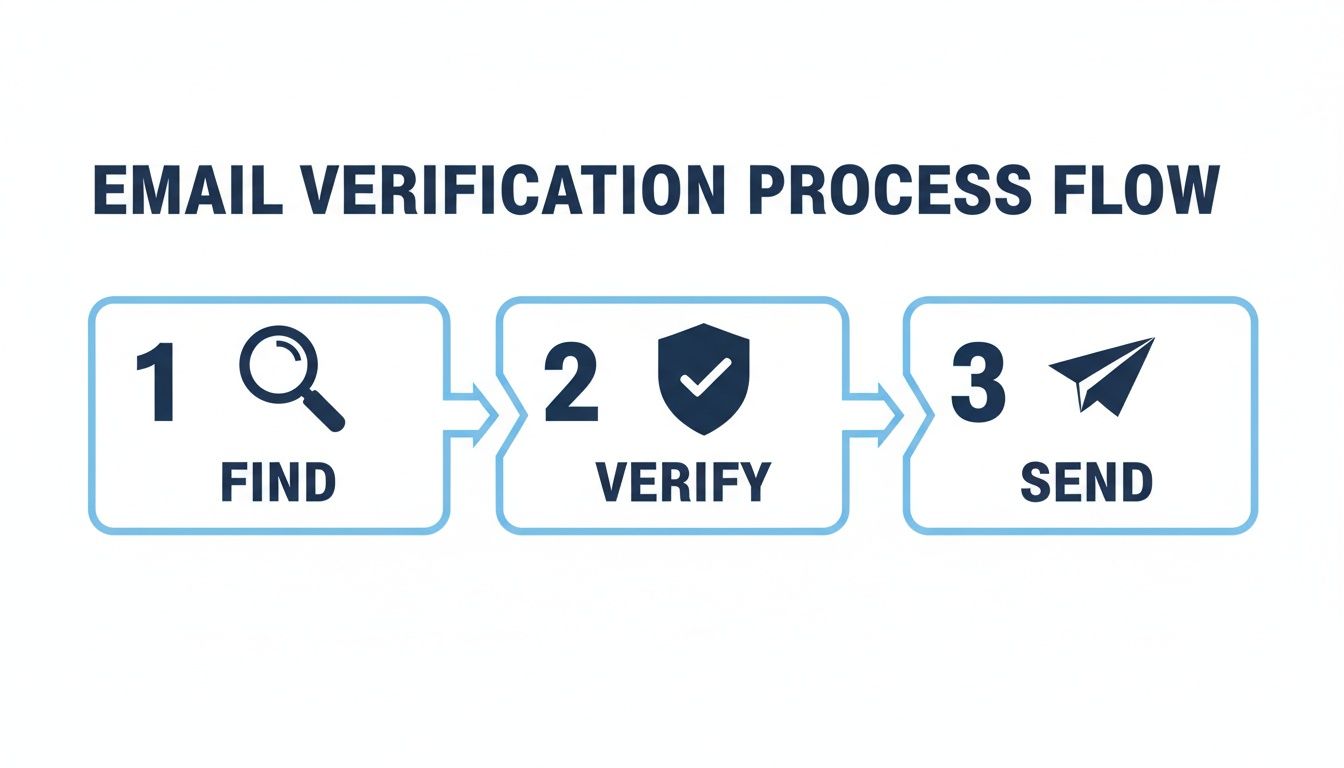
It reinforces a simple truth: finding an email is just step one. The verification piece is what gives you the confidence to actually hit "send" and protects your sender reputation.
This isn't just about being more efficient—it’s about scaling your outreach intelligently. You can design different workflows for different kinds of leads. A high-value enterprise prospect? Route them directly to a senior account executive. A smaller SMB lead? Enroll them in a B2B newsletter nurture sequence. Our guide on how to create a workflow dives deeper into the nuts and bolts of setting this up.
The best growth teams don't just find business emails. They build systems that manage the entire prospect lifecycle, from discovery to outreach. This frees up their people to focus on what actually matters—building relationships and closing deals.
From Manual Chores to a 24/7 Engine
Putting an automated prospecting workflow in place is the ultimate force multiplier for any growth team. You’re taking the most repetitive, error-prone parts of the job and handing them over to software that works for you 24/7.
This systematic approach gives you a few major advantages:
- Consistency: Every single lead is processed the same way, every time. Nothing falls through the cracks.
- Data Hygiene: With verification baked directly into the process, you keep your contact database clean. This is no longer a "nice-to-have"—with providers like Outlook getting stricter, it's essential for deliverability.
- Speed: The time it takes to go from identifying a prospect to actually engaging with them shrinks from days or hours to just minutes.
By building these automated pathways, you're not just saving time. You're creating a predictable and scalable engine that turns the endless task of finding business email addresses into a sustainable source of growth for your entire organization.
Navigating Compliance and Legal Best Practices
Finding the right email is only half the battle. How you find it—and what you do with it—is what separates a successful campaign from a one-way ticket to the spam folder.
In a world where data privacy is everything, ignoring the rules isn't just risky; it's plain bad for business. But navigating regulations like Europe's GDPR and the U.S.'s CAN-SPAM Act doesn't have to be a headache. With a few core practices, you can build a growth strategy that respects privacy, builds trust, and keeps you on the right side of the law.
The key is to remember the spirit of these laws. They weren’t created to kill B2B communication. They were created to stop deceptive, unwanted spam. When you’re transparent and offer real value, you’re already aligned with their main goal.
Understanding Key Regulations
For any team focused on B2B newsletter growth, two major regulations really set the tone for email outreach. While they have their differences, their core purpose is identical: protect the person on the receiving end.
- CAN-SPAM Act (U.S.): This law is pretty straightforward for B2B cold email. You can contact business addresses as long as you follow some clear rules. Your message needs a non-deceptive subject line, must identify itself as an ad, include your physical address, and provide an obvious way for people to opt out.
- GDPR (Europe): This one is much stricter. For cold outreach to anyone in Europe, you generally need to establish a "legitimate interest." This means you have a valid business reason for contacting them, your outreach doesn't infringe on their rights, and you clearly inform them of their right to object.
Keeping clean records of where and how you found each business email is a fundamental first step in proving you're compliant with either regulation.
Legitimate Interest in Practice
The idea of "legitimate interest" under GDPR can feel a bit vague, but in the B2B world, it's actually quite practical. If you've found a contact at a company that fits your ideal customer profile (ICP) and their job role is directly relevant to the solution you're offering, you can often establish legitimate interest.
A perfect example is contacting a "Head of Marketing" about a new marketing automation tool. That fits the model. But you always have to balance this with the individual's right to privacy.
Respecting privacy isn't just a legal checkbox; it's a strategic advantage. When prospects see you handle their data responsibly—offering clear opt-outs and relevant content—you build trust from the very first interaction. This creates a stronger foundation for a long-term business relationship.
This means you can’t just scrape a list and hit send. Your targeting needs to be sharp, and your message has to offer genuine value to that specific person in their specific role.
Actionable Best Practices for Compliance
Staying on the right side of these rules really boils down to a few non-negotiable habits. Bake these into your workflow from day one to minimize risk and keep your deliverability high.
- Honor Opt-Outs Instantly: This is the golden rule. When someone unsubscribes, they need to be removed from all lists immediately. Trying to manage a suppression list manually is a recipe for disaster; your system should automate this.
- Maintain Transparent Records: Document where every single contact came from. Was it a public LinkedIn profile, the company’s website, or a data provider? This audit trail is your proof of due diligence if you're ever questioned.
- Lead with Value and Transparency: Never use clickbait or misleading subject lines. Be upfront about who you are and why you're reaching out. A relevant, helpful message is your best defense against spam complaints.
- Perform Regular List Hygiene: Beyond simple verification, make it a habit to purge contacts who haven't engaged in a long time. This signals to email providers that you’re actively managing your list quality and respecting inboxes.
Frequently Asked Questions
Even with a solid game plan for finding emails, a few questions always pop up. Let's tackle some of the most common ones we hear from teams building out their B2B outreach.
Is It Legal To Find and Email Prospects?
This is the big one, and the short answer is: it depends on where your prospect is located.
In the U.S., the CAN-SPAM Act gives B2B cold email the green light, provided you play by the rules. That means being totally transparent, never using misleading headers, and always giving people a crystal-clear way to opt out.
If you're reaching out to contacts in Europe, you're in GDPR territory. This generally requires you to have a "legitimate interest" for making contact. Think of it this way: if your product is a perfect fit for their job role, you have a solid business reason to email them, as long as it doesn't infringe on their privacy rights. Easy unsubscribes and transparency are non-negotiable.
What Is a Good Bounce Rate?
For any cold email campaign, you have to keep your bounce rate below 5%. The moment you start creeping above that number, providers like Gmail and Outlook take notice and might start flagging your domain as spammy.
A consistently high bounce rate is one of the fastest ways to kill your sender reputation. It signals to email providers that you're not managing your lists properly, which can land even your legitimate emails in the spam folder. This is why email verification isn't just a "nice-to-have"—it's an essential part of the process.
How Accurate Are Email Finder Tools?
The truth is, accuracy varies a lot. Most email finder tools hover somewhere between 70% to 95% accuracy. No tool is ever going to be perfect, mostly because contact data goes stale so quickly as people switch jobs.
This is exactly why you can't skip the verification step. Running your list through a dedicated verification service is the only way to catch those invalid or risky addresses before you send. It's a simple step that protects your sender score and stops you from wasting money on emails that were never going to arrive anyway.
Ready to turn your B2B newsletter into a growth engine? Breaker combines powerful sending features with automatic, exact-match subscriber acquisition. Start your free 7-day trial and see how it works.
Keep reading
All articlesNewsletter Agency Services: How Agencies Scale Client Newsletters
Managing multiple client newsletters? Learn what a true newsletter agency platform needs to prevent list mixing, voice drift, and invisible ROI.
Building Owned Audiences: Move Followers to Your Newsletter in 2026
Social platforms can vanish overnight. Learn how to convert Instagram, TikTok, and YouTube followers into a newsletter list you actually own.
Newsletter Analytics: Which Metrics Actually Matter in 2026
Open rate and clicks don't predict buyers. Learn the 7-step method to track click depth, recency, and topic affinity for a revenue-predictive intent score.