
Facebook Ads Newsletter The Ultimate B2B Growth Playbook
The definitive guide to using a Facebook ads newsletter strategy for B2B subscriber acquisition. Learn targeting, creative, and funnels for high ROI.
Using Facebook Ads to grow your B2B newsletter is a surprisingly effective way to land high-quality subscribers. The trick is to combine Meta's powerful targeting with ad copy that actually speaks to professionals, turning a social platform into a serious lead generation machine.
Why Facebook Ads Are Still a Goldmine for B2B Newsletters
When B2B marketers think about lead gen, LinkedIn or good old-fashioned outreach usually come to mind first. Facebook, with its B2C reputation, often feels like the wrong playground for serious business professionals. But that's exactly where the opportunity is hiding.
The big misconception is that executives and decision-makers aren't on Facebook for anything related to work. While they’re not there to sign contracts, they are there. They're scrolling during their downtime, connecting with old colleagues, and following pages that genuinely interest them.
Your goal isn't to interrupt their workday. It's to become a valuable part of their personal feed—the go-to source for insights that help them grow in their careers.
Shifting Your Mindset From Volume to Value
To make a Facebook Ads newsletter campaign work, you have to ditch the B2C mindset of chasing huge numbers at rock-bottom costs. Instead, your entire focus should be on attracting a smaller, highly qualified audience that fits your Ideal Customer Profile (ICP) perfectly.
One engaged subscriber who’s a decision-maker at a target company is worth a hundred random sign-ups who will never become customers.
This means your ads can't just offer "free tips." They need to promise exclusive data, deep analysis, or a unique perspective that a busy professional can't just Google. Think of your newsletter as a premium content product, and your ad is the exclusive invitation to get it.
The numbers back this up. Meta’s advertising revenue continues to climb, hitting $196.2 billion in a recent year. With the average revenue per user (ARPU) reaching $68.44 in the US and Canada, it's clear high-value audiences are not only on the platform but are also highly reachable.
The real win on Facebook isn't just getting an email address. It's about starting a conversation with the right person by offering tangible value directly in their feed, making your newsletter an indispensable resource for their career.
While there are many places to acquire subscribers, Facebook Ads hold a unique spot in the B2B marketer's toolkit. Here’s a quick look at how it stacks up against other popular channels.
Facebook Ads vs Alternative B2B Acquisition Channels
Channel
Targeting Precision
Scalability
Typical Cost-Per-Lead
Best For
Facebook Ads
High (Behavioral, Interest, Lookalikes)
Very High
$15 - $75
Reaching decision-makers in their personal time with highly specific ad creative at scale.
LinkedIn Ads
Very High (Job Title, Company)
High
$50 - $150+
Targeting specific professional roles and industries directly in a business context.
Google Search Ads
High (Keyword Intent)
High
$30 - $100+
Capturing high-intent prospects who are actively searching for solutions.
Content Syndication
Medium
Medium
$25 - $100
Generating a high volume of leads from a broad audience, often requiring more qualification.
Cold Email
High (Manual Prospecting)
Low-Medium
Varies
Hyper-personalized outreach to a small, curated list of high-value prospects.
As the table shows, no channel is perfect for every scenario. But for growing a B2B newsletter, Facebook offers a powerful combination of granular targeting, massive scale, and relatively efficient costs that's hard to beat when executed correctly.
Defining Your Ideal Customer Profile
Before you even think about opening Meta Ads Manager, you need to know exactly who you're talking to. Defining your ICP is the single most important step, and it goes way beyond basic demographics. For a B2B newsletter, you have to get specific.
A well-defined ICP is the foundation of a profitable campaign. Consider these factors:
- Job Titles: Are you trying to reach VPs of Marketing, fractional CMOs, or enterprise sales directors? Be specific.
- Industries: Which sectors need your content the most? SaaS, professional services, or manufacturing?
- Company Size: Are you targeting scrappy startups, mid-market companies, or massive enterprises?
- Pain Points & Goals: What professional challenges keep them up at night? What are their career goals?
For example, if your newsletter is all about product-led growth, a great ICP might be a "Product Manager at a Series B SaaS company with 50-200 employees."
This level of detail lets you write ad copy that feels like it was written just for them, which dramatically boosts your ad's relevance and conversion rate. To get started, you can find a ton of expert tips on creating Facebook Ads that dig deeper into the mechanics. This foundational work is what turns a shot-in-the-dark campaign into a precision-guided growth strategy.
Crafting Ad Campaigns That B2B Professionals Actually Click
Alright, you’ve mapped out your Ideal Customer Profile (ICP). Now it's time to roll up your sleeves and get into Meta Ads Manager. This is where the real work begins—translating all that strategic thinking into an ad campaign that actually stops the scroll and earns a click.
A successful Facebook Ads newsletter campaign really comes down to three things: the right campaign objective, copy that resonates, and creative that grabs attention. Nail these, and you're building a predictable subscriber machine. Get them wrong, and you're just burning cash.
Choosing Your Campaign Objective
The very first thing Meta asks when you build a new campaign is to pick an objective. This one choice dictates everything. It tells the algorithm what you want to achieve, which directly impacts who sees your ads and how your budget gets spent. For newsletter sign-ups, you’ve got three main plays.
- Leads Objective: This is the most straightforward path. You can use Meta’s native Lead Forms, which pre-fill a user's name and email, making it almost frictionless to sign up. It’s a great way to maximize the sheer volume of sign-ups, especially when you’re starting out.
- Traffic Objective: This one is designed to do exactly what it says—send people to a destination off of Facebook, like your newsletter's landing page. The catch? Meta’s algorithm gets really good at finding people who click, but not necessarily people who will follow through and subscribe once they land on your page.
- Sales (Conversions) Objective: This is the most powerful option, but it does require a bit more setup. Here, you're telling Meta to hunt for people who are most likely to complete a specific action on your site, like filling out your sign-up form. This relies on a properly configured Meta Pixel, and honestly, it’s my go-to for finding high-quality subscribers who stick around.
For most B2B newsletters, the Sales (Conversions) objective is the superior choice. It aligns your ad spend directly with your actual business goal—getting subscribers—not just generating clicks or leads. It teaches the algorithm what a valuable user looks like, which makes your targeting smarter over time.
While it's tempting to start with a Leads campaign for its simplicity, I always recommend putting in the effort to set up proper conversion tracking. The long-term payoff in subscriber quality is absolutely worth the initial setup.
Writing Ad Copy That Speaks to Professionals
Your ad copy has a split second to prove you get your audience's world. B2B professionals are scrolling through an endless feed of personal updates and memes; your ad has to cut through that noise with a crystal-clear, professional value prop.
Ditch the generic benefits like "learn marketing tips." You have to get specific and talk about the real-world pain points and tangible outcomes they care about. Let's say you're a fractional CMO with a newsletter on scaling strategies.
- Weak Copy: "Get weekly marketing advice."
- Strong Copy: "Struggling to build a scalable growth engine? My weekly briefing breaks down one proven B2B growth lever in 5 minutes. No fluff, just actionable frameworks for fractional CMOs."
The strong example just works. It calls out the audience (fractional CMOs), hits a core pain point (scalability), and makes a specific, time-bound promise (5-minute read, actionable frameworks). That level of specificity builds instant credibility.
Designing Creative That Captures Attention
In a crowded feed, your visual is your hook. It has one job: stop the scroll and earn you a few seconds of consideration. While video is often king, a sharp, well-designed static image can be just as potent if it’s on-brand and communicates value.
Here are a few creative angles that consistently work well for B2B newsletter ads:
- The "Micro-Infographic" Image: Pull a simple chart, graph, or diagram from your newsletter that teases a key insight. It’s a powerful visual cue that you provide data-driven value.
- The Text-Heavy Quote: Take a bold, compelling quote from a past issue or a subscriber testimonial and make it the visual centerpiece. The text itself becomes the hook.
- Simple Video with Captions: A quick video (think 15-30 seconds) of you speaking directly to the camera can create a strong personal connection. Just be sure to burn in captions, since most people watch with the sound off.
The data backs this up. When you're running campaigns, knowing the benchmarks is crucial. For instance, the average click-through rate (CTR) for Facebook ads hovers around 1.44%, but well-optimized campaigns can easily push past 2.5%. Understanding numbers like these helps you know if you're on the right track, especially when 54% of marketers find Facebook ads 'very effective' for driving sales. You can dive deeper into Facebook ad statistics to see how your campaigns measure up.
At the end of the day, your creative doesn't need a Hollywood budget. It just needs to be clear, professional, and perfectly aligned with the promise you make in your copy. Combine a sharp campaign objective with targeted copy and clean creative, and you'll have a campaign that B2B professionals actually want to click.
Great ad copy and creative will only get you so far. The real magic behind a successful Facebook Ads newsletter campaign happens in the audience settings. This is where you stop broadcasting a message and start delivering it right to the inboxes of your future best subscribers.
Getting this right is the difference between burning your budget on irrelevant clicks and building a predictable engine for acquiring high-value B2B professionals. The goal isn't just to find people—it's to find the right people who fit your Ideal Customer Profile.
Moving Beyond Basic Demographics
When most people start with Facebook targeting, they think of age, gender, and location. That’s a start, but it's way too broad for B2B. You need to dig much deeper into Meta’s detailed targeting options to pinpoint professionals based on their careers, employers, and interests.
You can layer these targeting criteria to build a highly specific audience. For example, if your newsletter is for marketing leaders, you could combine:
- Job Titles: Start typing in roles like "Marketing Director" or "VP of Marketing."
- Employers: You can even target employees of specific companies, which is incredibly powerful if you have a list of target accounts.
- Interests: This is where it gets interesting. Think about what your ideal subscribers engage with. Do they follow industry voices like Seth Godin? Do they use specific software like HubSpot or Salesforce?
By layering these options, you create a much more qualified audience. For instance, you could target people who list "VP of Marketing" as their job title AND have an interest in "SaaS." Suddenly, your audience is far more refined than one based on age alone.
Don't be afraid to get granular. A smaller, hyper-relevant audience of 50,000 people will almost always outperform a broad, generic audience of 2 million. Your Cost Per Lead may feel higher, but the quality of the subscriber will be exponentially better.
Putting Your Existing Data to Work with Custom Audiences
This is where your existing data becomes your greatest asset. Custom Audiences let you connect your off-Facebook data—like customer lists and website traffic—directly with Meta’s platform. This creates powerful targeting pools based on people who already know you.
There are a couple of key types to focus on for newsletter growth.
First is your Customer List. This is your gold mine. Export a list of your best customers or most engaged subscribers from your CRM or email platform. Uploading this list allows you to either re-engage them with new offers or, more importantly, exclude them from seeing ads for a newsletter they already get.
Next up are your Website Visitors. Using the Meta Pixel, you can build an audience of everyone who has visited your website (or specific pages) in the last 30, 60, or 90 days. These are warm leads who have already shown interest in what you do.
Creating a Custom Audience from your existing subscribers is a non-negotiable first step. Wasting ad spend showing sign-up ads to people who have already subscribed is one of the most common and easily avoidable mistakes.
Scaling Smartly with Lookalike Audiences
Once you have a high-quality Custom Audience, you can create a Lookalike Audience. This is arguably Meta's most powerful targeting tool. You give the algorithm a "seed" audience (like your best customers), and it finds millions of other users who share similar characteristics, behaviors, and interests.
For a B2B newsletter, this is a massive advantage. Imagine uploading a list of your 500 highest-LTV customers and telling Facebook, "Go find me more people just like them."
Start with a 1% Lookalike Audience, which finds the top 1% of users in your target country who are most similar to your seed list. This group is small but incredibly high-quality. As you scale, you can test broader Lookalikes (2%, 5%, etc.), but the 1% audience is almost always the most effective place to start. You can learn more about defining your core audience by checking out our guide on building an Ideal Customer Profile for B2B growth.
The Critical Role of Exclusions
Targeting is as much about who you don't want to see your ads as it is about who you do. Using exclusions is key to improving ad efficiency and making your budget work harder for you.
Your exclusion list should always include:
- Current Newsletter Subscribers: Upload your subscriber list as a Custom Audience and exclude it from all of your acquisition campaigns.
- Recent Converters: Exclude anyone who has signed up in the last 30-90 days.
- Competitors: If you know the names of key competitors, you can exclude people who list them as their employer.
This simple act of cleaning up your targeting prevents you from paying to acquire leads you already have. It ensures every dollar is spent on finding new, qualified subscribers for your newsletter. By combining detailed targeting with the power of Custom, Lookalike, and exclusion audiences, you build a sophisticated system that consistently finds your ideal readers.
Optimizing Your Lead Capture and Conversion Funnel
Getting someone to click your ad is a great start, but the real work begins after the click. What happens next is what separates a wasted ad dollar from a new, high-quality subscriber. This post-click journey is your conversion funnel, and getting it right is everything.
You've got one big decision to make: where do you send people who click? Your two main options are Meta's built-in Lead Forms or your own dedicated landing page. There’s no single right answer here—it’s all about trading speed for quality.
Meta Lead Forms: The Path of Least Resistance
If you want speed and volume, Meta’s native Lead Forms are your best friend. When someone taps your ad, a form pops up right inside the Facebook or Instagram app. The best part? Meta pre-fills their name and email straight from their profile.
It’s an incredibly smooth experience. A user can subscribe in a couple of taps without ever leaving the app or wrestling with their phone's keyboard. This low-friction setup almost always leads to a higher number of leads and a lower Cost Per Lead (CPL).
But that speed can come at a price. Because it's so easy, the intent behind the sign-up can be weaker. You might get subscribers who don’t quite remember opting in, which can hurt your open rates and lead to more unsubscribes later on.
Dedicated Landing Pages: The Path to Higher Quality
Sending traffic to a dedicated landing page puts you in the driver's seat. You have full control over the branding, the messaging, and the overall experience. It’s your chance to really sell the value of your newsletter and build trust with social proof like testimonials or subscriber stats.
That extra click to an external site adds a bit of friction, but think of it as a quality filter. Someone who takes the time to visit your page, read your copy, and manually type in their email is showing real intent. These are the people who become your most engaged readers. Of course, a landing page only works if it's built to convert, so learning how to create a landing page that actually converts is non-negotiable.
Over the years, I've developed a simple checklist for building B2B newsletter landing pages that just work:
- A Killer Headline: It has to match the promise you made in the ad and nail the core benefit of subscribing. No surprises.
- Concise Body Copy: Use bullet points. Tell them exactly what they'll get—weekly insights, exclusive data, actionable frameworks. Be specific.
- Strong Social Proof: Show off logos of companies where your subscribers work, add testimonials from readers, or display your current subscriber count if it's impressive.
- A Simple Form: Just ask for the email. Seriously. Every extra field you add will cost you subscribers.
- A Clear Call-to-Action (CTA): Ditch the boring "Subscribe." Use something action-oriented like "Get the Insights" or "Join 5,000+ Marketers."
If you want to go deeper, we've put together a full guide on building B2B landing pages that generate quality leads.
This whole funnel strategy is powered by feeding it the right audience from the start.
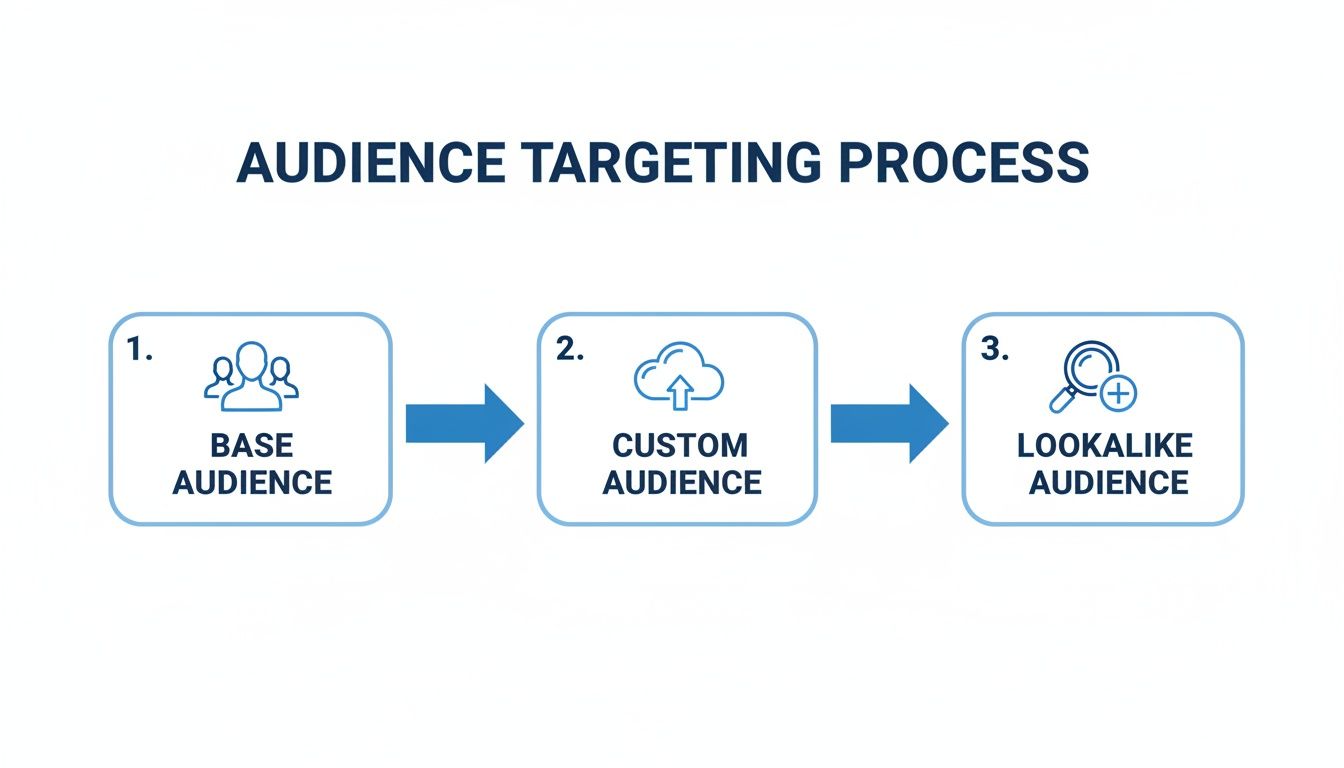
As you can see, you start broad and then use your data to create highly-focused Custom and Lookalike audiences. This ensures the traffic hitting your funnel is qualified from the get-go.
Tracking Conversions to Fuel the Algorithm
Whether you choose a Lead Form or a landing page, none of it matters if you aren't tracking conversions properly. This is how you teach Meta's algorithm what a successful sign-up looks like so it can go out and find more of those people for you.
You’ll need to get two pieces of tech set up:
- The Meta Pixel: A snippet of code that goes on your website. It watches what users do, like view a page or submit your sign-up form.
- The Conversions API (CAPI): This works hand-in-hand with the Pixel. It sends conversion data directly from your server to Meta's, bypassing issues from ad blockers and browser privacy updates that can make the Pixel less reliable on its own.
You absolutely need both the Pixel and CAPI running to make a Sales (Conversions) campaign work. This combination feeds Meta the rich, reliable data it needs to optimize your ad delivery and bring your CPL down over time. Without it, you’re flying blind and burning cash on your facebook ads newsletter campaign.
Before scaling spend, compare your cost per subscriber with the alternatives in our email ads cost guide; newsletter sponsorships often beat paid social for B2B niches.
Measuring Real ROI and Scaling Your Growth Engine
Turning ad spend into a predictable growth machine means looking past the surface-level numbers. A successful Facebook Ads newsletter campaign isn't just about a low Cost Per Lead (CPL). It's about bringing in subscribers who actually deliver business value over the long haul. This is the shift from just running ads to strategically managing a growth engine.
Your work starts in Ads Manager, but it definitely doesn’t end there. The key is to draw a straight line from your front-end ad metrics to your back-end business results. Once you nail this, you can confidently pour fuel on what’s working and cut what isn’t, turning your budget into a powerful investment.
From Ad Metrics to Business Outcomes
First things first, you need to get a handle on the essential metrics inside Meta Ads Manager. These are your early warning signs, telling you if your ads are hitting the mark with your target audience. Don't get lost in the data; just focus on the numbers that really matter for a newsletter campaign.
These front-end metrics are crucial for your day-to-day campaign tweaks. If your Click-Through Rate (CTR) is tanking, you might have ad fatigue. If your CPL is suddenly spiking, it’s probably time to refresh your audience or creative. But these numbers only tell you half the story.
The real measure of success is knowing what each new subscriber is actually worth to your business.
The most critical calculation you can make is your Subscriber Lifetime Value (LTV). Knowing your LTV completely changes your perspective: you're no longer just "spending" on ads; you're investing a specific amount to acquire an asset with a known future value.
Figuring out LTV can be as simple or as complex as you need it to be. At its core, you're just estimating the average revenue a subscriber brings in before they churn. Once you know a subscriber is worth, say, $150 to your business over 12 months, paying $15 to acquire them through an ad suddenly looks like an incredible deal.
For a deeper dive, our comprehensive guide can help you build a newsletter ROI calculator that’s tailored to your specific business model.
To keep your campaigns on track, you need to monitor metrics across the entire funnel. Here’s a breakdown of what to watch and what good looks like in the B2B space.
Key Metrics for Measuring Newsletter Ad Campaign Success
Metric
What It Measures
Good Benchmark (B2B)
How to Improve It
Click-Through Rate (CTR)
Ad relevance and creative appeal.
1% - 2%
Test new headlines, visuals, and copy hooks. Refine your audience targeting.
Cost Per Lead (CPL)
Efficiency of lead acquisition.
$10 - $25
Optimize your landing page/form, improve ad creative, and narrow audience targeting.
Conversion Rate (Leads/Clicks)
How effectively your funnel captures leads.
20% - 30%
Simplify your form, strengthen your value proposition, and ensure mobile-friendliness.
Subscriber LTV
The total long-term value of a subscriber.
Varies (e.g., $150+)
Improve newsletter content, segment your audience, and create targeted offers.
Return on Ad Spend (ROAS)
The revenue generated for every dollar spent.
3:1 or higher
Focus on acquiring high-LTV subscribers and optimize your entire funnel for value.
Tracking these numbers gives you a complete picture, from the initial ad click all the way to the long-term profitability of your subscriber base.
When to Scale and When to Hold Back
With a clear handle on your ROI, you can start making smart calls about scaling. Scaling isn't about blindly cranking up your budget; it's a careful process of expanding on what works without wrecking your performance. The opportunity is massive, considering Facebook's scale with over 3 billion monthly active users and a projected $32.55 billion in US ad revenue for 2024.
Plus, the fact that 38.5% of US users are expected to make a purchase through the platform in 2025 shows a strong commercial intent that translates well to our subscription funnels. You can find more details in this excellent breakdown of Facebook's market statistics.
Here are my go-to rules for scaling smart:
- Boost Budgets on Winning Ad Sets: If an ad set has been stable for 5-7 days and is consistently hitting your target CPL (well below your LTV), it's time to scale. I recommend increasing the budget by just 20% every 2-3 days. Small, slow bumps keep the algorithm happy and prevent it from going back into a chaotic learning phase.
- Duplicate and Broaden Lookalike Audiences: Is your 1% Lookalike audience killing it? Don't touch it. Instead, duplicate the ad set and test a broader 1-3% or 3-5% Lookalike. This lets you tap into a much larger pool of similar people without messing with your original high-performer.
- Introduce Fresh Creatives: Once you have a winning audience, the clock starts ticking on ad fatigue. Get ahead of it by creating 2-3 new ad variations based on what’s already working. Try a different hook, a new image, or a slightly tweaked call-to-action to keep performance from dipping.
Scaling your Facebook ads newsletter campaign is a balancing act. You have to push the winners while constantly testing new variables to find your next breakthrough. Do this right, and your ad account transforms from an expense line into a powerful, repeatable engine for business growth.
Answering Common B2B Newsletter Ad Questions
When you're ready to use Facebook Ads to grow your B2B newsletter, a few questions almost always pop up first. Let's get those out of the way so you can build your first campaign with confidence.
How Much Should I Budget for My First Campaign?
There's no single magic number here. A solid starting point is whatever you're comfortable testing with—think $25 to $50 per day.
The goal at this stage isn't explosive growth. It's data. You're paying to learn what works, what doesn't, and what your initial Cost Per Lead (CPL) looks like. Think of it as a small investment in valuable market intelligence.
Plan to run this initial test for at least 7 to 10 days. That's enough time for the Meta algorithm to find its footing and for you to gather enough data to make smart decisions. After a week or so, you'll have a much clearer idea of whether to scale, tweak your targeting, or go back to the drawing board with new creative.
Can I Really Target Specific Job Titles on Facebook?
Yes, but it's more of an art than a direct science. You can target users based on the "Employer" and "Job Title" fields in their profiles, but relying on that alone can be too restrictive and often misses great prospects.
The real trick is to layer your targeting. A powerful targeting stack combines a few different signals:
- Job Title & Employer Data: Start with the basics by targeting self-reported career information.
- Interest Targeting: Add interests that your Ideal Customer Profile (ICP) would have. Think specific industry publications, professional groups, or even the software tools they use daily, like Salesforce or HubSpot.
- Lookalike Audiences: This is where the magic happens. Upload a list of your best customers or most engaged subscribers and let Meta build a Lookalike Audience. This method often uncovers the highest-quality leads you wouldn't find otherwise.
A high CPL is almost always a symptom of a deeper problem. Before you even think about killing a campaign, you need to diagnose the mismatch. Is your ad creative speaking the right language, or is your audience simply too broad? A quick audit of these two areas will solve the problem nine times out of ten.
My Cost Per Lead Is Too High, What Should I Do First?
Seeing your Cost Per Lead (CPL) creep up can be alarming. It’s a clear signal that there's a disconnect between your ad and your audience. But don't panic and hit the off switch just yet. The fix is usually simpler than you think.
First, take a hard look at your ad creative and copy. Is your value prop crystal clear and compelling? Does your visual stop the scroll? If your message isn't resonating instantly, you're paying for empty impressions, and your costs will reflect that.
Next, review your audience targeting. A high CPL is Meta’s way of telling you that you're spending money to show your ad to people who just aren't interested. If your audience is too broad or poorly defined, you're essentially burning cash. Tighten up your targeting to ensure your message is only reaching the most relevant people.
Ready to turn your newsletter into a lead generation machine without the guesswork? Breaker combines a powerful email platform with an automated subscriber acquisition engine. We find your exact-match B2B audience and deliver engaged subscribers directly to your list. Start your 7-day trial with Breaker today.
Keep reading
All articlesNewsletter Segmentation Strategy: Increase Engagement in 2026
Build a data-driven newsletter segmentation strategy using behavior, intent score, and topic affinity to lift opens and clicks. Step-by-step guide.
How to Grow Newsletter Subscribers with Qualified Leads in 2026
Discover 8 channels to grow engaged newsletter subscribers in 2026, with real cost-per-engaged-subscriber data to focus your list-building strategy.
B2B Lead Generation via Newsletter: What Actually Works
Cold outbound is losing steam. See 7 proven newsletter tactics for B2B lead generation, from gated content to sponsorship swaps, that beat cold outreach.