
10 Email Subject Line Best Practices for B2B Growth in 2026
Master these 10 email subject line best practices. Get data-driven tips, templates, and strategies to boost your B2B newsletter open rates and engagement.
In the crowded world of B2B communication, the subject line isn't just a title—it's the single most critical factor determining whether your message is opened or ignored. A weak subject line renders even the most brilliant email content invisible, wasting resources and capping your growth potential. This is especially true for B2B newsletters where every open represents a potential lead, a retained customer, or a step towards brand authority.
The challenge is that what worked yesterday may not work today; inbox algorithms, mobile devices, and audience expectations are constantly shifting. To truly master email marketing and understand why your subject line is your most important line of code, a deep dive into core Email Subject Line Best Practices is essential. This guide cuts through the noise and gets straight to the point.
We're breaking down 10 proven email subject line best practices, backed by data, real-world examples, and actionable strategies tailored for B2B marketers, product teams, and newsletter creators. You'll learn not just what to do, but how to implement these tactics to drive measurable results: higher open rates, better deliverability, and ultimately, more revenue.
We'll explore everything from advanced personalization and A/B testing frameworks to the psychology of power words and the nuances of compliance, providing a complete playbook for turning your subject lines into your most powerful growth lever. Let's dive into the practices that will get your emails opened, read, and acted upon.
1. Personalization and Dynamic Content in Subject Lines
One of the most effective email subject line best practices is to move beyond generic, one-size-fits-all messages. Personalization involves using subscriber data to dynamically insert relevant information-like a name, company, or recent activity-directly into the subject line. This simple act transforms a mass broadcast into a one-to-one conversation, immediately signaling to the recipient that the content inside is relevant specifically to them.

The core principle is relevance. A subject line that addresses a prospect by name or references their company feels less like an advertisement and more like a direct communication. This approach significantly increases the likelihood of your email being opened amidst a crowded inbox.
Real-World Examples of Personalization
- For B2B Sales:
John, thoughts on improving [Prospect Company Name]'s Q3 pipeline? - For Newsletter Engagement:
Sarah, your weekly [Industry] insights are here - For Product-Led Growth:
Your team at [Company Name] unlocked a new feature!
Actionable Tips for Implementation
To get personalization right, you need a clear strategy and clean data. It’s about more than just inserting a first name; it’s about demonstrating genuine understanding of the recipient's context.
- Start Simple, Then Scale: Begin with first name personalization (
{{first_name}}). Once you confirm its effectiveness, advance to more specific variables like company ({{company_name}}) or job title ({{title}}). - Segment Your Audience: Don't send the same personalized subject line to everyone. Use a tool like Breaker's targeting engine to segment your list by Ideal Customer Profile (ICP), industry, or recent behavior. Tailor the subject line to resonate with each specific group. For example, a subject line for a "Fractional CMO" segment should differ from one for an "Enterprise Sales" segment.
- Always Have a Fallback: Ensure your email service provider is configured with a fallback value (e.g., "there" instead of a blank space) in case a data field like a first name is missing. A subject line like ", check this out" looks broken and unprofessional.
- Test and Validate: Before launching a campaign, send tests to internal accounts to confirm that all dynamic fields are rendering correctly. For a deeper dive into validating your approach, you can explore this guide on email personalization testing.
2. A/B Testing Subject Lines for Data-Driven Optimization
Guesswork has no place in a high-performance email strategy. One of the most critical email subject line best practices is to systematically test variations to see what truly resonates with your audience. A/B testing, or split testing, involves sending two or more subject line versions to small, separate segments of your email list. The version that performs best (typically based on open rate) is then sent to the remainder of your subscribers.
This data-driven approach removes subjectivity and ensures your campaigns are continuously improved based on real engagement data, not just assumptions. By testing, you replace "I think this will work" with "I know this works," leading to better open rates, increased engagement, and more effective communication.
Real-World Examples of A/B Testing
- Benefit vs. Question: ConvertKit found that testing a benefit-driven subject line like
“5 steps to your first 1,000 subscribers”against a question like“Struggling to get your first 1,000 subscribers?”reveals what motivates a specific audience segment more effectively. - Statement vs. Question: A Mailchimp case study showed that question-based subject lines can outperform statement-based ones by a significant margin, sometimes as much as 18%, by sparking curiosity.
- Urgency Indicators: GetResponse data highlights the impact of word choice, showing how testing
“URGENT: Your offer expires tonight”against“FYI: Your offer expires tonight”can dramatically alter open rates.
Actionable Tips for Implementation
Effective A/B testing requires a methodical process to generate reliable insights. It’s about isolating variables to understand exactly what drives performance.
- Test One Variable at a Time: To get clean data, change only one element per test. Test length, tone, personalization, or emoji use, but not all at once. This helps you attribute the change in performance directly to that single variable.
- Use a Statistically Significant Sample: Allocate 10-15% of your list for the A/B test (e.g., 5% for variation A, 5% for B). Send the winning version to the remaining 85-90% of your list.
- Document Everything: Maintain a testing log to track your hypotheses, variations, results, and key takeaways. Over time, this document will reveal powerful patterns about what your audience responds to, informing future campaign strategies.
- Target Your ICP: For the most relevant insights, run tests on segments that match your Ideal Customer Profile (ICP). What works for a general audience may not work for your most valuable prospects. For more details on the right software, explore this comparison of A/B testing tools for B2B email marketers.
3. Strategic Use of Urgency and Scarcity Language
Incorporating time-sensitive or limited-availability language is a powerful method for motivating immediate action. This email subject line best practice works by creating a sense of FOMO (fear of missing out), which encourages recipients to prioritize your message. When used authentically, urgency drives higher open and click-through rates without damaging deliverability or brand trust.

The key is to apply this tactic with genuine constraints. A subject line that signals a real deadline or limited quantity feels helpful and important. This approach cuts through inbox noise by providing a compelling reason for the recipient to act now rather than later.
Real-World Examples of Urgency
- For B2B SaaS:
Stripe: Black Friday sale ends in 24 hours - For Product Upgrades:
Calendly: Limited-time: 50% off annual plans - For B2B Programs:
Y Combinator: Application deadline: 48 hours remaining
Actionable Tips for Implementation
To use urgency effectively, you must balance the drive for action with the need to maintain credibility. Abusing this technique with false deadlines can quickly erode subscriber trust and lead to higher unsubscribe rates.
- Be Explicit and Genuine: Only use urgency when it's real. A subject line with a clear deadline like
48 hours remainingperforms better and is less likely to be flagged as spam than a vague phrase like "Act now!". - Moderate Your Frequency: Avoid sending urgent messages for every campaign. A good rule of thumb is to limit urgent or scarce subject lines to no more than 20-30% of your monthly sends to prevent subscriber fatigue.
- Balance Tone for B2B: For enterprise audiences, pair urgency with a professional tone. A subject line like
Your exclusive Q4 report access expires Fridayis more appropriate thanFINAL CHANCE! Don't miss out!. - Test Against Alternatives: A/B test your urgent subject lines against benefit-focused alternatives. This will reveal how your specific audience segments respond and help you understand when urgency is the right choice.
- Support with Preview Text: Pair your urgent subject line with a preview text that clearly states the value. For example, if the subject is
Limited-time offer ending, the preview text could beSave 50% on your annual plan and unlock new features.
4. Optimal Subject Line Length and Character Count
In email marketing, brevity is a strength. One of the most critical email subject line best practices is managing length, as it directly influences how your message is perceived across different devices. With over half of all emails being opened on mobile, a subject line that gets cut off can lose its impact and appear unprofessional, significantly reducing open rates. The goal is to be concise enough to display fully while remaining clear and compelling.
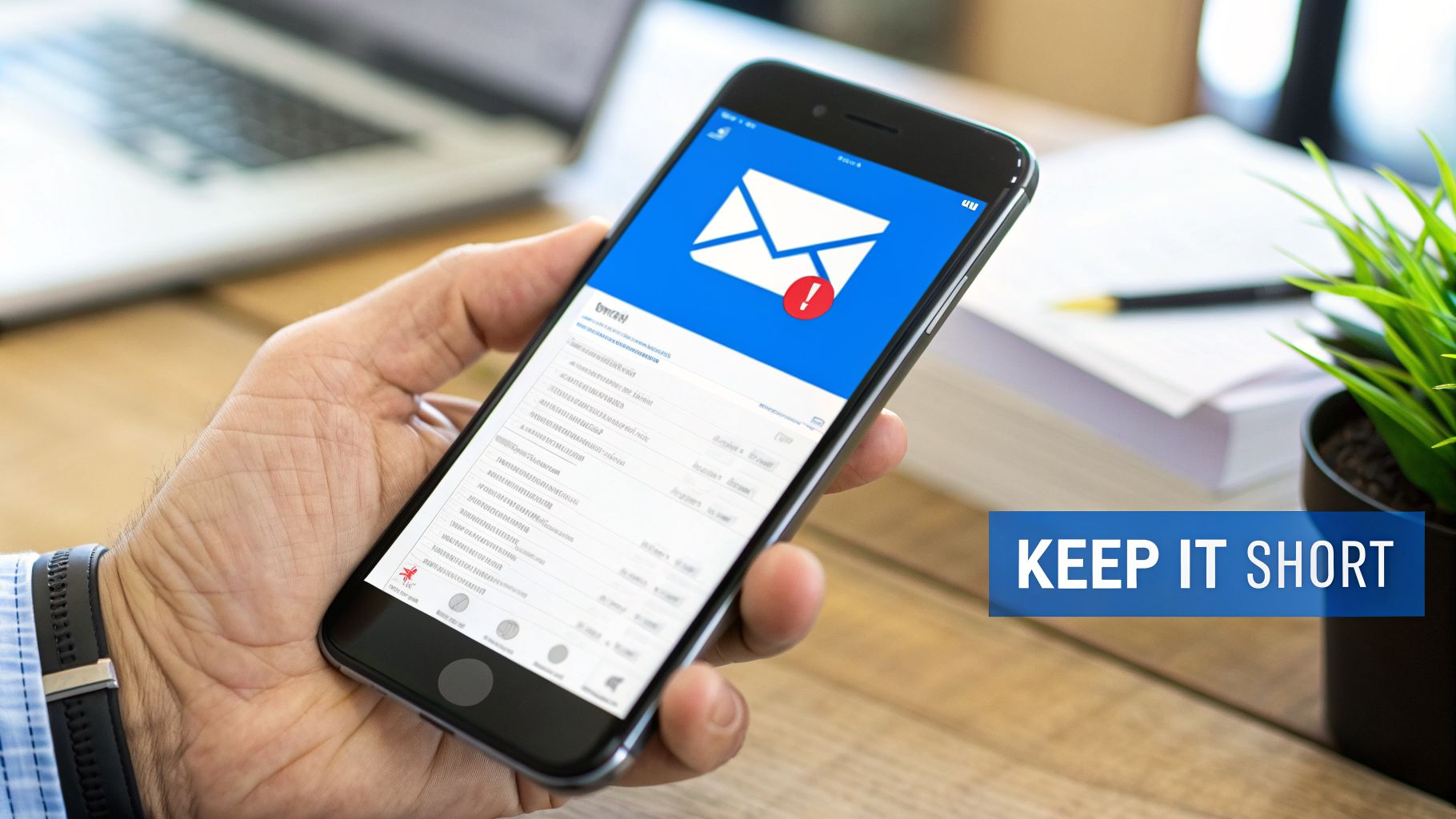
The core principle is front-loading your value proposition. B2B professionals scan their inboxes quickly, making decisions in seconds. A short, powerful subject line respects their time and communicates your core message before they even consider opening the email. This practice is about designing for the most constrained environment-the mobile screen-to ensure maximum impact everywhere.
Real-World Examples of Conciseness
- For Product Alerts:
Slack: 12 new mentions(19 characters) - For Collaboration:
Notion: Share your workspace(25 characters) - For Customer Support:
Intercom: You have new messages(23 characters) - For Newsletters:
HubSpot: Your weekly digest is ready(30 characters)
Actionable Tips for Implementation
Optimizing for length requires a mobile-first mindset and an understanding of how different email clients render subject lines. It's not just about counting characters; it's about strategic placement.
- Target the Sweet Spot: Aim for 35-50 characters to ensure your full message is seen on most mobile devices. This provides enough space for clarity without risking truncation.
- Front-Load Critical Information: Place the most important words and your call to value at the very beginning of the subject line. This ensures the core message is conveyed even if the end is cut off.
- Use Preview Text Strategically: The preview text, or preheader, is the line of text that appears after the subject line in an inbox. Use this valuable real estate to add context, a secondary call-to-action, or details that didn't fit in the subject line.
- Test Mobile Rendering: Always use your email service provider's preview tools to see exactly how your subject line will appear on different devices and clients like iOS Mail and Gmail. Breaker’s email builder, for example, allows you to visualize mobile rendering before you send.
5. Clear Value Proposition in Subject Lines
In a sea of subject lines competing for attention, clarity trumps cleverness. A core email subject line best practice is to immediately articulate the specific benefit or value a subscriber will gain by opening your email. This approach moves away from vague or clickbait-style hooks, instead focusing on transparently communicating the "what's in it for me" (WIIFM) factor.

The principle is simple: your subject line is a promise. By clearly stating the outcome-whether it's saving time, learning a new skill, or gaining a competitive edge-you build trust and attract higher-quality opens from genuinely interested subscribers. This ensures the people who click are the ones most likely to engage with the content inside.
Real-World Examples of Value Propositions
- For Productivity & SaaS:
Loom: Record and share video explanations in seconds - For Content & Newsletters:
Gong: 5 sales objection responses that actually work - For Product Discovery:
ProductHunt: Today's top 5 tech products for your team
Actionable Tips for Implementation
Crafting a value-driven subject line requires you to think from your audience's perspective. What problem are you solving for them right now? Focus your message on that solution.
- Lead with the Outcome: Frame the subject line around the benefit, not just the topic. Instead of "Our New Workflow Guide," use "How to automate your workflow in 15 minutes."
- Use Numbers and Specifics: Quantifiable details make the value proposition more tangible and believable. Phrases like "5 ways," "10-minute read," or "30% increase" are more compelling than general statements.
- Match the Promise to the Content: Never oversell or make a claim in the subject line that your email body doesn't deliver on. This is the fastest way to lose subscriber trust and harm your sender reputation.
- Emphasize ROI for B2B: When writing for B2B audiences, center the value on outcomes that matter to businesses: increased revenue, time savings, reduced costs, or a clear competitive advantage. Your preview text can then briefly explain how or why it matters.
6. Industry and Role-Specific Language Targeting
Using language that speaks directly to a recipient's professional world is one of the most powerful email subject line best practices. This means going beyond general business terms and using the specific terminology, challenges, and acronyms familiar to your target industry or job role. This technique signals that your content isn't just a generic blast but was created with their specific context in mind, establishing immediate relevance and credibility.
An email to a SaaS CFO will perform better with a subject line about "reducing cloud infrastructure costs" than one about "saving money." The first one uses their exact language and addresses a known pain point, making the message feel like it's coming from a knowledgeable peer. This level of specificity dramatically increases open rates by showing you understand their world.
Real-World Examples of Role-Specific Language
- For SaaS CFOs:
Reduce cloud infrastructure costs by 40% - For E-commerce Founders:
3 strategies to improve your repeat purchase rate - For Sales Leaders:
Cut sales cycle length from 90 to 60 days - For Product Managers:
A feature prioritization framework from Figma's PM team
Actionable Tips for Implementation
Targeting by role and industry requires research and a commitment to understanding your audience segments on a deeper level. The goal is to reflect their daily conversations back to them in the subject line.
- Map Your ICP Language: For each Ideal Customer Profile (ICP) segment, create a "lexicon" of common pain points, goals, and technical terms. You can find this language in industry forums, LinkedIn groups, and by conducting interviews with current customers.
- Segment for Precision: Use a tool with custom targeting capabilities, like Breaker, to define precise segments by job title, company size, and industry. This allows you to deploy highly specific subject lines to the right people. For example, a "VP of Engineering" segment gets a different subject line than a "Head of DevOps."
- Test Specificity vs. Generality: Run A/B tests to measure the impact. Pit a role-specific subject line (e.g.,
New SOC 2 compliance workflow for FinTech) against a more general one (e.g.,Improve your security compliance) to quantify the performance lift. - Combine with Personalization: The most effective approach combines role-specific language with personalization. For example:
{{first_name}}, a new framework for your product team's feature prioritization.
7. Power Words and Emotional Triggers
Another key email subject line best practice involves strategically using "power words" and emotional triggers. These are specific, psychologically-effective words that are proven to provoke an immediate response, such as curiosity, urgency, or excitement. Integrating these words can dramatically increase your open rates by making your subject line stand out in a crowded inbox and connecting with the recipient on an emotional level.
The goal isn't to be sensational or deceptive, but to accurately frame your content in the most compelling way possible. The right power word signals significant value and grabs attention, convincing the subscriber that the email is worth their time. Context and authenticity are critical; the power word must align with your brand and the actual content of the email to build long-term trust.
Real-World Examples of Power Words
- For Educational Content:
ConvertKit: 'Theultimateguide to...'(Ultimate implies comprehensiveness) - For Authority Building:
Neil Patel: 'Provenstrategies for...'(Proven builds credibility) - For Evoking Curiosity:
Copy Hackers: 'Thesecretto...'(Secret creates an information gap) - For Announcing Innovation:
HubSpot: 'Breakthroughinsights for...'(Breakthrough suggests new, valuable information)
Actionable Tips for Implementation
Using power words effectively is more science than art. It requires a thoughtful approach to ensure your subject lines are compelling without sounding like clickbait.
- Choose Words for Your Audience: The most effective power words vary by industry. For B2B audiences, focus on credibility and results with words like Proven, Data-driven, Official, or Blueprint. For B2C or creative audiences, words that evoke exclusivity or curiosity, such as Secret, Exclusive, or Insider, may perform better.
- Combine with a Clear Value Proposition: A power word alone is not enough. Your subject line must still clearly communicate the benefit to the reader. A subject like
Proventactics to increase lead qualityis much stronger than justProventactics. - Rotate and Test Frequently: Overusing the same power words can lead to recipient fatigue and diminish their impact. Keep a running list of effective words for your audience and rotate them through your campaigns. A/B testing is essential to identify which words consistently drive opens and, more importantly, engagement.
- Match Intensity to Brand Voice: Ensure the power words you select align with your brand's personality. A conservative financial services firm might avoid "mind-blowing," while a high-energy marketing agency could use it effectively. The intensity of the word must match the recipient's expectations of your brand.
8. Question-Based Subject Lines for Engagement
One of the most effective email subject line best practices involves framing your message as a question. This technique works by stimulating cognitive engagement and natural curiosity. A well-posed question prompts the recipient's brain to search for an answer, turning a passive scan of their inbox into an active mental process that encourages an open.
The power of a question lies in its ability to create a small, unresolved loop in the reader's mind. Unlike a declarative statement, a question invites a response, even if it's just an internal "yes" or "no". This makes it an excellent tool for grabbing attention and making the recipient feel involved before they even open the email.
Real-World Examples of Question-Based Subject Lines
- For B2B Marketing:
Are you targeting the right audience? - For SaaS Companies:
What if you could predict customer churn? - For Productivity Tools:
Tired of scheduling back-and-forth emails? - For Thought Leadership:
Want to organize your life like a CEO?
Actionable Tips for Implementation
Using questions effectively requires a strategic approach; they must feel relevant and genuine, not like a cheap trick. The goal is to start a conversation, not to ask something so obvious it feels manipulative.
- Prioritize Relevance: Ask questions that directly address a known pain point, challenge, or aspiration of your target segment. The more relevant the question, the stronger the pull to find the answer inside.
- Aim for an Internal "Yes": The most effective questions are those a subscriber would mentally answer "yes" to. A subject line like
Struggling to generate qualified leads?immediately resonates with a marketer facing that exact problem. - Pair with a Benefit: Use your email's preview text to hint at the solution or benefit. For example, a subject line of
Can your team close deals faster?can be followed by a preview text that reads, "Our new integration automates the proposal process." - Test and Measure: Don't assume questions will always outperform statements. A/B test your question-based subject lines against declarative alternatives to quantify their impact on open rates and engagement for your specific audience.
- Moderate Your Frequency: Avoid overusing this tactic. If every email you send asks a question, the effect will diminish. A good rule of thumb is to limit question-based lines to around 25-30% of your monthly sends to keep them fresh and impactful.
9. Compliance and Avoiding Spam Trigger Words
A critical component of email subject line best practices is understanding what not to say. Avoiding language and formatting that triggers spam filters is essential for deliverability. Internet service providers (ISPs) and email clients use sophisticated algorithms to flag subject lines that appear deceptive, overly aggressive, or characteristic of phishing attempts, often sending them directly to the spam folder where they will never be seen.
This practice is about more than just avoiding a few "bad" words; it’s about adhering to email regulations like CAN-SPAM and GDPR. Maintaining compliance protects your sender reputation and keeps your business on the right side of the law. A subject line that respects these rules signals professionalism and trustworthiness to both filters and recipients.
Real-World Examples of Spam Triggers
- High-Risk Phrases:
Free!!!,You're a WINNER!!!,Click here now,$$$ - Better, Safer Alternatives:
Your no-cost resource,Congratulations on your progress,Learn more inside - Risky Urgency:
Verify your account immediately! - Safe & Professional:
Action Required: Update Your Account Information
Actionable Tips for Implementation
To ensure your subject lines are clean and compliant, you must be intentional with your word choice and formatting. This proactive approach is key to long-term deliverability success.
- Minimize Risky Formatting: Avoid using ALL CAPS, excessive exclamation points (!!!), or special characters (like $$$). These are classic red flags for spam filters.
- Promise What You Deliver: Your subject line must accurately reflect the content of your email. Making false or exaggerated claims is a quick way to damage trust and get marked as spam.
- Maintain List Hygiene: Ensuring high deliverability is not just about avoiding spam trigger words; it also involves actively verifying your recipient list. A master guide on how to check email address is valid can significantly protect your sender reputation.
- Stay Legally Compliant: A clear unsubscribe link is a legal requirement in most jurisdictions. To ensure you're meeting all criteria, review this guide on CAN-SPAM Act requirements for B2B marketers.
- Test Before Sending: Use a spam-checking tool to test your subject lines before a major send. These tools can analyze your content and score its likelihood of triggering filters, allowing you to make adjustments.
10. Using Numbers, Data, and Specificity for Credibility
One of the most effective email subject line best practices for cutting through inbox noise is to anchor your message with concrete data. Incorporating numbers, statistics, and specific details signals precision and credibility. Generic claims are easy to ignore, but a subject line with a quantifiable outcome immediately captures attention because it feels tangible and verifiable.
This approach works because numbers stand out visually and psychologically. The human brain is wired to notice digits amidst a sea of letters, and specific figures suggest that the content inside is backed by research or real results, not just marketing fluff. This instantly builds a foundation of trust before the recipient even opens the email.
Real-World Examples of Specificity
- For Newsletter Growth:
ConvertKit: 47 creators earned 6-figures last year - For B2B Integrations:
Zapier: 6,000+ integrations in your workflow - For Productivity Tools:
Airtable: Reduce project planning time by 18 hours per week - For Sales Enablement:
Gong: 8 objections and how top closers handle them
Actionable Tips for Implementation
To use numbers effectively, you must present them with clarity and context. The goal is to make your claim believable and relevant to the recipient’s own challenges or goals.
- Use Precise Figures: Opt for specific numbers over rounded ones. "47 creators" sounds more authentic and data-driven than "Around 50 creators." This small detail adds a layer of credibility to your claim.
- Source Your Data Transparently: Your numbers should come from verifiable sources like original research, customer case studies, or internal product data. This ensures you can back up your subject line’s promise within the email body.
- Lead with the Number: Place the statistic or digit at the beginning of your subject line for maximum visual impact. This makes it the first thing a recipient sees while scanning their inbox.
- Focus on Business Metrics: For B2B audiences, frame your data around key performance indicators they care about. Emphasize ROI, time saved, revenue growth, or efficiency gains to connect directly with their business objectives.
- Include Units for Clarity: Always specify the unit of measurement to avoid ambiguity. Clearly state if a number refers to a percentage (%), hours, or dollars to give the data immediate context.
10-Point Email Subject Line Best Practices Comparison
Tactic
Complexity 🔄
Resource Requirements ⚡
Expected Outcomes 📊
Ideal Use Cases 💡
Key Advantage ⭐
Personalization & Dynamic Content in Subject Lines
Medium–High: templating and data integration
High: clean subscriber data, CRM/AI enrichment, tagging
Higher open rates (≈20–50%), improved retention & engagement
B2B growth at scale, account-based campaigns
Delivers individualized relevance that boosts opens
A/B Testing Subject Lines
Medium: design tests & track stats
Medium: analytics, sufficient list size, testing cadence
Incremental, measurable lift; data-driven winner selection
Continuous optimization, large-list sends
Removes guesswork with empirical improvements
Urgency & Scarcity Language
Low–Medium: copy-focused but must be authentic
Low–Medium: offer coordination, deadline tracking
Short-term spikes in CTR and conversions
Product launches, webinars, limited-time offers
Prompts immediate action via FOMO when genuine
Optimal Subject Line Length & Character Count
Low: editorial rules and preview checks
Low: mobile/desktop previews and basic tooling
Better mobile visibility and higher mobile open rates
Mobile-first audiences, executive newsletters
Ensures subject lines aren’t truncated, improving clarity
Clear Value Proposition in Subject Lines
Low–Medium: alignment with content required
Medium: tight copywriting and content coordination
Higher-quality opens, lower spam complaints, better trust
Educational emails, newsletters, credibility-driven sends
Sets clear expectations and builds long-term trust
Industry & Role-Specific Language Targeting
High: deep segment knowledge & multiple variants
High: research, segment definitions, template management
Strong relevance and higher conversion in target segments
Account-based marketing, persona-driven outreach
Highly targeted messaging that attracts qualified opens
Power Words & Emotional Triggers
Low: copy tweaks with moderation
Low: copywriting and rotation/testing
Short-term open-rate lifts; effectiveness decays if overused
Quick optimizations, headline refreshes across campaigns
Cost-effective boost when matched to audience tone
Question-Based Subject Lines
Low–Medium: depends on question relevance
Low: copy testing and audience insight
Increased cognitive engagement and CTR when relevant
Thought leadership, educational CTAs, webinars
Encourages mental engagement and curiosity-driven opens
Compliance & Avoiding Spam Trigger Words
Medium: requires policy awareness & checks
Medium: deliverability tools, SPF/DKIM/DMARC, list hygiene
Better inbox placement, protected sender reputation
All B2B sends, compliance-sensitive programs
Preserves deliverability and legal compliance
Using Numbers, Data & Specificity
Low–Medium: needs accurate sourcing & clarity
Medium: access to data, case studies, verification
Higher credibility and open rates (≈20–30%) when accurate
ROI-driven campaigns, case studies, benchmarks
Conveys precise, trustable value that attracts attention
From Best Practices to Consistent Performance
Mastering the art and science of the inbox doesn't happen overnight. The ten strategies we've explored, from Personalization and Dynamic Content to the Strategic Use of Numbers and Data, represent the core components of a successful email program. Yet, viewing these as a simple checklist to be completed is a mistake. True mastery comes from internalizing these principles and building a repeatable, adaptable system for your B2B growth engine.
Think of it this way: a single great subject line might get you a one-time boost in open rates. A system built on these email subject line best practices delivers predictable engagement, campaign after campaign. This is where the most effective B2B marketers, fractional CMOs, and newsletter creators separate themselves from the noise. They don't just guess what works; they create a feedback loop.
Building Your Subject Line System
The journey from inconsistent results to predictable performance involves shifting from isolated tactics to an integrated process. The key is to connect the dots between the practices we've covered.
- Combine Personalization with A/B Testing: Don't just test generic subject lines against each other. Test a personalized version (
[First Name], your Q3 marketing plan) against a question-based one (Is your Q3 marketing plan ready?). This tells you not just what works, but why it works for specific segments. - Balance Urgency with Value: The power of a deadline (
[Webinar] 24 hours left to register) is amplified when the value is crystal clear ([Webinar] Drive 20% more pipeline: 24 hours left). Merging these two principles creates a compelling reason to act now. - Integrate Deliverability with Specificity: Avoiding spam filters isn't just about deleting trigger words. It's about earning your place in the primary inbox. A highly specific, credible subject line like "Case Study: How Acme Corp. cut support tickets by 34%" is inherently more deliverable than a vague, salesy one like "BIG SAVINGS INSIDE!".
This systematic approach is what turns an email list from a simple audience into a powerful asset. You begin to understand the unique psychological triggers of your ideal customers, whether they are enterprise sales leaders or product-led growth teams. You learn what language resonates, what data points build credibility, and what questions spark genuine curiosity.
The ultimate goal is not just to write a better subject line. It's to build a better, more meaningful relationship with every single subscriber. Each email is a chance to prove you understand their challenges and can provide real solutions.
Ultimately, your commitment to continuous improvement is the most critical factor. By dedicating time to analyze your metrics, test new hypotheses, and refine your approach based on real data, you transform your email marketing from a shot in the dark into a reliable driver of engagement and revenue. The path forward is clear: start with one or two of these best practices, measure the impact, learn from the results, and build from there. Over time, this disciplined process will compound, solidifying your brand's authority and creating a powerful, direct line to your most valuable prospects and customers.
Ready to stop guessing and start targeting? Breaker helps you acquire exact-match subscribers based on your ICP and then enriches their profiles with AI-powered data, giving you the precise information needed to write hyper-personalized subject lines that convert. Turn your newsletter into a predictable growth channel by visiting Breaker and seeing how our platform operationalizes these best practices at scale.
Keep reading
All articlesNewsletter Agency Services: How Agencies Scale Client Newsletters
Managing multiple client newsletters? Learn what a true newsletter agency platform needs to prevent list mixing, voice drift, and invisible ROI.
Building Owned Audiences: Move Followers to Your Newsletter in 2026
Social platforms can vanish overnight. Learn how to convert Instagram, TikTok, and YouTube followers into a newsletter list you actually own.
Newsletter Analytics: Which Metrics Actually Matter in 2026
Open rate and clicks don't predict buyers. Learn the 7-step method to track click depth, recency, and topic affinity for a revenue-predictive intent score.