
Email Marketing for Lead Generation That Drives B2B Revenue
Master email marketing for lead generation with our B2B guide. Learn to build automated campaigns that turn prospects into measurable revenue and drive growth.
Email marketing isn't just another channel—it's the most direct and powerful way to turn an audience into revenue. This makes it the absolute core of any serious B2B lead generation strategy. It gives you a direct line to potential customers, letting you nurture their interest over time and guide them toward a sale with content they actually find valuable. Think of it as building a relationship, one inbox at a time.
Building Your B2B Email Lead Generation Foundation
Before a single email goes out, the groundwork you lay determines whether your campaign soars or sinks. This is where we get past the generic advice and dig into the strategic details that separate high-performing B2B campaigns from the ones that fall flat.
Success starts with a solid foundation, which means effectively building a B2B email database. A high-quality list is your most valuable marketing asset, and building it with precision is non-negotiable.
To put it simply, a solid email lead gen program is built on a few core pillars. Getting these right from the start saves you countless headaches down the road.
Pillar
Objective
Key Action
Strategy
Define who you are targeting and why.
Develop a detailed Ideal Customer Profile (ICP) based on your best customers.
Execution
Build and maintain a high-quality list.
Implement targeted list-building tactics and strict data hygiene protocols.
Optimization
Ensure your message gets delivered and read.
Focus on deliverability, compelling content, and clear calls-to-action.
These components work together to create a system that doesn't just send emails but generates real, qualified leads.
Define Your Ideal Customer Profile
Your entire strategy rests on knowing exactly who you're talking to. An Ideal Customer Profile (ICP) isn't just a buyer persona; it's a detailed description of the perfect company you want as a customer.
To get razor-sharp with your ICP, dig into your best existing customers. Look for the common threads across these areas:
- Firmographics: What industry, company size, and geographic location do they share?
- Technographics: What specific technologies are they using that make them a great fit for your solution?
- Pain Points: What business challenges are they all trying to solve—the ones your product directly addresses?
A well-defined ICP ensures your message actually connects with decision-makers who have the authority and budget to buy. It stops you from wasting time and money on leads that will never convert.
Your ICP is your north star. Every email, every subject line, and every call-to-action should be created with this specific profile in mind. Without it, you're just sending emails into the void.
Focus on High-Quality List Building
Once you know who to target, it’s time to build your list. The goal here is quality over quantity. You want engaged subscribers, not just a vanity metric.
This is where data hygiene and compliance become your best friends. We have a whole guide covering powerful email list building strategies you should check out.
The sheer volume and engagement potential of email make it a lead generation powerhouse. Daily sends are projected to hit 392.5 billion in 2026 and climb to 523 billion by 2030, driven by 4.6 billion global users. This explosion highlights just how durable email really is.
It's no surprise that 69.2% of marketers use email in their top channels. While average click-through rates hover around 2-3.5%, click-to-conversion rates jumped 28% in 2026, proving that those clicks are leading to real action. This is why 49% of B2B marketers are laser-focused on generating more leads, and 84% use forms to turn visitors into sales-ready prospects.
Ultimately, a strong foundation combines a crystal-clear ICP with a clean, targeted, and compliant email list. This one-two punch ensures your message not only reaches the right inbox but also speaks directly to the needs of your most valuable potential customers, setting the stage for everything that follows.
A great email list is a solid start, but it's only half the job. Now comes the real work: writing emails that your Ideal Customer Profile (ICP) will actually open, read, and act on. This isn't about flashy designs or clever taglines. It’s about delivering clear, tangible value that speaks directly to a B2B buyer’s very real challenges.
A high-converting B2B email gets straight to the point. It grabs attention, presents a solution to a known problem, and gives a clear next step. Every single element, from the subject line down to your signature, has to work together to guide your reader toward that one specific action.
Nail the Subject Line
Let’s be honest: your subject line is the gatekeeper. In a B2B inbox overflowing with noise, it has to be sharp enough to earn the click.
Forget about clickbait. B2B decision-makers are short on time and high on skepticism. Your only goal here is to be relevant and clear.
- Focus on the Value: What are they getting out of it? "Your Q3 Manufacturing Efficiency Report" works much better than "Our New Whitepaper."
- Create Authentic Urgency: Use time-sensitive language that’s actually true. Think "Registration closes Friday" or "Your demo link expires in 24 hours."
- Spark Curiosity: Ask a question that hits on one of their known pain points. For example, "Is manual invoicing slowing your team down?"
Personalization is also a huge advantage. Just including the recipient's company name in the subject line can bump open rates by as much as 18% in B2B sends. A platform like Breaker can automate this for you, making it an easy win.
Structure Body Copy for Scanners
Once the email is open, you have just a few seconds to keep their attention. The hard truth is that busy professionals don't read emails—they scan them. Your content has to be built for this behavior.
Keep your paragraphs short and use bullet points and bold text to make key information pop. The copy should follow a simple, logical path. First, show you get their world by acknowledging a specific pain point. Then, briefly introduce how your solution fixes that exact problem. Finally, back it up with a piece of proof, like a key stat or a link to a case study.
A great B2B email is like a quick conversation with a trusted advisor. It gets straight to the point, offers a solution, and respects the reader's time. Don't try to tell your entire company story in one email.
Design Calls-to-Action That Actually Drive Action
The Call-to-Action (CTA) is where email marketing for lead generation really happens. It needs to be specific, action-oriented, and feel low-effort. Vague CTAs like "Learn More" or "Click Here" are absolute conversion killers.
Instead, tell the reader exactly what to expect when they click. The difference is night and day.
Weak CTA
Strong CTA
Why It Works
Learn More
Get Your Free Demo
Sets a clear expectation of a product demonstration.
Download
Download the 2024 Report
Specifies the asset and makes it feel tangible.
Submit
Request My Custom Quote
Uses "My" to create ownership and clarifies the outcome.
A/B testing isn't just a "nice-to-have" practice; it's a revenue multiplier. One study of 5,000 campaigns found that marketers who A/B tested their subject lines consistently saw a 28% average jump in open rates. Even better, those who also tested their CTA button copy and placement saw a 42% higher click-through rate.
We've seen this in action. One SaaS company boosted conversions by 112% just by changing a CTA from "Learn More" to "Get Your Free Demo." Platforms that make this kind of testing easy are critical for squeezing every drop of ROI out of your campaigns, and you can see more data on the impact of A/B testing on ActiveCampaign.com.
Building and Scaling Your Automated Lead Engine
Sending a powerful, one-off email is a solid start. But the real magic in email marketing for lead generation happens when you build a scalable engine that works for you 24/7. This is where automation comes in, turning your manual efforts into a predictable stream of revenue.
The whole idea is to create automated workflows that guide leads from their first sign-up all the way to being sales-ready. These sequences run quietly in the background, delivering the right message at the right time and moving prospects along their buying journey—all without you having to hit "send" every single time.
Designing Essential Automated Workflows
Not all automated sequences are built the same. For B2B lead generation, there are a few core workflows that are absolutely non-negotiable if you want to build relationships and drive action at scale.
You can get started with just these three fundamental campaigns:
- The Welcome Sequence: This is your first impression, so make it count. Instead of a single "thanks for subscribing" email, design a 3-5 part series. Your goal is to introduce your brand, set expectations, deliver immediate value (like a link to a top-tier resource), and nudge them toward a small action, like following your company on LinkedIn.
- The Lead Nurturing Funnel: This is where the real education and persuasion happen. You can trigger this sequence when a lead takes a specific action, like downloading a whitepaper. From there, the funnel should deliver related content that speaks to their original pain point, subtly introduces your solution, and builds the case for a sales call.
- The Re-Engagement Campaign: Let's be honest, not every lead will stay engaged. This automated workflow is designed to target subscribers who haven't opened or clicked your emails in a while (say, 90 days). It usually offers a compelling incentive, asks for feedback, or simply asks if they still want to hear from you—which is also great for keeping your list clean.
Think of automation as your best salesperson's digital twin. It remembers every prospect's context, delivers the right message at the right time, and never forgets to follow up. It’s the key to scaling personal-touch marketing.
Building these flows is much simpler than it sounds. For example, a platform like Breaker lets you map out these sequences with an intuitive workflow builder, where you can set triggers and timing with just a few clicks.
Managing Your List for Long-Term Growth
As your list grows, keeping it clean and organized becomes mission-critical. A messy list tanks your deliverability, skews your metrics, and just flat-out wastes your time. Scalable list management really comes down to two key practices: segmentation and hygiene.
Segmentation is simply the art of dividing your audience into smaller, more focused groups based on what they have in common. This lets you send hyper-relevant content, which naturally drives up engagement.
Here are a few powerful B2B segmentation strategies that work:
- By Firmographics: Grouping leads by company size, industry, or location. A startup’s needs are worlds apart from an enterprise’s.
- By Behavior: Creating segments based on what people do, like which lead magnets they’ve downloaded or which pricing pages they’ve viewed.
- By Funnel Stage: Separating new subscribers from Marketing Qualified Leads (MQLs) and Sales Qualified Leads (SQLs) so you can tailor your messaging perfectly.
This flow shows how a straightforward email sequence can move a prospect from awareness to conversion with the right messaging at each stage.
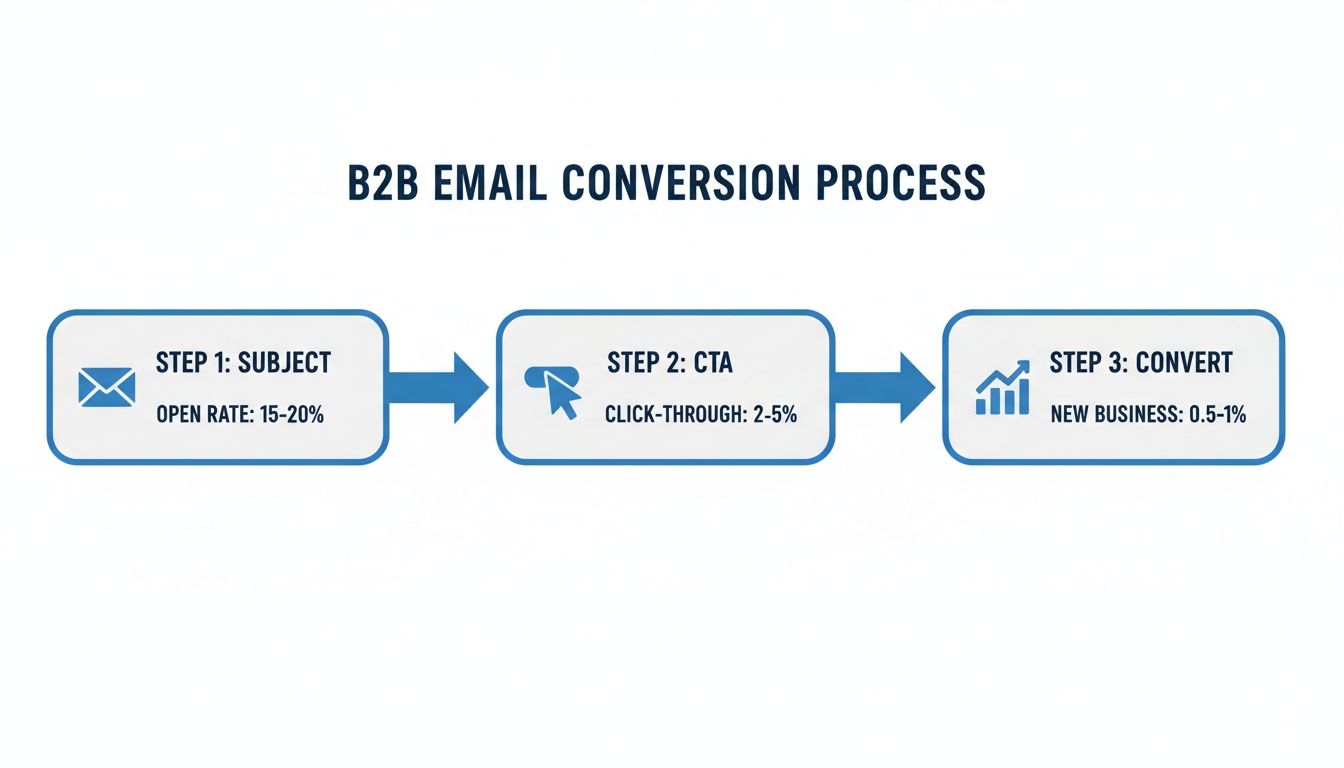
As you can see, a great subject line earns the open, a clear CTA drives the click, and a relevant offer secures the conversion. Simple, but incredibly effective.
This is where automation and segmentation truly shine together. By combining them, you create a system that ensures the right leads get the right message at exactly the right moment. For a deeper look at how this works in practice, check out our guide on B2B marketing automation.
The data doesn't lie: email marketing is a lead generation powerhouse. A massive 48% of marketers call it their most effective tactic, putting it ahead of website landing pages (44%) and even content marketing (43%). What's more, 78% of B2B companies depend on email campaigns to generate leads, with 42% calling it their absolute top-performing channel. The impact of nurturing is huge, too—marketers who use multi-step sequences can capture up to 76% more leads than those sending just a single email, all while seeing an incredible 36:1 ROI. You can find more lead generation stats and insights on EmailToolTester.com.
Mastering Deliverability to Land in the Inbox
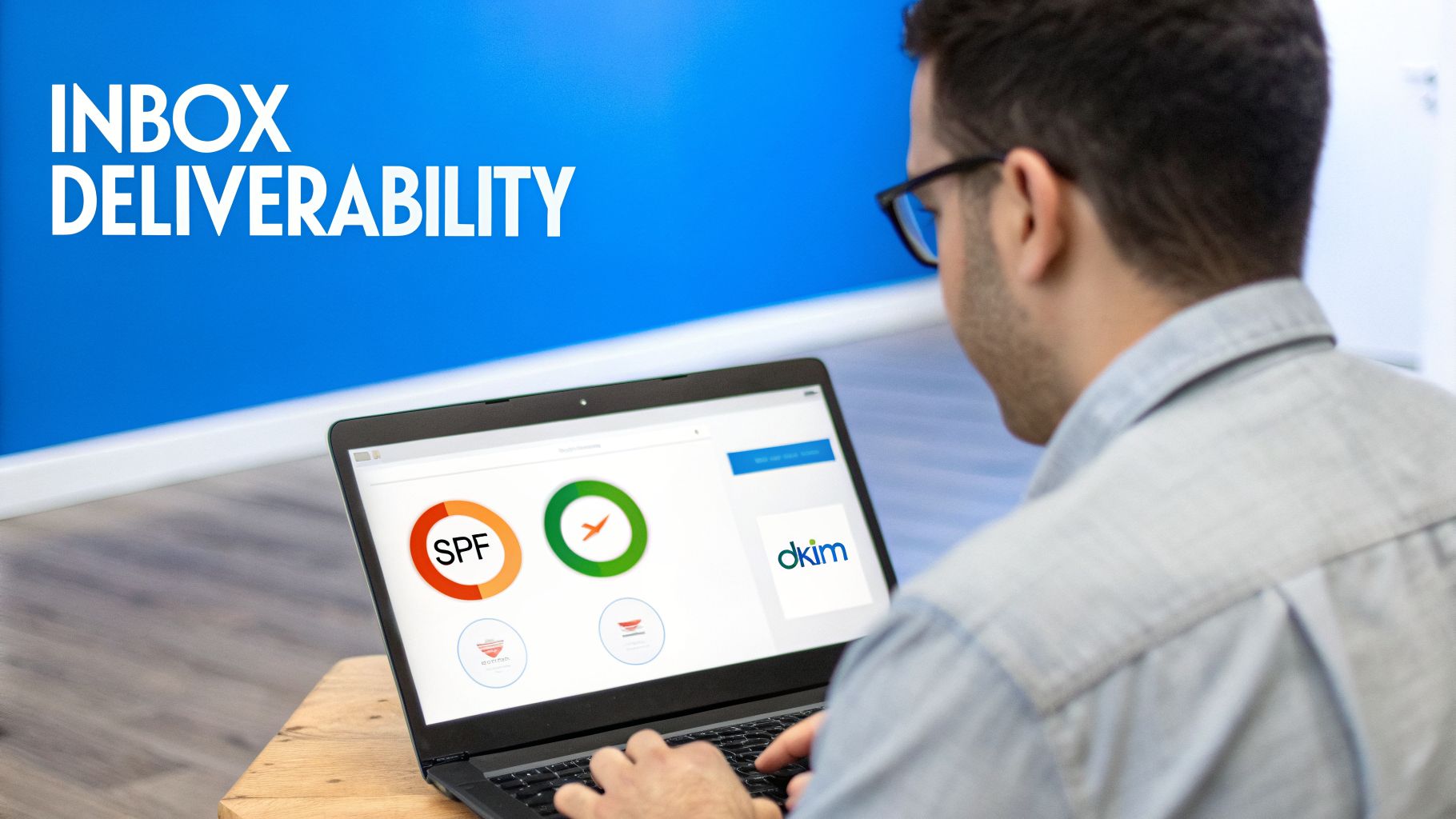
Let’s be honest. The most creative, brilliantly written email campaign is a total waste if it lands in the spam folder. Your entire email marketing for lead generation strategy lives or dies by one critical factor: deliverability.
This is the technical stuff that builds trust with inbox providers like Gmail and Outlook, proving you’re a legitimate sender. Think of it as earning your way past the digital gatekeepers. Get this right, and your campaigns have a fighting chance. Get it wrong, and you’re invisible.
Understanding Your Sender Reputation
At the heart of deliverability is your sender reputation. It’s basically a credit score for your sending domain. Internet Service Providers (ISPs) use it to decide if your emails are welcome or if they should be sent straight to junk. A low score gets your messages blocked.
A few things have a huge impact on this score:
- Sending Volume and Consistency: Suddenly blasting out thousands of emails looks suspicious. It’s always better to ramp up your sending volume gradually.
- Spam Complaints: This is a direct hit to your reputation. If people mark your emails as spam, ISPs notice immediately. A complaint rate above 0.1% is a major red flag.
- Engagement Rates: High open and click-through rates tell ISPs that your content is valuable and wanted.
This isn’t a one-and-done task; you have to manage your reputation constantly. Platforms like Breaker make this easier with built-in monitoring like TruSend, which helps you watch these signals and keep your score in a healthy range.
The Non-Negotiable Technical Trio: SPF, DKIM, and DMARC
Authenticating your domain is like showing your ID at the door—it proves to receiving mail servers that you are who you say you are. Three key records work together to make this happen.
First, you have SPF (Sender Policy Framework). This is a public list of the mail servers authorized to send emails from your domain. Next is DKIM (DomainKeys Identified Mail), which adds a digital signature to your emails to prove the content wasn't altered along the way.
Finally, DMARC (Domain-based Message Authentication, Reporting & Conformance) ties it all together. It tells inbox providers what to do with emails that fail SPF or DKIM checks—like rejecting them or sending them to spam—and gives you reports on your email activity.
Deliverability is the bedrock of email ROI, yet it's often overlooked. A recent analysis found that companies without proper SPF, DKIM, and DMARC authentication see an average inbox placement rate of just 72%, compared to 94% for those with full authentication.
Setting up these records is absolutely fundamental. Without them, you’re basically telling inbox providers you don’t care about security, which makes it much harder to reach anyone. Especially for Gmail, learning how to stop email from going to spam in Gmail is crucial for getting seen.
Proactive List Hygiene and Monitoring
Your email list isn't static; it needs constant attention. List hygiene is the practice of regularly cleaning out your subscribers, and it's essential for keeping your deliverability strong.
Every time you send to an invalid or inactive email address, you risk a bounce. High bounce rates will tank your sender reputation faster than almost anything else.
A good hygiene routine means regularly removing subscribers who haven’t engaged in a while and using validation services to check new sign-ups at the source. For a deeper dive, our guide on email deliverability best practices covers more advanced strategies.
By focusing on these technical details, you ensure your carefully crafted messages actually get seen, turning your email program into a reliable engine for B2B growth.
Measuring Success and Optimizing for Revenue
So, how do you prove your email marketing is actually making the business money? Opens and clicks are fine for a quick health check on a campaign, but they don't tell the whole story. To really show your value and get that executive buy-in, you have to connect your email efforts directly to revenue.
This means shifting your focus from surface-level engagement to the metrics that truly matter to the bottom line. It’s about tracking a lead’s entire path, from that first email click all the way to the final sale, and proving how your campaigns helped get them there. Your goal is to speak the language of the C-suite: profit, cost, and return on investment.
Key Performance Indicators That Matter to the C-Suite
When you're reporting on the impact of your email marketing for lead generation, you need to frame your results in terms of business outcomes. Executives care about growth and efficiency, not just how many people opened your email.
Here are the core metrics you should be tracking and reporting on:
- Customer Acquisition Cost (CPA): This is your total email marketing spend—platform fees, content creation, list acquisition—divided by the number of new customers you landed through email. A low CPA from email is undeniable proof of its efficiency.
- Customer Lifetime Value (LTV): This metric projects the total revenue a customer will bring in over their entire relationship with your company. A high LTV from customers acquired via email shows you’re attracting the right kind of high-value clients.
- Lead-to-Customer Conversion Rate: Of all the leads your email campaigns generated, what percentage actually became paying customers? This metric directly measures the quality of the leads your emails are bringing in.
- Return on Investment (ROI): This is the ultimate metric. Calculate it by taking the revenue generated by email, subtracting your total investment, and then dividing that by the investment. A high ROI is the clearest signal that your program is a success.
Tracking these KPIs properly requires a tight integration between your email platform and your CRM. A platform like Breaker that seamlessly connects with major CRMs automates this data flow, giving you a clear view of the financial impact of every single campaign.
Tying Email Activity to Sales Revenue
Attributing revenue back to a specific email can feel a bit tricky, but it’s absolutely essential for optimizing your strategy. The key is to have a system that tracks a lead’s journey from their very first interaction to the moment they make a purchase.
This whole process starts with smart link tracking. Using UTM parameters in your email links allows you to tag traffic coming from your campaigns. When a lead fills out a form on your site, these parameters get captured in your CRM, creating a direct, unbreakable link between the lead and the email that brought them to you.
When your CRM and email platform are in sync, you create a single source of truth. Marketing can see which campaigns generate qualified leads, and sales knows the full context of every prospect they engage with, leading to smarter conversations and higher close rates.
This data is what allows you to build attribution models. For example, a "first-touch" model would give all the credit to the very first email a lead ever clicked. A "multi-touch" model, on the other hand, would spread the credit across several emails that influenced the customer along their journey. Either way, you get a much clearer picture of how email is driving real business.
How Personalization Directly Boosts Revenue
At the end of the day, optimizing for revenue often comes down to one thing: delivering more relevant experiences. Personalization isn't just a buzzword; it directly translates to higher engagement and more revenue.
Recent data proves this out. B2B marketers who use AI for personalization report a 34% higher spend from customers who receive tailored experiences. Even more telling, a study of over 300,000 email campaigns found that segmented campaigns drive a massive 760% increase in revenue compared to generic, one-size-fits-all sends. You can discover more about the multiplying value of personalization from McKinsey.
By measuring these deeper business metrics and using the insights to constantly refine your targeting and messaging, you can transform your email program from a cost center into a powerful, predictable revenue engine.
Taking Your B2B Email Program to the Next Level
Once you have the basics down, you’ll find that your email program can do so much more than just generate leads. The truly great programs become core business assets—ones that create new revenue streams and even help your enterprise sales team close bigger deals.
This is where seasoned marketers find their edge. Let's dig into a few advanced strategies and answer some common questions that come up when it's time to scale.
Turning Your Newsletter into a Revenue Stream
An engaged B2B audience is an incredibly valuable asset. One of the most direct ways to capitalize on that is through sponsorships. Once you've built a consistent, targeted readership, you can offer other non-competing businesses a chance to get in front of your subscribers.
There are a few ways this usually plays out:
- Dedicated Sends: A company pays you to send an email entirely on their behalf. This is the priciest option and should be used sparingly to avoid burning out your audience.
- Primary Sponsorship: You feature one main sponsor at the top of your regular newsletter. This usually includes their logo, a quick blurb, and a clear call-to-action.
- Classifieds: These are smaller, text-based ads that sit further down in your newsletter. They're a lower-cost option and let you feature multiple sponsors in a single send.
To get the ball rolling, put together a simple media kit. It should outline your audience demographics, key engagement stats (like open and click-through rates), and your sponsorship pricing. This small step makes you look professional and makes it a whole lot easier to pitch potential partners. These sponsorship package template examples show how to structure it.
Pouring Fuel on the Fire with Paid Acquisition
Organic growth is great, but if you want to really hit the accelerator on your lead generation, you need to bring paid acquisition into the mix. This creates a powerful flywheel: you use paid ads to drive targeted traffic to your sign-up forms, which rapidly expands your list with high-intent subscribers.
Your email list is one of the only marketing assets you truly own. By using paid channels like LinkedIn or search ads to grow it, you're not just buying clicks—you're investing in a long-term, direct line of communication with your ideal customers.
A popular move here is to run ads promoting a high-value lead magnet—think a meaty report, a webinar, or a free tool—that requires an email to access. This ensures you're not just grabbing random email addresses but attracting prospects who are genuinely interested in the problems you solve. The trick is to have a solid welcome sequence ready to go, so you can immediately engage these new subscribers and start building that relationship.
Can My Newsletter Actually Help with Enterprise Sales?
Absolutely. In fact, your newsletter can be a secret weapon for your enterprise sales team. When your reps are working on those large, complex deals, the newsletter becomes a perfect "soft touch" to stay top-of-mind with all the key players in a target account.
Here’s how I’ve seen it work wonders in practice:
- Reps Identify the Buying Committee: The sales rep maps out all the decision-makers and influencers at the target company.
- They Suggest a Subscription: During a call, the rep might say, "We actually have a weekly newsletter that covers trends in [their industry]. I think you'd find it valuable. Mind if I sign you up?"
- You Provide Consistent Value: Now, those key contacts are getting your high-quality content every single week. This keeps your brand visible and reinforces your expertise without the rep having to send those awkward "just checking in" emails.
This strategy effortlessly positions your company as a thought leader and gives your sales team a non-intrusive way to nurture relationships across the entire buying committee.
When Is It Time for More Advanced Automation?
The right time to build more complex automation is when you can point to a repetitive manual task that, if automated, would either save a ton of time or open up a new revenue opportunity. Don't build complicated workflows just for the sake of it.
Start by looking for patterns. Are your reps manually sending the same three follow-up emails to every new demo request? That’s a perfect candidate for an automated nurture sequence. Have you noticed that leads who download a specific case study are way more likely to convert? Create a triggered workflow that sends them related content and maybe a special offer.
The whole point of advanced automation is to scale personalization and efficiency. If you find yourself thinking, "I really wish I could send a specific message to everyone who does X," it's probably time to build that automation.
Ready to turn your B2B newsletter into a predictable lead generation engine? Breaker combines a powerful email platform with automatic list expansion, delivering engaged, exact-match subscribers directly to you. Start your 7-day trial and see how easy it is to grow your audience and revenue.
Keep reading
All articlesEmail Automation Workflow & Drip Campaign Data Structure
Learn the database schema behind email drip campaigns—tables, workflow states, and event logs that power reliable marketing automation.
Breaker Review: AI-Native ESP for Newsletter Growth
An unbiased Breaker review: pricing, features, deliverability data, and who this AI-native email platform fits best for newsletter growth.
Breaker for B2B, SME and Consumer Newsletter Senders
Learn how B2B, SME, and consumer audiences differ in newsletters, plus a framework for segmenting, messaging, and monetizing each without losing relevance.